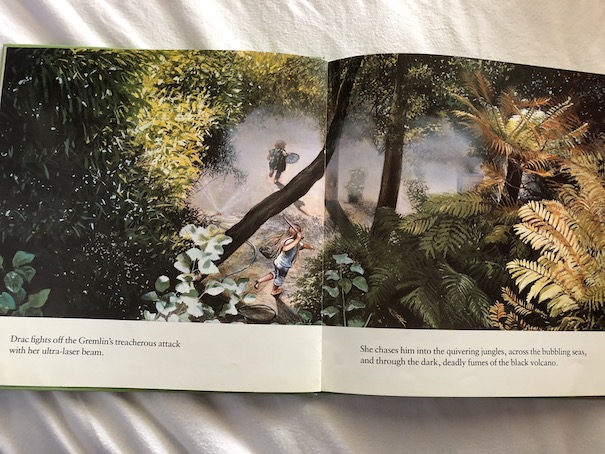
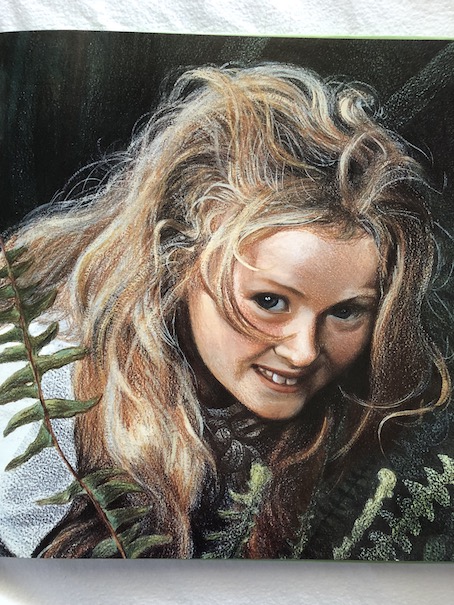
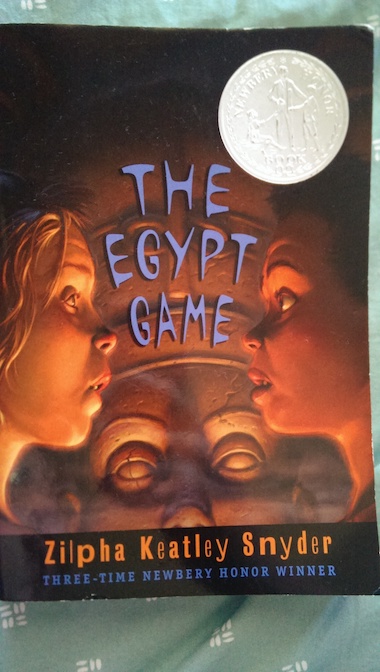
Mrs. Gigglebelly is Coming for Tea

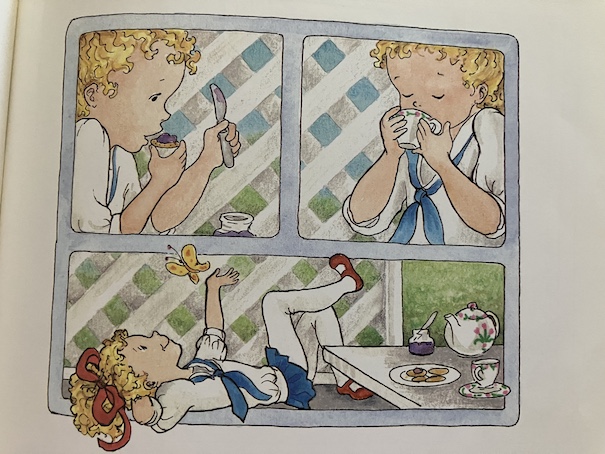
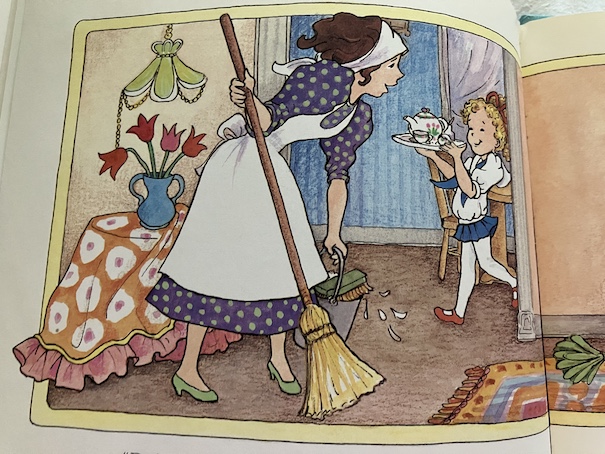
Elizabeth Ann tells her mother that Mrs. Gigglebelly is coming for tea today, but her mother says that she’s in the middle of her spring cleaning and doesn’t have time to prepare for Mrs. Gigglebelly today. In fact, she suggests that Mrs. Gigglebelly might be busy today, but Elizabeth Ann says that Mrs. Gigglebelly always has time for tea with her.

Since her mother is busy with chores and can’t prepare tea or a cake for Mrs. Gigglebelly, Elizabeth Ann fixes some lemonade and crackers with grape jelly for their “tea.” While Elizabeth Ann waits in the garden for Mrs. Gigglebelly, her mother dashes about, doing her chores.

At first, it seems like Mrs. Gigglebelly isn’t going to come, but she eventually arrives because she always has time for Elizabeth Ann … so does her mother.

This is a cute story about a mother who makes time for her child, even when she’s busy. “Mrs. Gigglebelly” seems to be a game of pretend the mother and daughter play together when they have their tea parties. On this particular day, the mother is very busy, but she still throws together a costume for their game. The book doesn’t say that “Mrs. Gigglebelly” is Elizabeth Ann’s mother, but it’s implied in the story, and in the last picture, readers can see pieces of “Mrs. Gigglebelly’s” improvised costume around the room.

I thought it was sweet that the mother in the story took time for a little fun and silliness and a special moment with her daughter, even though she had work to do. Some mothers might just lecture their child about how they’re busy and the child just has to accept that, but this mother understands that her attention is important to her child. Sometimes, it’s the little moments that mean a lot, even if it’s just pausing to share a snack. She does make her daughter wait because there are things she has to do, but the wait is worth it because the mother follows through and makes the effort to make time for her daughter.

Elizabeth Ann also doesn’t nag her mother about hurrying up or try to convince her mother to drop everything she’s doing and play with her instead of doing her cleaning. Instead, she waits patiently, confident that her mother will have time for her eventually because her mother has already established that her daughter is a priority and that she will make time for her. It looks like this mother-daughter pair understands each other well and that they have a good relationship with each other, and I like that.

The Enchanted Castle

Two brothers and two sisters spend most of their time at boarding schools. The boys go to a school for boys, and the girls go to schools for girls, so the only times when they are together are when they are home for school holidays or visiting at the house of a kind, single lady who lives near to their schools. Although the children’s parents are grateful for their single friend for hosting the children as guests from time to time, the children find it difficult to play at her house because everything is so neat and proper, and they don’t feel quite at home. Then, during one school break, one of the sisters, the one who makes it home first, comes down with measles. With their sister sick, the other siblings can’t go home, which is a great disappointment, and their parents have to make other arrangements for them. When the children tell their parents that they don’t want to visit the single lady for the entire school holiday, the parents arrange for the boys, Gerald and James (called Jerry and Jimmy), to board at their sister Kathleen’s school. It will be fine for them to be there because Kathleen (called Cathy) is the only student remaining at the school during the holiday, and there will only be one teacher there to supervise them, the school’s French teacher.

This arrangement suits them better than going to the single lady’s house, although they think that they ought to find something special to do during the school holiday. Kathleen suggests that they write a book, but the boys aren’t thrilled by the idea. They would rather do something outdoors, like playing bandits. However, they are a little concerned about the French teacher’s supervision. Fortunately, Gerald is good at charming grownups, when he wants to. Through a combination of flattery and small, thoughtful favors to the teacher, he gets on her good side, and he manages to convince her that he and his siblings would like to have some time to themselves to play and explore outside, maybe in the woods. The French teacher understands that what they really want is some freedom from supervision, but she agrees to give them some time to themselves.

The children don’t actually know if there are any woods in the area, but they decide to do some exploring and see if they can find an adventure of some kind. They end up getting lost during their exploring, but they find it exciting. When they sit down to rest, they find a cave and decide to explore it. The cave turns out to be a tunnel that leads them to a beautiful garden with a lake with a decorative waterfall and swans. The children imagine that it’s the garden of a magical castle. Going a little further, they find a thimble with a crown on it and a thread tied to it. It looks like the kind of thimble that might belong to a princess.

When they follow the thread, they find a young girl in a beautiful dress who looks like she might be a princess. She looks like she’s asleep, so she looks like an enchanted princess or Sleeping Beauty. Jimmy doesn’t really believe that she’s a princess, but the others aren’t so sure, and anyway, it makes a fun game to pretend that she is. Since Jerry is the eldest of the children, Cathy thinks that Jerry should kiss her to wake her up. Jerry refuses, so Cathy says Jimmy should do it. Although Jimmy is sure that she’s really just an ordinary girl dressed like a princess, he says he’ll kiss her to prove he’s braver than Jerry and that he should be the leader for the rest of the day.

When Jimmy kisses the girl’s cheek, she opens her eyes and says that she has been asleep for 100 years. She insists that she’s a real princess and asks them how they got past the dragons. Jimmy still doubts that, even though she shows them a mark where she pricked herself on a spindle, just like in the Sleeping Beauty story. She invites them to come back to the castle and see her beautiful things. The children say that they are hungry, so they go with her go get something to eat.

When they get to the “castle”, the princess brings them bread and cheese to eat with some water. This seem depressingly ordinary, and the princess apologizes, saying that was all she could find. However, she claims that the food in the castle is magical, so it can be whatever they want. The children imagine that it’s roast chicken and roast beef, but all they get is bread and cheese. Cathy doesn’t want to admit at first that it’s just bread and cheese because (like with the Emperor’s New Clothes), there is an implication that there is something wrong with her if the magic doesn’t work for her. Jimmy isn’t discouraged by that, so he asks the princess if it’s a game, but the princess denies it, insisting that the food is magical.

Then, the princess takes the children to a hidden door behind a tapestry. The room inside has paneled walls and blue ceiling with stars painted on it. The princess calls it her “treasure chamber”, but the room is completely empty. The princess acts surprised when the children say that they can’t see any treasure, and they refuse to believe it’s because they’re magical or invisible. The princess has the children close their eyes while she says some magic words. When they open their eyes, suddenly, there are shelves with jeweled objects on them. The children have no idea how the princess accomplished this trick, so they start to believe that maybe she can do magic.

The princess suggests that they all put on some of the jewels and be princes and princesses, too. It’s amusing for a while, but the boys start getting tired of dressing up, and they’re still a little skeptical about who the princess is. They suggest that they go play outside, but the princess insists that she’s actually grown up and doesn’t play children’s games, and she has the others help her put all the treasures back in their proper places. She tells the children that various pieces of jewelry have magical property. Jimmy asks her if that’s really true or if she’s kidding, but the princess insists that it’s true. Jimmy asks her to demonstrate how the magic works. The princess says that she will try on the magic ring that makes her invisible, but only if everyone closes their eyes and counts first.

When the children open their eyes, all of the shelves of jewels are gone and so is the princess. Jimmy says that it’s obvious that the princess just went out the door of the room. When they close their eyes and count again, Jimmy keeps his eyes open and sees the princess hiding behind a secret panel. When he tells the others, the princess says that he cheated. The weird thing is, even though they hear the princess say that he cheated, they still don’t see her. They tell her to stop hiding and come out, but she says that she already has. She says that if they want to pretend like they can’t see her, that’s fine, but the children seriously can’t see her. When the princess realizes that they’re serious that she’s actually invisible, the princess suddenly gets scared. She tries to shake the boys and get them to say that she’s not invisible, and Jerry catches hold of her, still unable to see her. She tells them that it’s time for them to go because she’s tired of playing with them.

Jerry makes the princess look in a mirror to prove that she’s invisible, and the princess gets very upset. Cathy sensibly tells her to just take the ring off, but the princess says it’s stuck. She admits that the whole thing, up to this point, was just a game of pretend. She says that the treasure shelves were hidden behind some paneling, and she just moved it with a hidden spring. She never expected that any of it was actually magical. The truth is that the girl’s aunt works at the house as a housekeeper and that her name is Mabel. She was just playing at being an enchanted princess because the rest of the household is away at the fair, and she happened to hear the other children coming through the hedge maze, so she roped them into her game.

Since one of the objects that Mabel claimed was magical was a buckle that would undo magical spells, Cathy suggests that she try the buckle. Mabel says that’s no good because she only made up that it was magical, but Cathy points out that she also made up the part about the ring being magical, and it turned out to be true, so she might as well try the buckle. Mabel would, but they accidentally locked the key inside the room and can’t get in now.

The children sit down to think about the situation. Since they can’t think what to do, the other children think maybe they should leave and go get their tea, but Mabel insists that they can’t just leave her invisible like this. Instead, she suggests that she go with them to tea and leave her her aunt a note. While they have tea, maybe they can think of something else to help Mabel. In her note, Mabel says that she’s been adopted by a lady in a motorcar and is going away to sea. The others say that’s lying, but Mabel says that it’s fancy instead of lying and that her aunt wouldn’t believe her if she said that she was invisible.

When they return to Kathleen’s school, they have tea and supper. They let Mabel have one of the three plates laid out for them, and Jerry and Cathy share one between them. Fortunately, the French teacher isn’t eating with them and doesn’t see an invisible person eating, but the children don’t know how they’re going to handle breakfast the next morning. They say that Mabel can stay the night with them, sharing Cathy’s bed and borrowing a nightgown. Mabel says that she can get some of her own clothes from the house tomorrow because no one will be able to see her and that she’s starting to see some possibilities for being invisible.

In the morning, the maid who comes to wake Kathleen sees Mabel’s discarded princess dress on the floor and asks Kathleen where it came from. Kathleen makes an excuse that it’s for playacting, which means that she and her brothers will have to figure out some kind of play to put on with it. Mabel thinks that acting sounds exciting, but Kathleen reminds her that she’s still invisible, so no one can see her perform anything.

The children feel bad about Mabel’s lies in the note to her aunt, and they insist that they should go and tell her the truth. Mabel doesn’t think this is a good idea because her aunt won’t believe her, but she reluctantly agrees. When they try to talk to her, the aunt doesn’t really want to listen to them, thinking that it’s just another one of Mabel’s pranks. She says that maybe Mabel was changed at birth and that her rich relatives have finally claimed her. They try to tell her that Mabel is with them, only invisible, and the aunt tells them not to lie to her. They ask about Mabel’s parents, and the aunt says that she’s an orphan. The children think that Mabel’s aunt is crazy because she doesn’t seem concerned about her and doesn’t want to hear anything they have to say, but Mabel says that she thought that her aunt might act that way because she spends so much time reading novels and can imagine anything.

In the meantime, Mabel has had some thoughts about what she can do. She says that she might be able to continue living in the house where her aunt works because the place is supposed to be haunted, so she can play ghost herself. However, the others think that she should stay with them. They just need a way to get some money to buy extra food for her.

Sine the fair is still going on, Mabel suggests that Jerry put on a magic show at the fair to get some money. The others say that Jerry doesn’t know any magic tricks, but Mable points out that it doesn’t matter when he has an invisible friend who can move things around, unseen, and make things disappear. Jerry dresses up as a conjurer from India (in a way that would be considered equal parts cheesy and offensive by modern standards because it involves black face), and he puts on the magic show with Mabel’s help. It’s incredibly successful, and toward the end of it, Mabel feels the ring coming loose. She takes it off and gives it to Jerry, who ends the act by vanishing himself.

Now, Mabel is visible again, and it seems like they’ve solved their problem, but now, they have a new one. The ring is now stuck on Jerry’s finger, and he is the one who’s stuck being invisible. Although Mabel can now go home, she insists on staying with the other children and taking part in their next invisible adventure.

Jimmy says that, if he was invisible, he would turn burglar. The girls point out that would be unethical, so Jerry decides that he will be a detective. There are advantages to a detective being invisible. Then, Mabel remembers that the treasure room is still locked from the inside, and they have to do something about it. Jerry says that, as an invisible person, he can sneak in easily enough through a window. When he does this, he ends up foiling a robbery by actual burglars, although he also ends up letting them escape from the police because he knows that conditions in prisons are horrible and can’t bring himself to send anyone there.

After his adventure, the ring comes loose from his finger while he’s in bed, and the maid at the school, Eliza, finds it and decides to “borrow” it for an outing with her fiance. When her fiance can hear Eliza’s voice but not see her, he thinks that he’s taken some kind of strange turn or fit, possibly because he’s been in the sun too long. The children convince him to go home and lie down while they deal with Eliza. They take Eliza on a little adventure of her own because they’re beginning to see that the ring doesn’t come off someone’s finger until its purpose is fulfilled. Afterward, they manage to convince Eliza that it was all a strange dream that she had because she felt guilty about taking the ring without permission. The children also think that the ring’s power might be diminishing and could be completely spent because it seems like its effect has been lasting shorter and shorter amounts of time every time it’s used. However, this is really just the beginning of the ring’s magic, and it can do much more than they think it can.

At this point, they feel a little guilty that they haven’t spent much time with the French teacher, who is supposed to be looking after them, so the buy her some flowers. She is pleased with the gift, and they have a little party with Mabel as their guest. They find out that the French teacher has artistic abilities, although she rarely has time to draw these days because she’s so busy teaching. Mabel also tells them more about the man who owns the house where her aunt works. Although the house is grand, the man who owns it doesn’t really have enough money to support it and live there full time with a full staff because his uncle wrote him out of his will for falling in love with a girl he didn’t approve of. It’s sad because he also never married the girl because she was sent away to a convent, and although he did try to find her, he never did. Mabel, whose knowledge of convents comes from the scandalous gothic novels that she and her aunt read (much like the kind the main character reads in Jane Austen’s Northanger Abbey), speculates that the girl might be bricked up in a wall by now because that’s the kind of wicked thing that happens in books. The French teacher tells her that real convents aren’t like that and that the women who live there are good and take care of girls without parents, although they can also be strict, and the girls aren’t allowed to leave. She says it in a way that implies that she was one of those girls raised in a convent.

Since the children had claimed earlier that they were going to put on a show of some kind with the princess outfit, they decide to go ahead and perform for the French teacher and Eliza. To fill out the audience for their performance, they make a bunch of stuffed dummies, which the French teacher finds amusing. The children use the ring as a prop in their play, although none of them put it on, and Kathleen wishes that the dummies were alive so they could have better applause from the audience. To the children’s amazement and the French teacher’s and Eliza’s terror, the dummies (which the children think of as “Ugly-Wugglies”) do come to life and start clapping. In a panic, the children debate what to do. Jerry realizes that the ring is actually a wishing ring and is responding to the children’s wishes, so he wishes on the ring that the dummies were not alive, to undo Kathleen’s wish, but it doesn’t work.

To Jerry’s surprise, the dummies begin speaking to him, although their speech isn’t clear because they don’t really have proper mouths. They ask him for a recommendation to a good hotel or suitable lodgings. The dummies don’t seem to know what they are, and they are behaving like respectable, aristocratic people. Jerry tells them that he can show them to some lodgings, if they will wait for him a little. He makes some excuses to give himself time to reassure the French teacher and Eliza that the effect with the dummies was just a trick pulled by the children with string, and he recruits Mabel to help him find a place for the dummies. He does this in an insulting and condescending way, and Mabel tells him off for that, but she agrees to help him. They decide to hide the dummies somewhere on the grounds of the big house where Mabel and her aunt live, thinking that the magic will wear off eventually and that the dummies will turn into dummies again by morning. The dummies turn nasty when Jerry and Mabel try to shut them away, and they are helped by a strange man.

The strange man demands an explanation from the children about the angry people they’ve shut away, but the children don’t want to explain. The man says, if they won’t tell him what’s going on, he’ll simply have to let the people out and ask them, but the children are afraid of what the dummies will do if they’re released. The man assumes that the imprisoned people are other children and this is all some children’s game, so Jerry and Mabel decide that they have to tell him the truth, even though they know it all sounds crazy. They can tell that the man doesn’t really believe him. The man thinks maybe Jerry has a fever or something, and he says that he’ll see the children home. Jerry can tell that the man plans to open the door after the children are gone, and he warns him not to do that. He insists that the man wait until tomorrow to open that door and to wait for them to meet him to see it opened because, by then, they’re sure that the dummies will just be dummies again. The man reluctantly agrees.

When the children arrive the next day, they discover that the man didn’t wait for them to open the door, and he is now lying unconscious and injured, apparently attacked by the dummies. The dummies are gone except for the most respectable dummy, who seems concerned about the unfortunate man on the ground. Mabel runs for smelling salts to revive the unconscious man, and Jerry looks around to see where the other dummies are. They find that the other dummies have turned back into piles of old clothes, and only the one living dummy is left. He seems to be becoming far more real. The children revive the unconscious man, who turns out to be the new bailiff. The bailiff assumes that the strange visions he had were because he was injured accidentally. After the children are sure that he’s all right and send him on his way, they try to figure out what to do with the remaining living dummy.

The remaining dummy seems to have developed a life of his own and is quite a wealthy man, although the children aren’t sure that this will last because the ring’s magic never seems to last very long. Jimmy says that he wishes he was wealthy, and the other children are horrified to see him age quickly, turning into an elderly, wealthy man. Jimmy doesn’t seem to remember who they are, and he refuses to turn the ring over to them when they ask for it, trying to stop his wish. He acts like the dummy is an old acquaintance of his, and he just wants to go to the nearest railway station with his dummy acquaintance.

Jerry sends the girls home to make some excuses for his and Jimmy’s absence, and he follows the now-elderly and wealthy Jimmy on the train to London. There, he learns that Jimmy and the living dummy have somehow acquired business offices, staff, and backstories. Other people seem to have somehow known the two of them for years (a warping of reality that makes Jerry’s head swim because neither of them existed in their current state before) and say that they are business rivals. Jerry pumps a boy who works at one of the offices for information, claiming that he’s a detective and is trying to reunite the elderly Jimmy with grieving relatives. The boy’s advice is that it will be difficult to get through to elderly Jimmy but that he might use the living dummy’s rivalry with elderly Jimmy to arrange things. The living dummy (now known as U. W. Ugli) helps Jerry to get control of the ring, and he wishes himself and Jimmy back to the house where Mabel lives.

Jimmy is restored to his younger self, and the children debate about what to do with the ring. They can see that it has some dangers. Mabel says that she ought to put it back in the treasure room, where she found it. However, while they’re in the treasure room, they begin to wonder if any of the other pieces of jewelry are magical, since the ring became an invisibility ring after Mabel pretended it was. Mabel can’t remember exactly what she said any of the other pieces of jewelry did because, at the time, she was just playing pretend and making things up. Then, something occurs to Mabel. She realizes that the ring only became an invisibility ring because she said it was one, and it turned into a wishing ring when they started calling it that. She says that proves that the ring does whatever they tell it to do, changing its powers to match whatever they say. To prove the point, she declares that the ring will now make people tall, and when she puts it on her finger, she is suddenly unnaturally tall.

Mabel’s experiment did prove the point, but they now have to hide Mabel until the effects wear off. The children get a picnic from Mabel’s aunt and go to hide out in the woods overnight. However, Mabel complicates things when she turns the ring into a wishing ring, and then, she accidentally turns herself into a statue. The children have a nighttime adventure with some living statues, learning that all statues apparently have the ability to come to life at night. They can also swim, so they have a nice swim and a feast. The statue of Hermes tells the children that “‘The ring is the heart of the magic … Ask at the moonrise on the fourteenth day, and you shall know all.'”

Then, the children learn that Lord Yalding, the man who owns the big house, is planning to come, and that he is thinking of renting the house to a wealthy American. Mabel’s aunt is busy, getting the house ready for Lord Yalding and the American. However, it turns out that the children have already met Lord Yalding without realizing it, and with the ring and the treasures in the hidden treasure room, they have the power to secure his future and reunite him with his lost love … if only they can figure out how to manage the ring’s power without causing any more chaos.

The book is now public domain and available to borrow and read for free online through Project Gutenberg and Internet Archive (multiple copies), including an audio recording from Librivox. The story was made into a BBC television miniseries in 1979, but it’s difficult to find a copy these days. As of this writing (April 2024), the only dvd release was in Australia in 2013. Sometimes, clips of it appear on YouTube.

For the first part of the book, it isn’t obvious that there will be any real magic in the story. At first, the children are all just playing pretend with each other, and even when Mabel turns invisible, it’s possible to believe that the children might still be playing pretend and letting their imaginations run away with them. Because the adults don’t seem that concerned about Mabel, I thought that they might have been humoring the children in their game, but the children later realize that the ring has the effect of muting people’s concerns for the one wearing it, even if they’re doing something bizarre or dangerous. That ends when the person takes off the ring, and people become more concerned about them and where they’ve been. The magic in the story is real, and as the story continues it involves too many other people, even adults and various bystanders, for it to just be a game.

Throughout the book, various adults experience the effects of the magic ring and witness things that the children do with it. They come up with various explanations for what they’ve witnessed, so they can disregard it, but they unquestionably experience magical events along with the children and have some consequences from the children’s adventures. While Jerry retrieves Jimmy from London when he accidentally turns himself old and wealthy, they never do retrieve the living dummy, so U. W. Ugli remains doing business there until his magic finally wears off. His employees don’t seem to know what he is and have memories of having worked for him for years, so they report him missing when he finally disappears, and the notice appears in the newspaper.

There’s a lot of humor in the story as the children experiment with the magic, deal with the consequences of their adventures, and try to invent excuses to explain away the inexplicable. There are times when they do try to tell adults the truth about what they’ve been doing and what’s happening, but most of the time, the adults don’t believe them. Sometimes, they feel a little bad about lying to adults and making up stories, but they have to resort to that because nobody really believes the incredible truth.

When the children start telling Lord Yalding the stories of their magical adventures and about the treasures they’ve found in the house, they are unable to prove what they say at first. Lord Yalding gets a chance to experience the magic himself, he thinks that he’s going crazy. At the proper time, the ring’s magic reveals itself to Lord Yalding, his love, and the children so they can all see the true magic and learn the ring’s history, which is a story of magic and tragic love. Lord Yalding comes to understand that he is not crazy and that the magic is real. His lover makes one final wish that turns the wishing ring into a wedding ring. The magic ends, and the castle and grounds are changed because of it, becoming less grand and more ordinary, but Lord Yalding and his bride are able to have their happy-ever-after.

I thought it was interesting that the author provided a backstory for the magic ring, explaining where it came from and its effect on the house and its grounds. I didn’t think there were many clues to that backstory provided along the way, and some buildup to the explanation would have been nice. However, I recognize that the author didn’t have to provide any explanation for the magic at all. Many other fantasy stories don’t offer explanations for magical objects, leaving that up to readers’ imaginations, because the focus is more on the effects of the magic rather than its origins.

As far as we know, the children’s other sister, the one who was sick with measles in the beginning, never finds out what her siblings have been doing during this particular school break. The children remain close to Lord Yalding and his wife, and they host them at their house during school breaks afterward. In fact, it sounds like they spend more time with Lord and Lady Yalding than they do with their parents.

Overall, I enjoyed the story. E. Nesbit’s fantasy stories are children’s classics, and they have influenced other children’s fantasy books that came after them, especially Edward Eager’s Tales of Magic series.

Although the original story is now public domain, there are different versions of this book because there are simplified forms of the story for younger children, and some newer editions have removed some of the problematic parts of the story. Some of E. Nesbit’s books contain problematic racial language or stereotypes or have children doing things that would be unacceptable by modern standards. In this book, such incidents are relatively mild, and their absence wouldn’t materially change the character of the story.

For example, when Jerry dresses up an conjurer from India, he uses black face as part of his costume. In the 21st century, use of black face is considered derogatory toward people with dark skin. In a way, Jerry’s costume is played for comedy because it’s made from pieces of his school uniform, and someone points out that he’s left out spots in his skin makeup. Nobody believes that he’s a real conjurer from India, although they are impressed by his act because they can’t figure out how he accomplishes his tricks.

There is also some anti-Catholic sentiment, although the children seem to say certain things because they’ve gleaned them from sensational novels or things other people have said, and the author does correct for it. The first instance of this comes from Mabel’s concept of the dark deeds done in convents, which she has apparently learned by reading gothic novels. I’ve read some old gothic novels myself, and the idea that sinister things happen in secrecy in convents and abbeys was a popular concept from 18th and 19th century literature. It’s partly due to anti-Catholic sentiment and, probably, because the idea of a closed society that isn’t open to the general public makes for a compelling setting for dark secrets, somewhat like the way secret societies and boarding schools have become the setting for sinister happenings and dark deeds in Dark Academia literature. However, the other does have the character of the French teacher contradict this view of convents with a more benevolent and realistic one, that the people in them are caring but strict. There is one other comment that Jimmy makes in the story when he’s arguing with Mabel, when he seems to be implying something about Jesuits, a branch of Catholic priesthood:

“If you’d been a man,” said Jimmy witheringly, “you’d have been a beastly Jesuit, and hid up chimneys.”

I wasn’t entirely sure what this comment meant, although I think it might be a reference to the ways Catholics hid priests in priest holes, little hidden rooms, when they were at risk for arrest, torture, and even execution in Elizabethan England. Some of these little hiding places were in fireplaces, which I think is what the reference to hiding in chimneys means. At the time, the children were arguing about bravery, so I think Jimmy is implying that Mabel is the type to run and hide in the face of danger. (That might actually be the best option when there’s real danger. Just saying.) If I’ve understood his meaning, that makes Jimmy’s comment more of a slur against Mabel’s bravery than against Jesuits, although he does still call the Jesuits “beastly”, and he’s implying that’s a bad thing to be.

When you read public domain versions of the story online, they will have these elements in the story because they were part of the original book. However, if you find a physical copy in a library, it may or may not have these elements, depending on the printing. If it was printed during the late 20th century or any time during the 21st century, there is a good chance (although not completely guaranteed) that it’s a revised version and may have these parts written out or at least toned down.
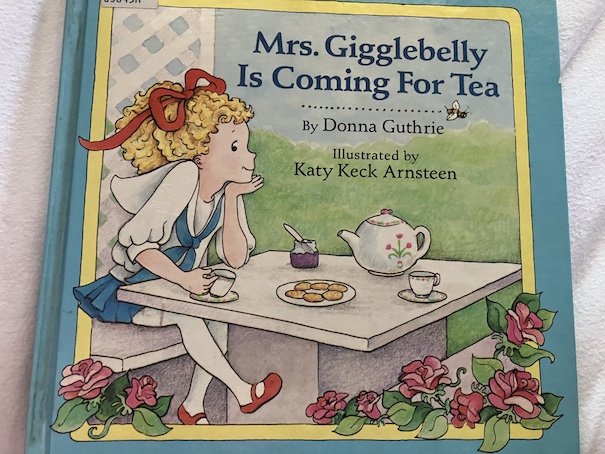
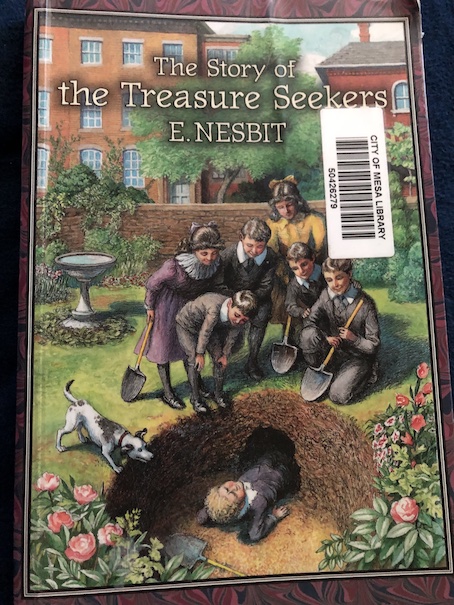
The Story of the Treasure Seekers

The story of the treasure seekers book cover

The Story of the Treasure Seekers by E. Nesbit, 1899.

This story (the first in a series) is told by one of the six Bastable children: Dora, Oswald (who won the Latin prize at his school), Dicky, the twins Alice and Noel, and Horace Octavius (called H.O. for short). The narrator initially refuses to identify which of the Bastable children he is, saying that he might admit it at the end, but his constant self-praise (which begins immediately) and the way he refers to his siblings kind of gives it away. At various points in the story, he forgets that he’s trying to be mysterious about his identity and just refers to himself in the first person, although he goes back to the third person when he remembers. The children live with their father, but their mother is dead. The narrator says, “and if you think we don’t care because I don’t tell you much about her you only show that you do not understand people at all.” The story isn’t about missing their mother, but about their search for treasure. (“It was Oswald who first thought of looking for treasure. Oswald often thinks of very interesting things.”)

The Bastables are in need of money. After their mother died, their father was ill for a time. Then, his business partner went to Spain, and his business hasn’t been very good since. The children can tell that their father is economizing on household goods. He’s sold some things from the house, there doesn’t seem to be money to have broken things fixed or replaced, and he’s let the gardener and other servants go. He’s not even sending the children to school right now because he can’t afford the school fees, and people have been coming to the house about unpaid bills. Oswald thinks that the best thing to do is to look for treasure to restore their family’s fortunes.

The children all think of ways that they can look for treasure. Oswald wants to become a highwayman and hold people up, but Dora, as the eldest, rejects that idea as wrong. His next suggestion is that they rescue a rich old gentleman and get a reward, but that’s a long shot. Alice thinks they should try using a divining rod. H.O. is in favor of the idea of being bandits. Noel likes books, and he wants to either write poetry and publish it or possibly marry a princess. Dicky is more practical with things like math and money, and he tells the others about an advertisement in the newspaper about a way to earn money in your spare time. Since the children aren’t going to school and have plenty of time, he thinks they should try it. He also has another idea, but he refuses to explain to the others exactly what the scheme is. Dora, as the eldest, decides that they should just try digging for treasure, not even bothering with a divining rod, because it seems like people always find treasure by digging. Since that’s the most straight-forward method any of them have thought of yet, they decide to go with that.

They recruit Albert, the boy from next door, to help with the digging. They don’t always get along with Albert because Albert doesn’t like reading and isn’t good at games of pretend. (The children seem to know that this treasure hunt is a game, although they’re still half-way hopeful that they’ll actually find something.) Still, they manage to persuade Albert, and the children begin digging a tunnel. It’s Albert’s turn to dig when the tunnel collapses, half-burying the unlucky Albert, who screams and keeps on screaming while Dicky runs to get Albert’s uncle. Albert’s father is dead, so he lives with his mother and his uncle, who used to be a sailor and now writes books. The children all like Albert’s uncle because they like his books, and he seems to know a lot. Albert’s uncle matter-of-factly digs Albert out of the hole and asks the children how he came to be buried. The Bastable children explain about their search for treasure. Albert’s uncle says that he doubts they’ll find any treasure in the area, but as he unearths Albert, he seems to find a couple of coins, which he gives to the children to divide among themselves and Albert. (It’s hinted that Albert’s uncle is just giving the children pocket money that he pretends to find.) It’s an uneven amount, so they agree that Albert can have the larger share because he got buried.

The Bastable children could have used their new pocket money as stake money for the venture Dicky saw in the newspaper, but there are some other things they want to buy, so they spend it all and have to try something else. One of the children (they disagree later about who it was) brings up the subject of detectives, like Sherlock Holmes. They think that detectives must earn a lot of money, so some of them think they ought to try being detectives. Alice says that she doesn’t want anything to do with murders because that would be dangerous, and even if they did kill someone, she would feel bad if she had to be the one to get them hanged for it. After all, surely nobody would want to kill someone more than once anyway, so there’s probably little risk that they’d do it again. (Oh, boy. Alice has apparently never heard of serial killers. Jack the Ripper had already committed his murders by the time this book was written and published.) The others tell her that detectives probably don’t get to choose which crimes they investigate. They just have to look into any mysterious situations they encounter and see what they turn out to be. That reminds Alice that she did see something mysterious herself. She got up during the night because she suddenly remembered that she’d forgotten to feed her pet rabbits, and she saw a light in a nearby house, where the entire family is supposedly away at the seaside. The children think that some criminals may be hiding in the empty house and decide to investigate. It turns out that there is an innocent explanation. Oswald accidentally falls and gets knocked unconscious during the investigation, so Albert’s uncle is again recruited to carry him home, and the uncle lectures them about spying on people.

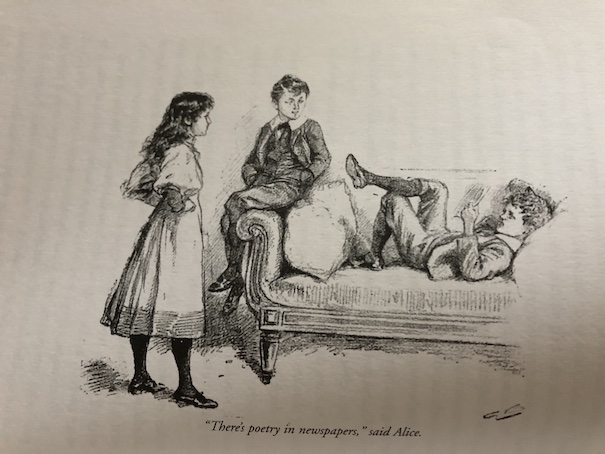
Since another money-making scheme has failed, they decide to move on to the next idea, publishing Noel’s poetry. He doesn’t have enough poems for a book, but they remember that they’ve seen poetry published in a newspaper, so they decide to talk to the newspaper editor. Oswald and Noel go to see the editor together. Along the way, they meet a woman who also writes poetry. She reads Noel’s poems and says that she likes them, giving the boys a little stake money to get Noel’s literary career started. At first, Oswald refuses the money because he remembers that he’s not supposed to accept gifts from strangers, but the woman insists that the gift is that from a fellow writer, not a stranger, and she gives them her card. The children’s father later says that she’s famous for her poetry, although the boys had never heard of her before.

When they see the newspaper editor, he seems amused by Noel’s poetry (which includes an elegy to a dead beetle) and very interested in how and why he came to write poetry. He invites the boys to join him for tea, and they explain about how they’re trying to restore their family’s fortunes. The editor says that he’s willing to buy Noel’s poems and publish them, and he asks what Noel thinks would be a fair price. Noel isn’t sure because he originally just wrote the poems because he likes poetry, not to sell. The editor offers him a guinea, which is more money than they’ve ever had before, and the boys are impressed and accept it. The editor says that his paper doesn’t normally publish poetry, but he can arrange for it to be published in a different paper. They later see a story in a magazine about them, written by the editor, with all of Noel’s poems with it. Oswald isn’t happy at how the story describes them, but Noel is pleased that he’s been published.

The book continues from the summer through the fall, and the children continue trying various money-making schemes, with varying degrees of disaster and success. Noel finds a princess to marry, but they only get a few chocolates out of that adventure. While Dora is away, visiting her godmother, the other children turn bandits on Guy Fawkes Day. The only person they can find to kidnap and ransom as bandits is Albert, who doesn’t like this game at all. (The children again seem to realize that this is only a game, but at the same time, they hope for a little money out of it.) They write the ransom note for Albert using H.O.’s blood because this adventure was his idea (although they also have to use red ink to finish it because they don’t get enough blood from H.O.’s finger). Albert’s uncle, who enjoys a good game of pretend, comes to ransom Albert, although he can’t pay the enormous sum mentioned in the ransom note. He tells the children that he knows it’s all a game, and he thinks a little more pretend play would do Albert good (Albert doesn’t have much imagination), and the rough play is also punishment for Albert sneaking out of the house while he should have been inside, nursing his cold. However, the uncle says they should have realized how scary that ransom note could have been for Albert’s mother if he hadn’t seen Albert with the children and knew where he was and what was really happening. The children apologize and admit that they don’t think much about people’s mothers since they lost their own. (Although the book is mostly funny, there are sentimental bits, too.)

Albert’s uncle suggests a more harmless money-making scheme to the children – starting a newspaper, and they let Albert join them. Their newspaper contains a couple of serial stories (that don’t entirely make sense, and some of the children can’t think what to contribute to them), some poetry by Noel, some “Curious Facts” (that aren’t entirely factual but are very curious), and an editorial piece on the subject of education by Alice, who says that if she had a school, nobody would learn anything they didn’t want to learn, but there would be cats, and the students would sometimes dress up like cats and practice purring. The newspaper turns out to be not very lucrative, and the children run out of things to write about, so they give that up and return to more hair-brained schemes.

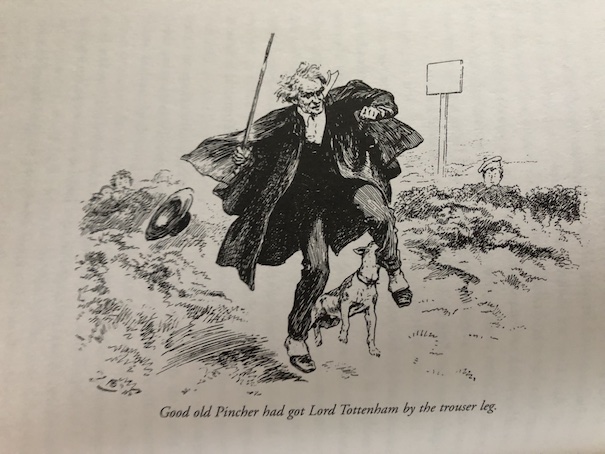
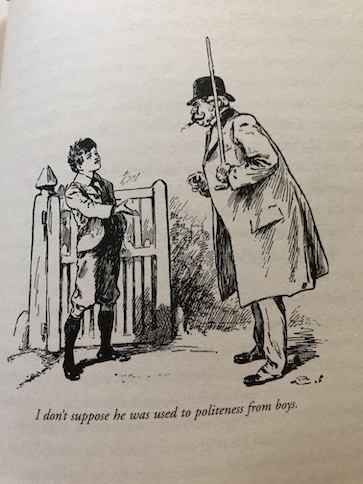
Oswald tries to rescue an elderly gentleman so that the wealthy old gentleman will richly reward him, just like in books, but not finding any danger to save him from, he sets their dog on him, so he can easily save him. The gentleman, a local lord and politician, figures out pretty quickly that this was a scheme and that the dog belongs to the children, and he demands an explanation. The children explain to him about trying to restore their family’s fortunes by doing the things that seem to work for people in books, only nothing they’ve tried works like it does it books. The old gentlemen gives the a lecture about honesty and honor and consideration for other people, and the children make their apologies to him.

From there, they try the part-time job advertised in the newspaper, which turns out to be getting people to place orders for wine by giving them free samples. The children try a little of the wine themselves, but they don’t like it, so they add a bunch of sugar to try to improve the taste. You can imagine how well a group of children trying to give various strangers free wine goes. Eventually, someone confiscates the bottle and tells their father what they’ve been up to.

Although they promise their father that they won’t attempt to go into business again without talking to him about it, they start thinking that they could make a lot of money if they invented a wonderful medicine that would cure something. After arguing about what they’re going to cure, they decide they’re going to cure the common cold. The only way they can think of inventing the medicine is for one of them to get a cold and then for all the others to try various things to cure it. Noel is the one who catches cold, and the others try to cure him. When they can’t cure Noel’s cold, they worry that he’s going to die from it, but fortunately, he does recover.

However, there are times when the children do things that are helpful, typically by accident. The best thing they do is to be extra friendly to a man who comes to see their father. The children come to the conclusion that he’s a poor man and that their father is being kind to him, but they’re not satisfied with the level of hospitality that their father offers. The children decide to invite him to their kind of dinner, and the fun they have together encourages him to give their father the help he needs. The children come to the conclusion that, sometimes, life can be like books.

The book is now public domain, so it is available to read online through Project Gutenberg (also in audio format) and Internet Archive (multiple copies, including audiobooks). There is also a LibriVox Audiobook on YouTube. It’s the first in a series of books about the same children. The story has also been made into movies multiple times. The original book contains some inappropriate racial stereotypes and language, which I discuss below. However, recent reprintings of the book have changed some of the inappropriate language, so the book would probably be okay for modern children, if you pick a book with a recent printing date.

My Reaction

I really enjoyed this story, even though there are some problematic racial issues, which I’m also going to describe and discuss. The descriptions of the children’s schemes and escapades are very funny, and I laughed out loud at some parts. The story reminds me of some of the MacDonald Hall books where the boys do some bizarre fund-raising efforts or try to get publicity for their school. The children’s efforts to find or earn money in this book are based on books that were popular with children in the late Victorian era and money-making schemes that existed at that time. Not all of them would be as familiar to modern children as they would have been to children of the late Victorian era, but I think modern children could understand most of them, with the possible exception of the man who I think was supposed to be a money lender.

If this book was set in modern times, in the early 21st century, I think that their bizarre money-making schemes would be a little more like those in the MacDonald Hall books, although I can think of a few more. Alice’s description of the ideal school, with cats who teach students how to purr, makes me think that, if she were a modern girl, she would want to start a cat cafe out of their house using a bunch of stray cats (or maybe some borrowed from neighbors without permission), which would also be hilarious. I would like to see a book with someone doing something like that because the opportunities for things to go wrong would be both boundless and guaranteed to happen. (Corralling the cats, possibly abducting cats from neighbors, messing up the tea and food, health violations, lack of business license, cats biting and clawing people and messing up the house and trying desperately to escape, etc.)

One thing that I like about the Bastable Children series in general is that there are many references to books that children from the late Victorian era would have known and enjoyed. This book references things that I think came from the Arabian Nights, and the children refer directly to Sherlock Holmes, The Jungle Books, and The Children of the New Forest, which was a 19th century historical novel.

Reality vs Pretend

Much of the book is about the difference between reality and pretend, and the Bastable children often end up about halfway between the two with most of their schemes. They draw much of their inspiration from books they’ve read, and they seem to be aware that much of what they do is a game of pretend, although they also seem to halfway hope that their schemes will work out for them the way they would if they were children from the books they’ve read.

The children’s innocence and naivete about the way the world works is a major reason why they don’t understand how things work differently between the real world and the world in stories. It’s also the reason why they only seem to halfway grasp their father’s money troubles and the reasons for them. Adults often find the innocence of children to be charming, and the adults in the story are often charmed by the children for that reason. It works in their favor in the end because they receive kindness from adults for being charming, innocent children, who know how to have fun. However, the adults in the story also understand the children’s family situation, seemingly even better than they do, and they frequently humor them and help them out of pity. It’s both funny and also a little sad and touching at times for adults reading this book. It’s funny because you can see what the children are really doing and follow their logic as they map out their plans, while at the same time spotting how it’s all going to go wrong before the children see it themselves. It’s also a little sad and worrying because you can also see how little the children are being supervised and how much they turn to the kindly uncle who lives next door for help when they’re in real trouble because their mother is dead and their father is wrapped up in his own troubles.

The subject of the children’s deceased mother comes up periodically throughout the book, as the children think about how things have changed for the family since she died. Dora admits to Oswald that, before their mother died, she asked Dora to look after the younger children. That’s why Dora has been trying to be responsible and to stop the other children from doing things she knows are wrong (like turning into bandits to rob people for money). The other children often get irritated with her for stopping them from doing things they want to do, and they frequently do the wrong thing anyway, even if they have to go behind her back to do it. Oswald develops some sympathy for Dora when he realizes that she’s been trying to do a difficult job that she doesn’t really know how to do, and he talks to some of the other children about going easy on her.

Racial Issues and Gender Stereotypes

This book has been reprinted many times since its original publication, and modern editions have been edited to remove inappropriate racial language. The original book has multiple places where there are racial issues and gender stereotypes, although they mostly come from two very specific sources. The gender stereotypes, which are found in other books in this series as well, come from our narrator, Oswald. Oswald has noticed that his sisters and other girls have different standards from him and his brothers, and it sometimes irritates him. Like other boys in vintage children’s books, he also has a tendency to try to show that boys are better than girls, sometimes saying things like, “Girls think too much of themselves if you let them do everything the same as men.” I partly think that the author, who was a woman, put things like that in her stories to show how boys of her time behaved, but maybe also to poke fun at men who felt threatened by women doing things that were considered for men only, like they’re little boys, feeling threatened by sisters who can do what they do.

Much of the racial issues in the story come from the children’s playacting, which is again based on the books they’ve read. They frequently refer to “Red Indians”, by which they mean Native Americans. Based on what they’ve read from books, American Indians are fascinating and exciting but also savage, and they love all of that. Actually, now that I think of it, that stereotype isn’t a bad description of the Bastable children themselves. They are somewhat savage or semi-feral in their behavior at times, although they would probably hate being called that. They’re certainly not tame children. I don’t entirely blame the children in the story for having misconceptions about other people because children can get misconceptions from things they read, see, or are told by adults. I don’t entirely blame the author for depicting the kind of misconceptions children have, either, especially because the Bastable children’s misconceptions make up a large part of the story and its humor. What is more concerning to me is the original sources of these misconceptions, the things that children get from people who should know better, who might even actually know better but who spread misconceptions anyway for their own purposes.

Whether the author of this book could be considered a source of misconceptions, or at least for perpetuating them, is a matter for debate. The references to other pieces of real literature and how the children use them for inspiration for what they do point to earlier books that sparked these misconceptions and racial stereotypes. I’ve always thought that the things children read early in life set them up for many of their attitudes as adults, and that’s why I think it’s unfair to expose children to literature that creates these misconceptions without an accompanying explanation about why certain attitudes are wrong or harmful and how spreading them causes problems. As adults, we often forgive children for things they do and think because we know they’re young and still learning, but children don’t stay little forever, and they need to know what is expected of them as they grow older. When they’re no longer little kids, people expect them to have a certain level of understanding about the world, the people in it, and how to treat others and speak respectfully about them. If they don’t demonstrate that kind of understanding by a certain age, many people will not take it that they’re still in the learning phase but will think that they’re being deliberately insulting or trying to provoke others when they speak inappropriately. In many cases, those people will be correct because there are people of all ages who like to push other people’s buttons to get a reaction, but I think it’s doing a great disservice to set children up for that type of conflict by trying to keep them “innocent” for too long. I’ve seen that even kids who know that there are certain words they shouldn’t use don’t always seem to understand why they’re not supposed to use them, and that half knowledge is part of the reason why they sometimes throw around nasty terms like they don’t know what they mean. The truth is, some of them really don’t. Kids like that don’t sound charmingly innocent in the 21st century. They sound dumb and clueless because they are these things. The things they don’t know are painfully obvious, and people, even possibly other kids their own age, will definitely notice and openly comment on it. The reason why they’re so clueless is that the adults in their lives who knew enough to tell them, at some point, that these were bad or shocking words to use around other people apparently didn’t explain to them why or make it clear what the social consequences for using these words would be. What I’m trying to say is not that reading this book or others of this vintage is bad, but if you’re going to share books like this with kids, with the original wording, you can’t do it properly without talking to the kids and being very direct about certain subjects. If you’re not, it could lead to problems, and it will be no favor to the child to set them up for that. The things people don’t know will almost certainly hurt them eventually and probably damage their relationships with others along the way.

The Bastable children don’t end up with damaged relationships or social consequences for the things they do because they are still young enough to be considered charmingly innocent and naive in their antics, although at least some of them would be considered old enough to know better about some things by their age. The children don’t even seem to understand the difference between Native American Indians and Indians from India until it is explained to them toward the book, when their “Indian uncle” comes to see them. The Indian uncle is the source of another racial issue in the language he uses. He’s one of the adults who says things he shouldn’t, and I need to talk about what he says and why he says it.

Readers should be aware that the original printing of this book contains the n-word. There is one use of the n-word by an adult character, toward the end of the book. It happens just once in the story, although it threw me when I reached that point because there wasn’t really anything leading up to it, so its use seemed rather sudden. It’s a shame because, up to that point, I was prepared to make some allowances for what the children say about “Red Indians” as part of their innocent ignorance, but as I said, we make allowances for the things children do that we don’t for people who are old enough to know better. The “Indian uncle” just throws out the n-word in a casual expression he uses, like “If Oswald isn’t a man, then I’m a monkey’s uncle,” except he uses the n-word instead of “monkey’s uncle.” A more recent edition of the book I’ve seen replaces the n-word with the word “fool.” I could forgive the children some of the racial stereotypes they use in some of their games because the entire premise of the story is that the Bastable children are naive and somewhat clueless, getting most of their sense of how the world works from storybooks instead of guiding adults, but things that adults say and do are different. To say that this was simply part of the way people talked during this period of history would be taking the easy way out and providing an apparent excuse for the behavior. Everyone has reasons for the things we say and do, and I’m not letting either the author or this “Indian uncle” off the hook that easily without prodding deeper into both of their motives.

The n-word isn’t something that appears in many of the children’s books I’ve read, even the vintage and antique books, because it’s a crude term. Technically, the n-word isn’t even really a word by itself but a slang corruption of a word, and it’s been considered a crudity and an insult since much earlier in the 19th century. By the early 20th century, its use was associated primarily with uneducated and unrefined “poor white trash” in the United States, and whatever their personal racial attitudes, people who wanted to be seen as educated would avoid its use. Those who did use it tended to use it in a derogatory and hostile way. Even in children’s books as old as this one, the use of crude racial terms (when they appear) are often used to establish the personality and background of the character who uses them. They appear as hints of crudeness, lack of good upbringing and moral character, and even violence and criminal tendencies (see books in the Rover Boys series for examples). Even when other characters use racial stereotypes in these stories, the use of the n-word in particular tends to signal something crude and nasty in the user’s character, something that goes beyond the other characters’ level of acceptability, especially when it comes from a character who is portrayed as being old enough and educated enough to know better. A contrast would be the Little House on the Prairie series, where characters sometimes use crude racial terms without being the villains of the story. However, the characters in the Little House on the Prairie books can still fall under the description of uneducated and unrefined. They are a poor farming family who lives much of their lives in the backwoods and on relatively isolated farms. When they associate with other people, it is most often people who are very similar to themselves, so they’re rarely in a position to get feedback from a wider society. The while the Ingalls family does try to better themselves and seek out educational opportunities later in the series, characters in those books could be considered “innocent” about certain things in much the same sense as the Bastable children are. That is, none of them know any better. The term “innocent” implies a lack of knowledge and experience as well as a lack of guilt. The Bastable children are, once again, proof that what you don’t know is obvious to others who do know, and it can hurt your image.

With that in mind, when I have seen the n-word or similar words in print, my main approach is to use it as a clue about the personality of the character who says it or about the author who wrote the dialog or both. One of the difficulties that I encountered with this particular book, compared to others, is that the author sets up the “Indian uncle” who uses the n-word to be one of the “good” characters, a rich and kindly relative who saves them all from poverty. He would seem to be in the position of someone who should know better than to use the n-word, but he does so anyway, in a casual and thoughtless way. That makes this book different from other books, where the n-word is used by characters who are definitely villains and whose use of crude language is portrayed as part of their rough and ill-mannered character. The uncle’s age and position in society wouldn’t seem to put him in the position of an ignorant innocent, and yet, he’s not portrayed as a rough villain. However, there is something else at play in this situation that I think explains who this “Indian uncle” really is and what his deal is, and that’s Victorian British colonialism.

In this series of books, adults are not always referred to by name but by their relationship to the children or the role they play in the children’s lives. In this case, the “Indian uncle” (who is never called anything else by the children, not even by his personal name) is not an “Indian” of any kind. This is just another of the children’s misconceptions because of what their father told them about him. He is apparently really an uncle of the children, and he has recently returned to England from India, but he is white and British, like the rest of their family. This is revealed in hints that go over the children’s heads at first, but which are explained more toward the end of the book.

First, the children listen in on some of the things their father and uncle say to each other when they’re having dinner, and they hear them talking about “native races” and “imperial something-or-other.” The children don’t understand what they’re talking about. Because of the books that they’ve been reading, they’re still under the impression that “Indian” means that this uncle of theirs is a Native American, but adults will put together the bits and pieces and realize that, since this story is late Victorian, the uncle has just come from India, which is under British imperial rule, and like an imperialist, he’s probably not saying many complimentary things about the “native races” there. 19th century British racial concepts were shaped by their colonization and quest for empire and were frequently expressed in a pseudo-scientific form of social Darwinism, that some races of people on Earth had evolved to be more successful than others, with the British at the top of the heap because they had successfully conquered other people and took over their land for their own use. (By this definition, I note that highwaymen and robbers should also be considered vastly superior to the people they rob because they successfully took something away from someone else. I’m sure that the Victorians would be insulted by that comparison, but I think it accurately shows the problems with this type of thinking.)

Second, when the uncle’s house is described, it’s full of taxidermy animals, most of which he killed himself (this is discussed further in the second book in the series) during his travels. That’s when it is revealed that the uncle has actually come from India and is not Native American at all, as the children had supposed. He is a wealthy man who has traveled as an adventurer, which is exciting for the children to hear about, but this is also another clue to the uncle’s personality. I noticed that the author made it a point to say that the uncle’s study was very different from the children’s father’s study because it didn’t have books in it but had those taxidermy animals. I took this as an indication that the uncle is not as much of a man of learning or business as the children’s father. He doesn’t use his study for reading and studying anything. He has money, but I’m guessing that he didn’t get it from having a profession. The children mention that their father went to Balliol College, and they meet a friend of his from his student days. Their father spends most of his time working, even though his business is suffering, and his old friend is also a family man with job (he is described as a sub-editor in the next book in the series). However, the “Indian uncle” is not described as having any profession. We don’t know if he ever attended college, but if he did, it probably wasn’t to be educated for a career. He is a man of leisure or relative leisure, who has apparently spent a good part of his life traveling around the world, shooting things and having them stuffed, and has little interest in books and studying. He’s had the money to live this kind of life, so he does it, fully confident in his superiority and ability to go where he wants and do what he likes. What I’m thinking is that this man is probably their father’s elder brother, who probably inherited money and indulged himself, while his brother studied and worked. Travel can broaden a person’s perspective, but the uncle seems to have traveled for self-indulgent adventure and excitement rather than learning about the world and the people in it. He’s got enough money that he probably doesn’t have to learn anything he doesn’t want to, and as the man who pays the bills and hires people to do things for him, he’s probably not held accountable for much. He can say and do what he likes, so he does that, without giving it a second thought, and maybe not even a first one. This isn’t explained in the course of the book, and I can’t point to much more than I already have to support it, but I think this man is meant to represent a type of wealthy British imperial adventurer.

Ultimately, what I’m saying is that the children think their uncle is a great man because he brings the family to live with him in his big house and helps their father with his business (probably by providing financial backing), so the family’s circumstances improve. He can invest money in their father’s business (the nature of which isn’t specified), and he showers the children with presents, which they love. However, as an adult, I’m noting his apparent relative lack of interest in books, intellectualism, and refinement of manners. I’m sure that the children will find him exciting to be around, but he doesn’t strike me as a learned man, a well-read one, or even a very well-behaved one. He has a lot of money, which can be used to fund the children’s education, but I don’t really trust his guidance or ability to be a role model. I also wonder if the children, who are being given an education and were definitely raised to love books, will continue to see their uncle in a romanticized way as they grow older. Few people can spend their lives traveling around, shooting things, and hiring “native races” to carry their baggage along the way. If that’s most of the uncle’s experience of life, it’s not really going to prepare the children for the future. At the time E. Nesbit wrote this book, she couldn’t have known that, about 15 year later, Europe would erupt into World War I, and boys who were children around this time, like Oswald, Dicky, Noel, and H.O., may very well have ended up being soldiers and had many of their illusions about life shattered. (I have more to say about that when I cover the next book, The Wouldbegoods.) People talk about past people being a product of their times, and in this case, the uncle and his racial attitudes are both a product of this time of imperial Britain and his own wealth, and nobody outside that bubble would see either the way he does.

That brings up the question of what the author, E. Nesbit, really thinks about these things. Does she also share the uncle’s view’s of British imperialism and other races, or is she just portraying the uncle as a type of person she observed around her in society? It’s not entirely clear because everything in the story is presented from young Oswald’s point-of-view, and he is uncritical of these things and seems to have little idea of the larger picture of things. But, there are things in The Wouldbegoods that I think help clarify some aspects of that, some possibly intentionally and others possibly not.

That was a long rant/explanation, but I thought it was important to delve into the issues a little deeper. The tl;dr of it is that, while people were the products of their times, they were also the ones who made their times what they were for their own purposes, even if they didn’t think as deeply about it at the time as we do today, and what we observe about them and their behavior are clues to their personality, life circumstances, and motivations. Overall, I found the racial issues with this story to be aggravating distractions from what is otherwise a fun and funny story, and their removal from modern printings actually improves the story by removing these distractions from the plot. The modern printings are fine for kids to read.

The Movie Version

I watched the 1996 version of the movie, which emphasized the more serious portions of the book and included the character of a female doctor, who helped the family in place of the uncle from India. It wasn’t bad, but it wasn’t as funny as the original book. I’m not sure about other movie versions.

The Witches of Hopper Street

The Witches of Hopper Street by Linda Gondosch, 1986.

Kelly McCoy and her friend, Jennifer, are offended that another girl from school, Rae Jean, is having a Halloween party and didn’t invite them. Jennifer says that they could just throw their own party on Halloween, but Kelly says that’s no good because everyone else they know is going to Rae Jean’s. It isn’t so much that Kelly really likes Rae Jean; it’s more that she hates being excluded.

The girls talk about what they want to dress as for Halloween, and Kelly suggests that they be witches because she’s fascinated by the witches she saw in a play of MacBeth. Kelly also has a book called “Magic and Witchcraft”, and she says that they could study the book and become real witches. Jennifer doesn’t see the attraction of becoming a witch, but Kelly promises that they’ll only perform white magic, where you use magic to perform good deeds, instead of black magic, which involves cursing people. Although, she might make an exception for just a few little black magic spells against Rae Jean. Jennifer says that Kelly can’t be serious, but Kelly says that she is because it’s awful being the only ones in the sixth grade not invited to Rae Jean’s party. Jennifer points out that Adelaide also wasn’t invited. The girls know that Adelaide isn’t popular because she’s overly tall and awkward and much smarter than the other kids. Then, Kelly gets an idea – there were three witches in MacBeth, so maybe they should invite Adelaide to become a witch with them.

When the girls see Adelaide on her way to Rae Jean’s house to help her with her math homework, they stop her and suggest to her that she join them as witches. Kelly tells her that Rae Jean is dangerous and that dangerous things will happen at her party. Adelaide says that she’s not going to the party anyway. Then, Kelly pretends to tell the future with a deck of cards, predicting that there will be a mysterious death in 24 hours. Her prediction comes shockingly true when Rae Jean’s cat kills her pet parakeet.

Kelly knows that the parakeet’s death was partly her fault for taking him out of his cage when Rae Jean brought her cat around, showing off her prize-winning pet, but she also blames Rae Jean for bringing her cat to her house in the first place, and the reason why they took the bird out of his cage was that Rae Jean was goading them about how dumb the bird was. (I think that the kids’ mother shouldn’t even have let Rae Jean bring her cat into the house. The other kids said that they didn’t want to talk to her, but the mother insisted that they let her in because she’s a “nice” girl. That was an irresponsible thing for the mother to do, and she’s not a good example to her children. When you have a pet in the house, you have to make the pet’s safety a priority, especially over being polite to someone who is rude and insulting anyway. Rae Jean shouldn’t have been allowed to bring a predatory pet into their house, uninvited, simply because she wanted to and the mother didn’t have the guts to say no and enforce some house rules. Of course, this is one of those annoying incidents in books that’s used to move the plot forward. If the parents acted anything like mine, it wouldn’t have happened, and this would be a different story.) Adelaide is impressed that Kelly’s prediction came true, and she agrees to be a witch with Kelly and Jennifer.

Kelly walks the others through rituals for being a witch, like signing their names in a Black Book (really, it’s an old brown science notebook), preparing their broomsticks (they’re supposed to be rubbed with the fat of a newborn piglet and belladonna, but the best they can do is strips of bacon and dieffenbachia), and preparing magical rings to protect themselves from evil creatures (Kelly got hers at an estate sale so she’d have one that belonged to a dead person, but the others just got their rings from the quarter machines at the supermarket). The girls pledge to keep their “coven” secret, but then someone leaves a message for them that says, “Midnight is the witching hour. Then you shall be in my power.” All of the girls deny having written it. So, who did? Who else knows about their witchy activities?

Kelly still hasn’t given up her plans to use this witch business to ruin Rae Jeans’ party. She soon acquires a new pet, a skunk, from her brother Ben’s friend Buster, whose father is a veterinarian. She calls the skunk Cinnamon and declares that he is her familiar. To keep the boys quiet about their activities, they have to let Ben and Buster join the coven as warlocks. As an initiation, all of the witches and warlocks have to drink salt water and eat beef liver. Kelly’s mother is perplexed by some of the odd things that they do, but she doesn’t question them too much, and none of the adults ever discover that the kids sometimes sneak out at night to perform rituals. (I could never have gotten away with this sort of stuff as a kid because my mother was always the type to ask a lot of questions about everything and get specific answers.)

Kelly gets the idea of making a voodoo doll of Rae Jean, using an old sweater of hers that Rae Jean’s mother gave her because she helped to get a box of old clothes down from the attic for a sale and because Rae Jean told her that the sweater was scratchy. To get Rae Jean’s hair and nails, the witches open a “spa” business at Kelly’s house. They succeed in getting hair and nail clippings, but Rae Jean gets scared away when their “spa” treatment involves mud that they just dug up in the backyard and has a worm in it. After they make the doll, they decide it looks really awful and sticking toothpicks in it is creepy, so they take the toothpicks out and get rid of it. Instead, they decide to focus on giving Rae Jean the “evil eye” – basically staring at her to make her feel uncomfortable. (That one works whether you’re a witch or not.) When Rae Jean and some others in class get sick, some of the other kids start to believe rumors that the girls have spread about a “poison plague.”

Eventually, Halloween comes, and Kelly gets the idea for her, Jennifer, and Adelaide to use their witch act while passing out candy to the trick-or-treaters. They put the candy in their “cauldron” (an old camping pot), give themselves fantastical names, and perform chants while handing out candy. They have fun with that, but they still feel left out of the party, so they decide to try one last witchy trick on Rae Jean. They decide to brew up a love potion (just apricot juice with honey, and they even think it tastes good themselves), sneak into the party as fortune tellers, and slip the potion into the party punch. Rae Jean’s mother is amused by their fortune telling act and lets them into the party, although Rae Jean isn’t happy to see them.

When Kelly’s new pet skunk gets loose in the party, there is some momentary chaos before Kelly manages to explain that the skunk is deodorized and can’t spray. During their time at the party, the girls learn the true identity of their mystery message writer and have an honest talk with Rae Jean about their feelings and apologize for the witchy things they’ve been doing. Rae Jean also tells them the reason why she didn’t invite them and how left out she felt when she didn’t get invited to a big party that Kelly had soon after she moved to the neighborhood. Rae Jean comes to realize how much she has provoked the other girls into hating her with some of her behavior, and she apologizes bringing cat to Kelly’s house and killing her parakeet. However, Kelly is also forced to acknowledge that she’s also provoked Rae Jean with her quick temper and attempts at revenge. All of the girls owe each other some apologies, and they make up. Kelly and her friends promise to give up all the witch stuff.

However, before they cut it out entirely, they have one last thing to do. Adelaide read about an old superstition that explains how to see a real witch at midnight on Halloween night, and before Halloween is over, the whole “coven” decides that they have to try it. What they see is a bit startling, and although it has an apparently logical explanation, gives the kids an appropriately witchy scare. Could there possibly be a real witch in their neighborhood?

I didn’t like the parts of this story about dead animals. I hated the part where the parakeet was killed, and later, I felt sorry for a cat that died (of natural causes, and it was a sickly stray, not Rae Jean’s cat). I never like stories where animals die, especially through human cruelty or carelessness. Yet, I have to admit that I have a particular attachment to this book, which I remember reading when I was ten years old. Some of their rituals are a little gross, but as I a kid, I think I was attracted to the idea of having a secret, mysterious club and intrigued by the identity of the mysterious message-writer. At the end of the story, they think they know who wrote the note, but their last midnight ritual causes them to have second thoughts.

This book is available to borrow for free online through Internet Archive.

My Halloween Story About My History With This Book:

This particular book and I have a history. This book was important to me as a kid because it sparked something formative, but to tell you what that something was, I have a confession to make: When I was a kid, I wanted to be a witch. I was in high school before the first Harry Potter books appeared, so it wasn’t about that. No, my introduction to witches was The Wizard of Oz, my favorite movie when I was five years old. I liked Glinda, the Good Witch of the North. Dorothy was my favorite character, but I liked Glinda, too. Later, when I saw the movie of Bedknobs and Broomsticks, my interest in witches increased. I also read The Blue-Nosed Witch when I was young, and I was hooked. For a portion of my early childhood, my favorite Halloween costume was a traditional witch costume.

I didn’t want to curse people or be an evil witch, like the Wicked Witch of the West, in spite of my traditional witch costume with the pointy hat. No, I wanted to be a Good Witch and maybe ride a broom and bring suits of armor to life and maybe defeat Nazis in a way that is far less gross than melting them, like in Indiana Jones and the Raiders of the Lost Ark. I had discernment. I had standards. I also had a fear of heights after falling off the monkey bars when I was four, so that probably should have been a clue that broomstick-riding was out for me, but when you’ve got magic, I guess these things aren’t much of a problem. I can’t say that I was really ambitious about wanting magical powers because I didn’t really do anything to acquire them, it was just that I kind of liked the idea … except for that one time, and that’s what this little side story is leading up to.

When I was about ten years old, I read this book with a friend, and we were both enchanted with the idea of making up our own rituals and becoming “witches” and maybe trying some spells on Halloween, just to see if magic works. I only had sort of a vague notion of what kind of spells that we could do. I guess I was picturing something like Bedknobs and Broomsticks, where you recite a rhyme and something is supposed to happen, but I didn’t know any real spells, just movie stuff, and I was clever enough to realize that the stuff in movies probably wasn’t real. Naturally, being a bookish person, I decided that the best way to learn more was at the library. PSAs on tv always told you to “Read more about it“, whatever “it” was. (This was the early 1990s, and I didn’t have access to the Internet yet. That wasn’t even an option.) If anybody had some real spells books, especially ones placed at a convenient height on shelves that a not-very-tall ten-year-old could reach, it would be my local public library, right? I was actually surprised myself when I found one in the library catalog. I really didn’t think it was going to be that easy. That wasn’t the hard part. The hard part was when I actually picked up the book and opened it.

Now, I have to admit here that I didn’t read the whole book, and years later, I can’t remember the title or even what the cover looked like. I kind of wish I did because there are people I would like to show this book to just to prove that it actually exists. When I told my mother about it later, she thought that I dreamed the whole thing, but I swear I didn’t.

This book did have “spells” of various kinds. I picked one from the table of contents (I forget what, but something that sounded like something two ten-year-old girls might want to do on Halloween) and looked at the instructions. It was disgusting. It involved things like animal entrails, which I wouldn’t have known where to get and wouldn’t have wanted to touch even if someone handed me a free bag full. There were other things about animal parts on different pages that disgusted me, too. Under no circumstances was I going to kill cute animals just to do some dumb trick on Halloween, and I wouldn’t have wanted these animals parts even if someone else had done the dirty work of getting them. I wasn’t a vegetarian, but these were definitely not things I could just buy at the grocery store, or better yet, cooked and yummy with a side of fries and a plastic toy.

As I was staring at this book, I suddenly realized that I had no desire to do anything it described and that I was never going to do anything it said. Then, I had a worse thought: someone else must have thought this was a good idea, or they wouldn’t have written it down. Maybe I didn’t want to mess with animal entrails and body parts to gain magical powers, but someone else obviously would. What kind of person would do such a thing? Whatever kind it was, it wasn’t me, and I knew it. The image of the type of person I would have to be in order to do any of this, in order to take any of this seriously, disturbed and repulsed me more than just what was written in the book itself. I slammed the book shut, shoved it back on the shelf, and ran away. I never saw it again, although I did try to find it again once to show it to my mother so that I could prove that I wasn’t dreaming. It wasn’t even in the catalog anymore then.

My guess is that, whatever this book was, either someone stole it from the library (it is the sort of thing an aspiring evil witch might do) or lost or damaged it or some parent or librarian realized that this might not be the best book for children and had it removed from the shelves. Since then, I’ve wondered who put that in the kids’ section in the first place. I’m not fond of censorship, but I have to admit that this book was pretty dang gross and creepy. Was that spell book really serious, or did I miss some introductory part that would have explained that it was all part of some larger ghost story or something? What was the point of the book? I’ve often wondered. All I really remember now is that it was in the first row of children’s non-fiction books at the library, probably the 100 or 200 section of the Dewey Decimal System.

I’m actually glad I did look at it, though, because it made me realize a few things about myself. I realized that there were limits to the things that I was willing to do and that I had the power to say no when something was beyond my limits. My friend was disappointed and thought I was a bit of a wimp for chickening out on our witch experiment so soon and not even showing her the book, but I didn’t care that much. I was firm. I also came to realize that sometimes, it’s the things we don’t do or won’t do that define who we really are. In the end, it may not matter what that book actually was so much as that it left me with a stronger sense of who I was. I should have paid more attention to the part in the Bedknobs and Broomsticks movie where Miss Price said that she realized a long time ago that she could never really be a witch because nobody who felt the way she did about “Poisoned Dragon’s Liver” could be a real witch. I came to appreciate the sentiment.

This experience didn’t completely scare me away from stories with witches in them, as evidenced by the Halloween stories I cover here. I was born close to Halloween, and I like the holiday because I enjoy the imaginative costumes and playing pretend. (Not to mention chocolate. I also enjoy chocolate.) I enjoyed the Harry Potter books, too. But, I know where the dividing line is between pretend and real. It doesn’t trouble me now because I already put the book back on the shelf and said no when it was asking too much, and some decisions stick for life. I don’t worry too much about giving fantasy books to kids, either. Everyone has decisions to make in life about who and what they want to be, and I figure that the younger generations might as well learn where the dividing line between fantasy and reality lies early in life. A bit of a scare now and then might even help them to think more deeply about life’s consequences and make better choices.

If that spell book had been less scary and disgusting, like something that Wiccans use that involves pretty things like crystals and herbs instead of entrails, I actually might have tried a few spells as a child, probably raiding the spice drawer in the kitchen or dismantling my rock collection for spell ingredients. However, Jenny Nicholson did a YouTube video, demonstrating how that typically goes for the aspiring witch. I thought it was hilarious, especially after my childhood escapade. I doubt that I would have had quite the range of objects that Jenny describes, and my parents would have been mad at me if I tried to throw eggs at trees, but I probably would have achieved similar levels of results if my friend and I had actually gone through with our experiment that Halloween. As an adult, I mostly think that things like that are more psychological tricks than anything else, and I find descriptions of them amusing now.

Anyway, that’s my creepy experience with “real” magic. If anyone thinks that they know what that creepy spell book was, feel free to tell me. I don’t feel like I have anything to prove magic-wise, but I still have people I’d like to convince that I didn’t just imagine that the book exists.

Jennifer, Hecate, Macbeth, William McKinley, and Me, Elizabeth

Jennifer, Hecate, Macbeth, William McKinley, and Me, Elizabeth by E. L. Konigsburg, 1967.

Elizabeth tells the story about how she first met her friend Jennifer one Halloween. Elizabeth is new in town, and doesn’t know many people yet. She doesn’t have any friends to walk with to or from school, and she encounters Jennifer in the woods she passes through on her way to school. When they meet, Elizabeth is dressed as a Pilgrim for the school’s Halloween parade. Jennifer also happens to be wearing a Pilgrim costume, and she’s sitting in a tree. Elizabeth sees that Jennifer is about to lose a shoe because it’s too big for her, so she impulsively pushes the shoe back onto Jennifer’s foot. Jennifer says that witches don’t lose things, and Elizabeth tells her that she’s not dressed like a witch because she’s wearing a Pilgrim costume. Jennifer says that this is what real witches dress like, not like the silly pointed hat costumes. (It becomes more clear later that Jennifer is referring to the accused witches at Salem, Massachusetts.) Elizabeth admires Jennifer’s costume because it looks more authentically old-fashioned than hers does, like a real antique. Elizabeth points out that they’ll have to hurry or be late to school, and Jennifer says that she’ll walk with her in exchange for the cookies Elizabeth is carrying. Elizabeth gives her the cookies because she isn’t hungry and badly needs some company. Jennifer makes it barely on time to her class, but Elizabeth is slightly late because she’s in a different class that’s further down the hall.

Elizabeth describes the Halloween parade at school, and you can tell that this book was written decades ago because there are kids wearing cardboard boxes because their costume is a pack of cigarettes, which would never happen at a 21st century school. Even in the 1980s and 1990s, when I was a kid, nobody would have dressed as a pack of cigarettes. There were a lot of anti-smoking campaigns when I was young, our teachers and most of our parents wouldn’t have allowed it, and with more exciting things to be, like super heroes and Ninja Turtles as well as the traditional witches, ballerinas, robots, vampires, and monsters, why the heck would somebody want to be a pack of cigarettes anyway? Lung cancer may be scary, but dressing as a pack of cancer sticks isn’t exactly fun Halloween scary. If you want to be a box of something, at least pick crayons so you can tell people you’re the sharpest crayon in the box. But, I digress.

At the parade, Elizabeth sees Jennifer unsnap the tutu of school mean girl Cynthia, who is dressed as a ballerina, so it falls down. It’s not a serious embarrassment because Cynthia’s still wearing her leotard underneath. Still, Cynthia is one of those two-faced kids who are good-looking and act like perfect angels when adults are watching but turn into nasty little monsters when the adults look away, so this minor embarrassment pleases Elizabeth and many of the other kids. Jennifer also passes a note to Elizabeth to meet her for trick-or-treating that evening, telling her to bring two bags. As the students parade across the stage for the costume contest, Jennifer amazes everyone by wearing a paper bag over her head that doesn’t have any eye holes cut into it, yet she doesn’t have any trouble walking, somehow seeing where she’s going or knowing where to go anyway. This is one of the odd things that Jennifer does that makes Elizabeth wonder if she really does have powers of some kind.
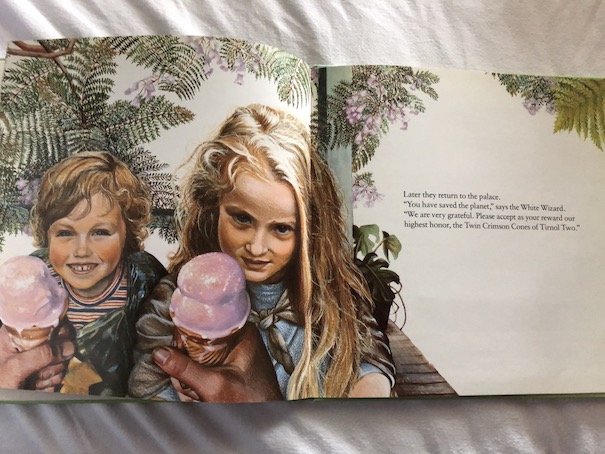
When the girls meet for trick-or-treating, Jennifer tells Elizabeth to give her the bigger bag of the two bags she brought. It’s a bit rude, but Elizabeth is fascinated by Jennifer and lets it go. Also, Jennifer has brought a small wagon with her. Jennifer has invented and mastered an act to get extra candy. At each house, she acts weak and breathless and asks for a drink of water. When the home owners give her a drink of water, she drops her empty bag, so the home owners will feel sorry for her and give her more candy. Then, out of sight of the home owner, Jennifer empties her bag of candy into the little wagon and does the same performance at the next house. Elizabeth wonders how Jennifer is able to drink so much water, but they collect an amazing amount candy from Jennifer’s act.

After Halloween, Jennifer tells Elizabeth to meet her at the library on Saturday, and she invites Elizabeth to become her apprentice witch. Elizabeth thinks it over and decides to accept. Jennifer begins leading Elizabeth through a series of rituals to make her into a witch. The first ritual involves both of them putting a drop of their blood on an old key that Jennifer was wearing around her neck. Afterward, Jennifer gives the old key to Elizabeth to wear. This ritual is kind of like a friendship pact.

Jennifer gives Elizabeth books to read from the library about witches and tells her to eat a raw egg every day for a week (she does it by mixing it into a milkshake), insisting that she also bring her a hard-boiled egg. From there, they progress through a list of other strange foods. When their grade starts rehearsing for their Christmas play, the food of the week is raw onions, which Elizabeth happens to love, in spite of being a notoriously picky eater. People notice the onions because Elizabeth is supposed to be a puppy in their school play that the princess played by nasty Cynthia gets for Christmas, and Cynthia can’t bear to get close to her.

Being Jennifer’s apprentice also means putting up with her rudeness and bossiness. When the girls decide to try making an ointment to change themselves into animals, they argue about what animals they’re going to be. Sometimes, Elizabeth finds Jennifer difficult to deal with because she isn’t considerate of her feelings, but she’s also fascinating because Jennifer is a serious reader and likes to talk about a wide range of interesting things, from witchcraft trials to Vincent Van Gogh to shipwrecks to the guillotines used in the French Revolution to secret codes. Their rituals continue through Christmas and the New Year and into the spring, with Jennifer promoting Elizabeth to Journeymen Witch and assigning her various “taboos”, things that she isn’t supposed to do.

For most of the book, Elizabeth doesn’t tell her mother about being friends with Jennifer. Jennifer, as a witch, is rather odd, and Elizabeth’s mother wants her to be friends with nice, normal children. In particular, she wants her to be friends with Cynthia because, like other adults, Elizabeth’s mother has been taken in by Cynthia’s two-faced act and thinks that Cynthia is a sweet, well-behaved little girl. When Cynthia invites her to her birthday party, Elizabeth knows that the invitation was really from Cynthia’s mother because she and Cynthia aren’t friends. However, Elizabeth’s mother makes her accept the invitation. The party is a trial because, thanks to Jennifer’s taboos, there are many party activities that Elizabeth can’t do (no eating cake, no pin-the-tail-on-the donkey because she can’t touch pins, etc.), but Elizabeth decides to make the most of it and enjoy being an oddball. Elizabeth has some fun when she realizes that she can act mysterious and witchy about knowing certain things and winning at the games she plays. She knows where the treasure is in the treasure hunt because it was just behind a pillow on the couch and she accidentally sat on it earlier, she wins at the clothespin drop game because she’s shorter than the other girls and finds the game easier, and she knows who brought which gift to the party without looking at the tags because she was the first to arrive and remembered what everyone else brought when they came. Of course, she doesn’t explain this to anyone, she just acts mysterious and witchy, like Jennifer. When she talks to Jennifer about the party, Jennifer acts like Elizabeth has actually used her witch powers to do those things, but Elizabeth insists that they were just ordinary incidents and her good memory for remembering the presents. Jennifer seems a little disappointed that Elizabeth doesn’t seem to see what she’s getting at with the witch business, and Elizabeth is disappointed that Jennifer doesn’t seem interested in the gossip she’s collected about the “normal”, non-witchy girls at the party.
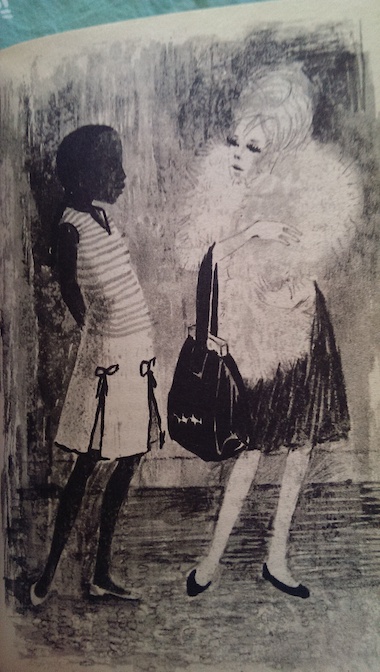
The girls get a toad, which they name Hilary Ezra, their first compromise with each other by combining the two names that they wanted. Jennifer says that the toad will help them with their flying spell. They treat the toad like a pet, giving it insects that they’ve caught and measuring how far he can jump. They both love Hilary Ezra, but when Jennifer plans to add Hilary Ezra to their flying potion, Elizabeth refuses to allow it. She makes Jennifer set Hilary Ezra free. Jennifer tells Elizabeth that she’ll never be a witch because she’s too sentimental and dismisses her as her student witch.

Elizabeth is angry at Jennifer and thinks that their friendship is over as well as the witch business. However, after thinking it over, Elizabeth realizes something: Jennifer actually wanted Elizabeth to stop her from putting the toad in the pot with the other ingredients because she changed the order in which the ingredients were added from the order that was given in MacBeth, saving the toad for last and making a big show of dangling him over the pot, waiting for Elizabeth to stop her. Still, it makes Elizabeth mad that Jennifer made her stop her when she could have stopped herself and probably would have if Elizabeth hadn’t intervened.

Elizabeth has a right to be angry, but she also goes back to being lonely, and she doesn’t like that. While she’s alone at her family’s apartment one day, she spends some time looking at the greenhouses on a nearby farm called the Samellson Estate, and some of Jennifer’s cryptic comments about Hilary Ezra’s origins and her father being a “plant wizard” fall into place. The more Elizabeth thinks about it, the more the things Jennifer acquired for their “spells” make sense and the more Jennifer herself begins to make sense. Then, Jennifer makes the first move in repairing their friendship.

The book is a Newbery Honor book. It’s available to borrow and read for free online through Internet Archive (multiple copies).

My Reaction

One of the important points about this story that helps make Jennifer more understandable as a character is that she’s African American and this book was written in the 1960s. The book doesn’t refer to Jennifer’s race or describe her physical appearance apart from her clothes until about halfway through the story, although she does appear in pictures before that. The 1960s was the time of the Civil Rights Movement, and in 1967, when this book was first published, Martin Luther King, Jr. was still live. School desegregations were a recent issue. The only time in the book that Elizabeth mentions race is when she notices Jennifer’s mother at the performance of the school play for the PTA, and she says that she knew that the woman must be Jennifer’s mother because “she was the only Negro mother there.” This one line says, without really saying it, that Jennifer is the only African American kid in her class because, if there was even one other, the black woman in the audience could have been somebody else’s mother.

When the story begins, each of the girls has a reason to feel like an outcast – Elizabeth because she’s new at school and doesn’t know anybody and Jennifer because she’s the only black kid. Both of them are lonely, and they’re actually a good fit for each other in terms of their interests, but in order to become real friends, they have to learn to relate to each other without the cover of their made-up witchcraft rituals. After Elizabeth realizes where Jennifer actually lives and what her life is really like, and Jennifer shows that she cares about Elizabeth’s feelings, the two of them are able to bond as friends instead of witches.

Elizabeth never explains why Jennifer came up with the witch idea in the first place, and the book ends soon after their friendship is repaired, so it’s left up to the readers’ imaginations. It might have something to do with feeling like an outcast because of her race and because her father is a blue-collar worker when the kids who live in the nearby apartment building are the children of white-collar workers. Because Jennifer feels different from other kids and often spends time alone, reading books and playing games of pretend, she might have felt uncomfortable explaining herself to Elizabeth, fearing that she might not accept her. Training Elizabeth to be a witch gave the two girls a reason to see each other, adventures to share, and something interesting to talk about. As long as Elizabeth needed Jennifer to teach her witch things, Jennifer would feel confident that she’d stick around as a friend. The girls gave that up when Jennifer realized that Elizabeth would be her friend anyway and might actually like her better just as Jennifer instead of a witch.

I Can Fly

I Can Fly by Ruth Krauss, 1950.

This is a cute Little Golden Book about a little girl playing.

As she plays, she compares herself to various animals. When she’s on her swing, she feels like she’s flying like a bird, and when she swims, she feels like a fish.

The story is told in rhyme, and in the back of the book, there is actually music so you can sing the rhyme as a song.

There are different printings of this book, some with different illustrations. The different versions also have different words, and it looks like the newer one includes both a boy and a girl and doesn’t have the music for the song. One of the newer versions is available to borrow for free online through Internet Archive.

Amazing Grace

Amazing Grace by Mary Hoffman, 1991.

Grace loves stories, both hearing them and acting them out. She is imaginative, and likes playing games of pretend and acting out adventures.

When Grace’s teacher tells the class that they are going to perform the play Peter Pan and will be holding auditions for parts in the play, Grace wants the title role of Peter Pan. A couple of the other kids think that it’s odd for her to want to be Peter Pan because she is both a girl and black, which is exactly the opposite of how they usually see the character.

However, Grace still wants to play Peter Pan. When she tells her mother and grandmother what the other kids said, they reassure her that she can get the part if she really wants it and puts her mind to it.

To prove to Grace that a young black girl can get starring roles, her grandmother takes her to see a ballet where the granddaughter of a friend of hers from Trinidad is playing the role of Juliet in Romeo and Juliet.

Seeing the performance cheers Grace up and gives her the confidence to audition for the part of Peter Pan. When her classmates see how good she is when she performs, they all agree that Grace should have the role of Peter Pan.

The message that young girls like Grace can do what they set their minds to, even if the roles they want in life aren’t quite traditional, is a good one. As I read the story, I was also thinking that the objection that Grace can’t be Peter Pan actually doesn’t make much sense if you know that Peter Pan, of all roles in plays, is one that is often played by a female. I remember that when I was a kid in elementary school, there was a girl who played the part of Peter Pan, and one of the teachers explained that women sometimes play Peter Pan, especially when the actors are all adults, because women have the higher-pitched voices that the part really needs. I would liked it if the teacher in the story also mentioned that. Also, acting is about capturing the spirit of the character in the story, thinking and feeling like they would think and feel and acting the way they would act. I would have liked it if they had mentioned that. Grace may not look quite the way people might picture Peter Pan, but if she can capture the character in her performance, she’s a good actor.

I liked the pictures in the book for their realism. In a couple of the pictures which show how Grace like to act out fantasies, she is shirtless, but she is very young and it isn’t possible to really see anything, so I don’t consider it inappropriate, but I thought that I would mention it.

This is a Reading Rainbow Book.

Drac and the Gremlin

Drac and the Gremlin by Allan Baillie, pictures by Jane Tanner, 1988.

The great thing about this book is that you really need to look at the pictures in order to get the full story.  If you read the text alone, it sounds like a magical space adventure story, but when you see the pictures, you realize that it all takes place in a girl’s imagination as she and her younger brother play in their backyard.  The book never mentions the children’s names (or directly talks about reality at all).  The girl calls herself “Drac, the Warrior Queen of Tirnol Two”, and her younger brother “the Gremlin of the Groaning Grotto.”

DracGremlinChase

Drac begins by trying to capture the The Gremlin.  She pursues him across the jungles, but when she finally traps him, she receives a message from the White Wizard.  The White Wizard is being attacked by “General Min” (their cat, Minnie) and desperately needs her help!  Drac persuades the Gremlin to help her.

DracGremlinCapture

The two of them get into Drac’s “anti-gravity solar-powered planet hopper” and race to the rescue!  They arrive just in time to save the White Wizard in her current form (a moth).

DracGremlinPlanetHopper

But, they are soon facing another peril: “The Terrible Tongued Dragon” (their dog)!   Drac is almost overcome by the dragon, but the Gremlin saves her just in time!

DracGremlinRescue

Their adventure ends at the palace, where the “White Wizard” (their mother) rewards them with “the Twin Crimson Cones of Tirnol Two” (ice cream).

DracGremlinReward

I love the way that the adventure unfolds in the children’s minds and the pictures show what is actually happening to the children, as their mother and everyone else sees them.  The pictures are beautiful and realistic.  The book was originally published in Australia, and I recognize some of the plants from pictures that a friend of mine there has sent me!

The book is available to borrow and read for free online through Internet Archive.

Drac

The Egypt Game

EgyptGame

The Egypt Game by Zilpha Keatley Snyder, 1967.

EgyptGameGirlsApril Hall has come to live with her grandmother (the mother of her deceased father) because her actress mother is touring with a band as a singer.  April’s mother isn’t a big star, although April likes to brag about her and their Hollywood life.  Really, her mother is mostly a vocalist who occasionally gets parts as an extra, hoping for that big break.  April is sure that when her mother gets back from her tour, she will send for her, and they will live together in Hollywood again. Although, from the way her grandmother behaves, it seems as though April may have to prepare herself for living with her for the long term.  April resents her grandmother’s apparent belief that her mother has dumped her because she is unwilling or unable to take care of her.

April is homesick and misses her mother.  To hide her feelings, she tries to act grown-up and ultra-sophisticated, which makes most people regard her as a little weird.  In spite of that, she makes friends with a girl named Melanie, who lives in a nearby apartment and sees through April’s act to her insecurity and creative side.  April has never had many friends (partly because of her mother’s chaotic lifestyle), but Melanie appreciates April’s imagination.  The two girls realize that they both like playing games of pretend and they both have a fascination with Ancient Egypt.  They go to the library and read everything they can find about Egypt, and it sparks the best game from pretend they’ve ever played.  Along with a few other friends, they start pretending to be Ancient Egyptians, building their own Egyptian “temple” and holding rituals in the old junk yard behind a nearby antique shop.

On Halloween night, the adults try to keep the children together in groups for safety, but the “Egyptians” sneak off alone to conduct one of their “rituals.”  It’s a dangerous thing to do because a child has been murdered in their area.  A young girl who was apparently abducted was later found dead, and people are frightened that other children could be in danger.  Fortunately, the only thing that happens on Halloween is that the Egyptians recruit a couple of new members when some boys from school find out what they’re doing.

However, the game starts taking on a life of its own when it seems that some other, unknown person has also joined in.  As part of their game, the children make up a new ritual and write messages to their “oracle,” asking questions that they want answered. To their surprise, someone starts writing replies.  Whoever is playing oracle and answering their questions, it doesn’t seem to be a child.

EgyptGameRitual

EgyptGameCostumesThe children are uneasy about this unexpected game player because frightening things are happening in their neighborhood.  The kids wonder if the mysterious messages could be from the crazed killer who murdered the young girl. People have been looking suspiciously at the loner who owns the antique store, an older man who everyone calls the Professor.  However, the kids have become too enmeshed in the Egypt game to give it up in spite of their fears.
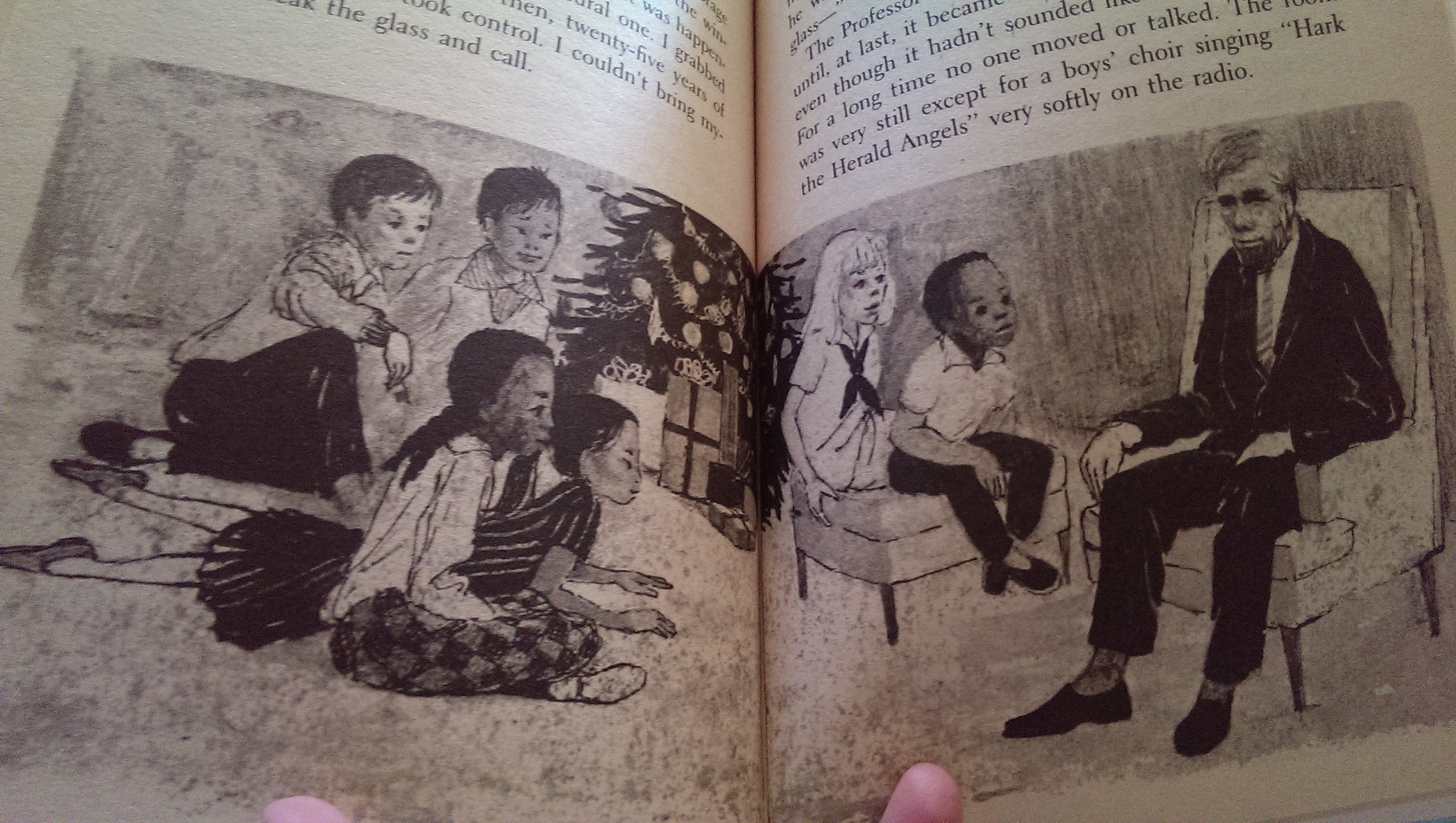
When April slips out one night to retrieve a text book she left in “Egypt,” she comes frighteningly close to being the killer’s next victim.

This is a Newbery Honor Book.  It is currently available online through Internet Archive (multiple copies).  There is a sequel called The Gypsy Game.

My Reaction

Although there are mysteries in the story (who killed the girl and who the unknown player of the Egypt game is), the development of the characters, especially April, is really at the heart of the story.  All through the story, what April wants most is for her mother to come for her and take her home again.  April fears that her mother doesn’t love her or want her, and at first, that keeps her from even trying to love the grandmother who took her in and really wants her.  However, she finds comfort when she realizes that she is creating a new life with her grandmother and friends, who really care about her.  Her mother does write to her later about coming to stay for a brief visit with her and her new husband (her acting manager, who she married on short notice without even telling April or inviting her to come to their wedding), but by then, April has started to feel at home in her new home and wants to share Christmas with the people who have been sharing in her life and adventures more than her mother has.  She never even tells her mother about her brush with death.

EgyptGameChristmas

The characters in the book are diverse, representing different racial backgrounds, ages, and family situations.  Melanie and her younger brother are African American.  Melanie understands more about human nature and how the world works than April does, partly because her mother talks to her about people and explains things.  Melanie realizes from the way that April behaves and how she doesn’t understand certain things, like the fact that there disturbed, dangerous people in the world, that her mother never really talked to her much or explained things when they were living together.  Melanie helps to ground April’s more flighty, insecure personality.  She joins in her imagination games eagerly, but she also helps to bring April more into sync with reality and other people.

The first new player they add to the game, Elizabeth, is Asian and lives with her widowed mother and other siblings.  Like April, she is a little lonely and looking for new friends in her new home.  Each of the kids, like April, have their own inner lives and personalities.  The Egypt game binds them together and provides them with friendship and insights into their lives.