The Night Before Christmas

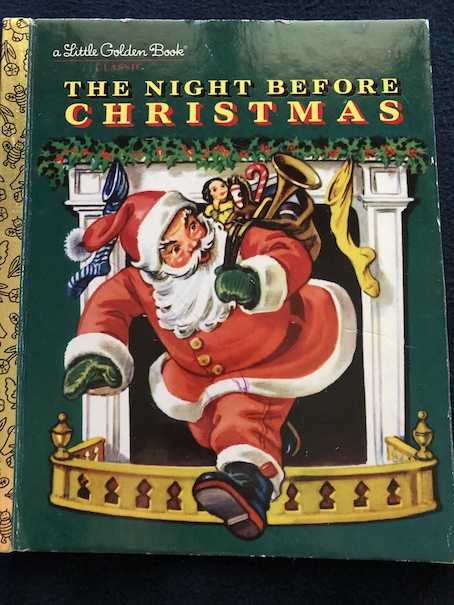
The Night Before Christmas by Clement C. Moore, illustrated by Corinne Malvern, 1949.

This version of The Night Before Christmas is part of the classic Little Golden Books series. The original poem, A Visit From St. Nicholas by Clement Clarke Moore, has been made into picture books for children many times since it was first published in 1823, but this version has some sentimental value to me. I think it was the first version that I ever read as a child. I had forgotten which version it was for years, but when I found this book again recently, I recognized the pictures. (It’s funny, but I remember thinking as a child that the youngest child looks a little too big to be in a cradle, but she is in the picture when the children are being put to bed.) Most people think of the poem as being called The Night Before Christmas instead of its original title, A Visit From St. Nicholas, because the phrase “the night before Christmas” appears in the first line of the poem. Many of the picture book versions that we read as children used The Night Before Christmas or ‘Twas the Night Before Christmas as a title.
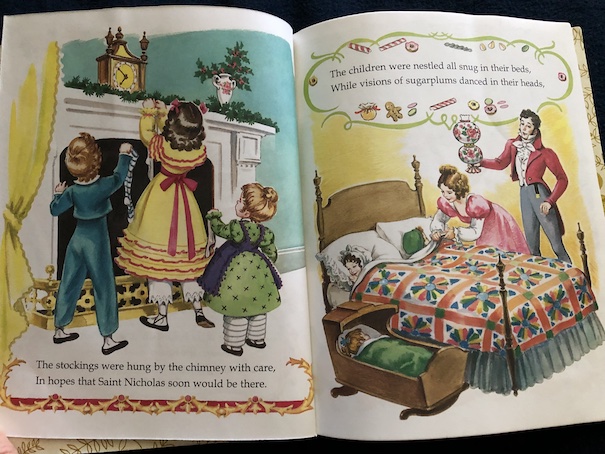
This Little Golden Book makes a cozy and pleasant bedtime story for Christmas Eve with its images of a 19th century/Victorian family hanging up their stockings and going to bed on Christmas Eve with the anticipation of the sweets, presents, and fun of the next day. Then, the father of the family is suddenly woken when he hears Santa Claus arriving.
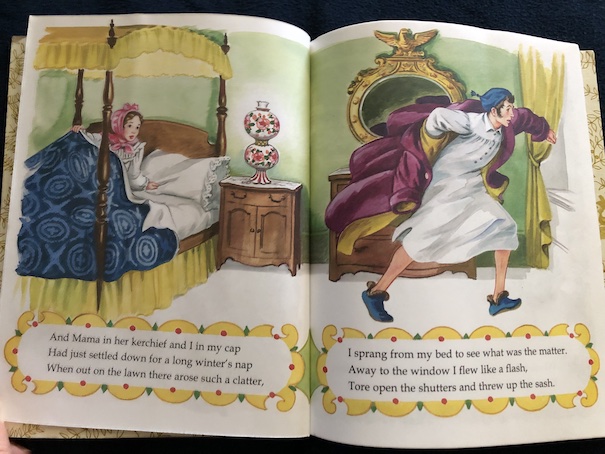
This 19th century poem established and popularized the image of Santa Claus as generations of Americans came to know it. It describes him as a fat and jolly little old man and names all of the reindeer who pull his sleigh. This is probably the first piece of writing that established that Santa has eight reindeer and gave them specific names, which would later be echoed in the storybook and song versions of Rudolph the Red-Nosed Reindeer.

The father of the family in the poem happily watches Santa Claus leaving presents for his children and then leaving by the chimney and riding off in his sleigh with a cheery, “Happy Christmas to all and to all a good night!”
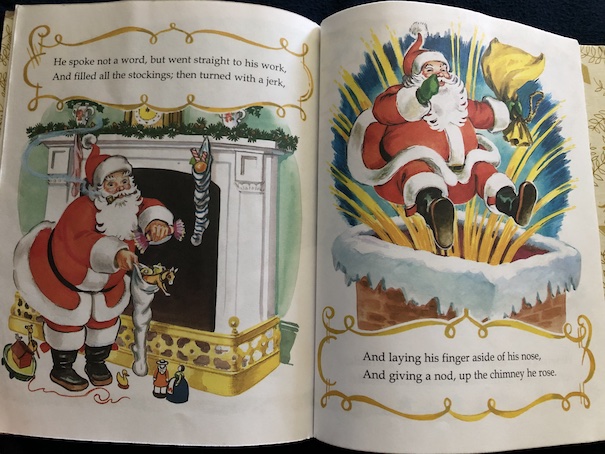
Various picture book versions of this poem are available online through Internet Archive, including this Little Golden Book version.

The Bone Keeper

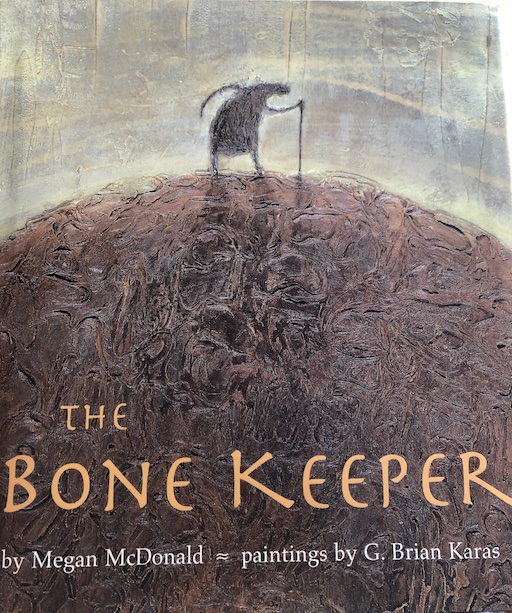
The Bone Keeper by Megan McDonald, paintings by G. Brian Karas, 1999.

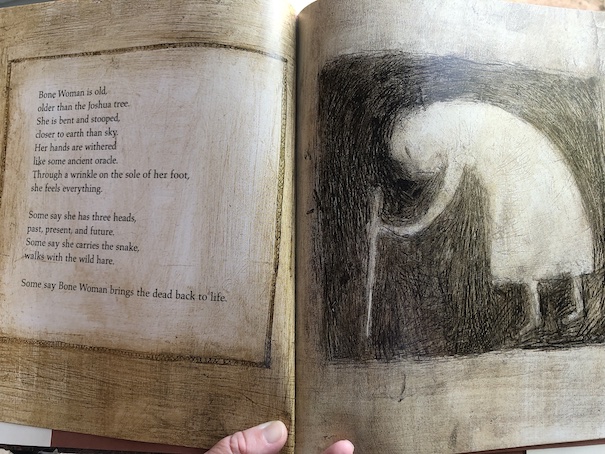
The story in this picture book is written as an unrhymed poem and illustrated with paintings that resemble paintings on a cave wall.

Bone Woman is a strange old woman. She is ancient, legendary, may have powers to bring back the dead, and lives in a cave full of bones.

She spends her time searching for bones in the desert sand. She collects the bones, studies them, and arranges them to form complete skeletons.

When she manages to complete a skeleton, she performs a ritual to bring the creature back to life!

The book is available to borrow and read for free online through Internet Archive.

My Reaction

This is one of those picture books that I think would actually be appreciated more by adults than by children. The poetry and art style seem more sophisticated than the styles that children seem to prefer. Most of the pictures are not very colorful, using a lot of grays and browns and black, although the art style is unusual and fascinating, looking like paintings and drawings scratched into rock.

I think kids could understand the action of the story – a strange old woman who lives in a cave collects bones, assembles them into skeletons, and can use them to bring animals back to life. It’s a strange story, partly because there is no explanation about why she is doing this.

One of my regrets about this book is that it doesn’t explain the background of this story. I had expected that there would be a section at the back of the book that would explain more, but there isn’t. From the context – the pictures, the style of the story, the names that the woman is called, and the fact that the artist thanked the Phoenix Public Library and the Heard Museum (both places that are familiar to me) in the dedication – adults can figure out that this is a story from folklore, but it’s not immediately clear what kind of folklore. Anyone who doesn’t already know the story might be confused. I didn’t know this story when I read the book, so I had to look it up.

The story of the Bone Woman has been told and referenced in other books. The story of La Huesera (the Bone Woman) is a Mexican folktale. Sometimes, it’s also called La Loba (the Wolf Woman) because that is the animal that she particularly wants to resurrect. The Bone Woman is a “wild woman” or a “crone” who uses a kind of natural magic to bring life to lifelessness and restoring what was lost.

We’re Going on a Ghost Hunt

We’re Going on a Ghost Hunt by Marcia Vaughan, illustrated by Ann Schweninger, 2001.

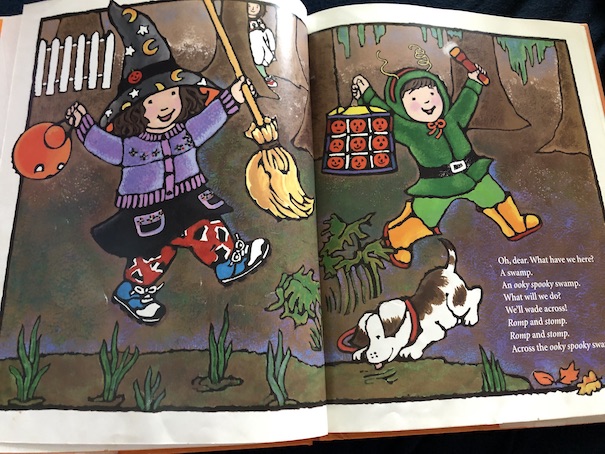
On Halloween night, two kids go out on a ghost hunt. This is a cute picture book, told as a poem, with a lot of repetition of phrases and sound words, like “thump” and “stomp.” The book also encourages children to notice details. The “ghost” appears in the scene where the children pass through the “swamp” and the ghost costume appears again at the end of the book.

As the kids go on their ghost hunt, passing through a swamp and past a haunted house and other scary things, they repeat that they’re not afraid.

The kids are brave, right up to the point where they finally find a ghost.

The kids run home to their mother, who gives them cupcakes and reads them a story.

Three guesses who the red-sneakered ghost was. Happy Halloween!

The book is available to borrow and read for free online through Internet Archive.