When Clay Sings

This children’s picture book is a salute to the ancient makers of Native American pottery, dedicated to these makers and the museums that preserve their work. It’s written as free form poetry with images of the American Southwest and designs from Native American pottery.
The story sets the scene on a desert hillside, where pieces of ancient pottery are buried. Sometimes, Indian (Native American) children dig up pieces of old pottery, and their parents remind them to be respectful of what they find because they are pieces of the past and of lives that went before. Sometimes, they’re lucky enough to find pieces that fit together or even a bowl that isn’t broken.

They reflect on the time and skill that went into making the pottery and how strong the pottery would have to be to last well beyond the lives of the people who made it. They think about the people who painted the beautiful designs on the pots and what their lives were like. Could their own children have requested favorite pictures painted on their bowls?

Some designs show animals or bugs or hunters, but others show bizarre creatures that might be monsters or spirits. Others show a medicine man trying to cure a child, ceremonies, dancers in masks and costumes, or the traditional flute player. People can reflect on the lives of those long-ago people and how they compare to the lives of people today.

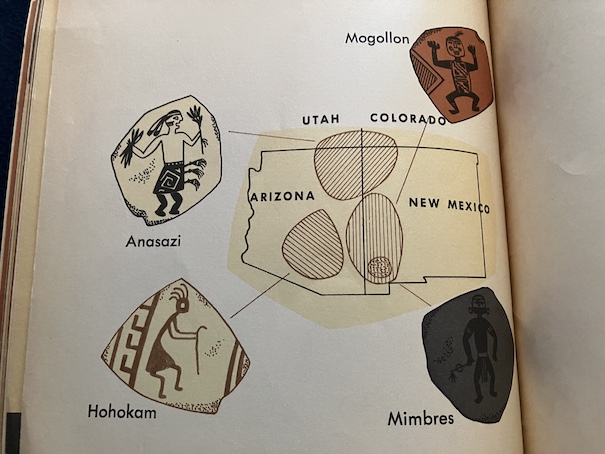
There is a map in the back of the book which shows the areas of the American Southwest (Arizona, New Mexico, Utah, and Colorado) where the pottery designs the book uses originated from and the tribes that used them.

This is a Caldecott Honor Book. It is available to borrow and read for free online through Internet Archive (multiple copies).

I grew up in Arizona, and I remember our school librarian reading books by Byrd Baylor to us in elementary school during the late 1980s or early 1990s. She wanted to introduce us to this author because she wrote about the area of the United States where we lived. In fact, this book about pottery was fitting because, when they were building our school in the 1970s, they found some ancient pottery. They used to have it on display in the school library. Even to this day, it’s common for people creating buildings in this area to have the site surveyed by archaeologists. Finds are fairly common, and the usual procedure is to thoroughly document everything that gets uncovered before burying it again in the same location and constructing the building over it. One of the reason why they usually rebury finds is that, in this dry, desert climate, putting them back into the ground will actually preserve them very well. It’s possible that later generations will find them again (especially with the location documented) when the building is gone or no longer necessary, but they may have better instruments or techniques for analyzing them.

I’m a little divided on how much I like this book, though. On the one hand, I like books about folklore and traditional crafts, and this book focuses on a geographical area that’s very familiar to me. On the other hand, the free verse poetry that reflects on the feelings of people about the pottery doesn’t appeal to me quite as much as books which show the process of making it, like The Little Indian Pottery Maker. I like to see the process and learn more of the known background legends of some of the designs than just try to imagine what things might have been going through the minds of the designers. Toward the end of the book, they show the legendary humpbacked flute player, but they don’t tell you that this figure is called Kokopelli and that there are legends about him. It’s a nice book, but I just felt like there was potential to include more background information.

This book uses the word “Indian” for “Native American” or “America Indian”, which is common in older children’s books.

After the Sun Sets

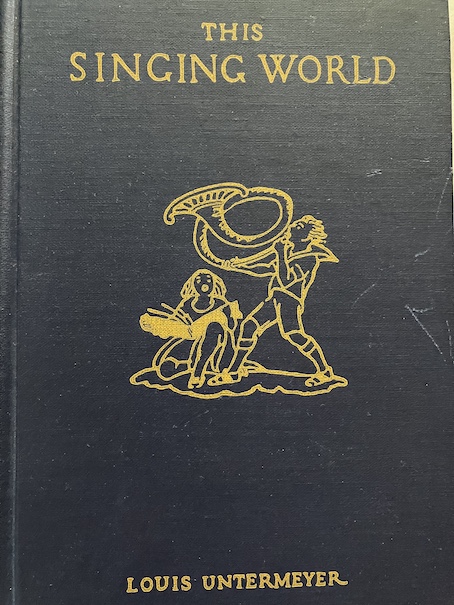
This was my favorite book of fairy tales when I was a kid! I gave away my copy years ago and regretted it, but I was thrilled to find another copy later at an antique/vintage mall.

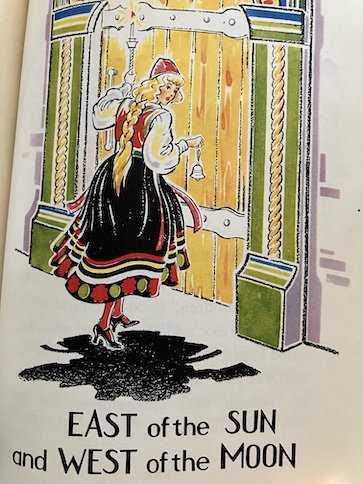
The collection includes some popular fairy tales that you can find in other fairy tale collections, like Cinderella, Brier Rose (the Sleeping Beauty story), and Hansel and Gretel. It also has some stories that are less commonly known these days, like Aiken-Drum, the Brownie and Prince Hal and the Giant. When I was young, my favorite stories in the book, the ones I read over and over, were Snow-White and Rose-Red, The Princess on the Glass Hill, and East of the Sun and West of the Moon.

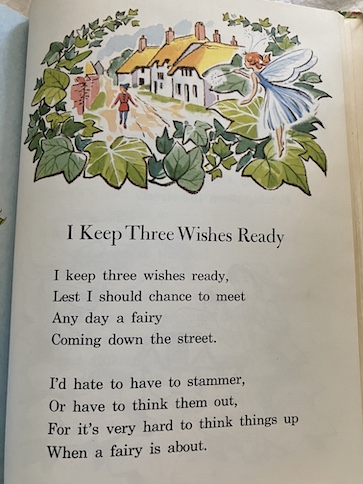
One of the things that makes this collection unique is that it includes a section of poems at the back of the book. I love the one called Cinderella’s Song, and it was one of the reasons why I missed this collection so badly. I don’t think I’ve seen that poem in any other book.

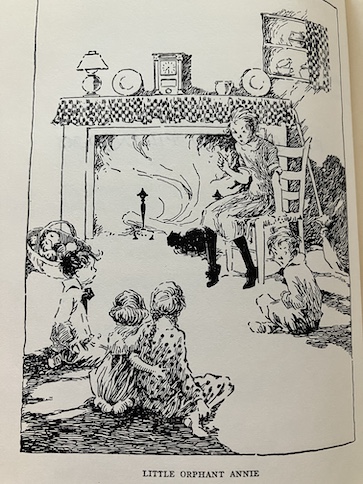
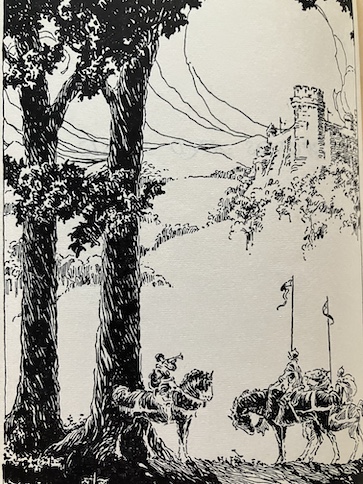
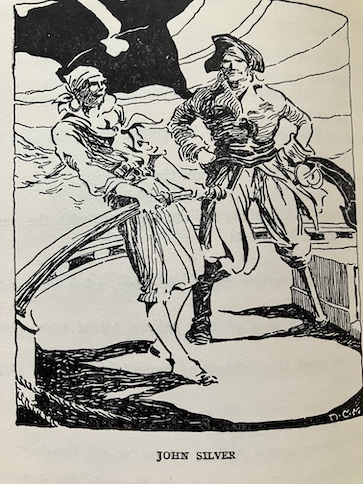
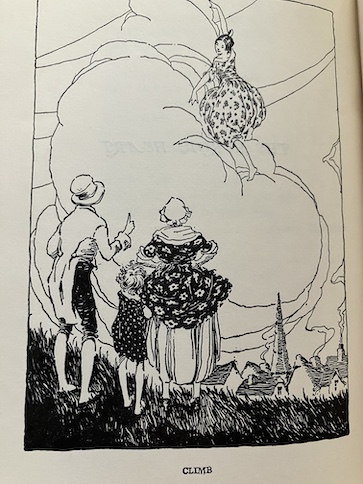
The illustrations in the book are beautiful! I loved them as a child, and I still find them enchanting as an adult. Some are in black-and-white, but some are in full color.

I didn’t realize it when I was a kid, but this book is actually the third book in a series, The Wonder-Story Books, and it was a unit in The Row, Peterson Basic Reading Program. I have the 1962 edition, but the book is actually older than that. Its copyright was renewed multiple times.

The book is available to borrow and read for free online through Internet Archive. There is also an earlier edition of this book available through Internet Archive, and it doesn’t have the section of poetry included, so the poetry might only appear in the 1962 edition.

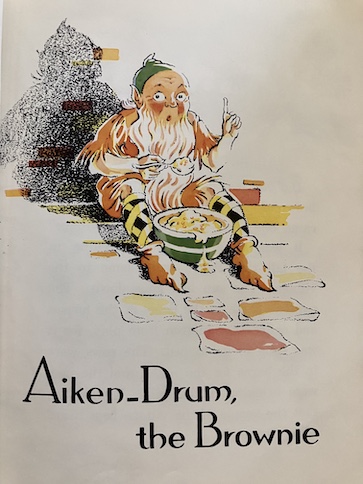
Aiken-Drum, the Brownie

Aiken Drum is a Brownie, a magical little man who likes to do chores for other people for little reward. Reward a Brownie too much, and he will leave.

Pat and the Fairies

Pat joins the fairies in a dance, and they loan him a pair of shoes when his wear out. When he later comes to return the shoes, he gets a wonderful reward. A greedy shoemaker tries to join the fairies in their dance and borrow a pair of shoes to get the same reward, but the fairies punish him when he tries to cheat them.

Change About

A husband grumbles about how little his wife accomplishes in the course of a day while she minds the house and their child and he works out in the fields. The husband and wife decide to switch places for a day to prove which of them works harder, and the husband has a surprise about what really happens at home while he’s away.

Cinderella

A girl who is abused by her stepmother and stepsisters receives magical gifts from her fairy godmother so she is able to attend the prince’s ball.

Snow-White and Rose-Red

A widow and her two daughters let a gentle talking bear spend the winter with them so he won’t freeze, but this bear is under a spell.

Snip, The Tailor

A tailor sets out to make his fortune. He uses his wits to defeat a pair of giants and win a castle and half the kingdom from the king.

Brier Rose

This is the Sleeping Beauty story. A young princess is cursed by a bad fairy. When she hurts her hand on a spindle, she and everyone in her castle falls asleep for a hundred years.

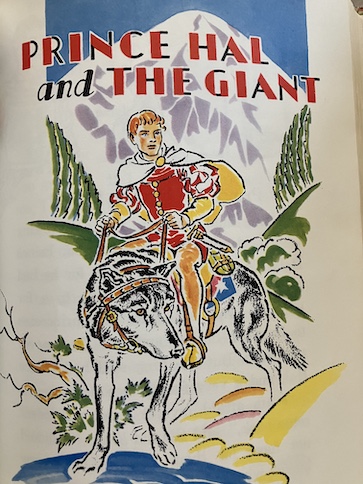
Prince Hal and the Giant

Prince Hal is the youngest of a king’s seven sons. The other six have left home to find brides and have never returned home. No one knows what happened to them. Prince Hal sets out to find what happened to his brothers. He finds out that they and their brides have been turned into stone statues in the house of a giant. Prince Hal must find a way to save them and the princess who has become the giant’s latest captive.

Hansel and Gretel

A pair of children are abandoned in the woods, and they find a strange house made of gingerbread. They are almost eaten by the witch who lives in the house.

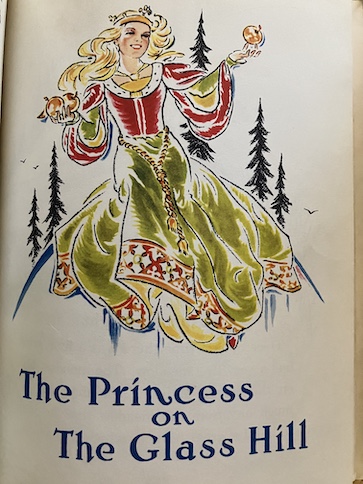
The Princess on the Glass Hill

Every year on Midsummer Night, the hay disappears from a farmer’s field. Each of his sons tries to find out why, but each of them is frightened by the strange things that happen, until the youngest son faces the phenomenon and discovers a strange horse with a coat of mail that fits him perfectly. The same thing happens twice more so that the youngest son acquires three fine horses and three sets of mail. He keeps them secret at first, but later, he uses them to perform an amazing feat and ride to the top of a glass hill to win the hand of a princess.

East of the Sun and West of the Moon

A white bear comes to a family with many children and says that he will make them rich if the eldest daughter, Freda, will come with him. At first, she doesn’t want to go, but when she does, he takes her to a magical castle. Unfortunately, she disobeys the bear’s instructions while she’s there. He is under a witch’s spell, and Freda must find a way to undo the damage she’s caused and break his spell, following him to the witch’s castle by riding the winds, east of the sun and west of the moon.

I Keep Three Wishes Ready by Annette Wynne – It’s good to know what you want to wish for, just in case you get the chance.

At the Zoo by A. A. Milne – There are many fascinating things to see in a zoo!

Some One by Walter de la Mare – Someone knocked at the door. Who?

Little Nut Tree by Mother Goose – A traditional rhyme about a magical tree. One of my favorites!

The Duel by Eugene Field – The gingham dog and the calico cat have a fight.

Queen Mab by Thomas Hood – About the fairy queen and how she gives pleasant dreams to children.

Cinderella’s Song by Elizabeth Madox Roberts – Cinderella confides her secret to her cat.

Trees by Harry Behn – Trees are wonderful things!

The Story of the Baby Squirrel by Dorothy Aldis – A child finds a baby squirrel and raises it. When it grows up, it runs away, but they think he’s probably still living with the other squirrels nearby. They sometimes see a squirrel who seems to be saying hello to them.

The Hens by Elizabeth Madox Roberts – It sounds like the hens are talking, but what are they saying?

Roads by Rachel Field – Roads might lead anywhere and to all sorts of wonderful things!

Washington by Nancy Byrd Turner – About George Washington. This one seems like an odd inclusion to me, adding a poem about a historical figure to a collection that has more fairy tale themes.

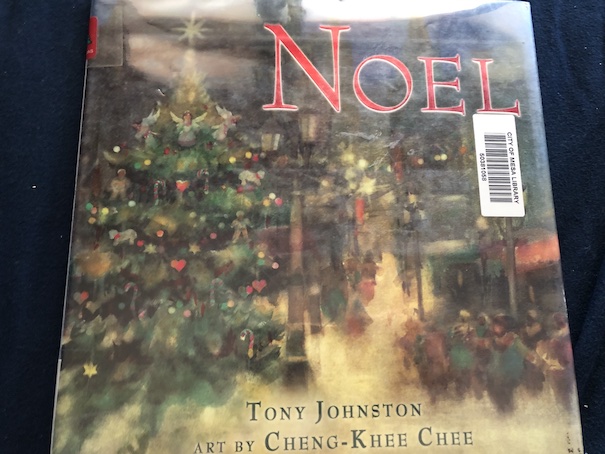
Noel

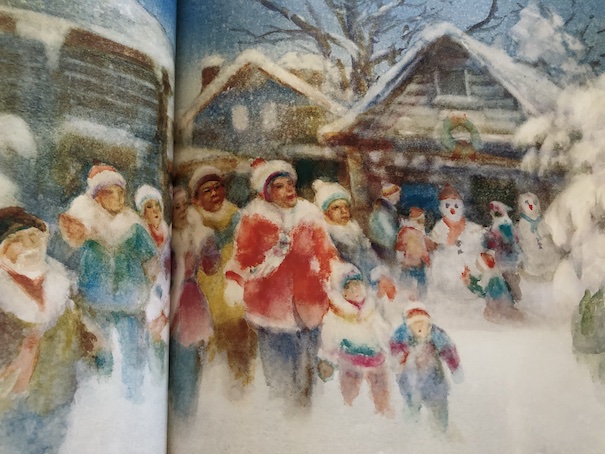
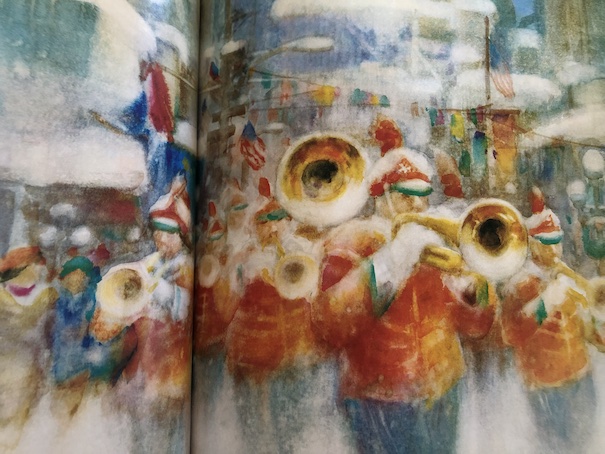
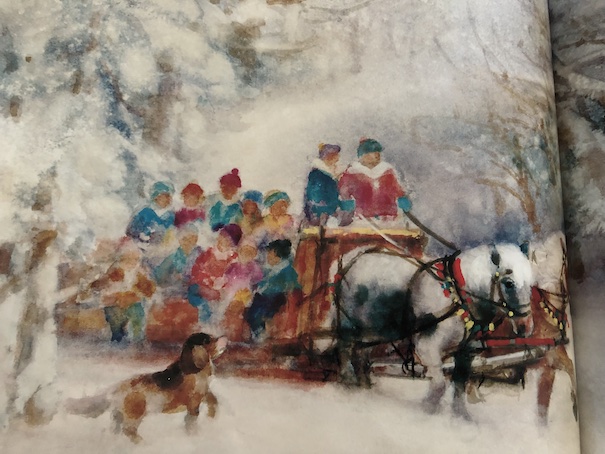
Noel by Tony Johnston, art by Cheng-Khee Chee, 2005.

This lovely Christmas picture book reads like a Christmas carol!

There is no story in the book. The text is poetry that celebrates the atmosphere of Christmas, the feelings in nature as anticipation builds and in cities as people gather to celebrate.

“Noel” is described as the sound of Christmas, like a bell, that people and animals all listen to hear.

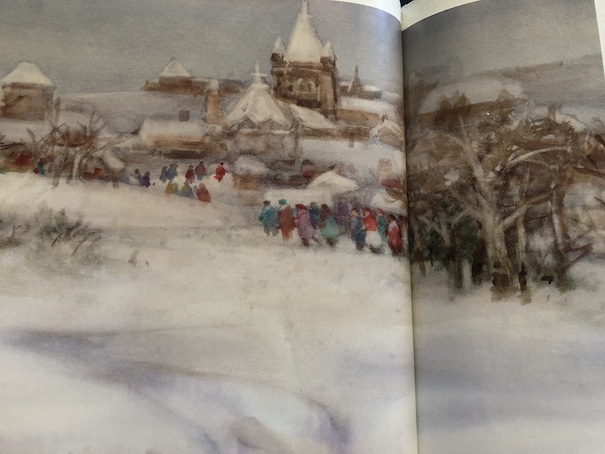
The artwork is beautiful, and there are scenes of people participating in classic Christmas celebrations, with a Christmas parade, snowmen, a public Christmas tree, and a sleigh ride.

The pictures really make the book beautiful and dreamlike. In the back of the book, there is a section that explains the art style. The artist used watercolors and a technique called “saturated wet-paper technique.” This technique is what gives the illustrations their fuzzy, dreamlike quality

The book is available to borrow and read for free online through Internet Archive.

The Bone Keeper

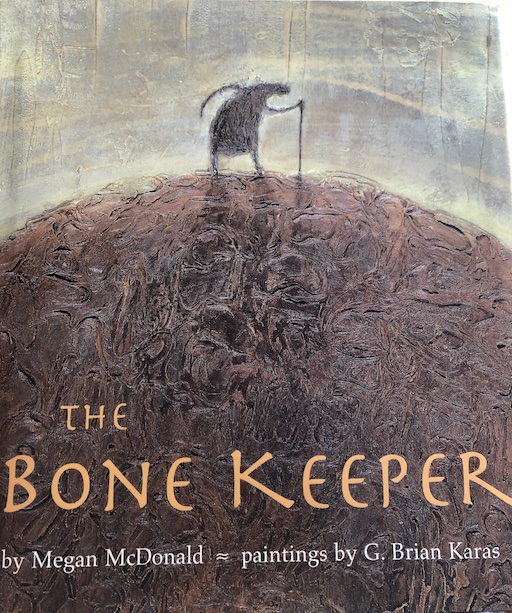
The Bone Keeper by Megan McDonald, paintings by G. Brian Karas, 1999.

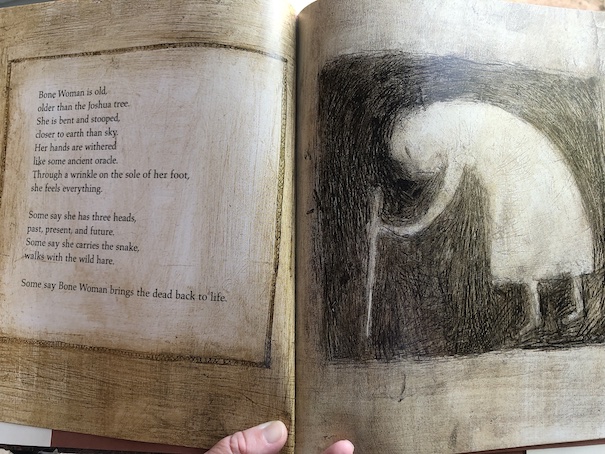
The story in this picture book is written as an unrhymed poem and illustrated with paintings that resemble paintings on a cave wall.

Bone Woman is a strange old woman. She is ancient, legendary, may have powers to bring back the dead, and lives in a cave full of bones.

She spends her time searching for bones in the desert sand. She collects the bones, studies them, and arranges them to form complete skeletons.

When she manages to complete a skeleton, she performs a ritual to bring the creature back to life!

The book is available to borrow and read for free online through Internet Archive.

My Reaction

This is one of those picture books that I think would actually be appreciated more by adults than by children. The poetry and art style seem more sophisticated than the styles that children seem to prefer. Most of the pictures are not very colorful, using a lot of grays and browns and black, although the art style is unusual and fascinating, looking like paintings and drawings scratched into rock.

I think kids could understand the action of the story – a strange old woman who lives in a cave collects bones, assembles them into skeletons, and can use them to bring animals back to life. It’s a strange story, partly because there is no explanation about why she is doing this.

One of my regrets about this book is that it doesn’t explain the background of this story. I had expected that there would be a section at the back of the book that would explain more, but there isn’t. From the context – the pictures, the style of the story, the names that the woman is called, and the fact that the artist thanked the Phoenix Public Library and the Heard Museum (both places that are familiar to me) in the dedication – adults can figure out that this is a story from folklore, but it’s not immediately clear what kind of folklore. Anyone who doesn’t already know the story might be confused. I didn’t know this story when I read the book, so I had to look it up.

The story of the Bone Woman has been told and referenced in other books. The story of La Huesera (the Bone Woman) is a Mexican folktale. Sometimes, it’s also called La Loba (the Wolf Woman) because that is the animal that she particularly wants to resurrect. The Bone Woman is a “wild woman” or a “crone” who uses a kind of natural magic to bring life to lifelessness and restoring what was lost.

A Child’s Garden of Verses

A Child’s Garden of Verses by Robert Louis Stevenson, illustrated by T. Lewis and Sara Gutierrez, 1989.

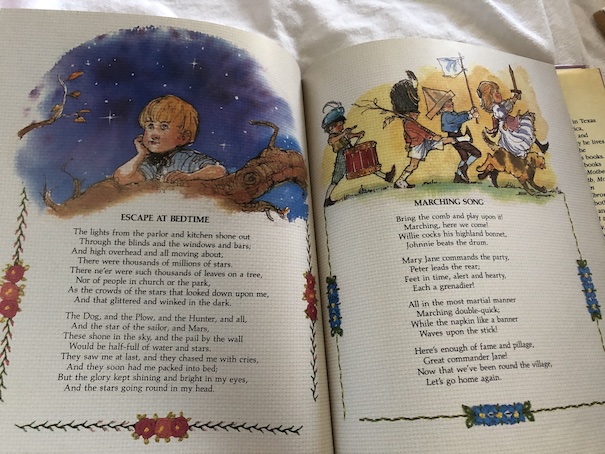
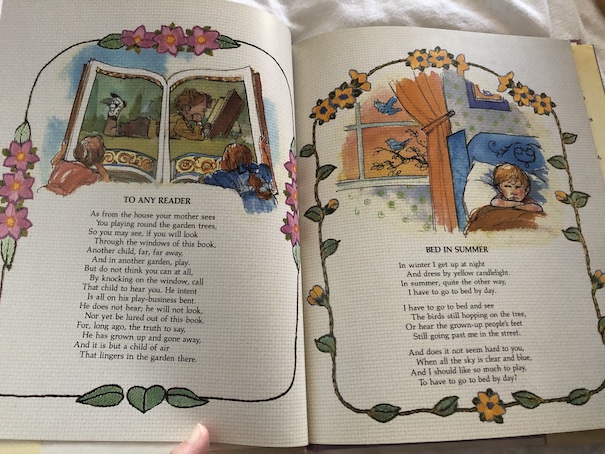
This is a reprinting of the classic collection of children’s poems by Robert Louis Stevenson first published in 1885 as Penny Whistles. What makes this edition of the book different from other printings is the illustrations, which are an unusual combination of watercolors and embroidered borders. Mary Pope Osborne, author of the Magic Tree House series wrote an introduction to the book about the life of Robert Louis Stevenson and his youth in Scotland in the 1850s, which inspired his poems for children. (See my list of Books from 1850s for the types of books children were reading during this time period, but remember that they also would have read books that were published in previous decades.)

The poems have gentle themes from the lives and fantasies of children, like games of pretend, bedtimes, and the little things that children notice and that adults often take for granted, like shadows and the beauty of stars. Some of them have things that are now anachronistic, like lamplighters, but they’re still imaginative and enjoyable for all ages.

I’ve always liked Robert Louis Stevenson’s children’s poems, and this book has my favorites! My personal favorites are:

To Any Reader – Robert Louis Stevenson speaks to children reading these poems about the child he used to be and how the poems are like a window on his childhood, although his own youth is long gone.
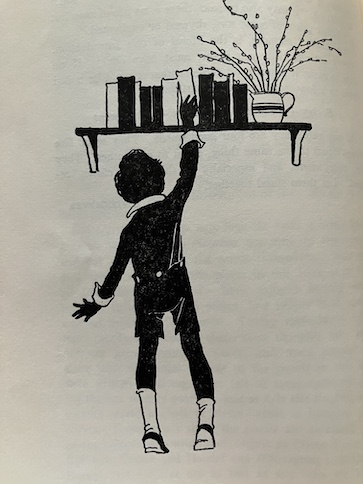
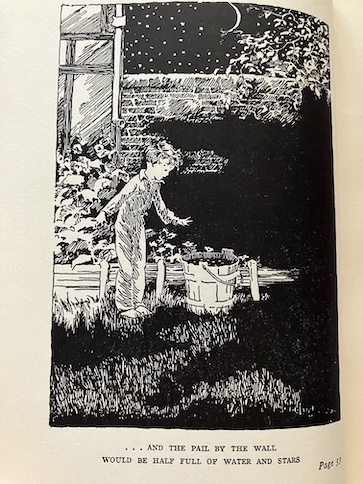
Escape at Bedtime – About a child who sneaks out of bed at night to look at the stars.
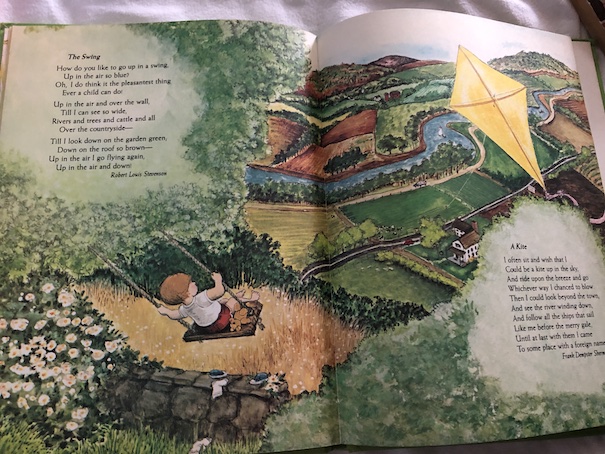
The Swing – I mentioned this one before because it’s included in another collection of poems, and I’ve often thought of it when I’ve been on swings.
Picture Books in Winter – A child enjoys picture books indoors when it’s cold outside.
The Land of Storybooks – About the adventures that children who love books enjoy in their imaginations.

However, my mother’s favorite children’s poem is Bed in Summer because it reminds her of her own childhood and having to go to bed while the sun was still shining in summer and other children in the neighborhood were still playing outside. (I didn’t have this experience when I was growing up because I never lived in a place that had daylight savings time, which changes the clocks by one hour, providing an extra hour of daylight before sunset. Arizona is very hot, so there’s a benefit for doing things after the sun has set, and few people have any interest in pushing back time to maximize the scorchingly hot daylight hours. My childhood memories include going to parks with my parents after the sun set and being put to bed after we got home.)

There are many copies of this book available in various printings online both at Internet Archive and Project Gutenberg because the text of the original book is now public domain. I didn’t see this particular printing with these illustrations available online, but if you just want to read the poems, there are plenty of other copies of the book to choose from!

A Child’s First Book of Poems

A Child’s First Book of Poems with pictures by Cyndy Szekeres, 1981.

I think this actually might have been my first book of poetry. At least, I’ve had it since I was a fairly young child, and I can’t remember reading any other book of poetry before this one. If I had an earlier book of poetry, it was probably a book of Mother Goose rhymes.

The poems in the book are about a variety of topics and some of them are by famous people and were popular poems for decades before this book was published. Among the authors whose poems appear in this book are Emily Dickinson, A.A. Milne, and Robert Louis Stevenson.

Among my favorite poems in the book:

Wild Beasts by Evaleen Stein – About children pretending to be animals.
Choosing by Eleanor Farjeon – About choosing between various nice things.
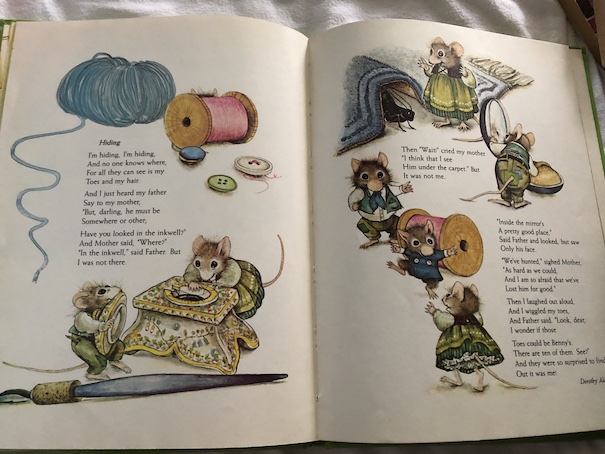
Hiding by Dorothy Aldis – A child hides while his parents search for him. My mother often quoted from this poem when we were kids and she was looking for one of us. “I’m hiding, I’m hiding, and no one knows where …”
The Swing by Robert Louis Stevenson – I think of this poem whenever I’m on a swing.
Bedtime by Eleanor Farjeon – Children making excuses to stay up later.

The pictures really make this book special. They are all drawn in a realistic style. Some just show ordinary children and animals, but some contain whimsical elements, like animals wearing clothes, depending on the poem.

The book is available to borrow and read for free online through Internet Archive.

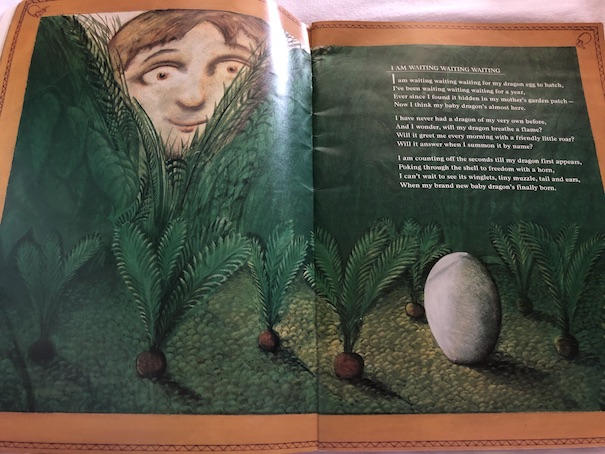
The Dragons Are Singing Tonight

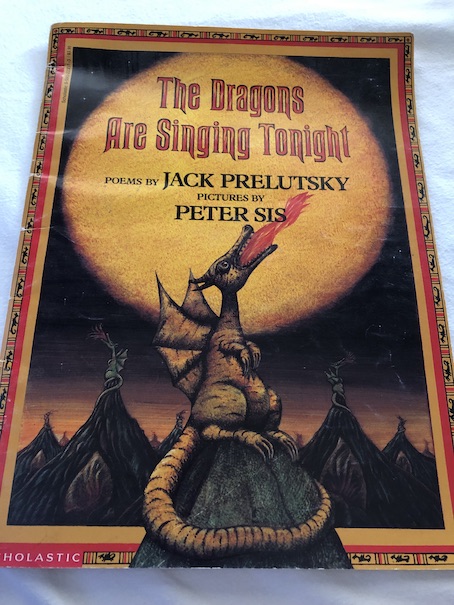
The Dragons Are Singing Tonight by Jack Prelutsky, illustrated by Peter Sis, 1993.

This is a picture book of poems about dragons, but that description doesn’t quite do the book justice.

Jack Prelutsky is best known for his books of humorous poems for children, but not all of the poems in this book are funny. Some of them are humorous or have humorous twists, but others are just about the magic and wonder of the idea of dragons, some of which only exist in the imagination. Sometimes, just believing in magic or imagining it can be magical by itself!

The pictures are all excellent, colorful, and fanciful, and they really bring the poems to life. The book is larger than average, and the pictures span full pages.

The book is currently available online through Internet Archive.

The Rescuers

The Rescuers by Margery Sharp, 1959.

This is the first book of The Rescuers Series.  Disney made a movie called The Rescuers based on this series, but the movie was very different from the book.  The movie involved a pair of mice who were members of a mouse version of the United Nations called The Rescue Aid Society who rescued a young orphan girl who was kidnapped for the purpose of recovering a treasure from a dangerous cave.  In the book, the prisoner the mice rescued was a poet who was being held captive in a castle.

The beginning of the first book of the series explains the purpose of the Prisoners’ Aid Society, an organization of mice that helps human prisoners:

“Everyone knows that the mice are the prisoners’ friends – sharing his dry bread crumbs even when they are not hungry, allowing themselves to be taught all manner of foolish tricks, such as no self-respecting mouse would otherwise contemplate, in order to cheer his lonely hours; what is less well known is how splendidly they are organized. Not a prison in any land but has its own national branch of a wonderful, world-wide system.”

However, the mice are daunted by their latest concern, a prisoner who is being held captive in the Black Castle, a Norwegian poet.  The Black Castle is a harsh prison, and because of the jailer’s cat, mice usually cannot reach the prisoners there.  However, the current chairwoman of the society believes that it may be possible to rescue one of the prisoners there.  She thinks that Miss Bianca is just the mouse for the job because she is the pet of an ambassador’s son and will soon be traveling to Norway with her owner.  The chairwoman sends Bernard, a pantry mouse, to Miss Bianca to recruit her for the mission.

Miss Bianca is frightened when Bernard explains the mission to her and faints.  However, it turns out that Miss Bianca is a poet, and so is the man who is being held prisoner.  Bernard uses her sympathy for a fellow poet and some flattery to inspire her to agree to help.

When Miss Bianca reaches Norway, she recruits some help from the mice in the cellar of the embassy.  In particular, a sailor mouse called Nils accompanies her to where the other mice from the Society are meeting.  There, Bernard joins them for the journey to the Black Castle.

When they reach the castle, Miss Bianca, Bernard, and Nils take up residence in an empty mouse hold in the head jailer’s quarters.  (There is a horrifying description of how the head jailer apparently pinned live butterflies to his walls to die. Ew!)  The jailer does have a horrible cat named Mamelouk, who is as cruel as his master.  At first, Miss Bianca isn’t afraid of the cat, having known a nice cat who didn’t eat mice when she was young.  After talking to Mamelouk and interacting with him, she comes to recognize his cruelty and real intentions toward her.  However, Mamelouk is an important source of information.  It is from Mamelouk that they learn that the jailers will be having a New Year’s Eve party soon and that many of them are likely to be lax in their duties.  This will be the best time for them to try to rescue the poet!

The mice do successfully rescue the poet, and Miss Bianca returns to her boy, who has been missing her. However, this is just the first of her adventures in this series!

Overall, I prefer the first Disney Rescuers movie to the book because the prison/castle seemed pretty dark for a children’s book, and I think the idea of rescuing a child is also more appropriate for a children’s book.

The book is currently available online through Internet Archive.

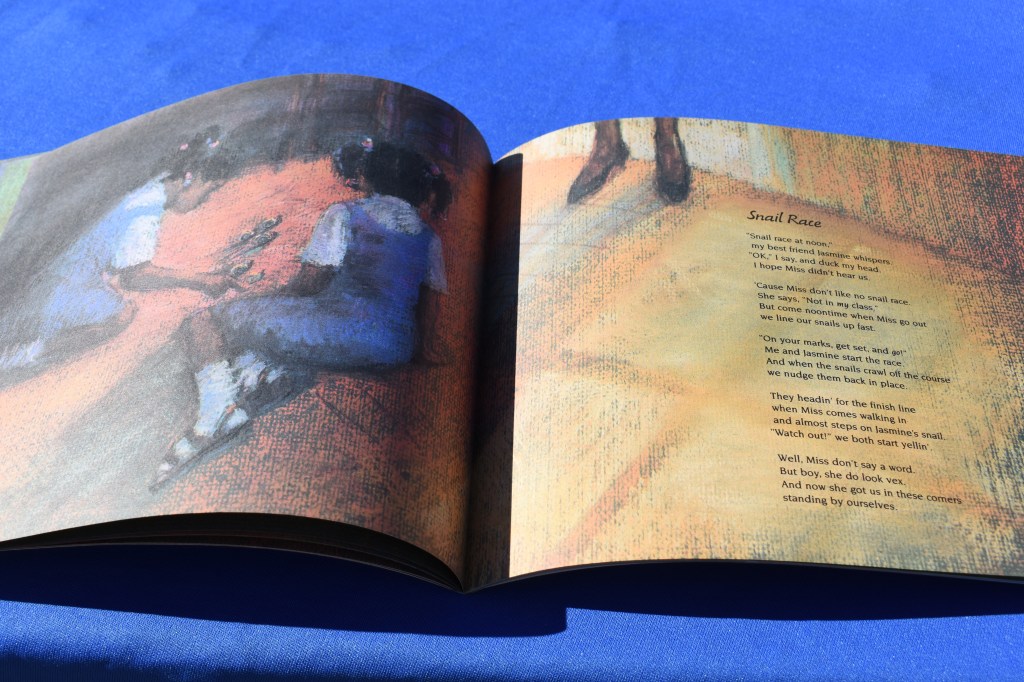
Coconut Kind of Day

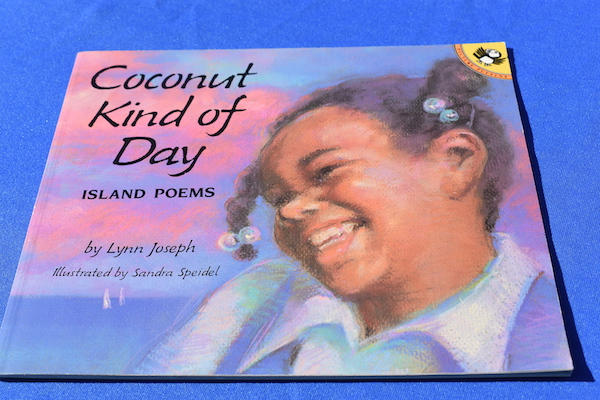
Coconut Kind of Day: Island Poems by Lynn Joseph, illustrated by Sandra Speidel, 1990.

The author’s note in the back of the book explains that the author was originally from Trinidad and that she wrote this book of poems about some of the things that remembers from growing up there.  She also explains some of the terms used in the poems that people who aren’t familiar with Trinidad might not know:

Palet man – Ice-cream man who sells ice cream on sticks, like popsicles (I knew this one because I’m used to the Spanish word “paletero” from growing up in Arizona.)

Soursop – A type of fruit often used as an ice cream flavor

Pullin’ seine – When the fishermen start pulling in their nets, and other people help.

Jumbi man – A bogey man.  It’s popular for people to dress in a Jumbi costume at Carnival time.

Sorrel – A plant used in making a drink around Christmas

The poems are mostly about small, everyday things, like going to school or to the market or how the children play together or get ice cream from the palet man.

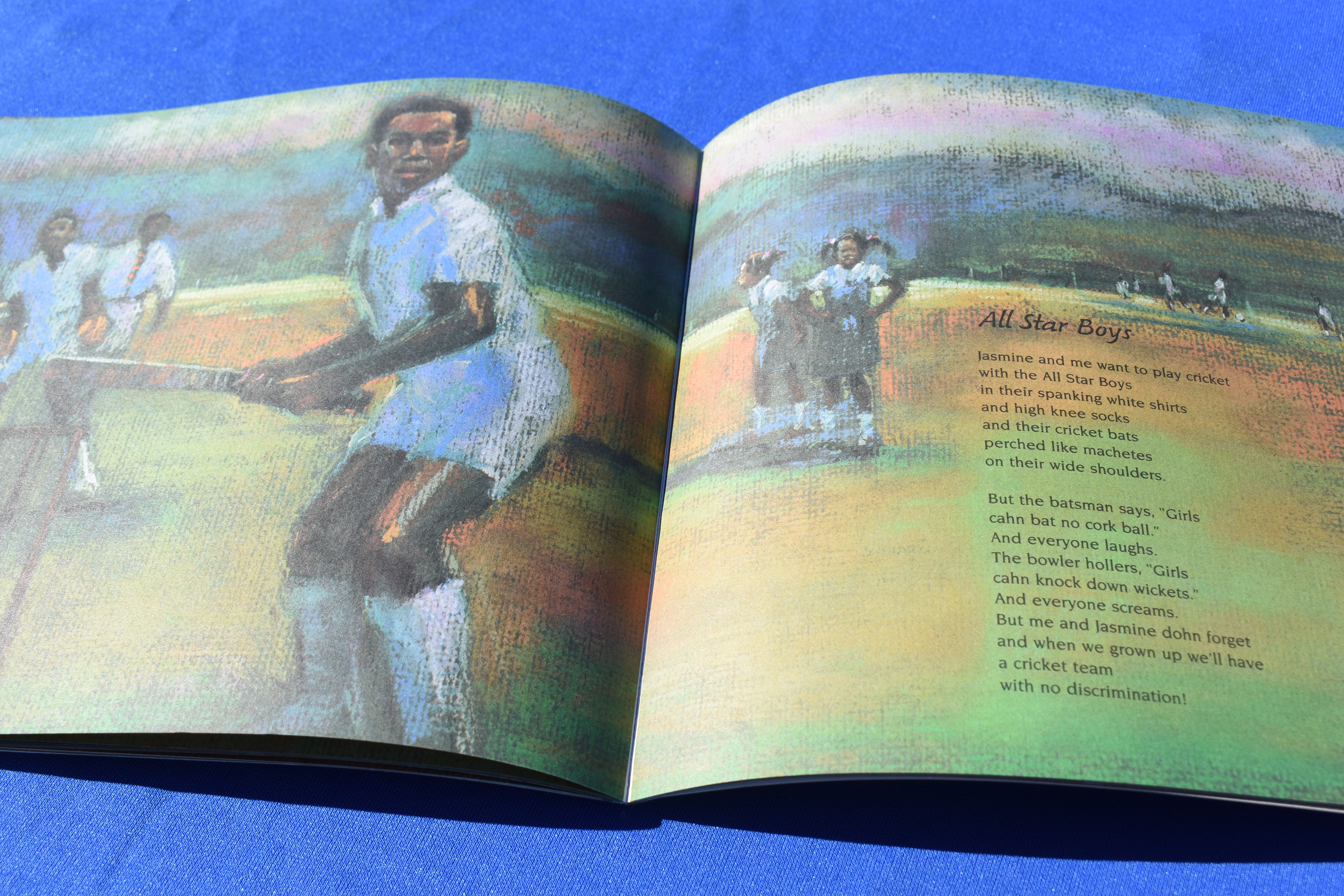
There is one poem where the girls want to play cricket with the boys, but the boys won’t let them, and they decide that when they’re older, they’ll have a cricket team of their own.

The pictures are beautiful, done in an impressionistic style.

The D- Poems of Jeremy Bloom

jeremybloomThe D- Poems of Jeremy Bloom by Gordon Korman and Bernice Korman, 1992.

This book is mostly a collection of funny poems, but there is an overarching story to them.  Jeremy Bloom, a typical middle school slacker, wanted to sign up for the easiest elective course he possibly could.  But, by accident, he overslept on the first day of school, and by the time he got there, sign-ups had already started and the easiest and most popular electives were full.  Desperately trying to find something easy and with as little work possible under the remaining electives, Jeremy decided to sign up for Pottery. (“It was no Snooze Patrol, but how hard could it be to make ashtrays?”)  Only, he made another mistake and accidentally signed up for Poetry, and once he was enrolled, there was no way out of it.  He was committed to spending a year writing poetry.

jeremybloompoemJeremy tries to make the best of things, but somehow (partly through his own fault and partly by accident), he continually manages to do things to annoy his poetry teacher, Ms. Terranova (or, as the kids call her, Ms. Pterodactyl, thanks to a mistake Jeremy made when he said her name on the first day of class).  Every single poem Jeremy writes during the year receives the same grade: D-.  The book is divided into different periods of Jeremy’s work, along with an explanation about what Jeremy did during each period to tick off his teacher.  At the end, the reader can be the judge: Are Jeremy’s D- grades because he’s a terrible poet or because his teacher is mad at Jeremy for everything else he does during the year?  (The answer is pretty obvious.)

My favorite poems are the longer ones like “Why I Was Late,” “The Wheeler-Dealer,” and “No Boring Parts Allowed.”  Just to give you an idea of what the poems are like (although they are written in a variety of styles), here’s another one of my favorites, “Honesty Is Not Always the Best Policy.”

The book is currently available online through Internet Archive.