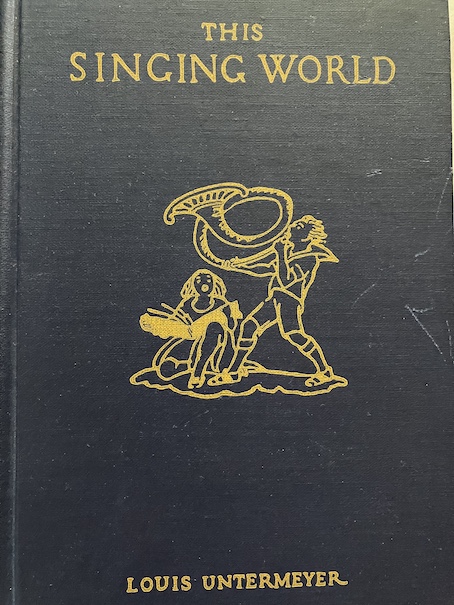
This Singing World collected and edited by Louis Untermeyer, 1923, 1926.
This little book is a collection of beautiful, classic children’s poems by some of the most famous poets for children and adults from the 19th century and early 20th century! Some of the poems are by Louis Untermeyer, the compiler of the book, but there are also poems by Robert Louis Stevenson, Henry Wadsworth Longfellow, Lewis Carroll, Robert Browning, Emily Dickinson, Walt Whitman, John Masefield, Robert Frost, William Butler Yeats, Walter de la Mare, Hilaire Belloc, and many others. In the book’s introduction, he says that most of the poems in the book “were written by living poets.” None of them are alive now, in the 2020s, but many (although not all) of the poets included were alive when this book was first compiled and published.
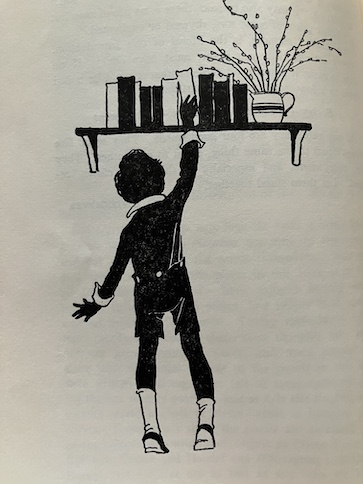
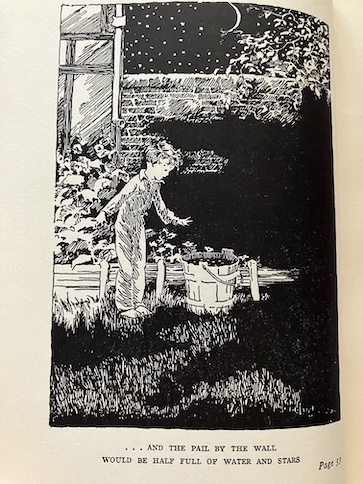
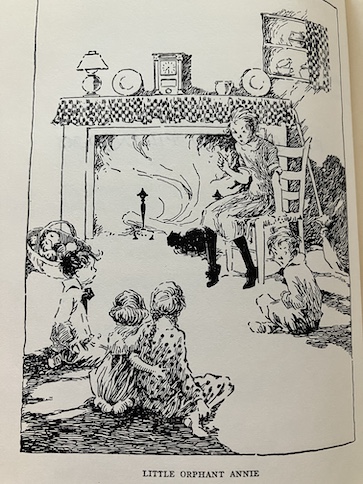
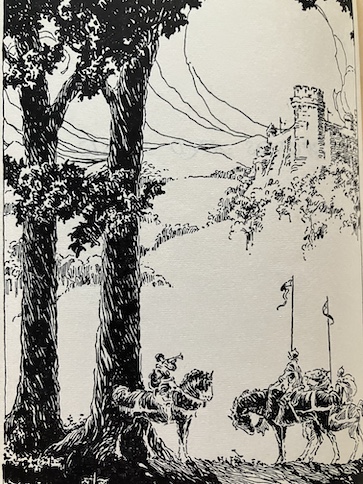
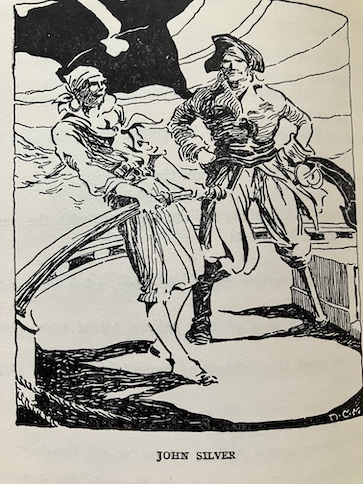
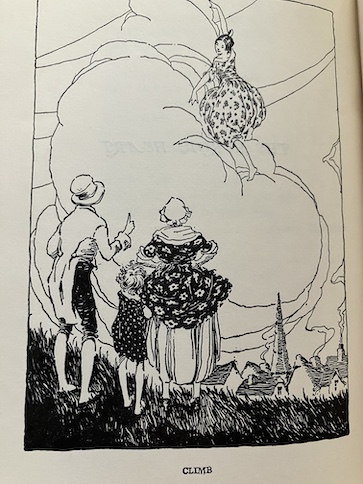
There are too many poems to list all the ones that appear in this book, but they are grouped by themes. Each section begins with a black-and-white illustration based on one of the poems in that section. There is also an interesting section of Notes in the back of the book that has extra information about some of the poems. I overlooked the Notes the first time I read the book, but it’s really worth seeing. Louis Untermeyer explains some of the background to his own poems there and also explains some of the background of other poems, pointing out ones that were based on real life incidents, giving some information about the authors of different poems, or explaining a little about the style of a poem. Although, Louis Untermeyer says that readers who prefer just to be left alone to read and enjoy are free to skip the Notes, anticipating exactly how I felt and what I did when I was a kid. I appreciate the extra information more now, so I’m glad it’s there, but I appreciate the Louis Untermeyer understood some things about how children’s minds work.
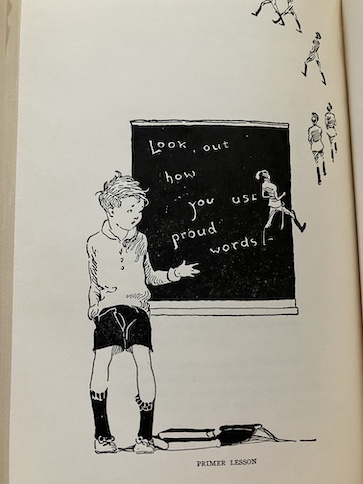
The author’s Introduction and A Few After-Words, two sections which I would also never have bothered to read when I was a child, are also worth reading because they take into account the feelings of child readers and his own philosophies about presenting poems to children. In A Few After-Words, the Louis Untermeyer addresses children reading the book and says that he wants them to know, whether their parents or teachers like it or not, that poems shouldn’t be taught in a formal way because turning them into lessons and picking them to pieces for analysis takes all the life and beauty out of them. He describes having gone to a lecture titled “How to Read a Poem in the Class Room”, which was an hour long (and a very long 60 minutes, to hear him describe it), where the lecturer outlined all the ways poems could be read and analyzed, never once mentioning “enjoyment.” Louis Untermeyer’s opinion was poems are best when read aloud, experienced, and not over-analyzed. (A philosophy not unlike that of the teacher in Dead Poet’s Society.) He is well aware, as he said in the Introduction, that nobody is going to like all of the poems in the book because they’re all very different from each other, but he hopes that there will be something in the book for everyone. He emphasizes, “don’t force yourself to like any of these poems just because they happen to be printed in this book.” He wants readers to explore what appeals to them now, in the phase of life they’re in, and be open to considering other poems later because some of them may take on more meaning for them later in life. I wish this man had been alive to be one of my high school English teachers because I argued about things like this with the teachers I had.
Sections in the Book:
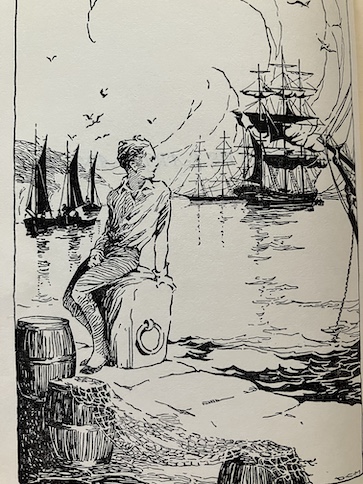
Songs of Awakening
Poems about morning, sunrise, and day. This section includes Sunrise by Lizette Woodworth Reese.
Breath of the Earth and Sea
Poems about nature. This section includes The Storm and Autumn by Emily Dickinson.
Open Roads
Poems about travel. This section includes The Joys of the Road by Bliss Carman, I Want to Go Wandering by Vachel Lindsay, and The Road to Anywhere by Bert Leston Taylor.
Common Things
Poems about everyday events and small pleasures. This section includes Simplicity by Emily Dickinson, The Commonplace by Walt Whitman, and Escape at Bedtime by Robert Louis Stevenson.
Places
Poems about fascinating places. This section includes Stopping by Woods on a Snowy Evening by Robert Frost.
Children and Other People
Poems about children and interesting characters. This section includes The Young Mystic by Louis Untermeyer, The Children’s Hour by Henry Wadsworth Longfellow, and The Land of Story-Books by Robert Louis Stevenson.
Birds and Beasts
Poems about birds and animals. This section includes The Runaway by Robert Frost and The Blackbird by W. E. Henley.
Fairies and Phantoms
Poems about fairies and other supernatural creatures. This section includes Little Orphant Annie by James Whitcomb Riley, Disenchantment by Louis Untermeyer, and I’d Love to be a Fairy’s Child by Robert Graves.
Words and Music
Poems about music and poetry itself. This section includes Ode by Arthur O’Shaughnessy and The Singer by Anna Wickham.
Whims and Fantasies
Poems about imagination. This section includes Apparitions by Robert Browning.
Tales and Ballads
Poems that tell a story. This section includes The Highwayman by Alfred Noyes.
Laughing Legends
Humorous poems and poems about silly things. This section includes The Lost Shoe by Walter de la Mare and The Twins by Henry S. Leigh.
Fables in Foolscap
Poems that have a moral or lesson, although the morals and lessons are silly ones. This section includes The Embarrassing Episode of Little Miss Muffet by Guy Wetmore Carryl.
Rhyme Without Reason
Nonsense poems. This section includes The Snark by Lewis Carroll, The Owl and the Pussy-Cat by Edward Lear, and Topsy-Turvy World by William Brighty Rands.
Croons and Lullabies
Poems about night and sleep. This section includes Wynken, Blynken, and Nod by Eugene Field.
Stars to Hitch To
Poems to inspire. This section includes The Arrow and the Song by Henry Wadsworth Longfellow.
The Heroic Heart
Poems about courage and brave deeds. This section includes Opportunity by Edward Rowland Will and Invictus by W. E. Henley.
 Jestress's Forgotten Books and Stories