The Illyrian Adventure

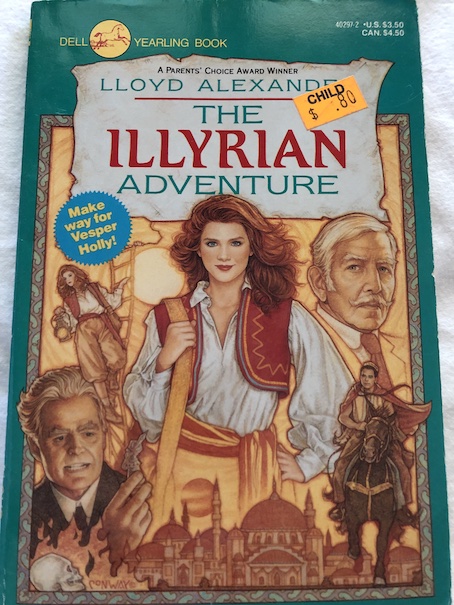
The Illyrian Adventure by Lloyd Alexander, 1986.

This is the first book in the Vesper Holly series. Vesper Holly is like a female Young Indiana Jones.
The story begins in 1872, when Professor Brinton Garrett and his wife, Mary, receive a letter saying that Professor Garrett’s colleague, Dr. Holly, has died overseas. Dr. Holly named Professor Garrett as executor of his will, gave him the rights to organize his person papers for publication, and made him the guardian of his 16-year-old daughter, Vesper. When Professor Garrett and his wife arrive at Dr. Holly’s country estate in Pennsylvania to meet Vesper and take charge, they at first expect that they will have to comfort a timid and grieving orphan. However, Vesper is anything but timid and seems to have gotten over whatever grief she was feeling and has quickly taken charge of the situation. She welcomes the professor and his wife, calling them Uncle Brinnie and Aunt Mary, and she quickly persuades them that, rather than her coming to live with them, it would be better for them to take up residence at the Holly estate, where there is plenty of room and Uncle Brinnie would have full access to her late father’s library and papers. At first, they’re reluctant to leave their own home, but Vesper Holly is practically a force of nature and very difficult to resist.

Vesper is intelligent and multi-talented, with interests in everything from science to women’s rights. (In some ways, she seems kind of like Mary Sue – impossibly talented and skilled at everything, with her main flaws seeming to be that she is difficult for everyone else to keep up with.) Uncle Brinnie quickly realizes that she is a daunting girl to have as his ward, and rather than he and his wife taking charge of her, Vesper has efficiently taken charge of them.

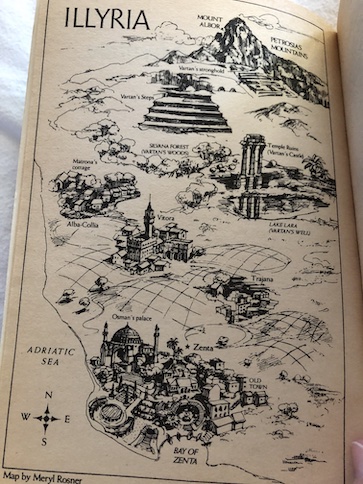
Soon after Professor Garrett and Mary settle in at the Holly estate, Vesper asks Uncle Brinnie if he’s read a piece of classic literature called the Illyriad and if he knows anything about Illyria. Professor Garrett has read this less-known classic piece, and while he’s never been to Illyria, he knows that it’s an incredibly unstable place. While the Illyriad is thought to be mostly legend, Vesper says that her father believed that there was more truth to it than most people know. He believed that the magical army described in the story may actually have been an army of clockwork automatons. Professor Garrett remembers Dr. Holly saying something like that before, but no one in the academic community took the theory seriously, and Professor Garrett says that he thought Dr. Holly had abandoned the idea. Vesper reveals that her father was still working on the theory and that, shortly before his death, he wrote to her, saying that he found something that seemed to support his ideas. Unfortunately, he died before revealing what he found. Vesper says that she wants Uncle Brinnie to take her on an expedition to Illyria so that she can finish her father’s work. Once again, Professor Garrett balks at the idea because of the dangerous political situation in the region, but also once again, Vesper’s powers of persuasion win.

Professor Garrett is sure that they won’t be granted permission to enter the country much less move around Illyria because of the unrest there, but to his astonishment, Vesper gets them permission to do both by writing to the king of Illyria himself. Although the king never met Vesper’s father, he has read Dr. Holly’s research and is fascinated by his theories, which is why he also grants Vesper a personal audience. Before their meeting with the king, Vesper and Professor Garrett are caught up in a riot while touring the city, and someone tries to stab Vesper! Although it could have been an accident during the riot, Vesper is sure that someone deliberately tried to kill her, and she tells the king about it at their meeting. The king is troubled by the news and admits that he had assigned someone to follow Vesper and Professor Garrett to protect them. It’s a failure on the part of his guard that they were attacked anyway.

The king’s vizier immediately says that they have to crack down harder on the native Illyrians, bringing up the cultural and political struggle that has made this country so dangerous. (Don’t worry too much about understanding it. This isn’t a real life historical situation with real groups of people.) Vesper boldly says that it doesn’t make sense to her that one half of the country crack down on the other half of the country, and she advocates for more respect for the native Illyrians and their wishes. The vizier is scandalized at a girl speaking up to the king like that, and the king tells Vesper that the situation isn’t that simple. The king has been trying to modernize and improve the infrastructure of the country with projects like building schools and railroads lines, but each of these projects has been ruthlessly sabotaged, apparently by the native Illyrians. The vizier has suggested hiring outside sources from other countries to complete the projects, but the king still thinks it’s important to keep the projects within the country. Hiring outsiders would be costly and would make Illyria dependent on outsiders. (Right about at this point, I was sure that I fully understood who the real villain of this story was and who was really responsible for the sabotage, and it wasn’t the native Illyrians. However, there is one more important character yet to be introduced.)

The king grants Vesper and Professor Garrett the ability to travel to the village Vesper wants to visit to pick up the trail of her father’s studies, but before they leave the palace, the king introduces them to anther visiting scholar, Dr. Desmond Helvitius. Dr. Helvitius is there to catalog the palace archives and conduct research for a book about the early history of Illyria. Dr. Helvitius says that, based on his studies, he believes that the army from the Illyriad Dr. Holly was researching never existed and was purely imaginary and says that the palace archives, which are thorough and complete, prove it. However, Vesper insists on seeing the archives herself, and she quickly notices that there is a gap in the records. Our heroes ponder what is missing and why Dr. Helvitius doesn’t want anyone to know that anything is missing.

As Vesper and Uncle Brinnie continue in pursuit of Dr. Holly’s theory, there are further attempts on their lives.

The book is available to borrow and read for free online through Internet Archive (multiple copies).

My Reaction and Spoilers

Although there are themes of history and archaeology in the Vesper Holly stories, I think it’s important to point out that all of the history and archaeology in the stories is fake. The locations they visit are fictional. The series takes place in the Victorian era, but this is not really a historical fiction series because they mostly focus on the history of places that don’t exist. The Indiana Jones and Young Indiana Jones franchise based their adventures on real places, people, artifacts, and legends that exist outside of the franchise, but that’s not the case with Vesper Holly. Really, the Vesper Holly series is just an adventure series. The locations and circumstances only exist to create the opportunities for adventure. That’s fine and fun, as long as readers understand that’s the case.

The name of Illyria comes from an ancient name for a region in the Balkans where people spoke a language that was called Illyrian, but Illyria didn’t exist as a country in the 1870s. People stopped referring to Illyria in the sense of a nation after the Ottomans invaded the region in the 15th century, and that was after it had already been under both Roman and Byzantine control. The term “Illyria” sometimes emerged after that in a cultural sense. The Illyriad doesn’t exist and seems to be based on the real piece of classical literature, the Iliad. I couldn’t find any references to a King Vartan, but there is a St. Vartan or Vardan, who was an Armenian military leader and martyr, who died in 451 AD. The political and social tensions in the story are between the ethnic Illyrians and the Zentans. The captial city of this fictional Illyria is Zenta, and I think it is based on the city now called Senta in modern day Serbia, which was the site of a battle in 1697, where the Ottomans were defeated and lost control of the region. So, my overall impression of the time period and location of the story is that it seems to take place in a sort of alternate reality of the Victorian world, semi-based on real places and historical concepts from Eastern Europe and the Mediterranean, especially the Balkans, but not adhering strictly to real history so the author could set up the adventure creatively.

The Illyrian characters in the book use words like “dragoman” (a term for a guide and interpreter, usually used in the Near East, particularly in areas with Arabic, Turkish, or Persian influence) and “effendi“, which is an honorific for a man of high status in eastern Mediterranean countries. It’s plausible that these terms would be used in the Balkans in the 19th century, but this isn’t really my area of expertise, so I can’t say how common that would have been.

The adventure in the story is good, and it has an element of mystery that adds an interesting twist to the ending. At the beginning of the story, Vesper and Professor Garrett explain that Dr. Holly had a theory about the historical events behind a legend described in a piece of classical literature. His theory was that this special army described in literature was actually some kind of mechanical or clockwork army, an army composed of something man-made rather than real humans. Professor Garrett and his colleagues never took Dr. Holly’s theory seriously because it does sound rather unbelievable, too technologically advanced for the time when the historical events took place. However, Vesper believes in her father and his theories, and now that he is dead, she wants to investigate and find the proof that her father wanted for the sake of his memory. If they had really found an amazing clockwork army, it would have been an incredible adventure, but I was pleased that what they actually found is a more plausible explanation that would have fit the time period. It turns out that Dr. Holly was half right; the legendary army was not composed of real people, but there is another kind of army that nobody considers until Vesper actually finds it. Legends tend to magnify things out of their original proportions. This particular legend not only exaggerated the army’s capabilities but also its size.

I liked the twists to the story, but Vesper herself got on my nerves a bit. Vesper only really makes sense if you look at her as being the kind of heroine of tall tales. She is overly perfect with no noticeable flaws. She rarely gets frightened or upset at anything, from the death of her own father to being threatened with death herself. She cheerfully pulls her new guardian into dangerous situations, and her guardian can’t even really get angry with her for doing it. Vesper is incredibly persuasive, whether it’s dealing with her guardian or a foreign king, and her guardian is adoring of her and constantly admires her intelligence and abilities. Like Sherlock Holmes with Watson, Uncle Brinnie is always one step behind both Vesper and the readers in figuring things out. Characters who are overly perfect can be a little grating, partly because there are times when they drag their friends into dangerous situations but, somehow, it’s never their fault because they’re perfect. In fiction, this kind of confidence and seeming perfection are strengths, but in real life, over-confidence is a sign of incompetence and lack of awareness. People who charge directly into dangerous situations in real life are just kind of clueless about the dangers they’re plunging into. The books in this series are just meant as fun adventure stories, not serious or true-to-life in either characterization or historical background, so Vesper’s amazing qualities, whether it’s her ability to eat all kinds of strange foods or learn new languages in barely any time at all or to compete intellectually with professional academics who are decades older than she is, fits with the story type. Vesper isn’t mean to be a real person so much as the ultimate teenage adventurer.

Kids can enjoy this teenage heroine who is on top of every situation, can rush into danger without any sense of fear, and gets her way with little argument from anyone. However, I think I would enjoy Vesper more if she did have a few more flaws and limitations. I would have liked it if Vesper had a definite fear of something, like Indiana Jones’s fear of snakes. It could be played for comedy, like in the Indiana Jones movies. I also would have liked it if Professor Garrett could have appeared more sharp than he did and provide more useful knowledge so that Vesper had to depend a little more on him professionally during their expedition. I felt like the story dumbed down the professor a bit so Vesper could appear more brilliant, and I don’t like it when characters are made to look stupid so another character can look more intelligent by comparison.

Vesper’s relationship with her deceased father is never really explained or developed, either. When we first meet her, she is well over being sad about his death and ready to embark on an adventure in his name. I would have liked it if she and her Uncle Brinnie had a heart-to-heart talk about her feelings during their travels. Dr. Holly seems to have spent a significant amount of time away from home or involved in his research work. Vesper is a motherless only child who does not seem to attend a regular school or have friends her own age. I would expect that this unconventional life would have an effect on her development and that she would have feelings about it. I would have liked her to explain more to Brinnie that her eclectic range of knowledge and expertise with languages comes from having been dragged around the world with her father from a young age, from spending time around her father’s professional colleagues and witnessing their discussions with each other, and from becoming an active research assistant to her father because their family consisted of only the two of them, and sharing his interests was a way for them to bond. I picture Dr. Holly reading pieces of classical literature to Vesper as bedtime stories because he would have little or no interest in the typical nursery rhymes or picture books.

If Vesper had more knowledge of ancient history and literature than things typical children know and like, that could also show character quirks and development. It might even be a flaw in the sense that Vesper knows more about how to speak to and relate to professional academics than girls her own age at a time when female academics were often not taken seriously. Vesper occupies an odd position in life but without the obvious awkwardness that would cause in real life. Her confidence and ability to stride forward in situations that would cause anyone else hesitation might actually come from the knowledge that, if she allowed anyone else time to think about what she’s barging into, she would never be able to accomplish what she wants to accomplish because other people wouldn’t accept it. She could be feeling more of the awkwardness of her position more than she lets on, and some discussion of her need to hide her own feelings, act more confident than she feels, or compensate for other people’s feelings about her would add depth to her character. It’s possible that later books in the series develop other sides of her personality and history more, but I would have liked more of that in this book.
Murder at Midnight

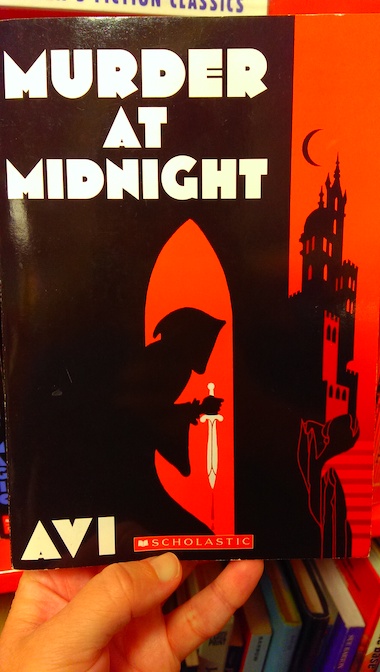
Murder at Midnight by Avi, 2009.

This story is a prequel to Midnight Magic.

Fabrizio was an orphan living on the streets of the medieval city of Pergamontio before he was taken in as a servant by Mangus and his wife, Sophia. It was really Sophia’s idea that Mangus needed a personal servant. Mangus says that he is able to take care of himself, and he is impatient with Fabrizio because Fabrizio is ignorant and uneducated.

When Sophia goes to visit her sister, Fabrizio tries extra hard to please Mangus so that Mangus will continue to let him live in his house. Mangus is primarily a scholar, but he supplements his income by performing magic tricks at a local tavern. That evening, a black-robed figure appears at the magic show, warning of danger coming to Mangus. The next day, the magistrate, DeLaBina, accuses Mangus of spreading papers with treasonous messages about the king around the city. During this time, all writing is by hand, and no one can understand how these papers can all look so identical unless they were produced by magic.

At first, DeLaBina offers to let Mangus go if Mangus gets rid of the papers and reveals the identity of the traitor. When Mangus protests that he cannot do real magic and that he knows nothing about the papers, he is arrested. Shortly afterward, DeLaBina is murdered. Fabrizio’s only hope of saving his master, and himself, is to find the real traitor.

The book is available to borrow and read for free online through Internet Archive.

My Reaction and Spoilers

I didn’t like this book as well as I liked the original Midnight Magic.  Partly, the problem was that I feel like some of the events of this story should have changed people and events in the other book, and they don’t because this book, which is supposed to take place earlier than the other story, was actually written after the other story. It all just seems out of order, and I didn’t like the addition of Prince Cosimo to the royal family.  In this book, Prince Cosimo is the crown prince of Pergamontio, not Prince Lorenzo from the previous book.  Prince Cosimo did not appear in Midnight Magic (although his absence is explained by the end of this book) and was never even referred to in that book (which is the part that really bothers be me everyone in that book would have known all about him and what happened to him, and I feel like Fabrizio should have at least thought about him in passing, it’s just weird when characters suddenly exist in a series that you know didn’t exist before).

Basically, there is a plot (although not by the person who did the plotting in the other book) to overthrow the king, who is wildly superstitious. The printing press is a relatively new invention in this time period, and Pergamontio has never had one before, which is why no one can understand why the writing on the papers is so strangely uniform.  This is the other thing that bothers me about this book.  Pergamontio is supposed to be somewhat backward in comparison to other kingdoms, partly because the king is so superstitious, but it just seems like going a bit far for people to suspect that oddly-uniform writing would be a sign of witchcraft because people of that time would already be aware of the existence of signet rings and official seals which were used as stamps in wax to mark documents, like a kind of signature.  Like a printing press, those would also produce an identical image, time after time of use.  Basically, they’re all just complex forms of stamps.  Superstitious or not, I think that people of that time who were capable of reading probably would have been able to tell that a stamp of some kind was being used, even though they might not have seen one as complex as a printing press before.

In the story, a family has recently brought a printing press to the city, and printing the treasonous papers was the first job they were hired to do. Shortly afterward, Maria, the daughter of the family, was arrested while passing out the papers. Her parents are taken into custody by Count Scarazoni, who is a sinister character in his own right but is actually in opposition to the real traitor in this book.

Scarazoni was the figure in the black robe who tried to warn Mangus. Fabrizio is arrested when he tries to gather up more of the papers for Mangus so they can learn where they came from.  He is nearly executed for treason, but he is saved by Scarazoni because Scarazoni realizes that the real traitor wanted him dead because he feared that Fabrizio might know too much. At the prison, Fabrizio meets Maria and helps her to escape as well. Maria explains to him the true origins of the papers, and they find DeLaBina’s body.  This is the murder referenced in the title of the book, and they must solve it to uncover the identity of the real traitor!

As in the other book in this series, Fabrizio and Mangus use a magic trick at Mangus’s trial to shock the traitor into revealing himself.  Although, at the end of the story, the king still believes that Mangus is a real magician, Scarazoni points out that without Mangus’s “magic” the real traitor might not have been discovered. The king tells Mangus that he will let him go provided that he confine himself to his own home and no longer practice magic, setting events up for the beginning of the other story.

The Traitor’s Gate

TraitorsGate

The Traitor’s Gate by Avi, 2007.

The story is set in London, in 1849. Fourteen-year-old John Huffam lives with his parents and sister and their servant, Brigit and attends a school taught by a former military man who acts like he is still in the army and teaches them little beyond discipline and what army life would be like.

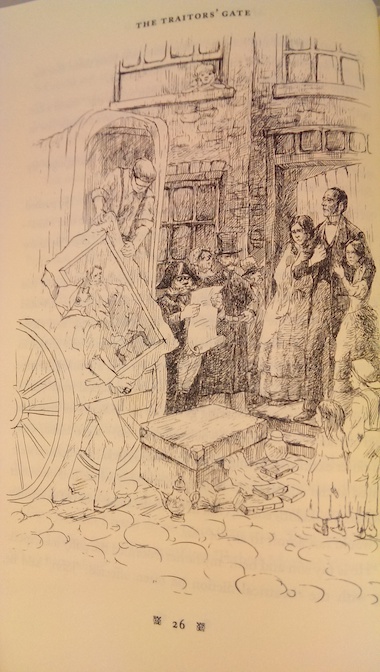
Then, one day, John is called home suddenly because of a family emergency. His family has fallen on hard times, and his father is in debt, so the family’s belongings are being confiscated. His father is summoned to appear in court, and if he cannot find the money to pay his debt, he will have to go to debtors’ prison. John’s father is shocked because he doesn’t actually owe any money to the man who is trying to call in the debt, Finnegan O’Doul.

TraitorsGateConfiscation

In spite of this, John and the rest of the Huffam family must spend the night in the bailiff’s sponging house, the Halfmoon Inn. There, John’s father again promises John that there is no debt between himself and Mr. O’Doul. He even says that he doesn’t really know O’Doul, although John doubts him. It seems like his father has had dealings of some kind with the man that he wants to keep secret.

John’s father, Wesley Huffam, was originally from a fairly well-off family, but all the family’s money ended up going to a great-aunt instead of to him (possibly because it became obvious to his relatives that he had little skill at handling money in the first place). John’s father is resentful toward the great-aunt, Euphemia Huffam, for inheriting when he thinks that, as a man, he should have been first in line for the family’s money. However, with this enormous (although possibly false) debt hanging over his head, he may be forced to appeal to Great-Aunt Euphemia for help. He persuades John to go and visit Great-Aunt Euphemia on his behalf, since he is not allowed to leave the sponging house for now and the past quarrels between him and his aunt would make it unlikely that his aunt would want to see him. John is beginning to realize that there are pieces of his father’s life and their family’s past that have been kept from him, and he doesn’t like the idea that his father has been deceiving him, but with their family in such a desperate situation, he agrees to visit Great-Aunt Euphemia.

TraitorsGateSary

The bailiff, John’s mother, and Brigid all agree that John is going to have to be instrumental in solving their family’s problems. Of all the people in his family, he is the most practical, in spite of his young age. His father is an impractical man, stuck in a vision of his family’s former glory (and his aunt’s current money, which he does not share in) that doesn’t fit their current circumstances. John’s mother thinks that her husband’s job as a clerk for the Naval Ordinance Office doesn’t provide enough money for the family to live on, even though he earns more than twice what typical London tradesmen of the time do. The real problem is that the family doesn’t live within its means (it is eventually revealed that Wesley Huffam has been withholding money from his family that he uses for gambling), and John’s father’s snobbish attitude because he thinks of his family as being more grand than the commoners around them alienates people who might otherwise be friends and help them. John knows that he’s young, and he’s not completely sure what he can do to help his family, but he knows that there is no other option but to try. In the process, he learns quite a lot about life, himself, the people in his family, and the wider issues in the world around him, including some political intrigue that hits uncomfortably close to home.

Great-Aunt Euphemia agrees to see John when he comes to her house, but their first meeting doesn’t go very well. Great-Aunt Euphemia is ill (or says she is), and she bluntly tells John that his father was always bad with money. She is not at all surprised that he is in debt and needs her help. John gets upset at the bad things that Euphemia tells him about his father, and she gets angry when John tells her the amount of the debt. At first, John is sure that she will refuse to help them completely, but Euphemia tells him not to assume anything but that he should come back the next day.  Her eventual contribution to helping John’s family in their troubles comes in the form of a job for John.

TraitorsGateRookery

As John moves around the city, he gets the feeling that he is being followed, and he is. One of the people following him turns out to be Inspector Copperfield (or so he calls himself) from Scotland Yard. When John confronts him, the inspector seems to have a pretty good idea of the difficulty that his family is in and what John himself has been doing. John asks him why he cares, and the inspector says that John’s father is suspected of a crime and that John had better learn more about what his father has been doing and share that information with him. John doesn’t believe that his father could be a criminal, but the accusation is worrying because he knows that his father is hiding something (his gambling addiction isn’t the only secret he has).

The other person following John is a young girl in ragged clothes. The girl, who calls herself Sary the Sneak, approaches John herself, freely admitting that she’s been following him. In spite of her young age, Sarah (or Sary, as she is frequently called) lives on her own and must support herself because her mother is dead and her father was transported to Australia. People don’t often notice a young girl on the street, so sometimes people will pay her to follow someone and provide information about them. The reason why she tells John about it is because she isn’t above playing both sides of the street; sometimes, she gets the people she’s been following to pay her to provide them with information about the people who hired her to spy on them. She considers it even-handed. However, John has no money to pay her for information and finds her spying distasteful, so he doesn’t want to take her up on the offer at first.

However, John does a little spying of his own when his father sneaks away from the Halfmoon Inn, which he is not supposed to do. He follows his father to a pub called the Red Lion, where he witnesses his father gambling with money that he had claimed not to have. More than that, he sees his father arguing with a man who turns out to be O’Doul, another gambler. To John’s surprise, his teacher also shows up and seems to know O’Doul. When John later confronts his father with what he saw at the Red Lion, all his father will say is that he is carrying a fortune around in his head. Later, John overhears the bailiff speaking with someone else, an Inspector Ratchet from Scotland, saying that it appears that Wesley Huffam may be a traitor involved with spies and that the Inspector Copperfield who spoke to John earlier was an imposter, probably also a spy.

Could it be true? Is John’s father really a traitor, selling naval secrets from his job? If so, who can John trust?  Conspirators seem to be around every corner, and John has the feeling that the people who are closest to him may be the biggest threats.

The book is currently available online through Internet Archive.

The Ship That Never Was

ShipThatNeverWasThe Ship That Never Was by Mickey Spillane, 1982.
Larry Damar and Josh Toomey are sailing in a boat off the coast of Peolle Island in the Caribbean when they rescue an old man from what seems to be a skiff. But, as soon as they get him aboard their own boat, they realize that what they thought was a skiff is actually more of a long boat, and it looks old. Very old.

They take the old man, who is suffering from exhaustion, to their fathers. While the old man rests, they inspect the boat and confirm that it is an antique. Oddly, from the condition of the wood, they believe that it has been resting in water for some years, but not salt water. It’s the kind of longboat that would have been carried aboard larger naval ships from a couple hundred years earlier. The name on the side of the boat, HMS Tiger, is familiar, but they heard that it was lost at sea ages ago. The old man is also carrying what appears to be some very old documents, but they are unable to read them, and when the old man speaks, they’re not quite sure what language he’s speaking.

They send a message to Sir Harry Arnold at the antiquities department of the British Naval Archives about the boat and the old man. When he arrives, he confirms that the longboat came from the HMS Tiger, a three-masted ship built in England in 1791. The Tiger was considered a jinxed ship because of everything that went wrong during its construction and its maiden voyage. Because of that, no one wanted to sail on it again or even work on the ship to dismantle it. So, the builder decided to send the boat on one last voyage by itself. He and his men loaded up the ship with supplies as if it had a crew aboard and then set it adrift, watching it sail off majestically, without a crew. Everyone had assumed that it would have eventually sunk, damaged by the weather, but apparently, it survived for longer than anyone had suspected.

Since no one can understand his language, the old man, who calls himself Vali, draws pictures to explain to them where he came from. Vali indicates which island he came from, and according to his other drawings, he lived there with many other people until many of them were killed in some kind of storm. He also draws a picture of a young girl with a crown on her head. Then, Larry’s dad, Vincent, recognizes the seal on a signet ring that Vali shows them. Vincent has read about the history of the country of Grandau (fictional country), and he recognizes its royal seal.

About 200 years before, Grandau was overrun by a neighboring country. Members of the royal family of Grandau escaped the invasion along with some loyal servants and tried to flee across the Channel to England to seek sanctuary. However, they were only in an old fishing boat, and it was thought that it sunk in a storm before they reached England because such a small craft would be unlikely to have survived. Grandau has not been a happy country since then. Over the years, they have been ruled by a series of dictatorships, and it has been in an almost constant state of unrest.

Now, the presence of the longboat from the HMS Tiger presents a much more intriguing theory of what happened to King Tynere of Grandau and his people. By an unbelievable coincidence (your suspension of disbelief is required for this story), the royal family’s attempted escape to England happened around the same time that the HMS Tiger was sent off alone and fully equipped for its final voyage. It now seems that the desperate people on the fishing boat were saved by encountering this grand, unmanned ship that no one else wanted, that everyone feared was jinxed. Grandau was not a seafaring nation, so the people were probably unable to actually sail the ship, simply letting it drift until they found land. Eventually, they arrived at an island in the Caribbean, and their descendants have been living there ever since in anonymity, until the disaster that prompted Vali to risk venturing out for help.

Unfortunately, their attempts to determine what language Vali was speaking and where he came from have also come to the attention of the wrong people. The government currently in power in Grandau has been working hard to stamp out the history and culture of the country in order to tighten its hold on the people, although their hold has never been more than tenuous, just like all the other dictatorships since Grandau’s royal family fled. Now that word has reached them that members of the royal family that the people of Grandau mourn may actually still be alive, they are determined to eliminate them before they can return to their ancestral home.

The author of this book, Mickey Spillane, is best known for his Mike Hammer series of hard-boiled mysteries for adults, and some of his hard-boiled style shows in this adventure book for children. This book is also part of a short series, although I don’t have the first book, The Day the Sea Rolled Back. In that book, Larry and Josh are helping their fathers hunt for sunken treasure, but their efforts are being sabotaged by a pair of treasure-hunting brothers.

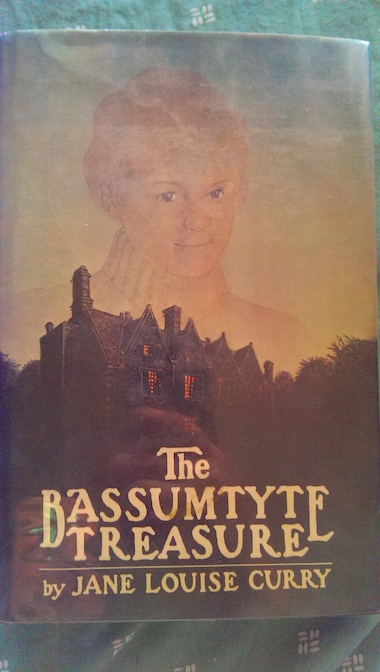
The Bassumtyte Treasure

BassumtyteTreasureThe Bassumtyte Treasure by Jane Louise Curry, 1978.

When young Tommy Bassumtyte’s parents died, he went to live with his grandfather. However, his grandfather is now dead, and he is living with his 92-year-old great-aunt, who is in a wheelchair, and her 72-year-old daughter, who has recently had her driver’s license revoked due to her poor eyesight. Although the pair of them have taken good care of Tommy, neighbors have become concerned that they will not be able to do so for much longer because of their age and failing health. Rather than see Tommy sent to a foster home, they decide that he must go to the man who Tommy learns should really be his legal guardian, a distant cousin also named Thomas who lives in the family’s ancestral home, Boxleton House, in England.

The elder Thomas Bassumtyte, who should have taken Tommy when his grandfather passed away, has also since died, but his son, also named Thomas, agrees to take him. Tommy is quickly shipped off to England before there can be a custody hearing in the United States about him because the relatives fear that some official might try to prevent Tommy from being sent out of the country. Tommy is eager to go because he remembers fantastic stories that his grandfather told him about Boxleton House. The current Thomas Bassumtyte also lives there, although the place has become rather run-down, and he fears that he will not be able to keep the place much longer. Thomas was a mountain climber, but he was injured in a fall and hasn’t been able to work much since. He tells Tommy that the two of them might have to move when he is fully recovered and can do more work for the Foreign Office, but Tommy loves Boxleton House from the first moment he sees it and wants to stay.

According to the lore of Boxleton House, a distant ancestor of theirs hid a treasure there, but no one has been able to find it. If young Tommy and Thomas can find it, it would solve many of their problems, and they would be able to keep the house and restore it. All young Tommy has is the mysterious rhyme that his grandfather told him and the strange medallion that his great-grandfather brought with him when he went to the United States in the late 1800s. Thomas tells him that the treasure was supposedly hidden by a distant ancestor of theirs who was fond of riddles, called Old Thomas.

The Bassumtytes were secretly Catholic during the reign of Elizabeth I. Old Thomas was alive then and had a son called Tall Thomas. Tall Thomas traveled frequently and was mysterious about the places he went. One night, he returned to Boxleton House with a young baby, who he said was his son. He had married in secret, and his young wife had died shortly after giving birth. Tall Thomas also brought her body back to Boxleton for burial. However, that wasn’t Tall Thomas’s only secret. Although he remarried, giving his son a stepmother, and lived on for a number of years, he was eventually executed for smuggling messages for the captive Catholic queen, Mary, Queen of Scots. The family was stripped of its noble title and only barely managed to hang onto their house and land. If there was a treasure hidden during this time, it was probably something that the Bassumtytes were afraid would be confiscated by the queen’s soldiers as punishment for the family’s disloyalty or something that Mary had given to Tall Thomas to hide for her.

As Thomas tells Tommy more about the house and the family’s history, he points out Tommy’s uncanny resemblance to Small Thomas, Tall Thomas’s son, as shown in an old painting. Tommy feels a strange connection to Small Thomas, and begins seeing and hearing strange things. An older woman comforts him in the middle of the night, having him recite the same rhyme that his grandfather taught him. A small painting later reveals that this woman was Small Thomas’s grandmother. She appears to Tommy other times, giving him a glimpse back in time and clues to solve the puzzles of Boxleton House.

It is only when Thomas accepts the advice of a family friend who works for a museum that they come to understand the full significance of their family’s heirlooms and the hidden treasure. The treasure may not be quite what the Bassumtytes have always believed it was, but then, the Bassumtytes themselves aren’t quite who they always thought they were, either.

The book is available to borrow and read for free online through Internet Archive.

Happy Birthday, Felicity!

American Girls

FelicityBirthday

Happy Birthday, Felicity! by Valerie Tripp, 1992.

FelicityBirthdayGuitarThis is part of the Felicity, An American Girl series.

It’s Felicity’s birthday, and her grandfather has given her a very special present: a guitar that once belonged to her grandmother, who is now dead. Felicity’s grandfather has heard Felicity singing and thinks that she shares her grandmother’s gift for music. He also thinks that Felicity is old enough to take proper care of the instrument, stressing the need for her to be responsible with it. Her mother tells her that she should keep the guitar safely in the parlor since she isn’t quite old enough for proper music lessons, like the ones Miss Manderly is giving Elizabeth’s older sister, Annabelle. Annabelle has been getting on Elizabeth and Felicity’s nerves by bragging about how they are still to young to even hold her guitar, although Annabelle really has no musical talent and struggles in her lessons.

Although Felicity knows that she should leave the guitar at home, she can’t resist taking it to Miss Manderly’s so that Miss Manderly can tune it for her and so that she can show it off to Elizabeth and Annabelle. Miss Manderly does tune the guitar for her and compliments her on owning such a fine instrument.

FelicityBirthdayGunpowderHowever, on the way home, something frightening happens. Felicity sees Elizabeth’s father, a known Loyalist, talking to a British soldier. She ducks into a bush so they won’t see her, and she hears them talking about the governor removing the gunpowder from the Williamsburg arsenal so the colonists can’t use it in the rebellion that has been threatening to come for some time.
Felicity hurries home to tell her family what she has heard, but when her mother and grandfather see that she has taken the guitar out of the house and gotten it wet and dirty while she was hiding, they refuse to listen to her. Her grandfather, also a Loyalist, particularly thinks that she’s making up stories to cover her irresponsibility about the guitar.

But, Felicity knows what she heard, and the situation is serious. What can she do to prove it to everyone?

In the back of the book, there is a section with historical information about how children were raised in Colonial America.  Another good book on the same topic is Going to School in 1776.

The book is currently available online through Internet Archive.

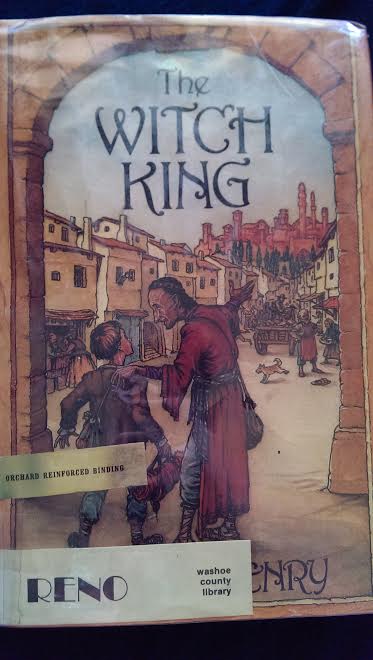
The Witch King

WitchKingThe Witch King by Maeve Henry, 1987.

Robert is the son of a fisherman in a small village by the sea. All his life, he’s grown up hearing stories of a mysterious City to the south that was fashioned ages ago from a silver tree. Wondrous things are said to happen there. People from the City used to visit the Witch Women in Robert’s village for advice, but no one has come there from the City in a long time, and people now doubt whether the City really exists. People have even stopped believing in the Witch Women. However, Robert believes in the old stories, and he wants desperately to see the City for himself.

The stories say that someday the Witch King will come to the City and plant a seed so that a new tree will grow. Robert wants to see this story come true, and Granny Fishbone, a strange old woman who tells Robert the old stories, says that the time of the Witch King is close. She gives him a pendant in the shape of a fish and tells him that it came from the City and that it is time for Robert to take it back there.

With some misgivings, Robert’s family lets him set off on his seemingly crazy quest of finding the City. To Robert’s surprise, he is met on the road by the Royal Wizard of the City. As Granny Fishbone said, the time of the Witch King is near, and there is trouble in the City. The Spell that controls the City is failing, and the King has been seeking a remedy for the problem.

The City has become corrupt because a usurper murdered the rightful king years ago and took over the City. He had his wizards cast a spell on the City that let him control everything in it, and he manipulated historical accounts to make it seem as though he was the founder of the City himself. Robert knows differently because Granny Fishbone is really one of the Witch Women, and she told him the true story about the miraculous tree and the founding of the City. The king’s grandson, David, is also corrupt and wants to learn to control the spell over the City for his own power. He believes that he is the prophesied Witch King, and he tries to convince Robert of it so that he will help him.

When Robert learns that David’s plans for controlling the spell may mean sacrificing his own sister, Princess Sophie, who Robert loves, Robert does his best to thwart his plans by telling the king and the Royal Wizard.  Although David at first seems to have the upper hand, he is not the true Witch King. Granny Fishbone was correct that the time of the true Witch King has come, and Robert has a much bigger role to play in the story than he thinks.  As the ancient prophesy says, the City will have to be destroyed in order to be saved.

Mystery of the Roman Ransom

romanransomMystery of the Roman Ransom by Henry Winterfeld, 1971.
This is the sequel to Detectives in Togas, a mystery story about a group of boys in Ancient Rome.  Like the first book, it was originally written in German and translated into English.

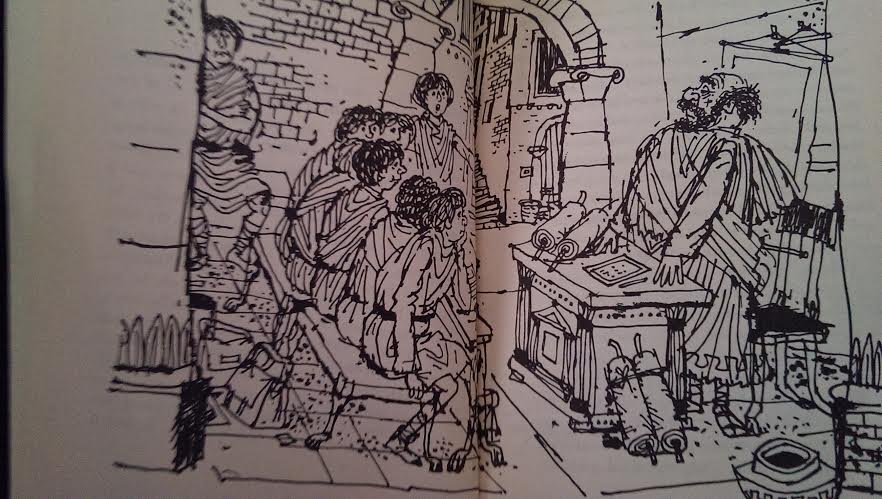
On Xantippus’s birthday, his students decide that they want to give him a special present because they think he’s turning 50.  Actually, it turns out that they did their math wrong because Xantippus (whose real name is Xanthos and only known as Xantippus as a nickname among his students) was born in Athens, and the Greeks use a different dating system from the Romans.  His Roman students forgot even after he had explained that in their history lessons, which really annoys him.  He is also really annoyed that the special present they decided to give him was a slave of his very own so that he can concentrate on his studies while the slave does all of his chores.  Xantippus points out that, far from being a present, slaves are actually a burden because there are extra expenses for owning them and it would end up costing him more money than he could afford (much like the “free” cars that Oprah Winfrey gave to some of her audience members), and Xantippus wants no part of it.  He gives the boys the day off from lessons to reward them for being thoughtful (although, not quite thoughtful enough), and tells them to return the slave to the dealer who sold him and get their money back.  But, it turns out that this slave isn’t just any ordinary slave.

romanransompicWhen they return to the slave dealer’s home, he is gone, and the place is boarded up.  An elderly slave who was left behind said that all of the other slaves were sold, and then the dealer simply fled, abandoning him.  He also says that there was someone else who had come to see the dealer, demanding that he hand over the slave called Udo (the one that the boys had already bought).  This man was a former gladiator with only one eye, and he was very angry that Udo was gone.  He swore that he would he would get Udo one way or another, dead or alive.  He threatened the dealer, saying that he would return later and kill the dealer and all of his slaves if Udo was not among them then.  The slave dealer, not knowing the names of the boys who had bought Udo or where he could be found and therefore unable to get Udo back, fled in fear of the former gladiator’s threats.

During this time in Rome’s history, crime rates were high because gangs of ex-gladiators, runaway slaves, and criminals roamed the city, robbing and terrorizing the citizens.  The boys soon learn that the dealer’s fears were well-founded when the ex-gladiator finds them in the marketplace while they are trying to decide what to do with Udo.  He tries to take Udo from them by force, but they fight with him and manage to escape by dumping a pail of honey over his head.

Once the boys are safely away and in their secret hideout with Udo, he reveals his true story to them.  At first, they had believed that Udo was deaf and mute because he acted like he couldn’t speak, but he tells them that he was afraid to do so because he is a hunted man.  He was the slave of a powerful Roman army commander now stationed in Germania.  He was sent to Rome by his master in order to deliver an important letter, but upon learning that he would be killed after handing over this letter, he did not complete his mission.

The meeting was to take place in a cemetery at midnight, and when Udo arrived, he became frightened and hid.  Then, he overheard his contacts, two men who did not seem to even know each other, talking about how he would be eliminated after passing on his message.  Now, these men are looking for him for the message that he did not give to them, and Udo cannot go back to his master because his master would probably kill him for disobeying orders.

Udo discovered that the letter contained instructions for an assassin to murder an important Roman senator, and upon learning that, all of the boys are immediately worried because they are all the sons of senators.  They demand to know which senator will be murdered, but Udo cannot tell them because that information was in the letter, and he lost it after he fled from the cemetery.  He thinks that it’s in a cellar where he hid and spent the rest of the night before he was found by a group of gladiators who sold him as a slave the next day.  Now, he’s not quite sure where that cellar was.  Udo also says that his master will arrive in Rome himself in three days and will probably just pass on the name of the intended target to the assassins then when he learns that Udo didn’t.  With time running out and their fathers’ lives possibly on the line, the boys and Udo struggle to find the letter and stop the assassination plot before it’s too late!

In Ancient Rome, slaves were common among the wealthy, and owners had the power of life and death over them.  They could punish a slave severely for even a small mistake, abandon them if they were sick or elderly, and even sell them to the gladiatoral arenas, where they would have to fight for their lives or die as public entertainment.  To the boys in the story, such things are simply facts of life as they have always known it.  Rome in general was a violent place.

The book is available to borrow and read for free online through Internet Archive.

Detectives in Togas

detectivestogasDetectives in Togas by Henry Winterfeld, 1956.
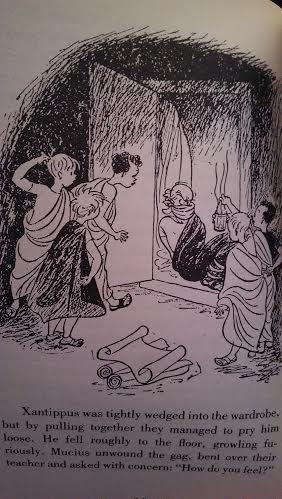
Seven Roman boys, all the sons of wealthy families, attend the school run by the Greek mathematician and scholar, Xanthos. Although the boys are proud of their school, the lessons are sometimes boring, and everyone has given Xanthos the nickname Xantippus, in reference to the wife of Socrates, who was known for her nagging.

During a rather boring lesson on Greek vocabulary, a fight breaks out between two of the students that ends up creating a strange mystery for all of them. Caius was poking Rufus with his stylus, so Rufus wrote “Caius is a dumbbell” on the wax tablet where he was supposed to write his lesson. The boys get into a fight, and when Xantippus breaks it up, he sends Rufus home with the threat that he will expel him from the school.

detectivestogaspicThe next day, when the other boys arrive at school, they discover that their teacher has been attacked and robbed during the night. Worse still, when they go to Rufus’s house to visit him, they learn that someone has written “Caius is a dumbbell” on the side of the Temple of Minerva, which has been dedicated to the emperor. Defacing a temple is a crime, and soon Rufus is arrested and sent to prison (being young and part of an important family does not guarantee him special treatment). Rufus swears that he was not the one who defaced the temple, but who else could have done it?

Rufus disappeared that night, but if he didn’t go to the temple, where was he? Does the vandalism have anything to do with the attack on their teacher?  The key to the mystery seems to be a mysterious soothsayer with ties to some of the highest officials in Rome. Something sinister is happening in Rome, and the boys are the only ones who can discover what it is!

This story was inspired by a piece of graffiti found during excavations of Pompeii in 1936. (This video doesn’t actually show the Caius inscription but similar types of graffiti, including ones done by children. I keep looking for the Caius graffiti, but I can’t find pictures of it. This video of a lecture at the Western Australian Museum about ancient graffiti in Pompeii shows the more graphic adult kind of graffiti with swear words, if you’re interested.) In ancient Pompeii, someone wrote “CAIUS ASINUS EST” on the wall of a temple, which basically means “Cauis is a dumbbell” (or similar type of insult) in Latin.

Although the book was originally from 1956, it was also originally written in German. I have a later reprinting that was translated into English.  The book is available to borrow and read for free online through Internet Archive.  There is a sequel called Mystery of the Roman Ransom.