Boxcar Children
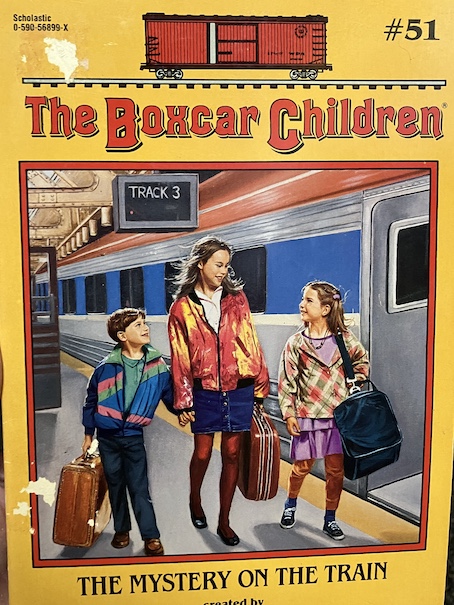
#51 The Mystery on the Train by Gertrude Chandler Warner, 1996.
The Alden Children’s Aunt Jane is planning to travel to San Francisco to join her husband, who is there on a business trip. Because the Boxcar Children have never actually traveled on a train trip before, she invites them to come with her. The trip will take three days by train. Then, they’ll spend a few days in San Francisco before flying hone. The Aldens love traveling, and they’re excited by the idea of a train trip!
When they arrive to catch the train, they witness an odd scene at the station. An older woman is fighting with a younger woman over what looks an art portfolio. The younger woman eventually gets hold of the portfolio, knocking the older woman to the ground, and runs for the train. The Aldens ask the older woman if she’s all right, and she says she is. They also ask her if the younger woman is the owner of the portfolio, and the older woman says yes. She doesn’t explain why they were fighting over it, but they later see her talking to the train porter and giving him some money. The Aldens wonder what that scene was all about.
On the train, they meet the young woman, whose name is Annie. She explains that she’s also heading to San Francisco because she wants to attend art school there. She tells them that she’s planning to stay with an uncle there and that her portfolio contains her art work. Annie and Violet enjoy talking about art together, but the Aldens have the feeling that there are things that Annie isn’t telling them. She seems very paranoid about her portfolio, always afraid to leave it unattended and panicking every time the porter tries to help her with it.
When the portfolio suddenly disappears, Annie admits to them that it doesn’t really contain her artwork. It actually has a set of vintage autographed movie posters that are valuable for collectors. They were part of an inheritance that she and her aunt shared, and she’s hoping that they will help fund her art school education. Who could have taken the portfolio on the train? Was it the man who actually told them that he collects old movie posters and that he’s hoping to purchase some in California, or maybe the mysterious man who wears sunglasses everywhere on the train? Could Annie’s aunt have paid the porter to retrieve the posters from Annie?
The book is available to borrow and read for free online through Internet Archive.
My Reaction
Mysteries set on a train are always fun because, like with mysteries set in isolated houses, there is a limited set of possible suspects, and they’re in a situation where people cannot easily enter or leave. We know that the portfolio is still on the train, somewhere, and the thief hasn’t left. It’s just a question of who the thief is and where the thief hid the portfolio.
There are some obvious suspects in this story, but there are a couple of points that make the mystery more complicated. One is that there are unknown relationships between different suspects, some which are easier to guess or figure out than others. Another point is that Annie is keeping secrets from the Aldens. Through the story, she isn’t entirely honest with them about what’s actually going on. There are also some things that Annie doesn’t fully understand. This is one of those stories where the stolen object is stolen more than once, changing hands before they fully grasp what happened to it the first time it disappears.
There are twists to this mystery that keep it interesting, and I love the train setting! The trains they ride on through their trip are real trains, and the experience of the trip is what the actual experience is like. They take two trains, changing in Chicago to the California Zephyr, which is a real Amtrak train that goes from Chicago to San Francisco. I’ve been on train trips before, and if you’re curious, there are YouTube videos people have made, showing their own train trips across the US, like this one showing a trip on the California Zephyr.