Mystery of the Silent Friends

SilentFriendsMystery of the Silent Friends by Robin Gottlieb, 1964.

Nina Martin loves her father’s antique store. Although selling antiques is how her family makes their living, there are some that Nina finds it difficult to let go of when someone wants to buy them. Nina especially doesn’t want her father to sell the two automatons that she calls Henri and Henriette. The automatons are beautiful mechanical dolls that each do something special. Nina calls the boy doll “Henri” because he writes the name “Henri Bourdon” on a piece of paper. (Her father points out that it might be the name of the maker, not the doll itself.) The girl doll, Henriette, is a little more complicated and draws a series of different pictures. Most of the pictures seem to be of a little Swiss village, although one of them is oddly of a monkey that looks like the “speak no evil” monkey in the saying “hear no evil, see no evil, speak no evil.”

SilentFriendsAutomatonsFor a time, it seems like there’s no risk of the automatons being sold because no one seems particularly interested in buying them. Then, suddenly, two different men come to the shop and ask to buy the dolls. Weirdly, each of them tells the same story to Nina’s father: that their name is George Ballantine the Third, that their family once owned the automatons, that the dolls are actually part of a set of three, that they own the third doll (a girl doll that plays the spinet), and that they want to purchase the other two in order to reunite the set. Nina’s father is bewildered by these two men with identical stories and identical names and refuses to sell the automatons because of his daughter’s attachment to them and because he doesn’t know which of the two men to believe and doesn’t trust either of them.

Nina comes to think of the two men as “Red Ballantine” and “Brown Ballantine” because of their different hair colors. Brown Ballantine seems to be the more credible of the two. He invites Mr. Martin and Nina to his home in order to show them the third automaton and, hopefully, persuade Mr. Martin to sell him the other two. They visit Brown Ballantine’s apartment in an old brownstone, and he shows them the beautiful, spinet-playing doll as well as the rest of his collection of mechanical toys. However, Mr. Martin still refuses to make the sale.

SilentFriendsMechanicalToys

Nina tells her friend, Muffin, about the two mysterious Ballantines. The two girls are curious about which of the men is the genuine George Ballantine the Third and decide to investigate. When “Red Ballantine” comes to the shop again, trying to persuade Mr. Martin to sell the automatons, the girls ask if he would consider showing them the automaton he owns as a test. At first, the red-haired man is hesitant, but then he agrees that they can come and see his doll. Mr. Martin is embarrassed at the girls’ forwardness in asking, but he admits that he is also curious about the two Ballantines.

SilentFriendsSpyingAt first, they all expect that Red Ballantine won’t be able to show them the third doll and will give up trying to buy the other two, but to their astonishment, he takes them to the same apartment where Brown Ballantine said that he lived and shows them the exact same doll they saw before. Instead of clearing things up, the identities of the two men seem to get all the more confusing. However, Muffin notices something strange about the tune that the doll plays on the spinet that gives them a clue as to why the three dolls are so important.  Later, someone breaks into the antique store and uncovers a hidden secret about Henri as well.

Together, the three automatons are hiding a secret, and only by considering the message that each of them offers can the girls discover what it is.

The book is currently available online through Internet Archive.  There is also a sequel to this book called Secret of the Unicorn, which involves a secret message hidden in a tapestry.

My Reaction

Although I was pretty sure which of the two Ballantines was the genuine one, I was never completely sure until almost the end.  In a way, I was a little disappointed by the dolls’ final secret because I though it was something that was especially old, from when the dolls were first created, but the secret messages were actually a more recent addition to the dolls’ repertoire by an eccentric man with a treasure to hide and a taste for practical jokes and riddles.  Muffin is a habitual practical joker, and that partly figures into the solution of the mystery.

I thought it was kind of interesting, too, that Mr. Martin has the habit of walking around with a cigarette in his mouth that he never lights, like Inspector Cramer in the Nero Wolfe mysteries.

Halloween Treats

HalloweenTreats

Halloween Treats by Carolyn Haywood, 1981.

This is a collection of short stories with the usual Haywood characters as they celebrate Halloween.  These stories have a tone that’s more like Halloween of the 1950s than the 1980s, when they were written.  In this neighborhood, everyone seems to know each other, and parents are unafraid to let even young children go out on Halloween without an adult along.  It isn’t even a problem when older children invite young trick-or-treaters into their Halloween party on a whim to participate in bobbing for apples.

The book is currently available online through Internet Archive.

Stories in the Book:

HalloweenTreatsPic1The Witch and the Balloon

Katie and Mark, a set of twins, believe that the old woman who lives next door is a witch.  She has a black cat and just seems odd, banging on the wall whenever she thinks the twins are being too noisy.  But, one Halloween, when they hear banging on the wall in the middle of the night, they realize that she needs help.

Anna Patricia’s Costume

Anna Patricia loves Halloween, and she especially loves planning new costumes.  By the time Halloween actually comes, she’s changed her mind about her costume many times over.  However, there is still one change more because a surprise invitation to a Halloween party while trick-or-treating causes her to change costumes once more.

The Two Halloween Bears

Penny (a boy) and Patsy (a girl) are best friends, and they have identical teddy bears.  On Halloween, the two of them think it would be fun to wear identical bear costumes to look like their teddy bears, but they’re so much alike, even their mother have trouble telling them apart.

HalloweenTreatsPic2Monkey Business

After Eddie buys an old grind organ at a second hand shop, he realizes that he has the basis for a great Halloween costume: he’ll be an organ grinder with a dancing monkey.  He manages to persuade the girl next door to dress up as his monkey, but the long tail on her costume causes them problems.

Trick or Treat

Eddie likes old Mr. Timkin, a retired sailor, but when Mr. Timkin forgets that it’s Halloween and has no treats for the kids, they feel obligated to play a prank on him. Eddie only hopes that Mr. Timkin won’t be too mad.

Billy’s Halloween Party

When Billy holds a Halloween party only for kids in his grade at school, the younger children in the neighborhood feel left out.  Eddie recruits Betsy’s younger sister and her friend to help him play a prank on the older kids that makes the party more memorable for everyone.

HalloweenTreatsPic3Jonathan and the Jack-o’-Lantern

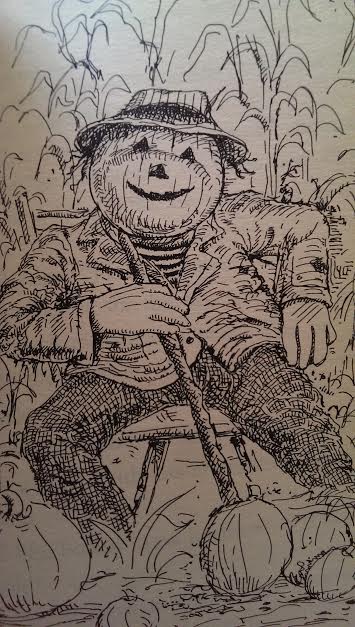
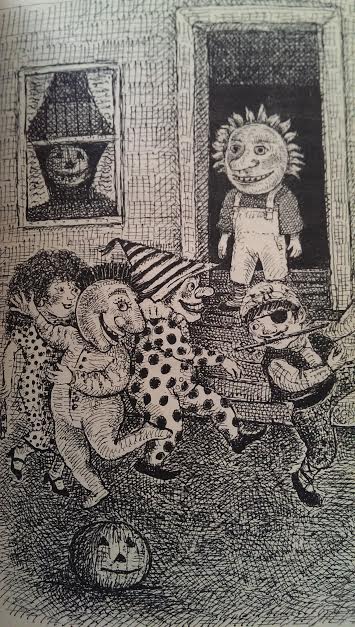
Jonathan’s family has moved from the city to the country, and he’s excited that he can see all the pumpkins growing before Halloween.  Then, some dummies with jack-o’-lantern heads give him the idea for the best costume to wear for the Halloween parade.

Who Scared Who?

Donald and Ronald, another young set of twins, are fascinated by the scary Halloween masks in the stores.  Even though the masks scare them, they think it would be funny if they could buy some really ugly masks to scare the neighborhood policemen.  However, the policemen also think it would be fun to give some of the neighborhood kids a fright.

Pennies for UNICEF

There is a contest for children collecting pennies for UNICEF.  The child who collects the most will win a trip to New York to visit the UN.  As an avid coin collector, Eddie is eager to win the contest, and he makes a special discovery among the coins that he collected on Halloween night.

The Haunted House

Peanut Butter and Jelly

PJHauntedHouse

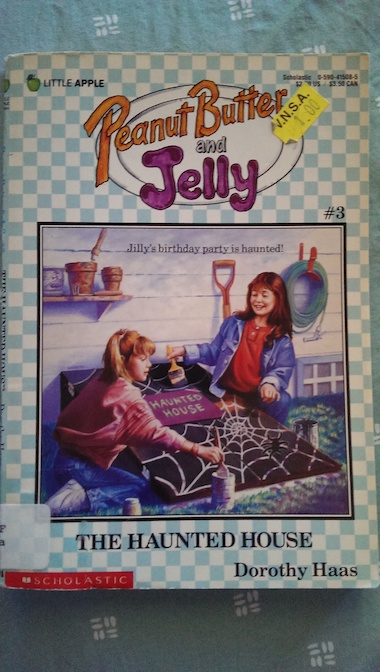
#3 The Haunted House by Dorothy Haas, 1988.

PJHauntedHouseCostumesJilly was sick on her birthday and couldn’t have a party, so she and Peanut decide to hold an haunted house party, just for fun and invite all the kids in their class. The girls’ nemesis, Jennifer, and her friends are in another class and won’t be invited to the party, but when they hear about it, they make it a point to tell Peanut and Jilly how childish it sounds.  However, no one else seems to think so, and the girls’ classmates are eager to come.

Peanut has fun making Halloween-themed food, and the girls decorate the fruit cellar in Jilly’s basement as their haunted house. They tell everyone to come in costume, and promise a prize to the person in the best costume.  Peanut also tells everyone to bring un-birthday presents to surprise Jilly and make up for missing her actual birthday.

Everyone is excited about the party, but when it starts, some strange things happen. First, it looks like more people show up than they expected.  Then, a mysterious, glowing ghost comes and tells them the tragic story of his death. What is going on?

This is just a fun book about a group of friends and a fun haunted house party they had together.  It doesn’t actually take place on Halloween (the girls get a fake skeleton on sale that was left over from Halloween), but it makes a nice Halloween-type story.  When I was a kid, I liked reading about the creative ways the girls set up the various surprises in the haunted house: making people crawl through a tunnel they’d made, having a skeleton pop out of a trunk by attaching elastic to it, and using a rubber glove filled with water and frozen as a ghostly hand reaching out to touch people, etc.  They also describe how Peanut made “frogs’ noses” out of shell pasta that was dyed green and covered with salad dressing as scary food for the party guests.

The book is currently available online through Internet Archive.

The Best School Year Ever

BestSchoolYearThe Best School Year Every by Barbara Robinson, 1994.

This year at school, Beth’s teacher has assigned everyone a year-long project to think about good points about their classmates, but it’s difficult when one of your classmates is Imogene Herdman.  The Herdmans are generally awful.  They lie, steal, set things on fire, bully other kids, and have been kicked out of almost every building in town for one reason or another.

Mr. Herdman deserted the family years ago, and Mrs. Herdman works long hours at the shoe factory, so the six awful Herman kids are left to do pretty much anything they want most of the time, even if what they want to do is to walk off with Louella’s baby brother Howard and draw pictures on his bald little head and charge other kids a quarter to see the amazing “tattooed baby” like some kind of sideshow freak.  It’s difficult for the adults in town to tell them off because they never listen or punish them because no punishment ever seems to stick.  Mostly, when the Herdmans are around, the adults seem to focus on damage control.

So, Beth struggles to find anything good to say about awful Imogene, the oldest girl in an awful family, but throughout the school year, Beth does begin to notice that Imogene does have other sides to her personality.  The book is more of a collection of short stories about the Herdmans’ various antics and escapades and Imogene’s role in them than one single story as Beth thinks about the things Imogene does.  Imogene can’t really be called “nice,” and she definitely causes her share of chaos, but she does have occasional moments when she’s helpful or does something in the name of justice, like giving her old blanket to Louella’s little brother to replace the one he lost so he wouldn’t be sad.

Some of Beth’s compliments to Imogene at the end are somewhat generic because Beth struggles to get around some of Imogene’s genuinely awful behavior, but when she considers what Imogene’s best trait is, she finds something that really captures Imogene’s spirit, a quality that Imogene genuinely admires and may lead her on to better things in her life.

This is the second book in The Herdmans Series.  The books are funny because of the chaos that the Herdmans cause wherever they go, although you can’t help but feel a little sorry for them at times, too.  It’s part of that awful dilemma when you think that someone deserves a good spanking for what they’ve done but, at the same time, you see that it wasn’t entirely their fault.  While the Herdmans are responsible for the things they do, they’re also victims of neglect.  Their parents aren’t really raising them, and the other adults have mostly given up on them.  They do what they do because they can and because no one is there to make sure that they’re doing the right thing.  No one even really expects them to do the right thing, so if they do something right, it’s completely up to them.

Beth’s observations about Imogene show that there is hope for her.  Imogene has some good traits as well as bad ones, and occasionally, she does do good deeds as well as bad.  Beth realizes that Imogene could do some great things in her life because of her resourcefulness (a quality that Imogene likes when Beth points out that she has it), but she realizes that what Imogene eventually turns out to be is still in her hands, whether she uses her abilities to rob banks or run for President.  Adults will know that Imogene’s reality is likely to be something in the middle, but the point is that Imogene has more good points than it appears at first and more possibilities in her life than just being a trouble-making Herdman.

As in the first book in the series, there is also something of a contrast between Imogene and Beth’s friend Alice.  Alice is the perfect child (at least in her mother’s eyes, and her mother lets everyone know it), but she is also often shallow, bragging up her looks, talents, and perfect behavior to get attention and feel important (which is what Beth thinks is really the best compliment to give Alice because it’s the one she would most value).  When Alice is nice, it’s not so much because she is a nice person as she likes the praise she gets for doing it.  Really, neither Alice nor Imogene are especially nice; they’re just not nice in different ways and for different reasons (although both have good points, too, which is the point of the story).  When Alice gets a compliment, she sees it as merely her due for her perfection, but for Imogene, compliments come as a surprise because she doesn’t hear them much and she knows that she is far from perfect.

The book is currently available online through Internet Archive (multiple copies, actually).

Soup

soupSoup by Robert Newton Peck, 1974.

This is the first book in a series about the author’s childhood best friend.  His friend’s real name was Luther Wesley Vison, but he always hated that name.  Because Luther refused to come home whenever his mother called his name for dinner, his mother took to just yelling, “Soup’s on!” when she wanted him to come home to eat.  After that, everyone else just started calling him “Soup”, which he liked a lot better than “Luther.”

Together, Soup and Robert had a reputation for getting into scrapes in their small town in Vermont.  The book is a series of short stories about the funny things they did as kids, like how they got revenge on the school nurse for asking embarrassing questions, how Soup got punished for breaking a window other than the one he’d actually broken, how Soup talked Rob into rolling down a hill in a barrel, and how Robert’s aunt let him tie her to a tree right before a lightning storm.

souppicSome of the stories are laugh-out-loud funny, and some of them have kind of a moral lesson to them, like the time when Rob realized that he didn’t have the heart to lie to his mother even if it would allow him to escape punishment for talking back to the school nurse, the time when Soup and Rob tried to cheat Mr. Diskin out of some money so they would have enough to go to the movies but ended up feeling guilty, and how the boys made themselves sick by attempting to smoke cornsilk.  Others are just stories of childhood events and friendship, like the story of how Rob and Soup played football and how Soup loaned Rob his new shoes when his were ruined.  Even though Soup often got Rob into trouble, he really was a good friend and went out of his way to make Rob feel better when he needed it the most.

Although it is a short chapter book that is easy to read, a couple of the stories might require some further explanations for young children reading them, like the one where the boys smoke cornsilk using homemade pipes and the one where Soup says that someone told him it was all right to cheat Mr. Diskin because he’s a Jew (a belief that they come to rethink when they feel guilty for cheating someone who was always fair with them and was kind to them even when he discovered the deception).  They deal with older practices and prejudices and can be the start of discussions about the lessons people learn by making mistakes. Other than that, these stories present a fascinating look at what it was like to grow up in the country during the 1920s.

The book is available to borrow and read for free online through Internet Archive.

Something Fishy at MacDonald Hall

somethingfishySomething Fishy at MacDonald Hall by Gordon Korman, 1995.

Time moves on, and Boots’s little brother, Edward, is just starting school at MacDonald Hall. He’s made it clear that he thinks his older brother and his friends are “over the hill” and uncool.  Mr. Sturgeon is also feeling “over the hill” and thinking about retiring.  Being the headmaster just doesn’t seem that exciting to him anymore.

But, MacDonald Hall just wouldn’t be MacDonald Hall without strange things happening, and some mysterious person has been playing a series of bizarre pranks that rival anything Bruno and Boots have ever done.

Naturally, Mr. Sturgeon suspects them of being the pranksters, but for once, Bruno and Boots aren’t guilty.  On the one hand, they’re a little envious of the prankster’s ingenuity, but on the other, they don’t want to take the rap for something they haven’t done.

Who could the mysterious prankster be?  It is Edward, trying to prove that he’s more clever than Bruno and Boots?  Could it be Cathy and Diane, the girls at Miss Scrimmage’s Finishing School for Young Ladies?  They’ve been somewhat distant this year, for some reason.  Maybe it was Mark, who runs the MacDonald Hall school newspaper, drumming up interest in the paper by creating the phantom joker so he can write stories about it.  Elmer Drimsdale, the school genius, has been acting pretty odd since he developed a crush on a girl at the summer science fair, a girl who also happens to attend Miss Scrimmage’s.

There are plenty of suspects to choose from, and time is running out.  Bruno and Boots may be facing expulsion if they can’t figure out who is behind all the pranks!

This book is part of the MacDonald Hall Series (or Bruno and Boots series).

MacDonald Hall Goes Hollywood

macdonaldhallhollywoodMacDonald Hall Goes Hollywood by Gordon Korman, 1991.
MacDonald Hall has been picked as a location for filming a movie about a boarding school, and people are going crazy (or crazier than normal)!  Bruno hopes that he’ll be discovered and become a movie star. His attempts to insinuate himself (not very subtly) into various scenes keep getting him into trouble.

The girls at Miss Scrimmage’s Finishing School for Young Ladies all have a crush on the teen star of the movie, Jordie Jones, further annoying Bruno.  Cathy and Diane, Bruno and Boots’s friends at Scrimmage’s, are especially getting on his nerves with their wild schemes to meet Jordie in person.

Meanwhile, poor Jordie wishes that he could live life out of the limelight for awhile.  His manager worries about him excessively and never lets him do anything fun.  In spite of his many admirers, Jordie is lonely because he spends all of his time with the movie people and doesn’t have many friends his own age.  Nobody has even remembered his birthday!

Bruno and Boots discover Jordie’s woes when Bruno tries to play a mean trick on Jordie, due to his jealousy of all the attention Jordie gets.  After Jordie opens up to the guys about his problems, Bruno feels more sympathetic toward him and decides to help.  The boys invite Jordie to play poker with them (after lights out and against school rules), take him to a dance at Miss Scrimmage’s (in disguise as a prince from a made-up country), and even get him to help with a hockey game as goalie (which earns Jordie a black eye).

Jordie has been having the time of his life, but the boys still have to conceal his activities as much as possible and deal with his over-protective manager, his rabid fans at Miss Scrimmage’s, and as always, The Fish.  Mr. Sturgeon (aka The Fish), is sympathetic to Jordie because he knows that activities like these are important to his growth as a person, but the movie people crack down on Jordie’s activities because the black eye interferes with his filming.

Although Jordie is supposed to keep quiet and let his eye heal, he runs away to join Bruno and Boots and several other boys on the school’s traditional wilderness survival trip (known to the students as “Die-in-the-Woods”).  It isn’t long before Jordie is discovered among them, but before the trip is over, the others are going to be glad that he’s there.

This book is part of the MacDonald Hall Series (or Bruno and Boots series).  It is currently available online through Internet Archive.

This Can’t Be Happening At MacDonald Hall

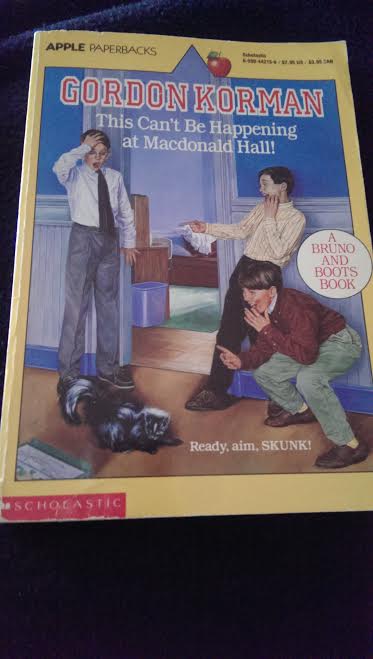
macdonaldhallThis Can’t Be Happening at MacDonald Hall by Gordon Korman, 1978.

Bruno and Melvin (called Boots) have been roommates ever since they began attending boarding school at MacDonald Hall.  The two of them are best friends, and they do everything together.  Quite a lot of what they do involves practical jokes.  But, they’ve really been pushing the limit with their antics, and when they go a little too far during a hockey game, the headmaster gives them the ultimate punishment: they can no longer share a room.  Mr. Sturgeon thinks that they’re a bad influence on each other.  Each of them is assigned to a new roommate, and they won’t even be able to hang out together.

The prospect of losing each other as best friends is too much for Bruno and Boots. Besides, neither of them likes their new roommates.  Boots has to share a room with George, who comes from a wealthy family and is only interested in money.  George is also a germophobe who hates it that Boots sneezes every morning when he wakes up.  Bruno’s new roommate is Elmer, the school’s supreme science nerd.  Elmer isn’t happy about Bruno’s presence, either, because Bruno and his belongings take up valuable space that Elmer requires for his many projects.  Obviously, the situation is completely intolerable for everyone.

Bruno, the idea man of the duo, declares that he will find a way for him and Boots to become roommates again.  They meet secretly at night to discuss their plans.  The boys try every tactic they can think of.  They try making themselves completely obnoxious to their new roommates so that Mr. Sturgeon will have pity on them and give them their old room assignments.  They try framing George and Elmer for some outrageous pranks of their own so Mr. Sturgeon will think that they’re a bad influence on Bruno and Boots.  Bruno and Boots even try (as an extreme measure) behaving themselves!  What will finally work?

This is the first book in the MacDonald Hall Series (or Bruno and Boots) series.  It is currently available online through Internet Archive.

The Blue-Nosed Witch

BlueNosedWitchThe Blue-Nosed Witch by Margaret Embry, 1956.
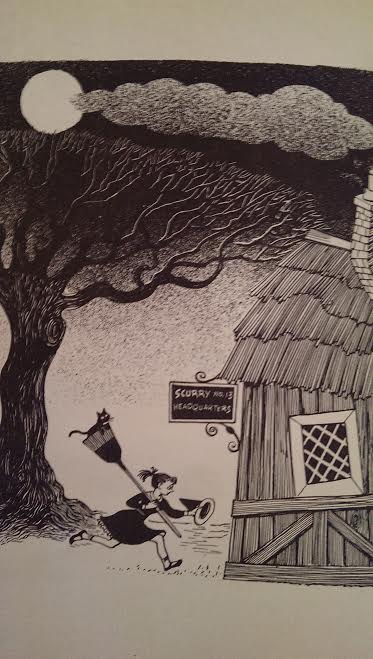
Blanche is still a very young witch, but because of her magnificent blue nose (which she can make glow at will), she’s allowed to join a group of adult witches, Scurry No. 13.  Their specialty is beautiful flight formations on their broomsticks, and they’re planning a special one for midnight on Halloween.

But, Blanche has a bad habit of being late to everything.  Some of the other witches have started complaining about her, saying that she’s too young and irresponsible to be part of Scurry No. 13.  If she’s late for the flight on Halloween, they might decide to send her back to Scurry No. 2 1/2 with the other young witches, where she’d only be allowed to ride a whisk broom.

To make sure that Blanche will be on time for Halloween, her friend Josephine sets her alarm ahead a couple of hours to give her extra time to get ready.  Unfortunately, Blanche doesn’t know that Josephine did that, so she sets her alarm ahead herself.  When she wakes up on Halloween night, it’s still early evening, instead of late at night.

BlueNosedWitchPic1Blanche looks for her fellow witches but ends up joining a group of trick-or-treaters by mistake.  They love her blue nose and introduce her to the idea of trick-or-treating.  Thinking that even the grumpiest man in town would be impressed by Blanche’s amazing nose, they stop at his house, too.  The old man isn’t impressed by anything and plays a mean trick on the kids.  However, Blanche is a real witch, and she and her cat Brockett give the old man a real Halloween scare.

Blanche is having fun on Halloween, but will she keep track of time well enough to join the other witches in their flight?

Even though this wasn’t written to be an historical novel, in a way, it kind of is now.  One of the interesting things about this book is that you can tell from the way the kids are trick-or-treating that it’s the 1950s.  Kids today don’t get jelly donuts or apples while trick-or-treating, and in this day of giving out only prepackaged treats for safety reasons, the kids would probably have to throw them away if they did (sigh).  Also, there is still the implied threat of Halloween tricks when the kids go asking for treats, something less common today.  Instead of saying “Trick or treat!”, the kids say “Candy or cake or your windows we’ll break!” (although the kids later promise the adults that they’re not going to soap any windows).  My mother said that the popular saying when she was young was, “We are the beggars of the street.  Do we soap, or do we eat?”

The book is available to borrow and read for free online through Internet Archive.

BlueNosedWitchPic2

Triple Trouble

TripleTroubleTriple Trouble by Michael J. Pellowski, 1988.
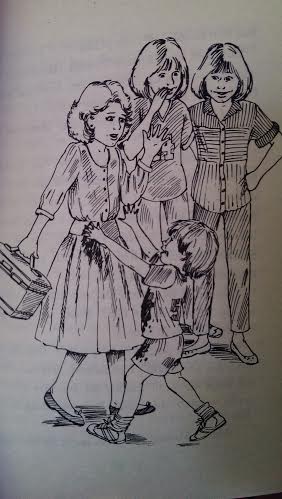
Randi and Sandi Daniels have a cousin named Mandy who is only slightly older than they are and who looks very much like the two of them.  Their two fathers were brothers, and their two mothers were sisters, which is why they look so much alike. When the three of them were young, they used to get along well and they were almost like triplets. However, when Mandy comes from California for a visit, it becomes apparent that she’s changed a lot.

The three of them still look a lot alike, but Mandy has become stuck up and snobbish. More than anything, she wants to be a big Hollywood star. Because she’s an only child, her parents have indulged her, but now they’ve become concerned that she’s become too wrapped up in her ambitions. She doesn’t really have any friends and isn’t interested in anything besides acting. They think that if Mandy spends some time with her cousins, it will encourage her to slow down and act her age more.

TripleTroublePicBut, Mandy’s snobbish attitude rubs Randi and Sandi the wrong way. Mandy doesn’t want to do anything because she might get dirty or break a nail, and she keeps bragging about how grown up she is compared with her not-much-younger cousins. The twins argue with their cousin, and they play tricks on each other. When Mandy takes advantage of acting skills and her similar appearance to the other girls to try spending time with a boy they like by pretending to be them, Randi and Sandi decide it’s the last straw! They decide to show Mandy that playacting is a game that three can play at.

Like the first book in this series, this one is also filled with black-and-white drawings.

This book is currently available through Internet Archive.