The Prince Who Knew His Fate

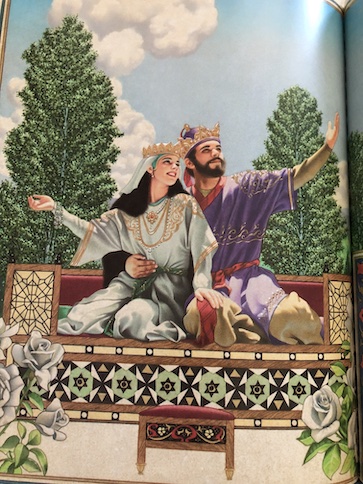
This picture book is a retelling of an Ancient Egyptian story (sometimes called The Tale of the Doomed Prince) about a prince and a prediction regarding his death with an unknown ending. The only known original version of the story is incomplete. For this book, the author has given the story an ending.

An Egyptian king wishes for a child, but when his son is born, the seven Hathor goddesses offer a prophecy for the prince’s fate. They say that, “He is destined to be killed by a crocodile or a snake or a dog.”

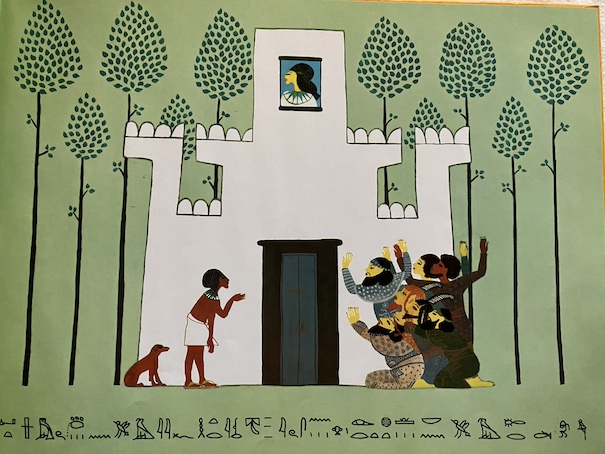
The king is distressed by this prediction for his son’s fate, and he decides to protect him from it as best he can. He has a special house built for the prince, where he grows up, attended by servants and given all sorts of good things to keep him happy. The king wants his son to stay in this house, where he will be safe. 

However, as the prince gets older, he becomes more interested in the outside world. One day, he sees a man passing the house with a dog, and the prince wants a dog of his own. The king relents and allows his son to have a dog, in spite of the prophecy.

The prince further demands that his father allow him to leave the house and travel. After all, he says, if his fate is already determined, it won’t matter if his father tries to protect him from it. He says that, if he must die eventually, he might as well live his life to the fullest while he can. The king allows his son to have a chariot and to hunt and travel the Nile. Everywhere the prince goes, he brings his dog with him.

Eventually, he comes to the country of the Chief of Naharin, who only has one daughter. The chief keeps his daughter in a special house with a single window, high off the ground. He says that he will allow his daughter to marry the man who can jump up to that window. The prince manages to make the jump, and he marries the chief’s daughter.

After they are married, the prince explains to his wife the prophecy about his fate. His wife wants to kill the prince’s dog, but he refuses to allow it because he’s had the dog since it was a puppy. His wife begins to watch over him, to try to prevent him from being killed. She manages to kill the snake that comes for the prince, and the prince manages to make a deal with the crocodile, but can he truly escape his fate?

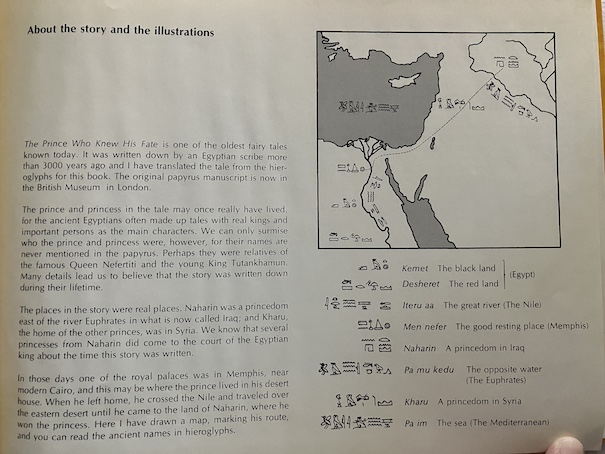
There is a section at the back of the book that explains more about the original story, which was written over 3000 years ago and is “one of the oldest fairy tales known today.” There is also some information about Ancient Egypt and the carvings that were the inspiration for the illustrations in the story.

I always enjoy folklore, and this story is fascinating because the original ending is unknown. The author of this book, Dr. Lise Manniche, who was a Danish Egyptologist, translated the story from the original hieroglyphics and added an ending to the story. I thought that the ending fit well enough, and I was pleased that it was a happy ending, even though it holds to the idea that the fate must be fulfilled. I also enjoyed the illustrations, based on Ancient Egyptian carvings from around the time that the story was created, and the addition of the hieroglyphs of the original story along the bottom of the pages.

I first heard about the folktale in this book in a mystery book for adults called The Snake, the Crocodile, and the Dog by Elizabeth Peters. It is part of the Amelia Peabody mystery series, about a Victorian era woman who is married to an archaeologist. Elizabeth Peters is a pen name for Barbara Mertz, who was an Egyptologist herself. Because this folktale featured prominently in that mystery novel, I was thrilled to find this version of it!

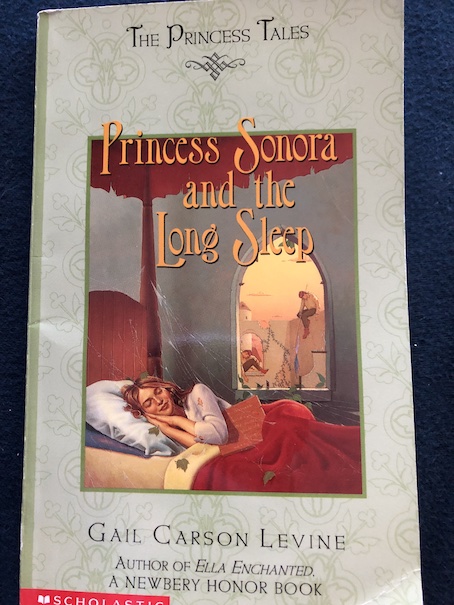
Princess Sonora and the Long Sleep

Princess Sonora and the Long Sleep by Gail Carson Levine, 1999.

This story is a retelling of the classic fairy tale, Sleeping Beauty. It’s part of a series of other retellings and re-imaginings of classic fairy tales called The Princess Tales.

When Princess Sonora was born, her parents invited the usual fairies to give her gifts. They do this because it can be dangerous to anger fairies, although fairies’ gifts are a risky proposition at the best of times. Unfortunately, there are two complications with the fairies who give Princess Sonora gifts. First, one of the fairies decides to top a previous fairy’s gift of intelligence by making Princess Sonora ten times as intelligent as any other human on earth. As a result, Princess Sonora is an unnaturally intelligent baby who begins to talk almost immediately and is smart enough to understand the second problem that arises.

Her parents neglected to invite a particular fairy because they’d heard a rumor that she was dead. Of course, the fairy shows up anyway, angry at the lack of invitation, and immediately curses Princess Sonora. As in the original Sleeping Beauty story, the curse is that, someday, Princess Sonora will prick her finger and die. Also, as in the original story, the last fairy who hadn’t yet given a gift uses her gift to soften the curse so that, instead of dying, Princess Sonora and everyone else in and around her castle will fall asleep for 100 years. She can’t completely remove another fairy’s spell because that might provoke a fairy war, but this change to the curse gives the family hope. She promises that Princess Sonora will meet an eligible prince when she wakes up. Princess Sonora, being an unnaturally intelligent baby who can talk, also gives her own feedback and suggestions on the situation, to her parents’ amazement. Her parents decide to try to prevent the curse from coming true by hiding anything that can prick Princess Sonora, but baby Princess Sonora has already realized that this will be impossible. She knows that the curse will come true someday, and as she lies in her cradle, she begins to make plans to prick herself on purpose, someday when she can choose just the right moment.

Being smart is generally a good thing, but Princess Sonora’s unnatural intelligence makes her a very peculiar girl in a number of ways. For one thing, she loves books and is always reading, even as a baby. She grows up to be a very studious girl. That’s not so bad, but Princess Sonora carries it to extremes. She also refuses to sleep. It’s partly because she knows that, at some point, she’s going to spend 100 years sleeping, so there’s no point in wasting more time asleep. She’s also afraid of sleep because she doesn’t know where her mind will go when she sleeps, and with her massive intelligence, she loves her mind and doesn’t want it to go away. Instead of sleeping, she just reads all night or thinks about things. Because of her intelligence, curiosity, and constant reading, Princess Sonora knows the answers to many questions, but people often find it irritating because they don’t want to hear her long explanations or all the ways she knows for people to do their jobs better. People start saying to each other, “Princess Sonora knows, but don’t ask her.” Princess Sonora wishes that other people would be more interested in what she has to say, but she knows better than to force the issue.

When Princess Sonora turns 14 years old, her parents begin looking for a prince she can marry, assuming that she doesn’t prick herself and fall asleep for 100 years first. They choose Prince Melvin, from a large and wealthy kingdom nearby. It seems like a smart match, but Princess Sonora knows it isn’t a good one. Prince Melvin has also received gifts from the fairies, and while they include positive qualities, like honesty and bravery, they don’t include intelligence. Prince Melvin isn’t very smart and wouldn’t appreciate any of the things Sonora knows or has to say. He would marry her anyway because he’s Honest and Traditional, but Sonora knows that she wouldn’t be happy. When she meets him, he’s very dull. The fairies made him a Man of Action, not of thought. He’s decided that thinking gets in the way, so he has few ideas and certainly no interesting ones. Sonora begins to think that the right time for pricking her finger might be coming soon. Pricking her finger doesn’t quite go as she had planned, but the curse works.

When Princess Sonora and everyone in the castle is put to sleep for 100 years, they are half-forgotten. Princess Sonora becomes a kind of legend, and the saying “Princess Sonora knows, but don’t ask her” becomes a common saying when someone doesn’t know the answer to something, with few people knowing who Sonora really is or why you’re not supposed to ask her what she knows. That is, until a prince with curiosity and a thirst for knowledge, someone who really needs Sonora’s knowledge to solve a problem, seeks her out for the answers he really needs. When Sonora wakes, she finally meets a prince needs a princess like her and is truly happy to hear what she has to say!

My Reaction

I liked this story when I first read it as part of a collection of other stories in the same series. Gail Carson Levine, who is also the author of Ella Enchanted, often writes stories themed on fairy tales but with her own twists. Princess Sonora’s extreme intelligence and fear of sleep weren’t part of the original fairy tale, although they fit this story nicely. I found the scene with the fairies giving Sonora gifts a little disturbing. When one of the fairies gives her the gift of beauty, the baby physically changes, and it is described as being painful. It is a theme in other stories by Gail Carson Levine that the magical gifts fairies give often have unfortunate side effects. Some of them really turn out almost like curses, but in this case, it turns out to be just what Sonora really needs and leads her to the person who really needs her. Even after people stop getting gifts from fairies when they’re babies, they still have quirks, and Sonora’s quirks fit with Prince Christopher’s quirk for curiosity!

Prince Caspian

The Chronicles of Narnia

Prince Caspian by C. S. Lewis, 1951.

This book starts with the four Pevensie children from the previous book in the series heading to their boarding schools by train. The girls are going to one school, and the boys are going to another. As they’re waiting for their trains at the station, they suddenly feel themselves being pulled and dragged by some unseen force. They feel like it’s magic of some kind, and they all join hands to stay together. The next thing they know, they’re in a forest. They wonder if they might have returned to Narnia.

They explore the area and realize that they are on an island. When they search for food, they find an abandoned apple orchard and the ruins of a castle. Something about the ruins seems strangely familiar to the children. When Susan finds a golden chess piece, they realize that the castle is the ruins of Cair Paravel, the castle where they used to live as kings and queens during their previous time in Narnia. The children are sad that the castle is now ruins. They’re also puzzled at how it can be ruins when they last saw it intact, and when they lived there, the castle was on a peninsula, not an island. Even though their previous adventures only took place a year before for them, it looks like many years, maybe centuries, have passed in Narnia.

They find their way into their old treasure room and discover that it is undisturbed. They leave the jewels and riches there, but they find the special presents that they were given during their last adventure and take them because they may be helpful during this adventure. The one thing they can’t find is Susan’s magic horn, which can be used to summon help in desperate times. Susan realizes that she had it with her during the stag hunt right before they returned to their own world from Narnia, and it was probably lost in the woods.

When they rescue a dwarf from some men holding him captive, the dwarf thanks them. He says that they were planning to drown him as a criminal, but he doesn’t fully explain. Instead, he offers to catch some fish for them all to have breakfast because all the children have are apples. When the children mention that there is firewood at the castle, he is amazed. He’s heard stories about an old castle there, but he wasn’t sure that it was real. The rumors are that the forest around the castle ruins is haunted.

After they eat, the dwarf explains that he is a messenger for Caspian, the king of Narnia. He then qualifies that by explaining that Caspian should be the king. The old Narnians recognize him as the rightful king, although he is considered one of the new Narnians himself. Prince Caspian was an orphan raised in the castle of his Uncle Miraz. He was mostly raised by his nurse and wasn’t very close to his aunt and uncle, but his uncle acknowledged him as his heir because he had no children.

According to the dwarf’s story, Prince Caspian has a fascination for the old days of Narnia from his nurse’s tales, when there were fauns and talking animals in Narnia, but his uncle says those are just fairy tale stories for little kids. The Pevensie children realize that the legends that Prince Caspian was told as a young child were about them and their adventures. People still tell stories about them, but not everyone believes them.

Miraz forbids Caspian from believing in those stories or talking about them again and sends away Caspian’s nurse. Instead, he hires a tutor for Caspian called Doctor Cornelius. Caspian misses his nurse, but he enjoys his lessons with Doctor Cornelius. From Doctor Cornelius, he learns that his ancestors and other humans came to Narnia from another land and conquered it. However, Doctor Cornelius is reluctant to explain exactly whom his ancestors conquered. Doctor Cornelius quietly admits that Miraz forbids anyone from talking about Old Narnia because it’s supposed to be a secret. Over time, Doctor Cornelius lets Caspian know the secrets of Old Narnia, which confirm to him that his nurse’s stories were true.

Caspian’s ancestors were the ones who silenced the taking animals and drove away or killed other races who inhabited Narnia. The reason why Miraz won’t let anybody talk about the history of Old Narnia and denies that other species once lived there is to cover up that his ancestors stole Narnia from its rightful inhabitants and that most of the humans are merely transplants to this land, not its rightful heirs. Doctor Cornelius reveals himself to be a dwarf, one of those few who still live in Narnia in secret. He is also part human, which is how he is able to pass for a human. He says that there are others there in disguise. Caspian feels like he should apologize to Doctor Cornelius, although he knows that what his ancestors did to the dwarves was not his fault. Doctor Cornelius says that apologies are not necessary, but he knows that Caspian will one day be king and can help the remaining Old Narnians who still live there, hiding from Miraz.

The stories about the woods around Cair Paravel being haunted were invented by Caspian’s ancestors to hide Narnia’s past and also because they want the forest to separate them from the sea. Caspian’s people fear the sea because, although they deny that Aslan exists, the legends all say that Aslan will return from across the sea. They fear the wrath that Aslan may visit on them for what they did to Narnia and its peoples. However, not all humans have this fear of Aslan and Old Narnia. Others, like Caspian, are fascinated and would like to see Narnia become more like its past self, with magic and talking animals and dwarves and fauns. As Caspian gets older, he realizes that many people in Narnia are unhappy with Miraz and the way he rules Narnia. He is a cruel king.

One night, while Caspian’s aunt is very ill, Doctor Cornelius wakes him and prepares him for a journey. He tells Caspian that he is not just the prince but the true king of Narnia. His father was the true king, and after Caspian’s parents were dead, Miraz took the throne for himself. Miraz murdered or exiled Caspian’s father’s old friends and supporters. Caspian was too small at the time to understand or have any memory of this, but now, Miraz is planning to murder Caspian. His aunt’s “illness” was actually childbirth, and now that she has given birth to a son, Miraz is planning to eliminate Caspian so his own son can be his heir with no opposition from the true heir. Doctor Cornelius says that Caspian has no other choice but to flee to another, friendly kingdom. To help him on his way, Doctor Cornelius gives him some food, a purse of gold, and Susan’s magic horn, an Old Narnian artifact found after she and her siblings disappeared from Narnia.

While Caspian is fleeing, he has an accident and is knocked unconscious. He is found by a dwarf and talking animals. They almost kill him as one of their enemies, but Caspian explains who he is and why Miraz wants to kill him. The dwarf still wants to kill him, but the badger realizes that Caspian is a hopeful sign. The golden age of Narnia was when human children ruled, and young Caspian’s belief in the Old Narnian stories and assertion that he has longed to meet Old Narnians like them are signs that he could be a true high king like King Peter. The badger says that he would be willing to follow King Caspian if he remains true to Old Narnia and its people.

Caspian is allowed to stay among the Old Narnians in hiding. He gradually makes friends with different species, and they begin to form a rebellion against Miraz. Doctor Cornelius finds Caspian and warns him that his uncle is searching for him. Caspian’s supporters convinced him that it was time to blow Susan’s horn to summon help, and that was how the Pevensie children were summoned back to Narnia.

The dwarf explaining all this to the Pevensie children is the same doubting dwarf who almost killed Caspian and ended up joining his supporters. The men trying to kill him were Miraz’s people. Trumpkin, the doubting dwarf, now doubts that the Pevensie children are the help they were hoping for. They are children again, not the great kings and queens they were when they left Narnia. The children aren’t too troubled by his doubts because they know who they are and the victories they have already achieved in Narnia. They have not lost all the skills they gained in Narnia before, and the more time they spend in Narnia, the more they become like the kings and queens they once were and still are. They outfit themselves from their old treasury and prepare to once again battle again evil in Narnia in support of Aslan.

The book is available to borrow and read for free online through Internet Archive (multiple copies, including some in different languages).

My Reaction

The books in The Chronicles of Narnia are famously Christian allegories, and Christian themes continue through this book. There are people who are doubters, but those who remain faithful believers in Aslan (who represents Jesus in this series) are the ones who prevail in the end. Like Jesus, Aslan wants his followers to do what they can on their own but is often near to offer them strength, support, and hints about the right thing to do. However, some people are more perceptive to his guidance than others, especially Lucy, and there is a theme that runs through the story about belief in things from people who have not seen them directly and are relying on other people’s experiences. As Lucy has a greater capacity for perceiving Aslan, some other people have a greater capacity for general belief. Edmund has learned his lessons from the previous book. Feeling badly about his earlier doubting of Lucy and how he had once belittled her, he becomes her biggest supporter during times when she can see Aslan and others can’t, urging his older siblings to listen to her. Some people, including Peter and Susan, doubt whether Lucy has actually seen Aslan when they haven’t seen him himself. Trumpkin, the doubting dwarf, is the classic Doubting Thomas of the story. He doubts everything, every step of the way, from Caspian’s intentions to the existence of the Pevensies and Aslan, but he keep son going until he sees the Pevensies himself and has the opportunity to see their abilities in action. Among Caspian’s followers, there are some, like the badgers, who have always believed in Aslan and always will, and there are others who are won over when they see for themselves.

There are also themes in the story that can apply equally to religious issues and political ones. Miraz struggles from the beginning to control the narrative of how his family came to rule Narnia and how he himself became the king when his brother’s son was actually the true heir. There are people who know the truth about both of these issues, but he’s not above censoring people, exiling them, and even killing them to prevent people from talking about the truth openly. Miraz is not a good king and has his self-interest in mind more than his subjects’, but he’s sharp enough to know that nobody really likes him or wants him to be king except he has convinced them that he has the authority to be king and that their self-interest lies with him. If people came to see him and his family for who and what they truly are and what they’ve actually done, he would lose all of that, and he knows it. Authoritarian rule is like that. It relies on maintaining the sort of image that, realistically, they can’t maintain if people know what the individuals involved are really like. Authoritarians try to make themselves look stronger and better than normal humans to cover up for their flaws, but the image collapses when they can’t or won’t deliver what they promise, and people see them for the flawed humans they really are, often more flawed than the people they tried to convince were weaker.

Aslan eventually reveals that Caspian and his people are not just from a foreign country in the world of Narnia, but their distant ancestor were actually pirates from our world. They had conquered and looted an island in the South Seas, murdered many of the inhabitants, and taken the women for their own. Then, they had argued and fought among themselves. Some of the pirates took their women and tried to hide in a cave from the others, but it was a gateway to the world of Narnia, and that was how they got there to later conquer Narnia. When Caspian hears this, he says that he wishes that he had come from a more noble lineage than murdering pirates, and Aslan tells him that, further back than the pirates, he is also a son of Adam and Eve, just like the Pevensies, and that lineage is noble enough. I liked this explanation because, in modern times, people have struggled with the concept of having slave-owning ancestors, fearing criticism, punishment, or some form of reparations for it. I’ve heard some people saying that they don’t want to be ashamed of themselves or their ancestors. They are hung up on one part of their family’s history, a history that, when you think about it, goes back as far as humans go, and they fear blame and shame for that. I don’t think I’ve heard many consider that their family didn’t always own slaves. They were something other than slave-owners before that, even if some of them can’t quite remember what that was. I’m not big on ancestor veneration and imitation, but everyone’s ancestry goes back too far to remember every generation. Even if some generations weren’t good examples, they’re not the only past generations, if you see what I mean. Maybe, instead of looking at what their family used to be and lost and might be blamed for even having, they should consider that what they’ve become since then might just be a return to what they were before that period in their family’s history, which might just be better and noble enough.

Earlier in the story, when the Old Narnians talk about whether to support Caspian or continue to support him, there are some who waiver in their support or withhold it, also out of self-interest. While nobody really likes Miraz, Narnian history and legends influence the way that the Old Narnians feel about Aslan and his supporters. Most of the Old Narnians remember the White Witch from the previous book as a wicked ruler, but the dwarves and wolves fared better under her than other species. Their descendants forget that their relatively better treatment came from their collaboration with the witch and their participation in her wickedness, and even then, the relatively better treatment still wasn’t that great. (Plus, some of the wolves are actually werewolves, not just talking animals, like the others.) They just vaguely remember that there was a time when a ruler put them in a better position relative to other species, which they are not now. In fact, they feel like they are now treated worse and given fewer supplies than the other groups. The other groups say that’s not true, but it feels like it is to them because they are no longer better off than the others. They miss that and want it back. When they become impatient with Caspian and feel like he won’t give them the treatment they want, they rebel, and some of them are killed. Prince Caspian and the others feel badly about that because the might not have rebelled and been killed in the struggle if circumstances were different and they had felt more satisfied, but they had no choice but to defend themselves from their attack.

The book also looks at the type of people who support authoritarian rulers. Much of their support also has to do with self-interest or apparent self-interest. Miraz does have supporters among the human nobility who helped him accomplish his rise to power and who helped do his dirty work in getting rid of his brothers old allies. Since then, some of them have become disillusioned with Miraz. Miraz has not followed through on what he promised them before in exchange for their loyalty and support, furthering his own self-interest instead of theirs, and that’s the one thing they can’t accept. The thing about supporting someone who is selfish and is willing to throw former supporters to the wolves or even kill relatives in pursuit of power … is that you end up being one of those former supporters who may be thrown to the wolves or killed when your leader pursues self-interest and power. Some people never think anything through. They may have assumed that they would be a special exception to the leader because of their support, but nobody is special to Miraz but himself. Everyone else is just a tool to be used until he can’t find a use for them or they seem to be a hindrance.

When Aslan reveals the true history of Caspian’s people to them, many of them are afraid that Aslan is going to kill them all for what they’ve been and what they’ve done, which is another factor in their support of Miraz and his narrative. Even some of those who knew the truth before were too scared to say anything or do anything about it because they feared the blame, guilt, and consequences that might follow acknowledging the truth. A major reason for their fear is that they and their ancestors have not been merciful to anybody, so it never occurs to them that someone else might have better intentions for them.

At the end of their adventure, when it’s time for the Pevensies to go home, Aslan tells them that Peter and Susan will not be returning to Narnia next time because they are getting too old, but Edmund and Lucy will return someday. It’s a common theme in children’s fantasy books that only children can experience certain types of magic, and when they get older, they can no longer experience it or believe in it. It’s a trope that is meant to explain why grownups don’t experience this type of magic in the real world and why the adults in stories think that the children are just imagining things when they experience magic, but to me, it doesn’t logically follow in this story. We already know that at least one adult the Pevensie children have met believes in Narnia and magic because he has also experienced them, and we know that the ancestors of Caspian’s people arrived in the world of Narnia as adults. The Chronicles of Narnia don’t seem to have a consistent principle about who can visit the world of Narnia or believe in it, not in age or even in moral character because Caspian’s ancestors were murdering pirates. I think, in the case of Caspian’s ancestors, it might have something to do with explaining how even flawed and immoral people can rise to power or even seemingly have God’s favor, when it seems like they’re the last ones who should. It seems to be a combination of random chance (happening to wander into the right cave, in this case), their own choices (conquering other people), and possibly, part of a much longer game on Aslan/God’s part (eventually producing Caspian, who is the kind of ruler Narnia needs, even though it involved a lot of evil along the way – the evil being the humans’ choice, not a requirement). That’s some speculation and interpretation on my part, but I think the story kind of sets that up. Aslan seems completely aware of what’s going on and what has been happening but hasn’t tried to interfere until the critical moment in this story when Prince Caspian needs his help to fulfill his destiny.

The Light Princess

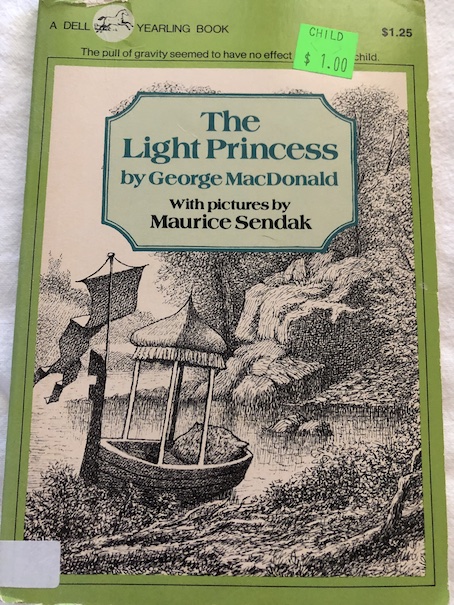
The Light Princess by George MacDonald, 1864.

A long time ago, a king is irritated with his queen because they have no children. The queen tells him to be patient, and she eventually gives him a daughter. The king is very happy, but he makes a critical mistake. He forgets to invite his own sister to his daughter’s christening. It would be embarrassing for anybody to forget to invite a family member to an important event, but it’s a serious problem in his case because his sister is a wicked witch. She has a nasty temper and is vindictive. So, she decides to show up for the christening anyway and get her revenge by putting a spell on the baby princess. From that moment on, the baby is weightless, no longer bound by gravity.

It doesn’t take the little princess’s parents long to realize who has caused this strange malady in their child. It’s not all bad. Her nurses find her very easy to carry around, and people in the palace have fun playing ball with the princess as the ball, and the little princess herself seems to find all of this delightful. However, there is always the fear that she could blow away by accident, which does happen once, when she is blown out of a window and into the garden. Her parents continually worry about her future. At the queen’s urging, the king attempts to go to his sister and apologize about forgetting her invitation to the christening and ask her to lift the spell on the princess, but his sister denies all knowledge of the spell. The king knows she’s lying, but as long as she continues to deny it, there isn’t much he can do.

The problem goes much deeper than the princess having difficultly keeping her feet on the ground literally. She also has difficulty keeping her feet on the ground mentally. Her lack of gravity extends to an inability to see the “gravity” or seriousness in any situation. She laughs all the time, at everything, even when nothing is funny, although there is no real depth of feeling to her laughter. Even though she laughs all the time, she never smiles, leaving it open to question whether she ever really feels happiness or any emotion at all. She certainly doesn’t understand genuinely serious or catastrophic situations or other people’s emotions. When her mother cries, the princess just thinks that she’s making funny faces and odd sounds because she can’t seem to understand what crying means or the emotion behind it.

When the princess gets older, her parents talk to her about her condition, but the princess refuses to take it seriously. They try to ask her about what she feels. The princess says that she doesn’t feel anything, except that she sometimes feels like she’s the only one who has any sense, and then, she bursts into a wild, inappropriate fit of laughter. When they ask her if there’s anything she wants in life, all she can think of is to have someone tie a string to her and fly her like a kite, and then, she bursts into laughter again.

Since it’s useless trying to get through to the princess, the king and queen try consulting others, but nobody can agree on a solution. They consider metaphysics and philosophy. They recommend education and bloodletting. Her parents wonder if she would acquire some gravity if she fell in love, but the princess can’t seem to fall into anything … until the day she falls into the lake.

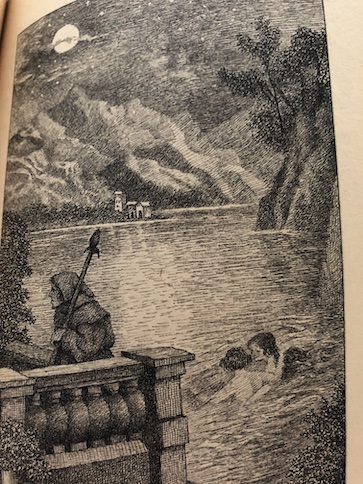
There is only one thing that the princess seems to love at all, and that’s the lake near the castle. When they take the princess out in a boat one day, she falls into the lake, and when she is in the water, she has gravity. She loves the water and loves swimming. She seems to have a better temperament when she is in the water, and she behaves better after a swim. Since water seems to affect the princess, they begin to consider that the cure to her problem might be to make her cry – a way of producing water that requires a grave emotion. However, nothing seems to make the princess cry. She is too flighty. (This book is full of puns related to gravity and flying, and they’re all given in a grave, direct manner.)

Then, one day, a prince tries to rescue the princess from the lake because he thinks she’s about to drown. When he pulls her from the water, she loses her gravity, and she angrily tells him to put her back in the lake. Unsure of how to do it when she’s weightless, the prince grabs hold of her and jumps into the lake with her. The princess is surprised and delighted because she has never truly fallen before. Now, she has fallen in with the prince … maybe in more ways than one.

However, even though the princess is starting to feel something for the prince, she has trouble understanding what she feels, not having felt much of anything for most of her life. When the lake suddenly begins drying up, the princess’s condition starts getting worse. The prince, who has truly begun to care about the princess, is willing to sacrifice himself to save the lake and the princess. It is only when the princess is confronted with the full reality of the prince’s sacrifice on her behalf that she is able to fully feel something and break free of her curse.

This book is now in the public domain, and you can read it online in your browser at Lit2Go. It is also accompanied by audio readings of each of the chapters.

My Reaction

Like other Victorian era children’s stories, there is a moral to this one, but it’s phrased in a unique and fun way. I remember liking this story the first time I read it as a kid, but I forgot about all of the puns involving “gravity”, which can refer to the force that makes things fall to earth or a state of serious emotion. The princess in the story lacks both, so she is very literally “flighty” and “can’t keep her feet on the ground.” Both of those terms are related to the idea that serious people have more emotional gravity, and unserious people lack it. For most of the book, the princess is an unfeeling air-head. I also missed the mention that the king doesn’t like puns, which may tacitly explain why his sister chose to make her curse in the form of a pun, knowing that her brother wouldn’t understand it.

The book notes that real happiness requires some emotional gravity because the person has to have enough emotional depth to understand their real emotional state and react appropriately to their emotions. That’s why the book describes the princess as never seeming happy, even when she laughs insanely at everything. She has no emotional depth or understanding. She doesn’t feel very much emotionally, and she has trouble understanding even her own limited emotional range. People often have trouble telling the difference between her laughing and screaming. Either way, it’s just a lot of loud noise with no real feeling behind it, and it’s pretty disturbing. It’s only when confronted with the apparent loss of the man she loves that the princess is able to feel a definite emotion. Fortunately, it all ends happily for our prince and princess. At the last minute, she decides to sacrifice her lake to save him, and finally, cries for the first time in her life, and that breaks her spell.

People don’t like to feel negative emotions, and some will use all kinds of defense methods to avoid what they’re feeling, but negative emotions (within reason, not taken to excess) are important to emotional health. People need to feel their full emotional range, and negative emotions often act as safety features in our lives. They tell us when we’re in an unsafe or unhealthy situation or when we’ve done something wrong, and they motivate us to do whatever is necessary to fix the situation. The princess’s habitual reaction to anything and everything is crazed and unfeeling laughter, but that’s not what she needs. She needs real feeling and honest tears to restore both her physical and emotional gravity. The princess, staring at the prince as he is about to die is literally staring death in the face and feeling the “gravity” of it. Contemplating the impending death of the prince and understanding for once the seriousness and finality of it, the princess experiences sadness and loss, and through that, she comes to understand love and sacrifice. Only when she has been through all of that is the princess truly able to be happy with her prince and his recovery. The princess has a difficult time adjusting to her new gravity, in more ways than one. She has to learn to walk for the first time because she always floated easily through life before, and sometimes, she falls down and hurts herself. She sometimes complains about it, but it’s still worth it because she has gained the ability to fully feel and to love and be loved.

During the story, none of the main characters actually have names. They are only referred to by their titles: king, queen, princess, and prince. Their names aren’t as important as their roles in the story.

There is a more modern story called Princess Hyacinth: The Surprising Tale of a Girl Who Floated from 2009 that uses the concept of a princess who is unaffected by gravity, but in a different way. It’s a picture book, and in that story, the princess isn’t cured of her lack of gravity. Instead, she learns how to make the most of it.

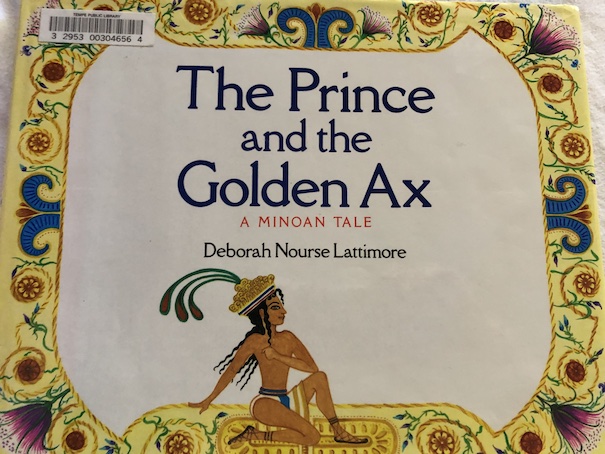
The Prince and the Golden Ax

The Prince and the Golden Ax by Deborah Nourse Lattimore, 1988.

This story is based around the ancient Minoan civilization and the destruction of the island of Thera. Thera was a real place, and it was actually destroyed, but the story itself is fiction, based upon the pieces of information that the Minoans left behind about their culture.

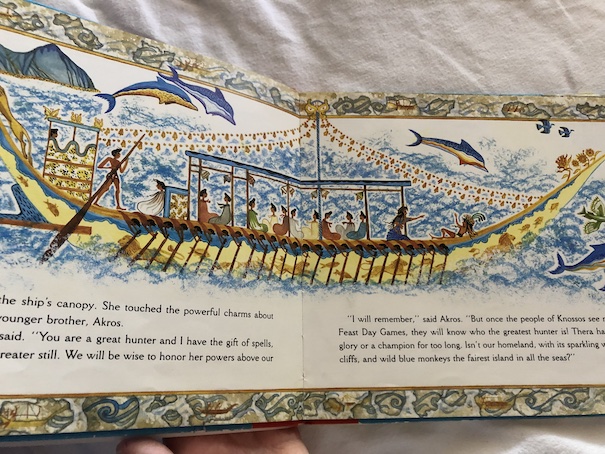
When the story begins, the city of Knossos on Crete is the home of the Goddess Diktynna. Princess Illyra and her brother, Akros, are on their way to Crete from Thera with their fleet of ships. Akros is eager to show off his skills at the games on this feast day, although Illyra cautions him to not show off too much and to remember to honor the goddess.

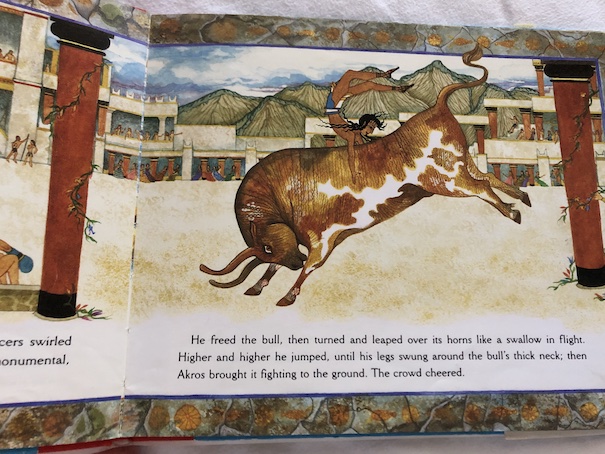
When they arrive at Crete, they are shown the goddess’s shrine with her statue holding the golden ax that is the source of her power. Akros is impressed by the golden ax and begins to think that if he had the ax, he could use it to bring glory to Thera. At the feast games, Akros shows off his ability to wrestle a bull. Full of pride for himself, he declares that he’s even better than the goddess because he did it without a golden ax. The goddess is angered by his comments and causes an earthquake.

The priestess says that Akros has challenged the goddess, and in order to make amends, Akros must find the golden-scaled fish of the Eastern Isle and obtain a bronze ax. If he fails to complete this task, the goddess’s golden ax will destroy Thera. Akros has no choice but to accept the challenge.

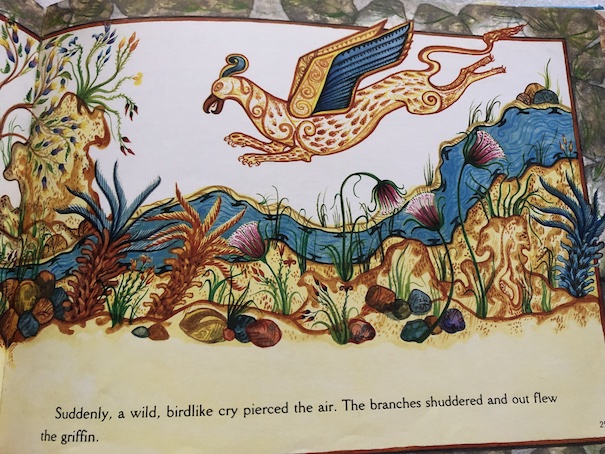
Illyria has the ability to use magic, and she helps her brother to complete the task successfully, but Akros can’t resist bragging about how easy it all was, angering the goddess again. This boast earns him a more difficult task, to capture a griffin and earn a silver ax.

Once again, Illyria helps Akros to succeed in his task, but when he is presented with the silver ax, Akros insists that it’s not good enough for him and that he wants the golden ax. The priestess says that only a godlike hunter can have that ax, and if he tries to get it, his homeland will be destroyed. Still, Akros insists that he can prove that he’s good enough by catching a creature that no one, man or god, has ever caught before.

What Akros has in mind is catching the blue monkeys on the island of Thera. This time, Illyria refuses to help him because the blue monkeys are sacred. At first, Akros thinks that he’s managed to capture the blue monkeys without her help, but they have abilities that he never expected. As promised, when Akros fails to accomplish his boast, the island of Thera is destroyed, and Illyria and Akros only narrowly escape.

The book ends with the discovery of the remains of the palace of Knossos centuries later, when the image of the goddess and a small ax are discovered.

My Reaction

I knew at the beginning of the story that there couldn’t be a happy ending because I already knew what happened to the real island of Thera, now called Santorini. The island was largely destroyed by a volcanic eruption during the Minoan period, a cataclysm that may have sparked the legend of the sunken island of Atlantis. However, this story does not mention Atlantis, instead using the statue of a goddess found in the remains of the palace of Knossos as inspiration. In spite of the ending, I wouldn’t call this a sad story. The book doesn’t dwell on the aftermath of the destruction of Thera, and we don’t actually see much of the civilization of Thera, so there isn’t much for us to miss when it’s destroyed. The colorful pictures throughout the book are beautiful and actually feel rather cheery.

The Case of the Roving Rolls

Brains Benton

The Case of the Roving Rolls by George Wyatt (Charles Spain Verral), 1961.

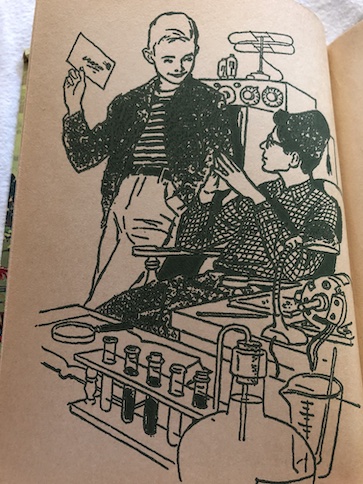
Summer has been dull, with no mysteries to solve. Jimmy doesn’t mind too much because he has other things to do, but his friend and partner in their detective agency, “Brains” Benton, is going a little stir-crazy. When they started their detective agency, they named it the Benton and Carson International Detective Agency, but so far, they’ve only solved local cases. Brains wants to find an international case to solve to justify the name. The opportunity comes when Jimmy gets a letter from his Uncle Ed, who has been living overseas.

Uncle Ed is a pilot who has been living in a fictional Middle-Eastern country called Kassabeba. In his letter, he mentions that something strange has been happening there recently, although he finds it hard to explain exactly what’s been happening. He says that, soon, the answer may be coming to the boys’ town of Crestwood, if it’s not there already. The Emir who ruled the country died under somewhat suspicious circumstances, and his half brother took over from him, but the Emir also had a son who was attending Eton at the time his father died. Apparently, the Emir’s half brother has been doing everything he can to prevent this young prince from coming home to challenge his rule of their country. Uncle Ed and some others who were friendly with the former Emir and like his son, Prince Halam, have been trying to help him, although it’s not going very well. The half brother hasn’t been coronated as the new Emir yet, but the prince’s supporters doubt they can get the prince back home before that happens in another month. Instead, they’ve decided to send the prince to Crestwood College, where Brains’s parents are teachers, seeing it as a quieter, safer place for him to finish his education. The prince’s supporters are hoping that he’ll have another chance at ruling his country when his education is complete. Unfortunately, Uncle Ed has just received word that the half brother has sent a couple of his associates to the US. It’s possible that he’s discovered where the prince is going, and his associates may be heading to Crestwood to harm the prince. Uncle Ed describes these two associates – Jujab, who is short and round with a moon-shaped face, and “the Duke”, who is tall and lanky with a horse face and claims to be British.

The prospect of helping to protect a prince from another country is exciting, and Brains has a thought about the first thing they should do. He says that, if people are coming to Crestwood from another country, probably one of the first things they would do is try to connect with someone else from their own country who is already living in Crestwood because they could use some help and support. Crestwood isn’t a big city, and there is only one other person from Kassabeba already living there, a man named Khouri who works as a cook for a wealthy woman in town. Jimmy is afraid of the cook because he’s a temperamental man, and he had a bad run-in with him at Mrs. Willoughby’s mansion. Jimmy’s been doing a little work there because Mrs. Willoughby hired him to make some shelves for a gardening show, and the cook flew into a rage at him for coming into the kitchen. However, Brains thinks it’s important that they find out if Jujab and the Duke have been to see the cook.

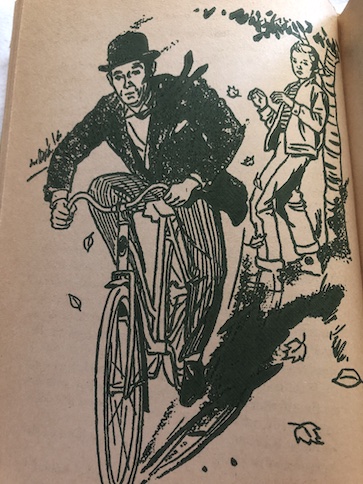
When Jimmy is on his way to the Willoughby estate to meet Brains there after his paper route, he is almost hit by Mrs. Willoughby’s Rolls-Royce … but there’s nobody driving it! Yet, somebody must be controlling it somehow because the car deliberately swerved toward Jimmy and then made a turn in the road. Just after the Rolls-Royce almost hits Jimmy, Mrs. Willoughby’s British butler and chauffeur, Frothingham, comes along on a bicycle, in pursuit of the car. He falls off the bike, and Jimmy helps him. Frothingham explains that he’s got to catch up to the car. He says that it was parked in the Willoughby driveway and that the hand brake was set, and he can’t understand what happened. When Jimmy says that maybe the brake just failed, Frothingham says that he doesn’t think it’s likely because it’s a good quality car and well-maintained. When Brains comes along, Jimmy explains the situation to him, and the two of them follow Frothingham to where he has found the Rolls-Royce parked and apparently undamaged.

Frothingham says that he still can’t imagine who was driving the car and just abandoned it, and Jimmy is still sure that he didn’t see anyone behind the wheel. Brains says that he has an idea about it but that this strange occurrence is a sign that something more serious is about to happen. When Frothingham asks him what he means by that, Brains asks him if he’s seen any unusual strangers around the Willoughby estate recently. Frothingham says that he hasn’t, but Brains is still convinced that the people who are after the prince have been around the Willoughby estate already and that there may be something important hidden in the car.

When the boys later see the Rolls-Royce strike a pedestrian, Frothingham is blamed. The boys are sure that he’s innocent, but they didn’t see who was driving the car, so they can’t swear to it. The boys struggle to clear Frothingham’s name.

My Reaction and Spoilers

I liked this story in the series better than the last one that I read because I felt like there was more intrigue and uncertainty. We do have two specific villains that Brains and Jimmy are looking for from the beginning – the men known as Jujab and the Duke. The characters have descriptions of them, and they know that these men pose a threat to the young prince who will be arriving soon. That means that these people haven’t actually done anything yet, but Brains and Jimmy want to find them before they do.

The incidents with the car are odd and seem like they might be unrelated at first, but they are actually part of the villains’ plot. When Frothingham was first introduced, I was suspicious of him because he seems to be British, but the man known as the Duke is known for posing as a British person. Although the characters in the story seem to have known and liked Frothingham for some time, it occurred to me that he could have been planted in Crestwood for longer than Jimmy’s uncle thought. However, that’s not the case. (Spoiler!) Frothingham is just exactly what he seems to be, an innocent man working for a wealthy local woman. In order for Jujab and the Duke to accomplish their mission, they have to establish some kind of identity for themselves in Crestwood. By making it seem like Frothingham committed a hit-and-run, they get his drivers’ license temporarily revoked so that the man known as the Duke can get hired as a temporary chauffeur for Mrs. Willoughby. Mrs. Willoughby is the one who’s going to meet the young prince when he arrives, so her chauffeur is in a perfect position for some foul play.

The boys have all the information they need to figure this out about halfway through the book, but what makes this book intriguing is that there’s more going on than just the evil half-uncle’s associates trying to get to the prince. When the prince actually arrives, the boys ask him what happens at a coronation ceremony in his country. (This is part of why the prince comes from a fictional country. Not only does the author not have to account for real people and events in a real country, but he can also make up any customs he wants for this country.) The prince describes the ceremony, including a part where the new Emir drinks spring water called the “Water of Life” from a special Golden Vial that has been used for the purpose for generations. The ceremony cannot take place without this Golden Vial, and Brains realizes that, although the prince believes that the vial is back in his home country with his half-uncle, it has actually been transported to the US. It turns out that Mrs. Willoughby’s car was originally owned by the prince’s father and that he left it to her because she was a friend of his and had admired it … and maybe because he hoped that his son would also go to her and retrieve the Golden Vial from the car. The half-uncle’s associates are not just in the US to find the prince but to retrieve this Golden Vial because, without it, the half-uncle cannot be coronated at all.

One other point I thought I would mention is that, when Jimmy first saw the car and didn’t see a driver, I thought that, for some reason, the villains installed a remote control device in the car. This book was written a few years before remote controlled cars were first sold, but with Brains interested in new inventions, it wouldn’t be out of the realm of possibility. However, that’s not the case with this story. The car does have a driver; it’s just that he’s crouched down so he can’t be seen as well. Science and invention enter the story when they realize that they can find the Golden Vial with a Geiger counter because it contains a special stone that contains radioactive material.

The 13 Clocks

The 13 Clocks by James Thurber, 1950.

An evil Duke lives with his niece, Princess Saralinda, in a castle with 13 clocks that do not work. The Duke is a cold-hearted man, so cold that his hands are always cold, and he has frozen all of the clocks. Time itself seems frozen in the cold castle. The Duke comes to believe that he has actually “murdered” time, that it will never again be “Now” in the castle. The Duke is afraid of “Now.” “Now” has urgency and consequences, and he hopes that by stopping time, he will never have to confront “Now.”

One of the Duke’s fears is of his niece’s suitors. Princess Saralinda is lovely and as warm as the Duke is cold, so the Duke does not want to let her go. He needs her warmth as relief from his own coldness. Every time a potential suitor attempts to call on Princess Saralinda and ask for her hand, the Duke thinks up some impossible task for the suitor to accomplish with a sentence of death for failing to accomplish the impossible so Princess Saralinda will never be married.

Then, a prince comes to town disguised as a minstrel named Xingu, which is dangerous because using a name that starts with ‘X’ is one of the things that the Duke sometimes kills people for doing. The prince is a youngest son, and as youngest sons often do in fairy tales, he has gone into the world to seek his fortune, adventure, and the lady of his dreams. At the town’s inn, the minstrel prince hears stories about Princess Saralinda, her suitors, and the Duke’s impossible challenges. In spite of the gruesome consequences for failing to complete the impossible tasks, the prince finds himself contemplating how he might be able to gain entrance to the castle and try his hand at defeating the Duke and winning the princess.

The minstrel prince begins making up a joking song about the Duke, and the people in town are nervous because the Duke kills people for any form of impertinence. One of the Duke’s spies, known as Whisper, witnesses the song and runs off to tell the Duke about it. Then, the prince is approached by a strange little man who calls himself the Golux and who offers to help him, although he freely admits that he makes up stories and often forgets what’s made up and what’s real. The prince doubts how helpful he can be, but the Golux suggests a story he can tell the Duke when the Duke considers killing him and feeding him to his geese, that Princess Saralinda can only be married two days after his death. The Duke would do almost anything to prevent Princess Saralinda’s marriage, so he wouldn’t kill him if his death might be the omen that causes her marriage to happen.

Soon, the Duke’s guards come to arrest the minstrel prince and take him to the dungeon. When he is brought before the Duke, the minstrel prince tells him what the Golux told him to say. The Duke isn’t sure whether he’s telling the truth or not, but since he’s not sure if he can kill him outright, he decides to set one of his impossible tasks for the minstrel to complete. The minstrel says that he can’t do an impossible task because he’s not a prince (as far as the Duke knows), but the Duke says that they’ll make him one just so he can do it.

As the guards escort the minstrel prince back to the dungeon, he sees Princess Saralinda, and she wishes him well, which is all that she can say in her uncle’s presence because she’s under a spell. The minstrel prince falls in love with her, and he realizes that his love is returned when she later manages to give him a rose.

In the dungeon, the minstrel prince encounters the Golux again and asks him how he got in and if there’s a way out, but the Golux is evasive, just telling another one of his stories about his mother being a witch and his father a wizard. However, the Golux has a useful suggestion for managing the Duke’s next impossible task: control what the task is through reverse psychology. He doesn’t use those exact words, but he tells the minstrel prince to beg the Duke to set him any task he likes but not to send him out in search of a thousand jewels. The Duke, being evil, will automatically set him the one task he begs not to be given. The minstrel prince says that he still can’t give the Duke a thousand jewels because he doesn’t have any jewels. The Golux points out that he’s no ordinary minstrel. He is actually Prince Zorn of Zorna, and his father will surely supply the jewels he needs. That’s all very well, but the prince isn’t sure if the Duke will give him the time he needs to reach his father and return.

Sure enough, the Duke sets the prince the task of getting a thousand jewels, but the matter is complicated because it turns out that he’s aware of who the prince really is. Knowing that it would take Prince Zorn 99 days to get the required jewels from his father and return, the Duke gives him only 99 hours to do it, and he further requires that all of the 13 clocks in the castle strike five o’clock (they are frozen at 10 minutes before five o’clock) when he returns with the thousand jewels.

The stakes of the task are high for both the Prince and the Duke because, as a guard explains to Prince Zorn, the Todal, which is a kind of blob monster in the service of the devil, waits to gobble up the Duke if the Duke fails to be sufficiently evil. If Prince Zorn passes whatever test the Duke sets for him, rescues the princess, and escapes, the Todal will surely put an end to the Duke.

The book is available to borrow and read for free online through Internet Archive (multiple copies).

My Reaction and Spoilers

This isn’t a princess book for young children because it has some dark content in it. The Duke is cruel to animals and has even killed children. The cruelty and killing isn’t described in detail, but the story is better for older elementary school children or middle school level. I’d say about 9 or 10 years old and older.

Through the course of the story, it’s revealed that Princess Saralinda isn’t actually the Duke’s niece. He later confesses that he actually abducted her from a castle as an infant, and even he isn’t completely sure of her true identity. Even as a child, she had that magical, glowing warmth that the Duke craves. He’s been raising her with the idea of marrying her himself when she’s old enough. He’s been unable to marry her up to this point because her former nurse was a witch and cast a spell that prevents him from marrying her until she’s 21 years old, and that time is approaching soon.

Part of the fun of this book is that it draws on many elements from fairy tales, like the woman who can cry jewels, which somewhat resembles the fairy tale about the kind girl whose words produce jewels and flowers when she speaks. The solutions to many of the problems in the story are also riddles. For example, if nothing makes a person laugh or cry, then literally nothing is what you have to provide. In the case of how to get the clocks moving again, Princess Saralinda has been the key all along. The clocks aren’t dead, merely frozen, and her warmth can get them moving again.

Of course, it all ends happily. Princess Saralinda’s true identity is established by the end of the story, and Prince Zorn is able to marry her. The Duke is thwarted and eaten by the Todal.

A Meeting of Minds

A Meeting of Minds by Carol Matas and Perry Nodelman, 1999.

This is the final book in the Minds series. Each book in the series begins shortly after the previous book ends, and this one starts only three weeks after the last book.

Princess Lenora and Prince Coren are still in Andilla for their impending wedding when, while simply walking down a hallway of the castle, they suddenly find themselves transported to a land of snow. The world in which they now find themselves is our world (which, I guess would be distant past of their world, the late 20th century). Disoriented and cold, Lenora and Coren go inside a shopping mall to get warm. At first, Coren thinks that Lenora has caused their present predicament (because, usually, she does, either consciously or unconsciously), but Lenora denies having anything to do with it.

At the time they’d been walking down the hallway, they’d been discussing the exhibition at the castle in honor of their upcoming wedding and Lenora’s desire for a better world. The exhibition was called “A Meeting of Minds” and designed to showcase the ways that different groups of people in their world live and what they envision as a perfect world. The entries in the exhibit were chosen as entries in a contest, and a panel of judges from different countries would choose winners from among them. The winning entries would be adopted as real laws in the hope of fulfilling Lenora’s wish of making the world a better place for everyone. What could go wrong? (Seriously, things in this world always go wrong when people try to enforce some vision of perfection, so what’s it going to be this time?) Could the exhibition have something to do with their present predicament?

Lenora and Coren briefly consider different possibilities, including the possibility that some unknown enemy has sent them to this strange place, but nothing really makes sense. Lenora has the uncomfortable feeling that something she’s done may have cause this problem after all, although she can’t think what it is. Either way, they are stuck in a strange land.

They stop a passing girl and ask them where they are, and she tells them that they’re in a mall called Portage Place. That doesn’t really explain much to Lenora and Coren, so the girl tells them to buy a map. Lenora and Coren don’t understand the concept of “buying” (in the last book, they didn’t know the word “economy”). When they try to ask her the name of her “world”, it turns out that the girl is an alien conspiracy theorist, wearing a shirt with a picture of an alien on it and the words “The Truth is Out There” (the slogan from the X-Files tv show). The girl is very excited, thinking that Lenora and Coren are space aliens. She tells them that they’re in Winnipeg on Earth and asks them where they’re from. Coren recognizes the name “Earth” as the old name for their world. This confirms that, although there are fantasy elements in these stories, Lenora and Coren are actually from the distant future of the Earth, although the three of them work out that they might actually be from a parallel universe of our Earth. However, her helpfulness ends when she suddenly seems to suspect them of being “Mindies” and making fun of her. Lenora and Coren don’t know what she’s talking about.

The two of them explore the mall, getting into trouble when they try to stop two girls from taking another child’s toy and end up having security called on them and not having money to pay for food in the mall food court. Fortunately, a couple of other young people in line offer to pay for their food. These young people, Barb and Thomas, seem to recognize them as Princess Lenora and Prince Coren, but strangely, Lenora and Coren learn that they think that they’re in costume and only pretending to be themselves. It slowly comes out that the authors of the book series live in Winnipeg and that there’s a fan convention in town for the books in which Lenora and Coren are fictional characters. (I’ve never actually heard of a convention specifically for this series of books, but I don’t live in Canada, so I can’t swear that it never happened. However, the characters later meet someone dressed as Spock at the convention, so it’s possible that this is supposed to be part of some larger book or sci-fi/fantasy-themed convention.)

Lenora and Coren don’t fully understand the concept of the fan convention, but Lenora sees it as a possible lead to what’s happening, so she insists on going to the convention center. At the convention center, Lenora and Coren encounter other people who are apparently trying to dress like they do and pretend to be them. Some of them even criticize what Lenora and Coren are wearing because their real outfits don’t agree with the fans’ interpretations of the characters. (Fandoms are like this in real life. The more someone likes something and spends time with it, the more they consider themselves an authority on it. They kind of are, but sometimes, fans get wrapped up in their own vision of what they’d like characters to be like that they kind of depart from the original story or get out of sync with the vision of the original authors. It’s almost like they mentally create an alternate reality of a world that was already fictional, which fits very well with the themes of this entire series.) Lenora and Coren think that they’re all very rude for criticizing the way they dress, telling them how they should talk to be in character, and thinking that Coren is a wimp or geek or that Lenora is annoying or arrogant, which some of them say right in front of them.

At this point, someone comments that Lenora sounds just like she does in the books, and the people at the convention start talking about all of the books in this series, which I’ve already reviewed. Finally, Lenora and Coren understand that these people know about them and are imitating them because they have read books about them. Coren is embarrassed when these fans start talking about some of his more embarrassing moments like they’re common knowledge. Lenora gets angry and decides that they need to talk to the authors. (Which seems to have been the goal of this book.)

Coren and Lenora get in line to talk to the authors of the books, but when they meet them, the authors also just think they’re fans of the books who are putting on a little skit for them. There’s some banter with the authors (including some inside jokes that Carol and Perry seem to have with each other, like how bad Perry’s handwriting apparently is), and the authors remark how much Lenora and Coren sound like their characters, although they don’t think they really look like them (which is interesting, as if they have a completely different vision of them in their minds). Lenora gets angry with them and accuses them of stealing from their lives to write their books, so she grabs some of the books the authors and signing and runs away with them.

As Lenora and Coren hide from security with their stolen books, they start reading about themselves. They find that the books do describe their previous adventures together, and they seem to capture some of what they were thinking and feeling at the time, but not everything is correct. In a twist that makes this book a little more interesting than it started out, not everything in the books they read is like the real-life Minds books. Lenora and Coren start noticing that Sayley plays a very prominent role and is described in glowing terms and that her favorite word, “scrumptious” appears frequently. Then, Lenora and Coren discover that one of the events at the convention is a worship service for the “Divine Sayley.” One of the other convention attendees tells them that the Sayley in the books was named after the Divine Sayley, who is a real figure in their world, an angelic-looking girl with divine powers, who seems to be a glowing version of their Sayley.

It seems that Lenora and Coren have discovered the source of this strange world and everything that has been happening to them, but how and why did Sayley do it? Or, did she really do it at all? And how can Lenora and Coren get home when their powers no longer work?

The book is available to borrow and read for free online through Internet Archive.

My Reaction and Spoilers:

First, I’d like to talk about why the authors wrote this book. It’s somewhat of a departure in theme and tone from the rest of the series, and because of that, it annoyed me. At first, I guessed that this book was just the authors’ excuse to have their own characters meet them in the story, to show off a few inside jokes for their own amusement, and to kind of toot their own horns. That sort of story annoys me. I don’t like it when authors do that. When I read a series that I like, I want to do it for the sake of the characters and the stories, not for the sake of the fandom, and any inside jokes the co-authors have with each other are not jokes I am personally in on, so I’m just not going to get the same charge out of them. (There’s an in-joke in this book about Perry Nodelman having some kind of special underwear. I don’t know what it is because it isn’t described, but I’ve seen lots of funny undershorts in those catalogs that come around Christmas, and I don’t really care which pair he owns. Younger readers would probably get more of a kick out of that bit of trivia than I do.)

However, I looked it up, and I found this explanation, written by one of the co-authors, Carol Matas:

Why We Wrote A Meeting of Minds

In thinking about the imaginative powers of the people of Gepeth, it suddenly struck us that they could have imagined us. After all, the Gepethians have the power to make whatever they imagine real, so why not this entire world of ours, including the city of Winnipeg and everyone who lives there–including us? Lenora and Coren are figments of our imaginations–but we might also be figments of theirs. In A Meeting of Minds, that is exactly what happens. Lenora and Coren and the authors Carol M and Perry N come face to face, as Lenora and Coren find themselves stuck without their powers in the city of Winnipeg and unable to get out. Who created whom? And will Lenora and Coren ever manage to escape this frightening city, worse than their worst nightmares? You’ll have to read the book to find out!

That explanation did make me feel a little better about the book, that more thought went into it than just a bunch of inside jokes for fans. The Minds books all focus on the power of the mind and the imagination and the nature of reality. A meta plot, like trying to decide if the authors created the characters or the characters created the author does fit with the theme of the theme of the series, almost like the end of Through the Looking Glass, where the reader is left to decide whether Alice dreamed the Red King or if Alice was just part of the Red King’s dream. However, by the end of this book, the question is resolved, as far as people in Lenora’s world is concerned. According to the story, Sayley really did create Winnipeg and everything in it, including the authors of this book and their books and fandom. There is something a little unsettled about the end of the book, but that’s not what it is.

I can’t talk about my full opinion of this story without some spoilers, though, so get ready: The current problem is actually a plot by Leni and Cori, the annoying doubles of Lenora and Coren created two books ago in the series, although it also turns out that their plot is part of the machinations of someone else.

It’s important to remember that Leni and Cori are basically Lenora and Coren themselves, sharing all of their memories up to the point in time when Lenora created them as separate people, but with twists to their personalities. She created Leni on purpose as a double of herself so she could go off and do what she wanted and people wouldn’t know she was missing, but she made Leni a distinct personality, who would like all of the boring things she didn’t like about managing a household and planning a wedding, so Leni would be happy to stay home and do those things while Lenora herself went adventuring. Cori was an accidental creation, when Lenora’s powers where acting erratically. She was in trouble and wished that Coren was there to help her, but she also wished that Coren was a braver, more action-oriented person, so Cori appeared as a kind of white knight figure to rescue her. Once Lenora created Leni and Cori, she didn’t have the heart to un-imagine them into non-existence because they are now distinct people and personalities by themselves.

Unfortunately, while Leni and Cori are pretty well-suited to each other, they both come with their annoying defects. Leni is frivolous and vapid, getting too wrapped up in petty details, like hair, clothes, and makeup, to care about larger issues. Cori is brave but reckless. He doesn’t have the real Coren’s thoughtfulness and rushes right into danger because his only solution to anything is fighting. Lenora and Coren come to appreciate each other more after seeing what their doubles are like and experiencing their annoying sides. Coren realizes that he doesn’t want Lenora to be like Leni, and Lenora stops complaining that Coren thinks too much. They don’t like their doubles, but the feeling is actually mutual. Because Leni and Cori have personalities that are almost opposite to Lenora and Coren, they find Lenora and Coren as annoying as Lenora and Coren find them, just for different reasons. Cori thinks that Coren is a wimp, and Leni thinks that Lenora is irresponsible and tasteless.

Part of the problem is that, while everyone knows that Leni and Cori are recently-created doubles instead of the real Lenora and Coren, Leni and Cori are still real people with all of the memories of Lenora and Coren. So, while the public and their royal parents acknowledge Lenora and Coren as their real children and the real princess and prince, Leni and Cori are angry and dissatisfied because they are no less “real” and have all the memories of being princess and prince. They are not treated as equals to Lenora and Coren, and their own parents don’t really consider them their children. Leni resents being treated like she’s secondary to Lenora, especially since Lenora made her to be the embodiment of all of the qualities that her parents wished she had. Leni is (for the most part) quiet and obedient, focused on spending all of her time looking the part of a princess, and rarely uses her powers in order maintain the Balance. While all of the preparations are going on for Lenora and Coren’s grand wedding, preparations that Lenora and Coren themselves don’t even find particularly interesting because they just don’t like all of the fuss and pageantry, Leni and Cori are also engaged to be married and actually want the pageantry of a grand wedding instead of the quieter ceremony being planned for them. With Lenora and Coren put out of the way, they can take over the wedding themselves, and Leni thinks that, once people get used to her instead of Lenora, they will think of her as an improvement and forget about Lenora.

Sayley did create the little world of Winnipeg that Lenora and Coren are trapped in as a display, her entry in the A Meeting of Minds contest, but Leni is the one who trapped Lenora and Coren in that world. In another twist, it turns out that Sayley created Winnipeg not as her example of the best world possible but as her example of the worst world possible, which she created for contrast. (Sorry, real world Winnipeg. It turns out that Sayley thinks snow is dreadful, but on the bright side, none of you will ever have to worship the Divine Sayley, which by itself makes real world Winnipeg immediately a better place for everyone.) When Sayley discovers what Leni and Cori have done, she wants to tell Coren’s parents, but Cori reads her mind and Leni banishes Sayley to her own exhibit along with Lenora and Coren.

By Sayley’s logic, what really makes her version of Winnipeg so bad is that nobody there believes in the power of the imagination. Everyone there likes to imagine things and they enjoy hearing about the power of imagination, which is why they are fans of Lenora and Coren, but none of them believe that imagination is real or that they can actually create the things they imagine. Their lack of belief in the powers of the mind is what prevents Lenora and Coren’s powers from working. Even though they worship Sayley as “divine”, Sayley says that they don’t really believe in her, they just consider her to be a symbol. Because of that, nobody there respects the real Sayley or listens to her. Sayley is unable to get the authors, Carol and Perry, to listen to them even though she tries to prove to them that she actually made them because she knows all about the embarrassing pair of underwear that Perry owns. Carol and Perry are still unconvinced and think that Sayley needs “help.”

Fortunately, there is one person in this world who Sayley allowed to have the power of imagination, Michael, and he believes that Sayley, Lenora, and Coren are all who they say they are. Michael figures out how to help them all to escape from the exhibit, but when they do, they still have to face down Leni and Cori and the evil force that is controlling them – Lenora’s old alter-ego and nemesis, Hevak.

The evil way that Leni behaves in this book is a clue that she isn’t quite herself. Normally, being well-behaved is a part of her personality, and her scruples would prevent her from doing any of the things she did, even though she secretly wanted to in the back of her mind. Hevak explains that, because Leni is another version of Lenora, he a part of her as well as Lenora. When Leni was feeling jealous and resentful about the wedding, it awakened him in her mind, and he used his influence to force her to overcome her normal inhibitions and do what she was thinking of doing. At first, I was thinking that having Hevak come back seemed like a bit of a cop-out and seemed a little like those cliched scenes in anime where the villain changes into their “final form” and reveals their “true power”, but that explanation actually does make sense for the way this world functions.

Just as Hevak and Lenora are poised for their ultimate battle, however, it all just kind of comes to an end. Defeating Hevak proves easier than it seems like it should because Hevak himself has changed, even though it doesn’t really seem like it from the rest of the book. What Hevak decides is that he’s been through just about everything – he tried to create perfection and failed, people have called him evil (because he does evil things), he tried to be perfectly good, and for a long period, he was stuck in a state of nothingness. Now, he wonders what it’s all for. He hasn’t really accomplished much, and he doesn’t really see the point in continuing on this way. He’s thought about it so much that he’d really rather return to nothingness and not have to think about anything. It’s a little anti-climactic for how much of a nemesis Hevak is.

However, Lenora can’t bring herself to imagine him as not existing permanently because he was always an extension of herself, so instead, she takes Michael’s suggestion and sends him to Winnipeg, which gives the authors a chance to make a few more jokes about life in Winnipeg. Michael says that there are many unimaginative people there who spend time not doing much or thinking much, so without his powers, Hevak will fit in nicely and feel comfortable. Sayley promises to make Winnipeg a little nicer than it is now without changing its character completely, giving it other seasons besides winter and making it part of a much larger world, so people in Winnipeg won’t feel trapped there if they don’t like the climate and can experience some variety. Unfortunately, she also says that, since Winnipeg was supposed to be her worst world, she’s going to give the other seasons a downside, too, which is why she decides to invent mosquitos for Winnipeg’s summer. (So, now we all know who to blame.) Michael isn’t worried because he says that people in Winnipeg are tough. I kind of liked Hevak’s banishment to Winnipeg for the humor value, even though it felt like a rather easy wrap-up to the story.

This is the final book in the Minds series, and from the way it ends, I think there could be room for another one after it, even though one was never written. The book ends with Lenora and Coren’s actual wedding, stopping just as the ceremony ends. It appears that they are going to live happily ever after with the form of perfection they’ve selected taking effect as the ceremony ends, but exactly what that means is never clarified, probably because perfection is a difficult thing to imagine and maybe complete perfection is impossible to achieve. Lenora and Coren are both happy, although Coren does have some slight misgivings about whether the perfection is going to be too perfect in some way. (Remember, this series is all about Balance.) However, he brushes his worries aside to complete the ceremony. Then, we don’t know what happens after that. Is their new perfect world everything they’ve ever wanted and keep everyone happy forever, or will there be new, unforeseen complications after their marriage? Would new, unforeseen complications actually make Lenora happier than a completely settled world because she actually likes excitement and new problems to solve? Could that actually be her version of perfection? Is there a chance that Hevak will return from Winnipeg or has he finally found his true niche there, shoveling snow? There are no answers to these questions because the series is over, so we’ll never know, but I’ll leave you with a final thought – this world is all about imagination and the power of the imagination to create, so if you imagine something after this, that’s what you’ve created.
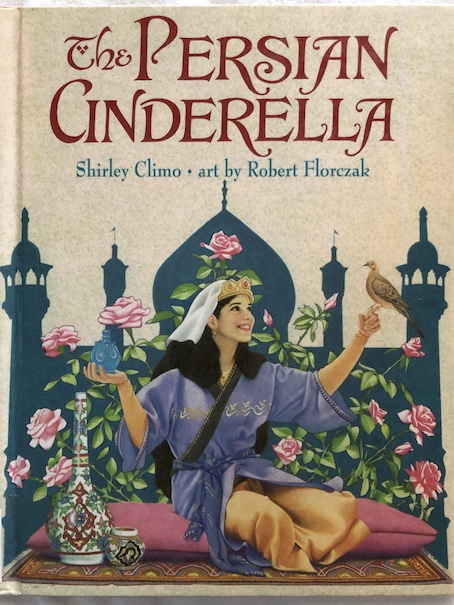
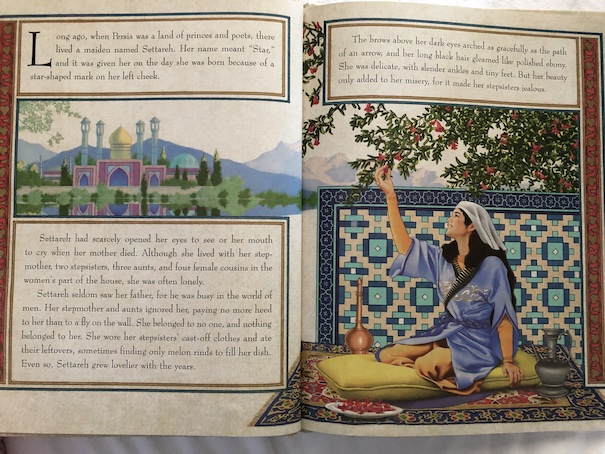
Out of Their Minds

Out of Their Minds by Carol Matas and Perry Nodelman, 1998.

When the book begins, Princess Lenora and Prince Coren are going to Andilla, where their wedding will finally be held. (That seems to go against earlier books in the series, where they were planning to hold their wedding in Gepeth, but whatever. It turns out the Balance that governs this world has decided that it demands it, and so do the authors and story plot.) However, Lenora has been having strange, disturbing dreams about her vanquished alter ego, Hevak.

Lenora is still preoccupied by the concept of the Balance that governs their world and keeps it from descending into chaos because of the powerful mental abilities that the people in their world have. She still feels like the rules that help maintain the Balance are too restrictive, particularly in her home country of Gepeth, and it bothers her that there doesn’t seem to be a system that makes everyone perfectly happy. Somehow, no matter what system people in different countries have, someone is always unhappy or doesn’t fit in with the way the country lives. Lenora dreams of developing a perfect system of life and Balance, providing every individual person with perfect happiness and justice. Fortunately, since the last book in the series, she has come to realize that before she attempts to create a perfect world, she needs to think it over more and decide what a perfect world really looks like and how it should work.

It’s noble goal, and I don’t consider myself a cranky old cynic who hates youthful enthusiasm, but anyone who’s ever tried to get a roomful of people to agree on pizza toppings only to learn that at least one person in that room is also gluten intolerant and can’t eat the pizza at all unless you specifically take that into account at the beginning of the process knows that finding any system that makes absolutely everyone happy is not an easy process. Even putting together a system in which the majority of people are pretty happy most of the time is a major undertaking and involves taking into account various real world conditions and different peoples’ needs, things which Lenora has previously found boring and completely ignored in her lessons. She usually likes to play with ideas and consider possibilities more than getting into the nitty gritty details of how things actually work. I’m saying that she’s got a long way to go.

However, Lenora and Coren soon encounter other problems which are even more pressing than the preparations for their upcoming wedding. Something is very wrong in Andilla. Usually, the people there prefer using their imaginations to change their perceptions of reality rather than doing anything to actually change reality itself. They let their buildings turn to ruins as they live in the mansions of their imaginations, which is why Prince Coren prefers the way people in Gepeth live, actually creating and maintaining real things. (When Lenora sees what Andilla is like, she decides that she’ll never think of Coren as a coward again, as she has in previous books. He is usually more cautious than she is, but Lenora comes to recognize that it has taken courage for him to acknowledge the way his people really live outside of their imaginations instead of trying to hide from it and live in his own mind. It’s a step forward for Lenora.) People in Andilla also use telepathy to communicate directly with each other, mind to mind, rather than speaking out loud, something even Coren finds invasive at times although he uses that power, too. However, the people of Andilla are suddenly losing their ability to communicate telepathically, and their ability to maintain their imagined realities is fading. They’re having to resort to speaking aloud and seeing things as they really are, and Coren’s mother is beside herself. Coren’s father, the King of Andilla, hardly even seems aware of the problem because he has become deeply absorbed in his new hobby, baking things. People in Andilla usually do very little cooking, just turning very basic foods into whatever they want to imagine that they’re eating, but the King Arno has discovered the joy of baking in the new kitchen that Lenora’s parents actually created for his castle out of sheer desperation.

Kaylor, the Thoughtwatcher, who is the person responsible for maintaining Andilla’s version of the Balance, suspects that the king’s recent cooking might be responsible for shattering Andilla’s illusions, but most people don’t think that’s it. Everyone in the country seems to be affected, although King Arno can’t recall his two closest advisers complaining. Actually, he can’t recall seeing them around at all since the trouble began. Actually, nobody else has ever heard either of their names before. Actually, it looks like King Arno probably invented them as imaginary friends when he was a boy, forgot he invented them, and has been following their imaginary advice ever since because it generally seems to work out.

Lenora suggests that, since there don’t seem to be any answers to the immediate problem in the castle, she and Coren should go out to the countryside, meet the people of Andilla directly, and see if there are any answers there. (Plus they can get away from their annoying doubles, Leni and Cori, who were created in the last book, and the argument they’re having over who really owns Coren’s old room and the stuff in it.) Queen Milda and King Arno admit that, although they’ve spoken to many of their subjects with their minds, they’ve never actually met them face-to-face.

As Lenora questions Coren about the people in the castle and life in Andilla, she is also surprised to learn that, although everyone in the kingdom eats an odd kind of blue mush at every meal (while imagining it to be something far better), even Coren isn’t quite sure what the mush is made of and where it comes from. Of all of the people in his kingdom, Coren is the one who was always more interested in living in reality than fantasy and finding out how things really work, and it seems odd to Lenora that he’s never questioned the food that he’s eaten at every meal for his entire life in Andilla. According to Coren, it just appears in vats every day, and people help themselves to it or have a servant bring them some. No matter how empty the vats are at the end of the day, they’re always full the following day, and he has no idea who fills them, how, or why. To his surprise, Coren realizes that he’s never even thought to question it before, although he’s questioned nearly everything else. Lenora starts to wonder if that could be a key to the puzzle and if Coren actually has some kind of mental block against questioning the food, perhaps something his own people intentionally put there in order to keep their country’s version of the “Balance” in place, reinforcing the version of reality they’ve chosen to live in.

Investigation of the countryside reveals a previously unknown side to Andilla that everyone there has been ignoring, along with the dilapidated condition of their own homes and society. In a place where no community is supposed to be is an entire town of strangely neat, well-kept houses (the only well-kept houses in Andilla) and people all dressed alike whose only goal in life is constant work. The people there, who call themselves Skwoes, seem surprised that Lenora and Coren can even see them. They are the source of the blue mush that the other Andillans eat, although everyone else is unaware of it. The Skwoes are a forgotten part of Andilla’s Balance because everyone is too busy living in their imagination to notice them. Although they feed the rest of the population in exchange for payment from Andilla’s supply of gold, according to an ancient arrangement, they are disdainful of the lazy population they support, who spend their entire time living in their imaginations. (This is when we learn that none of our main characters have any idea what the word “economy” means, not to mention being completely unaware of the fact that Andilla actually has one.)

That explains part of the mystery, but there is still the question of why the Andillans have now lost their powers of imagination or why Lenora’s bad dreams about Hevak are getting increasingly worse.

The book is available to borrow and read for free online through Internet Archive.

My Reaction and Spoilers

Hevak is back … sort of. In the first book of the series, Lenora made her evil alter ego, Hevak disappear. But, we’ve also previously established that everything Lenora creates actually does exist somewhere. Exactly where Hevak went is somewhat nebulous, but he manages to communicate to Lenora that, when she made him disappear before, she accidentally sent him to another world where everything is the opposite of what it is in their world. Hevak says that this world really is the perfect world that Lenora has always dreamed of creating, where everything is happy. He also claims that he has now turned “good” himself and wants to help Lenora make everything in her world “good.” Hevak’s influence has been what has been causing all of this disruption to everyone’s powers, and he begins taking over Lenora.

Lenora does have a genuine desire to make the world a better place. She really always has wanted the world to be better, but what that means changes over the course of the series. At first, Lenora thought that making a better world involved more excitement, more freedom, and fewer rules. In this book, it’s about people loving each other and having all of their needs fulfilled. In the end, the characters aren’t completely sure whether that part was Hevak’s idea or whether Lenora’s desire for a better world was what called Hevak back from wherever he is now, but it does call into question what “good” really is and whether it really is possible to have too much of a “good” thing.

When Lenora, under Hevak’s control, tries to be “good” and help everyone with even their tiniest problems, she does create some fantastic and helpful machines that last even beyond the latest adventure. However, this form of “good” and trying to help everyone goes way too far because it is an extreme form. There is no “Balance” to it. In her “good” form, Lenora unconsciously drains other people of their powers, apparently so she can use them herself to make everyone “happy” and build the perfect world. She uses the Andillan ability to read minds in order to plant the suggestion of love in everyone’s mind, drawing them to her because she is suddenly ultra-appealing to everyone, and to find out what everyone wants and needs. Then, she uses the Gepethian of creation to make everything as everyone wants. Because this is an out-of-balance approach to making people happy, Lenora ends up being ultra-controlling (something she normally hates herself, when she’s in her right mind) of other people, and also because she has this desperate, uncontrollable need to make everyone happy, she struggles to grant their tiniest wishes, whether or not they would actually be good for anyone involved. Some of the wishes people have might make them happy in the moment but would be terrible for them in the long run, like young Sayley’s wish to never stop eating because she’s enjoying the food so much, and Lenora, in her current state, is unable to think beyond this desperate need to just give everyone whatever they want the moment that they want it. Coren, recognizing the problem, tries to free Lenora from the influence of Hevak but ends up under Lenora’s control himself because he loves even without the telepathic influence and the efforts to please everyone and cannot help being drawn to her.

Fortunately, Lenora, being a human girl even with her extended powers, soon begins to find everyone’s constant demands on her overwhelming. Even in the midst of this unbalanced effort to make everyone happy, no one is ever completely happy. Just like in the last book, where Lenora visited the distant past and witnessed a completely out-of-control world where everyone could do absolutely anything they wanted with their minds, it quickly becomes apparent that getting everything a person can think of instantly doesn’t make them happy. No sooner does someone thing of something they want and get it, they think of something else that they also want. Sometimes, people change their minds about what they want because what they got didn’t make them as happy as they expected it would. Human wants and needs and the imagination to think of new possibilities are never-ending. These are the basic reasons why humans never achieve perfect happiness. Eventually, Lenora snaps under the pressure of trying to keep up this impossible system when Coren, who at first only wanted to love Lenora and seemed like he was the only one truly happy with her, suddenly decides that he needs a glass of water and that it must have a straw. Yep, that’s the last straw that finally annoys Lenora enough to break Hevak’s hold on her.

I already mentioned above that creating a perfect system of anything is difficult, especially when you have many people with competing needs and some with needs that are completely unknown. Throughout the series, both Lenora and Coren have been learning more about the way their world and their powers function, which I think is good because it shows character growth. Usually, it’s Lenora who needs to learn something, but in this book, Coren also learns about sides of his own home country that he never knew existed before. There is an entire group of people in Andilla he knew nothing about, and they’re the only reason why there is “Balance” in Andilla and why the system there keeps working (not to mention their “economy”). The Skwoes and the other Andillans are total opposites in the way they live their lives. While most Andillans live in their imaginations to the point where they have completely lost touch with reality and the state they actually live in, the Skwoes have shunned all imagination and creativity in the name of practical work. Both groups are extreme, and up to this point, they have needed to be extreme in order to maintain a Balance with each other. But, maybe they don’t actually have to be that way because Balance can also mean reaching a happy medium. Lenora comes to realize that the difference between the Gepethian Balance and the Andillan Balance is that the Andillan Balance is more communal (although about half of the community was completely unaware of it up to this point), with one group of extremists balancing another group of extremists. In Gepeth, society focuses more on making individual people behave in a more balanced way. In the past, Lenora has found the enforced individual responsibility in Gepeth repressive, but she actually comes to appreciate it as a more balanced approach than the Andillan extremes.

In the end, the different groups in Andilla (now that they really know about each other), begin building a new form of Balance where some of each of their qualities being rubbing off on each other. The formerly purely imaginative Andillans come to see that they do need to face some parts of reality in order to rebuild their crumbling buildings and society, and they work out new contracts with the Skwoes to help them take care of these practical projects. Meanwhile, the Skwoes, freed from the monotony of just producing blue mush (made from some kind of plant material that’s never fully explained), begin enjoying these new work projects and actually not feeling bad about enjoying something for once. This new variety of work has a creative side that reawakens some of the Skwoes’ latent imaginations, and the book leaves the impression that the different Andillan groups will develop and new Balance of creativity and practicality. Also, Coren, who was troubled before about the way his people lived and even resisted using his powers too much because it felt too out-of-balance to him, comes to realize that using his powers sometimes is also part of the Balance and comes to appreciate his own abilities more.

Even though part of this story really reiterated some of the themes of the last book, I thought that it also did a good job of exploring Andillan, delving into how such a world could actually work, and considering new possibilities for it to change. Lenora also becomes more thoughtful as a person in this book. Some of that was partly from her unnaturally increasing need to be “good” and help people, but the characters also consider that it was partly Lenora’s real desire to make the world better that may have accidentally summoned Hevak back. Lenora and Hevak are two sides of the same person (with Hevak being the more unbalanced one in everything he does), so this desire to be helpful is still a part of Lenora’s personality. Lenora also continues to use the lesson that she learned in the last book about the need to think before she acts (although her thoughts are disrupted due to Hevak’s influence), which I also thought was a nice touch of character development. One of Lenora’s before traits was that she was slow to learn and actually resisted learning when it was offered because she was too absorbed in wanting to do whatever she wanted in the moment, so it’s nice to see her growing out of that.

More Minds

More Minds by Carol Matas and Perry Nodelman, 1996.

Since the last book in the series, Princess Lenora and Prince Coren have become engaged. Prince Coren has been living at Princess Lenora’s family’s castle in Gepeth while they get to know each other better and begin planning their future lives. Prince Coren appreciates the real and solid style of life in Gepeth, which is very different from his own country, where people use their special mental abilities to live in their imaginations, never creating anything real. Princess Lenora has calmed down somewhat since their last adventure, brought on by the alternate version of herself that she accidentally created because of her over-indulgence in using her special abilities to bring things that she imagines to life. All of the people in Gepeth have that ability, but Lenora’s abilities are especially strong. Also, everyone else in Gepeth controls their abilities more in order to maintain the common reality that they all share and prevent the state of reality from collapsing into chaos – what the people of Gepeth call “maintaining the Balance.” After seeing what the dark side of her own mind can do if not managed properly, Lenora has been limiting herself only to creating small things with her imagination, like special desserts for her and Coren to enjoy.

However, news comes that a giant has been attacking the land, and even though the people of Gepeth have tried to use their special mental abilities to make it go away, it seems immune to them. It sounds frightening, but Princess Lenora always craves excitement and insists that she be allowed to try to solve the problem. After her past escapades, her parents and others don’t fully trust Lenora, and they tell her that there’s no way that they’re going to let her try to deal with the giant. They even suspect that perhaps the giant is a figment of Lenora’s powerful imagination, run amuck again. Only, that isn’t the case, this time. Lenora is just as surprised as everyone else by the news, and she’s determined not to be left out of the excitement. While everyone else tries to think of some boring, sensible solution, impatient Lenora tries to work out a plan of her own that will allow her to have the adventure she craves.

The plan Lenora chooses is to create an alternate version of herself with her imagination. This double of her will stay with her parents and Coren, doing what she’s supposed to do and being bored, while the real Lenora sneaks out to go on a wonderful, exciting giant hunt. What could possibly go wrong? Seriously, Lenora, what could possibly go wrong after you discovered an evil alternate version of yourself in the last book, created by indulging the dark side of your imagination and your selfish, immature tendencies?

To be fair, Lenora quickly realizes her mistake when she creates an exact duplicate of herself and starts to worry that her duplicate might want to get rid of her and take over. She makes her duplicate disappear just in time, right before her duplicate tries it. (Nice going, Lenora. You’ve proven once again that you can’t really trust yourself.) Instead, Lenora decides to create a duplicate of herself who looks like her but has a very different personality, the sort of girl who enjoys the boring tasks her parents want her to take an interest in and all the minutia of the wedding planning. When Coren meets her double while talking to the man in charge of handling the wedding arrangements, he notices an immediate difference in her. For the first time, Lenora suddenly seems to care about things like pew ribbons and italics on wedding invitations. At first, he thinks that Lenora is being sarcastic about how exciting wedding planning is compared to chasing a giant, but a peek into her mind doesn’t reveal any sarcasm or duplicity from “Lenora”, something that really puzzles Coren. He becomes increasingly suspicious as Lenora’s out-of-character behavior increases, and she starts calling him by the pet name “Cori” and insists that he call her “Leni.” Lenora’s friend, the healer Lufa, has also noticed “Leni’s” odd behavior, but they are soon distracted when a tornado strikes the city.

All over the kingdom of Gepeth, strange things are happening that shouldn’t be happening. The Gepethians work hard all the time to keep their kingdom orderly and predictable, to “maintain the Balance.” Normally, they even control the weather. Mostly, the weather is wonderful, and because plants need watering, it rains every Sunday between two and six o’clock. They never have tornados, and few people have even read enough old books to know that word.

As Lenora journeys to find the giant, she also encounters unpredictable weather in the form of a snow storm. She is forced to seek shelter with a family of farmers, and none of them has any idea what the snow even is. Although the farmer’s wife has reservations about using their special gifts, both her husband and Lenora try to imagine the snow away and are unable to do it. Like the giant, it seems unaffected by their powers. After awhile, the snow suddenly disappears, but it’s one more sign that something is terribly wrong in Gepeth.

In fact, it’s not just Gepeth that’s in danger. In Coren’s home country, Andilla, where people live mostly in their imaginations instead of in the world as it really is, people are increasingly finding their thoughts and imaginings are getting scrambled. People fantasies are intruding on each other’s, and when Coren’s father attempts to communicate with Coren mentally, his thoughts get jumbled with someone thinking about cooking.

It seems that the Balance is out of balance everywhere, and the usual mental gifts that people use to keep the Balance are no longer effective.

The book is available to borrow and read for free online through Internet Archive.

My Reaction and Spoilers

I have to admit that I don’t have nearly as much patience with Lenora as I did when I read these books back in middle school. In the beginning, Lenora is impatient with everyone else for wanting to think before acting, like that’s a bad thing, but she also worries that, after their thinking, they’ll actually come up with a solution to the giant problem before she has an opportunity to get involved herself. Oh, noes! First, she thinks that thinking is bad, which is a sure sign of stupidity and that she has learned nothing from her previous misadventures, but also, she seems aware that this thinking that she hates is actually pretty likely to produce a solution. Lenora doesn’t really want to solve problems; she wants to enjoy them, and that’s a large part of her problem. For a young teenager, this attitude can be accepted as just part of Lenora’s character and taken to be just the catalyst for the rest of the adventure, but for an adult, it’s just a sign that Lenora never learns. She’s in her late teens, contemplating marriage and the future ruling of her kingdom, and she never learns. Deep down, she kind of seems to know better, but she doesn’t want to think. It’s maddening. Of course, part of that is because I can tell that the stories in this series kind of magnify “typical” teen traits of impulsiveness, rebelliousness, and lack of full understanding of the world and then put them into this fantasy setting. When I was young, I was more fascinated by the dynamics of Lenora’s world and figuring out how it worked than noticing the teen tropes, and now the teen tropes are annoying me. I’m actually more annoyed by the tropes and this sense I have that the authors probably expect adults to nod their heads and think, “typical teen” than I am by Lenora herself because I think that some of her behavior is that the authors set her up to be this cardboard cutout of a “typical teen” who sometimes goes wild with her powers than a fully developed character. I feel like her personality needs more depth and nuance.

Before the book is over, however, Lenora becomes a little more interesting as she has to deal with certain situations on her own, and she begins to see the sense in using her brain to solve problems, by thinking, not just impulsively pulling things out of her imagination. It’s partly when she accidentally creates a duplicate of Coren who is more physically brave and impulsive than the real Coren that she realizes the benefits of thinking things through before acting. She also comes to realize that some of what she thinks of as Coren’s “annoying habits” are actually positive traits. She occasionally wishes that Coren would worry less and be quicker to act, but after seeing what this opposite Coren is like, she comes to value the real Coren that much more. Fortunately, the second Coren, who likes to be called “Cori”, turns out to be a perfect match for “Leni.”

I thought that the relationship development between Coren and Lenora was good, although Lenora admits, even to herself, that she is deceiving him with her double, they are separated for part of the book. The two of them still love each other, even when they sometimes disagree or drive each other crazy. Coren understands Lenora, although he doesn’t agree with her, which is commendable. He knows that she craves adventure, excitement, and travel, all things that he could happily do without, preferring a more comfortable, settled life. He tries to explain to Lenora that, once the two of them are married, they will have the power to organize their lives together as they see fit. If Lenora wants to travel through the kingdom, dealing with problems and settling disputes, while Coren stays home and manages the life of the palace, he would be perfectly happy with that arrangement. It’s the opposite of what Lenora’s parents expect, wanting Lenora to tend to domestic matters and raising her future children, but as Coren points out, it’s more important that they arrange their lives and relationship in a way that suits the two of them and how they want to live. Lenora also comes to realize that she loves Coren being the person that he is, especially after meeting the incarnation of her fantasy about what Coren could be.

Overall, I often have the feeling that Coren is a more developed, nuanced character than Lenora. I think it’s partly because he is a more thoughtful person, and than gives him depth. He has now lived in two lands which are very different from each other, and it’s given him more perspective on the nature of reality and how people interact with it. He has not only seen different ways of living and experienced different ways of thinking, but he’s processed it and come to conclusions about it. That’s growth and character development. Lenora, on the other hand, has to be practically hit over the head by any situation in order to take it in and learn anything from it, and a large part of that is, unfortunately, plot device and the authors’ need to keep her in this impulsive, rebellious teen way of thinking.

That being said, this book does make it clear that Lenora is not the only person in their land who is dissatisfied with things being the way they are. People are unhappy and somewhat stressed because life in general has become entirely too predictable. People don’t travel to other places because they’re expected to be settled and enjoy the “perfect” conditions exactly where they are. They don’t see or experience new things during the general course of their lives. People don’t even control the names of their own children, which also seem to be granted to them as part of the “Balance.” It never even rains unexpectedly in Gepeth. Maintaining the “Balance”, the stable life that people in Gepeth know and value, involves strict control, but it seems that their control has gotten entirely too strict. Their efforts to avoid chaos have pulled things too much in the other direct, over-control, and over-control isn’t really “balanced.” Lenora thinks of her parents and the other leaders of their community as “bullies” for forcing people to live in a system where nobody is really happy. They try to explain to her why it’s necessary, but Lenora doesn’t want to listen until she sees for herself what the world is like with no Balance at all.

Too much chaos is the entire reason why Lenora’s people created the Balance in the first place. As Lenora and her friends try to unravel the mystery of why the Balance itself is falling apart, Lenora discovers that she herself is accidentally the cause of it. When she left the world that her alter ego had created in Grag leaderless in the last book, the people living there decided to try living in anarchy. It was fun for them for awhile, doing anything and everything they wanted with no rules, but then they discovered that they also had the power to make things they imagined become real. They used their powers, experimenting with them freely, and things got out of control. The chaos from Grag has since been spilling over to other worlds, disrupting their Balance. But, just as Lenora discovers that she is accidentally the cause of the problem, she also turns out to be the accidental solution to it.

Lenora gets to see what the world was like before the Balance was created. This is the book that implies that Lenora’s world is actually our world, but in the far distant future, after people evolved to have special mental abilities. When she goes to the past, a boy tells her that it’s the 21st century. Her past is our current time, which is also chaotic, but for very different reasons than in the book. The people in the 21st century have no control over their abilities, and the fabric of reality changes almost constantly because no one focuses on any one version of reality for any length of time and there is no agreement from anyone on what reality is or should be. In an odd way, I do find that appropriate for today’s conspiracy theory atmosphere. (For the umpteenth time, no, coronavirus is not man-made as a biological weapon in order to control people and make them “live in fear” like something an evil overlord from an ’80s cartoon would do, and it would be the world’s stupidest biological weapon if it was. Only an idiot would both create and release a biological weapon they didn’t already have a cure or vaccine for so they could make sure that they themselves didn’t get sick, and you’ll notice that no country or group of people has been spared. Releasing the disease first and vaccinating after would be like burning the village first and then looting it. Some things just have to be done in order, or they don’t work. I’m not impressed by this theory in any way, and I’m not going to be. I think people who make real biological weapons put more thought into it than people who make conspiracy theories. A person who really wanted to control others wouldn’t care so much whether or not they stayed in their homes but about what they were thinking and whether or not they had access to outside information, so it would be smarter for them to try to bring down the Internet or restrict access to it. Or maybe just use it to spread wild conspiracy theories to confuse people about the nature of reality or, better yet, help them to confuse themselves while avoiding responsibility for it. That’s also a form of control, manipulating people mentally and emotionally. Think about it.)
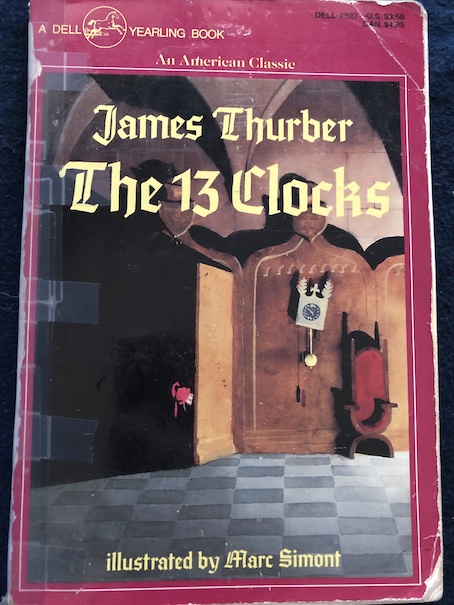
However, the past of Lenora’s world is like that if people had the actual ability to change reality for not only themselves but everyone else around them just by thinking something. Buildings constantly change shape there or turn into trees, and people become animals or wheels so they can just roll down the street. Sometimes, it rains candy, and sometimes, a giant worm destroys buildings. It’s pure chaos, and in the time that it takes for Lenora to notice each change, it suddenly changes again with someone’s next thought, leaving everyone unable to understand anything that’s going on or get any kind of grip on reality. (Personally, I would picture a world like this as being something like a physical version of absolutely everything that has ever appeared on the Internet without any moderator interference, but because this is a middle school level book, no one is naked or having sex in this world, at least not where Lenora can see it, thank goodness. There is a hint that people are definitively thinking about it, though, when everyone gets a peek into everyone else’s mind, and Lenora’s mother is appalled at some of the filthy things that people think.) In order to solve the problems with the world, Lenora has to reconcile her own feelings about the Balance and decide what sort of reality she would really prefer to live in. The fact is that people in this past world, where they could do and be absolutely anything they want whenever they want hasn’t made them happy. Part of the reason why things change so rapidly is that people discover that they’re not really happy with anything they create. No matter what it is, it’s never as good as what they originally imagined, it doesn’t change their emotions, and because the human imagination is limitless, they can always think of other possibilities to try that never turn out any better than what they did before and still leave them feeling unfulfilled … much like Lenora’s alter ego, Hevak, previously kept changing his/her perfect world because he/she never felt like she reached perfection in anything or like how Lenora’s creation of herself as the perfect princess she thought other people wanted is annoying and too absorbed with frivolous things or her fantasy of the perfect Coren turned out to be a dangerously rash bonehead because he never stops to think before he does anything. Maybe happiness isn’t really about getting everything you want (or think you might want) in the moment you want it but learning to stop and genuinely appreciate what you actually have. One 21st century person, reading Lenora’s mind, sees that she’s thinking exactly that and confirms that this is a problem. As exhilarating as Lenora finds this chaotic past, she begins to see the problems with it. It’s a very free place, but the truth is that it’s not perfect, either, by any stretch of the imagination.

In an ironic twist of fate and time loops (spoiler), it turns out that Lenora herself is the one who created the original Balance, producing the very world that she finds dull and stifling. When she was feeling overwhelmed by the chaos around her and even in her own mind, she conjured up a vision of home, and to her surprise, everyone liked it. It was the one world everyone could agree upon. It’s not perfect, and that still worries Lenora. At times, it’s overly controlled, and there is still room for improvement, but faced with that crazy, random chaos, it was a vast improvement. There was also some room in the Balance for people to gather in groups that wanted to do things in somewhat different ways, which is why people in different countries live in different ways or seems to have different mental abilities. The Balance feels rather controlling (especially to people who think like Lenora), but it does have some built-in flexibility. What Balance or Equilibrium or control feels like or requires is a little different everywhere, as each community interprets it, and there are some people who feel like misfits in their own land because they prefer the way other places do things, like how Coren really prefers the lifestyle in Gepeth to Andilla, where he was born. So, Lenora’s problems with the Balance might not be so much because Balance itself is a bad idea but that the way it’s implemented in Gepeth is a little too restrictive, and she would really prefer a slightly different type of Balance.

Because Lenora is kind of painted as this typical rebellious teen character, it seems that her acceptance of the concept of Balance stands for growing up and accepting adult responsibility and the rules and limits that come with it. When Lenora gets the chance to see inside her father’s head during the chaos, it turns out that he actually does feel the same way that she does about some things. He finds some of the processes involved in ruling boring and annoying, and he sometimes gets impulsive thoughts, like sending someone he doesn’t like to the bottom of the ocean. It’s just that, under normal circumstances, he doesn’t act on any of these thoughts or try to make them reality because he understands the heavy consequences that come with his actions and why it’s better to control his impulses. He understands the chaos that Lenora needs to experience for herself in order to understand the need for Balance. Lenora comes to realize that she does need some measure of control and stability after being confronted with a reality that is utter chaos. Like someone on an old episode of MASH said, “It’s easy to play the clown when you don’t have to run the circus.” Lenora likes excitement and a dash of chaos until everything is chaos, and she has to be the one to stop it and put things in order. But, I think that the book does pose questions and ideas that go far deeper than a teen learning to settle for some for the duller aspects of the adult world and responsibility. What is the real nature of reality? What level of control do we all really have in life, and how much do we really want? What do we really want our world to be?

Now, it’s possible that Lenora could still make some adjustments to the Balance. In the end, she still wants to do that. It’s possible that life in Gepeth could be a little less controlled. Maybe it doesn’t always need to rain on Sunday, or it could rain twice a week sometimes instead of once. Maybe a surprise rain storm could be fun, even if it does spoil your planned picnic because you end up staying inside and telling ghost stories with your friends and have more fun in an unexpected way. Maybe people could have some different names from the ones that they usually use and even come up with some better ones as well as a few that turn out hilariously bad. Maybe a dash of imperfection and unpredictability would make life a little close to feeling perfect … but maybe accepting that no version of life is ever completely perfect or makes everyone completely happy all the time might be the best way to start.
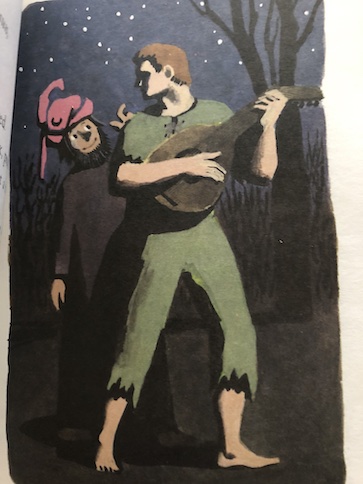
Everyone reading this lives in a world that is partially controlled by rules and limitations and is partially chaos, where things happen that nobody predicted and predictions are sometimes wrong. Is everyone here happy? Not everyone, and certainly, not all the time. In fact, much of the time, a lot of people aren’t particularly happy or entirely satisfied, even by our own personal decisions, which don’t always turn out the way we imagined they would when we made them. But, there are things, even in the middle of chaos or while dealing with the little rules and hassles of daily life, that are still good and make us feel happier. Life isn’t all great, but it’s not all bad, either. Sometimes, we get sudden shocks that lead us to rude awakenings, and sometimes, we’re pleasantly surprised. Everyone strives for balance in their own way, but whether or not we ever achieve perfect balance (we probably won’t), we could still appreciate some of the better things we do have and out own potential to improve. We can develop a kind of mental balance, even in an imperfect world.