Of Two Minds

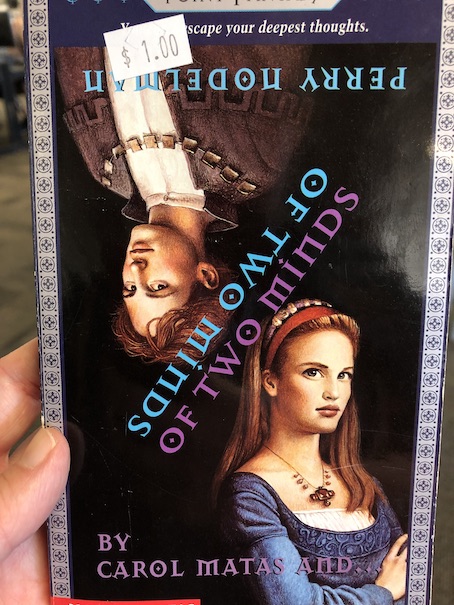
Of Two Minds by Carol Matas and Perry Nodelman, 1995.

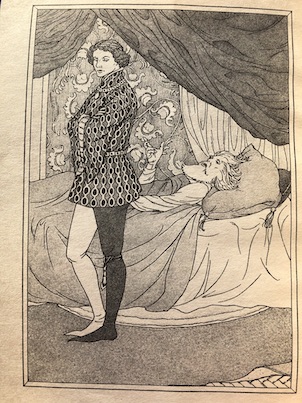
Princess Lenora lives in a world where people can make things from their imaginations real just by thinking about them. This is a common “gift” that everyone in her country has, but the thing that really upsets Lenora is that people aren’t allowed to use their “gift” whenever they want to. Lenora’s parents are frequently upset with her for disrupting their calm, orderly world with her wild fantasies. They remind her that the reason why they have these rules was that their world was in chaos before people learned how to use their “gift”, and the chaos was only resolved when everyone agreed to maintain the same reality so they could all live in a safe, stable world that makes sense. They call this maintaining “the balance.” However, Lenora thinks that this stable world is boring and laments that there are never any technological developments or anything really interesting or exciting, like in the fantasy books she reads.

At this point, I pause to reflect that, in real life, we don’t have a world where people can change the nature of reality just by picturing something, and in spite of living every day in a common reality, our world still doesn’t completely make sense, people can have very different interpretations of things that are happening as if they lived in completely different realities of their own making, the idea that everyone could agree on one shared reality to create for any length of time sounds unbelievable, and when “exciting” things happen in world events, they are often not “interesting” or pleasant. Lenora is a teenage girl who doesn’t have a lot of experience yet in worlds that her people maintain in order to stay safe and sane or that she has not created herself and had control over. That’s about to change.

While everyone in Princess Lenora’s world has mental “gifts” that allow them to make imaginary things real, Lenora’s abilities are stronger than most, and her parents worry that her powers are getting much stronger. Lenora has trouble resisting the urge to imagine things and make them real, and although she loves doing it for the excitement and sense of power it gives her, it’s starting to scare her because it feels like her fantasies are starting to control her instead of her controlling them. Her fantasies have started to take darker turns, and frightening things are starting to become real, and she’s not even sure if they’re really coming from her mind or not. Because Lenora is turning seventeen years old, her parents are in the process of arranging a marriage for her to a prince from a neighboring kingdom, and they hope that marriage will help settle her down. However, Lenora isn’t so sure about the marriage or her increasingly difficult to control powers. When she talks to the healer, Lufa, about it, Lufa says that it’s not unusual for young people to experiment with their mental powers and that Lenora’s disturbing fantasies are coming from a dark part of her own mind that she will have to learn to control. She offers to spend some time working with Lenora and helping to develop her control.

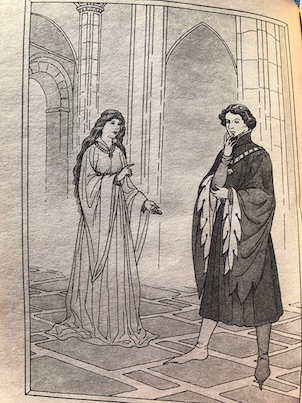
Meanwhile, Prince Coren, Lenora’s betrothed, is having his own doubts about the impending wedding. In the first place, he thinks that he isn’t very handsome and isn’t sure that Lenora is going to like him. In the second place, he doesn’t really like change. Change makes him very nervous, although he doesn’t like the way things are in his kingdom and has felt for some time that things really need to change. People in his kingdom, like in Lenora’s, have special mental gifts, but they work in somewhat different ways. The people in Lenora’s kingdom, Gepeth, have the ability to change the nature of reality with their imaginations but often restrain their abilities in order to live in a common reality. In Coren’s kingdom, people have the ability to make things they imagine look and seem real, but they cannot actually change the nature of reality itself. They don’t bother to restrain their abilities at all, preferring to live in their imaginations. They don’t bother to keep their homes and buildings in good repair, just imagining that they live in opulent mansions and sleep in soft beds when their buildings are actually crumbling and they sleep on the ground. More than anything, Coren wants to build and enjoy something real instead of living in this imaginary world that he knows is not real at all. Also, Coren’s people have the ability to read each other’s minds, and they do it all time. The mostly talk to each other directly in their minds, not out loud or face to face, and they’re also in the habit of snooping and eavesdropping on each other’s thoughts. Coren tries not to be so obtrusive, and while his parents have some concerns about him marrying a girl who can’t speak mentally, Coren finds the idea a relief. Still, he’s not quite sure what to expect of Lenora or sure that she’s going to approve of him.

As Coren and his family approach Lenora’s kingdom, and he thinks and worries about meeting Lenora, he begins accidentally joining Lenora’s thoughts and fantasies. He begins getting a taste of what goes on in Lenora’s thoughts and imagination, and for a person who craves stability as much as he does, it’s unsettling.

It turns out that, although Lenora’s parents have mentioned marriage to her before, she has not been informed that her intended husband is on his way until he actually arrives. She is shocked and angry when her father suddenly springs Coren on her without warning, and Coren’s parents are dubious about this marriage when they discover that Lenora was not even informed that it was going to take place. They read the Lenora’s father’s mind and learn about Lenora’s previous antics with her powers. Coren begins having serious doubts about this marriage, and so do his parents, although they kind of admire Lenora’s imagination since they live in their imaginations much of the time.

Lenora, in a desperate panic to escape this unwanted marriage, tries to figure out what to do. She thinks about imagining a change in the world so that she won’t have to get married, but she knows that her father is still powerful enough to stop her. Then, she thinks about creating a world of her own with her imagination that she can jump into, but strangely, Coren ends up playing a role in everything she imagines. Even though she doesn’t want to like Coren, she feels strangely drawn to him. Since she can’t seem to escape thinking about Coren, she decides to physically run away and visit other countries, but she’s caught before she gets out of the palace.

Lenora’s father informs her that, because of her reckless behavior and increasing powers, they’ve arranged for her to marry Coren the very next day, and after their marriage, they will go to live on an island their kingdom controls with guards to prevent her from leaving or using her powers to escape. Lenora and Coren are to live on the island until after the birth of their second child, in the hopes that Lenora will settled down and get control of herself through her family responsibilities.

It seems like Lenora is trapped, but during the wedding ceremony, a portal to another world opens up. Lenora feels like someone, although she doesn’t know who, is offering her a chance at escape and decides to take it. However, as she goes through his portal, Coren tries to stop her, sensing that it’s dangerous, and he’s pulled in with her. The two of them find themselves in a world with an unknown creator, and for the first time in her life, Lenora’s powers don’t seem to work, so she can’t get them home. At first, Lenora is charmed by this seemingly perfect world full of interesting people and with the promise of newfound freedom. However, Coren is dubious and, although his powers are also gone, has the troubling feeling that they are in danger. What is this world, and who wants them there? If they’re ever going to return to their own world, they will have to face a dangerous enemy … and the darkest corners of Lenora’s own mind.

The book is available to borrow and read for free online through Internet Archive. It’s the first book in a series.

My Reaction

I first read this book when I was in my early teens, back in middle school, and I think that’s the right age group for this book. Princess Lenora is a daydreamer, like many teenage girls, but unlike most teenage girls, she has the ability to make the things she daydreams about become reality with just a thought. It’s pretty normal for people to imagine all kinds of things, just as passing thoughts, even dark things. If Lenora lived in our world with fanfiction.net, FictionPress, and Wattpad and similar sites for amateur writers, my guess is that she’d be spending much of her time writing stories to post online, like fan fiction and creepypasta, and few people would think anything of it because she would have friends doing the same thing. In a few years, they would probably either graduate to newer sites, like Inkitt, start their own blogs, work on getting books published, or just get busy with their lives, college, and career and let the hobby go for awhile. Instead, because Lenora lives in a world where people’s imaginations change the shape of reality itself, Lenora’s unchecked imagination poses a real threat to people around her and the fabric of reality itself.

Lenora’s parents try to rush her into marriage and family life in the hope that it will curb her dangerous tendencies and teach her some self-control (like people getting married too young never backfires horribly) and get her over this self-insertion fantasy stage she’s in, but in a way, that’s exactly the problem. Many of Lenora’s fantasies, especially the dark ones are about control. I didn’t think of that much when I first read the book as a young teenager. Mostly, I just liked the concept of a world where people could change reality just by thinking about things and the exploring the concept of what that ability could lead to. Much of the story is about that, but also, many of Lenora’s darkest fantasies are about power and control, things that she both resists in her daily life and craves for herself. A lot of teenage rebellion is about control – who has power over whom and where the boundaries lie.

Teenagers are at that phase of life where they’re almost legal adults. Physically, they can do most of the things that full adults can do, like drive cars and get themselves around town to go places they want to go, but yet, they can’t legally consent to certain things, and they’re still required to ask their parents’ permission before making even basic decisions about their weekend plans, and their parents are often telling them what they think they should do for their futures in the way of jobs and education. It can be a frustrating experience, knowing that you have the ability to go out, have adventures, and explore what life has to offer but yet not really being allowed to get out there and do things. There are practical reasons why teenagers can’t act on every whim that enters their heads. For one thing, life requires money. There are few things that don’t cost anything, and you need some time to build resources. For another, people won’t hire you for just any job because you showed up and said you wanted to try it. Most jobs require a certain level of education and/or experience, and teenagers just haven’t had time to acquire it yet. They have to find lesser jobs first and continue their education or get some professional training. Also, when it comes to marriage and other deeply personal decisions, there are serious life consequences to the choices you make. Adults hope by making young people wait for things and build their lives gradually, they’ll get a better sense of who they are, the lives they want to lead, and the consequences of the decisions they’ll make. It doesn’t always work because I’ve seen even older adults make some pretty weird decisions, but that’s largely the goal.

People have a tendency to try to control those who don’t seem to have the ability or desire to control themselves, and that’s really the phase that Lenora is in. Lenora’s young powers are growing, and she wants to test them and see what she can do with them, to explore her deepest thoughts and express herself and make her mark on the world, but her parents and the society she lives in actually can’t let her do that as much as she wants because of what it would do to everyone around her and the very world they live in. Most people, teenagers or not, have some private thoughts or fantasies that they would never want to share with the world, but Leonora’s fantasies become the world around her. They don’t stay private because they don’t stay only in her mind. When Lenora’s fantasies come to life, she pulls real people into them, giving them a genuine stake in having some say over them and trying to limit or stop them. It’s not just that she disrupts people’s lives and inconveniences them, but she can put them in very real danger and actually poses a threat to their very existence. Lenora doesn’t fully consider what her flights of fantasy do to other people, such as when she temporarily sends her mother into a gray void at the beginning of the book so she can pretend that she has the family’s castle to herself or when she briefly considers a fantasy where her parents would be living in poverty at her mercy and charity so she could control them instead of the other way around, until she finds herself at the mercy of someone she can’t control. Sometimes, people don’t understand what they put others through until they have to live it themselves. You’d think, with as much of an imagination as Lenora has, she could put herself in someone else’s place, but she doesn’t develop that kind of empathy until she sees what it’s like to deal with a person who completely lacks it.

If Lenora could have a creative outlet for her energies, getting her ideas out on paper, writing stories to share, or exploring her visions through art, her life would be different, and she probably would feel less frustration. The purpose of imagination and daydreaming are to let people explore concepts and consider different things that might happen, both good and bad, without acting anything out in the real world. It gives people a chance to think things through and consider what could happen without risking bad consequences from actually doing anything. I’m not a very adventurous person in real life. I don’t like camping or hiking, I’m afraid of heights, and there are things that I actually can’t do physically. But, I don’t mind vicariously experiencing things through stories, where I can have a safe kind of adventure. However, Lenora has that problem where, if she imagines things too hard, they become real. Her people call it a “gift”, and she doesn’t always see it as a problem, but it really is because it removes that important safety net between thinking and acting, and when Lenora’s darker thoughts take over, it poses a danger to everyone. Since Lenora has fantasy books that she likes to read, it does seem like her people have a sense of creative writing and the arts, and there are times when Lenora considers things that she could make real but doesn’t, so her people can apparently control their thoughts enough to pick and choose what to make real and what to leave as fiction. It seems that Lenora does have the option of writing stories as a creative outlet, but this craving for a sense of power and control and the ability to make some real change in the world are what keep Lenora from just writing fan fiction and tempt her to play with the nature of reality itself.

Spoiler:

The spoiler for this story is that Lenora’s greatest enemy is another version of herself, the dark version from the back of her mind who can’t be controlled, who doesn’t care about other people, and insists on getting everything his way. (Lenora’s dark version is a man, the idea being that this Lenora turned herself into something completely opposite to what she used to be in order to have a more powerful image.) What Lenora and Coren both need to find is the Balance that Lenora’s society tries so hard to maintain. She comes to have more respect for the people and worlds that she has created, seeing them as real beings with feelings instead of playthings to be cast aside when she becomes bored of them.

Coren also turns out to be a nice counterpart to Lenora. In the beginning, all he wants is a safe, stable, comfortable life in the real world instead of the world of imagination, where his parents live. In the end, he realizes that he needs to find a balance between the two himself. Although Lenora’s imagination is what gets them into trouble, he comes to realize that not all of what she created is bad. Lenora (and even her dark side) comes up with genuinely good ideas. Coren’s praticality and Lenora’s flair for adding a dash of excitement and color to life complement each other well, and in the end, they decide that they love each other. They would make good life partners because of their ability to bring out positive traits in each other and provide some balance to each other’s lives, but the book ends with them deciding that they want to get to know each other better before actually getting married, which is a practical thought.

Murder at Midnight

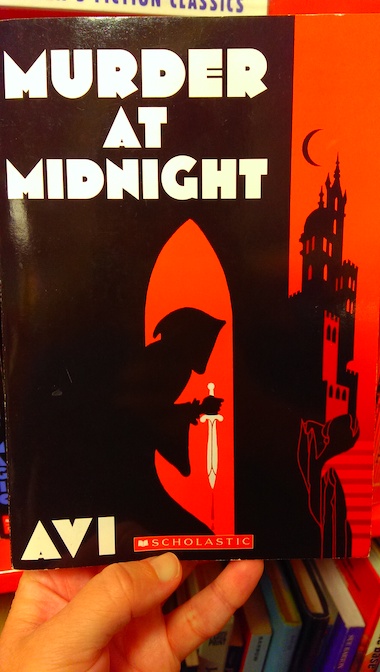
Murder at Midnight by Avi, 2009.

This story is a prequel to Midnight Magic.

Fabrizio was an orphan living on the streets of the medieval city of Pergamontio before he was taken in as a servant by Mangus and his wife, Sophia. It was really Sophia’s idea that Mangus needed a personal servant. Mangus says that he is able to take care of himself, and he is impatient with Fabrizio because Fabrizio is ignorant and uneducated.

When Sophia goes to visit her sister, Fabrizio tries extra hard to please Mangus so that Mangus will continue to let him live in his house. Mangus is primarily a scholar, but he supplements his income by performing magic tricks at a local tavern. That evening, a black-robed figure appears at the magic show, warning of danger coming to Mangus. The next day, the magistrate, DeLaBina, accuses Mangus of spreading papers with treasonous messages about the king around the city. During this time, all writing is by hand, and no one can understand how these papers can all look so identical unless they were produced by magic.

At first, DeLaBina offers to let Mangus go if Mangus gets rid of the papers and reveals the identity of the traitor. When Mangus protests that he cannot do real magic and that he knows nothing about the papers, he is arrested. Shortly afterward, DeLaBina is murdered. Fabrizio’s only hope of saving his master, and himself, is to find the real traitor.

The book is available to borrow and read for free online through Internet Archive.

My Reaction and Spoilers

I didn’t like this book as well as I liked the original Midnight Magic.  Partly, the problem was that I feel like some of the events of this story should have changed people and events in the other book, and they don’t because this book, which is supposed to take place earlier than the other story, was actually written after the other story. It all just seems out of order, and I didn’t like the addition of Prince Cosimo to the royal family.  In this book, Prince Cosimo is the crown prince of Pergamontio, not Prince Lorenzo from the previous book.  Prince Cosimo did not appear in Midnight Magic (although his absence is explained by the end of this book) and was never even referred to in that book (which is the part that really bothers be me everyone in that book would have known all about him and what happened to him, and I feel like Fabrizio should have at least thought about him in passing, it’s just weird when characters suddenly exist in a series that you know didn’t exist before).

Basically, there is a plot (although not by the person who did the plotting in the other book) to overthrow the king, who is wildly superstitious. The printing press is a relatively new invention in this time period, and Pergamontio has never had one before, which is why no one can understand why the writing on the papers is so strangely uniform.  This is the other thing that bothers me about this book.  Pergamontio is supposed to be somewhat backward in comparison to other kingdoms, partly because the king is so superstitious, but it just seems like going a bit far for people to suspect that oddly-uniform writing would be a sign of witchcraft because people of that time would already be aware of the existence of signet rings and official seals which were used as stamps in wax to mark documents, like a kind of signature.  Like a printing press, those would also produce an identical image, time after time of use.  Basically, they’re all just complex forms of stamps.  Superstitious or not, I think that people of that time who were capable of reading probably would have been able to tell that a stamp of some kind was being used, even though they might not have seen one as complex as a printing press before.

In the story, a family has recently brought a printing press to the city, and printing the treasonous papers was the first job they were hired to do. Shortly afterward, Maria, the daughter of the family, was arrested while passing out the papers. Her parents are taken into custody by Count Scarazoni, who is a sinister character in his own right but is actually in opposition to the real traitor in this book.

Scarazoni was the figure in the black robe who tried to warn Mangus. Fabrizio is arrested when he tries to gather up more of the papers for Mangus so they can learn where they came from.  He is nearly executed for treason, but he is saved by Scarazoni because Scarazoni realizes that the real traitor wanted him dead because he feared that Fabrizio might know too much. At the prison, Fabrizio meets Maria and helps her to escape as well. Maria explains to him the true origins of the papers, and they find DeLaBina’s body.  This is the murder referenced in the title of the book, and they must solve it to uncover the identity of the real traitor!

As in the other book in this series, Fabrizio and Mangus use a magic trick at Mangus’s trial to shock the traitor into revealing himself.  Although, at the end of the story, the king still believes that Mangus is a real magician, Scarazoni points out that without Mangus’s “magic” the real traitor might not have been discovered. The king tells Mangus that he will let him go provided that he confine himself to his own home and no longer practice magic, setting events up for the beginning of the other story.

Rapunzel

Rapunzel by Paul O. Zelinsky, 1997.

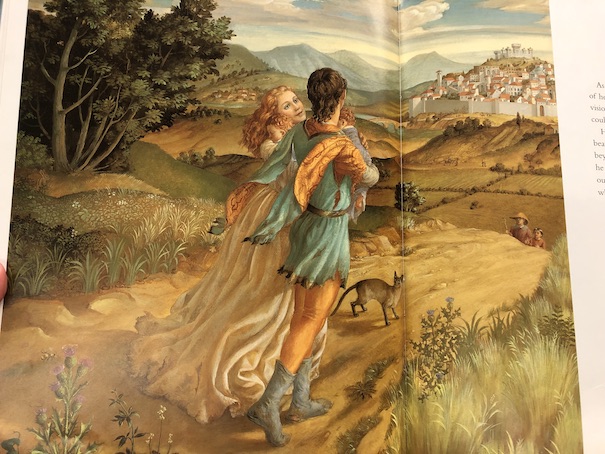
This retelling of the classic fairy tale is a Caldecott Medal winner.  The illustrations are beautiful!  A note in the beginning of the book explains a little more about the author’s sources for the story as well as his view about it.  Instead of focusing on an evil witch who holds a young girl captive, he presents “a mother figure who powerfully resists her child’s inevitable growth.”

A couple who have wished for children for a long time are excited to realize that they are finally going to have one!  However, the wife finds herself with an irresistible craving for the Rapunzel (an herb) that grows in the nearby garden of a sorceress.  She is so desperate to have some that she is able to persuade her husband to steal some for her.  But, even having some causes her craving to grow.

When the husband returns to the garden to get more Rapunzel, the sorceress catches him.  He explains the situation, saying that his wife’s craving is so intense that he fears she will die if she doesn’t get some Rapunzel.  The sorceress agrees that the wife can have the Rapunzel she needs, but in exchange, she demands the child when it is born.  Not knowing what else to do, the husband reluctantly agrees.  When the wife gives birth to a baby girl, the sorceress comes, names the baby “Rapunzel”, and takes her away from her parents.

The sorceress cares for the girl and raises her.  When the beautiful young girl turns twelve, the sorceress takes her to live in a tower in the forest.  The tower is magical, looking narrow on the outside, but containing many beautiful and comfortable rooms. The only way in or out is through the window at the very top.  The witch has Rapunzel let down her extremely long, beautiful hair so that she can climb up.

Rapunzel lives alone in the tower for years, until a prince happens to ride by and hears her singing.  The prince is enchanted by the singing and asks questions about the tower at the nearest houses, learning about the sorceress and the young woman in the tower.

One day, he sees the sorceress visiting Rapunzel and sees how she gets into the tower.  So, later, he calls to Rapunzel himself, asking her to let down her hair.  Rapunzel is surprised and frightened at first, when she sees that her new visitor isn’t the sorceress, but he speaks nicely to her, and they become friendly.  The prince proposes marriage, and Rapunzel accepts.  After that, he visits her every night, without the sorceress’s knowledge.

However, Rapunzel eventually gets pregnant, and when her clothes no longer fit her, the sorceress realizes it.  She calls Rapunzel a “wicked child” and says that she has betrayed her.  She cuts off Rapunzel’s long hair and exiles her into the wilderness, alone.

The sorceress uses Rapunzel’s long hair to trick the prince into climbing into the tower.  When he comes, she tells him that Rapunzel is gone, and he will never see her again.  The prince falls from the tower, injuring his eyes.  Blinded, the prince wanders alone for a year, lamenting for his lost wife.

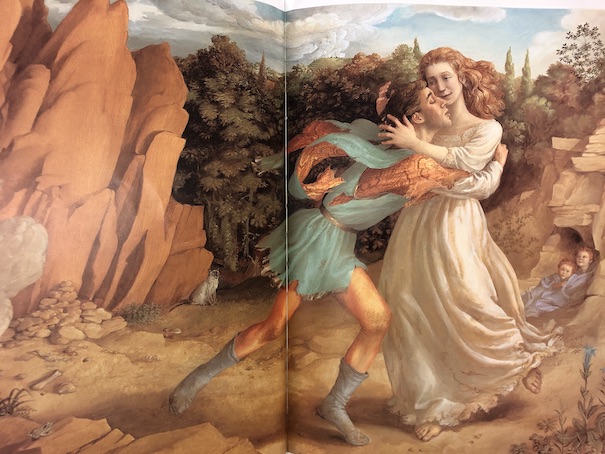
Eventually, he finds Rapunzel in the wilderness, recognizing her singing.  She has given birth to twins.  Rapunzel’s tears heal the prince’s eyes, and he is able to see again.  Realizing that they are near to his kingdom, he takes Rapunzel and the twins home.

The book is available to borrow for free online through Internet Archive.

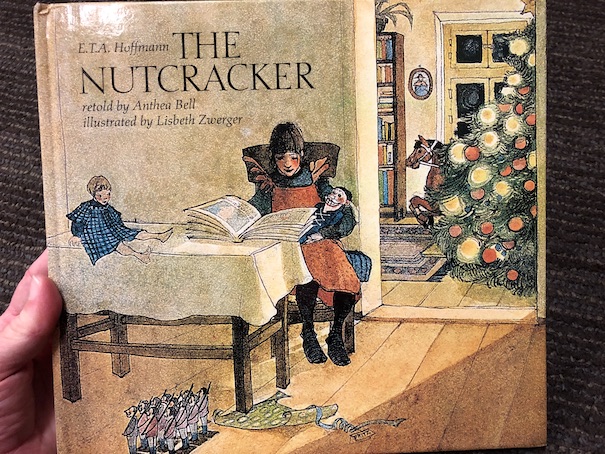
The Nutcracker

The Nutcracker by E.T.A. Hoffmann, retold by Anthea Bell, 1816, 1987.

The reason for the two dates of this book is that the original Nutcracker story was written by a German writer, E.T.A. Hoffmann, in 1816, as the novella The Nutcracker and the Mouse King. Some places, including the back of this book note different publishing dates for the original story because it was published more than once during the 1810s, as part of different story collections. This article gives more details about the original version of the story and different publications. Since then, it has been retold many times and in many different forms, including the famous ballet based on the story. In ballets and plays, the name of the heroine is often Clara, but in this picture book, as in the original story, the heroine’s name is Marie.

In the beginning of the book, which is set in the 19th century, Marie and her brother Fritz, are opening their Christmas presents on Christmas Eve. (The book explains that opening presents on Christmas Eve is a German tradition. A friend in Germany also explained that to me once because, in Germany, presents are supposedly brought by the Christ Child, not by Santa Claus. Since then, I’ve read that explanation may vary, depending on whether the household is Catholic or Protestant.) The children receive many wonderful presents, including a toy castle from their godfather, Mr. Drosselmeier. Marie’s favorite present is a nutcracker that looks like an odd little man. When Fritz is too rough with the nutcracker and breaks it, Marie takes care of it.

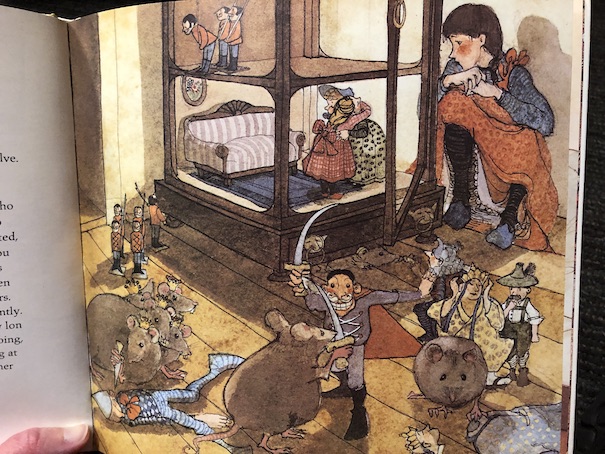
Marie stays up late, and when she finally puts the nutcracker away at midnight, she is astonished to see an army of mice coming out of the floorboards. The leader of the mouse army is the Mouse King, who has seven heads. The Nutcracker leads an army of toys against the mouse army. The mouse army appears to be winning, so, to save the Nutcracker, Marie takes off her shoe and throws it at the mice. Then, her arm hurts, and she apparently faints.

When Marie wakes up, she is in her own bed, and her mother tells her that she apparently put her arm through the glass door of the toy cabinet, cutting herself badly. When Marie tries to tell her mother about the battle between the toys and the mice, her mother and the doctor think that she’s ill and confine her to her bed for a few days. Mr. Drosselmeier repairs the Nutcracker and returns it to Marie, telling her the reason why nutcrackers look so strange and ugly, calling it The Tale of the Hard Nut.

Year ago, there was a royal banquet given by the King and Queen who were the parents of Princess Pirlipat. A mouse who claimed to be the queen of Mousolia demanded some food from the banquet as the Queen was preparing it. The King was angry that the mouse took some of the food and wanted revenge. The King asked his Court Watchmaker, who was also named Drosselmeier, to build some mousetraps to catch the mouse queen’s seven sons. When the sons were caught, the mouse queen vowed that she’d take her revenge on Princess Pirlipat. Princess Pirlipat was a pretty baby, but the mouse queen turned her ugly. The King took out his anger on the Court Watchmaker, ordering him to find a way to change Princess Pirlipat back to normal and threatening to behead him if he failed. After consulting the Court Astronomer, the Court Watchmaker learned that the key to breaking the spell on the princess was a special nut, which had to be cracked by being bitten by a man who filled certain special requirements, which all happened to be met by the son of the Watchmaker’s dollmaker cousin. The King had promised that the person who could break the spell could marry his daughter, but the mouse queen interrupted the last part of the ritual, causing the young cousin to turn ugly himself. When pretty Princess Pirlipat saw her rescuer turn ugly, she didn’t want to marry him anymore. The Court Astronomer said that the only way to break the spell on the young man was for him to defeat the new Mouse King – the mouse queen’s youngest son – and for him to find a woman who would love him regardless of his appearance.

Marie knows that the story is true because she has seen the Mouse King herself. She loves the Nutcracker and wants to help him. The Nutcracker returns to visit Marie during the night and makes repeated demands of her for her candy and toys. Marie knows that, no matter what she gives him, the Mouse King will keep returning to demand something else. The Nutcracker tells her that he needs a sword to fight the Mouse King. They borrow one from a toy soldier, and the Nutcracker successfully defeats the Mouse King, giving Marie his seven golden crowns.

As a reward for helping him, the Nutcracker takes Marie to the land where he is from, leading her there through a magic staircase in an old wardrobe. The Nutcracker’s land is beautiful, filled with candy and sweets and gold and silver fruit. (The Christmas Wood that they pass through reminds me of the woods in the wardrobe in The Lion, the Witch, and the Wardrobe.) The Prince Nutcracker’s home is Marzipan Castle in Candy City, where his beautiful princess sisters live. They welcome Marie and the Nutcracker home.

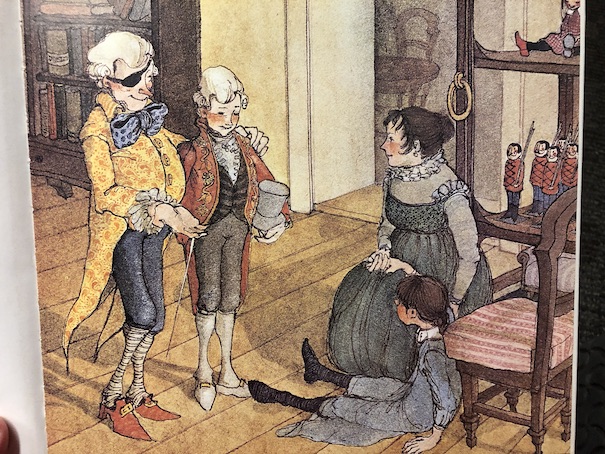
Then, suddenly, Marie wakes up, as if it were all a dream. However, Marie knows that it wasn’t a dream because she still has the Mouse King’s crowns. Marie tells the Nutcracker that she loves him. There is a sudden bang, and Marie faints. When she wakes up, she is told that Mr. Drosselmeier’s nephew has come to visit them. The nephew is the Nutcracker, restored to human form and now a handsome young man, thanks to Marie’s love. Marie later marries the nephew, and the two of them rule magical Kingdom of Sweets.

There is a section in the back of the book that explains a little more about E.T.A. Hoffmann and the original version of the Nutcracker story.

This book is available to borrow for free online through Internet Archive.

The Whipping Boy

The Whipping Boy by Sid Fleischman, 1986.

Jemmy is an orphan who lives in the royal castle as the prince’s new whipping boy.  Prince Horace, or Prince Brat, as the prince is commonly called, is known for constantly misbehaving, playing mean pranks, and refusing to do his lessons (he tells his tutor that he doesn’t need to learn how to read because he could always get someone else to do his reading for him).  However, in their land, it is illegal for anyone to use any kind of physical force or punishment on a prince.  Instead, the royal family employs a whipping boy to take the prince’s punishments for him.  As you can imagine, seeing someone else whipped in his place does little to correct the prince’s bad behavior.  In fact, the prince usually likes the spectacle of the whipping boy yelling.  He doesn’t like it that, unlike the others, Jemmy never yells when he’s whipped.

Jemmy was recruited for the role of whipping boy off the streets, where he survived by being a mudlark and rat catcher.  There are benefits to living in the palace, even if his purpose in being there is to take the prince’s punishments.  Jemmy gets food to eat and nice clothes to wear and attends the prince’s lessons with him, where he pays attention when the prince does not.  Jemmy actually loves the books and learning he receives.

After about a year, though, the prince suddenly comes to Jemmy in the middle of the night and tells him that he’s running away from home and wants Jemmy to come with him as a manservant.  When Jemmy asks him why he wants to leave, the prince says that he’s bored.  Jemmy wonders why Prince Brat wants him to come along instead of a friend, but then he realizes that, as nasty as he is, Prince Brat doesn’t have any real friends.

When the two of them are outside of the palace, Jemmy is tempted to run off and leave Prince Brat to fend for himself, but before he can make up his mind about it, the two boys are taken prisoner by bandits, Cutwater and Hold-Your-Nose Billy (named for all the garlic he eats).

Prince Horace tries to pull rank on the bandits, telling them who he is and ordering them to go away.  It’s a mistake.  When the bandits see the royal crest on the saddle of the horse that the boys are riding, they decide that they can probably get a good ransom for the prince.  Since neither of the bandits can write, they try to make the prince write his own ransom note, but of course, Prince Brat can’t write because he’s refused to learn. 

Jemmy, seeing an opportunity to turn the situation around, offers to write the note instead.  As Jemmy suspected, when the bandits realize that he can write and Horace can’t, they start assuming that he’s actually the prince and that the two boys have switched places.  After writing the note, Jemmy suggests that they let the “whipping boy” (Horace) take it to the castle, thinking that not only will Horace get safely away but that he’ll be rid of Horace after that.

To Jemmy’s surprise, Prince Horace ruins the whole scheme by refusing to return to the castle.  Jemmy tries to reason with him, but Horace says that he won’t go home until he’s ready.  The boys to manage to slip away on the bandits, and Horace insists on following Jemmy even though Jemmy wants to be rid of him.

Although Jemmy can’t understand why, Horace says that he’s having the time of his life.  For once in his life, he doesn’t have people fussing over him and telling him to keep his clothes clean.  Horace has found palace life stifling and boring, and he feels like his father hardly notices him or cares.  Part of the reason why Horace acts up is to get his father’s attention.  Jemmy is surprised by these insights into the prince’s life and character, and he is also surprised that, when he finally gets the chance to slip away and leave Horace behind, he can’t do it.  He knows that Horace isn’t used to life outside the palace, and Jemmy worries about what might happen to him if he’s left alone, although he tells himself that Horace could always return to the castle.

Before their adventures are over, Horace gets to experience what it’s like to do chores for himself and even to be whipped by the bandits, when they think he’s the whipping boy.  Being whipped himself shows Horace what he has subjected others to on his account.  Jemmy is surprised that Horace bears the punishment without crying or complaining, something which Horace says that he learned from watching Jemmy, who made it a point to take whippings with quiet dignity.  Horace also learns what other people really think of him when a woman at a fair comments on the prince’s disappearance, using the “Prince Brat” nickname and saying that the young prince is a “terror” and bound to be a terrible king when he’s older.  Usually, people are careful about what they say in front of the prince, and Horace is shocked to find out how disliked he is because of his bad behavior.  However, Horace’s new experiences and realizations bring a change in his outlook and personality that make him more sympathetic and likeable.  There is also the realization that what Horace really needs in his life isn’t a whipping boy to take his punishments for him but someone who can be a real, honest friend with him, like Jemmy.

In the end, Jemmy becomes the prince’s companion, not his whipping boy, so that the prince will be less lonely and stop acting out to get attention.  The king promises that Horace can keep Jemmy as his companion and his responsibility as long as Horace himself can behave responsibly and do his lessons as he should.

Although the country and characters in the story are fictional, the practice of keeping a whipping boy so that princes wouldn’t have direct physical punishment was a real practice.  Even today, the term “whipping boy” can stand for a person who takes blame or punishment in the place of someone with higher rank or authority, even when the person of higher rank is the one at fault.  For example, if a business manager or CEO makes a bad decision and orders one of his employees to do something they shouldn’t and the employee gets the blame for it as if what they did was their idea and not the boss’s, that employee can be considered the “whipping boy.” Another example would be if a stepchild in a family was given blame or punishment in place of a biological child because of favoritism on the part of the punishing parent (similar to the crude saying “beaten like a red-headed stepchild“). In fact, depending on the circumstances, a “whipping boy” might not even be a person, but a thing or a concept that is blamed instead of the person or thing that is the true cause of a problem, such as blaming “modern society” or “kids these days” for an individual’s bad habits or behavior, “the government” or “the system” for a business’s bad decisions or policies, or “millenials” for practically everything they’ve been blamed for by older people. It is similar to the concept of the “scapegoat” or “fall guy” but with the connotation that the person who is really at fault, the one who is trying to avoid blame or punishment, succeeds because of higher rank, authority, seniority, or some other form of favoritism among those who will assign blame or punishment.

This book is a Newbery Medal Winner and is available online through Internet Archive (multiple copies).

There is also a movie version of the book, sometimes called Prince Brat and the Whipping Boy.  The movie follows the concept of the original story pretty well, but it elaborates more on Jemmy’s life before he became the whipping boy and on how Horace feels neglected by his father.  In the movie, Jemmy is pressed into service as whipping boy by the king’s soldiers, who don’t bother to find out if he has any other family.  Although Jemmy is an orphan in both the book and movie, in the movie, he also has a younger sister he looks after, and part of what he wants to do when he leaves the palace is to find her.  The boys together learn that the younger sister was arrested for attempting to steal a handkerchief in Jemmy’s absence, and they have to rescue her from prison, a side adventure that didn’t occur in the book.  In the movie, Horace also explains to Jemmy that his mother died in a riding accident when he was young and that his father pays more attention to affairs of state than he does to him.  Horace is shown multiple times trying to get his father’s attention, only to be brushed off because his father is too busy.  In the movie, the king almost declares war on another country, thinking that Horace was kidnapped over a border dispute, something that didn’t happen in the book.  In both the book and the movie, Jemmy’s new friendship with Horace brings about a change in the prince.  At the end of the movie, both Jemmy and his sister are taken in to the palace as companions for Horace. Sometimes you can find this movie or clips of it on YouTube. Although it was originally released on VHS, it is currently available on DVD.

Talking to Dragons

Talking to Dragons by Patricia C. Wrede, 1985.

This is both the fourth book in the Enchanted Forest Chronicles and the first book in the series that was written.  The author wrote this story before the others and then wrote the other three to explain how the characters got to this point.  The first three books in the series focus on Princess Cimorene and her adventures, but this book focuses on her son, Prince Daystar.

Partly because this series is kind of backwards, with the last book being the first written, I’m going to start with a spoiler.  When the book begins, Daystar is unaware that he is a prince and that his father is the king of the Enchanted Forest.  He grew up in an ordinary cottage on the edge of the forest, so he is accustomed to the presence of all kinds of fantasy creatures and fairy tale characters.  He thinks of himself and his mother as ordinary poor folk.  However, his mother has taught him not only reading and writing but other skills that are more unusual for peasants, like music, fighting, and even a little magic.

When Daystar is 16 years old, a wizard named Antorell comes to their house.  Daystar’s mother, Cimorene, seemed to know him, and he knows her.  Antorell demands “the sword” and the boy, and Cimorene casts a spell to melt him.  (“’No! Not again!’ he screamed.”  If you’ve read the other books, you already know why.  But, again, this book was written first.)

The next day, Cimorene gives Daystar a sword that he’s never seen before but which seems to draw him to it, and she starts giving him instructions.  The instructions are vague, but Cimorene insists that Daystar is to go into the Enchanted Forest and not to come back until he can explain why he had to go in there in the first place.  Also, he is not allowed to draw the sword from its scabbard unless he really needs to use it.  Cimorene says that she can’t explain more because it might “ruin everything.”  Not knowing what else to do, Daystar starts into the Enchanted Forest.  When he glances back, Cimorene and the cottage have suddenly disappeared.  Daystar has no idea why, but he has no choice but to keep going.
In the forest, Daystar meets a talking lizard called Suz, who claims to know everything about the Enchanted Forest and what goes on there (a tall claim, considering everything that goes on there).  When Daystar asked him if he knows anything about the mysterious, magical sword that his mother gave him, Suz tells him that it’s the Sword of the Sleeping King and that everyone has been looking for it.  Daystar knows nothing about it, which surprises Suz.  To Daystar’s surprise, both the sword and Daystar’s lack of knowledge agitate Suz, who says that he must get Kazul, who will know what to do.  Before he then runs off, leaving Daystar wondering who Kazul is, Suz tells him that he’s going to have to learn about the sword by himself because there are certain rules associated with magic, but that he should follow the sword to find out.

The next person Daystar meets is a red-haired girl who is stuck in a hedge.  She is surprised by how easily Daystar can get into the magical hedge, and at first, she thinks that he is a wizard.  She is relieved when she finds out that he’s not.  The girl, Shiara, tells Daystar that wizards have been chasing her because she burned the Head Wizard’s staff.  Most people could never accomplish that because wizards’ staffs are extremely powerful and have protective spells on them, but Shiara is a fire-witch.

As the two of them talk, Daystar learns that, while fire-witches are extremely rare and powerful come by their powers naturally, Shiara’s abilities are more unpredictable than most.  She has trouble casting spells on purpose, but when she gets mad, she can do some extremely powerful ones without really trying.  Fire-witches tend to have tempers, and Shiara is no exception.  Because of that, she doesn’t have many friends.  Most people are afraid to be around her because they never know when she’ll lose her temper and accidentally set things on fire.  Even worse, for Shiara, is knowing that most fire-witches are able to do very impressive spells and are almost invulnerable, but yet, she can’t even burn her way through a hedge when she tries it.  The wizards are very interested in her because most fire-witches are immune to their spells.  When they learned that she was a fire-witch who couldn’t cast her own spells, they tried to kidnap her in order to study her magic, which she how she ended up setting the Head Wizard’s staff on fire.

Daystar and Shiara finally get out of the magical hedge when Daystar suggests that Shiara try being polite to it instead of losing her temper.  Creatures and objects in the Enchanted Forest tend to respond well to politeness.  When they’re out of the hedge, a wizard shows up and tries to kidnap Shiara again, but Daystar defends her with his sword.  However, Daystar’s hand is injured when he tries to pick up the pieces of the wizard’s staff, and it explodes.

Daystar and Shiara seek help from Morwen, a witch who lives nearby.  It is from Morwen that Daystar begins to get a sense of what his sword is capable of doing.  He also meets up with Suz again, who tells him that he should go to the castle and that Kazul will meet him there.  Daystar still doesn’t know what he’s walking into, but missions in the Enchanted Forest can’t be ignored, and he has a mission to complete that everyone has been waiting for since before he was born.

By the end of the story, Daystar has learned what he needs to do to rescue his father, and Cimorene and Mendanbar are reunited.  Shiara ends up getting what she wants, partially, because she gains the ability to use her powers, but is forced to be polite in order to do so, which really irritates her.  She becomes Kazul’s new princess, where she will learn both the personal skills and magical skills she needs to control both herself and her ability.  Cimorene believes that Shiara will end up marrying Daystar eventually and becoming the next queen of the Enchanted Forest.  However, the series ends here, and the future is left to the imagination.  Morwen also decides to marry Telemain, a character from the previous books.

Like other books in this series, this book contains a lot of humor and parodies on popular fairy tales and fairy-tale creatures. Personally, I like the first two books in the series the best, but this one is also fun. There is a mild touch of romance to it, which is also nice.

The book is currently available online through Internet Archive.

There is one more story after this series, a short story in the collection Book of Enchantments that features Daystar and both of his parents but does not have Shiara.

The King’s Equal

The King’s Equal by Katherine Paterson, 1992.

Everyone dreads the day that Prince Raphael will rule the kingdom instead of his father.  Prince Raphael is good-looking and highly educated, but he’s also selfish and greedy.  His one outstanding characteristic is that he’s arrogant.  He assumes that no one knows as much as he does about anything and no one is as deserving as he is . . . of anything.  Knowing that, as the old king lies dying, he makes his final decree that the prince will not wear his crown until he is married to a woman who is his equal.

When the prince hears that, he immediately becomes angry, saying (as his father guessed he would) that there could not possibly be any woman in the world who is his equal, who is as rich, intelligent, or beautiful as he is.  After his father dies, the prince immediately begins looting the kingdom for his own gain and generally abusing his subjects (as they had also guessed he would).  Still, he doesn’t have the one thing he really wants: his father’s crown.

The prince orders his councilors to find him an appropriate bride but (as the councilors feared), the task proves impossible.  No matter what options they place before the prince, the prince finds something about them to nit-pick.  Princesses of fabulous wealth are not beautiful or intelligent enough for him.  Princesses who have amazing beauty either aren’t beautiful enough or don’t know enough.  Princesses with amazing knowledge are still lacking in some area of knowledge or are just plain ugly in the prince’s eyes.  One by one, he dismisses them all.

Meanwhile, a farmer in the prince’s kingdom, has sent his daughter, Rosamund, to live in the mountains with their goats to avoid having the prince confiscate their only livestock, which he has done with everyone else.  During the winter, Rosamund and the goats almost starve, but they are saved by a magical Wolf.

The Wolf assures Rosamund that her father is alive and well, and Rosamund says that she is worried about what is happening in the kingdom.  The Wolf tells Rosamund that the kingdom would be saved if the prince finds the princess that he is looking for and that she should go to the capital and present herself as that princess.  Rosamund doesn’t see how she can do that because she is definitely not as wealthy as the prince, and she doesn’t think of herself as particularly beautiful or clever.  However, the Wolf tells her that her mother, who died when she was born, had blessed her, that she would be a king’s equal.  To fulfill her dead mother’s wish, Rosamund does as the Wolf tells her.

To Rosamund’s surprise, the prince falls in love with her beauty at first sight.  She also impresses him with her intelligence when she tells him that she knows what no one else does, that he is actually very lonely.  (Which is natural, since he thinks that no one can be his equal or true companion.)  Although she cannot demonstrate that she possesses great wealth, she can demonstrate that there is nothing in particular that she wants while the prince still feels like he is lacking things he needs (like his father’s crown).  The prince is satisfied that Rosamund has passed all the necessary tests to be his equal, but Rosamund turns the tables on the prince by pointing out that his description of her has made her more than his equal, challenging him to prove to her that he is worthy of marrying her.

It is in meeting Rosamund’s challenge, taking care of her goats in the mountains for a year, Raphael learns humility from the Wolf.  While he’s away from the palace, Rosamund tends to the kingdom, ruling more compassionately than Raphael had.  When Raphael returns, he is humble enough that he doesn’t think that he is worthy of marrying Rosamund, but his humility is precisely what makes him worthy, and they do marry.

My Reaction

Overall, I liked the story, although I wish that we could see a little more of the conversation between Rosamund and Raphael when she explains to him who she really is. They still get married, so whatever Rosamund told Raphael must have persuaded him, but it’s left to the imagination how she explains it. How I picture it is partly based on the fact that, during the last year, Rosamund has lived as a princess, even though she was originally a goatherd, and Raphael has lived as a goatherd, even though he is really a prince. By the time the year is over, they have each lived in the other’s place, and that is what really makes them each other’s equal. Raphael was callous and arrogant because he never thought about how other people lived until he tried it himself.

I don’t know if Rosamund really learned anything from her experiences as a princess, which bothers me a little because I think that she really should have because it was so far outside of her experience. We don’t really hear about that because the focus is on Raphael’s changing character. Personally, I’d like to think that part of what Rosamund may have learned is that running a country is a big, difficult job, and that, while her rule was better than Raphael’s for being more compassionate, it’s not a job that she would like to do alone, emphasizing that she and Raphael would be better ruling as a team than either of them would be by themselves. If Rosamund and Raphael really both need each other, it would be fitting for a story about equals.

The Paper Bag Princess

PaperBagPrincess

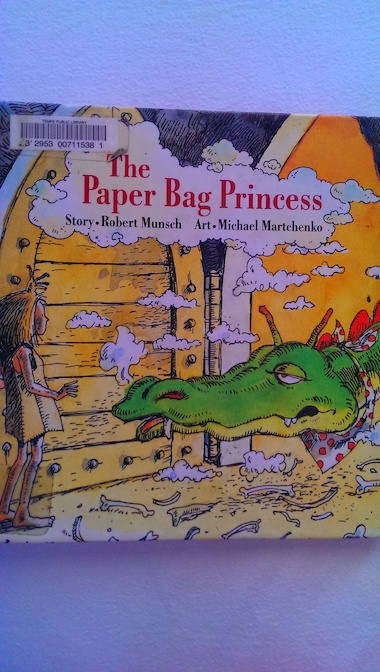
The Paper Bag Princess by Robert Munsch, 1980.

Princess Elizabeth is a stylish young princess, engaged to the handsome Prince Ronald. But, one day, a dragon attacks her castle, incinerating all of Elizabeth’s fine clothes and carrying Ronald off to its lair.

Donning the only thing she can find to wear, an old paper bag, Princess Elizabeth tracks the dragon down to rescue Ronald.

In this unconventional fairy tale story, Princess Elizabeth must defeat the dragon in a duel of wits in order to rescue her prince, but in a humorous twist ending, Ronald is somewhat less than grateful for her help because Princess Elizabeth is no longer stylish in her old paper bag.

The book is available to borrow and read for free online through Internet Archive.

PaperBagPrincessRonaldRescued

My Reaction

Books like these can be a good antidote to people who are tired of prissier princess stories with flamboyant gowns and a wedding (or at least kissing) at the end. The story is deliberately humorous and correct in pointing out that people who worry more about the clothes you’re wearing than the things you do for them are not worth bothering with.  Prince Ronald is shallow. He has the look of a prince but not much substance, caring more about appearances than about what his princess went through for his sake.

Papa Gatto

PapaGatto

Papa Gatto by Ruth Sanderson, 1995.

This beautiful picture book, set in a fairy-tale Italy, is based on several folk tales, as the author explains on the page with the publishing information.  Among the tales that served as inspiration for this story is The Colony of Cats, which is from Andrew Lang’s The Crimson Fairy Book.  In some ways, this story is similar to Cinderella and Mother Holle, with its wicked stepmother and stepsister.

In the distant past, so the story says, it was common for animals to talk, and one of the wisest cats was Papa Gatto, who served as an adviser to the prince.  Papa Gatto had a lovely wife and a beautiful mansion, but soon after the birth of their eight kittens, his wife died.  Needing someone to help care for the motherless kittens, Papa Gatto decides to advertise for someone to help.

PapaGattoAdvertises

In the town, there is a widow who has a daughter named Sophia and a stepdaughter named Beatrice.  As in many fairy tales, the widow favors her own daughter, who is lazy and spoiled, while giving all of the hard work to her stepdaughter, who is much nicer.  When they hear about Papa Gatto’s advertisement, Beatrice feels sorry for the young kittens and wants to help.  However, the widow, thinking of the generous fee that the wealthy Papa Gatto is offering, decides that she wants it for Sophia.  Sophia doesn’t want the job, but at her mother’s urging, she goes to see Papa Gatto anyway.

PapaGattoSophia

Papa Gatto gives Sophia the job tending his house and family while he’s away on a trip, but Sophia doesn’t know how to work hard and has no real intention of doing a good job.  She simply makes herself at home in Papa Gatto’s lovely mansion, trying on his dead wife’s jeweled collars as bracelets and neglecting the housework and kittens.  When Papa Gatto returns home and sees what she’s done, he sends her away in anger.

When Beatrice hears that Papa Gatto is once again looking for help, she goes to see him without telling her stepmother about it.  Papa Gatto sees how interested she is in the kittens and how gently she treats them, he gives her the job, reassured that she will do it well.

PapaGattoBeatrice

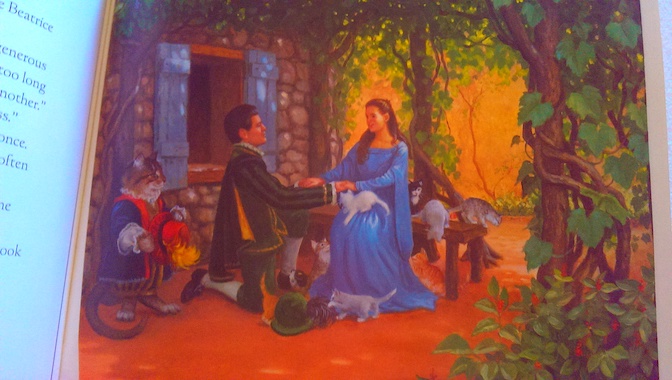
Sure enough, when he returns from his next journey, he sees that Beatrice has taken good care of the house and kittens and rewards her with the jeweled necklace/bracelet that Sophia had admired.  Needless to say, Beatrice’s stepmother and stepsister are angry with Beatrice when she returns home, and Sophia takes the bracelet for herself.

Meanwhile, Papa Gatto has told the prince about Beatrice.  The prince has been thinking about marrying, and he says that he would like to meet Beatrice.  Papa Gatto tells him that she will probably be at the coming fair in town, and the prince should attend and look for the girl with the bracelet.

At first, the prince mistakes Sophia for Beatrice, a deception that she and her mother encourage.  However, when the prince speaks to Papa Gatto again, Papa Gatto realizes the deception and sets things right.

PapaGattoRevelation

The pictures in this book are beautiful!  And, of course, there’s a happy ending.

I liked it that Beatrice didn’t accept the prince’s offer of marriage immediately, saying that she’d like to get to know him first.  It’s more sensible than the fairy tales where they get married right away.

PapaGattoHappyEnding

Midnight Magic

midnightmagicMidnight Magic by Avi, 1999.

The story takes place in Italy, toward the end of the Middle Ages.  Mangus, a formerly wealthy scholar and philosopher, is living under house arrest because the king believes that he has practiced black magic. Mangus was merely performing magic tricks to earn extra money, and in fact, does not believe in real magic.  However, the king is very superstitious and easily influenced by his scheming advisor, Count Scarazoni, who needed a scapegoat to distract everyone from his schemes.  Unfortunately, many people in the kingdom of Pergamontio believe that Mangus is a real magician with frightful powers.  Even Fabrizio, an orphan who is Mangus’s only remaining servant, believes that magic really exists.

When a messenger arrives, summoning Mangus to the castle to see the king, they are afraid that the king has reconsidered his decision to spare Mangus’s life. However, it turns out that the king is in need of Mangus’s help. He believes that his young daughter, Princess Teresina, is being tormented by a ghost, and he wants Mangus to use his magic to get rid of it.

Mangus again protests that he does not do real magic, but both the king and Count Scarazoni promise dire consequences if he fails to help them deal with the problem.  Mangus isn’t sure why Count Scarazoni has asked for his help because he knows that the count doesn’t really believe in magic, except perhaps as a way of appeasing the king.  The king promises that if Mangus can free the princess from the influence of the ghost, he will not only end Mangus’s house arrest but reward him with a generous pension.  Mangus has little choice but to agree to do his best, and the promise of the pension for his master convinces Fabrizio to do everything he can to make sure that Mangus succeeds, not only to save his master’s life but to restore his family’s fortunes.

But, what is the secret of the ghost?  Fabrizio believes in ghosts, even though Mangus doesn’t.  Princess Teresina insists that the ghost is real, appealing directly to Fabrizio to convince Mangus that it is. Adding to the mystery is the disappearance of the princess’s brother, Prince Lorenzo, and the murder of the princess’s tutor. Danger lurks in the castle, and conspiracies are around every corner. Could the troubled spirit really belong to the murdered prince?

The book is available to borrow and read for free online through Internet Archive.

My Reaction

I love historical books and spooky mysteries, and this is both! The Italian kingdom where the story takes place is fictional, but it takes its inspiration from real kingdoms of the later Middle Ages and early Renaissance, with Machiavellian intrigue, power struggles, and arranged marriages, even for children, that could influence the balance of power and successions. (There is talk of a potential arranged marriage in the story, but no child marriages actually take place.  If a child is old enough for ghost stories and murder mysteries and isn’t too frightened by them, there is really nothing more concerning than that to prevent them from reading this book.)

Princess Teresina is one of the most intriguing characters in the book.  Although young, she isn’t a shrinking violet or anyone’s fool, and she’s definitely not a tea party and ball gown kind of princess.  Like real life Medieval princesses, she is the product of a family who came to power by the sword and maintains it by the iron fist in the velvet glove and some clever political maneuvering, although some members of the family are more clever about it than others.  Princess Teresina well knows the family she was born into and what’s expected of her as royalty, and she knows to be careful about who she trusts and what the consequences of trusting the wrong people can be.  Although apparently terrified by the ghost, the princess has a kind of toughness and shrewd determination to do what she thinks is necessary.  She seems to be smarter and knows more than most people give her credit, and Fabrizio often wonders just how much she really knows.

One of the best things about the story is that, as soon as you think you know what’s going on, you learn that there is more to the story. There are conspiracies within conspiracies!

Hint: If you like pseudo-ghost stories, spooky stories of the Scooby-Doo variety, where there are logical explanations for the supernatural phenomena … you won’t be disappointed.