Princess Hyacinth by Florence Parry Heide, illustrated by Lane Smith, 2009.
For reasons nobody understands, Princess Hyacinth is not affected by gravity, and she floats upward anytime she is not restrained or weighted down.
It’s a real problem because, while it’s difficult enough when she floats up to the ceiling of the palace, if she were allowed out of the palace without something weighing her down, she would simply float away.
Princess Hyacinth’s parents go to great lengths to make sure that she is always secured to something or weighed down with special weighted clothes and a very heavy crown.
Of course, being weighted down all of the time makes life difficult for Princess Hyacinth, too. She wishes that she could go outside and play and swim with the other children, but she can’t because she can’t be outside without the weights. There is one boy in particular who comes by her window with a kite with a crown on it and says hello to her, but it would be difficult for her to go out and play with him.
Then, one day, when Princess Hyacinth is particularly bored and tired of being weighted down, she persuades a balloon man to tie a string to her and let her float among his balloons. At first, it’s fun, floating along as the balloon man walks through the park, but then, the balloon man is startled by a dog and accidentally lets go of her!
As Princess Hyacinth floats upward into the sky, she is thrilled because she has never felt so free in her life, but where will it end? How high can she go, and is there any way for her to get back? Fortunately, there is a way for her to get home, with the help of a friend!
The book is available to borrow and read for free online through Internet Archive (multiple copies).
My Reaction
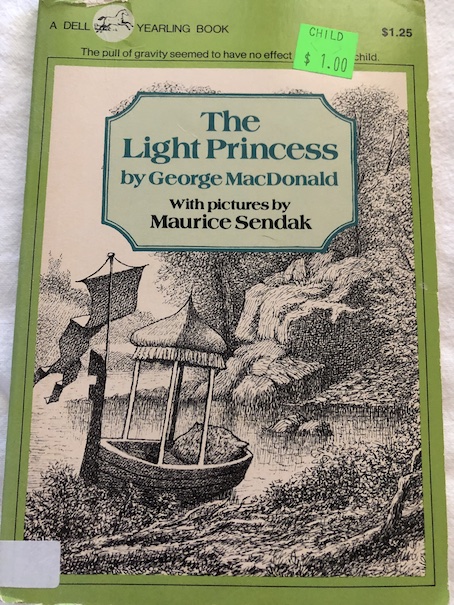
This story reminded me of a much-older story from the 19th century, The Light Princess, but this picture book is much, much less serious than that book. In The Light Princess, the princess is cursed, and the story is about breaking this curse that has afflicted her all of life. In this book, there is never any explanation about why Princess Hyacinth isn’t affected by gravity, and she is never cured. Instead, she makes a friend who helps her find a way to live with her condition and enjoy it.
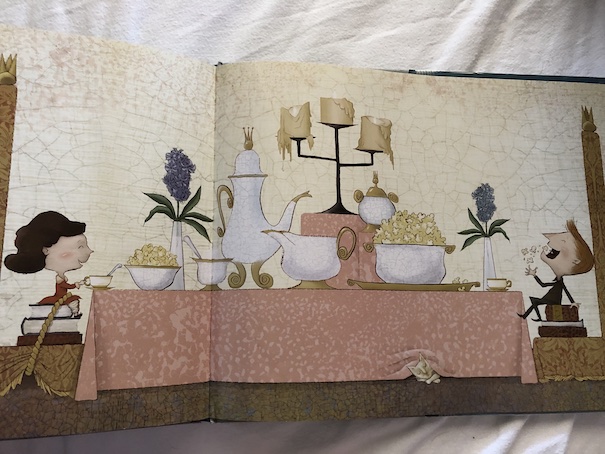
I liked the art style in this book. I found it amusing that the king, queen, and palace guards are drawn in the style of the face cards in a deck of playing cards. Princess Hyacinth is a cute little girl, and when she’s wearing her heavy princess gear, you can almost feel the weight of it on her. In the end, there are still times when she has to be tied down, but she seems more normal, less weighted down, because she has found someone to help her deal with her condition.
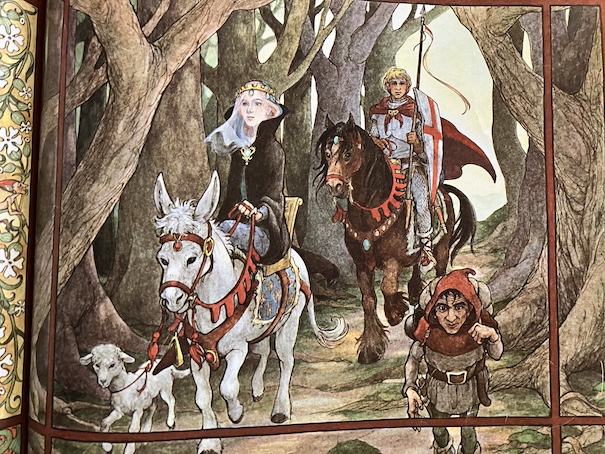
The Red Cross Knight, who carries a shield decorated with a red cross, does not know his own name or even where he came from. He only knows that the Queen of the Fairies has sent him to face a terrible dragon. He is accompanied on his journey by a princess with a little white lamb and a dwarf. The Princess’s name is Una, and her kingdom is being attacked by the dragon.
On their journey, they meet a hermit, who shows the knight a distant palace on a mountaintop, where angels travel between the palace and heaven. It’s so beautiful that the knight wants to go there immediately, but the hermit says that this palace is in another world and that he cannot go there until he faces the dragon. The hermit also reveals the knight’s past to him. He is not one of the fairy folk, although the fairy folk are the ones who sent him. The hermit knows that he was kidnapped by the fairies as a baby and hidden in a farm field, where he was discovered by a plowman who named him George. His true destiny is to become Saint George, the patron saint of England.
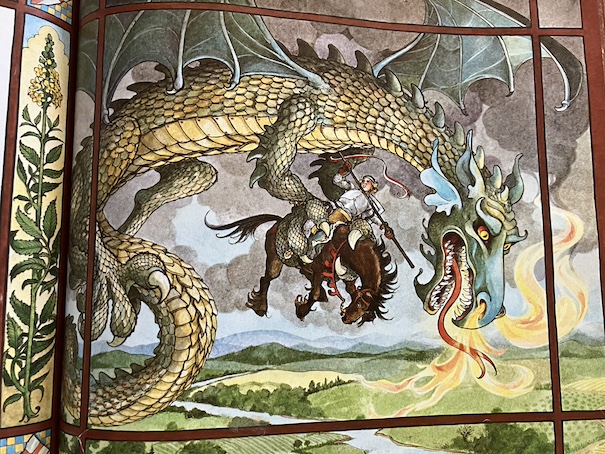
Una takes George to her parents’ fortress. As they approach, they see the dragon for the first time. George sends Una away from danger, and he and the dragon battle for the first time. The dragon picks up George, horse and all, and throws them to the ground. George manages to drive the dragon away, but he is also injured. At first, he and his friends think he is going to die, but he lies down in an ancient spring that cools and heals him. By morning, he is able to rise and fight again.
The second time George fights the dragon, he is able to cut off part of the dragon’s tail and one of its paws. The dragon’s fire finally drives George away, and once again, George seems too wounded to survive. However, he rests under an apple tree that drops healing dew, and George survives.
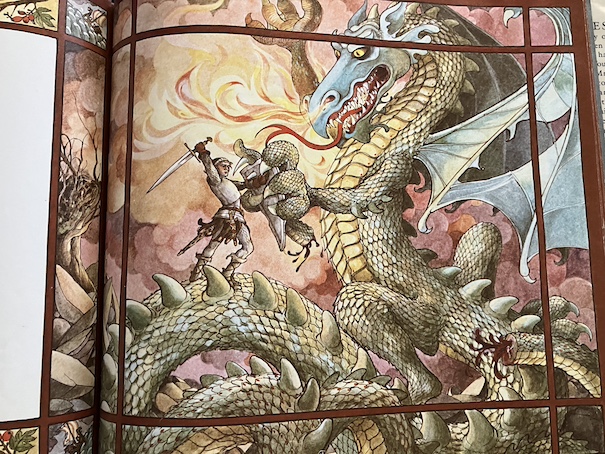
The third time George and the dragon fight, George manages to kill the dragon. Everyone celebrates, and Una’s parents thank George. The king gives George rich rewards, but George passes them on to the poor people. George is bound to the service of the Fairy Queen for six years, but the king allows George to marry Una and promises him that he will become the next king when his service is finished.
The book is available to borrow and read for free online through Internet Archive.
My Reaction
I love the colorful illustrations in this story, although some of them seemed a bit brutal for an audience of young children, showing George badly injured and the dragon spurting blood. Because I love folklore, I know that the legend of St. George and the Dragon is a Christian allegory, although it has some basis in earlier folktales and historical figures. I’ve heard different interpretations of what the dragon is supposed to represent. It can be a symbol of evil, the devil, or sin, and I think I’ve heard that it could represent paganism, which was replaced by Christianity (represented by St. George in the story), although I can’t remember where. In a way, I think this is one of those picture book that might mean more to adults because they would understand more of the symbolism, history, and folklore references in the story. On the other hand, who doesn’t love a story that ends with a gallant knight marrying a beautiful princess?
As another odd piece of literary trivia, the legend of St. George has a connection to another story that I’ve on this blog, Phoebe the Spy. The connection isn’t an obvious one because Phoebe the Spy was set in New York during the American Revolution, which seems far removed from Medieval England. However, on April 23, 1770 (St. George’s Day), the St. George Society (originally called the Sons of St. George) was founded at the Fraunces Tavern in New York, just six years before the story of Phoebe the Spy begins at the same tavern. The St. George Society was and still is a charitable organization that helps immigrants from Britain, using the patron saint of England as its namesake.
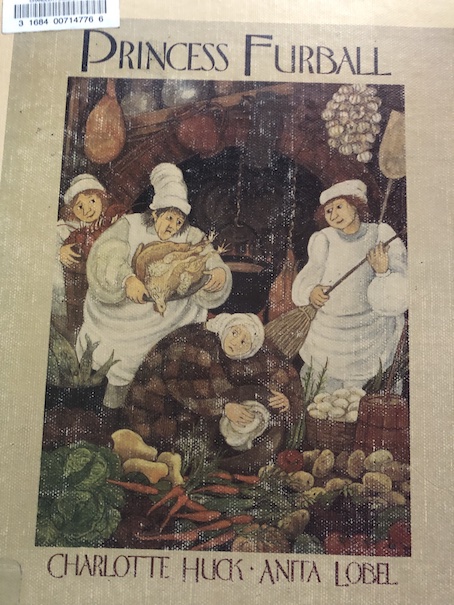
Princess Furball retold by Charlotte Huck, illustrated by Anita Lobel, 1989.
There was a princess whose mother died when she was only a baby and whose father never paid much attention to her. In spite of this misfortune, she had a happy childhood because her nurse loved her and let her play with other children. She arranged lessons appropriate to a princess with skilled tutors and let the princess learn how to cook in the royal kitchen.
However, when the princess was grown, the old nurse died, and the princess was very lonely. Her father only cared about the money he could get from the princess’s marriage, and to the princess’s horror, he arranged a marriage to an ogre who promised him fifty wagons of silver in exchange for the princess.
Unable to face the prospect of such a horrible marriage, the princess requests a special gift from her father for her wedding. She asks for three dresses: one golden like the sun, one silver like the moon, and one as sparkling as a the stars. She also asks for a special fur coat made of a thousand different types of fur. At first, the princess doesn’t think the king will be able to meet her demands, but to shock, he sets his people to accomplishing the task and presents her with everything she asked for.
Deciding that there is no other option but to run away, she takes the three dresses with her along with three small golden treasures that belonged to her mother: a ring, a thimble, and a tiny spinning wheel. She also takes along her favorite soup seasonings, which she got from the castle’s cook. Then, she puts on the bulky fur coat and flees into the woods.
In the woods, she is found by the hunting party of a neighboring king. At first, they mistake her for some kind of strange animal. When they find out that she’s a person, they take her back to their castle and put her to work in the kitchen. There, they make her do all the messy cleaning jobs. Nobody knows her real name, so everyone just calls her Furball after her strange, bulky coat made of a thousand patches of fur.
The princess always wears the fur coat as a disguise, but one day, she finds out that the young king of this kingdom is having a ball. She slips away from her kitchen duties and dresses in her dress like the sun. When she is unrecognizable as the kitchen servant, she is able to meet and dance with the king. Being herself is essentially a disguise!
When she slips away from the king and returns to the kitchen, the cook has her make soup for the king, and she uses her special blend of seasonings. When no one is looking, she she also puts her golden ring into the king’s bowl. When the king finds the ring, he asks the cook about it. The cook admits that Furball made the soup, so the king questions her about the ring, but she doesn’t explain.
At the king’s next ball, the princess repeats the same performance, this time wearing the dress like the moon. This time, she slips the golden thimble into the king’s soup when she returns to the kitchen. Again, she doesn’t explain when the king questions her about the thimble.
As in many fairy tales, it’s the third time that’s the charm. When the princess shows up to a ball dressed her her dress like the stars and doesn’t have time to completely change when she gets back to the kitchen that all is revealed, and there’s a happy ending!
The book is available to borrow and read for free online through Internet Archive (multiple copies).
My Reaction
I remember reading this book when I was a kid in elementary school! I think I read it when I was about 7 years old, when the book was pretty new. I always liked fairy tales. There is a brief explanation at the beginning of the book that the story is a Cinderella variant. This version is very similar to the English folktale Catskin and to the tale of Many Furs or Thousand Furs by the Brothers Grimm.
Like so many little girls, I was fascinated as a kid with the concept of the dresses that resemble the sun, the moon, and the stars. The fur coat made of many animals is a little alarming to me now, but it makes a good disguise in the story. I love the illustrations that show the princess in all of her different dresses and the Furball disguise!
The story doesn’t explain why the princess put her treasures into the soup, but my guess was that she wanted an excuse to see the king again and a way to keep him intrigued about her identity and her relationship to the mysterious princess who keeps showing up to his balls. It’s only after the king decides that he really loves the mysterious princess that it’s safe to reveal her identity.
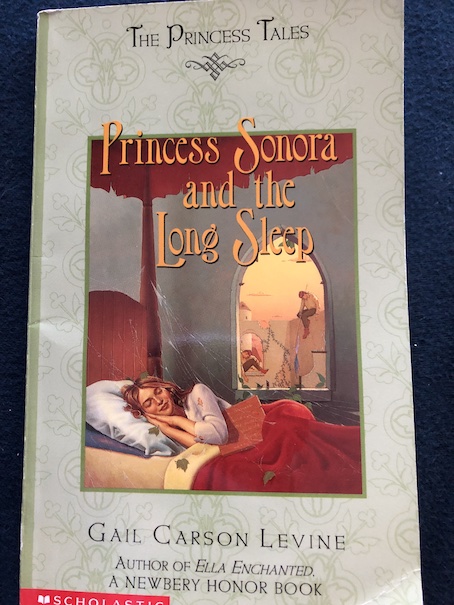
Princess Sonora and the Long Sleep by Gail Carson Levine, 1999.
This story is a retelling of the classic fairy tale, Sleeping Beauty. It’s part of a series of other retellings and re-imaginings of classic fairy tales called The Princess Tales.
When Princess Sonora was born, her parents invited the usual fairies to give her gifts. They do this because it can be dangerous to anger fairies, although fairies’ gifts are a risky proposition at the best of times. Unfortunately, there are two complications with the fairies who give Princess Sonora gifts. First, one of the fairies decides to top a previous fairy’s gift of intelligence by making Princess Sonora ten times as intelligent as any other human on earth. As a result, Princess Sonora is an unnaturally intelligent baby who begins to talk almost immediately and is smart enough to understand the second problem that arises.
Her parents neglected to invite a particular fairy because they’d heard a rumor that she was dead. Of course, the fairy shows up anyway, angry at the lack of invitation, and immediately curses Princess Sonora. As in the original Sleeping Beauty story, the curse is that, someday, Princess Sonora will prick her finger and die. Also, as in the original story, the last fairy who hadn’t yet given a gift uses her gift to soften the curse so that, instead of dying, Princess Sonora and everyone else in and around her castle will fall asleep for 100 years. She can’t completely remove another fairy’s spell because that might provoke a fairy war, but this change to the curse gives the family hope. She promises that Princess Sonora will meet an eligible prince when she wakes up. Princess Sonora, being an unnaturally intelligent baby who can talk, also gives her own feedback and suggestions on the situation, to her parents’ amazement. Her parents decide to try to prevent the curse from coming true by hiding anything that can prick Princess Sonora, but baby Princess Sonora has already realized that this will be impossible. She knows that the curse will come true someday, and as she lies in her cradle, she begins to make plans to prick herself on purpose, someday when she can choose just the right moment.
Being smart is generally a good thing, but Princess Sonora’s unnatural intelligence makes her a very peculiar girl in a number of ways. For one thing, she loves books and is always reading, even as a baby. She grows up to be a very studious girl. That’s not so bad, but Princess Sonora carries it to extremes. She also refuses to sleep. It’s partly because she knows that, at some point, she’s going to spend 100 years sleeping, so there’s no point in wasting more time asleep. She’s also afraid of sleep because she doesn’t know where her mind will go when she sleeps, and with her massive intelligence, she loves her mind and doesn’t want it to go away. Instead of sleeping, she just reads all night or thinks about things. Because of her intelligence, curiosity, and constant reading, Princess Sonora knows the answers to many questions, but people often find it irritating because they don’t want to hear her long explanations or all the ways she knows for people to do their jobs better. People start saying to each other, “Princess Sonora knows, but don’t ask her.” Princess Sonora wishes that other people would be more interested in what she has to say, but she knows better than to force the issue.
When Princess Sonora turns 14 years old, her parents begin looking for a prince she can marry, assuming that she doesn’t prick herself and fall asleep for 100 years first. They choose Prince Melvin, from a large and wealthy kingdom nearby. It seems like a smart match, but Princess Sonora knows it isn’t a good one. Prince Melvin has also received gifts from the fairies, and while they include positive qualities, like honesty and bravery, they don’t include intelligence. Prince Melvin isn’t very smart and wouldn’t appreciate any of the things Sonora knows or has to say. He would marry her anyway because he’s Honest and Traditional, but Sonora knows that she wouldn’t be happy. When she meets him, he’s very dull. The fairies made him a Man of Action, not of thought. He’s decided that thinking gets in the way, so he has few ideas and certainly no interesting ones. Sonora begins to think that the right time for pricking her finger might be coming soon. Pricking her finger doesn’t quite go as she had planned, but the curse works.
When Princess Sonora and everyone in the castle is put to sleep for 100 years, they are half-forgotten. Princess Sonora becomes a kind of legend, and the saying “Princess Sonora knows, but don’t ask her” becomes a common saying when someone doesn’t know the answer to something, with few people knowing who Sonora really is or why you’re not supposed to ask her what she knows. That is, until a prince with curiosity and a thirst for knowledge, someone who really needs Sonora’s knowledge to solve a problem, seeks her out for the answers he really needs. When Sonora wakes, she finally meets a prince needs a princess like her and is truly happy to hear what she has to say!
My Reaction
I liked this story when I first read it as part of a collection of other stories in the same series. Gail Carson Levine, who is also the author of Ella Enchanted, often writes stories themed on fairy tales but with her own twists. Princess Sonora’s extreme intelligence and fear of sleep weren’t part of the original fairy tale, although they fit this story nicely. I found the scene with the fairies giving Sonora gifts a little disturbing. When one of the fairies gives her the gift of beauty, the baby physically changes, and it is described as being painful. It is a theme in other stories by Gail Carson Levine that the magical gifts fairies give often have unfortunate side effects. Some of them really turn out almost like curses, but in this case, it turns out to be just what Sonora really needs and leads her to the person who really needs her. Even after people stop getting gifts from fairies when they’re babies, they still have quirks, and Sonora’s quirks fit with Prince Christopher’s quirk for curiosity!
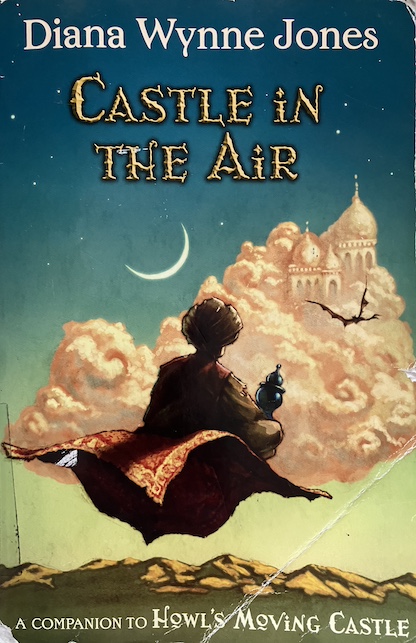
This is the sequel to Howl’s Moving Castle, the second book in the Howl Trilogy, although the characters from the first book only appear in secondary roles in this one. The series is somewhat loose, sort of like the Chrestomanci series by the same author. Characters from earlier books appear in later ones, but the main characters change in each book. This story is set in a country to the south of Ingary, where the first book took place, in a sort of Arabian Nights type setting.
Abdullah is a carpet merchant, operating a modest booth in the bazaar. He did not receive much inheritance from his father, having disappointed him in some way before he died. Apparently, there had been some sort of prophecy about Abdullah when he was born, and Abdullah has not lived up to it. He doesn’t know what the prophecy was, and mostly, it doesn’t bother him much, although he sometimes likes to imagine what it could have been, building “castles in the air” in his daydreams, where he is the kidnapped son of a king. Abdullah is mostly content with his life, doing enough business to get by, slowly building his business to have better stock, and using his free time for his daydreams. The only part of his life that he doesn’t like is when his father’s first wife’s relatives stop by his booth and nitpick him, telling him what a disappointment he is, how he should be more prosperous, how his business should be better than it is, how he should already be married, everything they can think of to make him feel bad about himself.
Then, one day, a stranger comes by Abdullah’s booth to sell him a carpet. The stranger is rude and disparaging of Abdullah’s shop, and Abdullah is dubious about the quality of the carpet he is trying to sell. The carpet seems rather old and worn. The stranger tells him that it’s a magic carpet and can fly. At first, Abdullah thinks that’s just a story to make him pay more for the carpet than it’s worth, but the stranger shows him that the carpet can fly by making it hover in Abdullah’s shop. Abdullah checks the carpet over and tries it out himself to assure himself that it’s not some kind of trick, but the carpet can really fly! Abdullah wonders why someone would be selling a perfectly useful and valuable flying carpet, even if it is a bit worn, but he decides to buy it anyway. Since he doesn’t like the stranger and suspects that there is some kind of trick involved, he drives a hard bargain, but eventually purchases the carpet. That night, Abdullah decides to sleep on top of the carpet, just in case the stranger’s trick is to call the carpet back to him in the middle of the night after having made the sale.
When Abdullah wakes up in a beautiful garden, like the one he imagines in his daydreams where he is secretly a prince, he assumes that he is dreaming. When a beautiful princess comes to him in the garden, he is sure that this must be a dream, although she doesn’t look exactly like the princess he always imagined himself in his daydreams. He decides to alter his daydreams to suit the girl. Since he thinks this is just a dream, he introduces himself to the girl as his imaginary alter-ego, the long-lost prince of a distant kingdom.
To Abdullah’s astonishment, the princess is astonished when he says that he is a man. For one thing, Abdullah is still wearing his nightgown, which the princess thinks resembles a dress, and for another, Abdullah doesn’t resemble any man she’s ever seen before. The truth is that the princess has not seen many men before. In fact, the only man she’s ever seen in her life is her father, who is a much older man than Abdullah. She thinks that all men are older men, like her father. Abdullah has heard that royal girls are kept practically prisoners, hidden away from other people. The princess, who is called Flower-in-the-Night, says that her father has kept her away from other men because he has already chosen her husband for her and doesn’t want any other man to fall in love with her and carry her off first, ruining his plans. Even though she knows that she has lived a relatively sheltered life, she still suspects that maybe Abdullah is still not a man, although she admits that it could just be because he is from a different country. She says that she wants to know all about him and his country. Abdullah, still thinking this is a dream, tells her about his daydreams of being a prince as if they were true. Then, in spite of thinking that this encounter is all a dream, he offers to come again and bring the princess as many pictures of other men as he can find, both to prove that he really is a man and also so that the princess will have a more realistic idea of what men are, so she will know whether or not she really loves the man he father has chosen for her.
After he lays back down on his carpet again, he wakes up in his own booth in the bazaar, and the carpet is still there, underneath him. The only thing he can’t find is his nightcap. After his dream, which is the most realistic dream he’s ever had, Abdullah’s ordinary life suddenly seems incredibly drab. The more he thinks about his dream, the more Abdullah remembers that he took off his nightcap in his dream. It makes him realize that the dream was actually real, and he left the nightcap behind in a real garden he visited during the night!
Abdullah comes to the conclusion that, thinking about his daydreams while he went to sleep, he must have said something in his sleep that caused the carpet to take him to the garden of a real princess. Now that he knows that the princess is real, he goes to a local artist and asks him to draw portraits of all different types of men, young and old. It’s a strange request, so he explains that it’s for a friend who is an invalid and cannot go out and see people. The artist is intrigued (and also thinks that Abdullah may be crazy), so he agrees to do it for a low price. When other people learn that Abdullah is collecting portraits now, many people try to sell him their portraits, too. It just sounds that much crazier when Abdullah refuses to buy any female portraits. Abdullah tells people that he’s think of expanding his business to selling art as well as rugs.
Abdullah realizes that the magic carpet seems to require a kind of code word to work, something that the man who sold it to him didn’t tell him but which he’s been saying in his sleep. He tries all kinds of words when he’s awake, but he can’t figure it out. Fortunately, the carpet works again when he’s asleep. He once again finds himself in the garden with Flower-in-the-Night. After he shows her all of the pictures of different men he’s collected, Flower-in-the-Night admits that she was wrong and that he’s definitely a man. She now realizes that her father is not a typical example of what all men are like, and to Abdullah’s delight, she says that she likes him better than any of the other men in the pictures. She says that she wants to marry him! Although that’s what he wants, too, it’s awkward because, when he saw her before, he was acting out his daydream with her, and he’s not really a prince. Breaking it to her gently, Abdullah says that, even if he was once a prince, he is now a carpet merchant and not a wealthy man, like her father would want to marry. Flower-in-the-Night insists that she doesn’t care.
Abdullah explains to her how he comes to her on the magic carpet but that he can apparently only use it to travel when he says the right word when he’s asleep. Flower-in-the-Night is an educated and intelligent young woman, something that Abdullah admires in her besides her beauty, and she deduces from what’s she’s read about magic carpets that the secret word is some common word that is pronounced in an old-fashioned way. Unfortunately, Abdullah accidentally sends himself back home too quickly, without Flower-in-the-Night!
He consoles himself by thinking that he will just have to make some arrangements that day and visit her again the next night to elope with her. However, his father’s first wife’s relatives have also been making arrangements for him. Although Abdullah has not known what kind of prophecy was made about him when he was a baby, they have known for years. That day, they reveal to him that the prophecy was that he would not follow his father in his business (the thing that had always disappointed his father) but that he would be raised above everyone else in the land two years after his father’s death. They’re not exactly sure what being raised above others in the land means, but they think it must mean that he is destined for some kind of honor or high social rank or wealth. Now, two years after his father’s death, the news that Abdullah has started dealing in art and not just carpets, like his father did, signals to them that Abdullah’s fortunes are changing and that his destiny for some kind of greatness must be close at hand.
His father’s first wife’s relatives try to force him to marry a couple of nieces of theirs to keep that greatness or whatever wealth might be coming to Abdullah in their family. Abdullah is appalled, and to get out of the marriages they are trying to arrange, he lies and tells them that his father made him take a solemn vow not to marry until he has achieved the goal of the prophecy and been raised above all others in the land. This gets him a temporary reprieve, but he knows that the relatives will check all of the officially recognized vows to verify whether he’s telling the truth.
His only hope is to return to Flower-in-the-Night and elope with her, taking her as far away as they can go to start over beyond her father’s reach. Unfortunately, when he returns to her garden, he is just in time to see her abducted by a djinn! Horrified, he tries to chase after the djinn on his magic carpet to rescue Flower-in-the-Night, but he isn’t able to follow the djinn. Not knowing where the djinn has taken Flower-in-the-Night, Abdullah returns home without her. The next morning, he is arrested by the Sultan’s men for kidnapping the princess! The Sultan knows that he has been visiting Flower-in-the-Night because he left behind his nightcap, with his name on it.
Under the Sultan’s questioning, Abdullah admits to visiting the princess and bringing her all the portraits of men that the Sultan has found among the princess’s belongings, although really, the Sultan has found less than half of the pictures that Abdullah brought. Abdullah points out that the Sultan has a strange way of caring for his daughter, by raising her to be so isolated that she can’t even recognize a man when she sees one. The Sultan admits that he had to raise her that way because a prophecy when she was a baby said that she would marry the first man she saw, apart from her own father. He planned to introduce her to the man he picked for her before she could see anyone else, and Abdullah’s sudden appearance has ruined his plans. Abdullah is sure that the Sultan will execute him for what he’s done. To Abdullah’s relief, the Sultan knows that he can’t cheat the prophecy, so the Sultan plans to find his daughter and make her marry Abdullah. Unfortunately, that doesn’t rule out executing Abdullah after the wedding. The Sultan also doesn’t believe Abdullah’s story about the djinn kidnapping the princess. He’s convinced that Abdullah is hiding the princess somewhere, so he has Abdullah locked in the dungeon until he can find her.
Abdullah despairs in the dungeon, knowing that the Sultan and his men won’t find Flower-in-the-Night and that he can’t tell them where she is. Then, his friend Jamal’s dog accidentally brings him the magic carpet. From there, Abdullah sets off on a wild journey, fleeing from the Sultan’s men, becoming the captive of bandits, and finding a bottle with a genie in it who must grant his wishes. With the help of a genie, finding Flower-in-the-Night seems like it should be easier, but that doesn’t mean that’s going to be easy. Even if the prophecy guarantees that Abdullah will somehow be successful in finding and marrying Flower-in-the-Night, there are no guarantees for what will happen to him afterward. Even the djinn is a pawn in someone else’s game.
The book is available to borrow and read for free online through Internet Archive (multiple copies).
My Reaction
I first read this book not long after I read Howl’s Moving Castle in high school. At the time, I knew it was a sequel to Howl’s Moving Castle, and I was confused by the change in location and because it took a long time before Howl and Sophie appeared in the story. At first, it seems like this is a completely unrelated story to the first book, but actually, Howl and Sophie are very involved in Abdullah’s situation. It just isn’t obvious because neither of them are recognizable when they first appear in the story. About halfway through the book, Abdullah learns what has happened to Howl’s moving castle, but what has happened to Howl and Sophie isn’t clear until later. Howl’s moving castle has been commandeered by the true villain of the story, and the people of Ingary think that Howl is missing. By the end of the book, it is established that Howl is a royal wizard as well as Suliman, and he and Sophie are not only married, but they have a child of their own. Their son’s name is Morgan. Since the last book, Sophie’s sister Lettie has married Suliman and also has a baby.
Prophecies play important roles in the story, and I like how the characters realize that prophecies can be literal or figurative, and there are situation that the prophecies don’t cover. The Sultan accepts that his daughter must marry the first man she sees other than himself because of the prophecy about her, and while he’s disappointed that this man turns out to be Abdullah the carpet merchant, there’s nothing in the prophecy that says that he can’t execute Abdullah immediately after the wedding and marry his daughter to someone else. The prophecy that Abdullah will be “raised above” everyone else can also have many possible meanings. It could mean that Abdullah will come to some high status in life, or it could mean that the Sultan will follow through on his threat to have Abdullah impaled in the air on a 40-foot pole.
Of course, the story has a happy ending. I was concerned that Flower-in-the-Night would be upset that Abdullah wasn’t telling her the truth about being a kidnapped prince, but she actually realizes the truth before Abdullah admits it to her. She understands how Abdullah feels because she used to have a daydream of her own about being an ordinary girl with a father who sold carpets in the marketplace.
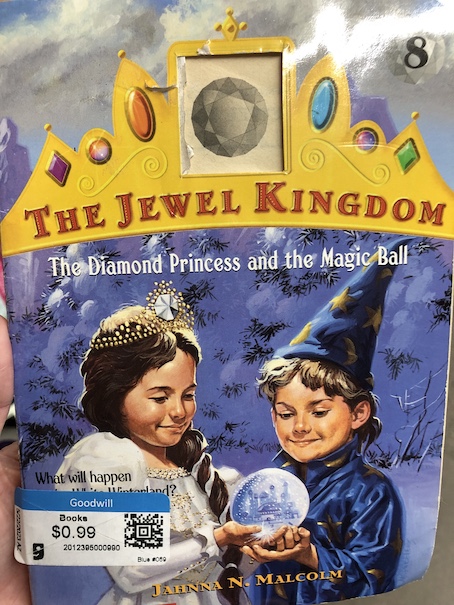
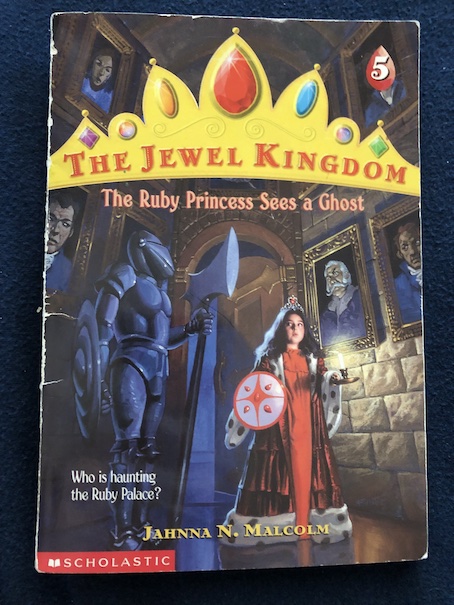
The Ruby Princess Sees a Ghost by Jahnna N. Malcolm, 1997.
Princess Roxanne lives in the Ruby Palace in the Red Mountains, and each of her sisters live in and rule over a different part of the Jewel Kingdom. The sisters visit each other from time to time, but Princess Roxanne has noticed that her sisters seem reluctant to visit the Ruby Palace. She finds out why the first time her sisters come to visit her.
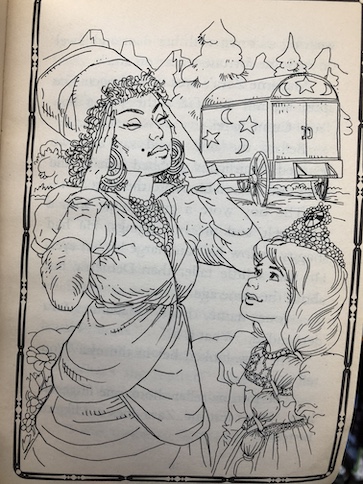
Princess Sabrina tells her that she saw someone in white waving from a tower as she approached the Ruby Palace, but Roxanne knows it wasn’t her and there shouldn’t have been anyone in the tower. That’s when her sisters tell her that there are rumors that the Ruby Palace is haunted.
Roxanne says that she’s never noticed anything strange about the Ruby Palace that would make her think it was haunted. But, almost immediately, strange things begin to happen. The cook sees a ghost in the kitchen. A picture falls off the wall, and the princesses hear mysterious laughter.
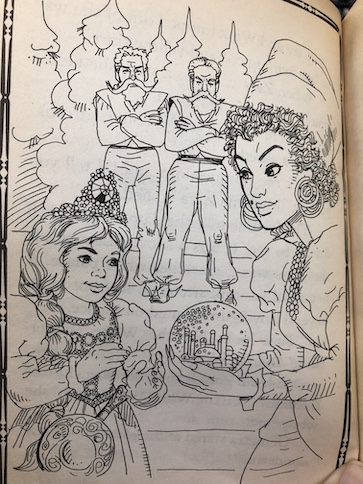
To Roxanne’s dismay, her sisters are all too scared to continue their visit. After the other princesses leave, Roxanne hears the ghost threatening to come get her, but as she tries to get away, she picks up a ring dropped by the ghost.
Roxanne knows that she has to get to the bottom of this mysterious haunting or she’ll never feel comfortable in the Ruby Palace again. Fortunately, Sabrina decides to return to the Ruby Palace to help her, and she recognizes the crest on the ghosts’ ring as the crest of Lord Bleak, their arch-enemy. Roxanne and Sabrina also discover a hidden door and secret passage in the Ruby Palace. Is Lord Bleak responsible for this haunting? Did he somehow send the ghost, or is this ghost more than just a ghost?
The book is available to borrow and read for free online through Internet Archive.
My Reaction and Spoilers
I thought this was a cute story. I didn’t read this series when I was a kid, although I saw books for sale. This is the first book in the series I read, and fortunately, it provides enough backstory to explain who Lord Bleak is and why he might be staging a haunting in the Ruby Palace. It’s a pretty easy read, just a short chapter book, and I think the mystery is probably not too difficult to figure out if you already know the backstory of the series and who Lord Bleak is. Still, I think a young child would still enjoy the suspense and atmosphere of the story and how the princesses turn the tables on the fake “ghost.” There is also a twist at the end of the story where there is actually a ghost who haunts the Ruby Palace, but it’s not the one they think, and she’s on Roxanne’s side.
I think the setting is the most fun part of the Jewel Kingdom stories. The Jewel Kingdom is divided up into different regions, each with its own terrain and magical creatures. Each princess rules over a region that fits her personality. The Ruby Palace is described as being made of stone and rather drafty and mysterious compared to the other princesses’ palaces, but Roxanne loves it.
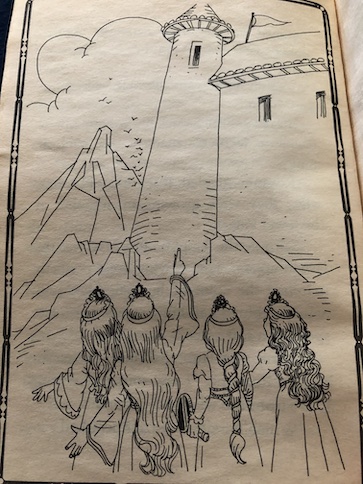
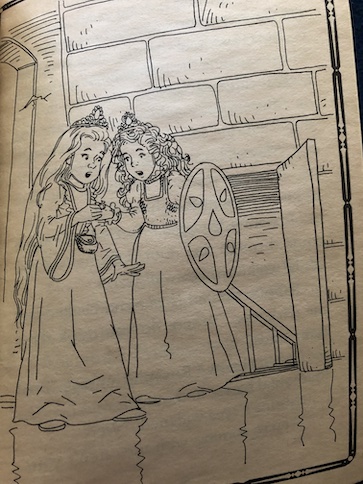
A long time ago, a king is irritated with his queen because they have no children. The queen tells him to be patient, and she eventually gives him a daughter. The king is very happy, but he makes a critical mistake. He forgets to invite his own sister to his daughter’s christening. It would be embarrassing for anybody to forget to invite a family member to an important event, but it’s a serious problem in his case because his sister is a wicked witch. She has a nasty temper and is vindictive. So, she decides to show up for the christening anyway and get her revenge by putting a spell on the baby princess. From that moment on, the baby is weightless, no longer bound by gravity.
It doesn’t take the little princess’s parents long to realize who has caused this strange malady in their child. It’s not all bad. Her nurses find her very easy to carry around, and people in the palace have fun playing ball with the princess as the ball, and the little princess herself seems to find all of this delightful. However, there is always the fear that she could blow away by accident, which does happen once, when she is blown out of a window and into the garden. Her parents continually worry about her future. At the queen’s urging, the king attempts to go to his sister and apologize about forgetting her invitation to the christening and ask her to lift the spell on the princess, but his sister denies all knowledge of the spell. The king knows she’s lying, but as long as she continues to deny it, there isn’t much he can do.
The problem goes much deeper than the princess having difficultly keeping her feet on the ground literally. She also has difficulty keeping her feet on the ground mentally. Her lack of gravity extends to an inability to see the “gravity” or seriousness in any situation. She laughs all the time, at everything, even when nothing is funny, although there is no real depth of feeling to her laughter. Even though she laughs all the time, she never smiles, leaving it open to question whether she ever really feels happiness or any emotion at all. She certainly doesn’t understand genuinely serious or catastrophic situations or other people’s emotions. When her mother cries, the princess just thinks that she’s making funny faces and odd sounds because she can’t seem to understand what crying means or the emotion behind it.
When the princess gets older, her parents talk to her about her condition, but the princess refuses to take it seriously. They try to ask her about what she feels. The princess says that she doesn’t feel anything, except that she sometimes feels like she’s the only one who has any sense, and then, she bursts into a wild, inappropriate fit of laughter. When they ask her if there’s anything she wants in life, all she can think of is to have someone tie a string to her and fly her like a kite, and then, she bursts into laughter again.
Since it’s useless trying to get through to the princess, the king and queen try consulting others, but nobody can agree on a solution. They consider metaphysics and philosophy. They recommend education and bloodletting. Her parents wonder if she would acquire some gravity if she fell in love, but the princess can’t seem to fall into anything … until the day she falls into the lake.
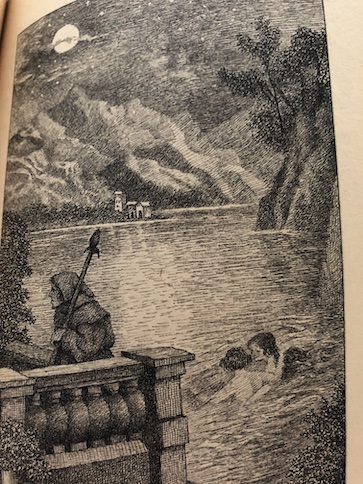
There is only one thing that the princess seems to love at all, and that’s the lake near the castle. When they take the princess out in a boat one day, she falls into the lake, and when she is in the water, she has gravity. She loves the water and loves swimming. She seems to have a better temperament when she is in the water, and she behaves better after a swim. Since water seems to affect the princess, they begin to consider that the cure to her problem might be to make her cry – a way of producing water that requires a grave emotion. However, nothing seems to make the princess cry. She is too flighty. (This book is full of puns related to gravity and flying, and they’re all given in a grave, direct manner.)
Then, one day, a prince tries to rescue the princess from the lake because he thinks she’s about to drown. When he pulls her from the water, she loses her gravity, and she angrily tells him to put her back in the lake. Unsure of how to do it when she’s weightless, the prince grabs hold of her and jumps into the lake with her. The princess is surprised and delighted because she has never truly fallen before. Now, she has fallen in with the prince … maybe in more ways than one.
However, even though the princess is starting to feel something for the prince, she has trouble understanding what she feels, not having felt much of anything for most of her life. When the lake suddenly begins drying up, the princess’s condition starts getting worse. The prince, who has truly begun to care about the princess, is willing to sacrifice himself to save the lake and the princess. It is only when the princess is confronted with the full reality of the prince’s sacrifice on her behalf that she is able to fully feel something and break free of her curse.
This book is now in the public domain, and you can read it online in your browser at Lit2Go. It is also accompanied by audio readings of each of the chapters.
My Reaction
Like other Victorian era children’s stories, there is a moral to this one, but it’s phrased in a unique and fun way. I remember liking this story the first time I read it as a kid, but I forgot about all of the puns involving “gravity”, which can refer to the force that makes things fall to earth or a state of serious emotion. The princess in the story lacks both, so she is very literally “flighty” and “can’t keep her feet on the ground.” Both of those terms are related to the idea that serious people have more emotional gravity, and unserious people lack it. For most of the book, the princess is an unfeeling air-head. I also missed the mention that the king doesn’t like puns, which may tacitly explain why his sister chose to make her curse in the form of a pun, knowing that her brother wouldn’t understand it.
The book notes that real happiness requires some emotional gravity because the person has to have enough emotional depth to understand their real emotional state and react appropriately to their emotions. That’s why the book describes the princess as never seeming happy, even when she laughs insanely at everything. She has no emotional depth or understanding. She doesn’t feel very much emotionally, and she has trouble understanding even her own limited emotional range. People often have trouble telling the difference between her laughing and screaming. Either way, it’s just a lot of loud noise with no real feeling behind it, and it’s pretty disturbing. It’s only when confronted with the apparent loss of the man she loves that the princess is able to feel a definite emotion. Fortunately, it all ends happily for our prince and princess. At the last minute, she decides to sacrifice her lake to save him, and finally, cries for the first time in her life, and that breaks her spell.
People don’t like to feel negative emotions, and some will use all kinds of defense methods to avoid what they’re feeling, but negative emotions (within reason, not taken to excess) are important to emotional health. People need to feel their full emotional range, and negative emotions often act as safety features in our lives. They tell us when we’re in an unsafe or unhealthy situation or when we’ve done something wrong, and they motivate us to do whatever is necessary to fix the situation. The princess’s habitual reaction to anything and everything is crazed and unfeeling laughter, but that’s not what she needs. She needs real feeling and honest tears to restore both her physical and emotional gravity. The princess, staring at the prince as he is about to die is literally staring death in the face and feeling the “gravity” of it. Contemplating the impending death of the prince and understanding for once the seriousness and finality of it, the princess experiences sadness and loss, and through that, she comes to understand love and sacrifice. Only when she has been through all of that is the princess truly able to be happy with her prince and his recovery. The princess has a difficult time adjusting to her new gravity, in more ways than one. She has to learn to walk for the first time because she always floated easily through life before, and sometimes, she falls down and hurts herself. She sometimes complains about it, but it’s still worth it because she has gained the ability to fully feel and to love and be loved.
During the story, none of the main characters actually have names. They are only referred to by their titles: king, queen, princess, and prince. Their names aren’t as important as their roles in the story.
There is a more modern story called Princess Hyacinth: The Surprising Tale of a Girl Who Floated from 2009 that uses the concept of a princess who is unaffected by gravity, but in a different way. It’s a picture book, and in that story, the princess isn’t cured of her lack of gravity. Instead, she learns how to make the most of it.
The Princess and Curdie by George MacDonald, 1883.
This is the sequel to The Princess and the Goblin, but it isn’t as well-known. Personally, I prefer The Princess and the Goblin, but it’s worth explaining what this book is like and how this two-book series ends.
When we last met Curdie, he was living in a cottage in the mountains and working in the mine with his father. At the beginning of this story, he is still there and still working in the mine. Most of the goblins who inhabited the mines were drowned at the end of the previous book. The beginning of the story briefly recounts the previous adventure and how the king offered Curdie a position in his guard after he helped to rescue the princess and fight the goblins. Curdie turned down the position to remain with his parents, and the king accepted his decision because he approved of the boy’s loyalty to his family. Since then, the king took Princess Irene away with him, and Curdie has missed her.
Since the old, castle-like manor house where the princess spent her earliest years flooded at the end of the story, Curdie has wondered what happened to the great-great-grandmother the princess always spoke of. Nobody ever saw her leave the house, but then again, nobody but the princess and her father ever saw her at all. Curdie’s mother says that she once saw a mysterious light, like the kind Princess Irene said that her great-great-grandmother had, but Curdie still thinks maybe the princess just dreamed that she had a great-great-grandmother, even though he once followed the magical string that the great-great-grandmother gave her.
As Curdie grows up, he believes in fewer things than he once did and focuses more on being a miner than on the little things he once noticed in the upper world. The book describes him as becoming mentally dull and more rigid and common in his thinking. Like other common and mentally-dull people, he is starting to follow the path of being so afraid of being fooled into believing something foolish that he is at risk of making a fool of himself because he is unable or unwilling to think about things deeply, consider possibilities, and believe things that he should:
“There is this difference between the growth of some human beings and that of others: in the one case it is a continuous dying, in the other a continuous resurrection. One of the latter sort comes at length to know at once whether a thing is true the moment it comes before him; one of the former class grows more and more afraid of being taken in, so afraid of it that he takes himself in altogether, and comes at length to believe in nothing but his dinner: to be sure of a thing with him is to have it between his teeth. Curdie was not in a very good way then at that time.”
Curdie’s parents worry about this change in him and find themselves wistfully thinking about how he was when he was younger. Curdie no longer makes up the songs and verses he used to because it is no longer necessary to scare the goblins away. He seems to have lost much of his former creativity, imagination, and mental flexibility because he has not been exercising them, and with them, he has been losing his critical-thinking and analysis skills and his ability to look outward and see the big picture of life and other people.
One day, Curdie makes a bow and arrows, and he uses them to shoot a pigeon. As he watches it die, he is horrified at what he has done. He suddenly remembers what the princess said about her great-great-grandmother keeping pigeons, and he feels terrible that he has killed something so lovely. His remorse stirs his heart and brings back the memories and feelings of the boy he used to be. Then, the pigeon moves, and he realizes that it is still alive, and he sees the globe of light of the great-great-grandmother. Curdie hurriedly takes the injured pigeon to the old castle. The door is open, so he goes inside and follows the sound of a spinning wheel to find the princess’s great-great-grandmother, seeing her for the first time.
Curdie admits what he has done to the great-great-grandmother and gives her the bird. The two of them discuss right and wrong, and Curdie comes to realize that he has done a great many wrong things for some time because “I was doing the wrong of never wanting or trying to be better. And now I see that I have been letting things go as they would for a long time. Whatever came into my head I did, and whatever didn’t come into my head I didn’t do.” In other words, Curdie has fallen into the habit of being thoughtless, and this is the first time in a long time that he’s paused to think about things he’s been doing or could have been doing instead. He realizes that he has even been grumbling about his work and not adequately helping his parents, and even though he noticed that they’ve been seeming unhappy and he suspected it had to do with him, he never once asked them how they felt or why.
After they have this talk and Curdie realizes the real problems behind the things he’s done and is genuinely sorry for them, the lady tells him not to worry because the pigeon will recover now, and she will take care of it. She merely gives him the caution to “Do better, and grow better, and be better. And never kill anything without a good reason for it.” Curdie offers to destroy his bow and arrows, but the lady tells him not to because there are bad things that need to be killed and that the bow and arrows may be useful someday. She also tells him that there are people who tell stories about her and laugh about her, and she asks that Curdie not laugh with them or side with them.
Curdie goes home and tells his parents what happened. They believe him and say that he should do what the lady says. The next day, when the other miners are telling stories about the lady, saying that she’s an evil witch, Curdie has to fight to hold his tongue. When they press him for what he thinks, he only says that he thinks that, if they’re going to tell stories about her, they’d better be sure that they’re true because she wouldn’t like to be slandered. The others laugh at him for being afraid of her or for wanting to defend her.
The lady appears to Curdie and his father again later. She tells them that they have the blood of the royal family in their veins, and she hints that there is a special destiny in store for Curdie. Curdie tries to ask her some questions about who she really is and about her changing appearance, but all she says is that she has many names and can appear in many different forms, and even different people see her differently. She tells Curdie to come see her alone in her tower the next night.
When he sees her the next time, the lady asks if he is ready for a difficult trial. She says that it will hurt and that it will require trust and obedience, but it will be good for him. When Curdie tells her to command him, she tells him to put both of his hands into her fire. He does it quickly, trying not to think about it, and it does hurt at first. However, it stops hurting, and when he takes his hands out of the fire again, he discovers that they are softer than they were before. The roughness and callouses from his work in the mines are gone. The lady tells him that his hands have changed more than that. She says that he will now be able to feel when he touches the hand of a man who is actually a beast on the inside, but he will lose that gift if he uses it for a selfish purpose. To demonstrate the gift, the lady calls a strange creature called Lina to them, and when Curdie feels the creature’s paw, it feels like a child’s hand. Although the creature appears strange and menacing, it’s actually good and gentle on the inside.
The lady tells Curdie to tell his parents that he must go to the king’s court the next day. She has given his father an emerald that they can use to see if he is all right during his travels because its appearance will change if he isn’t. The lady also sends Lina with Curdie to help him on his journey. Curdie is a little uneasy about that because he can tell that Lina is one of the goblins’ creatures, but Lina is genuinely helpful to him, and he becomes fond of her.
When they finally reach the king’s city, Curdie meets the king’s baker. The baker stumbles on a stone sticking up out the street and curses the king for not maintaining that road. Curdie argues that the baker himself bears some responsibility for watching where he’s going, especially since he says that he’s tripped on that stone before and knows it’s there. However, Curdie has his pickaxe with him and sees an easy way of dealing with the problem. He breaks up the rock that’s sticking out of the road, but a piece of it flies out and breaks the barber’s window. The barber comes to complain about it, and he insists that Curdie pay him more than the window is actually worth. Curdie gives him what he thinks is a fair price, and he feels the animal paw in the barber’s hand, showing what kind of man the barber is and that Curdie’s gift is still working.
There are other cruel, hard-hearted, immoral, and brutish people in this city, and sadly, some of the nicer people tend to be on the receiving end of the malicious gossip of the others. Curdie and Lina are taken in by a woman who is rumored to be a witch simply because she prefers to live quietly and not gossip like the others. Of course, everyone immediately begins gossiping about Curdie and his strange animal companion. The local magistrate believes the slander of a couple of people whose dogs Curdie had to kill because they were trying to kill him and Lina. These people claim that the dogs were harmless and Curdie killed them for no reason. When the magistrate and his soldiers come to arrest Curdie, he says that he’ll surrender, but he refuses to restrain Lina so they can kill her. Lina chases off the crowd that’s gathered to watch, but then, she vanishes herself, and Curdie is arrested. Fortunately, Curdie manages to escape and reunite with Lina. Then, he and Lina find their way into the king’s cellar and kitchen. There, he finds that the king’s servants are drunk and passed out. His touch tells him that these people are beasts inside. Going further into the palace, he finds the king’s chamber, and there, he meets Princess Irene again.
Princess Irene recognizes Curdie again immediately. It’s been less than two years since they last saw each other. She was about eight years old then, so she can’t be more than ten years old now, but Princess Irene seems older than she should be because of everything that’s been happening in the king’s palace. Her father has been ill for a year and is not in his right mind. Princess Irene thinks that the entire kingdom is concerned for him because that’s what the lord chancellor has told her, but Curdie knows that isn’t true because he hasn’t heard a word about there being anything wrong with the king outside of the palace. Princess Irene says that the king has also asked for Curdie, and his staff claimed that they tried to send for him but couldn’t find him. Curdie knows that definitely isn’t true because, until he started his journey to the king’s palace, he had been living in the same cottage where he always lived, and no one from the palace tried to find him or sent him any message.
It’s obvious that there are wicked people in the palace. These people are responsible for the king’s current condition, and they’re trying to keep the public from finding out what’s been happening. With his gift of telling who is a beast on the inside, can Curdie help Princess Irene to find and deal with the conspirators and restore the king to his right mind?
The book is public domain now. It is available to read online through Project Gutenberg (multiple formats) and Internet Archive (multiple copies). You can also listen to a LibriVox audio reading online through YouTube or Internet Archive.
My Reaction and Spoilers
As with the first book, royalty is used to represent people with the best morality in the story. Curdie and his family have royal blood because they are more wise and moral than other people around them. It feels a bit classist to think that royalty is supposed to be morally superior to everyone else just because they were born into a particular family. That certainly isn’t how these things work in real life. Just think of Prince Andrew. However, this type of comparison does fit with the fairy-tale setting of the story.
In spite of whatever royal blood he has, Curdie isn’t perfect. He was falling into bad habits until he realizes that he has done a terrible thing by shooting the pigeon, which causes him to seek out the great-great-grandmother Princess Irene told him about and to do some soul-searching about his behavior. During the time when Curdie is being thoughtless and falling into bad habits, he is portrayed as being too common, like the other men working in the mine. However, I would argue that the bad habits of the miners, like their wild, gossipy stories and rude joking and teasing, are not because they lack royal blood but because they lack thought. Curdie and his father say as much when they’re talking in the mine. The other miners are being thoughtless, and they’re simply not making any effort to be more thoughtful. More than any royal blood, Curdie proves himself worthy by his ability to be thoughtful about other people, and he gets that ability by wanting to improve himself and making the effort to do what it takes to improve.
A large part of this book comes off as a lecture about morality, but that’s not unusual for a Victorian era children’s book. The Princess and the Goblin had some of that, too, but this book has much more. That might be part of the reason why this book seems like it’s less well-known than the first book, but the ending of the book is also strange and kind of depressing.
As one might expect in a fairy-tale story of this kind, Princess Irene marries Curdie (not immediately, because they’re still children, but eventually), and the two of them are said to rule their kingdom wisely for many years. It seems like a happy ending because, thanks to Curdie’s ability to sense the true nature of people, they are able to surround themselves with the best people, and the city becomes less wicked under their rule. However, the story doesn’t end there. In the final paragraphs of the book, it says that Curdie and Irene had no children to inherit the crown. Without a blood heir to the kingdom, someone else was chosen to rule instead, and this person was wicked and greedy, so the royal city went back to being wicked. In fact, this new king was so greedy and stupid that he had his people mining continuously, right under the city itself, to bring him riches. They eventually completely undermined the entire city, so the city physically collapsed in on itself, destroying it completely and killing everyone there. I guess that’s meant to explain why this fairy tale kingdom no longer exists, but that’s quite an ending to this story! With this royal family apparently having some kind of magic about them, it seems incredible that their kingdom would have gone this way, but then again, maybe the author just didn’t want to write about them anymore.
Note to the wise: Wherever your source of wealth comes from, for the love of all that is good in the world, don’t mine your support beams! They serve a purpose and need to stay there for a reason.
The Princess and the Goblin by George MacDonald, illustrated by Jessie Willcox Smith, 1872, 1920, 1986.
“But, Mr. Author, why do you always write about princesses?” “Because every little girl is a princess.” “You will make them vain if you tell them that.” “Not if they understand what I mean.”
The Princess and the Goblin, Chapter 1: Why the Princess Has a Story About Her
This is an enchanting fairy tale-type story about a princess. One of the best parts comes at the beginning of the book, when the reader supposedly interrupts the author as he starts to tell the story, asking him why he likes to tell stories about princesses. The author explains that princess stories remind every little girl that she is a princess, that they are all the daughters of kings (apparently in the sense that any man can be the king of his family with all the dignity and wisdom that implies, and it reflects well on them when their daughters behave well, as if they were raised with the manners of royalty), even if they sometimes forget that and behave in very un-princesslike ways. He wants to remind them that they are all princesses and can behave with the grace and dignity of princesses, and he can also pamper them a little because, in the course of the story, he can give them every beautiful thing he wants all the little princesses of the world to have. There’s kind of a behavioral caution in that explanation, but also a sweet sentiment. Even if you’re just an ordinary girl, you can still act with royal dignity and grace, and through the story, you can vicariously enjoy all the riches and adventure that a fairy tale princess can have.
The princess in the story, Princess Irene, is about eight years old, being brought up in a castle or manor house in the countryside because her mother was not physically strong when she was born and is now dead. She is largely raised by her nurse and only sees her father, the king, occasionally. Her father spends his time traveling between his castles and manors, visiting various parts of his country to make sure that everything is in order. Princess Irene cannot go with him because she is still too young to travel that much.
There are caverns under and around the castle-like manor house where Princess Irene lives. There are mines in the area, and the caverns are inhabited by creatures like kobolds or goblins. The story says that there are legends that these creatures once lived above ground, but having some quarrel with requirements imposed on them by the king or human society, they retreated underground to live there in secret. From generations of living underground, they have become physically altered into deformed creatures, but they have also acquired arcane knowledge and delight in playing mischievous tricks. Because of fears of the goblins coming out at night, Princess Irene is kept safely indoors before the sun goes down and has never seen the night sky by the age of eight.
One rainy day, Princess Irene is sitting in her nursery, bored. She has many fabulous toys (so amazing that the author of the book declines to describe them and cautions the illustrator against attempting to draw them, so readers can imagine any fabulous toys they like), but Irene in not in any mood to be amused by anything. Princess Irene is restless and doesn’t even quite know what she wants. When her nurse leaves the room, Irene takes the opportunity to run off and explore parts of the castle she has never before explored. She runs up some stairs into a passageway full of doors. She continues running through the passageways with doors leading to rooms with nobody in them until she becomes lost and confused. The corridors are empty, and there is no sound but the rain. One of my favorite quotes from this book says, “It doesn’t follow that she was lost, because she had lost herself though.” Just because Princess Irene doesn’t know where she is or where she’s going doesn’t mean that she isn’t heading in the right direction, where she needs to be.
Frightened, Princess Irene tries to find her way back to the nursery. Eventually, she finds her way to a room where she hears a humming sound. When Irene enters the room, she finds a beautiful old lady with silver hair sitting at the spinning wheel. Irene isn’t sure how old the lady is because she seems almost ageless. The lady notices that she’s been crying and asks her why, and Irene explains that she is lost. The lady is kind to her, washing her face and hands, and she introduces herself as Irene, too. She says that she is the princess’s great-great-grandmother and that Princess Irene was named after her. Princess Irene wonders why she’s never seen her before, and the elderly Queen Irene says that no one else knows that she is here. She shows Princess Irene the pigeons she keeps and promises that Princess Irene will see her again. Then, she guides the little girl to the stairs back to the nursery.
When Princess Irene is back in her nursery, her nurse is relieved because she’s been looking for her. The princess explains that she was with her great-great grandmother, but her nurse doesn’t believe her. Princess Irene is offended that her nurse thinks she made up the whole story. The next day, Princess Irene tries to find the old lady’s room again, but she can’t. She almost starts to wonder if she did just dream about her.
After the rain is over, the princess and her nurse spend some time outside. They wander farther than they should, and the nurse realizes in a panic that they cannot get back to the castle before the sun sets. The nurse grabs the princess’s hand and begins running for home. She becomes even more panicked when the princess thinks she sees little men and hears a sound like laughing. In their haste and panic, they get lost. The princess doesn’t understand why her nurse is so panicked because no one is supposed to scare her by telling her about the goblins.
Fortunately, they meet up with Curdie, a young miner boy. It scares the nurse that Curdie is singing about goblins, but Curdie says that goblins can’t stand singing. Goblins don’t bother Curdie because he’s used to them and doesn’t let them frighten him. This is the first time Princess Irene learns about the goblins. When the nurse tells him who the princess is, Curdie says that they wouldn’t have gotten lost if they weren’t frightened and that it was a bad idea to say the princess’s name because the goblins might have heard and will recognize her if they see her again. Curdie guides them back to the castle before anyone realizes that they are missing. Irene likes Curdie and wants to give him a kiss for helping them, but the nurse stops her. Curdie tells her that there will be another time, and she can keep her promise of a kiss later.
Curdie can tell that the goblins are angry with him for interfering with their pursuit of the princess by their behavior toward him the next day. It doesn’t bother him much because he knows exactly how to deal with them. Goblins are intimidated by songs and rhymes, probably because they can’t make any themselves. Miners who are good at remembering songs and rhymes or making new ones for themselves don’t need to worry about the goblins, and Curdie has a talent for this sort of thing.
While Curdie is in the mine after the other miners have left, he overhears a goblin family talking, and he learns some useful things. First, he finds out that goblins’ feet are a vulnerable point on their body. Their heads are very hard, but their feet are very soft, and they have no toes. The only one who wears shoes is the goblin queen, and the goblins say that’s because the goblin king’s first wife wore shoes, and the second queen doesn’t want to seem inferior to the first. The goblin king’s first wife was a human woman, who died giving birth to their son. Second, the goblins are building new homes further away from where the miners have been mining. Third, the goblins are planning some kind of disaster against the miners. Curdie secretly follows the goblins to find out where the goblin palace is and learn more of their plans. At the goblin palace, he hears them discussing their plans. They don’t offer many new details, but it is clear that they are planning some sort of revenge against humans.
Princess Irene finds her way to her great-great-grandmother’s room again one night. This time, the old Queen Irene shows Princess Irene what she is spinning. She is spinning spiderwebs to make something for Princess Irene. She heals a wound on the princess’s hand and invites her to spend the night with her. When Princess Irene wakes up, she is back in the nursery, but she now believes that it wasn’t just a dream.
Later, the princess is frightened by a horrible goblin creature that enters her nursery through a window that the nurse left open when it was getting dark. Terrified, Princess Irene runs out of the castle into the darkness (somehow missing the extra guards that her father left at the castle for her protection). Fortunately, her great-great-grandmother sends her a magical lamp that guides her back to the castle. There, she gives the princess the present that she has finished making: a ball of finely-spun spider silk. She also gives Princess Irene a ring with a fire opal. She tells the princess that these things will guide her to safety any time that she is frightened.
The magical spider silk thread helps Princess Irene to find Curdie when he is captured by the goblins. Curdie has been trying to learn more about the goblins’ plans. Curdie discovers that the goblins are planning to kidnap Princess Irene as both a hostage and a bride for their half-human, half-goblin prince. Worse still, if their plot to abduct the princess doesn’t work, they plan to flood the mines and drown the miners!
This book is in the public domain. It’s available to read online through Project Gutenberg (multiple formats) and Internet Archive (multiple copies). You can also hear a LibriVox audio reading of this book online through YouTube and other audio recordings at Internet Archive. The story was made into an animated movie in 1991, and you can see it online through Internet Archive. There is only one sequel to this book, The Princess and Curdie. Personally, I think the original is better than the sequel.
My Reaction
This is a classic children’s fantasy story! The princess is sweet, the villains pose a real threat, and the story doesn’t shy away from the goblins’ evil. When they’re describing what to do with the princess when they get her, they talk about how they’re going to make her toes grow together so she’ll be like them. As princess stories go, this one isn’t as sparkly and pink as many modern princess books. Still, as the author notes in the beginning, this story allows all little girls to think of themselves as princesses and imagine themselves going through the adventure with Princess Irene.
As with many other Victorian era children’s stories, there are moral lessons in this one. The author periodically reminds readers about how princesses should behave with bravery and should keep their promises. There are also various other morals in the story, like the value of hard work and duty to others, learning to understand other people and give them the benefit of the doubt, and having the courage to admit mistakes and make them right. All of these values are described as being noble, and it’s implied that Curdie might have princely blood for exhibiting these values. The book uses royalty or the behavior of princesses and princes as a sort of metaphor for moral behavior.
Princess Irene’s great-great-grandmother is never fully explained. At one point, Princess Irene brings Curdie to see her, but he can’t see her, even when the princess is sitting on her lap. However, the king himself goes to see her without the princess. The princess knows that’s where he’s going because he’s heading in that direction. He is aware that the old Queen Irene is there, but he doesn’t share that knowledge with anyone else. When Curdie tells his mother that the princess tried to show him her great-great-grandmother but nobody was there and he thought that she just made it all up, his mother tells him that there is something very odd about the royal family. She says that they’re not sinister, but there are rumors and implications that there is something magical about them or that they are not quite normal humans. At the end of the story, we never get a firm answer about what Queen Irene really is. When I first read this book, I thought that she might be a ghost because, as an ordinary human, she shouldn’t be alive anymore, and I figured that she only shows herself to members of her own family. However, that doesn’t fully explain her magic, and from what Curdie’s mother says, maybe she’s some kind of fairy or elf or maybe a powerful sorceress, who can either live forever or for a long period beyond the normal human lifespan.
One of the parts that I always liked best about this book is the illustrations. They’re charming and magical! These particular illustrations were made by Jessie Willcox Smith, a famous illustrator of children’s books in the early 20th century, in 1920.
The Prince and the Golden Ax by Deborah Nourse Lattimore, 1988.
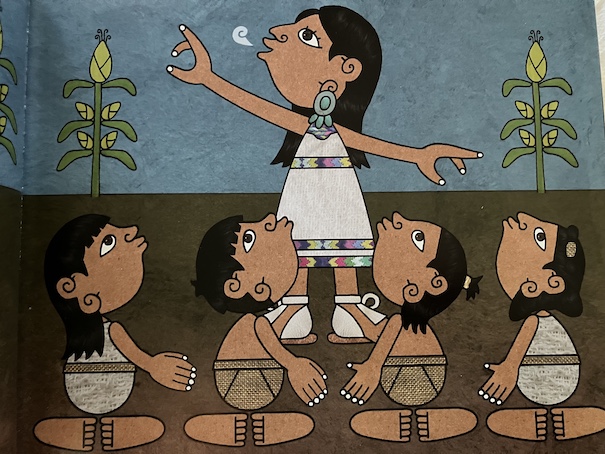
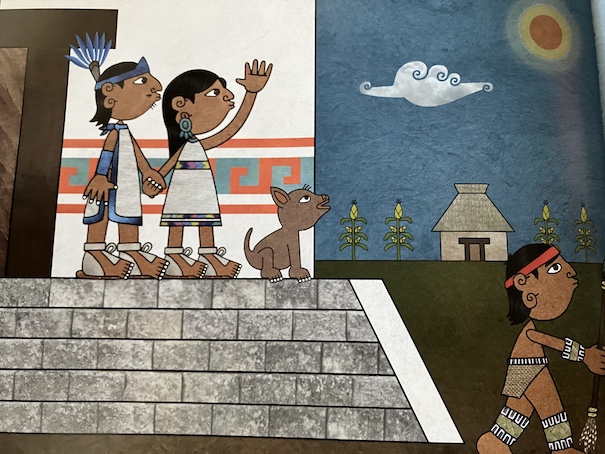
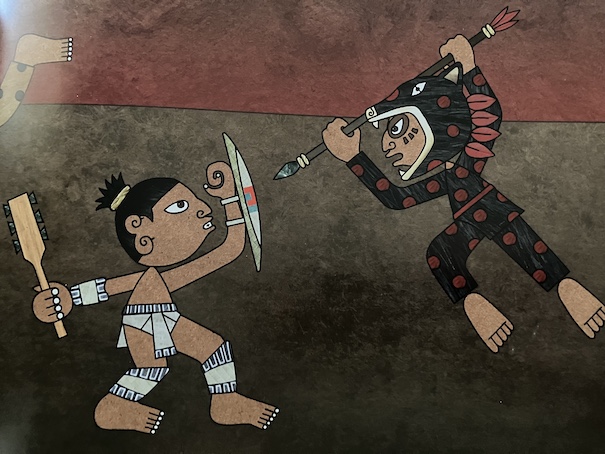
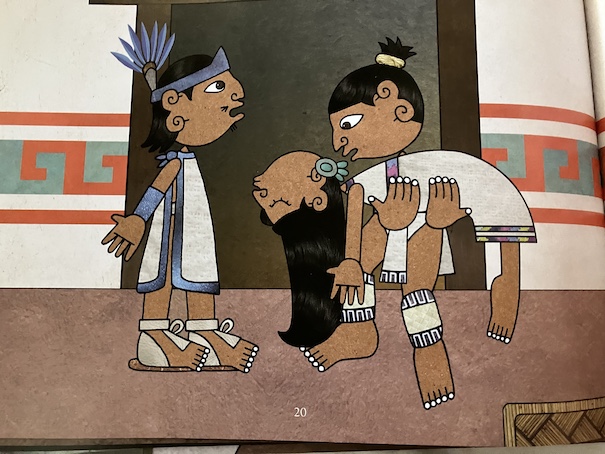
This story is based around the ancient Minoan civilization and the destruction of the island of Thera. Thera was a real place, and it was actually destroyed, but the story itself is fiction, based upon the pieces of information that the Minoans left behind about their culture.
When the story begins, the city of Knossos on Crete is the home of the Goddess Diktynna. Princess Illyra and her brother, Akros, are on their way to Crete from Thera with their fleet of ships. Akros is eager to show off his skills at the games on this feast day, although Illyra cautions him to not show off too much and to remember to honor the goddess.
When they arrive at Crete, they are shown the goddess’s shrine with her statue holding the golden ax that is the source of her power. Akros is impressed by the golden ax and begins to think that if he had the ax, he could use it to bring glory to Thera. At the feast games, Akros shows off his ability to wrestle a bull. Full of pride for himself, he declares that he’s even better than the goddess because he did it without a golden ax. The goddess is angered by his comments and causes an earthquake.
The priestess says that Akros has challenged the goddess, and in order to make amends, Akros must find the golden-scaled fish of the Eastern Isle and obtain a bronze ax. If he fails to complete this task, the goddess’s golden ax will destroy Thera. Akros has no choice but to accept the challenge.
Illyria has the ability to use magic, and she helps her brother to complete the task successfully, but Akros can’t resist bragging about how easy it all was, angering the goddess again. This boast earns him a more difficult task, to capture a griffin and earn a silver ax.
Once again, Illyria helps Akros to succeed in his task, but when he is presented with the silver ax, Akros insists that it’s not good enough for him and that he wants the golden ax. The priestess says that only a godlike hunter can have that ax, and if he tries to get it, his homeland will be destroyed. Still, Akros insists that he can prove that he’s good enough by catching a creature that no one, man or god, has ever caught before.
What Akros has in mind is catching the blue monkeys on the island of Thera. This time, Illyria refuses to help him because the blue monkeys are sacred. At first, Akros thinks that he’s managed to capture the blue monkeys without her help, but they have abilities that he never expected. As promised, when Akros fails to accomplish his boast, the island of Thera is destroyed, and Illyria and Akros only narrowly escape.
The book ends with the discovery of the remains of the palace of Knossos centuries later, when the image of the goddess and a small ax are discovered.
My Reaction
I knew at the beginning of the story that there couldn’t be a happy ending because I already knew what happened to the real island of Thera, now called Santorini. The island was largely destroyed by a volcanic eruption during the Minoan period, a cataclysm that may have sparked the legend of the sunken island of Atlantis. However, this story does not mention Atlantis, instead using the statue of a goddess found in the remains of the palace of Knossos as inspiration. In spite of the ending, I wouldn’t call this a sad story. The book doesn’t dwell on the aftermath of the destruction of Thera, and we don’t actually see much of the civilization of Thera, so there isn’t much for us to miss when it’s destroyed. The colorful pictures throughout the book are beautiful and actually feel rather cheery.