The Case of the Dragon in Distress

The Case of the Dragon in Distress by E. W. Hildick, 1991.

The McGurk organization start getting interested in the Middle Ages when they acquire a round table, which reminds them of King Arthur’s Round Table, and they begin studying the Middle Ages in school. Shortly after that, Brains buys a set of walkie-talkies at a fire sale. At first, they don’t work, but Brains tinkers with them until he can get them to send and receive. The strange thing is that they only seem to work well at night.

One night, the organization decides to test them, and somehow, they are transported into the Middle Ages. A strange voice speaks to them through their “little black boxes” and sends them on a quest that takes them to the castle of Princess Melisande the Bad. The castle is supposedly guarded by a dragon, but it is really a couple of servants in a dragon costume. Like many others in the castle, they are prisoners of Princess Melisande, who appears young and sweet, but is actually evil. She uses the dragon story to lure brave men to the castle so that she can imprison them and drink their blood. She has leeches put on them, and then she eats the leeches. That is how she maintains her youth, even though she is ancient. Among her prisoners are the king’s son, Prince Geoffrey, and the young chief of the McGurk clan from Ireland, who may be a distant ancestor of Jack P. McGurk.

When the members of the McGurk Organization arrive at the castle, everyone is amazed by their strange appearance, modern clothes, and the little black boxes that talk. Even Princess Melisande is in awe of them, but the McGurk in her prison is weakening, and she may be planning to replace him with the McGurk from modern times.

The book is currently available online through Internet Archive.

My Reaction and Spoiler:

The two servants who were pretending to be the dragon, Gareth and his sister Gwyneth, are also time travelers, but they are from the 17th century. They were brought to the Middle Ages after drinking a potion that was supposed to cure them of a fever. In their own era, they live close to the castle where they are now imprisoned, and they know that there is a secret passage that leads out of the castle from the dungeon. The kids develop a plan to sneak out of the castle under the dragon costume, but they are caught and thrown in the dungeon. They try the secret passage, not knowing if the path goes all the way through. It does, and they make it to the king’s camp. When they tell the king that Princess Melisande has his son, the king plans to storm the castle and free the prisoners. McGurk says that their mission is accomplished, and the voice from their little black boxes says that it’s time for them to go home. Everyone wakes up in their own beds, as if nothing had happened. They believe that the walkie-talkies are responsible for what happened, but they aren’t quite sure if they actually went back in time or merely dreamed that they did. There is some evidence that they really went back in time, but it isn’t answered definitely.

I liked this book as a kid, although it’s a little bizarre because most of the books in this series are just mysteries involving a group of neighborhood friends that take place contemporary to when the books were written. There is usually nothing magical or supernatural about the books in this series, and it’s kind of a weird departure from the usual format. There is another book after this one that continues their time traveling adventures.

The Ravenmaster’s Secret

The Ravenmaster’s Secret by Elvira Woodruff, 2003.

Forrest Harper is the son of the Ravenmaster of the Tower of London in 1735.  The story begins by explaining the tradition of keeping ravens at the Tower of London because of the superstition that the Tower would be conquered by its enemies if the ravens ever abandoned it.  This superstition led to the creation of the job of Ravenmaster, who looks after a flock of ravens that live at the Tower with wings clipped so that they can’t fly away.

Forrest Harper lives at the Tower with his parents and sisters, training to become a Ravenmaster, like his father.  He likes the ravens, and they like him.  He is pretty good at caring for ravens, but there is something that bothers him: he thinks that he isn’t brave enough and that others think that he is a coward, too.  He is smaller than the other boys and is often teased.  He has trouble cutting up the squirrels that the rat catcher’s boy (his only real friend, although his mother doesn’t approve of him) brings to him to feed to the ravens.  Even though it’s necessary, Forrest doesn’t like the sight of blood and feels kind of sorry for the squirrels.  Worse still, when Forrest’s family attends the public hangings (which were treated as a kind of festival day with music and entertainment in Forrest’s time), Forrest is unable to look at the criminals who are being hanged.  The one time he does try it, he throws up, and again, the other boys tease him mercilessly for it.  Forrest’s problem, as readers will see, isn’t so much that he’s a coward as he has more empathy than the other boys, both for animals and people, and that isn’t really as much of a problem as he believes.  His father tells him to ignore the bullies because they are foolish, and their foolishness will show in time.

Forrest sometimes dreams of going out into the wider world, beyond the Tower, where he could do something brave that would impress everyone.  The rat catcher’s boy, whose real name is Ned although most people just call him Rat, also dreams of running away because he is an orphan, treated harshly by his master and always in danger of being turned over to the chimney sweep to be used as a climbing boy.  He doesn’t think that Forrest has a real problem because his life at the Tower is pretty good, living comfortably at the Tower with his parents, whatever the local bullies say.  Still, the two boys often imagine what it would be like to go to sea together and have adventures.  When there is an announcement that a new prisoner will be arriving at the Tower, a Scottish Jacobite rebel, Forrest thinks that helping to guard a dangerous rebel will make the Tower bullies respect him.

To Forrest’s surprise and embarrassment, this rebel actually turns out to be a girl.  She is the daughter of the rebel Owen Stewart, who is being held in a different tower at the Tower of London (the Tower of London is actually a fortress with multiple towers – she is imprisoned in Bloody Tower and her father is in Bell Tower).  She has been charged with treason, along with her father and uncle.  Forrest isn’t happy about being given the task of taking food to a girl prisoner. 

However, Madeline McKay Stewart, the girl prisoner, is pretty tough in her own right.  Although Maddy’s been separated from her father and uncle and all three of them are likely to be executed, she is being pretty brave about it.  She talks to Rat and Forrest.  She is interested in Forrest’s pet raven, Tuck, and tells him about how she used to feed baby owls back home.  She talks about her life and family in Scotland, and Forrest realizes that he’s starting to think of her as a friend instead of an enemy to be guarded.

While Forrest is used to hearing English people criticize the Scots for being “savage,” he is astonished and a bit offended when Maddy talks about English people being “evil.”  For the first time, it makes him think of the situation from the other side.  He knows that not all English people are evil and realizes, having seen that Maddy actually has refined manners, that Scottish people aren’t “savage.”  One day, at Maddy’s request, he takes a message to her father in exchange for her ring, which he plans to sell in order to buy Ned back from the chimney sweep after the rat catcher loses his term of indenture to the chimney sweep in a game of cards, sparing him from the horrible life and health problems that the young climbing boys suffer.  Then, Owen Stewart gives Forrest a message to take back to Maddy.  Without really meaning to, Forrest realizes that he has suddenly become a go-between for the rebels and could be considered a conspirator under English law.

As Forrest considers the fate that lies ahead for Maddy and the nature of war between England and the Scottish rebels, it occurs to him that the adults in his life have often done the opposite of the things that they have always taught him were important.  His father always emphasized fairness, yet the war and Maddy’s possible execution are unfair.  Maddy shares Forrest’s feeling that the world might be a better place if people didn’t become adults and abandon their values.

Then, Maddy’s father and uncle are shot while attempting to escape, and Maddy is left completely alone.  Forrest feels badly for Maddy.  Soon after, he is unexpectedly approached by a carpenter who seems to know that he has become friends with Maddy.  The carpenter, who is a stranger to Forrest, tells him that Maddy will soon be executed by beheading but that he has a way to save her life.  Forrest has to decide if he is willing to trust the stranger and save Maddy, knowing that doing so would make him a traitor himself.

One of the parts of this story that interested me was how Forrest noted the hypocrisy in the adults around him as he was trying to decide what he should do.  Qualities that adults often praise and try to instill in their children are often ignored in the way that the adults live and even in how they treat other children, like Ned and Maddy.  Abandoning values, even the ones that they really want their children to have, isn’t something that adults have to do as they grow older, but it is something that some adults do if they think they must in order to live as they want to live or accomplish something that they want to accomplish.  The adults who think that Maddy should be beheaded would probably say that they were doing it for the greater good in promoting their cause against the rebels.  However, treating Ned as a piece of disposable property is something that they mostly do because they can and because they know that there is nothing that Ned can do to stop them.  Ned actually tries to repay his indenture legally with money that Forrest gives him, but although the sweep accepts the money, he refuses to let him go, saying that no one will take Ned’s word over his and that he could always use the money to make sure that Ned is hung as a thief if he tries to make trouble.  It is this type of attitude and situation that make the children realize that they are on their own to solve their problems and that working within the law is not going to be an option for them because the law is not just and it is not on their side.  It’s a frustrating situation, and I often feel frustrated when I encounter this type of thing in books, but fortunately, things do turn out well in the end.

This is one of those coming-of-age stories where a boy must decide what he stands for and where he really belongs.  Through Maddy and the inscription on her ring, which means “Face Your Destiny,” Forrest comes to understand the destiny that is right for him as he helps both Maddy and Ned escape to a better life elsewhere. 

The book also includes some interesting historical information. There’s a map of the Tower of London in the front of the book, and in the back, a short history of the Tower with information about famous prisoners and escapes. There is also a glossary of English and Scottish words that modern children (especially American children) might not know, such as breeches, wench, loch, and tattie-bogle (scarecrow).


The book is currently available online through Internet Archive.  (To borrow a book through Internet Archive, you have to sign up for an account, but it’s free, and then you read the book in your browser window.)

Spoiler: In the last chapter of the book, it explains what happened to the characters after the story ends.  Forrest does become the Ravenmaster after his father, realizing that it is the right kind of life for him and that he no longer desires to have adventures outside the Tower.  He has a wife and daughter, and years later, he receives a message from Ned, who says that he has become a captain in the Royal Navy and that Maddy has gone to live in the colonies with other Stewarts (something that my own Jacobite ancestors did, which is how I got to where I am now).

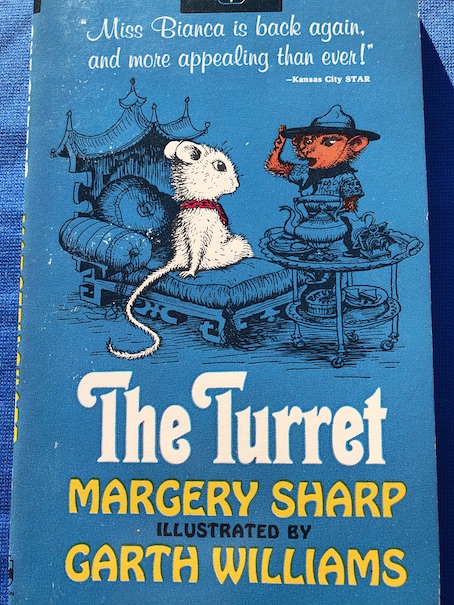
The Turret

The Turret by Margery Sharp, 1963.

Miss Bianca has decided to resign as Madame Chairwoman of the Mouse Prisoners’ Aid Society.  She has never felt particularly drawn to public life, really preferring her quiet life as a pet of an Ambassador’s son (whom she always calls “the Boy”), keeping him company during his lessons and writing poetry in her spare time.  During the times when she is away from the Boy, undertaking rescue missions for the society, she knows that the Boy pines for her and worries about where she is.  She has started to feel a little guilty that she might be neglecting her Boy.

Bernard, the Secretary of the society, actually feels a little relieved by her decision to resign.  While he thought that she made a great chairwoman, he has always worried about the dangerous nature of their missions, afraid that something might happen to Miss Bianca.  (Miss Bianca is a little annoyed that he seems so eager for her to resign, and his comment that “you’re too beautiful to be allowed into deadly peril” makes a weirdly chauvinistic compliment – like it would be okay for her to risk her neck if she were ugly because it would be less of a loss? – but Miss Bianca takes it in the spirit in which it seems to be offered.)  The two of them reminisce about some of their past missions.  Bernard thinks that the worst villain they’ve faced was the head jailer in the Black Castle (from the first book in the series), but Miss Bianca thinks that the worst was Mandrake (from the last book) because the target of his cruelty was a defenseless child.

The society plans to throw a special dinner for Miss Bianca, and Miss Bianca suggests that she would like a picnic by water.  The ideal place for it would be the moat around an old tower outside of the city.  Miss Bianca enjoys the picnic and is fascinated by the crumbling old turret.  Then, she notices something white in the window.  Thinking that it’s a piece of litter, one of the mouse boy scouts goes to retrieve it.  It turns out to be a small piece of linen, and after the boy scout takes it, it’s replaced by another.  Miss Bianca comes to the conclusion that there is someone in the turret and that the person could be a prisoner, signaling for help.  When she studies the scrap of linen more closely, she also realizes that she knows who the prisoner is because it has the name Mandrake on it!

After the events of the previous book, the evil Duchess had Mandrake locked in the turret.  To Bernard, it sounds like a just punishment for Mandrake, but Miss Bianca feels a responsibility to rescue him, in the hope that he might reform.  However, Bernard is skeptical about that possibility, thinking that they would just be letting a criminal lose if they tried to free Mandrake, and Miss Bianca is unable to persuade the other members of the society to undertake the mission.

However, Miss Bianca is unable to give up on Mandrake and goes to see him in his turret. Mandrake is a shadow of his former self.  She introduces herself to him as a member of the Mouse Prisoners’ Aid Society, and it turns out that he’s heard about it from friends of his who have been in jail (having had many disreputable associations over the years).  In order to test how likely Mandrake would be to reform, Miss Bianca asks him what he would do if he were freed from captivity, and he says that he’d like to be a gardener at an orphanage.  He feels badly about the child slaves he helped to abuse while serving the Duchess, and he’d like to see children happy, making their garden a beautiful place.  Miss Bianca is satisfied with this and sets about planning his escape. (She’s free to undertake this mission because her Boy is having his tonsils out and won’t miss her for awhile.)

At first, Mandrake doesn’t know how people even bring him food, since his room in the turret doesn’t seem to have a door and food just seems to arrive during the night.  Miss Bianca stays up at night to see what happens and learns that there is a hidden staircase in the turret that his jailers use.  Before Mandrake can escape, though, he needs to be stronger because he’s badly under-nourished.  Miss Bianca recruits the mouse boy scouts to bring him vitamins to help make him healthier and tries to figure out how the secret passage works and think of some way to create a distraction so that Mandrake can escape.

Shaun, the leader of the boy scouts, helps her to come up with a plan.  (The book says that Shaun is half-Irish and thinks of himself as being a “handsome boy-o.”  Stereotypical.)  Shaun has figured out that the jailers watching Mandrake are actually grooms by trade, and he knows of a race horse, Sir Hector, who could provide a good distraction for them.  Miss Bianca approves of the plan and persuades Sir Hector to help them.

Meanwhile, the members of the Prisoners’ Aid Society are getting fed up with their strict new chairwoman, who only seems interested in forcing them to participate in group exercises.  Members are starting to avoid going to meetings, and worse still, someone suggests to Bernard that the bossy chairwoman particularly likes calling committee meetings because she’s in love with him and wants the excuse to see him. The thought horrifies Bernard, but he’s afraid to say anything to Miss Bianca because he doesn’t want her to feel obligated to try to become the chairwoman again in order to solve the society’s problems (or his), not knowing what she’s actually been up to in her free time.

In the end, everything works out well.  When Mandrake is rescued, he actually does become the gardener for an orphanage.  The members of the society find out Miss Bianca’s daring mission, undertaken with just a handful of boy scouts, and feel badly that they didn’t take part.  They complain to the new chairwoman that she was just wasting their time with exercises instead of real missions, and she resigns, saving Bernard from her attentions.  Miss Bianca does not return to the society as its chairwoman, but the next chairwoman is more competent.

This is the third book in the Rescuers series, and it is currently available online through Internet Archive.

The Rescuers

The Rescuers by Margery Sharp, 1959.

This is the first book of The Rescuers Series.  Disney made a movie called The Rescuers based on this series, but the movie was very different from the book.  The movie involved a pair of mice who were members of a mouse version of the United Nations called The Rescue Aid Society who rescued a young orphan girl who was kidnapped for the purpose of recovering a treasure from a dangerous cave.  In the book, the prisoner the mice rescued was a poet who was being held captive in a castle.

The beginning of the first book of the series explains the purpose of the Prisoners’ Aid Society, an organization of mice that helps human prisoners:

“Everyone knows that the mice are the prisoners’ friends – sharing his dry bread crumbs even when they are not hungry, allowing themselves to be taught all manner of foolish tricks, such as no self-respecting mouse would otherwise contemplate, in order to cheer his lonely hours; what is less well known is how splendidly they are organized. Not a prison in any land but has its own national branch of a wonderful, world-wide system.”

However, the mice are daunted by their latest concern, a prisoner who is being held captive in the Black Castle, a Norwegian poet.  The Black Castle is a harsh prison, and because of the jailer’s cat, mice usually cannot reach the prisoners there.  However, the current chairwoman of the society believes that it may be possible to rescue one of the prisoners there.  She thinks that Miss Bianca is just the mouse for the job because she is the pet of an ambassador’s son and will soon be traveling to Norway with her owner.  The chairwoman sends Bernard, a pantry mouse, to Miss Bianca to recruit her for the mission.

Miss Bianca is frightened when Bernard explains the mission to her and faints.  However, it turns out that Miss Bianca is a poet, and so is the man who is being held prisoner.  Bernard uses her sympathy for a fellow poet and some flattery to inspire her to agree to help.

When Miss Bianca reaches Norway, she recruits some help from the mice in the cellar of the embassy.  In particular, a sailor mouse called Nils accompanies her to where the other mice from the Society are meeting.  There, Bernard joins them for the journey to the Black Castle.

When they reach the castle, Miss Bianca, Bernard, and Nils take up residence in an empty mouse hold in the head jailer’s quarters.  (There is a horrifying description of how the head jailer apparently pinned live butterflies to his walls to die. Ew!)  The jailer does have a horrible cat named Mamelouk, who is as cruel as his master.  At first, Miss Bianca isn’t afraid of the cat, having known a nice cat who didn’t eat mice when she was young.  After talking to Mamelouk and interacting with him, she comes to recognize his cruelty and real intentions toward her.  However, Mamelouk is an important source of information.  It is from Mamelouk that they learn that the jailers will be having a New Year’s Eve party soon and that many of them are likely to be lax in their duties.  This will be the best time for them to try to rescue the poet!

The mice do successfully rescue the poet, and Miss Bianca returns to her boy, who has been missing her. However, this is just the first of her adventures in this series!

Overall, I prefer the first Disney Rescuers movie to the book because the prison/castle seemed pretty dark for a children’s book, and I think the idea of rescuing a child is also more appropriate for a children’s book.

The book is currently available online through Internet Archive.

Changes for Felicity

American Girls

FelicityChanges

Changes for Felicity by Valerie Tripp, 1992.

FelicityChangesPennyThis is part of the Felicity, An American Girl series.

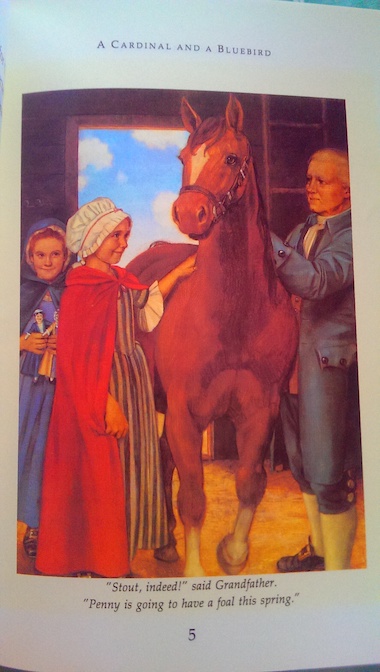
Everything is changing for Felicity. To begin with, her horse, Penny, is expecting a foal. Penny has been happy and healthy since she came to live with the Merrimans, but Felicity worries about what will happen when Jiggy Nye, her abusive former owner, gets out of prison. He has been in jail for not paying his debts. Felicity learns that he was once a respected member of the community and an expert with animals, but he became an alcoholic after his wife’s death. However, Felicity can’t bring herself to feel sorry for Nye after the way he’s behaved, even when she learns that he is sick. Felicity’s friend, Elizabeth, convinces her that they should send him some medicine and other supplies in prison, partly to have pity on him and partly so that he will feel grateful to Felicity when he gets out and not make trouble for her.

FelicityChangesGrandfatherSickUnfortunately, Elizabeth’s father also soon ends up in prison. Tensions between Patriots and Loyalists are high. The former governor has fled Williamsburg, and Patriots are arresting Loyalists. That Mr. Cole is a Loyalist has been well-known for some time. Felicity fears for Elizabeth and wonders what will happen to their friendship.

Then, Felicity’s grandfather also becomes ill. He soon dies of his illness, devastating her family, but before his death, he takes steps to make things better for Elizabeth’s family, Jiggy Nye, and his own family, especially Felicity. In return for Felicity’s charitable gift and her grandfather’s honorable payment for the horse, Jiggy Nye also helps Felicity and Penny when they need him the most, redeeming himself in everyone’s eyes.

FelicityChangesMotherWith the war everyone has dreaded finally becoming reality, there are still more changes yet to come. Elizabeth’s father must leave Williamsburg, Felicity’s father decides how he will support the war effort, and Felicity begins to play more of a role in the running of her father’s shop, as she had wished to do before.
In the midst of Felicity’s grief over her grandfather’s death and worries about the coming changes in all of their lives, her mother has some poignant thoughts about the nature of death and change. While Felicity wishes that it were summer again, back when her grandfather was alive and they were all happy, her mother says that not all changes are bad ones. As she points out to Felicity, even though it might be tempting for her to wish that she were a child again herself, when both of her parents were still alive, to go back to that time would mean giving up her life with her husband and her children. She loves her children and enjoys seeing them grow up and change.  The ability to witness those happy changes is worth dealing with the less happy changes in life as well.  Death, like change, is just another part of life, and Felicity’s mother points out that love still connects us to those we’ve lost.  Like everyone else, the only way Felicity can move in her life is forward, and that’s a good thing. Felicity still has growing up to do and happier changes yet to come.

In the back of the book, there is a section of historical information about the Revolutionary War.

The book is currently available online through Internet Archive.

The Keeping Room

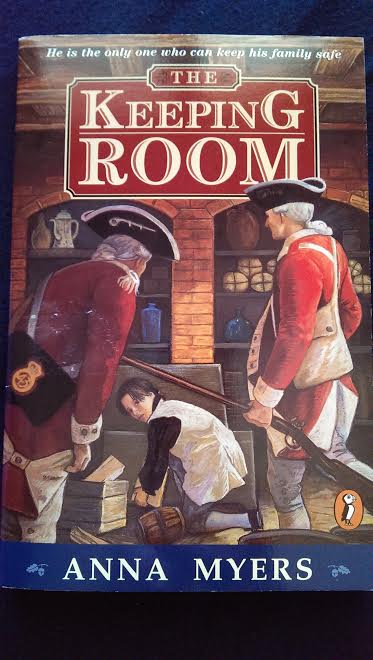
KeepingRoomThe Keeping Room by Anna Myers, 1997.

Joey was named after his father, Colonel Joseph Kershaw, a wealthy businessman in Camden, South Carolina during the Revolutionary War.  Joey is like his father in many ways.  He idolizes him and does everything as his father wishes.  When his father marches off to fight on the side of the revolutionaries, he tells twelve-year-old Joey that he must be the man of the house while he is away and look after his mother and the younger children.  Joey takes pride in his new position as man of the house, but he is soon to undergo hardships that will turn him into an older and wiser person.

Joey’s father and his troops lose their battle and are captured by the British.  Soon, the whole town is taken by the British troops, and they commandeer the Kershaw house, the biggest house in town, as their headquarters, keeping Joey and his family as prisoners.  Joey can only watch in helpless anger as the British set up gallows in his family’s garden and hang rebels, his father’s surviving troops.

Joey’s mother was a Quaker before her marriage, and so is Joey’s tutor, Euvan.  They do not believe in the violence of war or harboring hate.  Although Joey seethes with anger at his father’s imprisonment, his family’s captivity in their own home, and the death and destruction he sees around him, they make efforts to remind him that British soldiers are human too, some good, some bad, and not all monsters.  However, how can Joey see the British as anything but monsters when he has seen their cruelty, when he and his family have suffered at their hands, and when he has watched them put many good men to death?

Before the British captured the house, Joey managed to hide away his father’s pistol.  It isn’t enough to fight an army, but Joey knows that he will use it to fight if he gets the chance.

Throughout the story, Joey undergoes a transformation, not just from a boy to a man, but from his father’s little copy into his own person.  From the beginning, Joey identifies himself mainly as his “father’s son.”  He loves his father and truly idolizes him.  He wants to be just like him, and his father is grooming him to take over his businesses one day, to do everything the way he does.  Joey loves how respectful everyone is toward his father, a wealthy and successful man, and how respectfully they treat him when he is with his father.  He hangs on his father’s words and adopts all of his beliefs.  But when his father is gone, things are different.  People who were respectful of him because of his father now regard him as just a boy, a little spoiled and not really knowing or understanding much.

Joey struggles to grow into his new role as man of the house, to really be a man as his father would have wanted.  But along the way, he comes to realize that there are many things that his father didn’t really understand himself and that he was wrong about many things.

Joey’s father didn’t believe in educating women beyond basic reading and writing.  His sister Mary has defied their father’s wishes before by borrowing Joey’s books, and although he didn’t want to tattle on his sister, Joey could never bring himself to support her studies openly because he didn’t want to go against what his father wanted.  However, during their captivity, Joey comes to appreciate his sister Mary’s courage and intelligence.  She gives him great support through their harrowing circumstances. He is proud of her and realizes that she is worthy of the studies she craves.

Similarly, Joey comes to question his father’s beliefs about slavery. Although his father railed against British tyranny, claiming that he would never be a slave to them, he kept slaves of his own.  When Joey had previously questioned him about that, his father told him not to worry about it because it was part of “the order of things.”  But, Joey’s own experiences in captivity make him think differently.  He also comes to appreciate the two slaves who stood by the family to help them through their captivity, learning more about their lives and history.  Because of his experiences, he decides that he will never be a slave owner himself.

Most of all, Joey finally sees the truth of what his mother, Euvan, and even Biddy and Cato (the two slaves who remained with them) tried to tell him about hate and killing when one of the British soldiers gets killed while saving Joey’s life.

As Joey reacts to the frightening circumstances around him, doing what he can to protect his mother and younger siblings, he realizes that he must rely on himself and his own judgement, not his absent father’s, to handle the situation.  In the end, he decides that, although his still loves his father and eagerly waits his return home, he does not really want to be like his father anymore.  He has truly become his own man and is ready to stand up for the man he has become, even though his father may no longer want him to run his businesses.

This book is currently available online through Internet Archive.

The Ghost that Came Alive

GhostCameAlive The Ghost that Came Alive by Vic Crume, 1975.

Jenny Blair is a gloomy gus who often gets premonitions of impending doom, much to the annoyance of her siblings.  They poke fun at her pessimism, but some of those premonitions start to come true when her youngest brother falls ill on a family vacation to the beach and needs to be taken to the hospital.

Jenny and her twin brother, Chris, accompany their older teenage brother and sister as they start the long drive home while their parents tend to their younger brother at the hospital. On the way home, the kids accidentally become stranded during a storm and seek out help from a large old house that they had mistaken for a hotel. With a fallen tree blocking the road, the inhabitants of the house reluctantly agree to take them in until they can continue their trip home, but all of the kids can tell that there is something sinister about their hosts.  Miss Cliff makes it obvious that she resents the children’s presence, and Dr. Cliff is a peculiar kind of scientist working on . . .  something . . . in the basement.

GhostCameAlivePicThey tell the kids that the house is supposed to be haunted and people can often hear the ghost of Andrea Cliff calling out in the night.  The kids soon hear this spooky voice themselves, calling for help.  Trapped in the house with the ghost and unfriendly people, the Blairs decide that they have to figure out what’s really going on, but the danger is worse than they know, and Jenny’s premonition of doom is getting stronger all the time . .

The book is available to borrow and read for free online through Internet Archive, but the version there does not have pictures.

My Reaction:

This creepy little book has been a favorite of mine for years!

Young people trapped in a spooky old house with a ghost story during a storm is a common trope of spooky stories, but this one is a particular favorite because of the way it’s done. I like the implication that Dr. Cliff might be some kind of mad scientist. Mad scientists appear in other books in children’s literature, but it’s an element that provides a nice twist on the ghost story and allows readers to wonder whether Dr. Cliff or the ghost might be the bigger threat.

The ghost story and the mysterious voice the kids hear is also well done, and they confront the problem very practically. For those who like the Scooby-Doo style of mystery, where the “ghosts” turn out to be people, and there’s an explanation for everything . . . you’ll love this story.  Not all copies of the book have pictures, but my book contains a few black and white illustrations.  The one I used in my review is the scene where the kids hear the ghost’s voice for the first time.

There is one final twist at the end of the story that readers might see coming if they pay close attention to the story. There’s even a clue to this twist that is shown in pictures if you have a copy with pictures, but I’m not going to spoil it here.