Mystery Madness

Mystery Madness by Otto Coontz, 1982.

While Murray’s parents are on vacation, his older sister, Blanche, is in charge of the house. One day, he calls Blanche to get a ride home from the dentist and hears what he thinks is Blanche shooting their housekeeper.

Earlier that morning, he had heard Blanche talking on the phone to someone about a gun. Then, when he calls home, a friend of Blanche’s, Harold, answers, and Murray hears a gun going off in the background and Blanche apologizing to the housekeeper and talking about blood on the carpet. When Murray gets home, his mother’s Persian rug is missing and sees what appears to be a head in a bucket under the sink in the kitchen, further proof that the housekeeper is dead and that her blood stained the carpet.

Murray doesn’t know what to do because he is sure that his sister would never shoot anyone on purpose, and he doesn’t want to see her go to jail. He consults a private detective, Mat Cloak, who he met in a doughnut shop, for help.

The detective agrees to look into the case, and along the way, he realizes that it has connections to a case that he is already investigating. What really happened to the housekeeper? Is Blanche really guilty of murder? Moreover, who is the strange man who is following Murray around?

It’s a very funny story with some twists that readers won’t be able to guess right away. Part of the mystery is pretty obvious because Blanche is a theater student, but the real mystery is one that Murray isn’t even trying to solve and the real villain is someone who Murray thinks is a victim.

The book is available to borrow and read for free online through Internet Archive.

Coffin on a Case

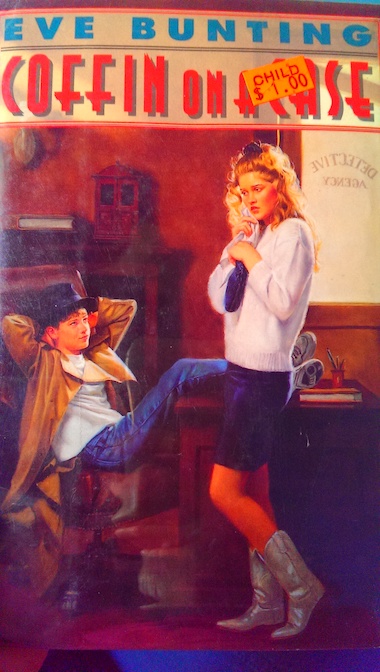
CoffinCaseCoffin on a Case by Eve Bunting, 1992.

Twelve-year-old Henry Coffin’s father is a private investigator, and Henry hopes to be one himself someday.  He’s learned a lot by watching his father in action.  One day, a sixteen-year-old girl, Lily, comes to the office and asks for help in finding her missing mother.  Lily found her mother’s car in their driveway with groceries still in it, and her mother is nowhere to be found.  She doesn’t want to go to the police because she once called the police about her mother being missing only to discover that there was a mix-up and that her mother had tried to leave her a note that she hadn’t seen.  Lily has double-checked this time to make sure that there was definitely no note from her mother and none of her mother’s friends have heard from her, but she worries that the police would think that she’s being paranoid, so she decided to consult a private investigator instead.

Henry’s father is concerned about the disappearance of Lily’s mother, but he’s unable to take the case because he has to go out of town.  He tries to refer Lily to another investigator or a friend of his who is with the police, but Lily just storms out of the office.  Henry wishes that he could take the case for his father.  His own mother abandoned him and his father when Henry was just a baby, so disappearing mothers are of great concern to him.  Later, when Lily gets in touch with him, Henry agrees to help her without telling either his father or Mrs. Sypes, the housekeeper who has looked after him since his mother left.

At first, there doesn’t seem to be much to go on.  Lily’s mother makes wooden storks that she sells as lawn decorations to people who have recently had a baby.  She was going to sell a couple before going to pick up the groceries, but Lily says that there is an extra one missing.  Somewhere between the grocery store and home, Lily’s mother made an unexpected stop . . . and there are signs that someone other than Lily’s mother drove the car to Lily’s house.  But, who was it, and what happened to Lily’s mother?

The answers to these puzzles put Henry on the trail of some dangerous thieves who would do just about anything to cover up their crime.

The book is available to borrow and read for free online through Internet Archive (multiple copies).

My Reaction

Henry shows excellent deductive reasoning as he analyzes the clues and reconstructs Lily’s mother’s trail to learn what happened to her. Both Henry and his father are inspired by the fictional character, Sam Spade, and Henry makes frequent references to him in the story, thinking what Sam Spade would say or do in certain situations.

Throughout the book, Henry also considers his own mother’s disappearance years ago.  Her abandonment of her family was her own choice, not an abduction, which makes her situation different from what happened to Lily’s mother.  Henry has no real memory of his mother, which pains him somewhat.  He sometimes dreams that she’ll return home one day for a happy ending, like in the movies, but he also realizes that’s really just a daydream.  When Lily’s mother is finally rescued, Henry and Lily continue being friends, and Henry also considers whether a relationship would be possible between his father and Lily’s mother.  It’s a nice idea, but Henry also thinks that isn’t likely, and he’s okay with that.

Basil in the Wild West

BasilWestBasil in the Wild West by Eve Titus, 1990.

This book picks up right after the previous book in the Basil of Baker Street Series, Basil in Mexico.

After leaving Mexico, Basil and his best friend Dr. Dawson journey north into the western territories of the United States.  There, some friends of their ask them to investigate a smuggling operation.  Mice have been illegally bringing Mexican antiquities across the border.

Basil realizes that the smugglers have been smuggling the antiquities in the open, pretending that they are ordinary replicas, the kind that tourists often buy.  Because the border guards aren’t experts in antiquities, they haven’t been able to tell the difference between harmless souvenir replicas and the real thing.

When they catch one of these smugglers, they learn that the mastermind behind the scheme is a mouse called J.J. in a town called Moriarty in New Mexico (the name of the town irritates Basil).  They go to the town with the help of some friendly horses and confront J.J..  At first, they think it won’t be too difficult because, although J.J.’s house is well-guarded, he is confined to a wheel chair because of an accident.  However, the wheel chair is an act, and J.J. is no ordinary mouse.

BasilWestPic2Although J.J. escapes, Basil and Dr. Dawson decide that the smuggling ring has been defeated and it’s alright to continue their sight-seeing.  However, their adventures are not over!

Basil and Dawson want to see the Grand Canyon, but it turns out that the hotel where they are staying is being terrorized by a weird, glowing Thing.  Nobody knows what it is, but guests think it could be some kind of ghost or monster, and many of them are too afraid to stay.  The owners of the hotel ask Basil to discover what the Thing is and stop whoever may be behind it before their hotel is ruined!

This book is really two stories in one, and neither has any direct bearing on the other.  In that way, it’s kind of disjointed.

The book is currently available online through Internet Archive.

Basil and the Pygmy Cats

BasilPygmyCatsBasil and the Pygmy Cats by Eve Titus, 1971.

Mouse detective Basil’s arch enemy, Professor Ratigan, has taken over the Asian country of Bengistan, near India.  Basil discovers that he is holding the real ruler of the country captive so that he and his gang can loot the country for everything they can get, keeping the populace in subjugation.  Basil is determined to go there and free the rightful ruler so they can vanquish Professor Ratigan!

When Dr. Edward Hagerup of the British Mousmopolitan Museum hears that Basil is heading to Asia, he asks him to investigate an historical mystery for him.  There have been tales of a race of pygmy cats, no bigger than mice, but new evidence has been found that suggests there is more truth behind the stories than anyone has realized.  Basil has an interest in archaeology and eagerly accepts this extra task as part of their mission.  Along the way, other mice who have heard of the expedition join up to help Basil.

At first, Basil’s original mission, stopping Ratigan, seems easy.  Basil and his friend Dawson allow themselves to be captured so that they can get into the palace and find the real Maharaja of Bengistan.  After solving a secret code in the dungeon, they find the Maharaja, who tells them that another acquaintance of theirs, the opera singer, Relda, is also a prisoner in the palace.  She was giving a performance there when Ratigan and his thugs took over, and Ratigan has forced her to stay, giving private performances for him.  During one of these performances, Basil and his friends manage to take Ratigan by surprise and capture him.

BasilPygmyCatsPic1Now, Basil thinks that he and his associates are free to continue their other mission, finding the lost civilization of pygmy cats.  However, that mission is fraught with danger and surprises, and they haven’t quite heard the last of Ratigan.

The story isn’t really much of a mystery.  It’s really more an adventure story.

Basil and his friends manage to locate the island of pygmy cats with the help of Jeannie (a sea serpent related to the Loch Ness Monster who lost her way back to Scotland after a family trip — I kid you not) and the Sacred Catfish (which they bribe with catnip — I also kid you not, and his nip trip is a little disturbing).

This is my least favorite of the Basil series, partly because of the lack of mystery and also because of “primitive” nature of the pygmy cats when they find them.  Basil makes it clear that the pygmy cats are inherently less intelligent than mice and that their greatest achievements were because of the influence of royal mice who washed up on the shores of their island years ago, only to be wiped out by a volcano.  (Really?  Really.  Basil, if these mice were so superior and the pygmy cats so inferior, why were the cats able to get away from the volcano when the mice didn’t, hmm?  Why didn’t the mice just go to the part of the island where the cats were until the volcano stopped erupting?  Just what kind of bill of goods are you trying to sell us, Basil?)  Basil comes off sounding like a 19th century imperialist, and the fawning adoration he gets for his discovery is really annoying.

In general, I don’t like the Basil stories that turn out to be more adventure than mystery, and Basil’s smug superiority at various points in the story are off-putting.  It’s true that that Sherlock Holmes (which this series parodies) had an ego as well, but these sort of imperialist attitudes in a children’s story are distasteful.  Although I like recommending nostalgic books for future generations, this is one that I really can’t recommend.  The brightest spot in this book was the secret code in the dungeon, which is more in keeping with the mystery theme.  If the book had made the plot to capture Ratigan and end his reign of terror in another country without all this stuff about an “inferior” species of small cats, it would have been a much better story.

Like other books in this series, this book contains a number of jokes on the original Sherlock Holmes stories.  Read a number of the names backwards, and you’ll see some familiar names from Sherlock Holmes as well as a reference to another series by Eve Titus.

This book is available to borrow and read for free online through Internet Archive.
Basil and the Lost Colony

BasilLostColonyBasil and the Lost Colony by Eve Titus, 1964.

A Norwegian scholar from the British Mousmopolitan Museum approaches Basil about a letter that he has recently received along with an arrow.  The letter mentions a recent sighting of the mysterious Adorable Snowmouse (no, that’s not a typo, he’s big for a mouse, but really adorable and saves people lost in the mountains), and the arrow is evidence that points to the whereabouts of a lost colony of mice who fled Switzerland during the time of William Tell, about 600 years previously.  These particular mice lived in William Tell’s basement, and like Tell himself, the Tellmice (as they are called) left their home because they opposed the rule of a tyrant.  However, even after the tyrant’s reign ended, the Tellmice did not return home and no one knows for sure what became of them.

Basil is eager to join the expedition to search for the lost colony, but he is also concerned about opposition from his nemesis, Professor Ratigan.  Professor Ratigan has recently made attempts on his life, and he now knows about the expedition to find the lost colony, even stealing the evidence from Basil’s home.  Basil is sure that Professor Ratigan will do everything he can to prevent them from reaching the lost colony.

In Switzerland, the expedition is joined by a pretty and adventurous opera singer, Relda (a take-off on Irene Adler, from the original Sherlock Holmes stories, read her name backwards), who comes in disguise after Basil tells her that the mission is too dangerous for her.  That’s just one of the jokes on original Sherlock Holmes stories that appear in this book.  These jokes would go over the heads of kids who aren’t familiar with the original stories, but make the story more entertaining for adults.

Basil and his friends do meet up with the Adorable Snowmouse, find the lost colony, and defeat Ratigan (well, temporarily, at least).

Although the Basil of Baker Street Series is supposed to be about a mouse detective kind of like Sherlock Holmes, some of the entries in the series, like this one, are really more adventure than mystery.  The book is currently available online through Internet Archive.

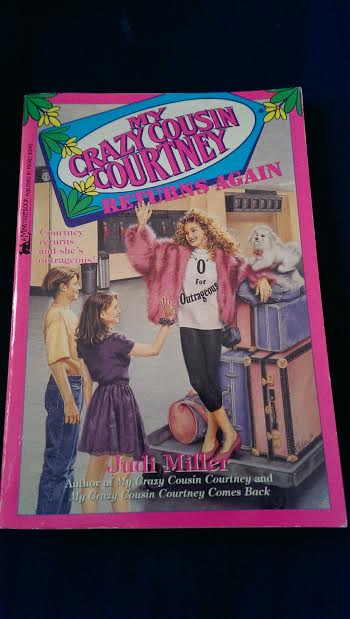
My Crazy Cousin Courtney Returns Again

CousinCourtneyReturnsMy Crazy Cousin Courtney Returns Again by Judi Miller, 1995.

Courtney is back in New York with her cousin Cathy and living her dream of becoming an actress!  Courtney has landed a part in a movie called The Laundry Bag Murder (see the first book in the series for that explanation).  With Courtney’s new professional responsibilities, Cathy hopes that this visit will be quieter than their last ones, but no such luck.  Excitement follows Courtney wherever she goes, and if things aren’t exciting enough to suit her, she knows how to stir them up!

When Cathy and Courtney go to the Central Park Zoo to try out Courtney’s new video camera, Courtney ends up turning the expedition into a vampire hunt that ends up catching a criminal.  When they go to see a friend’s rock band perform at a bar, Courtney turns a barroom brawl into a hug-in.

Courtney is also giving Cathy relationship advice.  Cathy and Frank are boyfriend and girlfriend now, but both of them are pretty shy.  Too shy to even go on a real date.  Courtney says that maybe Cathy should act a little helpless to bring out Frank’s protective instincts and to get his attention.  She says that Cathy should tell Frank that she thinks someone might be following her around (it’s not a lie if Cathy isn’t sure).  That way, Frank will want to spend more time with her to look after her.

With some reservations, Cathy does tell Frank someone may be following her, which does get Frank’s attention.  Then, to Cathy’s surprise, she actually does notice someone following her around.  At first, she suspects that Courtney got another actress to follow her for awhile to make her story to Frank true, but it turns out, that’s not the case at all.  Who is that mysterious woman in the sunglasses and what does she want?

There is another book in the series which I don’t have and haven’t read called My Crazy Cousin Courtney Gets Crazier.  Courtney ends up going to school in New York with Cathy because she lands a role in another movie which will be shooting there during the fall.