Trouble at School

The Berenstain Bears

Trouble at School by Stan and Jan Berenstain, 1986.

“When a problem at school
Is kept secret too long,
It can grow ’til a cub
Thinks that everything’s wrong!”

Brother Bear runs into problems at school after he catches a bad cold. While he’s recovering from his cold, he is allowed to watch tv and read comic books. His teacher sends home a packet of schoolwork for him to do, but he ignores it and forgets about it.

He doesn’t remember the packet of work until he’s better and going back to school. However, he soon becomes preoccupied with the news that Cousin Freddie has taken over his position on the soccer team during his absence.

When his teacher gives a quiz on the new lesson in division, Brother fails it. Brother is supposed to show the quiz to his parents and have them sign it, but his parents become preoccupied with Sister, who is now sick, and Brother doesn’t show them the quiz.

The next day, Brother is so upset about his bad grade and what’s happening on the soccer team that he doesn’t go to school. He makes his quiz into a paper airplane and throws it away.

Then, Brother gets the idea of going to see his grandparents for help. He explains the entire situation to them. His grandfather tells him a story that helps put the situation in perspective.
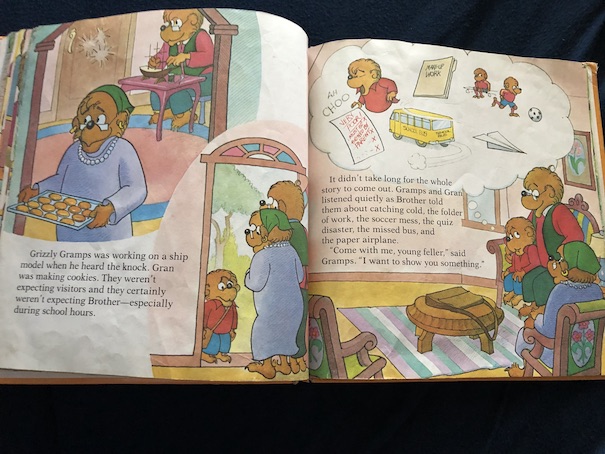
There was a time when Gramps did something wrong, and instead of admitting his mistake, he just kept going and made the problem worse, like Brother did by ignoring his schoolwork and not telling his parents about his problems at school. Gramps says that it’s best to admit when you’ve made a mistake so you can do what you need to do in order to turn the situation around.
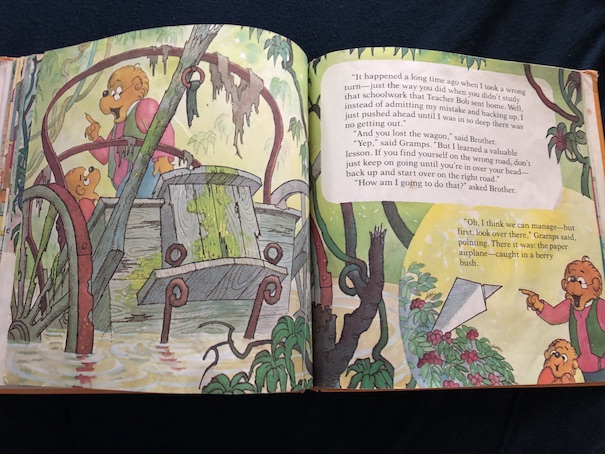
They find the quiz that Brother threw away and go home to tell Brother’s parents about his school problems. They’re not happy about the situation, but they tell Brother that “It’s never too late to correct a mistake,” and Gramps proves to Brother that he can do division by having him divide a bag of cookies among the family members.

When Mama takes Brother back to school, he learns that nobody else in class did very well on the quiz, so the teacher is letting them do a retake. Now that Brother realizes what division is really about, he does much better. At the soccer game that afternoon, Brother also gets a chance to retake his old position on the team. If he hadn’t gone to school that day, he would have missed these chances to make things right, but because he did go and took the second chances that he was offered, things were much better by the end of the day.

Adults reading the story will recognize that the reason why Brother’s parents are supposed to sign his failed quiz is because that is how the teacher draws parents’ attention to problem areas that their children have so they can make sure that they can pay extra attention to the child’s homework and help him with his problem areas. It’s not about shaming or punishing the child but getting the child the help he needs to understand the subject. By hiding the bad quiz from his parents, Brother was avoiding the help that his parents were supposed to provide and making the situation worse. Parents can be disappointed when their children bring home bad grades, but this is a situation where parents would rather know than not know if their children are struggling with something because they generally want to help their children when they need it.

The lesson of the story is a good one. Anyone can occasionally make mistakes, have problems, or just plain fail at something, but the people who succeed in the end are the ones who face up to their problems and do what’s necessary to make them right. Some people feel overwhelmed when confronted by problems, but the best thing they can do is admit that there is a problem and that they’re feeling overwhelmed and get help from someone else. Brother could have just told his parents and gotten help with division immediately, as soon as he realized that neglecting his make-up work had left him behind in class. At first, he was too embarrassed and worried to do that, but he did manage to turn things around by talking to his grandfather about his problems and taking the help and advice that he offered. Making mistakes or even failing something doesn’t have to be scary or overwhelming because there are always things you can do to make the situation better and people who are able to help.

The book is available to borrow and read for free online through Internet Archive.
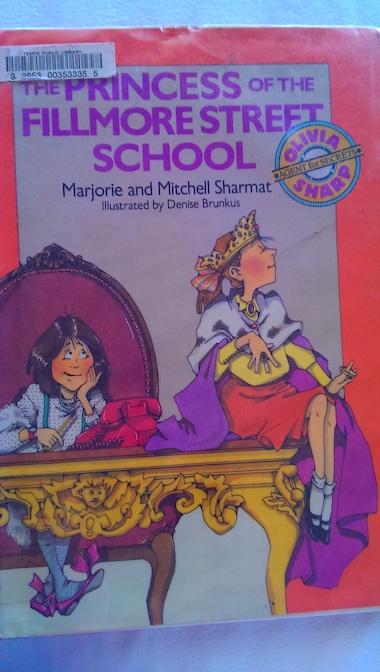
The Princess of the Fillmore Street School

Olivia Sharp, Agent for Secrets

OSPrincess

The Princess of the Fillmore Street School by Marjorie Weinman Sharmat and Mitchell Sharmat, 1989.

Desiree, who has always been a bit prissy, tells Olivia that she has decided that she wants to be princess of their school. She plans to prove that she is a perfect princess by trying to make all the other kids perfect. She is getting on everyone’s nerves, telling them to stand up straight or that their hair needs to be fixed.

When the others ask Olivia to help, she suggests to Desiree that she concentrate on making improvements to the school itself, but even that causes problems. Eventually, things get to the point where the school’s principal asks for Olivia’s help. Can anything stop the princess of Fillmore Street School before she drives everyone crazy?

Olivia’s solution is partly pointing out to Desiree the effect that she’s having on other people and partly explaining that a school which is already governed by a principal doesn’t also need a princess.  Then, she finds a way to help Desiree to feel like a princess even though she can’t be one.

The Pizza Monster

Olivia Sharp, Agent for Secrets

OSPizzaMonster

The Pizza Monster by Marjorie Weinman Sharmat and Mitchell Sharmat, 1989.

Olivia lives in a penthouse in San Francisco with her chauffer, Willie, and her housekeeper, Mrs. Fridgeflake. Her wealthy parents live there, too, but they are often traveling and are rarely home. When her best friend, Taffy, moves away, Olivia is lonely. She buys herself a pet owl named Hoot, but that still doesn’t completely help.  She needs something to help keep herself busy. Olivia realizes that she is good at keeping secrets and at helping people with their problems, so she decides to busy herself running a service to help people with their secret problems. She has a bunch of flyers made and hangs them up around town saying that she is an agent for secrets and will help people.

A boy named Duncan, who Olivia knows from school, asks her to help him with his friend, Desiree. He says that they were together at the pizza parlor when she suddenly got angry and walked out.  He doesn’t know what made her angry, but he asks Olivia to help him find out and fix their relationship.

Olivia’s attempts to help are a matter of trial and error. At first, Olivia thinks that Desiree was merely offended that Duncan gave her the smallest slice of pizza. She suggests that Duncan buy her another whole pizza, but that doesn’t work. Even Olivia’s idea to buy her a lot of different kinds of pizza doesn’t work. Eventually, Olivia talks to Desiree herself and learns that there is another reason why she is angry with Duncan.

It turns out that the problem doesn’t have anything to do with pizza but with Duncan himself.  He’s always full of doom and gloom and criticism for everything.  What Duncan needs is an attitude adjustment.  He doesn’t realize that his pessimism and negativity makes it difficult for others to be around him.  Olivia encourages him to be more positive and to develop his sense of humor.  Once his attitude improves, so does his relationship with Desiree.

The Westing Game

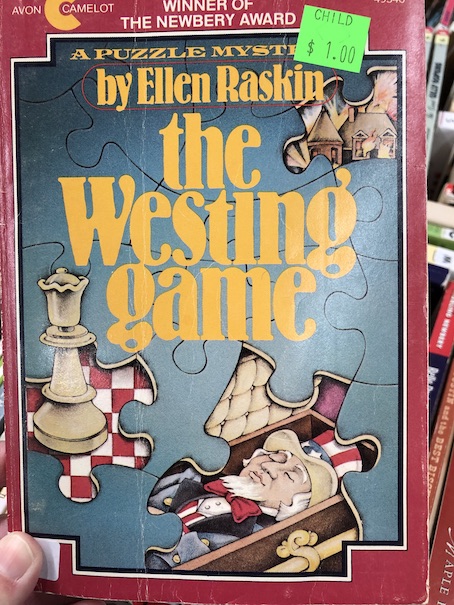
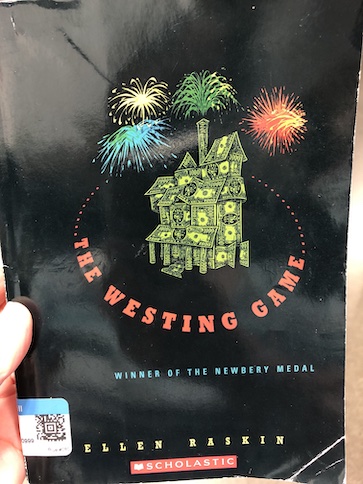
The Westing Game by Ellen Raskin, 1978.

It all starts when a mysterious person invites six sets of people to live in the new apartment building, Sunset Towers.  Sunset Towers is a luxury apartment building, but the rent for these individuals and families is surprisingly affordable.  That is because these people are special, and the owner of these apartments is preparing for a very special game.  Although there doesn’t seem to be anything to tie these people together at first, they do share a special connection that isn’t immediately obvious, a connection to the wealthy but mysterious Samuel Westing.

Among the new tenants of Sunset Towers is young Turtle Wexler.  Although she is often in the shadow of her overly-shy but pretty older sister, Angela, she has ambitions of her own in life.  While her mother dreams of making it in high society, Turtle (whose real name is also something of a mystery to the other tenants for most of the book) wants to become a successful businesswoman when she grows up, and one of the things she wants most is a subscription to the Wall Street Journal.  To raise the money she needs, Turtle accepts a bet to sneak into the supposedly empty Westing House on Halloween night, earning $2 for every minute she spends there.  There are stories that the place is haunted and that Mr. Westing’s body lies rotting on an oriental rug there, but Turtle doesn’t believe them.  As it turns out, she’s right.  Instead, she finds Mr. Westing dead in bed.

To everyone’s surprise, the tenants of Sunset Towers are all named in the will, but not in an ordinary way.  In order to determine who the final heir will be, they must all play The Westing Game.  The heirs are divided up into teams of two and given $10,000 and a set of clues.  They must use these to give an answer at the end.  But, what kind of an answer?  Mr. Westing’s will implies that he was murdered, but is that really true?  Could his murderer even be among the heirs/game players?

As the book continues, readers learn more about each of the contestants.  Each of them has their own personalities, ambitions, and problems.  For example, Angela Wexler is about to be married but seems less than enthusiastic about the wedding.  Cristos Theodorakis suffers from a strange malady that keeps him confined to a wheelchair.  Sydelle Pulaski was actually invited to join the tenants by mistake, but it might be the best mistake of her life.  Mr. Hoo is worried about his restaurant, and Madame Hoo dreams of returning to China.

The competition is fierce in the Westing Game.  Players are suspicious of other players cheating.  Things around the apartments start disappearing, and some mysterious person has even started planting explosives in unlikely places!  Whether the thefts and explosions have anything to do with the contest itself is for the reader to discover, but there is an answer to the Westing Game, and only one of the contestants will discover it.

The book is a Newbery Award winner.  There is a movie version of the book called Get a Clue! (1997), although it doesn’t follow the book completely.  There are multiple copies of the book currently available online through Internet Archive.

My Reaction

One of the great things about the Westing Game is how the seemingly mismatched pairs of contestants actually complement each other, giving people new perspectives on their lives and the answers to problems that some of them have been struggling with.   Lonely Flora Baumbach, grieving for her deceased daughter, is paired with young Turtle, who finds in her a more motherly person than her own mother, someone who values her for her intelligence and her unique skills in a way that no one else does.  Mrs. Baumbach enjoys having someone to care for again, and Turtle blossoms under her care and attention.  Mr. Hoo, meanwhile, finds some unexpected support for his business from Mrs. Wexler, who develops broader interests in life than her previous social ambitions and an unexpected flair for business and marketing.  Judge Ford, who was educated by Mr. Westing and always worried about how to repay the debt, finally finds a way to repay his kindness, a way that Mr. Westing would have approved.  Bertha Crow, an unhappy woman who turned to religion to atone for past sins, finds new happiness with someone who understands and accepts her past and is willing to help her continue her good works.  Even Angela, who seems to have everything a young girl would want (good looks and a kind fiance with a promising future in medicine), figures out what she really wants in life and finds the courage to stand up for it.