Among the Ghosts

Noleen-Anne Maypother’s mother died shortly after she was born, while holding her for the first time, so her life started with her first encounter with death. Since then, Noh has been raised by her widowed father with some help from her two aunts. Noh doesn’t realize it, but there’s usually one child in her family in each generation who has unusual talents, and in this generation, it’s her.

One summer, her naturalist father is going to study newts in the Appalachian Mountains, so he sends her to stay with one of her aunts. However, when she arrives, she finds out that her aunt has gone on a trip to the beach with her cousins because she wasn’t expecting Noh to arrive. Unsure of what to do at first, Noh realizes that she can just go to her other aunt, Aunt Sarah, who teaches English at a boarding school. Noh is supposed to attend this boarding school this coming fall anyway, so she decides that she can just go to the school early.

By the time Noh arrives at the school, her father and Aunt Sarah have realized what happened, and Aunt Sarah is expecting Noh to arrive. From the very beginning, this school is strange, though. Noh likes the school, but she has an odd encounter with a strange old lady when she tries to take a shortcut through a cemetery, and the woman gives her something that looks like an evil eye.

Later, when Noh is exploring the school, she meets a friendly girl called Nelly. Nelly chats with her, but Noh feels uneasy around her, for some reason. Although Noh doesn’t realize it right away, the reason is because Nelly is dead. Nelly is part of a group of ghosts who inhabit the damaged West Wing of the school, where no students live now.

Each of the ghost children who “live” there now died at the school at varying points in the past. Nelly died from an allergic reaction to a bee sting, which was ironic because she always wanted to be an entomologist. Trina died falling from a horse, although that doesn’t keep her from being friendly and nosing into other people’s business. She likes to follow living students around and listen to their gossip. Henry is an older ghost, having died at the school at the age of 13, about 50 years earlier. He is lonely for his parents and his old life, even though he has the other ghosts for company, and he sometimes broods over the letters he got from home before he died. Thomas is older still. He’s been dead for about 80 years, and he likes watching the school’s cook make pies in the kitchen.

At dinner that night, Noh tries to ask about Nelly because she notices that she is the only child among the faculty. The adults tell Noh that there are no other students at the school yet and that they’ll arrive in the fall. Someone suggests to Noh that maybe she saw a ghost, and Noh starts to wonder. When she returns to the West Wing to investigate, she meet Henry. Noh is startled at this confirmation that there are ghost children at the school, and Henry is startled that a living person can actually see him. There are plenty of ghosts around the school, but Henry has never met a living person who can see ghosts before.

While the two of them are talking, something strange happens. A bright light appears, and Henry goes into it, disappearing. Noh doesn’t understand what happened or what it means. However, when she meets Trina later, she learns that other ghosts around the school have vanished, and Trina is worried. It seems to have something to do with the strange parades of ants that have been moving across the school, carrying something white with them.

Strange things have been happening at this school for generations. Noh learns that it’s a place that attracts people with unusual abilities, and it has been home to bizarre experiments and a shape-shifting monster that wants badly to eat “something big” as well as home to various ghosts. There are secret passages and hidden rooms and faculty who seem to know much more than they want to tell about the mysterious things that happen there. Noh must learn the school’s secrets to help her new ghost friends!

I enjoyed this creepy story. I think it was well-written and fun to read, although I also did feel like Noh figured out some things unnaturally quickly at the end. In the end, readers are given enough answers that the plot makes sense, and we can get a general pictures of what’s been happening at this school, but there are some things that appear intentionally open-ended. It felt to me like the author was setting up this story to be the first in a series, but as far as I can tell, it doesn’t have a sequel.

The story combines many elements of classic scary stories – spooky boarding school, ghosts, weird teachers with secret knowledge, secret passages and hidden rooms, girl with apparent psychic abilities that she doesn’t fully understand, secrets buried in the past, a bizarre invention that appears to have been made by some kind of mad scientist and has an unknown purpose, and a lurking monster that wants to eat someone. Although the story has plenty of creepy elements, they’re softened by humor along the way. There is a monster referred to as the “nasty thing that refuses to be named”, which appears periodically throughout the story to remind us that it once ate “something big”, that what it ate was “really big”, that it wants to eat “something big” again, that it can tell that readers don’t like it but that it doesn’t care what you think, etc. By the end of the story, we are told what the monster actually is, but it’s still on the loose, leaving it open to Noh and the ghost kids trying to hunt it down again later.

The author, Amber Benson, is also an actress, known for her role on Buffy the Vampire Slayer.

Moondial

Araminta Kane, called Minty, has always had the ability to sense things that others can’t. For as long as she can remember, she has had the ability to sense and even see spirits. She doesn’t talk about it much because this happens to her routinely. When she does mention it, her mother assumes that it’s imagination or a trick of the light. Minty becomes more aware of her ability after her father dies, and she is still able to hear his voice from time to time.

She has been learning to cope with her father’s death and the changes to her life since it happened. She and her mother have been getting along pretty well, but her mother has to work long hours. It’s bad enough that Minty has to be alone so much on weekends, but her mother wonders what she will do during her school holidays. Minty’s mother decides to send Minty to stay with her godmother, Mrs. Bowyer, in the village of Belton, for the summer. Mrs. Bowyer is an elderly lady who lives in an old, stone cottage, which is near the old manor known as Belton House. Belton House once belonged to Lord Brownlow, but it is now owned by the National Trust (UK organization that focuses on preservation and protection of historic sites) and operates as a tourist attraction, open to the public. Mrs. Bowyer used to work for the Brownlow family as a domestic servant, and now, she sometimes helps out in the gift shop at Belton House.

Minty is happy about spending the summer with Mrs. Bowyer, who they call Aunt Mary, because she has heard about Belton House, and she would like to see it. She knows that there is a hidden tunnel on the property, and the idea of exploring it sounds intriguing. However, she wonders if that will be enough to keep her occupied all summer, and she does worry about whether her mother will be all right without her. She knows that her mother is still mourning her father and that she sometimes cries at night. Minty’s mother reassures her that she will be fine and that they’ll be too busy working to be sad and lonely. She also reassures Minty that she won’t be bored while she’s in Belton. When she stayed with Aunt Mary as a child, she always had the feeling that Belton was unusual somehow, that unseen things were happening beneath the surface. Minty asks her if she means ghosts, that the village is haunted. Her mother isn’t quite sure because she never actually saw any ghosts or anything of the kind.

Aunt Mary is happy to have Minty stay with her, and she says that Minty can help her in the shop at Belton House. She says that things at Belton House aren’t like they were in the old days, when the Brownlows lived there, and she remarks that they would turn over in their graves if they saw all the tourists and school groups tramping through their house and grounds. Before her mother leaves Belton, they explore the nearby churchyard together. Even though it’s July, Minty feels a strange gust of cold air. She senses that there is something strange about it, she plans to return later and examine the area more closely.

Minty has a strange sense that time doesn’t work in quite the same way in Aunt Mary’s village that it does elsewhere. She thinks it makes sense that time would stand still in the old graveyard because everyone there is dead, but Aunt Mary herself seems to move as if she’s in a different time as well. Aunt Mary is puzzled even about basic pieces of modern technology, not understanding even what Minty’s headphones are for.

While Minty is with Aunt Mary, she gets word that her mother has been in a car accident and is in the hospital. Minty is terrified of losing her mother as well as her father. A nice man named John Benson from her mother’s office is helping to arrange things, and Aunt Mary urges Minty to try not to think about it or worry too much, but Minty can’t help it. When Minty feels like she needs to get out of the house and go for a walk, Aunt Mary suggests that she go explore Belton House and meet Mr. World, the groundskeeper, who likes children.

When Minty meets World, he asks her if she’s there to meet the children. At first, Minty doesn’t know who he’s talking about, since she just saw a tour group of other children leaving the grounds. She asks if there are any children currently living in the old house, but World isn’t talking about living children. World tells her that there are children who haunt the place. He says that they’re trapped and need someone to free them, and he thinks that Minty will be “the one to turn the key” and set them free. This isn’t exactly reassuring talk for Minty’s current situation, but she has the feeling that what World says is true and that she’s just been given a kind of invitation that she can’t refuse.

In the gardens of the manor, Minty finds a mysterious sundial that has the power to take her back in time. The very first time she encounters it, it gives her a strange feeling, and for some reason, she keeps thinking of it as a “moondial” instead of sundial. Suddenly, Minty finds herself back in the Victorian era with a boy named Tom. Tom is an orphan from London who works at the manor house, and the adults there abuse him. Minty tries to intervene, but none of the adults can see or hear her, and she suddenly finds herself back in her own time, uncertain of what made her travel through time and what brought her back to the present.

Later, when Minty visits the old house again, she has another encounter with the sundial/moondial and finds herself visiting the grounds of the manor at night. This time, she meets a girl from the past called Sarah. Sarah sings little rhymes (old, traditional ones – Poor Mary (sometimes called Poor Jenny or Poor Sally, and sometimes she’s weeping for a lost sweetheart and sometimes for a playmate) and Girls and Boys Come Out to Play (listen on YouTube). Minty watches as a frightening adult dressed in black hurries her back into the house, calling her a “little devil.”

When Minty visits Tom’s time again, she learns that Tom has also seen Sarah. He seems to also have the ability to travel through time, and when he sees Sarah, it’s also at night. Tom still thinks that both Minty and Sarah are ghosts. Minty doesn’t know why this is happening, but she senses that she needs to help Tom and Sarah.

When Minty visits the hospital, she isn’t sure what to say to her mother, who is still in a coma, so she decides that she will make recorded tapes about her time-traveling adventures that she can play for her mother, along with some music. The doctor approves of Minty make tapes for her mother to listen to, but Minty tells him that what she has to say is private, and she makes him promise that he and the nurses won’t listen to them while they’re playing. The doctor promises that there won’t be anyone in the room, and they won’t listen to the tapes themselves.

Then, Aunt Mary has a visit from a strange woman called Miss Raven, who says that she’s an author investigating the ghosts at the manor house. Aunt Mary even accepts Miss Raven as a lodger at her house. However, Minty has a strange feeling that Miss Raven is not to be trusted. Miss Raven tries to get Minty to admit that she has seen ghosts. She watches Minty closely and tries to get Aunt Mary to limit Minty’s freedom to go places by herself. World also shares Minty’s suspicions of Miss Raven. He tells her that Miss Raven is probably after the children, and it’s up to Minty to save them. She doesn’t know how to do that, but she’s determined to try.

The book is available to borrow and read for free online through Internet Archive. There is also a BBC miniseries based on the book. It’s available on DVD through Amazon, and you can sometimes see it or clips of it on YouTube. There is also a similar (although not identical) story by the same author called Stonestruck, which involves child evacuees from London during WWII.

I read Stonestruck first, and I read Moondial specifically because another reviewer mentioned the similarities between the two stories. It seems like the author wanted to revisit the themes of Moondial in a somewhat different setting and with some twists when she wrote Stonestruck. The two stories aren’t identical, but there are similar themes of captive children or children’s spirits trapped across time. The time travel in this book centers around the mysterious sundial/moondial, while Stonestruck has ghostly children playing a game, and capturing other children.

There are features of both books that I like, so it’s difficult to choose a favorite between the two of them. I like the features of the child evacuee and the ghostly game from Stonestruck. This one has a truly haunting ending with a frightening scene on a Halloween night in the past. The ending of Stonestruck is a little more open-ended than the ending of Moondial. You can read my review of Stonestruck for more about how that ends, but it’s less definite what happens to the captive children or captive children’s spirits in that book. In this one, we do find out what happens to them. There are hints of Tom’s fate all the way through the story, but Minty doesn’t recognize it immediately, partly because “Tom” is actually a nickname rather than his real name. He later explains to her that kitchen boys are always called “Tom” no matter what their real names are.

Time is important to the story, and Minty realizes that the key to the time travel is that the supposed “sundial” is actually a “moondial.” Sarah refers to it as a “moondial” when they see her because Sarah typically only comes out at night because her face is disfigured by a birthmark and people think it’s a sign of the devil. Since Sarah almost never sees the sundial when the sun is out, it’s a “moondial” to her. The superstition about birthmarks is historical. However, I though that what the characters say about measuring time was interesting.

At one point, World gives Minty a book about sundials to study, and he explains that “clock time is mean time. Sundial time is what they call apparent time …” and the only exact time is star time. Minty takes that to mean that the moondial measures true time. You can measure time by the stars, using Polaris and the Big Dipper, and measuring time that way is based on a 24-hour clock rather than standard 12-hour clocks. Measuring time based on the Earth’s rotation, relative to fixed stars, is called sidereal time. What World says about clocks being based on “mean time”, meaning the “the sun’s average (mean) rate for the year” is true. Sundials measure “how the sun travels across the sky“, but the movement isn’t completely regular, which is why our clocks use the average movement rate. Because of the variations in the sun’s movement from the average or mean calculations, you can’t accurately set a clock or watch by a sundial, unless you know how to calculate for the variations. That’s what World means about sundials showing apparent time. Measuring time by the positions of the stars in the sky creates a “day” that is just slightly shorter than the standard 24-hour day that we measure on clocks. However, star time isn’t the only true way of measuring time. Stars appear to move with the rotation of the Earth, which is pretty accurate, but we now also have the concept of atomic clocks. Even those aren’t 100% accurate, though. There doesn’t seem to be a 100% infallible accurate way of measuring time, but atomic clocks are only off by about 1 second every 100 million years. They’re about as close to full accuracy as we are able to get. The book doesn’t go into all of the scientific details of measuring time because it’s a fantasy story, but I thought that working some real concepts of measuring time into the story was fascinating.

The book also works in the concept of the mottos that are traditionally carved on sundials, like the ones that say they only count the sunny hours. However, some sundials have deeper inscriptions, and the concept of inscriptions on sundials explaining time travel appears in some other fantasy books, like The Time Garden. In this book, Minty considers inscriptions like, “For the Night Cometh – cutting off all Power of Passing of Time” and “Light and Shadow by turns, but always Love.” Both of these inscriptions give her clues to how the moondial works and what she needs to do to help the distressed spirits of the past children, who are trapped in time. Tom and Sarah are both lonely and unloved children where and when they are. When Minty reunites them with the spirit of Tom’s sister, Dorrie, who he is separated from in life, the three spirits are able to be the love and company they each need. There are two carved figures on the sundial, Chronos and Eros – Chronos representing time and Eros representing love. Love transcends time.

Miss Raven is the villain of the story, even though we don’t really meet her until later in the book. Miss Raven may possibly be a witch, and she uses cats to spy on Minty. The details about how and why Miss Raven became a witch are never clarified. She also seems to have originated from Sarah’s time and was once her governess, although that isn’t really clarified, either. Did she turn evil because of her resentment of Sarah, or was she always like that? We also don’t really know why she’s after the children or the children’s souls. At the end, she seems to have vanished, perhaps banished by something Minty did on a fateful Halloween of the past in her final travel through time, although Aunt Mary thinks that she has departed in a normal way. There are things that aren’t fully explained by the end of the story, although we do learn what happened to Tom, and Minty knows that Tom’s spirit is now free and happy with the spirit of his sister and another lonely girl who badly needed friends.

The Halloween scene in the final time travel is really chilling, and it’s especially spooky in the miniseries version of the book.

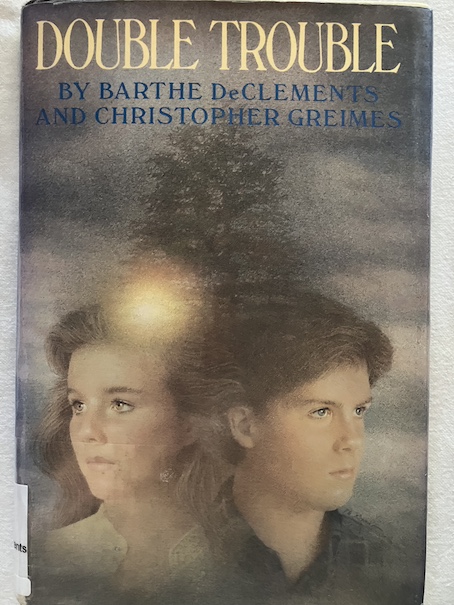
Double Trouble

Faith and Phillip are twins and the only members of their immediate family who are alive. Their parents and their older sister were killed in a car accident. Faith was taken in by their aunt, but their aunt didn’t think that she could manage to care for two children, so Phillip was sent to a foster home. The story is written in the form of letters to each other (this is called epistolary style) after their separation.

Separating is cruel, especially when they’re orphans, but there is something about Faith and Phillip that other people don’t know. They have psychic powers, and they have the ability to communicate their feelings to each other with their minds. They have to communicate specific information to each other in writing because their psychic abilities only communicate their general mood and circumstances, but their psychic link to each other makes them feel less alone when they’re apart. Apart from dealing with their grief over the loss of their parents and the changes to their lives, each of them is also in a troubling situation.

In her first letter to Phillip, Faith tells him about a disturbing encounter with a teacher at her new school. Faith was selling candy with another classmate, Sue Ellen, to support the school band. Sue Ellen gets the idea of going by Mr. Gessert’s apartment. Mr. Gessert is their social studies teacher and is considered one of the cool teachers in school. Faith can tell that Sue Ellen has a bit of a crush on him. He buys one of their candy bars, and Sue Ellen asks to use his bathroom. When Sue Ellen seems to be taking awhile, the teacher goes to see if everything is okay, and he catches Sue Ellen snooping around. He gets especially angry when Faith is about to touch his cane near the door. He grabs both girls by the arm and throws them out of the apartment. Although snooping in someone’s private rooms is rude, the girls are startled by how angry Mr. Gessert is. Faith asks Sue Ellen what she saw in his apartment, and Sue Ellen says that she didn’t see anything. She had just started to open the door to a room when he found her. The next day, Sue Ellen brags to other kids at school about having been in the teacher’s apartment, but Faith is still concerned about how angry Mr. Gessert was.

When Phillip replies, he says that he can understand why the teacher would be annoyed at someone snooping through his stuff, and he tells Faith about his new foster parents, the Wangsleys, Howard and Cynthia. He’s now living in Seattle, about 50 miles from where Faith is living. Phillip also got picked on at school by a bully, but a girl named Roxanne spoke up for him. He thinks Roxanne is pretty, and he describes her aura as being indigo. (The twins also have the ability to see people’s auras and use them to learn things about other people.) His new foster parents don’t take his vegetarianism seriously, trying to convince him to eat meat. They say that God put animals on Earth for people to eat and that he has to eat like they do. Their house is shabby, and Howard keeps Cynthia on a tight budget. That surprises Phillip because he thinks Howard must be making decent money at the shipyards. He wonders how Howard spends his money, if it’s not on his wife or home. He knows that Howard and Cynthia belong to some kind of religious group and that, whenever they return from one of their meetings, they act strangely, and their auras are weird. He’s still grieving their parents and sister, and with all the stresses of his new home, the only time he feels better is when he’s using astral projection, to get away from it all.

The twins learned their psychic skills from their sister Madalyn and Madalyn’s friend, Roger, who is an archaeologist. Faith doesn’t quite have Phillip’s ability with astral projection, but she can sometimes get visions of other people and what they’re doing. She uses this ability to try to learn more about Mr. Gessert, and she sees that his cane is actually a gun. She watches him loading it. Why would a teacher have a cane with a hidden gun?

Faith is still angry that her aunt didn’t take Phillip, too. She also hesitates to ask her aunt for things she needs because she doesn’t want to seem like a charity case. She has a part-time job taking care of her neighbors’ dogs while the neighbor is on vacation, and she uses the money to buy a pair of second-hand boots. When Aunt Linda finds out that Faith bought second-hand shoes, she says that Faith should have told her that she needed shoes because she doesn’t want people thinking that she isn’t taking care of her niece. Still, after she cleans them up, they don’t look bad, and she gets compliments on them at school.

The next time she sees Mr. Gessert in class, he seems normal at first. He gives the class a lesson on the Donner Party of pioneers, who were trapped by a snowstorm and resorted to cannibalism to stay alive. (This is actually described in gruesome detail in the book. Some kids like a good gross-out, but I never did.) After Mr. Gessert describes all the gory details in class, one of Faith’s other classmates comments that Mr. Gessert seems crazy. Faith knows that he was telling them the truth about what happened, but she finds it disturbing how much he seemed to enjoy recounting all the grossest parts, and other classmates agree. Phillip is concerned about Faith’s description of the teacher, so he uses astral projection to spy on him, and he agrees that Mr. Gessert gives off weird vibes.

Both Faith and Phillip connect with other kids at their schools who have an interest in psychic abilities. Faith meets a boy named Jake, who is intrigued because his father has been reading a book about remote viewing, which is what Faith does. As Phillip becomes friends with Roxanne, who is interested in the topic of astral projection. When Phillip confides in her about his astral projection abilities, she asks him to teach her how to do it.

One day, when Phillip and Roxanne are at the library, they see Mr. Gessert there. Mr. Gessert has an interest in Spanish treasure, and there is a special exhibit at the library with some very valuable pieces. Soon after that, the Spanish treasure is stolen from the library. It doesn’t take a psychic to see that Mr. Gessert, who has already been established as creepy and suspicious, might have a motive to steal it, but he’s not the only suspect. Working separately, with the help of their friends, Phillip and Faith use their special mental abilities to get to the bottom of Mr. Gessert’s secrets.

The book is available to borrow and read for free online through Internet Archive.

There are a lot of metaphysical themes to this story with the kids exploring their psychic abilities. It is revealed that their old family friend, Roger, is a kind of archaeologist/treasure hunter, but he is regarded as unorthodox by his colleagues because he uses his psychic abilities to guide his discoveries. Roger is the one who taught the twins and their older sister how to use their abilities.

In the story, the people who are open to developing their psychic/spiritual/metaphysical sides are the heroes, and they thrive when they connect to other, like-minded people and share what they know with each other, helping each other to develop. However, there are unhealthy forms of spiritual development in the story. Phillip is unnerved about the Wangsleys and their religious group from the beginning because the Wangsleys always act strangely after one of their meetings. Initially, I was concerned that this group might be doing drugs or something like that, but that’s not the case. It’s a little vague exactly what group the Wangsleys are part of, but it seems to be a very conservative Christian group with a cult-like devotion to their leader, and the the Wangsleys have an unhealthy relationship with it.

I don’t think it’s an unhealthy group for being Christian, but it seems like devotion to this particular group encourages overly harsh discipline and emotional manipulation and that Howard and Cynthia’s relationship with each other is troubled because of disagreements about their level of devotion to the group’s standards. I sometimes think that people who don’t have a religion imagine that all Christian groups are like that, but I’ve been to various Christian churches throughout my life, and most are not like this. There are some extreme groups like this, but this is definitely an extreme group. It seems to be an isolated group that isn’t part of a larger denomination. It seems to have just one charismatic leader. I think it’s implied, although not directly stated, that the reason why Howard isn’t spending more money on keeping up his house is that he’s contributing a large portion of his income to this religious group. I’m a little suspicious about the money issue and the long periods that the group’s leader seems to spend in Hawaii, ostensibly on religious business. While it isn’t stated explicitly, and I could be wrong, I think there are some implications about the Hawaii trips and the money of this group that make them seem suspicious.

Besides the metaphysical elements, there are themes of children adjusting to loss and trauma and major life changes with the deaths of the twins’ parents and their adjustments to their new homes. Initially, Faith doesn’t have a very good relationship with her aunt. She’s angry that her aunt didn’t accept her twin brother and sent him into the foster system, and she finds her aunt’s manners cold. She doesn’t trust her aunt enough to ask for the things she needs, even basic clothing, and her aunt gets upset about that. Things improve between them when they learn to communicate more openly with each other. Aunt Linda does care about Faith, but she’s also dealing with her own feelings and uncertainties about raising her niece. She has never married or had children, and while she does want Faith living with her, becoming a single parent is a major adjustment for her.

The Wangsleys are completely unsuitable as guardians for Phillip. They don’t accept his vegetarianism and complain about having to make special things for him. They keep trying to convert him, both to eating meat and to their religious group. I feel like their religious affiliation should have been disclosed from the beginning and that there should have been some discussion between them, Phillip, and Phillip’s caseworker about the differences between their lifestyle and the lifestyle that Phillip is accustomed to living, so they could all reach an understanding about what living together would mean for them before he actually went to life in their house. Phillip does describe some meetings with the Wangsleys and his caseworker during his time with the Wangsleys, where the caseworker tries to mediate circumstances between them and offer suggestions, such as ways they can deal with Phillip’s vegetarianism. Cynthia does make some efforts to accommodate Phillip’s eating habits, but they’re kind of half-hearted, and the Wangsleys absolutely cannot accept that Phillip doesn’t want to join their religious group. They heavily pressure him to convert, and when they discover Phillip’s astral projection activities, they’re convinced that he’s having visions given to him by the devil and demons. They tell Phillip’s caseworker that they want to adopt him, but Phillip finally speaks out about what life with them is really like. In the end, Roger decides that he will take Phillip, and the Wangsleys are forced to relinquish him to his caseworker.

From now on, Phillip will be living with a family friend who understands him and shares his lifestyle, and there are even hints of a possible romance between Roger and Aunt Linda. The hints of romance with Roger and Aunt Linda feel awkward, partly because the kids know that Aunt Linda is about 10 years older than Roger, a significant although not insurmountable age gap. Mostly, it just feels awkward to me because it seemed like there had been a romance relationship between Roger and the twins’ deceased elder sister. Switching attention from the niece to the aunt, even if the niece is now dead, just feels odd. Although, it’s not definite that their relationship will really be romantic. It might just end up being friendly.

The authors, Barthe DeClements and Christopher Greimes, are a mother and son team, and the inspiration for this story came from their own shared interests in psychic phenomena and “nontraditional methods of expanding awareness.”

I remember reading this book when I was a kid, and I was fascinated with the idea of communicating psychically with other people or being able to do astral projection. I don’t really believe in all of the metaphysical ideas that the book presents, but I think most children go through a phase where they’re interested in things like ESP and try to test themselves to see if they can do it. I actually had an English teacher in middle school who tested the whole class for ESP after we read some science fiction or fantasy story, just for fun. I can’t remember which story that was now, although I don’t think it was this one. I think it might have been a story about a typewriter that predicts the future, although I can’t remember the name of that one. I didn’t do very well on most of the tests, although there was one in particular where I did pretty well. After thinking it over for about 30 years, I’ve decided that it wasn’t because I had any significant psychic ability. The one test I did well involved predicting another person’s actions, and I think anybody could do that fairly well if you know something about the other person’s personality. The teacher did say that people do this activity much better if they do it with close friends, implying that friends have a special connection to each other, but I think it’s more the case that friends understand each other’s thinking better.

I can’t remember whether I read this particular book before or after I was tested for ESP, but I think it was after. I still had an interest in the subject, and I remember, one night, I tried my own experiment in astral projection. When I did it, I had a vision of space aliens. It was probably because I was dozing off in bed at night, and I was going through a sci-fi phase at the time, but I got spooked. You see, the punchline to this story is that I grew up in Arizona, and the night of my experiment happened to be the night of the Phoenix Lights. I was so creeped out the next day, when people were talking about UFOs that I stopped the astral projection experiments. Although I’m sure that it was all a coincidence, just a dream brought on by my own fascination with science fiction and space aliens, I decided that, while I was curious about how such things worked, I didn’t really want them to work for me. I might have been a cowardly child with a habit of spooking herself, but I was also a cowardly child who decided that there was no point in continuing to do things that she knew would spook her. I had my fun with that phase, and then it was time to move on to my next obsession.

Down a Dark Hall

Down a Dark Hall cover

Fourteen-year-old Kathryn Gordy, called Kit, is going to boarding school for the first time. She doesn’t really want to attend the Blackwood School for Girls, but her widowed mother has remarried, and she and Kit’s new stepfather, Dan, will be going on an extended honeymoon in Europe. Kit tried to persuade her mother to take her with them on the trip to Europe, but Dan is firm that she can’t come on their honeymoon trip. The Blackwood School has a good reputation, and graduation from the school would guarantee Kit entrance to a good college. At first, Kit thought it might not be so bad if her best friend, Tracy, could attend the school, too, but although Tracy applied to Blackwood, she wasn’t accepted there. Kit hates the idea of going there alone. Worse still, when her mother and Dan take her to the school, it’s an imposing, castle-like mansion that gives Kit the creeps. Her mother and Dan think it looks impressive, but just the sight of the building gives Kit a terrible sense of evil. Even though she doesn’t want to stay, her mother and Dan insist.

Because her mother and Dan have to leave on their trip, Kit has arrived at the school a day early, before classes will start. Madame Duret, the headmistress of the school, welcomes them and explains a little about the school’s history. The school is fairly new. Before it was a school, the mansion was the private home of a man called Brewer, who died about ten years ago. Because few people would want a house that size outside of town, the building was vacant for some time before the Blackwood School moved in, and there are some ghost stories and urban legends about it in the area. Kit’s mother and Dan laugh it off.

Madame Duret gives them a tour of the school and mentions her art collection. She says that she enjoys collecting lesser-known works by famous artists. The dorm rooms are incredibly luxurious. Each student will have a room to herself with a private bath and a canopied bed with velvet draperies. Art is important to Madame Duret, and she says that she wants the surroundings to inspire her students. When it comes time for Kit’s mother to say goodbye to her, her mother asks her if she thinks she could be happy at the school. If Kit really feels like there’s something wrong with the place, her mother is willing to delay her trip and make other arrangements. Shrugging off her earlier misgivings, Kit tells her mother that she will be fine, and her mother and Dan leave.

The school still bothers Kit, but she feels like she has to try to do well there for her mother’s sake. She knows that things have been hard for her since her father died several years before. Although nobody believes her, Kit remembers seeing her father’s ghost in her room the night he died in a car accident while he was on a business trip. Her mother has managed since then, but she wasn’t really happy until she met Dan, and Kit appreciates that her mother needs adult companionship. Still, Kit senses that this school is very strange, and there are things wrong it it. She can’t figure out why her friend, Tracy, was rejected by the school. The canopied bed is luxurious but kind of creepy because it reminds her of a scary story. Then, she notices that the bedroom doors have locks on the outside of the doors but not the inside.

At dinner that evening, Kit meets Professor Farley, who is a teacher at the school, and Madame Duret’s son, Jules. Professor Farley teaches math and science, and Jules, who has only recently gotten his degree, will teach music, giving the students piano lesssons. Madame Duret herself teaches languages and literature, and apart from these three, there are no other teachers at the school. Professor Farley says that he is the one who convinced Madame Duret to open a school in the United States, having seen her success at her school in England. A young cook named Natalie also works at the school, but strangely, Natalie says that Madame Duret doesn’t want her to speak to the students much.

When the other students begin arriving, Kit realizes that there aren’t going to be many students at this school, either. In fact, there are only three other students besides Kit: Sandy, Lynda, and Ruth. All of the girls also seem to be somewhat removed from their families. Sandy is an orphan who lives with her grandparents, who don’t drive, so they didn’t even drop her off at the school. Lynda and Ruth have both been to boarding schools before, and they were dropped off by a chauffeur. They say that Blackwood isn’t like their old school. Kit still wonders why Tracy wasn’t accepted to the school when there are so few students. Kit realizes that she herself isn’t a top student, and the other three students at this school are quite different from each other. However, Professor Farley says that there are other qualifications besides grades, and all of the girls at this school have the qualities they were looking for. Madame Duret refuses to discuss test results at all.

Kit does her best to settle into the school. Everyone acts nice to each other, and the classes are like having private tutors because there are so few students. However, Kit is still nervous and having strange dreams. She never remembers what she’s been dreaming about, but she dreads these strange dreams, so she has trouble getting to sleep. The only way she can get to sleep is to exhaust herself by reading and writing letters late at night until she is exhausted.

One night, while Kit is writing a letter to Tracy late at night, she hears a scream that is choked off suddenly. Although Kit is afraid, she feels like she has to investigate and find out if there is someone in trouble. She thinks the scream came from Sandy’s room. When Kit tries to check on Sandy, Sandy doesn’t answer, and she has trouble getting into Sandy’s room. Kit feels like there is someone in Sandy’s room, and the room is weirdly cold. When Kit finally gets the light on, Sandy is a little disoriented. She doesn’t remember screaming, but she remembers a strange dream about a young woman in old-fashioned clothing, who was watching her. Sandy tells Kit that she’s had strange dreams like this before, although not about this particular woman. When her parents were killed in a plane accident, Sandy sensed the accident when it happened, and she saw her parents in a dream, not unlike the apparent dream that Kit had about her father when he died. The next day, Kit talks to Lynda and Ruth and learns that they have also been having strange dreams that they have trouble remembering.

These dreams seem to be the one thing that all four of the Blackwood girls have in common, and all of them find them disturbing. When Kit has morning piano lessons, she feels strangely tired and her fingers are sore, as if she’s been playing the piano for hours already. Kit tries to talk to Jules about the strange things that have been happening and her own sense of unease. He tries to give her reasonable explanations, but from the way he speaks, Kit has the uneasy feeling like he knows something that he’s not telling. Jules tells Kit that he’s had some strange dreams himself, but he thinks it’s just the atmosphere of the strange old house. Kit asks him if he’s still having the dreams, and he says he is, but he also likes the house and thinks that it’s just a matter of getting used to the place.

Strange things continue to happen at the school. Lynda wakes up from a nap and suddenly draws an incredibly realistic portrait of Kit when she’s never even taken art classes or done any drawing before. Then, someone steals the portrait out of Kit’s room. Letters and post cards from Kit’s mother and Tracy reveal that they haven’t received any of the letters that she’s been writing to them. Sandy tells Kit that she has a sense that Blackwood School is evil, just like Kit felt when she first arrived.

Ruth is the one who realizes that all of the girls have ESP. Sandy and Kit both experienced ESP when they saw visions of their dead parents. Ruth admits that her excellent grades are only partly due to her naturally high IQ. She can also sense the contents of books without reading them and read the minds of people giving her tests, so she can give them exactly the answers they’re looking for. Lynda isn’t as bright as the other girls, but Ruth has been friends with her for a long time and has discovered that Lynda has memories of herself in a past life, when she lived in Victorian England. Ruth realizes that the girls’ psychic abilities are the reason why the four of them, and only the four of them, were chosen to be students at Blackwood School. The school has a dark purpose beyond providing an education, and these four isolated girls are there to fulfill that purpose.

The book is available to borrow and read for free online through Internet Archive. It was also made into a movie in 2018.

I read this book because it was mentioned as a book a character was reading in another children’s book, The Shimmering Ghost of Riversend, and because it occurred to me that it would fit the Dark Academia genre that’s been popular in the last few years. The reason why this book was mentioned in the other story is that both books involve ghosts who have the ability to act through other people and help them to do things that the living people couldn’t do by themselves. I have a tolerance limit on scary stories, but I felt like I had to read this one because it was mentioned in the other book, and I was curious about it. I’m not sure that I want to see the movie because trailers of the movie make it look even darker than the book, but the book didn’t go beyond my tolerance limits.

In Down a Dark Hall, Madame Duret has psychic abilities of her own and is using girls with psychic abilities to channel the spirits of famous dead people so they can complete works that they were unable to complete in life. Lynda draws and paints pictures that she shouldn’t be able to produce because she has no natural talent for art or training in it. She also begins signing her pictures with the initials TC because she is actually channeling the spirit and abilities of Thomas Cole. Sandy begins writing sonnets without having any prior interest and ability in poetry before because she is channeling Emily Bronte. Ruth finds herself making mathematical notes that are really too advanced for her and barely within her understanding. She’s not sure who she’s been channeling because the scientific and mathematical principles she’s been receiving have little personality attached to them. The reason why Kit’s fingers are always sore and she’s so tired every morning is that she’s been channeling Schubert and other musicians, playing piano music at night. There is one night when multiple musicians fight to control her and get their music out.

The girls are not channeling these spirits through any will or conscious effort of their own. Each of these episodes occurs either while the girls are asleep or just after they wake up from having been asleep. Madame Duret isn’t just facilitating this possession for the sake of art, literature, and scholarship, but also out of greed. She is known for having an impressive collection of works of little-known works of art from famous artists, but what no one else knows is that those works were not produced within the artists’ lifetimes. She has performed this same trick of using the psychic abilities of students to channel the spirits of dead artists to produce new works before, and she artificially ages these works so no one knows that they are new instead of previously-undiscovered works.

Being possessed by the spirits of the dead is disturbing enough, but the girls of Blackwood School also come to realize that the psychic bonds between them and these famous spirits are getting stronger over time. If they don’t find a way to escape Blackwood School soon, they will become permanent. Records in Madame Duret’s office reveal that some of her previous students died from their experiences, and others lost their minds and ended up in mental institutions. No one could stand this type of channeling over the long term and keep their sanity intact, and the spirits themselves don’t seem to have much or any concern for the well-being of the girls channeling them. They seem to have so many ideas that they want to get out that they push the girls harder and harder to produce them. Some of the spirits are gentler and more personable than others, but some regard the girls simply as tools to be used. They can even get violent when the girls resist them or when different spirits interrupt each other’s work. This is a very creepy book, and the girls have some close calls, but fortunately, it has a good ending. I like atmospheric books, but I don’t like books that are overly dark, and I was relieved that all the girls survived. I would have found it hard to take if children died during the course of the story.

Although I knew before reading the book that the story involved ghosts and possession, I initially thought that the isolation each girl has from family and friends was part of the reason why these particular girls were chosen for the school. Before I found out that each girl has psychic abilities, I noticed that none of them are in a position where they are very closely watched by their relatives. Kit’s mother and stepfather are going to be traveling through Europe, so they won’t be trying to visit the school anytime soon, and it would make sense if they didn’t hear from Kit for a while. Sandy is an orphan whose grandparents can’t travel easily, so they won’t be coming to check on her every weekend. Lynda’s mother is an actress who now lives in Italy, so again, there is a separation by great physical distance. Ruth’s parents are busy professionals with doctorates. None of the girls is likely to have any visitors while she’s at school or anybody who would be overly concerned about not hearing from them for a while. At first, I thought that could have been part of the reason why Tracy was rejected as a student, because she has both parents living, and those parents would be in more of a position to check on her and more likely to go to the school themselves if they didn’t hear from her. However, it turns out that her rejection is really because she isn’t psychic, like Kit. The chosen students’ relative isolation from family is just icing on the cake to their psychic abilities and plays into the plot as a reason why nobody outside the school realizes all the weird things that are going on.

I thought that the build-up of the sinister atmosphere at the school was great! Kit has a blatant sense of evil when she first arrives, which feels at first like we’re just being told that the place is evil, but there are also a lot of little details that support it. First, the place is overly luxurious for a boarding school, especially one with so few students to support it. Kit is quick to spot that the girls’ doors can only lock from the outside, which is chilling, although Jules says that’s just to keep people from going into their rooms when they’re not there themselves. However, someone does enter Kit’s locked room to take the portrait of her that Lynda drew, indicating that the girls’ rooms are not safe from anyone and that it’s possible for them to be locked in and unable to get out.

There are also hints from the beginning of the book that Madame Duret and Professor Farley are sinister. Blackwood is actually Madame Duret’s third school that we know about. She had one in France, one in England, and now, one in the US. For some reason, she tends to move countries, which seems odd for someone building a reputation as an elite educator. Boarding schools often have an air of tradition, and their reputations rest on long-term success, which is built over time. Moving around is actually a warning sign, at least to me, that Madame Duret doesn’t want to stay places long enough for people to figure out what she’s really been doing at her schools. Even Jules admits that he doesn’t know things about his mother because he has spent most of his life at other boarding schools himself, not at her schools, so the two of them have mostly been living apart. However, he does know about the possessions of the girls because he has the recordings of the music Kit plays at night. It’s just that he doesn’t fully realize the harm being done to the girls until the end of the book or the harm his mother has already done to previous students.

The old mansion the school is in has a sinister history. The former owner, Mr. Brewer, lost his wife and children, including a baby, in a fire at the house, mostly due to smoke inhalation because the fire didn’t damage the building too badly. After that, he lived as a recluse, and he would act like his family was still alive, buying things for them in town. He could have just lost his mind from grief, but there are indications that his family still haunted the house as ghosts. Locals started telling ghost stories about the place after a plumber heard a baby crying in the house.

Recent reprintings of this book have been updated to include the concepts of laptops, cell phones, and emails, which were not in use when the book was first written. The explanation for why the girls can’t use their laptops to email anybody or get outside help is that there is no Wi-Fi or Internet access at the school. They can write reports on their laptops, but they can’t do much else. Their cell phones don’t get signals, so they can’t call or text anyone.

The version of the book that I used for the cover image is one of the new, revised books with modern technology, and it also has an interview with the author, Lois Duncan, in the back, in which she talks about the inspiration behind the story, her own beliefs about ghosts and psychic abilities, and how she was impacted by the murder of her own daughter, which she earlier documented in a book called Who Killed My Daughter?, in which she consulted psychics for insight into her daughter’s death because the police seemed unable to make progress in the case. Her daughter’s murder happened in 1989, years after Down a Dark Hall was written. Lois Duncan wrote many suspense books for children and young adults, but after her daughter’s death, she gave up writing suspense because it was too upsetting for her to write about girls in danger. She started writing picture books instead. Duncan had already passed away by the time one of the suspects in the case confessed more than 30 years after the murder.

The Magic Nation Thing

The Magic Nation Thing by Zilpha Keatley Snyder, 2005.

Abigail O’Malley’s life was turned upside down when her parents divorced when she was in kindergarten. They sold the family home, and her father went to live in Los Angeles and pursue his law career while her mother opened a detective agency. Abby isn’t fond of her mother’s detective agency and has no such ambitions herself. In fact, she would be satisfied if she just has a nice, normal family someday. She misses the nice house where her family used to live and doesn’t like the shabby Victorian house where she and her mother now live and use as the office of the detective agency. Abby envies her friend, Paige Borden, whose family has plenty of money and who life a much more “normal” life. Abby’s mother, Dorcas, isn’t too enamored of the Bordens, thinking that the family is boring. She wishes that Abby would become interested in joining her detective agency someday because the truth is that Abby isn’t quite normal herself, although she doesn’t like to think about it much.

Abby’s mother, Dorcas, says that Abby has an ability to notice information that other people miss, but that’s not quite it. Dorcas says that people in her family have had a “gift” for doing unusual things, like reading people’s minds or finding missing objects. Dorcas is convinced that Abby has inherited this “gift.” However, Abby denies having any such “gift.” As far as she’s concerned, she just occasionally gets hunches about things, and once or twice, they’ve turned out to be right. Abby resents the idea of a special gift partly because she thinks that her mother’s crazy desire to be a detective has something to do with her belief that she also has this special gift, and Abby doesn’t think she does. Abby doesn’t like to think about any of her relatives having been that strange. She just wants a normal family, like Paige’s.

However, Abby’s gift is re-awoken when her mother accepts a case involving a missing girl, who is believed to have been kidnapped by her own father because her parents are divorced. When Abby holds a locket belonging to the little girl, she begins to have visions, not unlike visions that she’s had at other times in the past. Mrs. Watson, who owned the day care that Abby used to attend said these vision episodes were just her imagination, which Abby used to think of as her “Magic Nation.” Abby has spent years trying to ignore it, but this is one of those times when it’s impossible to ignore. Abby has a vision of the little girl at Disneyland with her father. At first, Abby doesn’t want to admit the existence of this vision, but thinking about how worried the girl’s mother is, Abby casually suggests to her mother that, if the girl was taken in a custody dispute, her father might have decided to take her somewhere fun, like Disneyland, to try to win the girl’s favor so she’d want to stay with him. Her mother follows up on the hint, and with the help of the police, the girl is found and reunited with her mother.

That’s the end of the kidnapping case, but it’s only the beginning of Abby’s acknowledgement of her “gift.” Dorcas’s success in the kidnapping case brings more business to her detective agency. As Dorcas gets busier, Abby feels neglected, but Paige’s mother offers to look after her after school to help out, helping Dorcas to feel better about Abby’s friendship with the Bordens. Abby enjoys spending more time with Paige after school, and the girls even start getting along better with Paige’s annoying younger brothers, Sky and Woody. The youngest boy, Sky, particularly comes to like Abby when Abby intervenes after he makes the family’s intimidating cook angry by spilling juice in the kitchen. Abby sensed the boy’s fear and went to the kitchen to find out what happened. Although Abby still wonders how much of her “hunches” are really due to some kind of “gift” because they don’t work all the time, she increasingly realizes that what she still thinks of as her “Magic Nation thing” is not something that she can simply ignore.

Paige is fascinated by Abby’s mother’s work, and she particularly idolizes her pretty assistant, nicknamed Tree. When Abby tells her that her mother and Tree are investigating a case of arson, Paige talks her into coming with her on a little stakeout of their own, which messes up Tree’s actual stakeout and Dorcas’s plans. Dorcas is angry with the girls, and Abby finds herself using her “Magic Nation thing” to try to learn something about the arsonist and make up for ruining the stakeout. Abby does discover who the arsonist is, although she still doubts the reality of her “hunches.” When she shares that information with Tree, Tree also becomes aware of what Abby can do. Tree has known that Abby sometimes gets “hunches” about things, and although Abby still isn’t sure what to think about them, Tree says she’s noticed that Abby’s hunches pay off more than her mother’s do. Then, after the arsonist is caught and Paige goes overboard in her idolizing of Tree for catching the arsonist, Abby lets it slip that she was the one who figured out who the arsonist was.

Abby had been trying to keep this weird and questionable “gift” a secret, but once she tells Paige that she was the one who found the arsonist, she has to explain how she did it. To Abby’s surprise, Paige believes her about the “Magic Nation thing” and thinks it’s really cool. She’s noticed before that there are times when Abby seems to know things that other people don’t or learns things more quickly that most, and Paige thinks that’s a product of her “Magic Nation.” Paige is so enthusiastic about Abby’s “gift” that she thinks the two of them should start their own detective agency, and she starts trying to find cases for them to solve. Paige’s efforts to find an exciting mystery for Abby to solve don’t lead to much, and Abby finds herself doubting her “gift” and its usefulness again.

Then, Abby goes on a ski trip with Paige and her family, and young Sky disappears. Abby realizes that, whether or not her “gift” is real or reliable, she has to try again for Sky’s sake.

The book is available to borrow and read for free online through Internet Archive (multiple copies).

My Reaction

I like Zilpha Keatley Snyder books. She’s also the author of The Headless Cupid. This story is well-written and fun to read, and I enjoyed seeing how Abby comes to understand and accept her “gift” and make it work for her. I particularly liked the way that Abby comes to understand her “gift” and accept its limitations. There are points when Paige is disappointed or angry that Abby can’t use it to come up with all of the answers that she wants on demand, but Abby can’t make the “gift” do what her friend wants, and she makes it clear that Paige is going to have to accept that. Sometimes, Abby isn’t even interested in trying to use her gift in the way Paige wants, just like she isn’t really interested in using her gift to follow her mother’s profession. Abby comes to realize that an important part of learning to live with her gift is making it clear that this “Magic Nation thing” belongs to her – it’s her gift, to use or not use, as well as she can, in whatever way she sees fit. It’s her right to create her own boundaries, even refusing to talk about her “gift” when she doesn’t want to. The “Magic Nation thing” can’t be forced, and Abby herself won’t be pushed or bullied, either. This personal development is actually a bigger part of the plot than any of the mysteries that Abby solves or attempts to solve.

We don’t know what will happen with Abby and her “gift” after the story ends. There are hints that Abby might be willing to use her powers again, if the situation is important enough and she’s still able to do it. It seems that her mother no longer gets the visions that she used to get when she was Abby’s age, which is why her “hunches” don’t work out as well as Abby’s do now. Dorcas isn’t going to be able to rely on her “powers” to make her a great detective, but Abby comes to appreciate that her mother still enjoys her work and is pretty good at it, not because she’s relying on psychic powers, but because she works hard and is attentive to details. It’s possible that Abby’s powers will also fade as she grows up, but even if they do, it will be okay because Abby can also have a fulfilling life doing the things she loves and is good at. Dorcas is still more enamored of the idea of their shared “gift” than Abby is, but the reality is that neither of them really needs to rely on it. It might be there in the future, if they need it, but it’s not their only strength.

There are some contemporary cultural references in this story that help set the time of the story. Paige is a Harry Potter fan, Abby says that she has some Lemony Snicket books, and they refer to Jennifer Lopez, the Olsen Twins, Leonardo di Caprio, and Britney Spears.

The Shimmering Ghost of Riversend

Kathy Wicklow is going to visit her Aunt Sharon at their old family home over the summer. The old family home, Wicklow Manor, is in Riversend, California, which is in an area where gold was found years ago. Kathy isn’t happy about the trip. She has to leave her dog behind because her aunt owns a cat. She doesn’t even really know her aunt very well. Aunt Sharon is her father’s sister, and her mother has said that she’s weird (which was not a good thing for her to say, both because it’s insulting and because that’s not something to make her daughter glad about spending time with her). Kathy blames her mother for going back to work. Because her mother is working and won’t be home with her, Kathy has to leave her home, her friends, and her dog for a month!

Although Kathy loves to draw, she doesn’t think that she’ll want to do that in a place she is sure she’s going to hate. She also thinks maybe her parents don’t trust her at home because of the weird dreams she’s been having. Kathy has dreams about things that later happen, although she doesn’t know why.

Her father has nostalgic memories of the old family home where he and Sharon grew up. Sharon has only recently returned there after living on the East Coast. Kathy’s father says that Sharon is looking forward to seeing Kathy again and getting to know her because she hasn’t seen Kathy since she was a baby.

Right from the first, Wicklow Manor gives Kathy the creeps. There’s even a small graveyard nearby where Kathy’s father says their ancestors are buried because people used to be buried close to their homes. When she can actually see the house, Kathy is also shocked to realize that she has drawn that house before! She thought that she had invented the house she drew from her imagination, but somehow, she had a vision of the real house. Her father thinks that she must have seen a picture of it somewhere or maybe was inspired by his descriptions of the place. However, Kathy has also done a drawing of Aunt Sharon’s pet cat, without knowing what it looked like before. When they meet Aunt Sharon, she mentions that she’s glad Kathy is there because the house has been lonely, especially at night. Kathy’s dad starts to ask her if something is still happening, but Aunt Sharon quickly denies it before he can finish the thought. Kathy can tell there’s some kind of secret between them.

Aunt Sharon has turned the family’s manor into an inn, and she’s expecting guests soon. It also turns out that part of the reason why Kathy’s mother says that Sharon is weird is that she’s into health food, and Sharon is aware that Kathy’s mother thinks that she’s a weird health nut. Kathy’s father volunteers her to help in the kitchen, although Kathy is a little worried that she won’t like the health food, although the lemonade that she makes with maple syrup instead of sugar is pretty good.

Still, Aunt Sharon gives Kathy a beautiful room with a balcony. Kathy also meets a boy named Todd who lives nearby with his great-grandfather, who is called Upstream Mike. Todd and his great-grandfather pan for gold in the nearby river, and Mike also takes his burro called Nugget into town so tourists can pay for rides on him and pictures with him. Todd is just a little older than Kathy, and he tells Kathy that he likes to write down stories that his grandfather tells him, especially scary stories about the old Wicklow Manor. Kathy asks if there are ghosts there, and Todd tells her to ask his great-grandfather about it. Kathy asks her aunt about ghosts, and Aunt Sharon tells her that Mike has told scary stories about the place for years that were apparently passed down in his family. Mike’s family lived in the area when the first Wicklows arrived.

Aunt Sharon shows Kathy some of the things in the house that belonged to their ancestors, including a portrait of a pretty young woman, who Aunt Sharon says was Jenny Wicklow, who died young by drowning in the river and was buried in the old family graveyard. One of their ancestors, James Wicklow, made his fortune as a banker during the Gold Rush days, and Jenny was his daughter. There is one room in the house where Kathy isn’t allowed to go, which is the old room in the tower. Aunt Sharon says that the staircase is broken, and she can’t have it fixed yet.

On her first night at the manor, Kathy sees a woman in a cloak with a lantern. When she asks Mike about it, he says that it’s a ghost or spirit of some kind that usually appears to young ladies at the manor, possibly a banshee or similar spirit that is a harbinger of death. Kathy worries about that, and Mike tells her the story about Jenny Wicklow. Jenny was one of three children of James Wicklow. She also had a sister named Lora and a brother named Daniel, and Kathy is a descendant of Daniel. After their parents died, Daniel went to work in the city and left the running of the manor and family farm to his sisters. The two young women hired a handsome young drifter to help them, but he started flirting with both of the sisters. The sisters seemed to develop a rivalry for him and argued with each other about it. Rumor had it that Lora was the one who pushed Jenny into the river so she could have not only her own inheritance but her sister’s as well and get the man they both wanted. After Jenny was dead, it seemed like all of their gold disappeared, and so did Lora. People assumed that Lora ran off with her lover and took the money. Mike thinks that the ghost is dangerous, and that Sharon is the one who’s in danger!

Kathy soon begins to learn that Mike is both right and wrong about the ghost. The ghost is Lora, but she’s not trying to hurt Sharon or anyone else. Something tragic happened at Wicklow Manor years ago, and Lora is trying to tell someone about it, if she can find anyone brave enough to listen … and to discovered what actually happened to Lora herself.

The book is available to borrow and read for free online through Internet Archive.

For a good part of the story, I wasn’t sure exactly what Lora’s ghost was attempting to accomplish, keeping me in suspense. I did have the sense that Lora wasn’t the one who had murdered Jenny and that she had probably been murdered herself, which was why nobody saw her after Jenny’s body was found.

Mike is correct that Lora is the ghost, but she was not Jenny’s murderer. Like Kathy, Lora was psychic. She has been trying to communicate with different girls in the family over the years to clear her name, but the other girls have all been frightened of her. Sharon claims not to believe Kathy at first about how Lora is trying to communicate with her, but she later admits that it was because she was frightened. She also saw Lora when she was young, and that’s part of the reason why she was afraid to return to the old family home for so long. She was afraid to admit that the house was really haunted and that she was afraid of the ghost. It was a long time before she could even tell her own mother and brother about seeing Lora because she was afraid of being different from everyone else in the family. Sharon is also psychic, and like Kathy was initially, she was afraid of her gift.

Kathy and Todd use the messages that Lora communicates through Kathy’s drawings and Lora’s old diary to learn the truth. Jenny was murdered by the man she loved. Lora didn’t actually love him at all. She saw that he was a violent person and tried to warn Jenny about him, but Jenny wouldn’t listen because she thought Lora wanted him for herself. Lora saw the murder that was going to happen in a dream, and she wanted to stop it by using her own inheritance to pay the man to leave her sister alone. However, Lora was unable to save her sister. After he killed Jenny, the man came after Lora and murdered her, too. Then, he stole both of their inheritances. He hid Lora’s body, which was why everyone thought she must have run away with him.

After Lora’s ghost leads Kathy to where her body is buried in the cellar and she is given a proper burial in the family graveyard, the haunting ends. However, Kathy learns to appreciate her psychic gift because of this experience. She finds it reassuring that she shares her abilities with other people in her family. When she reads in Lora’s diary that Lora thought of her own psychic abilities as a gift, Kathy also comes to think of being psychic as a gift rather than a weird defect or something to fear.

The mystery in the story was good, and I also liked the information about panning for gold that Mike gives to Kathy when he gives her a gold panning lesson. There is also a tie-in with real children’s literature because Kathy mentions that she is reading Down a Dark Hall by Lois Duncan. I’ve reviewed Down a Dark Hall on my site, and it is about girls with psychic abilities at a haunted boarding school who channel the spirits of famous people to complete their unfinished works. The channeling and spiritual possession in that book are dangerous and harmful to the girls doing it, but in this book, Kathy becomes reconciled to her psychic abilities and Lora’s gentle spirit, who needs her help.

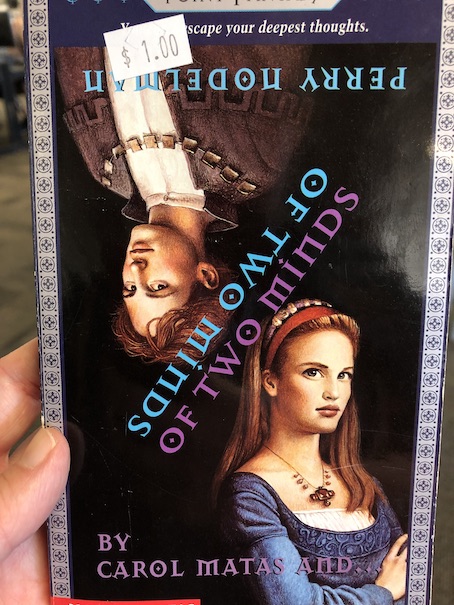
A Meeting of Minds

A Meeting of Minds by Carol Matas and Perry Nodelman, 1999.

This is the final book in the Minds series. Each book in the series begins shortly after the previous book ends, and this one starts only three weeks after the last book.

Princess Lenora and Prince Coren are still in Andilla for their impending wedding when, while simply walking down a hallway of the castle, they suddenly find themselves transported to a land of snow. The world in which they now find themselves is our world (which, I guess would be distant past of their world, the late 20th century). Disoriented and cold, Lenora and Coren go inside a shopping mall to get warm. At first, Coren thinks that Lenora has caused their present predicament (because, usually, she does, either consciously or unconsciously), but Lenora denies having anything to do with it.

At the time they’d been walking down the hallway, they’d been discussing the exhibition at the castle in honor of their upcoming wedding and Lenora’s desire for a better world. The exhibition was called “A Meeting of Minds” and designed to showcase the ways that different groups of people in their world live and what they envision as a perfect world. The entries in the exhibit were chosen as entries in a contest, and a panel of judges from different countries would choose winners from among them. The winning entries would be adopted as real laws in the hope of fulfilling Lenora’s wish of making the world a better place for everyone. What could go wrong? (Seriously, things in this world always go wrong when people try to enforce some vision of perfection, so what’s it going to be this time?) Could the exhibition have something to do with their present predicament?

Lenora and Coren briefly consider different possibilities, including the possibility that some unknown enemy has sent them to this strange place, but nothing really makes sense. Lenora has the uncomfortable feeling that something she’s done may have cause this problem after all, although she can’t think what it is. Either way, they are stuck in a strange land.

They stop a passing girl and ask them where they are, and she tells them that they’re in a mall called Portage Place. That doesn’t really explain much to Lenora and Coren, so the girl tells them to buy a map. Lenora and Coren don’t understand the concept of “buying” (in the last book, they didn’t know the word “economy”). When they try to ask her the name of her “world”, it turns out that the girl is an alien conspiracy theorist, wearing a shirt with a picture of an alien on it and the words “The Truth is Out There” (the slogan from the X-Files tv show). The girl is very excited, thinking that Lenora and Coren are space aliens. She tells them that they’re in Winnipeg on Earth and asks them where they’re from. Coren recognizes the name “Earth” as the old name for their world. This confirms that, although there are fantasy elements in these stories, Lenora and Coren are actually from the distant future of the Earth, although the three of them work out that they might actually be from a parallel universe of our Earth. However, her helpfulness ends when she suddenly seems to suspect them of being “Mindies” and making fun of her. Lenora and Coren don’t know what she’s talking about.

The two of them explore the mall, getting into trouble when they try to stop two girls from taking another child’s toy and end up having security called on them and not having money to pay for food in the mall food court. Fortunately, a couple of other young people in line offer to pay for their food. These young people, Barb and Thomas, seem to recognize them as Princess Lenora and Prince Coren, but strangely, Lenora and Coren learn that they think that they’re in costume and only pretending to be themselves. It slowly comes out that the authors of the book series live in Winnipeg and that there’s a fan convention in town for the books in which Lenora and Coren are fictional characters. (I’ve never actually heard of a convention specifically for this series of books, but I don’t live in Canada, so I can’t swear that it never happened. However, the characters later meet someone dressed as Spock at the convention, so it’s possible that this is supposed to be part of some larger book or sci-fi/fantasy-themed convention.)

Lenora and Coren don’t fully understand the concept of the fan convention, but Lenora sees it as a possible lead to what’s happening, so she insists on going to the convention center. At the convention center, Lenora and Coren encounter other people who are apparently trying to dress like they do and pretend to be them. Some of them even criticize what Lenora and Coren are wearing because their real outfits don’t agree with the fans’ interpretations of the characters. (Fandoms are like this in real life. The more someone likes something and spends time with it, the more they consider themselves an authority on it. They kind of are, but sometimes, fans get wrapped up in their own vision of what they’d like characters to be like that they kind of depart from the original story or get out of sync with the vision of the original authors. It’s almost like they mentally create an alternate reality of a world that was already fictional, which fits very well with the themes of this entire series.) Lenora and Coren think that they’re all very rude for criticizing the way they dress, telling them how they should talk to be in character, and thinking that Coren is a wimp or geek or that Lenora is annoying or arrogant, which some of them say right in front of them.

At this point, someone comments that Lenora sounds just like she does in the books, and the people at the convention start talking about all of the books in this series, which I’ve already reviewed. Finally, Lenora and Coren understand that these people know about them and are imitating them because they have read books about them. Coren is embarrassed when these fans start talking about some of his more embarrassing moments like they’re common knowledge. Lenora gets angry and decides that they need to talk to the authors. (Which seems to have been the goal of this book.)

Coren and Lenora get in line to talk to the authors of the books, but when they meet them, the authors also just think they’re fans of the books who are putting on a little skit for them. There’s some banter with the authors (including some inside jokes that Carol and Perry seem to have with each other, like how bad Perry’s handwriting apparently is), and the authors remark how much Lenora and Coren sound like their characters, although they don’t think they really look like them (which is interesting, as if they have a completely different vision of them in their minds). Lenora gets angry with them and accuses them of stealing from their lives to write their books, so she grabs some of the books the authors and signing and runs away with them.

As Lenora and Coren hide from security with their stolen books, they start reading about themselves. They find that the books do describe their previous adventures together, and they seem to capture some of what they were thinking and feeling at the time, but not everything is correct. In a twist that makes this book a little more interesting than it started out, not everything in the books they read is like the real-life Minds books. Lenora and Coren start noticing that Sayley plays a very prominent role and is described in glowing terms and that her favorite word, “scrumptious” appears frequently. Then, Lenora and Coren discover that one of the events at the convention is a worship service for the “Divine Sayley.” One of the other convention attendees tells them that the Sayley in the books was named after the Divine Sayley, who is a real figure in their world, an angelic-looking girl with divine powers, who seems to be a glowing version of their Sayley.

It seems that Lenora and Coren have discovered the source of this strange world and everything that has been happening to them, but how and why did Sayley do it? Or, did she really do it at all? And how can Lenora and Coren get home when their powers no longer work?

The book is available to borrow and read for free online through Internet Archive.

My Reaction and Spoilers:

First, I’d like to talk about why the authors wrote this book. It’s somewhat of a departure in theme and tone from the rest of the series, and because of that, it annoyed me. At first, I guessed that this book was just the authors’ excuse to have their own characters meet them in the story, to show off a few inside jokes for their own amusement, and to kind of toot their own horns. That sort of story annoys me. I don’t like it when authors do that. When I read a series that I like, I want to do it for the sake of the characters and the stories, not for the sake of the fandom, and any inside jokes the co-authors have with each other are not jokes I am personally in on, so I’m just not going to get the same charge out of them. (There’s an in-joke in this book about Perry Nodelman having some kind of special underwear. I don’t know what it is because it isn’t described, but I’ve seen lots of funny undershorts in those catalogs that come around Christmas, and I don’t really care which pair he owns. Younger readers would probably get more of a kick out of that bit of trivia than I do.)

However, I looked it up, and I found this explanation, written by one of the co-authors, Carol Matas:

Why We Wrote A Meeting of Minds

In thinking about the imaginative powers of the people of Gepeth, it suddenly struck us that they could have imagined us. After all, the Gepethians have the power to make whatever they imagine real, so why not this entire world of ours, including the city of Winnipeg and everyone who lives there–including us? Lenora and Coren are figments of our imaginations–but we might also be figments of theirs. In A Meeting of Minds, that is exactly what happens. Lenora and Coren and the authors Carol M and Perry N come face to face, as Lenora and Coren find themselves stuck without their powers in the city of Winnipeg and unable to get out. Who created whom? And will Lenora and Coren ever manage to escape this frightening city, worse than their worst nightmares? You’ll have to read the book to find out!

That explanation did make me feel a little better about the book, that more thought went into it than just a bunch of inside jokes for fans. The Minds books all focus on the power of the mind and the imagination and the nature of reality. A meta plot, like trying to decide if the authors created the characters or the characters created the author does fit with the theme of the theme of the series, almost like the end of Through the Looking Glass, where the reader is left to decide whether Alice dreamed the Red King or if Alice was just part of the Red King’s dream. However, by the end of this book, the question is resolved, as far as people in Lenora’s world is concerned. According to the story, Sayley really did create Winnipeg and everything in it, including the authors of this book and their books and fandom. There is something a little unsettled about the end of the book, but that’s not what it is.

I can’t talk about my full opinion of this story without some spoilers, though, so get ready: The current problem is actually a plot by Leni and Cori, the annoying doubles of Lenora and Coren created two books ago in the series, although it also turns out that their plot is part of the machinations of someone else.

It’s important to remember that Leni and Cori are basically Lenora and Coren themselves, sharing all of their memories up to the point in time when Lenora created them as separate people, but with twists to their personalities. She created Leni on purpose as a double of herself so she could go off and do what she wanted and people wouldn’t know she was missing, but she made Leni a distinct personality, who would like all of the boring things she didn’t like about managing a household and planning a wedding, so Leni would be happy to stay home and do those things while Lenora herself went adventuring. Cori was an accidental creation, when Lenora’s powers where acting erratically. She was in trouble and wished that Coren was there to help her, but she also wished that Coren was a braver, more action-oriented person, so Cori appeared as a kind of white knight figure to rescue her. Once Lenora created Leni and Cori, she didn’t have the heart to un-imagine them into non-existence because they are now distinct people and personalities by themselves.

Unfortunately, while Leni and Cori are pretty well-suited to each other, they both come with their annoying defects. Leni is frivolous and vapid, getting too wrapped up in petty details, like hair, clothes, and makeup, to care about larger issues. Cori is brave but reckless. He doesn’t have the real Coren’s thoughtfulness and rushes right into danger because his only solution to anything is fighting. Lenora and Coren come to appreciate each other more after seeing what their doubles are like and experiencing their annoying sides. Coren realizes that he doesn’t want Lenora to be like Leni, and Lenora stops complaining that Coren thinks too much. They don’t like their doubles, but the feeling is actually mutual. Because Leni and Cori have personalities that are almost opposite to Lenora and Coren, they find Lenora and Coren as annoying as Lenora and Coren find them, just for different reasons. Cori thinks that Coren is a wimp, and Leni thinks that Lenora is irresponsible and tasteless.

Part of the problem is that, while everyone knows that Leni and Cori are recently-created doubles instead of the real Lenora and Coren, Leni and Cori are still real people with all of the memories of Lenora and Coren. So, while the public and their royal parents acknowledge Lenora and Coren as their real children and the real princess and prince, Leni and Cori are angry and dissatisfied because they are no less “real” and have all the memories of being princess and prince. They are not treated as equals to Lenora and Coren, and their own parents don’t really consider them their children. Leni resents being treated like she’s secondary to Lenora, especially since Lenora made her to be the embodiment of all of the qualities that her parents wished she had. Leni is (for the most part) quiet and obedient, focused on spending all of her time looking the part of a princess, and rarely uses her powers in order maintain the Balance. While all of the preparations are going on for Lenora and Coren’s grand wedding, preparations that Lenora and Coren themselves don’t even find particularly interesting because they just don’t like all of the fuss and pageantry, Leni and Cori are also engaged to be married and actually want the pageantry of a grand wedding instead of the quieter ceremony being planned for them. With Lenora and Coren put out of the way, they can take over the wedding themselves, and Leni thinks that, once people get used to her instead of Lenora, they will think of her as an improvement and forget about Lenora.

Sayley did create the little world of Winnipeg that Lenora and Coren are trapped in as a display, her entry in the A Meeting of Minds contest, but Leni is the one who trapped Lenora and Coren in that world. In another twist, it turns out that Sayley created Winnipeg not as her example of the best world possible but as her example of the worst world possible, which she created for contrast. (Sorry, real world Winnipeg. It turns out that Sayley thinks snow is dreadful, but on the bright side, none of you will ever have to worship the Divine Sayley, which by itself makes real world Winnipeg immediately a better place for everyone.) When Sayley discovers what Leni and Cori have done, she wants to tell Coren’s parents, but Cori reads her mind and Leni banishes Sayley to her own exhibit along with Lenora and Coren.

By Sayley’s logic, what really makes her version of Winnipeg so bad is that nobody there believes in the power of the imagination. Everyone there likes to imagine things and they enjoy hearing about the power of imagination, which is why they are fans of Lenora and Coren, but none of them believe that imagination is real or that they can actually create the things they imagine. Their lack of belief in the powers of the mind is what prevents Lenora and Coren’s powers from working. Even though they worship Sayley as “divine”, Sayley says that they don’t really believe in her, they just consider her to be a symbol. Because of that, nobody there respects the real Sayley or listens to her. Sayley is unable to get the authors, Carol and Perry, to listen to them even though she tries to prove to them that she actually made them because she knows all about the embarrassing pair of underwear that Perry owns. Carol and Perry are still unconvinced and think that Sayley needs “help.”

Fortunately, there is one person in this world who Sayley allowed to have the power of imagination, Michael, and he believes that Sayley, Lenora, and Coren are all who they say they are. Michael figures out how to help them all to escape from the exhibit, but when they do, they still have to face down Leni and Cori and the evil force that is controlling them – Lenora’s old alter-ego and nemesis, Hevak.

The evil way that Leni behaves in this book is a clue that she isn’t quite herself. Normally, being well-behaved is a part of her personality, and her scruples would prevent her from doing any of the things she did, even though she secretly wanted to in the back of her mind. Hevak explains that, because Leni is another version of Lenora, he a part of her as well as Lenora. When Leni was feeling jealous and resentful about the wedding, it awakened him in her mind, and he used his influence to force her to overcome her normal inhibitions and do what she was thinking of doing. At first, I was thinking that having Hevak come back seemed like a bit of a cop-out and seemed a little like those cliched scenes in anime where the villain changes into their “final form” and reveals their “true power”, but that explanation actually does make sense for the way this world functions.

Just as Hevak and Lenora are poised for their ultimate battle, however, it all just kind of comes to an end. Defeating Hevak proves easier than it seems like it should because Hevak himself has changed, even though it doesn’t really seem like it from the rest of the book. What Hevak decides is that he’s been through just about everything – he tried to create perfection and failed, people have called him evil (because he does evil things), he tried to be perfectly good, and for a long period, he was stuck in a state of nothingness. Now, he wonders what it’s all for. He hasn’t really accomplished much, and he doesn’t really see the point in continuing on this way. He’s thought about it so much that he’d really rather return to nothingness and not have to think about anything. It’s a little anti-climactic for how much of a nemesis Hevak is.

However, Lenora can’t bring herself to imagine him as not existing permanently because he was always an extension of herself, so instead, she takes Michael’s suggestion and sends him to Winnipeg, which gives the authors a chance to make a few more jokes about life in Winnipeg. Michael says that there are many unimaginative people there who spend time not doing much or thinking much, so without his powers, Hevak will fit in nicely and feel comfortable. Sayley promises to make Winnipeg a little nicer than it is now without changing its character completely, giving it other seasons besides winter and making it part of a much larger world, so people in Winnipeg won’t feel trapped there if they don’t like the climate and can experience some variety. Unfortunately, she also says that, since Winnipeg was supposed to be her worst world, she’s going to give the other seasons a downside, too, which is why she decides to invent mosquitos for Winnipeg’s summer. (So, now we all know who to blame.) Michael isn’t worried because he says that people in Winnipeg are tough. I kind of liked Hevak’s banishment to Winnipeg for the humor value, even though it felt like a rather easy wrap-up to the story.

This is the final book in the Minds series, and from the way it ends, I think there could be room for another one after it, even though one was never written. The book ends with Lenora and Coren’s actual wedding, stopping just as the ceremony ends. It appears that they are going to live happily ever after with the form of perfection they’ve selected taking effect as the ceremony ends, but exactly what that means is never clarified, probably because perfection is a difficult thing to imagine and maybe complete perfection is impossible to achieve. Lenora and Coren are both happy, although Coren does have some slight misgivings about whether the perfection is going to be too perfect in some way. (Remember, this series is all about Balance.) However, he brushes his worries aside to complete the ceremony. Then, we don’t know what happens after that. Is their new perfect world everything they’ve ever wanted and keep everyone happy forever, or will there be new, unforeseen complications after their marriage? Would new, unforeseen complications actually make Lenora happier than a completely settled world because she actually likes excitement and new problems to solve? Could that actually be her version of perfection? Is there a chance that Hevak will return from Winnipeg or has he finally found his true niche there, shoveling snow? There are no answers to these questions because the series is over, so we’ll never know, but I’ll leave you with a final thought – this world is all about imagination and the power of the imagination to create, so if you imagine something after this, that’s what you’ve created.

Out of Their Minds

Out of Their Minds by Carol Matas and Perry Nodelman, 1998.

When the book begins, Princess Lenora and Prince Coren are going to Andilla, where their wedding will finally be held. (That seems to go against earlier books in the series, where they were planning to hold their wedding in Gepeth, but whatever. It turns out the Balance that governs this world has decided that it demands it, and so do the authors and story plot.) However, Lenora has been having strange, disturbing dreams about her vanquished alter ego, Hevak.

Lenora is still preoccupied by the concept of the Balance that governs their world and keeps it from descending into chaos because of the powerful mental abilities that the people in their world have. She still feels like the rules that help maintain the Balance are too restrictive, particularly in her home country of Gepeth, and it bothers her that there doesn’t seem to be a system that makes everyone perfectly happy. Somehow, no matter what system people in different countries have, someone is always unhappy or doesn’t fit in with the way the country lives. Lenora dreams of developing a perfect system of life and Balance, providing every individual person with perfect happiness and justice. Fortunately, since the last book in the series, she has come to realize that before she attempts to create a perfect world, she needs to think it over more and decide what a perfect world really looks like and how it should work.

It’s noble goal, and I don’t consider myself a cranky old cynic who hates youthful enthusiasm, but anyone who’s ever tried to get a roomful of people to agree on pizza toppings only to learn that at least one person in that room is also gluten intolerant and can’t eat the pizza at all unless you specifically take that into account at the beginning of the process knows that finding any system that makes absolutely everyone happy is not an easy process. Even putting together a system in which the majority of people are pretty happy most of the time is a major undertaking and involves taking into account various real world conditions and different peoples’ needs, things which Lenora has previously found boring and completely ignored in her lessons. She usually likes to play with ideas and consider possibilities more than getting into the nitty gritty details of how things actually work. I’m saying that she’s got a long way to go.

However, Lenora and Coren soon encounter other problems which are even more pressing than the preparations for their upcoming wedding. Something is very wrong in Andilla. Usually, the people there prefer using their imaginations to change their perceptions of reality rather than doing anything to actually change reality itself. They let their buildings turn to ruins as they live in the mansions of their imaginations, which is why Prince Coren prefers the way people in Gepeth live, actually creating and maintaining real things. (When Lenora sees what Andilla is like, she decides that she’ll never think of Coren as a coward again, as she has in previous books. He is usually more cautious than she is, but Lenora comes to recognize that it has taken courage for him to acknowledge the way his people really live outside of their imaginations instead of trying to hide from it and live in his own mind. It’s a step forward for Lenora.) People in Andilla also use telepathy to communicate directly with each other, mind to mind, rather than speaking out loud, something even Coren finds invasive at times although he uses that power, too. However, the people of Andilla are suddenly losing their ability to communicate telepathically, and their ability to maintain their imagined realities is fading. They’re having to resort to speaking aloud and seeing things as they really are, and Coren’s mother is beside herself. Coren’s father, the King of Andilla, hardly even seems aware of the problem because he has become deeply absorbed in his new hobby, baking things. People in Andilla usually do very little cooking, just turning very basic foods into whatever they want to imagine that they’re eating, but the King Arno has discovered the joy of baking in the new kitchen that Lenora’s parents actually created for his castle out of sheer desperation.

Kaylor, the Thoughtwatcher, who is the person responsible for maintaining Andilla’s version of the Balance, suspects that the king’s recent cooking might be responsible for shattering Andilla’s illusions, but most people don’t think that’s it. Everyone in the country seems to be affected, although King Arno can’t recall his two closest advisers complaining. Actually, he can’t recall seeing them around at all since the trouble began. Actually, nobody else has ever heard either of their names before. Actually, it looks like King Arno probably invented them as imaginary friends when he was a boy, forgot he invented them, and has been following their imaginary advice ever since because it generally seems to work out.

Lenora suggests that, since there don’t seem to be any answers to the immediate problem in the castle, she and Coren should go out to the countryside, meet the people of Andilla directly, and see if there are any answers there. (Plus they can get away from their annoying doubles, Leni and Cori, who were created in the last book, and the argument they’re having over who really owns Coren’s old room and the stuff in it.) Queen Milda and King Arno admit that, although they’ve spoken to many of their subjects with their minds, they’ve never actually met them face-to-face.

As Lenora questions Coren about the people in the castle and life in Andilla, she is also surprised to learn that, although everyone in the kingdom eats an odd kind of blue mush at every meal (while imagining it to be something far better), even Coren isn’t quite sure what the mush is made of and where it comes from. Of all of the people in his kingdom, Coren is the one who was always more interested in living in reality than fantasy and finding out how things really work, and it seems odd to Lenora that he’s never questioned the food that he’s eaten at every meal for his entire life in Andilla. According to Coren, it just appears in vats every day, and people help themselves to it or have a servant bring them some. No matter how empty the vats are at the end of the day, they’re always full the following day, and he has no idea who fills them, how, or why. To his surprise, Coren realizes that he’s never even thought to question it before, although he’s questioned nearly everything else. Lenora starts to wonder if that could be a key to the puzzle and if Coren actually has some kind of mental block against questioning the food, perhaps something his own people intentionally put there in order to keep their country’s version of the “Balance” in place, reinforcing the version of reality they’ve chosen to live in.

Investigation of the countryside reveals a previously unknown side to Andilla that everyone there has been ignoring, along with the dilapidated condition of their own homes and society. In a place where no community is supposed to be is an entire town of strangely neat, well-kept houses (the only well-kept houses in Andilla) and people all dressed alike whose only goal in life is constant work. The people there, who call themselves Skwoes, seem surprised that Lenora and Coren can even see them. They are the source of the blue mush that the other Andillans eat, although everyone else is unaware of it. The Skwoes are a forgotten part of Andilla’s Balance because everyone is too busy living in their imagination to notice them. Although they feed the rest of the population in exchange for payment from Andilla’s supply of gold, according to an ancient arrangement, they are disdainful of the lazy population they support, who spend their entire time living in their imaginations. (This is when we learn that none of our main characters have any idea what the word “economy” means, not to mention being completely unaware of the fact that Andilla actually has one.)

That explains part of the mystery, but there is still the question of why the Andillans have now lost their powers of imagination or why Lenora’s bad dreams about Hevak are getting increasingly worse.

The book is available to borrow and read for free online through Internet Archive.

My Reaction and Spoilers

Hevak is back … sort of. In the first book of the series, Lenora made her evil alter ego, Hevak disappear. But, we’ve also previously established that everything Lenora creates actually does exist somewhere. Exactly where Hevak went is somewhat nebulous, but he manages to communicate to Lenora that, when she made him disappear before, she accidentally sent him to another world where everything is the opposite of what it is in their world. Hevak says that this world really is the perfect world that Lenora has always dreamed of creating, where everything is happy. He also claims that he has now turned “good” himself and wants to help Lenora make everything in her world “good.” Hevak’s influence has been what has been causing all of this disruption to everyone’s powers, and he begins taking over Lenora.

Lenora does have a genuine desire to make the world a better place. She really always has wanted the world to be better, but what that means changes over the course of the series. At first, Lenora thought that making a better world involved more excitement, more freedom, and fewer rules. In this book, it’s about people loving each other and having all of their needs fulfilled. In the end, the characters aren’t completely sure whether that part was Hevak’s idea or whether Lenora’s desire for a better world was what called Hevak back from wherever he is now, but it does call into question what “good” really is and whether it really is possible to have too much of a “good” thing.

When Lenora, under Hevak’s control, tries to be “good” and help everyone with even their tiniest problems, she does create some fantastic and helpful machines that last even beyond the latest adventure. However, this form of “good” and trying to help everyone goes way too far because it is an extreme form. There is no “Balance” to it. In her “good” form, Lenora unconsciously drains other people of their powers, apparently so she can use them herself to make everyone “happy” and build the perfect world. She uses the Andillan ability to read minds in order to plant the suggestion of love in everyone’s mind, drawing them to her because she is suddenly ultra-appealing to everyone, and to find out what everyone wants and needs. Then, she uses the Gepethian of creation to make everything as everyone wants. Because this is an out-of-balance approach to making people happy, Lenora ends up being ultra-controlling (something she normally hates herself, when she’s in her right mind) of other people, and also because she has this desperate, uncontrollable need to make everyone happy, she struggles to grant their tiniest wishes, whether or not they would actually be good for anyone involved. Some of the wishes people have might make them happy in the moment but would be terrible for them in the long run, like young Sayley’s wish to never stop eating because she’s enjoying the food so much, and Lenora, in her current state, is unable to think beyond this desperate need to just give everyone whatever they want the moment that they want it. Coren, recognizing the problem, tries to free Lenora from the influence of Hevak but ends up under Lenora’s control himself because he loves even without the telepathic influence and the efforts to please everyone and cannot help being drawn to her.

Fortunately, Lenora, being a human girl even with her extended powers, soon begins to find everyone’s constant demands on her overwhelming. Even in the midst of this unbalanced effort to make everyone happy, no one is ever completely happy. Just like in the last book, where Lenora visited the distant past and witnessed a completely out-of-control world where everyone could do absolutely anything they wanted with their minds, it quickly becomes apparent that getting everything a person can think of instantly doesn’t make them happy. No sooner does someone thing of something they want and get it, they think of something else that they also want. Sometimes, people change their minds about what they want because what they got didn’t make them as happy as they expected it would. Human wants and needs and the imagination to think of new possibilities are never-ending. These are the basic reasons why humans never achieve perfect happiness. Eventually, Lenora snaps under the pressure of trying to keep up this impossible system when Coren, who at first only wanted to love Lenora and seemed like he was the only one truly happy with her, suddenly decides that he needs a glass of water and that it must have a straw. Yep, that’s the last straw that finally annoys Lenora enough to break Hevak’s hold on her.

I already mentioned above that creating a perfect system of anything is difficult, especially when you have many people with competing needs and some with needs that are completely unknown. Throughout the series, both Lenora and Coren have been learning more about the way their world and their powers function, which I think is good because it shows character growth. Usually, it’s Lenora who needs to learn something, but in this book, Coren also learns about sides of his own home country that he never knew existed before. There is an entire group of people in Andilla he knew nothing about, and they’re the only reason why there is “Balance” in Andilla and why the system there keeps working (not to mention their “economy”). The Skwoes and the other Andillans are total opposites in the way they live their lives. While most Andillans live in their imaginations to the point where they have completely lost touch with reality and the state they actually live in, the Skwoes have shunned all imagination and creativity in the name of practical work. Both groups are extreme, and up to this point, they have needed to be extreme in order to maintain a Balance with each other. But, maybe they don’t actually have to be that way because Balance can also mean reaching a happy medium. Lenora comes to realize that the difference between the Gepethian Balance and the Andillan Balance is that the Andillan Balance is more communal (although about half of the community was completely unaware of it up to this point), with one group of extremists balancing another group of extremists. In Gepeth, society focuses more on making individual people behave in a more balanced way. In the past, Lenora has found the enforced individual responsibility in Gepeth repressive, but she actually comes to appreciate it as a more balanced approach than the Andillan extremes.

In the end, the different groups in Andilla (now that they really know about each other), begin building a new form of Balance where some of each of their qualities being rubbing off on each other. The formerly purely imaginative Andillans come to see that they do need to face some parts of reality in order to rebuild their crumbling buildings and society, and they work out new contracts with the Skwoes to help them take care of these practical projects. Meanwhile, the Skwoes, freed from the monotony of just producing blue mush (made from some kind of plant material that’s never fully explained), begin enjoying these new work projects and actually not feeling bad about enjoying something for once. This new variety of work has a creative side that reawakens some of the Skwoes’ latent imaginations, and the book leaves the impression that the different Andillan groups will develop and new Balance of creativity and practicality. Also, Coren, who was troubled before about the way his people lived and even resisted using his powers too much because it felt too out-of-balance to him, comes to realize that using his powers sometimes is also part of the Balance and comes to appreciate his own abilities more.

Even though part of this story really reiterated some of the themes of the last book, I thought that it also did a good job of exploring Andillan, delving into how such a world could actually work, and considering new possibilities for it to change. Lenora also becomes more thoughtful as a person in this book. Some of that was partly from her unnaturally increasing need to be “good” and help people, but the characters also consider that it was partly Lenora’s real desire to make the world better that may have accidentally summoned Hevak back. Lenora and Hevak are two sides of the same person (with Hevak being the more unbalanced one in everything he does), so this desire to be helpful is still a part of Lenora’s personality. Lenora also continues to use the lesson that she learned in the last book about the need to think before she acts (although her thoughts are disrupted due to Hevak’s influence), which I also thought was a nice touch of character development. One of Lenora’s before traits was that she was slow to learn and actually resisted learning when it was offered because she was too absorbed in wanting to do whatever she wanted in the moment, so it’s nice to see her growing out of that.

More Minds

More Minds by Carol Matas and Perry Nodelman, 1996.

Since the last book in the series, Princess Lenora and Prince Coren have become engaged. Prince Coren has been living at Princess Lenora’s family’s castle in Gepeth while they get to know each other better and begin planning their future lives. Prince Coren appreciates the real and solid style of life in Gepeth, which is very different from his own country, where people use their special mental abilities to live in their imaginations, never creating anything real. Princess Lenora has calmed down somewhat since their last adventure, brought on by the alternate version of herself that she accidentally created because of her over-indulgence in using her special abilities to bring things that she imagines to life. All of the people in Gepeth have that ability, but Lenora’s abilities are especially strong. Also, everyone else in Gepeth controls their abilities more in order to maintain the common reality that they all share and prevent the state of reality from collapsing into chaos – what the people of Gepeth call “maintaining the Balance.” After seeing what the dark side of her own mind can do if not managed properly, Lenora has been limiting herself only to creating small things with her imagination, like special desserts for her and Coren to enjoy.

However, news comes that a giant has been attacking the land, and even though the people of Gepeth have tried to use their special mental abilities to make it go away, it seems immune to them. It sounds frightening, but Princess Lenora always craves excitement and insists that she be allowed to try to solve the problem. After her past escapades, her parents and others don’t fully trust Lenora, and they tell her that there’s no way that they’re going to let her try to deal with the giant. They even suspect that perhaps the giant is a figment of Lenora’s powerful imagination, run amuck again. Only, that isn’t the case, this time. Lenora is just as surprised as everyone else by the news, and she’s determined not to be left out of the excitement. While everyone else tries to think of some boring, sensible solution, impatient Lenora tries to work out a plan of her own that will allow her to have the adventure she craves.

The plan Lenora chooses is to create an alternate version of herself with her imagination. This double of her will stay with her parents and Coren, doing what she’s supposed to do and being bored, while the real Lenora sneaks out to go on a wonderful, exciting giant hunt. What could possibly go wrong? Seriously, Lenora, what could possibly go wrong after you discovered an evil alternate version of yourself in the last book, created by indulging the dark side of your imagination and your selfish, immature tendencies?

To be fair, Lenora quickly realizes her mistake when she creates an exact duplicate of herself and starts to worry that her duplicate might want to get rid of her and take over. She makes her duplicate disappear just in time, right before her duplicate tries it. (Nice going, Lenora. You’ve proven once again that you can’t really trust yourself.) Instead, Lenora decides to create a duplicate of herself who looks like her but has a very different personality, the sort of girl who enjoys the boring tasks her parents want her to take an interest in and all the minutia of the wedding planning. When Coren meets her double while talking to the man in charge of handling the wedding arrangements, he notices an immediate difference in her. For the first time, Lenora suddenly seems to care about things like pew ribbons and italics on wedding invitations. At first, he thinks that Lenora is being sarcastic about how exciting wedding planning is compared to chasing a giant, but a peek into her mind doesn’t reveal any sarcasm or duplicity from “Lenora”, something that really puzzles Coren. He becomes increasingly suspicious as Lenora’s out-of-character behavior increases, and she starts calling him by the pet name “Cori” and insists that he call her “Leni.” Lenora’s friend, the healer Lufa, has also noticed “Leni’s” odd behavior, but they are soon distracted when a tornado strikes the city.

All over the kingdom of Gepeth, strange things are happening that shouldn’t be happening. The Gepethians work hard all the time to keep their kingdom orderly and predictable, to “maintain the Balance.” Normally, they even control the weather. Mostly, the weather is wonderful, and because plants need watering, it rains every Sunday between two and six o’clock. They never have tornados, and few people have even read enough old books to know that word.

As Lenora journeys to find the giant, she also encounters unpredictable weather in the form of a snow storm. She is forced to seek shelter with a family of farmers, and none of them has any idea what the snow even is. Although the farmer’s wife has reservations about using their special gifts, both her husband and Lenora try to imagine the snow away and are unable to do it. Like the giant, it seems unaffected by their powers. After awhile, the snow suddenly disappears, but it’s one more sign that something is terribly wrong in Gepeth.

In fact, it’s not just Gepeth that’s in danger. In Coren’s home country, Andilla, where people live mostly in their imaginations instead of in the world as it really is, people are increasingly finding their thoughts and imaginings are getting scrambled. People fantasies are intruding on each other’s, and when Coren’s father attempts to communicate with Coren mentally, his thoughts get jumbled with someone thinking about cooking.

It seems that the Balance is out of balance everywhere, and the usual mental gifts that people use to keep the Balance are no longer effective.

The book is available to borrow and read for free online through Internet Archive.

My Reaction and Spoilers

I have to admit that I don’t have nearly as much patience with Lenora as I did when I read these books back in middle school. In the beginning, Lenora is impatient with everyone else for wanting to think before acting, like that’s a bad thing, but she also worries that, after their thinking, they’ll actually come up with a solution to the giant problem before she has an opportunity to get involved herself. Oh, noes! First, she thinks that thinking is bad, which is a sure sign of stupidity and that she has learned nothing from her previous misadventures, but also, she seems aware that this thinking that she hates is actually pretty likely to produce a solution. Lenora doesn’t really want to solve problems; she wants to enjoy them, and that’s a large part of her problem. For a young teenager, this attitude can be accepted as just part of Lenora’s character and taken to be just the catalyst for the rest of the adventure, but for an adult, it’s just a sign that Lenora never learns. She’s in her late teens, contemplating marriage and the future ruling of her kingdom, and she never learns. Deep down, she kind of seems to know better, but she doesn’t want to think. It’s maddening. Of course, part of that is because I can tell that the stories in this series kind of magnify “typical” teen traits of impulsiveness, rebelliousness, and lack of full understanding of the world and then put them into this fantasy setting. When I was young, I was more fascinated by the dynamics of Lenora’s world and figuring out how it worked than noticing the teen tropes, and now the teen tropes are annoying me. I’m actually more annoyed by the tropes and this sense I have that the authors probably expect adults to nod their heads and think, “typical teen” than I am by Lenora herself because I think that some of her behavior is that the authors set her up to be this cardboard cutout of a “typical teen” who sometimes goes wild with her powers than a fully developed character. I feel like her personality needs more depth and nuance.

Before the book is over, however, Lenora becomes a little more interesting as she has to deal with certain situations on her own, and she begins to see the sense in using her brain to solve problems, by thinking, not just impulsively pulling things out of her imagination. It’s partly when she accidentally creates a duplicate of Coren who is more physically brave and impulsive than the real Coren that she realizes the benefits of thinking things through before acting. She also comes to realize that some of what she thinks of as Coren’s “annoying habits” are actually positive traits. She occasionally wishes that Coren would worry less and be quicker to act, but after seeing what this opposite Coren is like, she comes to value the real Coren that much more. Fortunately, the second Coren, who likes to be called “Cori”, turns out to be a perfect match for “Leni.”

I thought that the relationship development between Coren and Lenora was good, although Lenora admits, even to herself, that she is deceiving him with her double, they are separated for part of the book. The two of them still love each other, even when they sometimes disagree or drive each other crazy. Coren understands Lenora, although he doesn’t agree with her, which is commendable. He knows that she craves adventure, excitement, and travel, all things that he could happily do without, preferring a more comfortable, settled life. He tries to explain to Lenora that, once the two of them are married, they will have the power to organize their lives together as they see fit. If Lenora wants to travel through the kingdom, dealing with problems and settling disputes, while Coren stays home and manages the life of the palace, he would be perfectly happy with that arrangement. It’s the opposite of what Lenora’s parents expect, wanting Lenora to tend to domestic matters and raising her future children, but as Coren points out, it’s more important that they arrange their lives and relationship in a way that suits the two of them and how they want to live. Lenora also comes to realize that she loves Coren being the person that he is, especially after meeting the incarnation of her fantasy about what Coren could be.

Overall, I often have the feeling that Coren is a more developed, nuanced character than Lenora. I think it’s partly because he is a more thoughtful person, and than gives him depth. He has now lived in two lands which are very different from each other, and it’s given him more perspective on the nature of reality and how people interact with it. He has not only seen different ways of living and experienced different ways of thinking, but he’s processed it and come to conclusions about it. That’s growth and character development. Lenora, on the other hand, has to be practically hit over the head by any situation in order to take it in and learn anything from it, and a large part of that is, unfortunately, plot device and the authors’ need to keep her in this impulsive, rebellious teen way of thinking.

That being said, this book does make it clear that Lenora is not the only person in their land who is dissatisfied with things being the way they are. People are unhappy and somewhat stressed because life in general has become entirely too predictable. People don’t travel to other places because they’re expected to be settled and enjoy the “perfect” conditions exactly where they are. They don’t see or experience new things during the general course of their lives. People don’t even control the names of their own children, which also seem to be granted to them as part of the “Balance.” It never even rains unexpectedly in Gepeth. Maintaining the “Balance”, the stable life that people in Gepeth know and value, involves strict control, but it seems that their control has gotten entirely too strict. Their efforts to avoid chaos have pulled things too much in the other direct, over-control, and over-control isn’t really “balanced.” Lenora thinks of her parents and the other leaders of their community as “bullies” for forcing people to live in a system where nobody is really happy. They try to explain to her why it’s necessary, but Lenora doesn’t want to listen until she sees for herself what the world is like with no Balance at all.

Too much chaos is the entire reason why Lenora’s people created the Balance in the first place. As Lenora and her friends try to unravel the mystery of why the Balance itself is falling apart, Lenora discovers that she herself is accidentally the cause of it. When she left the world that her alter ego had created in Grag leaderless in the last book, the people living there decided to try living in anarchy. It was fun for them for awhile, doing anything and everything they wanted with no rules, but then they discovered that they also had the power to make things they imagined become real. They used their powers, experimenting with them freely, and things got out of control. The chaos from Grag has since been spilling over to other worlds, disrupting their Balance. But, just as Lenora discovers that she is accidentally the cause of the problem, she also turns out to be the accidental solution to it.

Lenora gets to see what the world was like before the Balance was created. This is the book that implies that Lenora’s world is actually our world, but in the far distant future, after people evolved to have special mental abilities. When she goes to the past, a boy tells her that it’s the 21st century. Her past is our current time, which is also chaotic, but for very different reasons than in the book. The people in the 21st century have no control over their abilities, and the fabric of reality changes almost constantly because no one focuses on any one version of reality for any length of time and there is no agreement from anyone on what reality is or should be. In an odd way, I do find that appropriate for today’s conspiracy theory atmosphere. (For the umpteenth time, no, coronavirus is not man-made as a biological weapon in order to control people and make them “live in fear” like something an evil overlord from an ’80s cartoon would do, and it would be the world’s stupidest biological weapon if it was. Only an idiot would both create and release a biological weapon they didn’t already have a cure or vaccine for so they could make sure that they themselves didn’t get sick, and you’ll notice that no country or group of people has been spared. Releasing the disease first and vaccinating after would be like burning the village first and then looting it. Some things just have to be done in order, or they don’t work. I’m not impressed by this theory in any way, and I’m not going to be. I think people who make real biological weapons put more thought into it than people who make conspiracy theories. A person who really wanted to control others wouldn’t care so much whether or not they stayed in their homes but about what they were thinking and whether or not they had access to outside information, so it would be smarter for them to try to bring down the Internet or restrict access to it. Or maybe just use it to spread wild conspiracy theories to confuse people about the nature of reality or, better yet, help them to confuse themselves while avoiding responsibility for it. That’s also a form of control, manipulating people mentally and emotionally. Think about it.)

However, the past of Lenora’s world is like that if people had the actual ability to change reality for not only themselves but everyone else around them just by thinking something. Buildings constantly change shape there or turn into trees, and people become animals or wheels so they can just roll down the street. Sometimes, it rains candy, and sometimes, a giant worm destroys buildings. It’s pure chaos, and in the time that it takes for Lenora to notice each change, it suddenly changes again with someone’s next thought, leaving everyone unable to understand anything that’s going on or get any kind of grip on reality. (Personally, I would picture a world like this as being something like a physical version of absolutely everything that has ever appeared on the Internet without any moderator interference, but because this is a middle school level book, no one is naked or having sex in this world, at least not where Lenora can see it, thank goodness. There is a hint that people are definitively thinking about it, though, when everyone gets a peek into everyone else’s mind, and Lenora’s mother is appalled at some of the filthy things that people think.) In order to solve the problems with the world, Lenora has to reconcile her own feelings about the Balance and decide what sort of reality she would really prefer to live in. The fact is that people in this past world, where they could do and be absolutely anything they want whenever they want hasn’t made them happy. Part of the reason why things change so rapidly is that people discover that they’re not really happy with anything they create. No matter what it is, it’s never as good as what they originally imagined, it doesn’t change their emotions, and because the human imagination is limitless, they can always think of other possibilities to try that never turn out any better than what they did before and still leave them feeling unfulfilled … much like Lenora’s alter ego, Hevak, previously kept changing his/her perfect world because he/she never felt like she reached perfection in anything or like how Lenora’s creation of herself as the perfect princess she thought other people wanted is annoying and too absorbed with frivolous things or her fantasy of the perfect Coren turned out to be a dangerously rash bonehead because he never stops to think before he does anything. Maybe happiness isn’t really about getting everything you want (or think you might want) in the moment you want it but learning to stop and genuinely appreciate what you actually have. One 21st century person, reading Lenora’s mind, sees that she’s thinking exactly that and confirms that this is a problem. As exhilarating as Lenora finds this chaotic past, she begins to see the problems with it. It’s a very free place, but the truth is that it’s not perfect, either, by any stretch of the imagination.

In an ironic twist of fate and time loops (spoiler), it turns out that Lenora herself is the one who created the original Balance, producing the very world that she finds dull and stifling. When she was feeling overwhelmed by the chaos around her and even in her own mind, she conjured up a vision of home, and to her surprise, everyone liked it. It was the one world everyone could agree upon. It’s not perfect, and that still worries Lenora. At times, it’s overly controlled, and there is still room for improvement, but faced with that crazy, random chaos, it was a vast improvement. There was also some room in the Balance for people to gather in groups that wanted to do things in somewhat different ways, which is why people in different countries live in different ways or seems to have different mental abilities. The Balance feels rather controlling (especially to people who think like Lenora), but it does have some built-in flexibility. What Balance or Equilibrium or control feels like or requires is a little different everywhere, as each community interprets it, and there are some people who feel like misfits in their own land because they prefer the way other places do things, like how Coren really prefers the lifestyle in Gepeth to Andilla, where he was born. So, Lenora’s problems with the Balance might not be so much because Balance itself is a bad idea but that the way it’s implemented in Gepeth is a little too restrictive, and she would really prefer a slightly different type of Balance.

Because Lenora is kind of painted as this typical rebellious teen character, it seems that her acceptance of the concept of Balance stands for growing up and accepting adult responsibility and the rules and limits that come with it. When Lenora gets the chance to see inside her father’s head during the chaos, it turns out that he actually does feel the same way that she does about some things. He finds some of the processes involved in ruling boring and annoying, and he sometimes gets impulsive thoughts, like sending someone he doesn’t like to the bottom of the ocean. It’s just that, under normal circumstances, he doesn’t act on any of these thoughts or try to make them reality because he understands the heavy consequences that come with his actions and why it’s better to control his impulses. He understands the chaos that Lenora needs to experience for herself in order to understand the need for Balance. Lenora comes to realize that she does need some measure of control and stability after being confronted with a reality that is utter chaos. Like someone on an old episode of MASH said, “It’s easy to play the clown when you don’t have to run the circus.” Lenora likes excitement and a dash of chaos until everything is chaos, and she has to be the one to stop it and put things in order. But, I think that the book does pose questions and ideas that go far deeper than a teen learning to settle for some for the duller aspects of the adult world and responsibility. What is the real nature of reality? What level of control do we all really have in life, and how much do we really want? What do we really want our world to be?

Now, it’s possible that Lenora could still make some adjustments to the Balance. In the end, she still wants to do that. It’s possible that life in Gepeth could be a little less controlled. Maybe it doesn’t always need to rain on Sunday, or it could rain twice a week sometimes instead of once. Maybe a surprise rain storm could be fun, even if it does spoil your planned picnic because you end up staying inside and telling ghost stories with your friends and have more fun in an unexpected way. Maybe people could have some different names from the ones that they usually use and even come up with some better ones as well as a few that turn out hilariously bad. Maybe a dash of imperfection and unpredictability would make life a little close to feeling perfect … but maybe accepting that no version of life is ever completely perfect or makes everyone completely happy all the time might be the best way to start.

Everyone reading this lives in a world that is partially controlled by rules and limitations and is partially chaos, where things happen that nobody predicted and predictions are sometimes wrong. Is everyone here happy? Not everyone, and certainly, not all the time. In fact, much of the time, a lot of people aren’t particularly happy or entirely satisfied, even by our own personal decisions, which don’t always turn out the way we imagined they would when we made them. But, there are things, even in the middle of chaos or while dealing with the little rules and hassles of daily life, that are still good and make us feel happier. Life isn’t all great, but it’s not all bad, either. Sometimes, we get sudden shocks that lead us to rude awakenings, and sometimes, we’re pleasantly surprised. Everyone strives for balance in their own way, but whether or not we ever achieve perfect balance (we probably won’t), we could still appreciate some of the better things we do have and out own potential to improve. We can develop a kind of mental balance, even in an imperfect world.

Of Two Minds

Of Two Minds by Carol Matas and Perry Nodelman, 1995.

Princess Lenora lives in a world where people can make things from their imaginations real just by thinking about them. This is a common “gift” that everyone in her country has, but the thing that really upsets Lenora is that people aren’t allowed to use their “gift” whenever they want to. Lenora’s parents are frequently upset with her for disrupting their calm, orderly world with her wild fantasies. They remind her that the reason why they have these rules was that their world was in chaos before people learned how to use their “gift”, and the chaos was only resolved when everyone agreed to maintain the same reality so they could all live in a safe, stable world that makes sense. They call this maintaining “the balance.” However, Lenora thinks that this stable world is boring and laments that there are never any technological developments or anything really interesting or exciting, like in the fantasy books she reads.

At this point, I pause to reflect that, in real life, we don’t have a world where people can change the nature of reality just by picturing something, and in spite of living every day in a common reality, our world still doesn’t completely make sense, people can have very different interpretations of things that are happening as if they lived in completely different realities of their own making, the idea that everyone could agree on one shared reality to create for any length of time sounds unbelievable, and when “exciting” things happen in world events, they are often not “interesting” or pleasant. Lenora is a teenage girl who doesn’t have a lot of experience yet in worlds that her people maintain in order to stay safe and sane or that she has not created herself and had control over. That’s about to change.

While everyone in Princess Lenora’s world has mental “gifts” that allow them to make imaginary things real, Lenora’s abilities are stronger than most, and her parents worry that her powers are getting much stronger. Lenora has trouble resisting the urge to imagine things and make them real, and although she loves doing it for the excitement and sense of power it gives her, it’s starting to scare her because it feels like her fantasies are starting to control her instead of her controlling them. Her fantasies have started to take darker turns, and frightening things are starting to become real, and she’s not even sure if they’re really coming from her mind or not. Because Lenora is turning seventeen years old, her parents are in the process of arranging a marriage for her to a prince from a neighboring kingdom, and they hope that marriage will help settle her down. However, Lenora isn’t so sure about the marriage or her increasingly difficult to control powers. When she talks to the healer, Lufa, about it, Lufa says that it’s not unusual for young people to experiment with their mental powers and that Lenora’s disturbing fantasies are coming from a dark part of her own mind that she will have to learn to control. She offers to spend some time working with Lenora and helping to develop her control.

Meanwhile, Prince Coren, Lenora’s betrothed, is having his own doubts about the impending wedding. In the first place, he thinks that he isn’t very handsome and isn’t sure that Lenora is going to like him. In the second place, he doesn’t really like change. Change makes him very nervous, although he doesn’t like the way things are in his kingdom and has felt for some time that things really need to change. People in his kingdom, like in Lenora’s, have special mental gifts, but they work in somewhat different ways. The people in Lenora’s kingdom, Gepeth, have the ability to change the nature of reality with their imaginations but often restrain their abilities in order to live in a common reality. In Coren’s kingdom, people have the ability to make things they imagine look and seem real, but they cannot actually change the nature of reality itself. They don’t bother to restrain their abilities at all, preferring to live in their imaginations. They don’t bother to keep their homes and buildings in good repair, just imagining that they live in opulent mansions and sleep in soft beds when their buildings are actually crumbling and they sleep on the ground. More than anything, Coren wants to build and enjoy something real instead of living in this imaginary world that he knows is not real at all. Also, Coren’s people have the ability to read each other’s minds, and they do it all time. The mostly talk to each other directly in their minds, not out loud or face to face, and they’re also in the habit of snooping and eavesdropping on each other’s thoughts. Coren tries not to be so obtrusive, and while his parents have some concerns about him marrying a girl who can’t speak mentally, Coren finds the idea a relief. Still, he’s not quite sure what to expect of Lenora or sure that she’s going to approve of him.

As Coren and his family approach Lenora’s kingdom, and he thinks and worries about meeting Lenora, he begins accidentally joining Lenora’s thoughts and fantasies. He begins getting a taste of what goes on in Lenora’s thoughts and imagination, and for a person who craves stability as much as he does, it’s unsettling.

It turns out that, although Lenora’s parents have mentioned marriage to her before, she has not been informed that her intended husband is on his way until he actually arrives. She is shocked and angry when her father suddenly springs Coren on her without warning, and Coren’s parents are dubious about this marriage when they discover that Lenora was not even informed that it was going to take place. They read the Lenora’s father’s mind and learn about Lenora’s previous antics with her powers. Coren begins having serious doubts about this marriage, and so do his parents, although they kind of admire Lenora’s imagination since they live in their imaginations much of the time.

Lenora, in a desperate panic to escape this unwanted marriage, tries to figure out what to do. She thinks about imagining a change in the world so that she won’t have to get married, but she knows that her father is still powerful enough to stop her. Then, she thinks about creating a world of her own with her imagination that she can jump into, but strangely, Coren ends up playing a role in everything she imagines. Even though she doesn’t want to like Coren, she feels strangely drawn to him. Since she can’t seem to escape thinking about Coren, she decides to physically run away and visit other countries, but she’s caught before she gets out of the palace.

Lenora’s father informs her that, because of her reckless behavior and increasing powers, they’ve arranged for her to marry Coren the very next day, and after their marriage, they will go to live on an island their kingdom controls with guards to prevent her from leaving or using her powers to escape. Lenora and Coren are to live on the island until after the birth of their second child, in the hopes that Lenora will settled down and get control of herself through her family responsibilities.

It seems like Lenora is trapped, but during the wedding ceremony, a portal to another world opens up. Lenora feels like someone, although she doesn’t know who, is offering her a chance at escape and decides to take it. However, as she goes through his portal, Coren tries to stop her, sensing that it’s dangerous, and he’s pulled in with her. The two of them find themselves in a world with an unknown creator, and for the first time in her life, Lenora’s powers don’t seem to work, so she can’t get them home. At first, Lenora is charmed by this seemingly perfect world full of interesting people and with the promise of newfound freedom. However, Coren is dubious and, although his powers are also gone, has the troubling feeling that they are in danger. What is this world, and who wants them there? If they’re ever going to return to their own world, they will have to face a dangerous enemy … and the darkest corners of Lenora’s own mind.

The book is available to borrow and read for free online through Internet Archive. It’s the first book in a series.

My Reaction

I first read this book when I was in my early teens, back in middle school, and I think that’s the right age group for this book. Princess Lenora is a daydreamer, like many teenage girls, but unlike most teenage girls, she has the ability to make the things she daydreams about become reality with just a thought. It’s pretty normal for people to imagine all kinds of things, just as passing thoughts, even dark things. If Lenora lived in our world with fanfiction.net, FictionPress, and Wattpad and similar sites for amateur writers, my guess is that she’d be spending much of her time writing stories to post online, like fan fiction and creepypasta, and few people would think anything of it because she would have friends doing the same thing. In a few years, they would probably either graduate to newer sites, like Inkitt, start their own blogs, work on getting books published, or just get busy with their lives, college, and career and let the hobby go for awhile. Instead, because Lenora lives in a world where people’s imaginations change the shape of reality itself, Lenora’s unchecked imagination poses a real threat to people around her and the fabric of reality itself.

Lenora’s parents try to rush her into marriage and family life in the hope that it will curb her dangerous tendencies and teach her some self-control (like people getting married too young never backfires horribly) and get her over this self-insertion fantasy stage she’s in, but in a way, that’s exactly the problem. Many of Lenora’s fantasies, especially the dark ones are about control. I didn’t think of that much when I first read the book as a young teenager. Mostly, I just liked the concept of a world where people could change reality just by thinking about things and the exploring the concept of what that ability could lead to. Much of the story is about that, but also, many of Lenora’s darkest fantasies are about power and control, things that she both resists in her daily life and craves for herself. A lot of teenage rebellion is about control – who has power over whom and where the boundaries lie.

Teenagers are at that phase of life where they’re almost legal adults. Physically, they can do most of the things that full adults can do, like drive cars and get themselves around town to go places they want to go, but yet, they can’t legally consent to certain things, and they’re still required to ask their parents’ permission before making even basic decisions about their weekend plans, and their parents are often telling them what they think they should do for their futures in the way of jobs and education. It can be a frustrating experience, knowing that you have the ability to go out, have adventures, and explore what life has to offer but yet not really being allowed to get out there and do things. There are practical reasons why teenagers can’t act on every whim that enters their heads. For one thing, life requires money. There are few things that don’t cost anything, and you need some time to build resources. For another, people won’t hire you for just any job because you showed up and said you wanted to try it. Most jobs require a certain level of education and/or experience, and teenagers just haven’t had time to acquire it yet. They have to find lesser jobs first and continue their education or get some professional training. Also, when it comes to marriage and other deeply personal decisions, there are serious life consequences to the choices you make. Adults hope by making young people wait for things and build their lives gradually, they’ll get a better sense of who they are, the lives they want to lead, and the consequences of the decisions they’ll make. It doesn’t always work because I’ve seen even older adults make some pretty weird decisions, but that’s largely the goal.

People have a tendency to try to control those who don’t seem to have the ability or desire to control themselves, and that’s really the phase that Lenora is in. Lenora’s young powers are growing, and she wants to test them and see what she can do with them, to explore her deepest thoughts and express herself and make her mark on the world, but her parents and the society she lives in actually can’t let her do that as much as she wants because of what it would do to everyone around her and the very world they live in. Most people, teenagers or not, have some private thoughts or fantasies that they would never want to share with the world, but Leonora’s fantasies become the world around her. They don’t stay private because they don’t stay only in her mind. When Lenora’s fantasies come to life, she pulls real people into them, giving them a genuine stake in having some say over them and trying to limit or stop them. It’s not just that she disrupts people’s lives and inconveniences them, but she can put them in very real danger and actually poses a threat to their very existence. Lenora doesn’t fully consider what her flights of fantasy do to other people, such as when she temporarily sends her mother into a gray void at the beginning of the book so she can pretend that she has the family’s castle to herself or when she briefly considers a fantasy where her parents would be living in poverty at her mercy and charity so she could control them instead of the other way around, until she finds herself at the mercy of someone she can’t control. Sometimes, people don’t understand what they put others through until they have to live it themselves. You’d think, with as much of an imagination as Lenora has, she could put herself in someone else’s place, but she doesn’t develop that kind of empathy until she sees what it’s like to deal with a person who completely lacks it.

If Lenora could have a creative outlet for her energies, getting her ideas out on paper, writing stories to share, or exploring her visions through art, her life would be different, and she probably would feel less frustration. The purpose of imagination and daydreaming are to let people explore concepts and consider different things that might happen, both good and bad, without acting anything out in the real world. It gives people a chance to think things through and consider what could happen without risking bad consequences from actually doing anything. I’m not a very adventurous person in real life. I don’t like camping or hiking, I’m afraid of heights, and there are things that I actually can’t do physically. But, I don’t mind vicariously experiencing things through stories, where I can have a safe kind of adventure. However, Lenora has that problem where, if she imagines things too hard, they become real. Her people call it a “gift”, and she doesn’t always see it as a problem, but it really is because it removes that important safety net between thinking and acting, and when Lenora’s darker thoughts take over, it poses a danger to everyone. Since Lenora has fantasy books that she likes to read, it does seem like her people have a sense of creative writing and the arts, and there are times when Lenora considers things that she could make real but doesn’t, so her people can apparently control their thoughts enough to pick and choose what to make real and what to leave as fiction. It seems that Lenora does have the option of writing stories as a creative outlet, but this craving for a sense of power and control and the ability to make some real change in the world are what keep Lenora from just writing fan fiction and tempt her to play with the nature of reality itself.

Spoiler:

The spoiler for this story is that Lenora’s greatest enemy is another version of herself, the dark version from the back of her mind who can’t be controlled, who doesn’t care about other people, and insists on getting everything his way. (Lenora’s dark version is a man, the idea being that this Lenora turned herself into something completely opposite to what she used to be in order to have a more powerful image.) What Lenora and Coren both need to find is the Balance that Lenora’s society tries so hard to maintain. She comes to have more respect for the people and worlds that she has created, seeing them as real beings with feelings instead of playthings to be cast aside when she becomes bored of them.

Coren also turns out to be a nice counterpart to Lenora. In the beginning, all he wants is a safe, stable, comfortable life in the real world instead of the world of imagination, where his parents live. In the end, he realizes that he needs to find a balance between the two himself. Although Lenora’s imagination is what gets them into trouble, he comes to realize that not all of what she created is bad. Lenora (and even her dark side) comes up with genuinely good ideas. Coren’s praticality and Lenora’s flair for adding a dash of excitement and color to life complement each other well, and in the end, they decide that they love each other. They would make good life partners because of their ability to bring out positive traits in each other and provide some balance to each other’s lives, but the book ends with them deciding that they want to get to know each other better before actually getting married, which is a practical thought.