Happy Haunting, Amelia Bedelia by Herman Parish, pictures by Lynn Sweat, 2004.
When Amelia Bedelia arrives at the Rogers’s house just before Halloween, she is appalled by all the cobwebs. The house looks like a run-down haunted house, and Amelia Bedelia thinks someone wrecked it. Mr. and Mrs. Rogers reassure her that the house is just decorated for the Halloween party they are having that night. Amelia Bedelia almost forgot what day it was because she’s been busy, helping the local children make their costumes.
When Amelia Bedelia tries to help the Rogers get ready for the party, she demonstrates that she still takes everything way too literally. When Mr. Rogers asks her to both get the hammer and to crack a window, Amelia Bedelia assumes that he means her to use the hammer on the window and actually breaks it. When they ask Amelia to add an extra leaf to the table for the guests, she assumes they mean a tree leaf, and when Mr. Rogers asks her to hand him a witch, she asks him “Which what?”
Amelia Bedelia is enough to drive anyone batty, but she really does her best work in the kitchen. She is a good cook, and she and Mrs. Rogers have fun making a bunch of traditional Halloween goodies. Then Cousin Alcolu arrives with a bunch of pumpkins and a scarecrow for the party. They ask Amelia Bedelia what costume she will wear for the party that night, but she doesn’t have one. Mrs. Rogers says that she has an idea for her and for Cousin Alcolu.
The Rogers’s party that night is a success, and Amelia’s influence is obvious in the literal nature of some of the treats and the costumes she helped the children make. However, nobody can figure out where Amelia Bedelia is. At first, Mr. Rogers thinks that maybe Amelia is offended because he mistakenly called her normal outfit a costume, but then, he is sure that he recognizes Amelia Bedelia in her Halloween costume. Is he right? It certain seems something strange is going on! But, then again, Amelia Bedelia is there.
The book is available to borrow and read for free online through Internet Archive (multiple copies).
My Reaction
This is one of the newer Amelia Bedelia books, written after the death of the original author. Parts seemed a little cheesy to me, like Amelia Bedelia seeming confused about the Halloween decorations after helping the children make Halloween costumes. Amelia Bedelia is often a little mixed-up, but getting confused about the nature of the holiday just seemed to be overdoing it. Then again, even in the original books, she was confused about ordinary things associated with holidays, like what kind of “star” goes on top of a Christmas tree. It might be more in character than I thought at first, and it just seemed like overdoing it in this book because I read the original books when I was a kid wasn’t thinking that deeply about it back then.
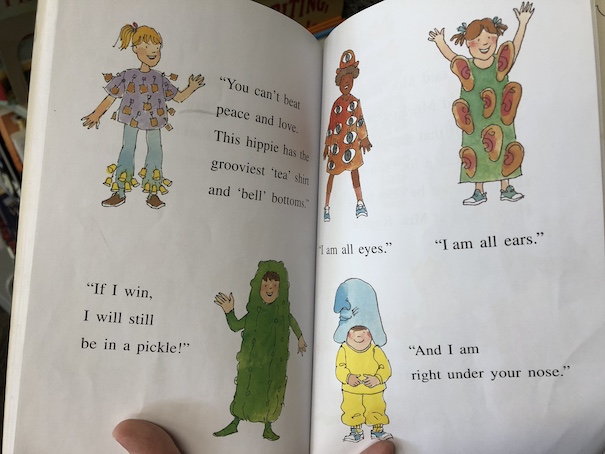
I did like it that Amelia Bedelia’s tendency to be overly literal is going strong in this book. Besides the mistakes she makes while helping Mr. and Mrs. Rogers get ready for their party, I enjoyed seeing the costumes that Amelia helped the children make. They’re all puns and literal interpretations of common expressions. Amelia Bedelia’s own costume is a fun twist!
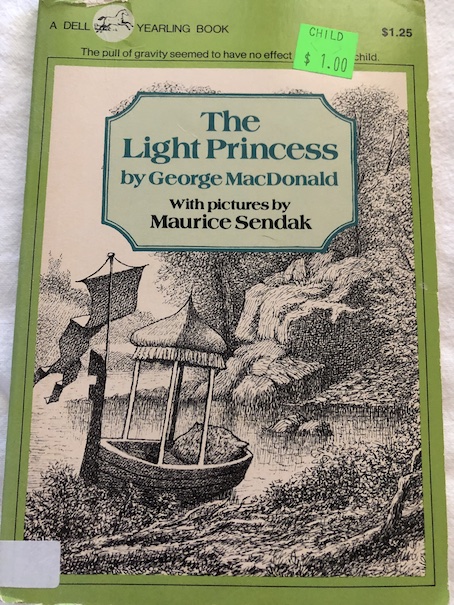
A long time ago, a king is irritated with his queen because they have no children. The queen tells him to be patient, and she eventually gives him a daughter. The king is very happy, but he makes a critical mistake. He forgets to invite his own sister to his daughter’s christening. It would be embarrassing for anybody to forget to invite a family member to an important event, but it’s a serious problem in his case because his sister is a wicked witch. She has a nasty temper and is vindictive. So, she decides to show up for the christening anyway and get her revenge by putting a spell on the baby princess. From that moment on, the baby is weightless, no longer bound by gravity.
It doesn’t take the little princess’s parents long to realize who has caused this strange malady in their child. It’s not all bad. Her nurses find her very easy to carry around, and people in the palace have fun playing ball with the princess as the ball, and the little princess herself seems to find all of this delightful. However, there is always the fear that she could blow away by accident, which does happen once, when she is blown out of a window and into the garden. Her parents continually worry about her future. At the queen’s urging, the king attempts to go to his sister and apologize about forgetting her invitation to the christening and ask her to lift the spell on the princess, but his sister denies all knowledge of the spell. The king knows she’s lying, but as long as she continues to deny it, there isn’t much he can do.
The problem goes much deeper than the princess having difficultly keeping her feet on the ground literally. She also has difficulty keeping her feet on the ground mentally. Her lack of gravity extends to an inability to see the “gravity” or seriousness in any situation. She laughs all the time, at everything, even when nothing is funny, although there is no real depth of feeling to her laughter. Even though she laughs all the time, she never smiles, leaving it open to question whether she ever really feels happiness or any emotion at all. She certainly doesn’t understand genuinely serious or catastrophic situations or other people’s emotions. When her mother cries, the princess just thinks that she’s making funny faces and odd sounds because she can’t seem to understand what crying means or the emotion behind it.
When the princess gets older, her parents talk to her about her condition, but the princess refuses to take it seriously. They try to ask her about what she feels. The princess says that she doesn’t feel anything, except that she sometimes feels like she’s the only one who has any sense, and then, she bursts into a wild, inappropriate fit of laughter. When they ask her if there’s anything she wants in life, all she can think of is to have someone tie a string to her and fly her like a kite, and then, she bursts into laughter again.
Since it’s useless trying to get through to the princess, the king and queen try consulting others, but nobody can agree on a solution. They consider metaphysics and philosophy. They recommend education and bloodletting. Her parents wonder if she would acquire some gravity if she fell in love, but the princess can’t seem to fall into anything … until the day she falls into the lake.
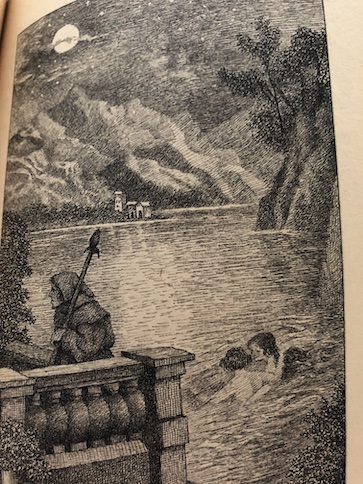
There is only one thing that the princess seems to love at all, and that’s the lake near the castle. When they take the princess out in a boat one day, she falls into the lake, and when she is in the water, she has gravity. She loves the water and loves swimming. She seems to have a better temperament when she is in the water, and she behaves better after a swim. Since water seems to affect the princess, they begin to consider that the cure to her problem might be to make her cry – a way of producing water that requires a grave emotion. However, nothing seems to make the princess cry. She is too flighty. (This book is full of puns related to gravity and flying, and they’re all given in a grave, direct manner.)
Then, one day, a prince tries to rescue the princess from the lake because he thinks she’s about to drown. When he pulls her from the water, she loses her gravity, and she angrily tells him to put her back in the lake. Unsure of how to do it when she’s weightless, the prince grabs hold of her and jumps into the lake with her. The princess is surprised and delighted because she has never truly fallen before. Now, she has fallen in with the prince … maybe in more ways than one.
However, even though the princess is starting to feel something for the prince, she has trouble understanding what she feels, not having felt much of anything for most of her life. When the lake suddenly begins drying up, the princess’s condition starts getting worse. The prince, who has truly begun to care about the princess, is willing to sacrifice himself to save the lake and the princess. It is only when the princess is confronted with the full reality of the prince’s sacrifice on her behalf that she is able to fully feel something and break free of her curse.
This book is now in the public domain, and you can read it online in your browser at Lit2Go. It is also accompanied by audio readings of each of the chapters.
My Reaction
Like other Victorian era children’s stories, there is a moral to this one, but it’s phrased in a unique and fun way. I remember liking this story the first time I read it as a kid, but I forgot about all of the puns involving “gravity”, which can refer to the force that makes things fall to earth or a state of serious emotion. The princess in the story lacks both, so she is very literally “flighty” and “can’t keep her feet on the ground.” Both of those terms are related to the idea that serious people have more emotional gravity, and unserious people lack it. For most of the book, the princess is an unfeeling air-head. I also missed the mention that the king doesn’t like puns, which may tacitly explain why his sister chose to make her curse in the form of a pun, knowing that her brother wouldn’t understand it.
The book notes that real happiness requires some emotional gravity because the person has to have enough emotional depth to understand their real emotional state and react appropriately to their emotions. That’s why the book describes the princess as never seeming happy, even when she laughs insanely at everything. She has no emotional depth or understanding. She doesn’t feel very much emotionally, and she has trouble understanding even her own limited emotional range. People often have trouble telling the difference between her laughing and screaming. Either way, it’s just a lot of loud noise with no real feeling behind it, and it’s pretty disturbing. It’s only when confronted with the apparent loss of the man she loves that the princess is able to feel a definite emotion. Fortunately, it all ends happily for our prince and princess. At the last minute, she decides to sacrifice her lake to save him, and finally, cries for the first time in her life, and that breaks her spell.
People don’t like to feel negative emotions, and some will use all kinds of defense methods to avoid what they’re feeling, but negative emotions (within reason, not taken to excess) are important to emotional health. People need to feel their full emotional range, and negative emotions often act as safety features in our lives. They tell us when we’re in an unsafe or unhealthy situation or when we’ve done something wrong, and they motivate us to do whatever is necessary to fix the situation. The princess’s habitual reaction to anything and everything is crazed and unfeeling laughter, but that’s not what she needs. She needs real feeling and honest tears to restore both her physical and emotional gravity. The princess, staring at the prince as he is about to die is literally staring death in the face and feeling the “gravity” of it. Contemplating the impending death of the prince and understanding for once the seriousness and finality of it, the princess experiences sadness and loss, and through that, she comes to understand love and sacrifice. Only when she has been through all of that is the princess truly able to be happy with her prince and his recovery. The princess has a difficult time adjusting to her new gravity, in more ways than one. She has to learn to walk for the first time because she always floated easily through life before, and sometimes, she falls down and hurts herself. She sometimes complains about it, but it’s still worth it because she has gained the ability to fully feel and to love and be loved.
During the story, none of the main characters actually have names. They are only referred to by their titles: king, queen, princess, and prince. Their names aren’t as important as their roles in the story.
There is a more modern story called Princess Hyacinth: The Surprising Tale of a Girl Who Floated from 2009 that uses the concept of a princess who is unaffected by gravity, but in a different way. It’s a picture book, and in that story, the princess isn’t cured of her lack of gravity. Instead, she learns how to make the most of it.
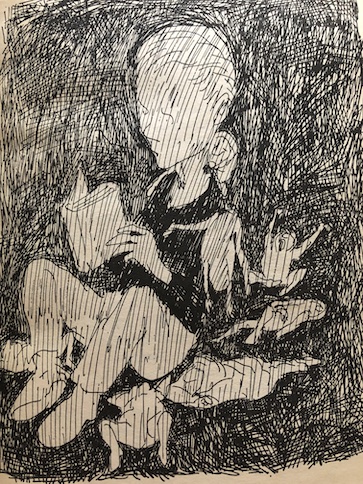
Milo is a boy who never really knows what he wants or what to do with himself. He is always bored because he doesn’t really know the purpose or point of doing anything. Nothing he learns in school interests him because he can’t see what he could ever do with the knowledge. He never bothers to read the books he has, play with his toys, or learn to use his tools because he just doesn’t have the imagination to appreciate them or what he could do with them.
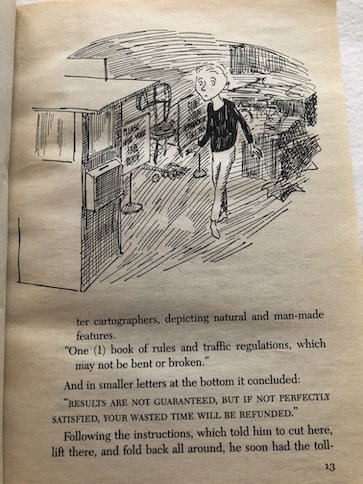
One day, when Milo gets home from school, he finds an unexpected package. It’s not his birthday or Christmas, but the package is definitely intended for him because it has his name on it: “For Milo, who has plenty of time.” There is a list of items contained in the package: 1 tollbooth (which must be assembled, according to the directions), 3 precautionary signs (“to be used in a precautionary fashion”), some coins for the tollbooth, a map (with no familiar places on it), and a driver’s rule book (which must be obeyed). Interestingly, it promises that if Milo is not satisfied with his tollbooth experience, his time will be refunded. Since Milo doesn’t think he has anything else to do anyway, he decides that he might as well unwrap the tollbooth and set it up.
Although Milo thinks that the map is purely fictional and that the tollbooth is just a playset, he decides that he might as well select a destination on it for his trip through the tollbooth. He closes his eyes, puts a finger on the map, and selects a place called “Dictionopolis.” He gets in the toy car, puts a coin in the tollbooth, and goes through it.
To his surprise, Milo suddenly finds himself driving down a real highway, no longer in his own apartment. He sees a sign pointing the way to a place called Expectations, and he stops to ask a man about it. At first, he thinks he’s talking to a weather man, but the man corrects him, saying that he’s really the “Whether man.” Part of his job is to hurry people along, even if they have no expectations. Nothing the Whether Man says to Milo makes sense to him, so he decides that he’d better just get going.
As Milo drives down the highway, he gets bored and starts daydreaming. As his mind wanders, the scenery gets duller and grayer, the car slows down, and eventually, the car stops and won’t move further. Milo looks around and wonders where he is. It turns out that he’s in the Doldrums, the home of the Lethargarians. They tell him that thinking isn’t allowed there. Milo says that’s a dumb rule because everybody thinks. The Lethargarians say that they never think and Milo must not have thought either because, if he had, he wouldn’t be there. People usually get to the Doldrums because they’re not thinking, and once they’re there, nobody is allowed to think. They refer Milo to the rule book that came with the tollbooth. Milo looks in the rule book and sees that is a rule. There are also limits on laughing and smiling in the Doldrums. Milo asks the Lethargarians what they do if they can’t think or laugh. They say that they can do anything as long as they’re also doing nothing. Mainly, they do things like daydreaming, napping, loafing, loitering, and wasting time. They say it gives them a full schedule and allows them to get nothing done, which they consider an important accomplishment. Milo asks them if that’s what everybody here does, and they say that the one person who doesn’t is the Watch Dog, who tries to make sure that nobody wastes time.
At that point, the Watch Dog shows up. The Watch Dog looks like a dog, but his body is an alarm clock. The Watch Dog asks Milo what he’s doing, and is alarmed when Milo says that he’s “killing time.” It’s bad enough when people waste time, but killing it is horrible! (The book is full of these kinds of puns. It’s just getting started.) Milo explains how he got stuck in the Doldrums while he was on his way to Dictionopolis and asks the Watch Dog for help. The Watch Dog explains that if he got there by not thinking, he can also get out by thinking and asks to come along because he likes car rides. Milo agrees, and the two of them get in the car. Milo thinks as hard as he can (which the book notes isn’t easy for Milo because he’s not used to thinking and doesn’t do it too often). Gradually, as Milo thinks of various things, the car begins to move. The faster Milo thinks, the faster the car goes. Milo learns that it’s possible to accomplish a lot with just a little thought.
The Watch Dog’s name is Tock because his older brother is named Tick. However, their names are a mistake because his older brother only makes a tock sound, and Tock only makes a tick sound. It’s a source of pain and disappointment. Tock tells Milo about the origin of time and why Watch Dogs find it important to make sure that people use time well. He says that time is the most valuable possession because it always keeps moving.
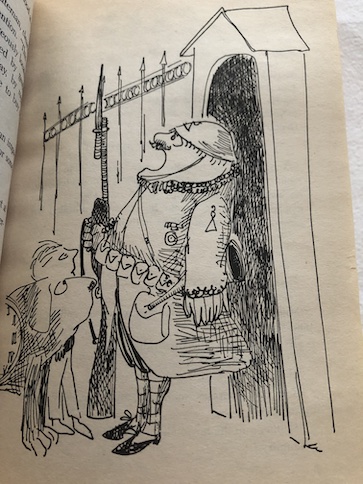
When they arrive at Dictionopolis, the gatekeeper won’t let them in immediately because Milo doesn’t have a reason for being there. Nobody gets let in without a reason. Fortunately, the gatekeeper always keeps a few spare reasons lying around, and he decides to let Milo have one. The one he selects is “WHY NOT?”, which the gatekeeper considers a good, all-purpose reason for doing anything. (I don’t know. I’ve heard that one followed up by an angry “I’ll tell you why not!” before.)
As readers have probably guessed, Dictionopolis is all about words. When Milo enters the city, he finds himself in the marketplace, which is called the “Word Market.” The ruler of Dictionopolis is Azaz the Unabridged, and when Milo is welcomed to the city by the members of the king’s cabinet, they do so in multiple ways, using synonyms. Milo asks them why they don’t just pick one word and stick with it, but they’re not interested in that. They say that it’s not their business to make sense and that one word is as good as another, so why not use them all? (That isn’t true, but the story tells you why not later.) They go on to tell Milo that letters grow on trees here, and people come from all over to buy all the words they need in the Word Market in town. Part of the cabinet’s duty is to make sure that all of the words being sold are real words and have real meanings because people would have no use for nonsense words that don’t mean anything and that nobody will understand. The cabinet doesn’t seem to care about whether or not the words are being used in a way that makes sense as long as they’re real words. (If you’re familiar with business speak or buzzwords, you’ve probably noticed that much of it works on a similar principle.) Putting the words into a context that makes sense isn’t their job. (Later, you meet the person who had that job.) However, the cabinet does advise Milo to be careful when choosing his words and to say only what he means to say. They excuse themselves to get ready for the banquet and say that they’ll see Milo there later, although Milo doesn’t know what banquet they’re talking about.
Milo and Tock explore the Word Market. Milo is fascinated by the variety of words available. He doesn’t know what they all mean, but he thinks that if he can buy some, he can learn how to use them. He chooses three words he doesn’t know: quagmire, flabbergast, and upholstery. (I’m surprised he didn’t know the last one because, surely, he has upholstered furniture in his apartment.) Unfortunately, Milo quickly realizes that he has only one coin with him, and he’ll need that coin to get back through the tollbooth. Eventually, he finds a stall selling individual letters for people who like to make their own words. The stall owner gives them some free samples to taste. They taste good to Milo, and the stall owner tells them that sets of letters come with instructions. Milo doesn’t think he’s very good at making words, but the Spelling Bee, a giant bee, begins showing him how to spell words. However, the Humbug, a grumpy bug, tries to tell Milo not to bother learning. The Spelling Bee tells Milo not to listen to the Humbug because he just tells tall stories and doesn’t actually know anything, not even how to spell his own name.
The Spelling Bee and the Humbug start fighting and knock over all the word stalls around them. There is a big mess, all the words get scrambled, and it takes some time before everyone sorts everything out. By that time, the Spelling Bee is gone, and when the policeman comes, the Humbug blames everything on Milo and Tock. At first, it seems like Milo will get off lightly because the policeman (who is also the judge) gives him the shortest “sentence” he can think of (“I am”). Unfortunately, he’s also the jailer and takes Milo and Tock to prison for 6 million years.
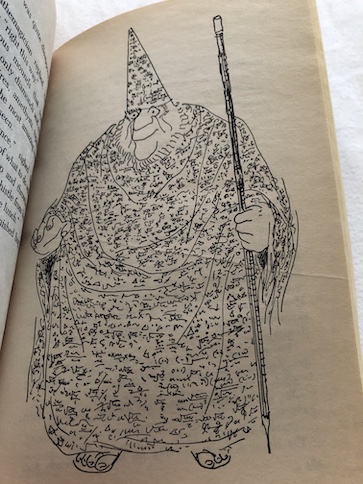
In the prison, Milo and Tock meet the Which. At first, Milo thinks that she’s a “witch”, but she says many people make that mistake. The Which is King Azaz’s great-aunt, and her job used to be to make sure that people correctly chose which words to use and didn’t use more words than necessary. (A problem that Milo noticed in the market.) The Which explains that she was thrown into prison because she got too carried away with her job and became too miserly with words. Word economy is good (and something I struggle with), but rather than promoting brevity, the Which started promoting silence instead,. It got so bad that people eventually stopped buying words and the market was failing, so the king had to put a stop to it. The Which says that she understands now where she went wrong, and Milo asks her if there’s anything that he can do to help her. The Which says that the only thing that would help her would be the return of Rhyme and Reason. When Milo asks who they are, she tells him the story of the founding of the Kingdom of Wisdom.
Years ago, the King of Wisdom had two sons, and he was proud of both, but one of them had an obsession with words, and the other had an obsession with numbers. The king didn’t realize how bad their conflict was growing, and it got worse over time. One day, the king found a pair of abandoned infant twins. The twins were both girls, and the king had always wanted daughters as well as sons, so he adopted them and named them Rhyme and Reason. Everyone loved Rhyme and Reason, and they had a talent for resolving problems and disputes. When the king died, he left his kingdom to both of his sons and left instructions for them both to look after Rhyme and Reason. The word-obsessed son, Azaz, established a capital city of his own, Dictionopolis, and the number-obsessed son, the Mathemagician, established the city of Digitopolis. Rhyme and Reason remained in the city of Wisdom and acted as advisers to the brothers, mediating their disputes. This system worked until the brothers got into their worst fight over whether words or numbers are most important. They took this dispute to Rhyme and Reason, who said that both are of equal importance. This satisfied most people, but both brothers were angry because they had wanted the girls to make a definite choice between them. In their last joint act, they banished Rhyme and Reason to the Castle in the Air. Since then, there has been continued fighting between the two brothers and their respective cities, the city of Wisdom has been neglected, and there’s been no Rhyme or Reason to any of it. (Ha, ha.)
Milo says that maybe they could rescue Rhyme and Reason from the Castle in the Air. The Which says that would be difficult because there’s only one stairway to the castle, and it’s guarded by demons. Milo remembers that there is also the matter of them being stuck in prison for 6 million years. The Which says that being in prison isn’t really a problem. Although the policeman/judge/jailer likes putting people in prison, he doesn’t care much about keeping them there, so Milo and Tock can leave when they like, and he probably won’t notice. (Sounds like he’s not very good at the “jailer” part of his job.) The Which points out a button on the wall, Milo presses it, and a door opens.
When they step outside, the king’s cabinet members come to take him to the banquet that they mentioned earlier. They have Milo and Tock step into their wagon and tell them to be quiet because “it goes without saying.” (Ha, ha.) They take Milo and Tock to a palace shaped like a book, where they meet King Azaz and join the banquet.
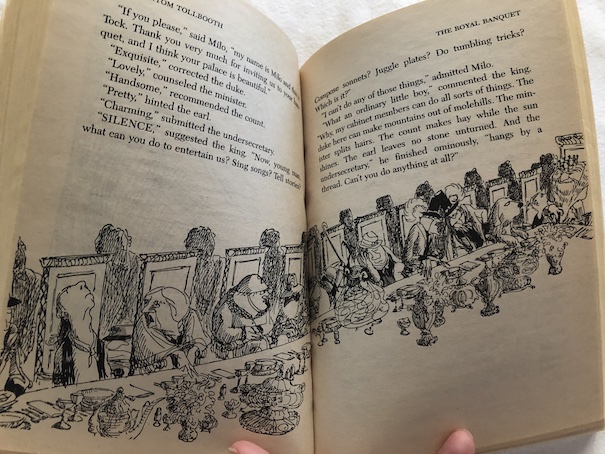
The banquet is a pun-filled meal where everyone has to literally eat their words and have half-baked ideas for dessert. (Half-baked ideas look good, but you shouldn’t have too many because you can get sick of them. Tock says so.) Nothing makes sense, and even the king realizes it, which gives Milo the opportunity to suggest bringing back Rhyme and Reason. The king isn’t sure that’s possible, and the Humbug, of course, volunteers Milo and Tock for the job. The joke turns out to be on him because the king volunteers the Humbug to assist Milo. Reaching Rhyme and Reason will be a perilous journey, and possibly the most difficult part will be getting the Mathemagician to agree to let them do it.
The book is available to borrow and read for free online through Internet Archive (multiple copies). There is also a movie version of this book (mostly animated but part live action) with songs. You can see a trailer for it on YouTube.
My Reaction
The Phantom Tollbooth is a fantasy story, but like many fantasy stories, it’s also a morality story. It’s a little like Charlie and the Chocolate Factory, which aims to correct children’s bad habits. Milo’s boredom problems are due to his lack of thought for the things he could do and imagination to figure out how to make use of what he has. His adventures after he goes through the Phantom Tollbooth help him to see things differently and to learn to use his mind creatively.
However, I wouldn’t say that the story is too preachy. A couple of parts started to feel a little like a lecture, but it’s set in a fantasy land that feels a little like Alice in Wonderland. There’s a healthy dose of nonsense that keeps things interesting and fun. The book is peppered with puns and peopled by a fascinating variety of characters. There’s the boy who can see through everyone and everything, who teaches Milo to look at things from an adult perspective and helps him to realize the benefit of keeping his feet on the ground (both of those are also puns). There’s the man who is the world’s shortest giant, the world’s tallest midget, the world’s thinnest fat man, and the world’s fattest thin man all at the same time. Basically, he’s just an ordinary guy who’s noticed that people think of him in different ways when they compare him with themselves.
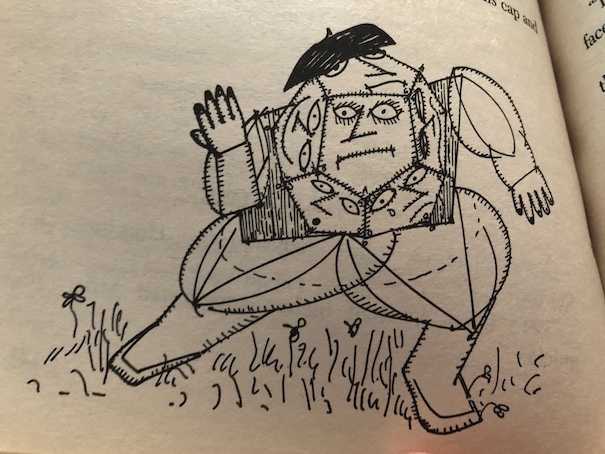
I was first introduced to this story when I was in elementary school, as many people were. Our teacher read it to us and showed us the cartoon version. Parts of songs from that version still get stuck in my head, almost 30 years later. (“Don’t Say There’s Nothing To Do the Doldrums …”) The part of the story that stuck with me the longest was the Dodecahedron, a shape with twelve sides. If you’ve seen the twelve-sided dice used for Dungeons and Dragons and similar role-playing games, those are dodecahedrons. In the book, the Dodecahedron is talking character as well as a shape, but I remember it because our teacher gave us paper cut-outs to make our own dodecahedrons. I made two of them, and I might still have one somewhere.
Amelia Bedelia’s Family Album by Peggy Parish, 1988.
Mr. and Mrs. Rogers realize that they’ve never met the rest of Amelia Bedelia’s family, so they tell her that they’d like to give a party for her and family. Amelia Bedelia is happy about the party and shows Mr. and Mrs. Rogers some pictures of her relatives.
It turns out that her tendency to be extremely literal is a family trait. Her father is a telephone operator who operates on telephones and her mother is a “loafer” who makes loaves of bread. One of her uncles is a “big-game hunter” and has a checkers set that takes up an entire room, and another “takes pictures” in the sense that he is basically an art thief.
With each relative introduced, readers can pause for a moment to consider what each of Amelia’s relatives do, in a very literal sense, based on Amelia’s description, before turning the page to confirm it. (I kind of identify with the “bookkeeper” because my room looks kind of like that, for similar reasons.)
In this picture book, Amelia Bedelia isn’t doing any chores or getting confused about instructions, like in other books, but all the occupation-related puns have the same feel as Amelia’s routine misunderstandings about the multiple meanings of words from the rest of the series.
The book is currently available online through Internet Archive.
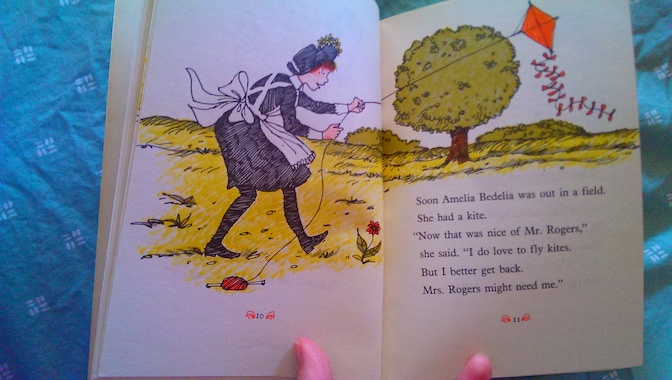
Amelia Bedelia works as a maid/housekeeper for Mr. and Mrs. Rogers. They like her, but they have to be extremely careful about the orders and instructions that they give her because Amelia Bedelia takes everything literally. For example, when Mr. Rogers asks her for toast and an egg for breakfast, she gives him a raw egg straight out of the refrigerator because he never told her to cook it. Telling her to “go fly a kite” is also pointless because she’ll simply go to the park and do it.
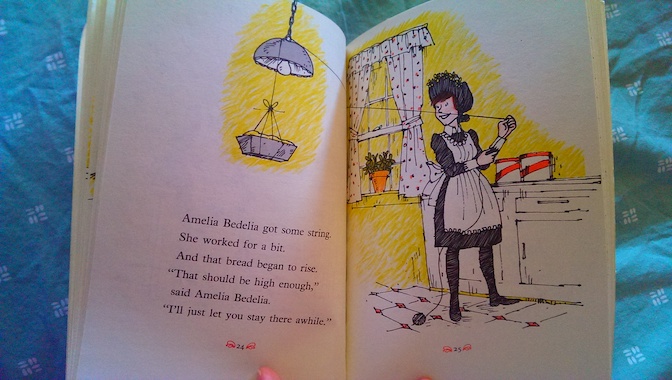
Possibly the most dangerous thing Mr. and Mrs. Rogers can do is leave Amelia Bedelia alone in the house with a “to do” list. Unsupervised, she reads each item on the list and does her best to obey all of the instructions to the letter. From putting plants in pots from the kitchen to making sure that the bread rises by hanging it from a string to making a “sponge cake” that includes actual sponge, Amelia Bedelia muddles her way through, getting everything wrong while still being technically correct.
So, why do Mr. and Mrs. Rogers put up with her? Well, for one thing, she makes a terrific butterscotch cake.
The book is currently available online through Internet Archive.











 Jestress's Forgotten Books and Stories