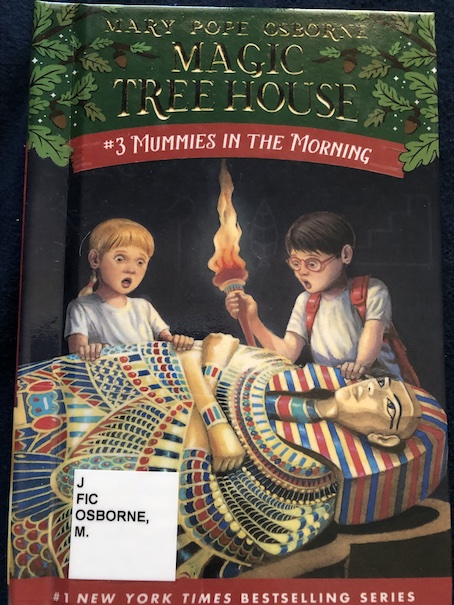
Mummies in the Morning by Mary Pope Osborne, 1993, 2014.
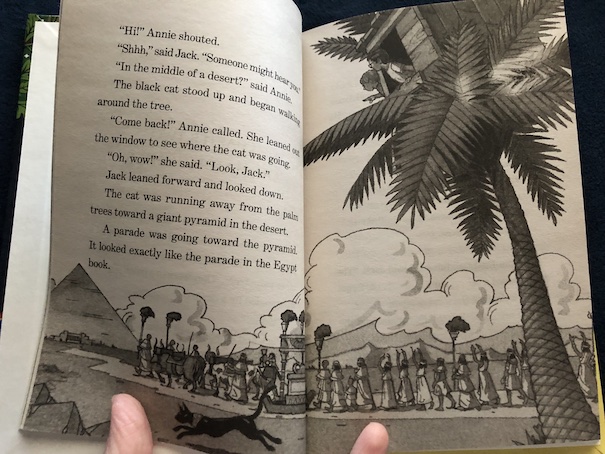
This time, Jack and Annie use a book in the magic tree house to travel back in time to Ancient Egypt. Jack has a fascination for mummies and pyramids, and Annie can’t wait to see them up close. When the children arrive, they witness what appears to be a royal funeral procession, but the people seem to vanish awfully quickly. Annie wonders if they could have been ghosts, although Jack thinks that’s nonsense. He thinks it was probably just a mirage, although he has reason to rethink that later.
The children follow a mysterious black cat into a pyramid. Annie is eager to see a mummy, but the children are startled when they see what appears to be a walking mummy that drops a scepter. Jack realizes that what they saw wasn’t a real mummy but probably a tomb robber in disguise. He reads in their book about Ancient Egypt about the problem of tomb robbers.
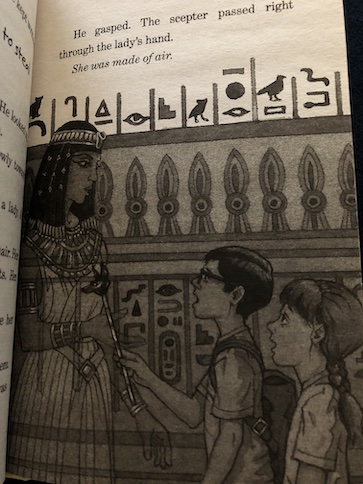
Then, the children encounter a real ghost! She is see-through, and objects pass through her. Fortunately, the ghost is nice instead of scary, and she explains to the children that she needs their help. She is the ghost of an Ancient Egyptian queen, and she has been unable to progress to the afterlife because she cannot find her copy of the Book of the Dead, which is supposed to guide her through the obstacles on the way to the afterlife. She knows that her brother, who designed her tomb, hid the book to protect it from tomb robbers and left clues for her in the symbols carved on the walls of her tomb. However, her brother apparently forgot that her vision was always bad, and she can’t read the symbols. (Apparently, poor vision doesn’t improve after death.) Jack would be willing to loan her his glasses, but since she’s incorporeal (not a word used in the book, but basically, she no longer has a physical presence and can’t use physical objects), the glasses wouldn’t stay on her face.
Instead, she asks the children to describe the symbols on the wall to her so she can interpret them. Together, the children and the ghost use the clues to find the scroll containing the Book of the Dead. After that, Jack and Annie have one more task: escaping the maze-like tomb!
My Reaction
The ghost in the story is a non-scary ghost, but there’s enough mild creepiness and mystery to satisfy kids who enjoy a little creepiness in their stories. Toward the end, they have to put the scroll in the sarcophagus with the queen’s mummy, which both grosses out and fascinates the children.
The historical information was good, although translating Egyptian hieroglyphics is much more complicated than the book indicates. In the book, the symbols are meant to literally depict specific objects, which some hieroglyphics can, but others are used to represent sounds to spell out words or names. I think the story just kept things simple for kids.
I liked the part where the kids get lost in the pyramid because pyramids were build with false hallways and dead ends to confuse tomb robbers. Everything work out fine in the end!
Although this is not the first book in The Chronicles of Narnia, it takes place earlier in time than the other books and explains much of what happens in the later books. It starts in London in the late 1800s. No exact date is given, but the story says that it’s when Sherlock Holmes was still living in Baker Street and the Bastable Children were hunting for treasure (a reference to a Victorian children’s book by E. Nesbit). In fact, the characters make many other references to popular literature of the period throughout the story.
A girl named Polly Plummer is living in London when a boy called Digory Kirke comes to live with his aunt and uncle in the house next door. Digory is very unhappy because he used to live in the countryside and have his own pony, and he doesn’t like the city. The reason why he has to live with his aunt and uncle is that his father needs to go to India, and his mother is very ill and may die, something that has Digory very worried. He also tells Polly that his aunt and uncle are very strange, and it makes him nervous. His uncle spends most of his time in his study at the top of the house, a room where Digory is forbidden to go, and Digory thinks that there might be some terrible secret there. He once heard what sounded like a scream from that room. There are times when his uncle starts to talk about something while they’re eating together, but Digory’s aunt (his uncle’s sister, not his wife) keeps interrupting him and stopping the conversation before it even starts. The children speculate that Digory’s uncle’s secret might be that he’s keeping a mad wife in the attic (like in Jane Eyre) or maybe he’s involved with pirates, like in Treasure Island. Polly thinks all this secrecy and mysteriousness sounds exciting, but Diory says she might not think so if she had to live in a house like that. His uncle is a sinister person, and Digory thinks he might be mad. After a fashion, Digory is correct.
Digory and Polly become friends and play together over the summer. The weather is frequently rainy, so they spend most of their time inside, exploring their own houses. Their houses are part of a row of adjoined houses, and Polly discovers an attic crawl space that links all of the houses together. The children realize that they can use this crawl space to access other houses in the block. They don’t want to trespass into an occupied house, but there’s an empty house beyond the one where Digory’s aunt and uncle live that’s been empty for years. The children are curious about that house and think maybe it’s haunted, so they decide to use the crawl space to access the empty house. Unfortunately, the children accidentally come out of the crawl space in Digory’s uncle’s secret study.
When Digory’s Uncle Andrew catches the children in his study, he locks them in, saying that children are exactly what he needs for his experiment, and this time, his sister can’t interfere. The children are frightened and ask to leave, but Uncle Andrew offers Polly one of the yellow rings he has on a table. Polly can’t resist touching one of the yellow rings, and she suddenly vanishes from the room. Digory angrily demands to know where Polly went, and Uncle Andrew explains that this is his experiment.
Uncle Andrew calls himself a scholar, but he’s also a magician, and he’s been experimenting with dangerous magic. When he was young, he had a godmother named Mrs. Le Fay. Mrs. Le Fay was a somewhat disreputable person who had been to prison (for things that Uncle Andrew doesn’t want to explain), but she was always nice to Andrew because they shared common interests. Their interests were magic and esoteric knowledge. Mrs. Le Fay was one of the few living humans who had some fairy blood in her, so she was Andrew’s “fairy godmother.” Before she died, she gave Andrew a strange box and told him to destroy it using a magical ritual after her death. Of course, Andrew broke his promise and kept the box to study it. Uncle Andrew thinks of himself as a great scholar and researcher, and things like promises and ethics and even the welfare of other human beings are not going to stand in the way of his pursuit of arcane knowledge.
After spending considerable time studying the box, he realizes that it was made in the ancient land of Atlantis, but more than that, the contents, a set of yellow and green rings, came from another dimension, another world in another universe. Uncle Andrew realized that the rings would allow a person to access that other dimension. The yellow rings would send people to the other dimension, and the green ones (he’s pretty sure) allow them to return from that dimension. Naturally, he thought of himself as too important to risk in the experiment, so he needed to send someone else instead. He tried it at first with guinea pigs, but he couldn’t tell the guinea pigs what to do to come back, so he realized that he needed to send humans. Now that he has tricked Polly into going, he says that the only way Polly can come back is if Digory goes, too, and brings her one of the green rings that she can use to return. Digory is angry at his uncle for trapping them in this way, but since he knows his uncle won’t rescue Polly, he agrees to go find her.
After using one of the yellow rings himself, Digory finds himself coming out of a pool in a strange forest. Polly is there, but something about this forest muddles their minds so they have trouble remembering who they are, where they’re from, and what they’re supposed to do. After talking to each other awhile, they remember. They’re about to return to their own world by putting on their green rings and stepping into the pool they both came from when Digory realizes that there are other pools around them that could lead them to other worlds. Digory is excited and wants to explore these other worlds, but Polly sensibility insists that they carefully mark the pool that will take them home and test it to make sure that it will allow them to return before they try going to a different world. They change rings before they are fully in their own world again, so they won’t immediately return to Uncle Andrew before they’ve fully understood what these other places are and what they’re about.
When the children try entering a different world, they find the ruins of an ancient palace and city. There is no one around, and it looks like it’s been dead or abandoned for ages. Exploring the palace, they find a collection of statues in royal clothes and crowns. Some of the statues seem to have kind and wise faces, while others are cruel and distressed. Then, the children see a little bell and a hammer with a warning on the bell in a strange language that the children are somehow able to understand. Polly thinks that they should leave the bell alone, but Digory feels a strong urge to strike the bell and see what happens. Digory grabs Polly’s arm to stop her from leaving this ruined world and strikes the bell. Almost immediately, the children realize that this was a terrible choice.
The bell wakes one of the statues, a tall and beautiful but cruel woman who says that she is Jadis, the last queen of this world. Digory finds her impressive at first, but that feeling turns to horror as she tells them her story. Jadis says that she and her sister were fighting for the throne, and her sister’s forces were winning. As she stood on the brink of defeat, Jadis used a terrible spell that immediately killed everyone in their world except herself, including her sister, her forces, and all of the citizens. Jadis says that the citizens served no other purpose than to serve her anyway, since she is rightful queen, and she blames her sister for not simply giving her the crown when she demanded it. After everyone was dead in her world, Jadis put herself into a magical sleep until someone came to wake her up. When she has finished telling the story, Jadis commands the children to take her to their world so she can rule them instead.
Polly and Digory try to use their magic rings to escape from this terrible queen, but Jadis grabs hold of them and is brought to Earth anyway. Although Jadis’s magical powers don’t seem to work on Earth as they did in her world, she is still unnaturally strong and formidable. She is as cruel, selfish, and vain as Uncle Andrew, but she could easily wipe the floor with him, if she wanted to. Uncle Andrew’s initial joy at his experiment being an unqualified success that actually bought someone from another world into his world turns to panic when he realizes that Jadis is more than he can control and regards him as no more important than one of his guinea pigs was to him. Digory apologizes to Polly for ignoring her warnings and waking Jadis, and the children try to figure out how they can get rid of her before she can take over their world.
My Reaction and Spoilers
I didn’t read this book when I was a kid, but I’m glad I did as an adult because I enjoyed it, and I appreciated the explanations behind some of the things that happen or exist in the other stories. Digory Kirke is actually the old professor the Pevensie children go to stay with in the country when they are evacuated from London during WWII in the first book in the series, The Lion, the Witch, and the Wardrobe. We also learn that he and Polly actually witness the creation of Narnia when they try to get Jadis back to her own, crumbling world. Jadis was inadvertently responsible for the lamppost that the Pevensie children find in the woods when they first visit Narnia. Jadis also becomes the White Witch who tries to make herself Queen of Narnia. At the end of the book, we also learn the origins of the magic wardrobe and what makes it so special.
There are Biblical themes throughout the story, but especially around the creation of Narnia and the mission that Aslan gives Digory to make up for accidentally bringing Jadis to Narnia. Narnia’s creation isn’t quite like the Biblical creation story. In this book, Aslan the Lion sings Narnia into existence. However, there is a pairing up of animals that almost mimics the pairs of animals being chosen for the Ark in the Noah story.
After Digory admits that he is the one who brought Jadis to this new world, Aslan sends him to fetch an apple from a distant garden, from which Aslan says he will plant a tree that will protect Narnia for years. The apple and the garden mimic the story of the Garden of Eden. The garden has a fence around it with a warning about trespassing and stealing fruit for selfish purposes. Digory retrieves the apple that Aslan asks for, and he is tempted to take one himself, but before he can go much further with that thought, he catches Jadis in the garden, stealing an apple for herself. When Jadis eats the apple, it turns her into the pale witch she becomes. Jadis says that she will now live forever and never age. She tries to convince Digory to eat the apple he has picked or give it to his ill mother, but Digory successfully resists the temptation. Aslan tells Digory that it is good that he resisted the temptation because, while the fruit would grant eternal life to whoever eats it, it comes with a heavy price if the fruit is obtained through dishonest means. Jadis/the White Witch is granted unnaturally long life, but she is never the same again. Aslan does give Digory the means to heal his mother before he returns home.
I really liked the children’s hideout in the crawl space that spans the houses. They use the crawl space and its relationship to the houses to explain how there can be parallel worlds that can be connected, but I like the setting so much that I would have liked to see a children’s mystery or adventure story in a similar setting. I found myself wondering what would have happened if the children had managed to reach the empty house they wanted to enter and explore. They never did because they got into Uncle Andrew’s study by mistake, but I think it’s fun to imagine what they would have done if they had. Maybe they would have turned it into a secret hideout, or maybe they would have encountered criminals who had already turned it into their hideout. Maybe someone would eventually buy the house and move in. The whole setup offers possibilities.
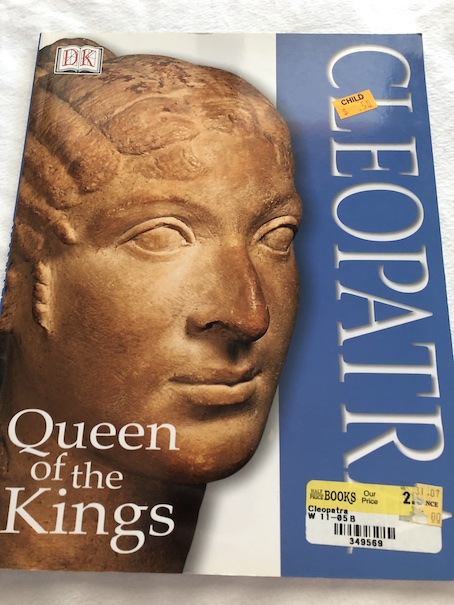
Cleopatra: Queen of the Kings by Fiona MacDonald, illustrated by Chris Molan, 1998, 2003.
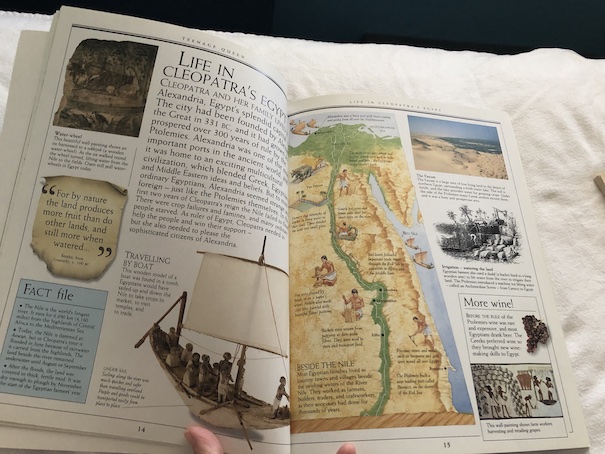
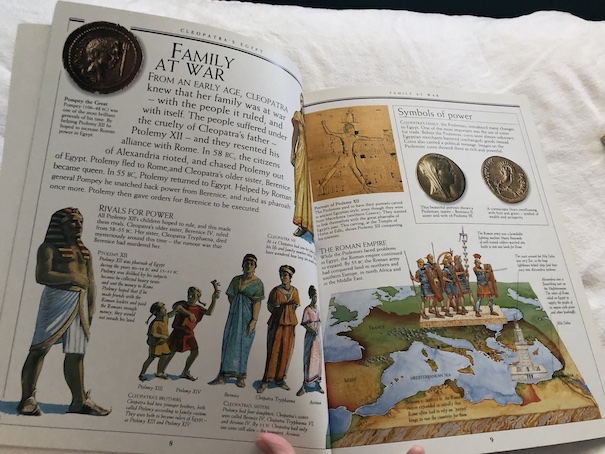
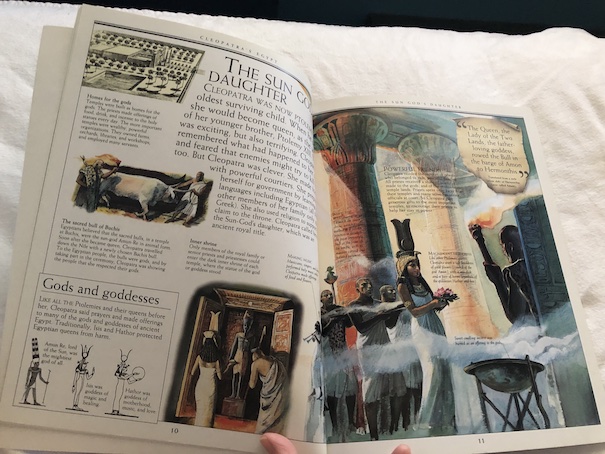
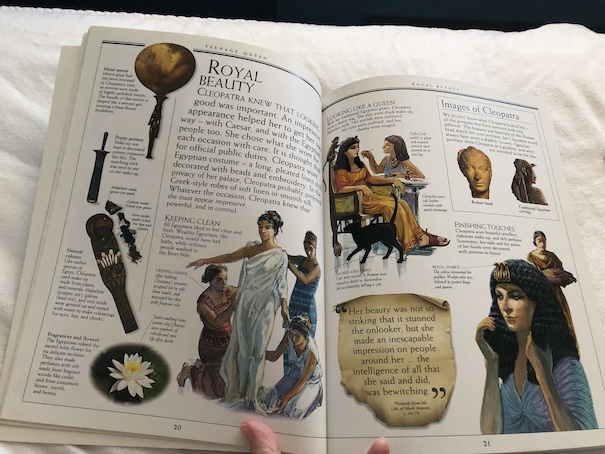
I always like books from DK Publishing because they have great illustrations, and they do a good job of helping to explain nonfiction topics, including different periods of history. However, one thing that’s important to realize is that you really have to read all of the small text that accompanies even the small pictures in order to get the full story. If you don’t, you may miss important details. Although this is a picture book, the detailed nature of the information and some of the dark subject matter make it inappropriate for young children.
This particular book is about the life of Cleopatra, the famous Egyptian queen. The queen we know as simply Cleopatra was actually Cleopatra VII. She was part of a dynasty of Egyptian rulers who were originally from Macedonia, a region of Greece. This dynasty was known as the Ptolemaic Dynasty because all of the kings in the dynasty were named Ptolemy, including Cleopatra’s father, Ptolemy XII. There were certain names that were repeated in every generation of the family and even within generations, like Ptolemy (Cleopatra’s two brothers both had this name), Cleopatra (Cleopatra also had a sister who was also named Cleopatra), and Arsinoe (Cleopatra’s younger sister). The book doesn’t fully explain why they came from Macedonia, but one of Cleopatra’s ancestors, Ptolemy I, was a Macedonian nobleman and a friend of Alexander the Great. Ptolemy I went with Alexander the Great on his military campaigns. Through his service to Alexander the Great, Ptolemy I was made the Greek governor of Egypt, ruling from the city Alexandria, which had been established by Alexander the Great. Alexandria was an important port city as well as the seat of the royal family. It was a gathering place of traders, scholars, and people from different cultures in Egypt, although average Egyptian citizens viewed it more as city of foreigners, just as the royal family itself was also foreign. That’s an abbreviated explanation of the family’s history, but it helps to understand that, while the family ruled Egypt for generations, they remained culturally Greek. The book mentions that most of the members of Cleopatra’s family only spoke Greek and that Cleopatra departed from the norm by learning to speak Egyptian.
Cleopatra was born into tumultuous times in the history of Egypt and her family. Her father was known as a cruel ruler who taxes his people heavily and sent large amounts of money to Rome, attempting to befriend Roman leaders and bribe them not to invade Egypt. In 58 BC, Alexandrian citizens had enough of Ptolemy XII and the way he catered to Rome, and they revolted, forcing Ptolemy XII to flee the city for Rome. Cleopatra was only fourteen years old at the time. Members of the family were left behind in Alexandria when Ptolemy XII fled, and Cleopatra’s oldest sister, Berenice claimed the throne in her father’s absence. The Ptolemies were always focused on maintaining their power, even in the face of competition or opposition from family members, and they were not afraid to fight or even kill each other to maintain control. Berenice may have murdered another of her sisters during her time as queen because she died under mysterious circumstances. However, when Ptolemy XII returned to Egypt a few years later, he had Berenice executed as a rival for the throne. By then, Cleopatra was the oldest surviving child of the family, with only her youngest sister and her brothers still alive.
A few years later, Ptolemy XII died, and Cleopatra acted quickly and prudently to secure both her life and her power. Her younger brother, Ptolemy XIII, had a claim to the throne, but he was still only twelve years old, and Cleopatra was eighteen. Asserting her authority over her child brother, Cleopatra took the throne as the oldest remaining offspring of Ptolemy XII and married her brother in order to turn her brother from a rival for power into a further source of her own authority. She could then rule on her brother’s behalf as his wife as well as his older sister. (Other Egyptian rulers had married close relatives for reasons like that. Tutankhamen was similarly the result of an incestuous royal relationship.) As queen, Cleopatra called herself the Sun God’s Daughter, an old royal title that tied her image to rulers of the past and the gods of Ancient Egypt.
From the beginning, being queen was a difficult task for Cleopatra. There were famines in Egypt during the beginning of her reign, and Cleopatra had to manage a response that would satisfy the citizens that she was doing her job as ruler. Family rivalries were also an ever-present danger. Cleopatra knew that she had enemies in her court, including people who favored her brother over her. As her brother got older, he became dissatisfied with the way his sister was ruling without sharing power and authority with him. For a time, Ptolemy XIII forced Cleopatra to flee Egypt and go to Syria. Cleopatra took her sister Arsinoe with her, both to protect her from their brother and to prevent her from trying to seize power herself. (In the Ptolemy dynasty, either could be a possibility. When family members weren’t in danger from each other, they could be a danger to each other.)
In the meantime, Julius Caesar came to Egypt to collect a debt that he claimed that Cleopatra’s father had owed him. He arrived during the power struggle between Cleopatra and Ptolemy XIII, and he decided that it would be for the best to try to mediate peace treaty with the two of them. He wanted to meet with both Cleopatra and Ptolemy XIII together, but Cleopatra knew that there was a risk that she might be killed if she showed up for a meeting. Yet, she did want to meet with Caesar because she recognized that he could be an important friend and source of protection for her. She ended up visiting Caesar in secret. According to legend, she had herself delivered to Caesar’s room in a rolled-up carpet. Caesar was charmed by Cleopatra and became her ally. When the news of their alliance spread, it tipped the balance of power in the royal family. Caesar learned that Ptolemy XIII’s adviser was plotting against him and had him executed. Ptolemy XIII fled with Arsinoe to join the Egyptian army and was later killed and found dead in Alexandria’s harbor. Getting rid of her brother/husband and his advisers secured Cleopatra’s position. She had one remaining brother, Ptolemy XIV, who was only eleven years old at the time, so she married him, too, further solidifying her power. As her ally (and possible lover), Caesar provided her with guards for her safety.
Cleopatra had a son named Caesarion, who was rumored to be Caesar’s son as well. However, Romans feared that Julius Caesar would proclaim Caesarion as his heir. They didn’t want him as the future ruler of Rome, citizens were appalled at the way Arsinoe was paraded through the streets as a war prize, and people generally began to fear that Caesar was becoming too powerful. In 44 BC, Caesar was assassinated by a group of senators. Cleopatra was in Rome when Caesar was killed, and she fled back to Egypt with her son. Around this time, Ptolemy XIV disappeared, and he may have been murdered by Cleopatra. With a son to inherit her throne, Cleopatra no longer needed Ptolemy XIV. However, her Roman protector was now gone, and Cleopatra still had enemies at court. Cleopatra’s remaining sibling, Arsinoe, sided with Caesar’s enemies and plotted against her sister and Caesarion.
Nobody knows exactly what Cleopatra looked like (statues and carvings of her don’t always look alike, and they may have been idealized images of her), but she took care of her appearance as part of her image as queen. Apparently, Cleopatra was more striking than beautiful, and what struck people about her the most was her intelligence and personality. Her charm was one of her most important tools in winning allies, and she used it again to win over a new ally to replace Caesar. She found a new ally in Marcus Antonius (also known as Mark Antony), one of the candidates to replace Caesar in Rome.
Mark Antony needed the control of Egypt and its resources and the support of Cleopatra for his own political purposes. To win his support for her purposes, Cleopatra began a romantic relationship with Mark Antony that eventually became a major part of the legends around Cleopatra. Although Mark Antony already had a wife in Rome, he became devoted to Cleopatra and fathered a set of twins with her and, later, a third child.
When Caesar’s nephew, Octavian, learned that Antony had divorced his wife and was conspiring against him, he declared war on Egypt to take down both Antony and Cleopatra. Cleopatra and Antony’s forces were defeated at the Battle of Actium although the two of the escaped. Feeling that the end was probably near, Cleopatra had stoneworkers hurry to complete her tomb. She began experimenting with poisons, and she and Antony swore to each other that they would die together. When Antony’s soldiers turned against him and refused to fight, Antony was disgraced and forced to flee. He ended up taking his own life by stabbing himself. Cleopatra had retreated into her own mausoleum, planning to die, but Octavian allowed her to remain there as a prisoner while she arranged Antony’s funeral. The exact cause of Cleopatra’s death has never been confirmed, but according to legend, she arranged her own death by the bite of an asp and sent a note to Octavian, asking that she be buried with Antony.
It’s a tragic end to a story that was full of treachery and family rivalries from the very beginning. Octavian refused to allow any of Cleopatra’s children to assume the throne of Egypt, ending the reign of pharaohs forever. Rome took control of Egypt, and Cleopatra’s children were sent to be raised by Antony’s first wife in Rome, Octavia (who was also Octavian’s younger sister). Caesarion tried to flee to Syria, but he was caught and executed by Octavian’s orders. No one knows what happened to Cleopatra’s other two sons because they disappear from historical records after this point, so they may have died young (or were murdered, given how things went in the powerful circles in which they lived). However, Cleopatra’s daughter survived, grew up, and eventually married the King of Mauretania, a region in North Africa. The book mentions that she had a son that she also named Ptolemy, but it doesn’t mention that this Ptolemy was the last king of Mauretania and was assassinated by Caligula. Caligula and Ptolemy were distant relatives of each other because Ptolemy of Mauretania was a grandson of Antony, and Caligula was descended from both Antony and Octavian. In many ways, it seems like this family’s greatest misfortunes were themselves and each other. Fortunately, the death of death of Ptolemy of Mauretania didn’t end the family line. It’s unknown whether or not Cleopatra has living descendants today, but Ptolemy of Mauretania did have a sister (the details of her life are unknown) and a daughter named Drusilla, who apparently grew up, married, and continued the family line. Further down the family tree, relationships and offspring become harder to trace.
Something I particularly liked about this book was the separation between the legends of Cleopatra and the her known history. As with other ancient historical figures, the history and legends go hand-in-hand, and it can become difficult to separate the two. The book is pretty open about which parts of her life are known, what can’t be firmly established, and which parts of her story come to us from legend and may or may not be reality. The final section in the book discusses the known facts and fiction about Cleopatra and possible confusions between her and other Cleopatras in her family (which may be another reason why not all of the images of Cleopatra look alike). It also explains the information about Cleopatra in Plutarch‘s biography of Mark Antony and how his stories inspired Shakespeare’s play and modern movies about Cleopatra.
The book is available to borrow and read for free online through Internet Archive.
A Hugga Bunch Hello by Phyllis Fair Cowell, illustrated by Ron C Lipking, 1985.
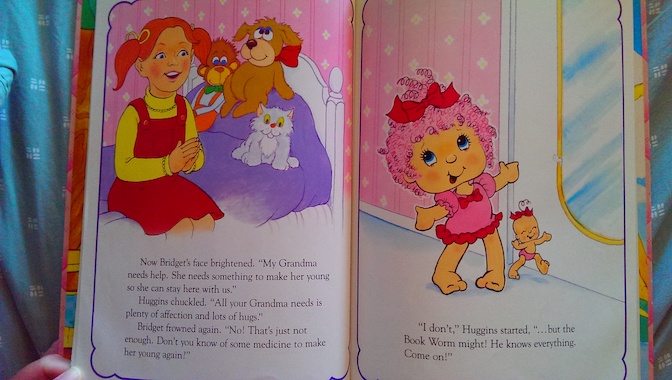
Bridget likes having her grandmother living with her and the rest of her family. Her grandmother always has time for her and is willing to give her a hug. Her parents are often too busy, her brother thinks hugs are just for girls, and her Aunt Ruth is too fussy.
Then, Aunt Ruth tries to persuade everyone that Bridget’s grandmother should go live in a nursing home. Bridget doesn’t want her grandmother to leave, but she doesn’t know what to do about it.
While she worries, a strange little person steps out of her bedroom mirror. This little person is Huggins, one of the Hugga Bunch. She says that she knows about Bridget’s problem and thinks that she can help. She invites Bridget to come with her to Huggaland.
In Huggaland, the Hugga Bunch take Bridget to see the Book Worm, who may have the solution that Bridget seeks. Both the Hugga Bunch and the Book Worm say that aging can be slowed by affection and “the knowledge that they are needed,” but Bridget thinks that the only solution is to find a way to actually make her grandmother young again.
The Book Worm says that if that’s what Bridget wants, then her grandmother must eat fruit from the Youngberry Tree. Unfortunately, the tree is in the territory of the Mad Queen of Quartz. Although the Hugga Bunch are afraid of her, Bridget is willing to face her for her grandmother’s sake.
Getting there involves going through a few obstacles, including walking sideways on a sideways sidewalk and facing a frightening beast who turns out to be a baby elephant who was under a spell. When they reach the tree, the mad queen takes them prisoner and turns Bridget into a statue. Fortunately, the others manage to break free and save her.
Bridget is happy at being able to bring the Youngberries to her grandmother, but as she passes through the mirror into her room, she accidentally drops them, and they disappear.
Not knowing what else to do, Bridget runs to give her grandmother a hug before she leaves, encouraging her brother to do the same. Bridget’s father wasn’t happy about her grandmother leaving, either, and seeing how much the children will miss her, he declares that she should stay.
This book was made into a made-for-tv movie. It is currently available on YouTube. It follows the plot of the book pretty closely.
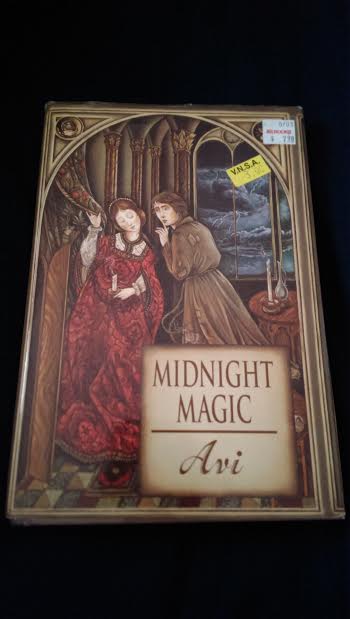
The story takes place in Italy, toward the end of the Middle Ages. Mangus, a formerly wealthy scholar and philosopher, is living under house arrest because the king believes that he has practiced black magic. Mangus was merely performing magic tricks to earn extra money, and in fact, does not believe in real magic. However, the king is very superstitious and easily influenced by his scheming advisor, Count Scarazoni, who needed a scapegoat to distract everyone from his schemes. Unfortunately, many people in the kingdom of Pergamontio believe that Mangus is a real magician with frightful powers. Even Fabrizio, an orphan who is Mangus’s only remaining servant, believes that magic really exists.
When a messenger arrives, summoning Mangus to the castle to see the king, they are afraid that the king has reconsidered his decision to spare Mangus’s life. However, it turns out that the king is in need of Mangus’s help. He believes that his young daughter, Princess Teresina, is being tormented by a ghost, and he wants Mangus to use his magic to get rid of it.
Mangus again protests that he does not do real magic, but both the king and Count Scarazoni promise dire consequences if he fails to help them deal with the problem. Mangus isn’t sure why Count Scarazoni has asked for his help because he knows that the count doesn’t really believe in magic, except perhaps as a way of appeasing the king. The king promises that if Mangus can free the princess from the influence of the ghost, he will not only end Mangus’s house arrest but reward him with a generous pension. Mangus has little choice but to agree to do his best, and the promise of the pension for his master convinces Fabrizio to do everything he can to make sure that Mangus succeeds, not only to save his master’s life but to restore his family’s fortunes.
But, what is the secret of the ghost? Fabrizio believes in ghosts, even though Mangus doesn’t. Princess Teresina insists that the ghost is real, appealing directly to Fabrizio to convince Mangus that it is. Adding to the mystery is the disappearance of the princess’s brother, Prince Lorenzo, and the murder of the princess’s tutor. Danger lurks in the castle, and conspiracies are around every corner. Could the troubled spirit really belong to the murdered prince?
The book is available to borrow and read for free online through Internet Archive.
My Reaction
I love historical books and spooky mysteries, and this is both! The Italian kingdom where the story takes place is fictional, but it takes its inspiration from real kingdoms of the later Middle Ages and early Renaissance, with Machiavellian intrigue, power struggles, and arranged marriages, even for children, that could influence the balance of power and successions. (There is talk of a potential arranged marriage in the story, but no child marriages actually take place. If a child is old enough for ghost stories and murder mysteries and isn’t too frightened by them, there is really nothing more concerning than that to prevent them from reading this book.)
Princess Teresina is one of the most intriguing characters in the book. Although young, she isn’t a shrinking violet or anyone’s fool, and she’s definitely not a tea party and ball gown kind of princess. Like real life Medieval princesses, she is the product of a family who came to power by the sword and maintains it by the iron fist in the velvet glove and some clever political maneuvering, although some members of the family are more clever about it than others. Princess Teresina well knows the family she was born into and what’s expected of her as royalty, and she knows to be careful about who she trusts and what the consequences of trusting the wrong people can be. Although apparently terrified by the ghost, the princess has a kind of toughness and shrewd determination to do what she thinks is necessary. She seems to be smarter and knows more than most people give her credit, and Fabrizio often wonders just how much she really knows.
One of the best things about the story is that, as soon as you think you know what’s going on, you learn that there is more to the story. There are conspiracies within conspiracies!
Hint: If you like pseudo-ghost stories, spooky stories of the Scooby-Doo variety, where there are logical explanations for the supernatural phenomena … you won’t be disappointed.
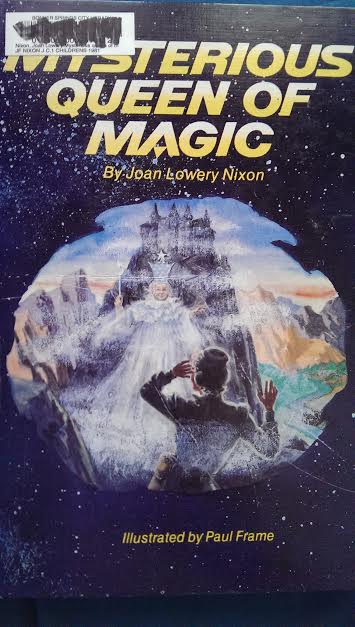
Kleep and Till meet a strange young man who is looking for Kleep’s grandfather, Arko. The young man, Mikkel, tells them a wild story, that an evil wizard is after him. He is controlling Mikkel’s people on the planet Durth, putting them under a spell and forcing them to become his slaves. Mikkel believes that Arko may have the key to getting rid of him because an old wise man told him to ask Arko how to find Queen Stellara. Queen Stellara was a legendary queen who could do magic, and Arko has some old write-rolls, scrolls of the kind people used to use before people began using computers alone for learning, that talk about her and her kingdom. However, Arko doesn’t believe in wizards or magic spells or anything of the kind.
Kleep remembers Arko telling her the old stories from the write-rolls when she was little, and unlike her grandfather, she believes that wizards and magic may be real and wants to try to help Mikkel. When Arko says that he doesn’t believe in magic and can’t help Mikkel, Kleep and her friend Till decide to use the scrolls to try to help Mikkel find Queen Stellara. Taking Kleep’s robot, Zibbit, with them, they journey to the planet Loctar, where Queen Stellara was supposed to live.
Although this series is mostly sci-fi with a bit of mystery thrown in, this book is more fantasy. When Kleep and her friends arrive on the planet Loctar, they discover that they must face a series of challenges to reach the legendary queen’s palace, like heros in a fairy tale. Magic is real, and they must prove themselves worthy in order to meet the queen and ask her for the solution to the problem of the evil wizard. But, their ordeal doesn’t quite end there because, while Queen Stellara provides them with the means to fight the wizard, they must face him themselves!
A little corny, but fun, although it’s not my favorite book in the series. The others were more sci-fi, and this is more fantasy. Also, for a “detective” series, there isn’t much mystery, more adventure. It sort of reminds me of the original Star Trek episode Catspaw, except that the magical beings in this one are apparently really magical and not just aliens. Like the other books in this series, I like the pictures, too.







 Midnight Magic by Avi, 1999.
 The Mysterious Queen of Magic by Joan Lowery Nixon, 1981.


 Jestress's Forgotten Books and Stories