The Log Cabin Quilt

Elvirey’s granny loves quilting, and she always saves scraps of cloth from old clothes in a flour sack for her quilts. After Elvirey’s mother dies, her father moves the family to Michigan, traveling by covered wagon. When Elvirey tries to pack some of her mother’s things to bring with them, her father insists that they leave them behind, saying that they don’t have room for them. However, Granny insists on bringing her sack of quilting scraps, saying that she will sit on them in the wagon.

When the family finally reaches their destination, it’s just a clearing in a wooded area. They camp near a spring, and Elvirey’s father and brother begin building a cabin for the family. Elvirey and her sister add the chinking to the log walls of the cabin, packing the gaps with a mixture of mud and grass to keep out the wind.

However, the cabin still doesn’t feel like home to Elvirey. They don’t have her mother’s books, and there aren’t any flowers growing nearby to decorate the house like her mother would.

Then, one cold day, Elvirey’s father goes out hunting. He says that he will back before dark, but he doesn’t return. The night is very cold, and Elvirey and her family suddenly realize that it’s more than unusually cold in the cabin. The chinking they put in the walls of the cabin has frozen and fallen out, and the cold is getting in. Worse still, it’s starting to snow.
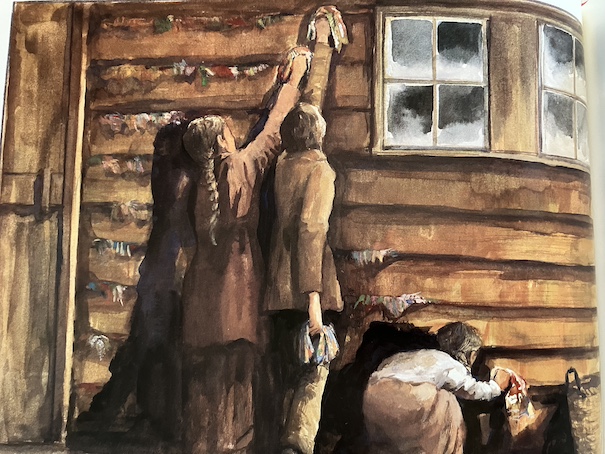
They’re worried about what happened to their father, and they’re worried about what they will do with the cold getting into the cabin. Then, suddenly, Elvirey has an inspiration. There is something they can use to fill the cracks in the cabin walls: Granny’s quilting scraps. With scraps from everyone’s clothes suddenly decorating the walls of the cabin, the cabin begins to look like it has turned into a quilt itself. When Elvirey’s father returns, he tells her that her mother would be proud of her, and for the first time, the cabin starts to feel like home to Elvirey.

The book is available to borrow and read for free online through Internet Archive.
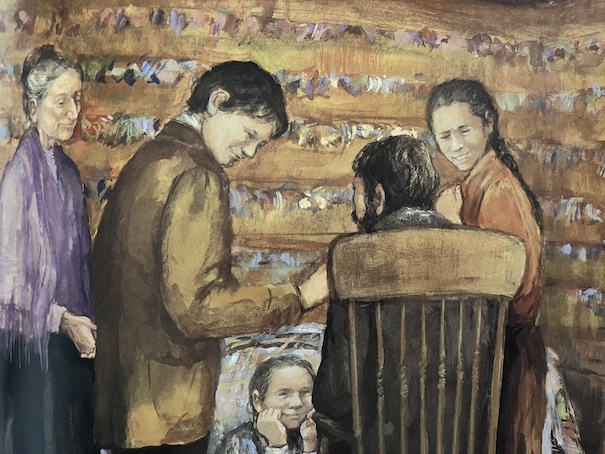
There’s a pun in this story that people who don’t know the names of quilting patterns might miss. There are many patterns that the squares of a quilt can have, and Log Cabin is a traditional quilting pattern. When Elvirey and her siblings stuff the quilting scraps into the walls of their cabin, their Granny laughs about them creating a “log cabin quilt”, and it’s not just that she’s amused that they’ve made their cabin walls look like a quilt with all the scraps; it’s a pun on the name of the quilting pattern.

Although the story is about a family of pioneers, the focus of the story isn’t really their journey by covered wagon or the building of their cabin. It’s about loss and change and about what makes a new place feel like home. At first, Elvirey doesn’t feel like their cabin is their home because they no longer have the familiar things that belonged to her mother, and she can’t do some of the things that her mother used to do, like decorating the home with flowers. Even the quilt scraps and their associated memories don’t quite make her feel like home, although they do add a needed touch of color and hominess to the cabin. What finally makes Elvirey feel like home is when her father mentions her mother. Since her mother died, her father hasn’t smiled and hasn’t talked about her mother at all. When he sees what they did with the quilt scraps, he does both, and that makes Elvirey finally feel like they’re home. She really needed that sense of her mother’s presence or her memory to really get a feeling of home.

Elvirey is an unusual name, but I think it’s a nickname or variation of Elvira. Elvira is an unusual name in modern times, and in the United States in modern times, it usually reminds people of Elvira, Mistress of the Dark, a character portrayed by Cassandra Peterson and known for hosting horror movies since the 1980s. That reference has no relation to the story. Elvira/Elvirey is just an interesting and unusual name.

Happy Birthday, Kirsten

Kirsten, An American Girl

It’s spring, and Kirsten’s family is planning to build a new barn on the farm that they share with Uncle Olav and his family, and her mother is expecting a new baby.

One day, while they are outside, working, dark clouds come, the wind picks up, and Aunt Inger thinks it might be a tornado. She urges everyone to get into the root cellar for safety. Miss Winston, the school teacher who is staying with Uncle Olav and Aunt Inger, joins them in the cellar. She brings her quilt with her for comfort and because it reminds her of home, so she wouldn’t want to lose it to a tornado.

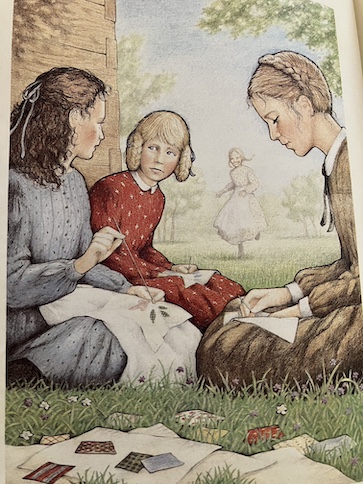
She tells Kirsten and her cousins that her mother and other women and girls in her family made the quilt for her as a present when she left Maine. The scraps of cloth in the quilt came from clothes members of her family used to wear and things she used to wear when she was younger. Everyone who worked on the quilt signed it, making it a “friendship quilt.” Kirsten and her cousins ask Miss Winston if she could teach them to make a quilt like this one, and she agrees. She says that she will give them some muslin for the backing, but they’ll have to supply the scraps of cloth for the designs themselves. Because it takes a lot of work to make a big quilt, she suggests that they each make a square. Quilts are an unusual concept to the Swedish family because people in Sweden during their time usually use woven blankets. Kirsten’s mother also reminds her that she will need her help to sew more clothes for the new baby. Kirsten’s cousins, Anna and Lisbeth, suggest that they do their quilt sewing during recess at school, and Miss Winston agrees.

At school, the girls trade cloth scraps with each other and invite other girls to join them in quilting. One of the other girls, Mary Stewart, has done quilting before, so she helps the others. While the girls sew, they talk, and Kirsten talks about the baby that her mother is expecting. Mary says that the little girl her family calls her little sister is actually her cousin. She was born as one of a set of twins to Mary’s aunt, but the other twin died at birth, and their mother died shortly after, so Mary’s mother took the baby to raise with her family. Stories like that worry Kirsten because she worries that something might happen to her mother or the new baby.

Mary also brings up the topic of whether or not Miss Winston will move on. She’s been going to Powderkeg School for four years, and every year, the previous teacher moves on, and they get a new one. Although Kirsten initially had trouble with Miss Winston, she has become fond of her, and she wouldn’t like to see her go. With all the other changes happening in Kirsten’s life, she doesn’t want any other major changes now. Kirsten suggests to the other girls that they turn their quilting project into another friendship quilt for Miss Winston, signing it like her family members signed their quilt. The other girls debate about whether they could manage to finish a quilt like that by the end of the summer term. Lisbeth thinks they could, but Mary doesn’t want to rush the project because the best part of making a quilt is sewing it with your friends.

The talk then turns to Kirsten’s birthday. She will be turning ten years old soon. She didn’t celebrate her last birthday because that was during their voyage to America. Mary says that ten is a more important birthday anyway, although Kirsten isn’t sure if her family will do anything for her birthday this year, either. Everyone’s attention is taken up with preparations for the new baby.

When Kirsten’s mother tells her that the new baby is about to be born, she also tells her that she remembers the day Kirsten was born, too. She says that she will never forget that day because she had been hoping for a daughter, and she knows that Kirsten’s birthday is coming in two more weeks. Kirsten is happy that her mother remembers, and she hurries to get her aunt to help with the birth of the baby.

Fortunately, Kirsten’s new sister is born safely, although Kirsten has to take some time away from school to help her mother with the new baby and household chores. However, her mother tells her that her friends from school will be coming to the raising of the new barn, which is the day before Kirsten’s birthday, and she will allow Kirsten to have her birthday free to have fun with her friends.

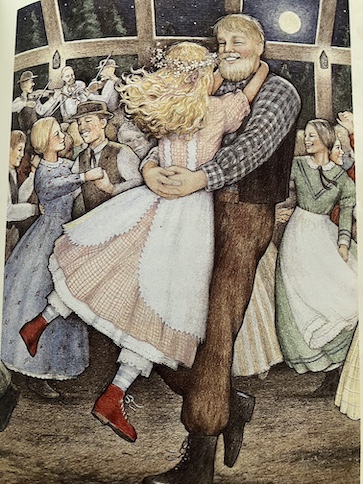
At the barn raising, Kirsten and her friends have a chance to work on their quilt again. Kirsten is behind on making her quilt square, but her friends have arranged a special surprise for Kirsten’s birthday.

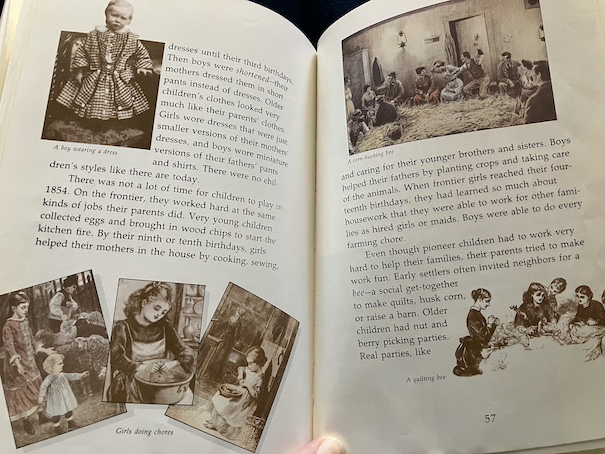
There is a section in the back of the book about babies and young children on the frontier during the mid-1800s. Children were born at home then, with the help of family members and midwives because there were few doctors and hospitals on the frontier. With limited access to medicine and without some of the modern medicines we have today, childbirth and early childhood were often risky. It was sadly common for families to lose a child or two before they were five years old. Because accidents as well as illness posed a threat to young children, parents were often strict with discipline so their children would listen to them and follow their instructions to avoid disaster.

This part of the book also talks about the phases of a child’s life on the frontier. Older children wore clothes that looked like smaller versions of their parents clothes, and they would often do the same kinds of chores that their parents did on their farms. Most children expected to become farmers or farm wives, like their parents. They were raised doing farm work, and they didn’t expect to do anything else when they were older.

Although their lives were filled with chores, there were still some opportunities for fun. Sometimes, neighbors would turn chores into social occasions, called “bees.” These work parties could center around any kind of chore that the community needed to do and could do together, like raising a barn or making quilts, like the characters in the story. Along with accomplishing their task, it was a chance for friends and neighbors to get together and talk and have a little fun.

The book is available to borrow and read for free online through Internet Archive (multiple copies).

I don’t think I read this particular book in the Kirsten series when I was young. I wasn’t as fond of the Kirsten books as I was other series in the American Girls franchise because there are some really sad parts in the series. However, I really enjoyed this particular book. Kirsten is worried at first about the welfare of her mother and her family’s new baby because she knows that life on the frontier can be dangerous, and sometimes mothers die in childbirth, and babies don’t always survive. Fortunately, everything turns out well for Kirsten’s mother and new little sister.

This is a happy spring story with a focus on new life and friendship. Even the smallest kitten in the new litter seems like it’s going to be fine. I liked it because, while life on the frontier could be very hard, it’s nice to see that not everything turned out as a tragedy. The book ends with the barn raising and birthday celebration for Kirsten.

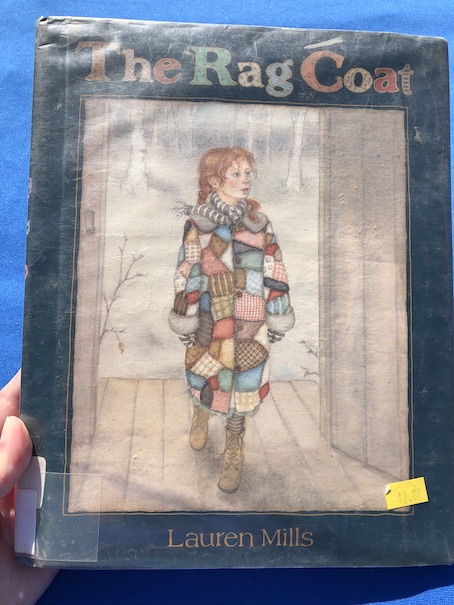
The Rag Coat

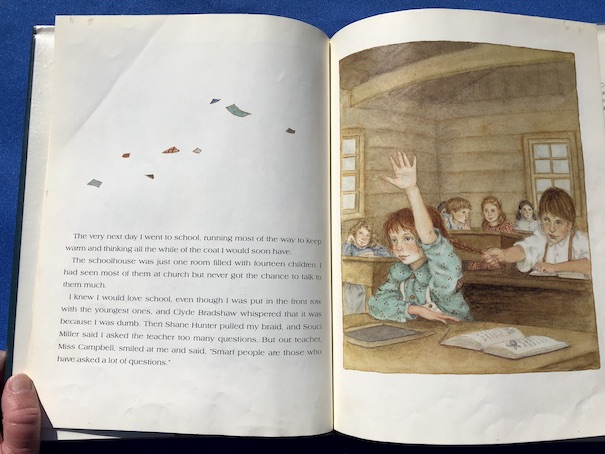
Minna is a poor girl, the daughter of a coal miner.  Her father has been ill with the miner’s cough, so Minna has to help her mother to make quilts that the family can sell for money.  She wants to attend school, but she can’t because she is needed at home and her family can’t afford a warm coat for her when winter starts.  It’s too bad because Minna really wants to make some friends her own age, and she would meet other children at school.  Her father says that he will find a solution to the problem, but he dies before he can.

After Minna’s father’s death, some of the other women in the community come to the house to work on making quilts with Minna’s mother.  When the women say that the quilt pattern they are using is named after Joseph’s Coat of Many Colors, Minna wishes again for a coat.  When the other women, who are mothers themselves, realize that Minna cannot go to school until she has a coat, they decide to make one for her.  They don’t have much money, but they do have plenty of quilting scraps.  They decide to make a new, quilted coat for Minna out of their old scraps.

Minna starts going to school and does well, although she gets some teasing because, as a new student who has never been to school before, she has to sit with the youngest children, and Shane pulls her braid.  Something that Minna particularly likes at school is Sharing Day (what my school always called “Show and Tell”), where students are given the chance to show special things to the class and talk about them.  Minna decides that when her coat is ready, she will show it to the class during Sharing Day.

As the coat is being made, Minna admires all of the beautiful colors of the cloth scraps in the coat and adds a piece of her father’s old jacket as well.  Each of the other scraps in the coat also has a story that goes with it.  The cloth pieces come from old clothes and blankets that people in the families of the quilting mothers have used, and they memories attached to them.  The mothers tell Minna all of the stories as they work on the coat, and Minna loves it.

However, when Minna wears the coat to school for the first time, the other kids make fun of her for wearing rags.  Minna is really upset and runs away into the woods.  After thinking about it, Minna remembers what her father said about how people really need other people, and she decides to go back to school.  There, she tells the other students that the rags in her coat are actually their rags, and she begins reciting the stories that go with them.

One of the scraps is from Shane’s old blanket from when he was a baby.  He was born so small that everyone was afraid that he’d die, but the blanket kept him warm, and he later carried it around with him until it fell apart.  Shane is happy, seeing the scrap of his favorite blanket again in Minna’s coat.  Everyone else gathers around Minna, looking for their scraps in the coat and listening to the stories behind them.  Each of the scraps in Minna’s coat is like an old friend that none of them ever thought they’d see again.  The other children apologize to Minna for their teasing and Minna says that friends share and that it took all of them to make her coat warm.

The book doesn’t say when this story is supposed to take place, but based on the children’s clothing, I think it’s about 100 years ago or more. It doesn’t say exactly where this story takes place, either, but a note on the dust jacket says that it takes place in Appalachia. The author said that she was inspired by Appalachian crafts that she learned from the women in her family and a patchwork coat that she wore as a child. However, years later, the author revisited this story and rewrote it in a longer version, and some of the explanations that accompany the new version of the story elaborate more on the background.

The author rewrote this story in a longer, novel form called Minna’s Patchwork Coat (2015). In the back of that book, the explanation behind the story mentions that the year of the story is 1908. It also discusses some cultural references and songs included in the expanded version of the story that were not part of the original. It states that the inspiration for this story came not only from the author’s experiences but from a song written by Dolly Parton, Coat of Many Colors, which was made into a picture book itself after the publication of this book.

There is also an expanded retelling of the story called Minna’s Patchwork Coat, and I’d like to talk about some of the differences. For example, the ending message of the story is slightly changed in the longer version, or at least the emphasis of the moral is different. The original book emphasized how much “people need people” and how the goodwill of many people (in the form of the quilting mothers and their hard work and scraps, cast-off from all of their children) changed Minna’s life. They emphasize it at the end, talking about how Minna’s coat is the warmest of all of them and that it took a lot of people to make it that way. However, in the expanded version, Minna also explains that when she started school, she liked her classmates better than they liked her because, thanks to their mothers’ stories as they made her coat, she already knew who the other children were, but none of them really knew anything about her. The message of the expanded version is that it is important to learn others’ stories to learn who they really are and to become friends with them.

Actually, I don’t like the second version of the story as well as the original. I thought that the moral and the story were stronger when the focus was on how people benefit from having relationships with other people because people can do great things when a lot of people contribute a little. Remember, it took a lot of people to make Minna’s coat warm because each of them contributed at least one scrap to it and others took the time to put them all together. It was their stories that made the coat special, more than just an ordinary coat. The expanded story has that element, too, but more emphasis is placed on Minna needing to share her story with the other children to win their respect and approval. I didn’t like the notion that Minna needed to win their approval by telling her story. Also, this story takes place in a small mining community. I find it difficult to believe that the other kids wouldn’t basically know her story already. Her mother knows their mothers. Their families see each other at church before Minna goes to school. The disease that took her father’s life isn’t terribly unusual for coal miners, and probably, a number of the other children are the children of coal miners as well. It seems to be the major industry in the area. Minna’s family might be more poor than the others’ since her father’s illness and death, but I don’t see why their circumstances would be so different and incomprehensible to people who must have seen her and her family around and who knew them from church or through their parents’ associations. One thing that small towns and communities are known for is everyone knowing everyone else and their business, so why didn’t they all know Minna’s story already? Even if the quilting mothers didn’t talk about helping to make the coat for Minna, the other kids should have known about the family’s money circumstances and the tragic death of Minna’s father. I don’t see why the other kids would have known so little about her or thought that she was so unusual.

The expanded version of the story also features a Cherokee midwife and a biracial friend for Minna who did not appear in the original story. This friend, Lester, is also something of an outcast among the other children, and Minna and the stories from her coat help the other children to be more accepting of him as well. It’s a nice thing, I guess, but it felt a little artificial to me because I knew that it wasn’t part of the original story. I hesitate to criticize it too much because the basic message of the story isn’t bad, but I guess that the way the second version came out just doesn’t have the same feel to me. The author put things into it that weren’t in the original, and with that change in emphasis on the ending, it makes the story and characters feel a little less natural to me now. I often feel the same way when I see a movie version of a story that adds things that weren’t in the original book.

The Quilt Story

The Quilt Story by Tony Johnston and Tomie dePaola, 1985.

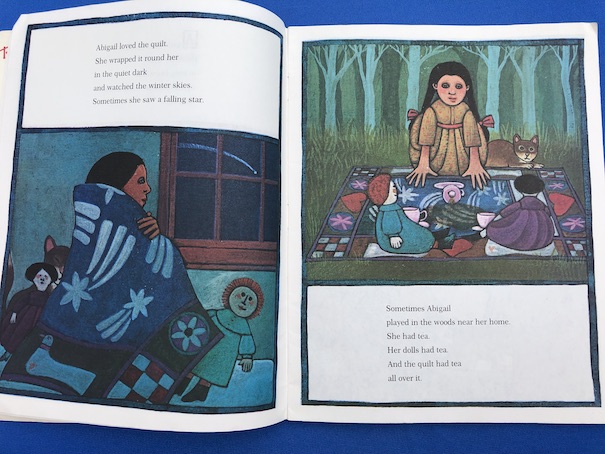
A woman (at some point in the 1800s, from the pictures) makes a special quilt for her young daughter, Abigail.  It has Abigail’s name on it and a pattern of falling stars.  Abigail loves it!

Abigail uses the quilt all the time, not just in bed.  She has tea parties with her dolls on the quilt, hides under it when playing hide-and-seek, generally taking it everywhere and playing all kinds of games with it.  The quilt gets worn and torn in the playing, but her mother mends it when necessary.

Eventually, Abigail and her family move to a new home, traveling in a covered wagon.  Everything in their new home seems strange to Abigail, but her old quilt comforts her.

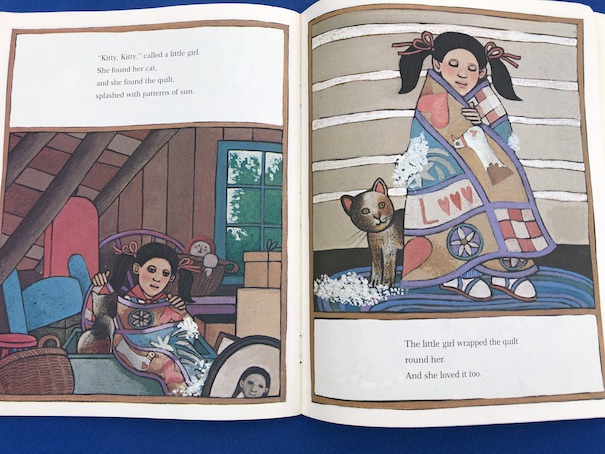
Eventually, when Abigail is older, she puts the quilt away in the attic, and people forget about it.  Still, animals use the quilt.  A mouse makes a nest it in.  A raccoon hides food in it, and a cat naps on it. Then, one day, another girl finds the quilt in the attic.  She loves it and brings it to her mother to be repaired. 

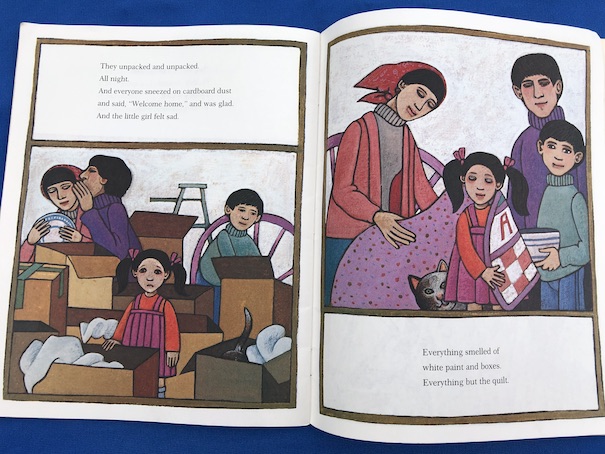
Like Abigail, though, the modern girl’s family soon moves to a new home, where everything seems new and strange.  However, the old, familiar quilt comforts the girl once again.

This is a gentle, comforting story that would make nice bedtime reading or a story that could be read to a young child who is moving or has recently moved, reminding them that, even in a new place, you can bring a sense of home and the familiar with you.

The book is currently available online through Internet Archive.