The Case of the Gobbling Squash

The Case of the Gobbling Squash by Elizabeth Levy, illustrated by Ellen Eagle, 1988.

This is the first book in the A Magic Mystery series, which is about a couple of kids who like magic tricks. In every book in the series, there is a section in the back with direction for performing the magic tricks in the story.

It’s Thanksgiving, and all of the kids at school are participating in a Thanksgiving Fair. Different kids are doing different things for the fair, and Kate has a booth where she is advertising her services as a detective. Unfortunately, she gets more teasing than people approaching her with mysteries to solve. Then, Max tells her that he needs her help.

Max is an amateur magician, and he keeps a couple of rabbits to use his act. One of his rabbits is missing. When Kate goes to his house to investigate, it doesn’t take her long to figure out where the missing rabbit is … and the rabbit has become a mother, which presents the kids with a new problem to solve. Max’s mother won’t let him keep that many bunnies.

Fortunately, Kate comes up with an idea to use Max’s magic act in their Thanksgiving play at school to provide the bunnies with new homes. However, when she and Max are preparing for the show, the bunnies disappear in a non-magical way. Someone has stolen them! Max points out that they were supposed to give the bunnies away anyhow, but Kate says they can’t let the matter rest until they’re sure that the bunnies are safe in a good home.

Once again, Max and Kate use Max’s magic tricks to expose the bunny thief and to turn their Thanksgiving magic act into something extra special!

The book is available to borrow and read for free online through Internet Archive.

My Reaction

The mystery is a little cheesy, but I thought that the kids were clever in the way they used concepts from magic tricks to solve their problems. Whether they would work so well in real life is questionable, but I though the concept was creative. The first mystery about where the missing rabbit is was easily resolved, but they have to figure out who took all the bunnies. I thought that the solution to that mystery was also obvious because there was really only one person who seemed to have a reason to mess up their magic act, but the mystery may seem more mysterious to young children.

The story gets some credit from me for being set at Thanksgiving because it’s a less popular holiday for kids’ books than Christmas or Halloween. Like other kids’ Thanksgiving books that aren’t set at the First Thanksgiving, this one is set at a school and involves a cheesy Thanksgiving celebration. The Thanksgiving play in the story involves some of the kids being dressed as Pilgrims and Native Americans, and the Native American aspects are also cheesy and stereotypical. It actually reminds me of actual school plays from my own childhood, which were equally cheesy and embarrassing to me when I was a kid.

I really liked the section in the back of the book that explained how all of the magic tricks in the book were done, even the one for their grand finale! The tricks include a card trick, making a coin disappear, and pulling a rabbit out of a hat.
The Runaway Bunny

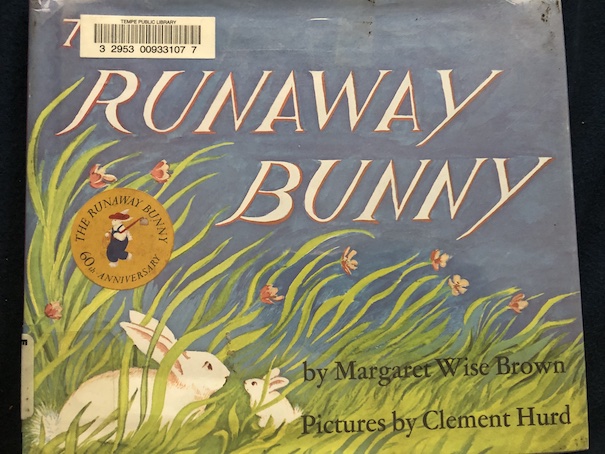
The Runaway Bunny by Margaret Wise Brown, pictures by Clement Hurd, 1942.

A little bunny tells his mother that he’s thinking about running away, but his mother assures him that, no matter where he goes or what he does, she would always come after him because he’s her little bunny, and she loves him.

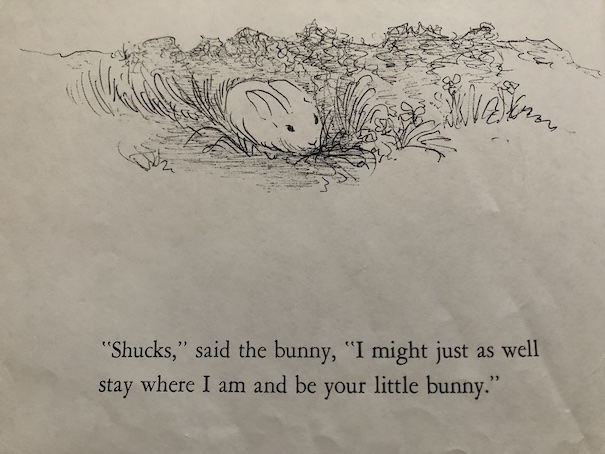
The pictures where the little bunny talks about all of his ideas for running away and evading his mother and where his mother explains what she would do to follow him are in black-and-white.

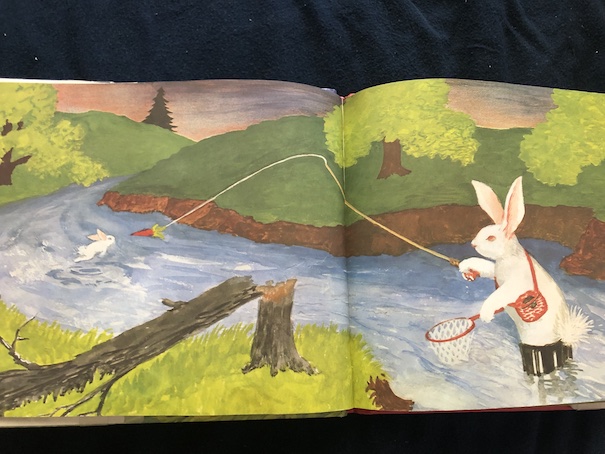
However, there are large, full color pictures after each of these sections showing what would happen as the mother follows her little bunny.

The little bunny’s plans for running away become increasingly imaginative and outlandish, from going up a mountain and joining the circus to transforming himself into a fish, a bird, or a sailboat.

No matter what the little bunny thinks of for running away and changing himself into something else, his mother assures him that she would find a way to come after him and be there for him. In the end, the little bunny decides that he might as well stay with his mother, just as they are.

The book is available to borrow and read for free online through Internet Archive (multiple copies).

My Reaction

This is a very well-known and much-loved book about parental love and the lengths that parents will go for their children. The mother bunny is determined to be there for her child, even when the child wants to run away. We don’t know why the little bunny was talking about running away from his mother, and without that, it seems just like the little bunny was just trying to provoke his mother to find out how much his mother loves him. When she tells him all the things she would do to reach him if he ran away, he seems reassured and content to remain her little bunny.

This book was originally published during WWII and is a calm and reassuring story that probably comforted many children living through unsettling times. It has never been out of print since its original publication.

The author and illustrator of this book also later wrote and illustrated Goodnight Moon. The scene where the little bunny imagines himself as a boy in a house and his mother says that she would still be his mother reminds me of the illustrations in that book, and I wonder if the mother and child rabbits in that book came from this one.

Goodnight Moon

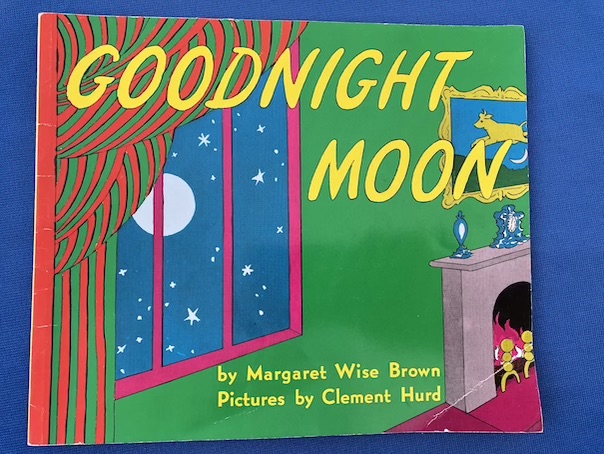
Goodnight Moon by Margaret Wise Brown, pictures by Clement Hurd, 1947.

This is a classic children’s bedtime book and has been for generations!

It all starts with a green room that has a red balloon.  The book describes everything in the room in rhyme.  There are kittens and mittens and a picture of bears in chairs.  It’s a cozy, peaceful room.

Then, the book says “goodnight” to everything in the room (and some things outside, like the moon), one thing at a time.

It’s just a cute, gentle book that is perfect to read to children who are going to bed. Reading it slowly can be very soothing.  The book never says it, but the “people” in the story are rabbits.

The book is currently available online through Internet Archive.

Ten Little Rabbits

Ten Little Rabbits by Virginia Grossman and Sylvia Long, 1991.

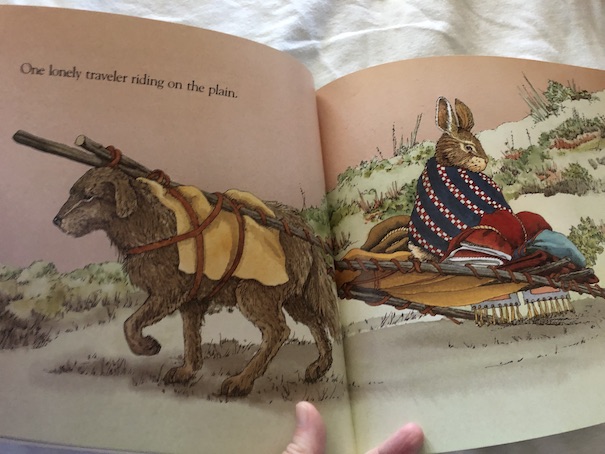
This picture book is loosely based on the Ten Little Indians counting rhyme, but with a twist. Instead of “Ten Little Indians,” it’s ten little rabbits. The rabbits in the pictures are dressed in traditional costumes from different Native American tribes. Also, unlike in some versions of the Ten Little Indians rhyme, none of the characters are eliminated during the course of the rhyme. The rhyme simply counts upward from one to ten.

The pictures are beautiful and detailed, and they do a good job of showing the rabbits in the poses of humans.

The book intentionally shows the rabbits acting out aspects of traditional Native American culture. Very young children might not fully appreciate what the book is trying to depict, but there is a special section in the back that explains which tribes the rabbits are supposed to belong to and what they are doing in the pictures.

The book is available to borrow and read for free online through Internet Archive.