Aria Volume 1

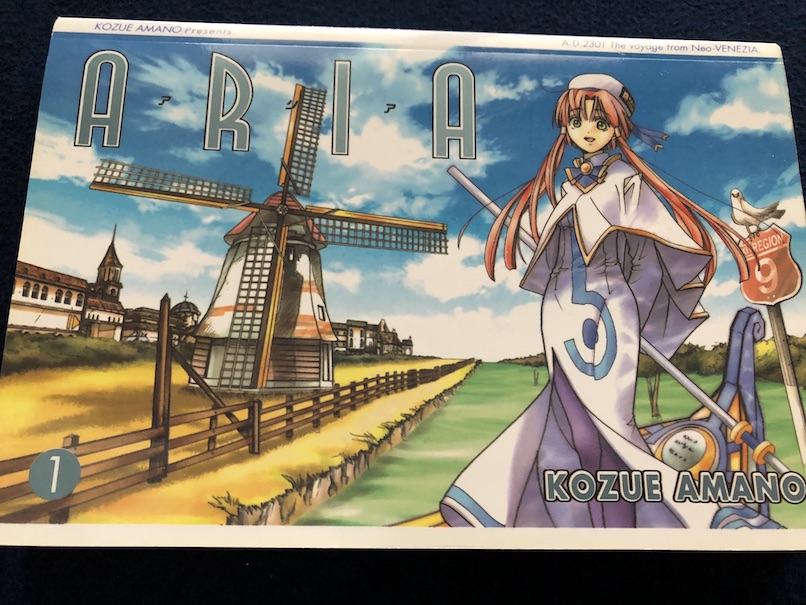
Aria Volume 1 by Kozue Amano, 2002, English Translation 2004.

The is the first volume of the second part of a fascinating manga series that combines sci-fi, fantasy, and slice of life. The series takes place about 300 years in the future, when Mars has been terraformed and renamed Aqua (because of all the water on its surface). The human colonies on Aqua are designed to resemble old-fashioned cities on Earth (called Manhome here). The people of Aqua prefer a much slower pace of life than people on Manhome, and aspects of life on Aqua more closely resemble Earth’s past.
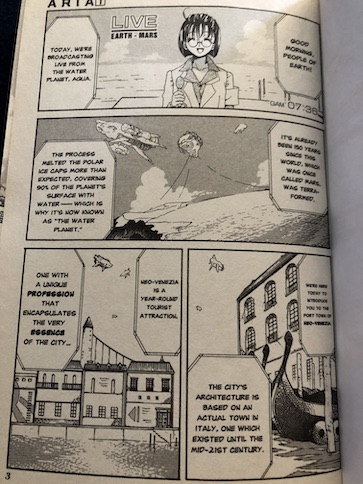
The series is divided into two parts. The first two books are the Aqua volumes and introduce Akari Mizunashi, the main character, a young girl who came to Aqua to learn to become a gondolier in the city of Neo Venezia (which resembles Venice). Female gondoliers, called Undines, give tours of the city, giving Akari plenty of time to admire the beauty of her new home and meet interesting people. The two Aqua books are the prequel to the main series, Aria. Aqua covers Akari’s arrival on the planet, her introduction to life on Aqua, and the beginning of her training. The main Aria series show Akari’s continuing training, her progression to becoming a full Undine, her evolving relationships with her friends, and as always, her delight in learning more about her new home and admiring its beauty.

The series has received some criticism for being slow and lacking danger and adventure, but that is not really the point of the series. The main purpose is to show people how to appreciate the small pleasures of life. The sci-fi and fantasy elements (the spaceships, advanced environmental controls, intelligent Martian cats, and even the occasional appearances of the legendary Cait Sith) are mainly background to the stories about the magic of friendship and simple pleasures. Each volume contains a few short stories about Akari and her friends and the little adventures they have on a daily basis and the life lessons they learn. It’s a great series for relaxing when you’re stressed out.

The stories included in this volume are:

Neo-Venezia

As autumn comes to Neo Venezia, Akari encounters a grumpy old man, a visitor from Earth, who has gotten separated from his daughter and lost in the city. He is frustrated with the confusing and inconvenient nature of Neo Venezia.
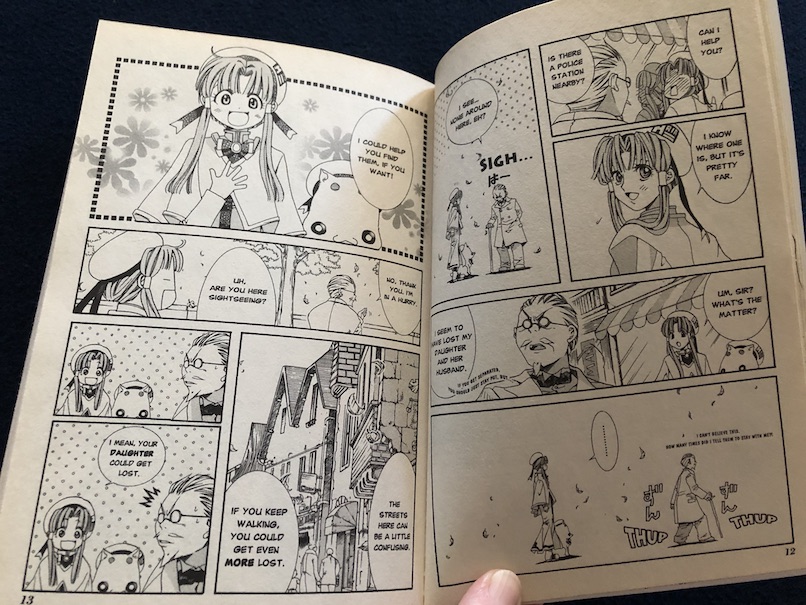
Akari says that she can help him find his daughter and gives him a tour of the city, showing him the beauty of the city and changes his mood with the help of some baked potatoes and green tea. A slower pace of life and appreciation for the little pleasures has benefits.

Drydocking

It’s time for the gondolas to be cleaned, so they are moved onto dry land. Akari and her friend, Aika are in charge of the cleaning, but it is Akari who makes it fun.

The Bridge of Sighs

Like the original Venice, Neo-Venezia also has a “Bridge of Sighs.” Akari goes there one day to meet Aika and finds her friend, Akatsuki, waiting for someone. Akatsuki is impatient while he is waiting, so he convinces Akari to give him a short tour to pass the time. Akari tells him about the original Bridge of Sighs and how she thinks the name is still appropriate but for a different reason.
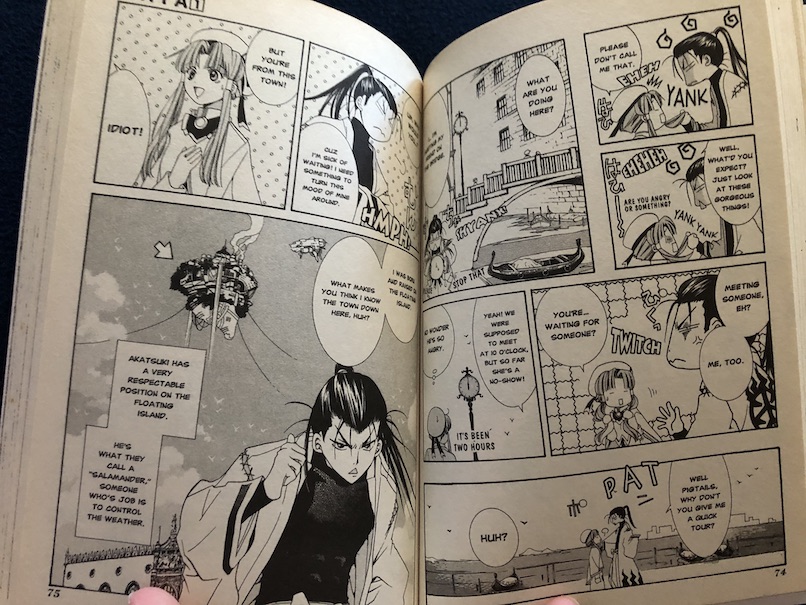
The original Bridge of Sighs, as Akari explains, was between an old courthouse and a prison, and the prisoners were said to sigh as they crossed the bridge because they were being led away to be incarcerated. However, Akari sighs because she likes living in the beautiful city of Neo-Venezia and feels like she’s lucky to be there. Her sigh is a sigh of contentment.

When the person Akatsuki is waiting for shows up, it turns out to be his older brother, who also appears in later stories.

Sun Shower

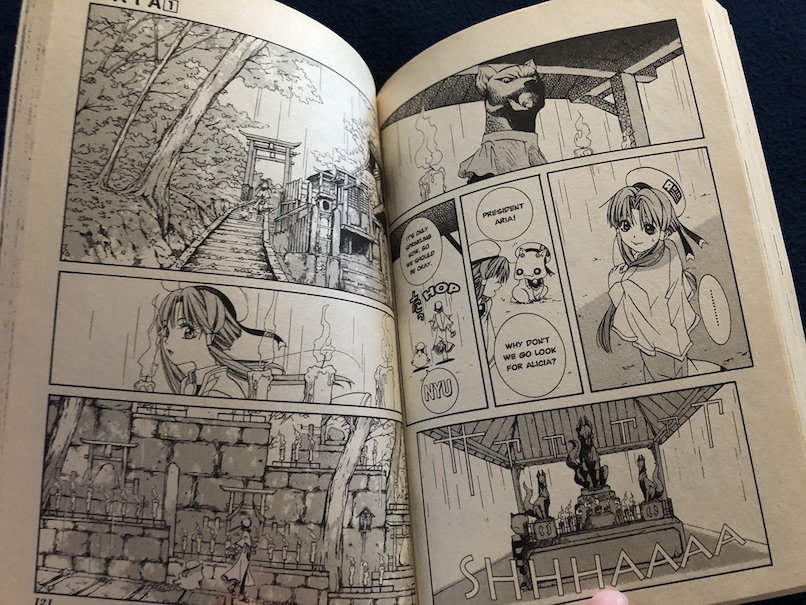
Although Akari lives in Neo-Venezia, which is designed to look like Venice, there are other parts of Aqua designed to look like different parts of Earth. Alicia takes Akari to an area much like Japan to see the changing autumn leaves and get some inarizushi.

They see a shrine on the island, and the woman at the sushi shop tells them a Japanese legend about the fox’s wedding, giving them a warning that the Inari fox might spirit them away to another world.

While admiring the red autumn leaves, Akari finds herself separated from Alicia, and she witnesses a strange wedding procession. When she seems to be invited to join it, she thinks quickly and gives the procession her inarizushi instead.

The story explains that a Japanese term for a sun shower (when it rains while the sun is still shining) is “the fox’s wedding.” Sun showers happen quite often when it rains where I live in Arizona, and I now think of this when I see one. I also know where to get some inarizushi. The Aria stories are good for making me want different types of food, whether it’s inarizushi or baked potatoes and green tea or pudding (from a previous book).
Vogare Longa

This story is based on a real gondola race that takes place in Venice.

Akari and Aika are told about the Vogare Longa gondola race, which all of the gondoliers, including the trainees, will participate in. Aika is determined to make a good showing in the race because there’s a rumor that it is used to judge trainees, but Akari gets caught up in the beauty of the day.

In the end, Akari admits to herself that she never forgot what Aika said about the race being used to judge trainees, but she just didn’t want to hurry because she was enjoying herself, and that’s the way she feels about her training in general. Akari wants to become a full Undine, but she wants to do it at her own pace and enjoy herself along the way.

It turns out to be just as well because the rumor about the race being used to judge trainees was only a rumor.

Steal Away

StealAwaySteal Away by Jennifer Armstrong, 1992.

Most of this story is framed as a flashback, actually two of them.  In the beginning, during the late 1800s, a girl named Mary is taken by her grandmother, Susannah, to visit an old friend of hers who is dying.  The friend, Bethlehem, is a black woman who is a teacher in Canada and has a student living with her, a young black girl named Free, who is about the same age as Mary.  At first, Mary doesn’t completely understand who Bethlehem is and why they are there to see her, and Free is somewhat aloof and suspicious of these white people, but together, Bethlehem and Susannah explain to both the girls about their unusual friendship and a shared history that changed both of their lives forever.  As they explain, Mary writes down their story.

Years ago, before the American Civil War, Susannah was a young teenage orphan.  She traveled from her home in Vermont to the home of her aunt and uncle in Virginia, her new guardians.  Homesick, missing not only her deceased parents but the friends she left behind, especially a boy who is her best friend (and who eventually becomes her husband, Mary’s grandfather), Susannah finds life in Virginia strange and unpleasant.  Her aunt and uncle own slaves, which is something that makes Susannah uneasy.  She was raised not to believe in slavery, but her aunt and uncle give her a slave of her own to take care of her, a girl about her age named Bethlehem.  Susannah is extremely uncomfortable with the situation, not really being the kind of person to get others to do things for her or order anyone around, and Bethlehem isn’t happy about being saddled with this sad, somewhat weak and clueless, white girl.

Bethlehem already has serious problems.  Susannah’s older, male cousin has taken a liking to Bethlehem and pursues her, trying to force his attentions on her.  Bethlehem resists but knows that one day she might not be able to stop him because she’s in his family’s power.  They own her and have authority over her.  Susannah is unaware of this situation at first, being a rather naive girl.  However, Susannah’s unhappiness at her new home increases, and more and more, she longs to return to her real home in Vermont, and her desire to escape also becomes Bethlehem’s ticket to freedom.

Both of the girls long for freedom, although each craves a different kind of freedom and has in mind a different kind of life they long to live elsewhere.  Together, they team up to run away in disguise as boys, although Bethlehem does not trust Susannah at first because she resents white people and the slavery that has been forced on her for her entire life. However, with their common interest in escape, they learn to rely on each other.  They come to trust and understand one another much better during the course of their journey.  It is an eye-opening and life-changing experience for both of them.  Then, when it comes time for them to say goodbye and go their separate ways, it is one of the hardest things that either of them have had to do.

It is a story about lives with separate directions but which crossed in unexpected ways to the benefit of both of them.  Because Susannah and Bethlehem have different destinies and different things that they want in life, they cannot live their lives together and do not see each other again for many years after their adventures, but because of their shared experiences, they still share a bond that lasts across time.

After Bethlehem’s death, Mary becomes concerned about the young student of Bethlehem’s, Free, who was living with her as a part of her family, but Free doesn’t want their help.  Susannah tells Mary that they have to let her live her life and establish her own independence in the way she wants, just as Susannah had to let Bethlehem go her own way years before as a strong, independent young woman who only wanted the freedom to choose her own course in life.

In the end, Mary, as an adult looking back on the one and only time she met her grandmother’s old friend, just before her death, realizes that she has also learned much from the experience, not just about her grandmother’s history, but about herself, other people, racial differences and attitudes, and some of the realities of the world, absorbing vicariously some of the lessons her grandmother learned years ago through her story and Bethlehem’s.

This isn’t really a happy story.  The ending kind of leaves readers with an unsettled feeling because there are many things left unanswered and unresolved.  The book does explain a little about what happens to the characters at the end, but for the most part, they all kind of go their separate ways.  Although they’ve had an effect on each other, nothing is clear-cut, and they share moments together more than lives.  I have to admit that I felt like some of the story dragged in places and others were downright depressing, making this a difficult book to get through.  However, it is interesting for showing a part of history, a life-changing event from different points of view, and some poignant thoughts about caring but letting go.

The book is available to borrow and read for free online through Internet Archive.

Secret of the Tiger’s Eye

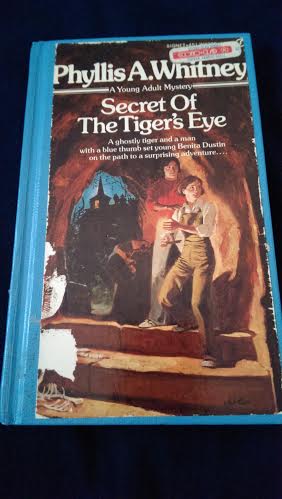
tigerseyeSecret of the Tiger’s Eye by Phyllis A. Whitney, 1961.

Benita Dustin’s father is a writer, just like she hopes to be one day. When her father announces that they will live for a year in South Africa with his Aunt Persis so that he can do research, it sounds like a grand adventure. The trouble is that her father’s editor has given permission for her son, Joel, to accompany them because she thinks the experience would be good for him, too. Benita’s little brother, Lanny, gets along well with Joel, but Benita and Joel fight and tease each other almost constantly. Benita gets annoyed with Joel’s obsession with facts and information, and Joel thinks that Benita’s stories and flights of fancy are silly.

Aunt Persis’s house is wonderful with a beautiful tower room where Benita is allowed to stay. There is even a fantastic story about the ghost of a tiger that Aunt Persis’s husband shot years ago in India haunting the grounds of the house and the little cave in the garden. Although Joel scoffs at the idea of a tiger ghost, Benita is captivated by the story, especially when strange things begin to happen around the house. Benita learns about the tragic death of Aunt Persis’s adopted son, Malcolm, and the strange theft of the emerald diadem that Aunt Persis received from the rajah that her husband saved from the tiger years ago. However, she will need Joel’s help to make sense of the situation, a difficult prospect at the best of times but almost impossible to ask for after Joel plays a cruel joke on Benita and tries to get Lanny to help gang up on her.  Then, Benita’s father tells her something that changes everything, and all the time, someone with sinister intentions is watching and waiting . . .

The book is available to borrow and read for free online through Internet Archive.

My Reaction

Besides the mystery, there is also a subplot about the nature of hate and prejudice. In South Africa, at the time the story was written, apartheid was still in force. Benita makes friends with a girl of mixed race called Charis, and they talk about racial issues in South Africa and the U.S. during the 1960s. Although Benita wouldn’t think of being prejudiced against anyone on the basis of race, she finds it harder to understand people with different personalities, like Joel.  Although the story focuses on Benita and the lessons she learns, I personally found Joel and his mistakes harder to accept.  Both Joel and Benita need to learn to be more understanding of each other, but in a way, I think Joel is worse because of his deliberately cruel pranks and because he already knows a couple of things that Benita doesn’t which should have influenced his behavior. Joel is deliberately trying to pick fights, and the book never really explains what he expected to accomplish by that.  Everyone needs a motivation, and Joel never really explains his, so he comes off seeming like he’s just there to be a mean character for no real reason.

I also wish that the parents in the story had more frank and straight-forward discussions with the kids.  As a professional writer and a professional editor, they should have been able to settle the kids’ arguments about imagination vs. facts or at least put the situation into perspective by explaining what they do in their jobs.  After all, Benita’s father is going to South Africa specifically to do research.  In other words, even fiction writers need to have a nonfiction background and real facts to use as a basis for their fictional stories.  Realistic backgrounds give stories the grounding they need in order to feel real to readers.  (Although that does depend somewhat on the type of story.  Fantasy stories don’t need to be based on real life, although they do have to have a consistent logic within the story so readers feel like they can understand the world in which the stories take place and the rules by which the magic in the story works.  If the story is meant to be surreal, the internal logic can be more loose.)  Editors, like Joel’s mother, fact check stories as well as ensuring that they are compelling for readers, helping to make decisions about where fictional stories need to be factually correct and where the author can depart from the facts for the sake of the story.  I think that Benita and Joel really should have had a better grasp of their parents’ professions and the balance between fact and imagination in fiction.  Of course, if they did, there would be less conflict in the story.

Fortunately, Benita and Joel work out their differences while confronting the mysterious situation and become friends when they learn to allow each other to be themselves and to appreciate each other’s good points.