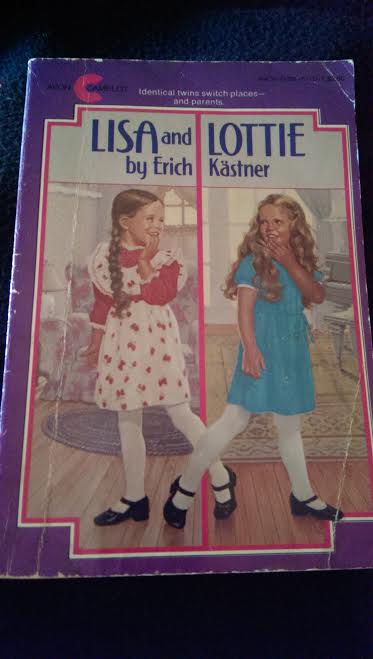
 Lisa and Lottie by Erich Kastner, 1969.
First, a note about the copyright: the date I give is for the edition I own, which is an English translation of the original German book. The original copyright date for the story is 1949. This is the story that was the basis for Disney’s The Parent Trap, both the version with Hayley Mills (1961) and the later Lindsey Lohan version (1998). Neither movie completely follows the original story (although some of the dialog in the Hayley Mills version is almost word-for-word from the English version of the original story) because the settings are shifted to new locations, but both of them capture the concept of twins who were separated as infants by their divorced parents only to meet again years later by accident. As in the book, each of the twins has been living a different kind of life with one of their parents, but they decide to switch places so that each of them can meet the parent they’ve never known.
Lottie Horn is a very serious little girl. She can’t help it because she lives with her single mother, who spends much of her time working, and she relies on Lottie to take care of a number of household chores. But, her mother feels badly that Lottie has been growing up so quiet and serious, so to help her relax and make more friends her own age, she decides to send Lottie to summer camp at Bohrlaken on Lake Bohren.
Shy Lottie thinks that her summer is going to be horrible when she meets up with boisterous Lisa Palfy, a girl who strangely looks exactly like her. Lisa is shocked at the sight of this girl who looks so much like her, and after some teasing, joking, and staring from all the other girls, she loses her temper and kicks Lottie in the shin. The camp leaders decide to give the two girls beds next to each other, saying that they’ll just have to get used to each other. Lottie thinks that it’s going to be awful, but when Lisa sees how unhappy Lottie is, she apologizes and starts being nicer to her.

The two girls discuss their lives and their strange resemblance with each other, and some unsettling details are revealed. First, they learn that they not only share a resemblance but the same birthday. They also realize that they were both born in the same city, although Lottie now lives in Munich and Lisa lives in Vienna. This strange coincidence is troubling enough, but then each girl reveals that she lives with only one parent: Lottie lives with her mother, and Lisa lives with her father. Lottie has no memory of her father and no knowledge of what happened to him, where he might be, or even if he’s still alive. Lisa also has no memory of her mother, but she did once see a picture of her, a picture which her father hid somewhere after he found her looking at it. The girls start getting suspicious, so Lottie shows Lisa a picture of her mother, and Lisa confirms that it’s an identical copy of the picture of her mother she saw before. Lisa and Lottie realize that they are long-lost sisters.
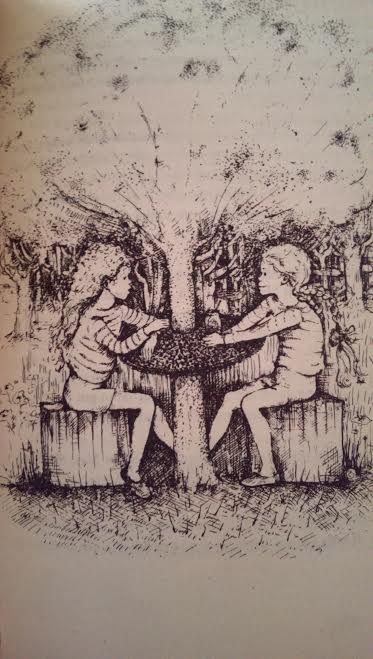 Through the rest of the summer, the girls discuss their lives and parents in great detail and continue speculating about the reasons for their parents’ separation and why they were never told about each other’s existence. They are somewhat angry at their parents for not telling them the truth, but they each also want to know more about the parent that they have never really known and perhaps to learn the truth behind their parents’ separation. They begin hatching a plot to switch places so that Lottie can go to Vienna to meet their father and Lisa can go to Munich to be with their mother. They get little notebooks and fill them with as many details of their lives as they can think of so that each girl can seem to behave like the other, although they know it won’t be easy because they’ve lived very different lives. They don’t like the same foods, and Lottie knows how to cook, but Lisa doesn’t.
Still, the girls proceed with their plan. When it is time to leave camp, the girls dress as each other. Lisa puts her hair in braids as Lottie always does. Lottie lets her curls hang loose, like Lisa usually does. Then, each of them boards the train for the other’s city at the station.
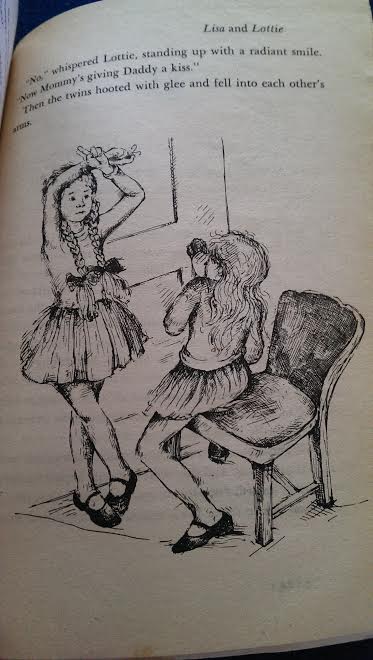 Lisa is overjoyed to finally meet her mother in Munich. But, her mother has to work very hard as a photographic editor for a newspaper, and they don’t have much money. Lisa isn’t as good at cooking or taking care of household chores as Lottie is, so she finds it difficult to help, although she learns quickly.
In Vienna, Lottie meets her handsome but somewhat reclusive father. Her father is an opera conductor, but he’s also a composer who needs to spend much of his time alone in order to compose his music, which was the primary reason for the divorce. He always wanted to devote his life to the arts, and he felt that marriage and family life got in the way, although he dearly loves his remaining daughter and dotes on her.
But, life in Vienna isn’t that great for either Lottie/Lisa or her father. Rosa, the housekeeper who often looks after “Lisa” and takes care of their apartment only pretends to like her when her father is around and steals from the household funds. Also, in spite of finally having plenty of time along for composing music (which is successful), her father is lonely and unhappy. Although he doesn’t want to admit it at first, he misses the comforts of family life and the company of his wife.
Each girl, because of her different personality, manages to make changes in the life of the other and in their parents which are for the better, but the charade cannot continue forever. Lottie finds out that their father is considering marriage to a woman who doesn’t like her. Then, Lottie falls seriously ill. More than ever, she needs her mother . . . and her twin.
The book is currently available online through Internet Archive (they have multiple copies).
My Reaction and Spoilers:
 The book is much less of a comedy than either of the two Disney movies, although there are some funny parts, like when Lottie (as Lisa) takes over the household accounts to stop Rosa’s stealing and ends up turning her into a much better housekeeper with her practicality. Surprisingly, Rosa actually starts respecting her more and even liking her better because of it.
Much of the focus of the book is how divorce affects children as well as parents, although there is room for debate on how each side views the issue, and some modern families may disagree with some of the points characters in the story make. The point of view of the story shifts between each of the girls and also between their parents and other characters to show different reactions to the situation.
The children are understandably upset at the entire issue and believe what their parents did was wrong. The girls admit that they do not think of either of their parents as evil or cruel, but they view the separation and lies that were forced on them without their consent as cruel. Lottie even has a nightmare which is a twisted version of Hansel and Gretel in which her father threatens to cut both her and her sister in half because it would only be fair for each parent to get half of each child. At camp, the girls see one of their friends crying, having just found out that her parents are going to get a divorce. Other girls at the camp call her parents mean for making the decision while she was away at camp and just springing it on her with no warning at all. For the children in the story, the worst part about parents divorcing is when they give little or no thought to how the children will feel or be affected by the decision and don’t even talk about the situation with them.
Some of that sentiment is echoed by adults in the story, although the adults are a little more ambivalent on the issue, knowing that different people and different circumstances must be judged on an individual basis. The adults try to do what they think is best for the children, but they make mistakes, partly because they are too absorbed in their own concerns to understand the entire situation, and they come to realize it. The overall sentiment of the book seems to be that, while marriages are made up of only two people, families are made up of more, including the children. When a couple divorces, it not only affects the marriage, but the whole family as well, and parents need to remember that.
Like the movies, the book also ends happily, and the father finds a way (with the help of Lottie) to balance his work life with his family life.
 Valentine Blues by Jeanne Betancourt, 1990.


 Jestress's Forgotten Books and Stories