The Mystery of the Blazing Cliffs

The Three Investigators
Jupiter Jones and his friends are helping out at his uncle’s salvage yard when they have a strange encounter with a disagreeable customer and his wife. Mr. Barron is a very demanding customer who throws a fit whenever something goes wrong, blaming other people when he’s at least somewhat at fault for what happens. He gets upset when one of the employees of the salvage yard tells him that they need to move his car because they’re expecting a delivery truck, and his car is in the way where he parked it. Mr. Barron gets angry because he parked his car “perfectly”, and he calls them incompetent for making him move.

The only reason why Mr. Jones puts up with Mr. Barron is that he’s buying a large amount of stuff, and it’s stuff that few other people would want, like a buckboard wagon, an old stove and stovepipes, and a broken butter churn. The weird thing is that Mr. Barron doesn’t seem interested in these things as antique collectibles or unique pieces of vintage decor, which would be what most people would use such things for. (I’m thinking of those restaurants where they have miscellaneous farm implements, wagon wheels, and antique/vintage items on the walls, and I think that’s what they’re thinking about, too.) Mr. Barron actually seems to want to fix them up and use them for their intended purposes.

Mrs. Barron glosses over her husband’s rudeness and talks about her belief in aliens as described by a popular book called They Walk Among Us. This book describes “the time for deliverance”, when our planet will be in danger from some kind of disaster, and aliens from the planet Omega will arrive to rescue people from the human race so our species won’t be lost. Mr. Jones thinks that the Barrons are crazy, but his own wife interrupts the conversation before Mr. Jones can say something that will ruin the sale.

Jupiter is intrigued by these weird people, and he persuades his uncle to let him and his friends go along on the trip to deliver all of the things they bought to their ranch up north. Jupiter’s friends are a little reluctant to see the Barrons again, but Jupiter points out that going on the delivery trip will allow them to also go on a buying trip at the same time, something that his uncle has promised them they can do. Jupiter has been wanting to take charge of a buying trip, but he also wants to learn more about the Barrons.

Before they leave, the boys do some research on Mr. Barron and learn that he came from a wealthy business family in the Midwest. However, he has been in and out of trouble with every business he’s ever run. He did pretty well at first after he inherited his family’s business, which made tractors, but then, workers went on strike for better pay and working conditions. Mr. Barron was forced to give them what they wanted, but he was so angry about the strike and being forced to make concessions that he sold that business and bought a different one. In his next business, he had problems complying with government anti-pollution regulations, so he sold that business and bought another one. In his third business, he was sued for discriminatory hiring processes, so he once again sold out and tried another business.

Since then, he has had a string of different businesses, and each and every time, he ran into some kind of problem with government regulations or labor disputes. Every time he has any kind of problem in business, he immediately quits that type of business entirely rather than sticking to it and working things out. He just can’t accept imperfection in any form, and he defines imperfection as anybody or anything that goes against what he, personally, wants to do, regardless of circumstances. He denies that he could be imperfect himself, that he needs to adjust to new or changing situations, or that he needs to improve in any way, blaming everyone else for all of his problems. Finally, unable to find any business where everything goes absolutely perfectly all the time, where there are no rules or standards to follow other than his own and nobody to check that he’s following them, and where he never gets any form of negative feedback, Mr. Barron decided to sell off his remaining business interests and buy a ranch in California, which is where he is now. He’s planning to use the ranch to experiment with new crops and self-sufficient living.

When the boys arrive at the ranch with one of Mr. Jones’s delivery drivers, Konrad, they realize that the ranch is a kind of commune. The people who work for Mr. Barron and live at the ranch show them around and explain how the ranch has its own power supply and water supply. Elsie, who is the cook at the ranch, tells them that Mr. Barron seems to be preparing for some kind of “revolution”, when there will be some kind of catastrophe and society falls apart. (Remember, for Mr. Barron, society and all other humans besides Mr. Barron are idiots and incompetents, so of course, everything is falling apart.) Most of the people at the ranch don’t really believe that’s going to happen. They’re there mainly because Mr. Barron hired them to work there. However, it seems like the Barrons are deep into this notion of a coming disaster.

Konrad thinks that this ranch is very weird, and he wants to leave, but the boys persuade him that they should accept Mrs. Barron’s invitation to stay for dinner. Konrad chooses to eat with the staff rather than face Mr. Barron again. During dinner, the boys are treated to Mr. Barron’s negative attitude about everything, from his disappointment in his adopted sons (and, by extension, in young people in general) to “the evils of plastic in almost any form”, from synthetic leather to polyester clothing. By contrast, Mrs. Barron is very fond of her adopted sons, one of whom is part of a rock band and the other of whom is a poet who supports himself by making wooden clogs. Mrs. Barron says that the rock drummer son will be coming to the ranch in August for the Blue Light Mission convention, a meeting of other people who also believe in aliens who will save humanity. The author of They Walk Among Us will also be there as a guest speaker. 

Although Mr. Barron seems to have at least some belief in the idea that society is falling apart because of “anarchists and criminals who want to take over”, his criticism of people in general also extends to his wife and the other people who attend these alien conventions and believe in They Walk Among Us. Even though he’s hosting this convention for his wife’s sake, he thinks that the convention attendees are a bunch of kooks and crazies who would victimize his wife if he didn’t keep an eye on her. Basically, both of the Barrons are conspiracy theorists, but they’re not following quite the same conspiracy theories. Mrs. Barron is the more positive and hopeful of the two of them, believing that things will somehow turn out okay when the aliens show up, cheerfully ignoring her husband’s negativity, and continuing to talk about how much she’s looking forward the convention and meeting other, like-minded people. By contrast, Mr. Barron thinks society is just going to fall apart, and it will be everyone for themselves, and that’s about it.

The Three Investigators’ involvement with the Barrons would have ended after their delivery errand and dinner, but when they try to leave the ranch, they are stopped by army officers. The officers tell them that the roads are closed because of orders from Washington. The boys and Konrad are forced to return to the ranch, and Mr. Barron is angry about the roads being closed. The army officers tell Mr. Barron that they are just following orders. They further say that something has happened in Texas, and because of that, there is no electrical power, and the telephones, televisions, and radios aren’t working. Elsie has a battery-operated radio, and she turns it on to find out what’s happening. They hear a speech, apparently from the US President, about unidentified aircraft being seen around Texas, New Mexico, and California and possible landings in those states.

Naturally, when confronted with this serious situation, Mr. Barron is ready to take charge and deal with it in his usual way – by immediately finding someone to blame, dishing out criticism, and calling other people stupid and incompetent. He complains that the President gave a stupid speech that doesn’t provide any useful information and that he can’t understand how this guy ever got elected in the first place. Then, he goes off on a rant against communists and anarchists. (Seriously, that’s how both this book and his thought processes go. In a way, he’s very 2020s, a man decades ahead of his time.) Elsie points out that the people at the ranch are safe, no matter what’s happening, because the ranch is designed to be self-sufficient. Mr. Barron may be an angry mess of paranoia and negativity, but he is thorough and has been planning ahead for disaster this entire time.

The military officers say that the roads are being blocked off to the public so they can be used for military vehicles. Mr. Barron becomes convinced that either some disaster has happened or that the politicians believe that one is imminent. He also thinks that the politicians blocked off the road to the ranch so they can come and shelter at his amazing, self-sufficient ranch themselves. (Once again, everyone else, from the government to the general public, is incompetent, and only Mr. Barron does things right. He further assumes that the rest of the world must somehow secretly know this, quietly envies him, and plots to take advantage of him.) There’s no sign of anyone else arriving, at least not yet, but Mr. Barron, who has a deep disdain for fools of all kinds, doesn’t like the idea of welcoming a bunch of political fools. However, he does show sympathy to the boys and Konrad because he can recognize that nothing that’s happening is their fault. He tells them that they’re welcome to stay at the ranch until this situation, whatever it is, is cleared up.

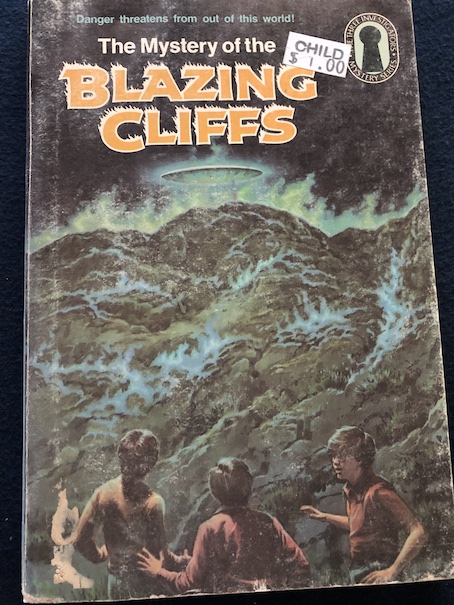
The Three Investigators decide that they need to find out what’s really happening in the cities outside of this ranch and verify what they’ve been told about the situation because everything was fine when they left home. Since they can’t leave by the road, they do a little scouting around the area to see if there’s a route they can use to walk to another town. Since it’s getting dark, they decide that it would be too dangerous to try hiking and climbing in the area at night. They plan to wait until morning to actually leave, but while they’re looking around, they witness something very strange. They see what looks like blue fire on the cliffs near the ranch and some kind of silver, oval-shaped object in the sky! Have they really witnessed a flying saucer? Is what Mrs. Barron believes about aliens coming to Earth true?

The book is available to borrow and read for free online through Internet Archive (multiple copies).

I love this Three Investigators mystery because the premise was so unusual! Three Investigators mysteries are often what I call Pseudo-Ghost Stories, like the mysteries in Scooby-Doo because any supernatural inevitably turns out to be faked in some way for some ulterior motive. This also applies to science-fiction other-worldly phenomena, like aliens. The great thing about this book is that the phenomena is so over-the-top that it’s difficult to think of a plausible way that it could be faked or a reasonable reason why someone would even do it. In this case, we know immediately that the boys see what looks like blue flames and a flying saucer, and there are either military personnel or people pretending to be military personnel blocking the roads out of the ranch. This is a plot that would seem to involve some impressive special effects and a significant cast of conspirators, and the purpose behind it doesn’t seem obvious.

Pretty early in the story, I had a couple of theories about who could profit from faking a UFO, but I had doubts about it because of the relatively small audience involved and because it seemed like there would be much easier methods of them accomplishing their goals. It is a pretty over-the-top plot, although it’s partially explained because Mr. Barron is a rather over-the-top figure to target. It is his paranoia and reluctance to call in authorities and outside help with anything that sets him up for this. Mr. Barron’s attitude that anything that contradicts him or his view of anything is inherently wrong cuts him off from the kind of reality checks he needs, even though he understands that his own wife can use some reality checks outside of her group of fellow alien enthusiasts. 

I knew that, for anybody to get the idea of doing this type of hoax and to plant the evidence to create the illusion of alien landings, one or more of the conspirators would have to be directly involved with the ranch. One of them is obvious, when you think about it, because it’s one of the people who directly supplies some of that evidence. Part of the mystery is about who else is involved. I could see multiple ways that could have gone, and I considered different possible masterminds for the scheme and different motives behind it. Most of what I considered turned out to be wrong, although my theory that Mrs. Barron could have engineered the whole thing with the help of her adopted sons and some friends from the alien conventions with the goal of demonstrating to Mr. Barron just how vulnerable his own paranoia and obsession with his personal conspiracy theories has made him would have been fun. Mrs. Barron may be gullible when it comes to her favorite alien conspiracy theory book, but I would have enjoyed a little role reversal, where she turns out to be more clued about human nature than Mr. Barron, who is so self-obsessed and ultra-skeptical about other people, refusing to receive information, advice, or criticism from anyone else, that he routinely fools himself without outside help. 

Alternatively, I though that the Barrons’ sons could have teamed up to pull this off to make both of the Barrons see the folly of their ways. In a way, I think that Mrs. Barron’s belief in the aliens is partly as a remedy to her husband’s relentless negativity. She believes him that disaster is impending because she actually thinks a lot of her husband and trusts his opinion on the way society is going, but being a more hopeful and trusting person, she has latched onto the idea of rescuing aliens because her husband doesn’t believe in fellow humans. Of course, Mr. Barron disdains that theory because he can tell that it comes from fellow human beings, who are all varying degrees of stupid, incompetent, and scheming, but Mrs. Barron clings to it as a hopeful thing that binds her to like-minded people because she needs that sense of hope and connection. At least, that’s how I read the situation. Mrs. Barron believes everything, even things she shouldn’t, and Mr. Barron refuses to believe anything, even things he should. There is a happy medium between believing everything other people say and allowing them to lead you around by the nose and being so paranoid that everyone is either wrong or out to trick you that you refuse to engage with the real world and turn aside legitimate sources of help and outside information. Neither of the Barrons represent that happy medium, and I would have liked the conspiracy to bring that to light. In a way, it does, but that’s not really the main focus. It’s more about taking advantage of the Barrons and their eccentricities.

I also considered the idea that the entire plot could have been a publicity stunt by the author of Mrs. Barron’s favorite book and the convention organizers. I even thought that Mrs. Barron might have been in on it as a true believer, trying to get her husband and others to believe. However, that’s not the case. The book and the convention just supply the inspiration for the conspiracy.

In a way, this story reminds me a little of the Sherlock Holmes story The Red-Headed League, where there’s a seemingly outlandish scheme to cover an ordinary theft. There is a twist to this one because nobody but Mr. Barron knows exactly where the thing they’re trying to steal is. In the end, only Jupiter reasons it out because he has really come to understand the way Mr. Barron’s mind works.

The mystery is intriguing because there are so many possibilities to consider. In a way, I preferred all the possibilities to the eventual resolution of the mystery, but the solution does make sense. It’s still an over-the-top plot that involves a significant number of people, equipment, and special effects, but it does appeal to my inner Scooby-Doo fan, who enjoys a good, complicated scheme and a villain behind the mask.

Ruth Fielding at Silver Ranch

Ruth Fielding

Ruth Fielding at Silver Ranch, or Schoolgirls Among the Cowboys by Alice B. Emerson, 1915.

In the last Ruth Fielding book, Ruth and her friends met a girl named Jane Ann who had run away from home. In this book, Ruth and her friends go to Silver Ranch in Montana, Jane Ann’s home, which is owned by her uncle, Bill Hicks. Ruth’s best friend, Helen, is surprised that Ruth’s Uncle Jabez let her come on the trip because he’s been very upset about the money he lost investing in a mine. Helen says maybe the investment will turn out fine after all, and Ruth says that the mine he invested in, the Tintacker Mine, is coincidentally nearby. It’s supposed to be a silver mine, although Uncle Jabez now doubts whether the mine is real or some kind of scam. The young man who talked him into investing hasn’t answered Uncle Jabez’s letters for months. So, while they’re staying at the ranch, Ruth plans to ask some questions in the area about the mine and see what she can learn.

On their first evening at the ranch, while they’re playing music, singing, and enjoying themselves, they suddenly get word that there’s a prairie fire up by Tintacker, and a cowboy says that it was probably set by “Bughouse Johnny.” (“Bughouse” is an old-fashioned slang word meaning “crazy”, so this is a descriptive nickname.) Ruth and her friends go to help the cowboys with the fire, and they watch as they slaughter three steers and use the carasses to smother the flames.

Ruth asks some questions about Tintacker, and the cowboys mention a new man who’s been hanging around that area. They don’t know much about him, but he’s pretty young, and they call him “the tenderfoot.” Ruth thinks he might be the young man her uncle has been looking for. She also asks them about Bughouse Johnny, but they don’t tell her much more than he’s a crazy guy who camps out in the area of Tintacker.

Ruth explains her uncle’s situation to Jane Ann’s uncle. Bill Hicks says that, as far as he knows, there’s no more silver left in the Tintacker Mine, and he thinks that Ruth’s uncle has been cheated. Ruth asks him if there’s any way that she can see the official papers associated with the mine, and Bill Hicks introduces her to a friend of his who is a lawyer, Mr. Savage. Mr. Savage confirms that ownership of the mine belongs to a man named John Cox, who bought out the other heirs of the mine’s original owners. Like Bill Hicks, Mr. Savage thinks that the mine isn’t worth anything, but if the young man Uncle Jabez invested with is John Cox, the investment is valid, just not one that’s likely to see a return. Ruth says that she will give the lawyer’s information to her uncle and that her uncle may ask him to act on his behalf later, depending on how he decides to handle this investment.

Ruth and her friends have some Western-style fun and adventures with Jane Ann, the cowboys, and the other locals. Jane Ann gets to show off her riding and ranching skills, and they all attend a local dance, where Ruth and her friends play matchmaker between a shy cowboy and the haughty schoolmistress he admires. They have a hair-raising encounter with a wild bear, and the man who saves them by shooting the bear turns out to be the man from Tintacker who Ruth wants to see.

When Ruth and one of Hick’s men go to see this man later, they find him deathly ill. If the man doesn’t recover, and if the mine turns out to be worthless, Uncle Jabez will lose his money, and there will be no way for Ruth to continue attending the boarding school she loves with her friends! However, the answer to the truth about John Cox’s identity is closer than Ruth and her friends suspect.

The book is available to borrow and read for free online through Internet Archive (multiple copies) and Project Gutenberg (multiple formats).

My Reaction

Like many other early Stratemeyer books, this story contains elements of a mystery but is really more of an adventure. I didn’t like parts of the adventure because there were repeated instances of characters being attacked by animals and then the animals needing to be killed. At one point, Ruth herself beats an attacking wolf to death, and I thought that was a shockingly violent scene for a Stratemeyer Syndicate book! Although, earlier Stratemeyer Syndicate books are quite different from the later ones.

The mystery part of the story focuses on the identity of John Cox, the man who convinced Uncle Jabez to invest in his mine, and the truth about his mine. I actually felt a little silly for not figuring out the true identity of John Cox sooner because he actually shares the same last name as one of the other regular characters in this series, and it’s not a coincidence. John Cox is Mary Cox’s brother.

Mary Cox, nicknamed “The Fox” by her schoolmates for being sly, is along on the trip with the other Briarwood Hall girls, although she is a nasty rival for Ruth in particular. Even though she has gotten along better with some of the other girls in the past, her snooty attitude and bad behavior have finally gotten on everybody’s nerves in this book.

When Mary is temporarily in control of a wagon Ruth and Helen are in, she does something reckless and almost gets them all killed until Ruth takes control of the reins and saves them. Everyone knows that the situation was Mary’s fault and that Ruth saved the day, and this is not the first time that Ruth has saved Mary from something. (By my count, it’s the third time.) However, Mary is ungrateful for her help and in denial that she did anything wrong (as usual). Just when everyone has decided that they’re completely fed up with her, the discovery of her brother changes things. While Mary is unmoved by Ruth saving her life, she is genuinely grateful to Ruth for saving her brother when he was ill and alone, which is astonishing for a girl who has never seemed to genuinely care about anybody else before. John Cox is an honest man, and Uncle Jabez’s investment turns out better than expected, guaranteeing that Ruth will be able to return to boarding school with her friends.

I want to warn readers that this is one of the Stratemeyer Syndicate books that has characters using racial slurs. The Ruth Fielding books were written before the Stratemeyer Syndicate revised its books in the mid-20th century to remove language like that. As in other Stratemeyer books, the use of inappropriate racial language is used to show which characters are crude and antagonistic, and in the case of this book, that character is Mary.

Mary Cox sneers at one of Bill Hick’s men, Jib, because he is of Native American descent, although Helen’s brother Tom stands up for Jib, pointing out that he’s much better educated than most of the men Mary knows, even though he works as a cowboy, and that Native Americans used to own the entire country before white people came, which is nothing to sneer at. Mary still insists on calling him a “savage”, mostly because Mary’s habitual method of communicating with people is to put someone else down so that she can look superior. This entire exchange takes place during an episode when Mary is trying to flirt with Tom, and bringing up racial slurs to put someone down during a flirtation with someone else is a very weird thing to do. It’s mostly a part of the story to show why Mary is such a pain. Tom just ends up being disgusted with her. It’s not the last time Mary uses racial slurs. At one point, she also calls the ranch cook a “fat and greasy Mexican squaw.” It’s pretty bad to see that kind of language in a kid’s book, even though it’s there to show that Mary has a nasty personality and behaves badly, which irritates and embarrasses people around her.

On a lighter note, the story is peppered with all sorts of Western words and slang. Since slang changes over time, and I’m not sure how people said things in the 1910s, I’m not sure how accurate the slang is for the time, but I’d like to call attention to a couple of words in the story that will be familiar to readers, but not in the way that they usually see them. “Cañon” is actually the Spanish word for “canyon”, pronounced the same way that we say in English, but the little tilde symbol over the ‘n’ adds the ‘y’ sound. The word that confused me the most was “kiotes,”, not because I didn’t know what they were talking about, but because that is not the Spanish version of the word. It looks like a phonetic spelling of the way we pronounce “coyotes” in English, but the Spanish word is also spelled “coyotes”, just pronounced a little differently. I didn’t know where the spelling “kiotes” came from, and I’d never seen it anywhere else before. I tried Googling it to find out more, and I saw a few mentions of the word with that spelling. One mention said that it was a Native American word, but it didn’t explain much more than that, so I can’t be sure. The book also uses the plural of “beef”, which is “beeves“, a word that used to be a joke with my brother and my friends the first time we heard it years ago because we thought it sounded funny. It also mentions the girls wearing “furbelow“, a word that I’d never heard before that means ruffles, pleats, or flounces in women’s clothing.

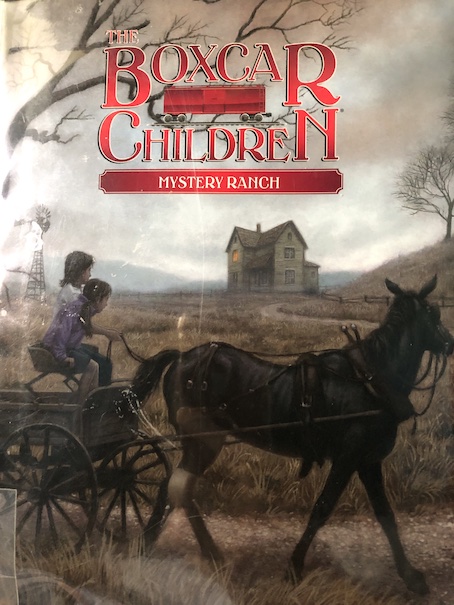
Mystery Ranch

The Boxcar Children

Boxcar Children Mystery Ranch

Mystery Ranch by Gertrude Chandler Warner, 1958, 1986.

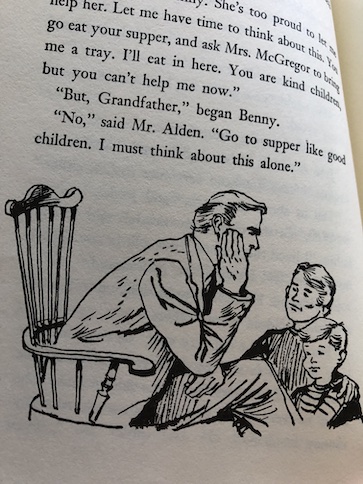
Boxcar Children Mystery Ranch Grandfather

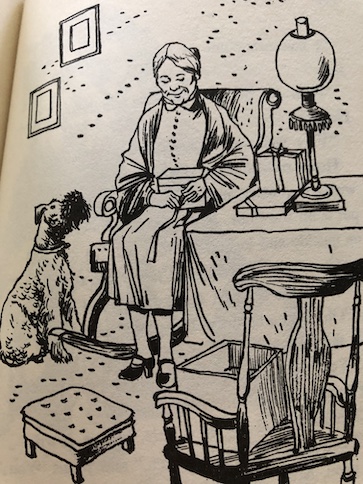
The children can tell that something is wrong when their grandfather, Mr. Alden, comes home and bangs the doors. When they ask their grandfather what’s the matter, he says that he’s worried about his sister, Jane, because he just got a disturbing letter about her. The children have never met their Great-Aunt Jane before, and she lives on a ranch out west. The trouble is that Jane is a difficult person to get along with. She can’t stay at the ranch alone because she’s elderly and needs help, but the person who was helping her before is leaving, and because Jane is such a difficult person, their grandfather doesn’t know where he’s going to find someone else willing to help her. Their grandfather admits that he doesn’t even get along with Jane himself, confessing that he hasn’t been very nice to her, either. (We never find out exactly why the children’s parents originally told them that their grandfather wasn’t a nice man, as established in the first book of the series, but this confession hints that he used to be much harder on his relatives than he is now, perhaps having mellowed a bit with age and experience.)

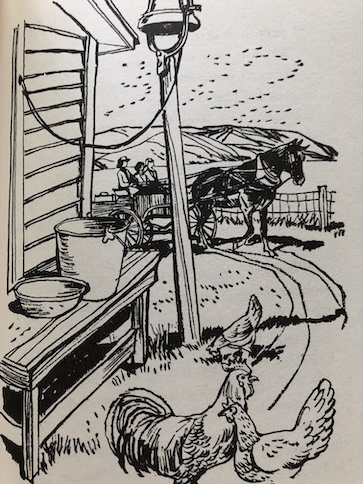
Boxcar Children Mystery Ranch wagon

Their grandfather says that the ranch where Jane lives is the ranch where both of them grew up. When he moved east years ago, Jane wanted to stay on at the ranch. He knows that Jane doesn’t have much money and doesn’t even keep many animals anymore, but because of her sense of pride and their past quarrels, Jane won’t accept any money or help from him. The children wish they could do something to help, and their grandfather says that he has to think things over. They ask who wrote the letter about Jane, and their grandfather says that it was written by the neighbor who has been staying with Jane. She says that she can’t put up with the bad treatment from Jane anymore. The letter further says that Jane wants to see Mr. Alden’s grandchildren. Naturally, the children say that they would like to see Jane themselves and try to help her. However, their grandfather isn’t sure that it’s a good idea because he doesn’t know how Jane would treat the children.

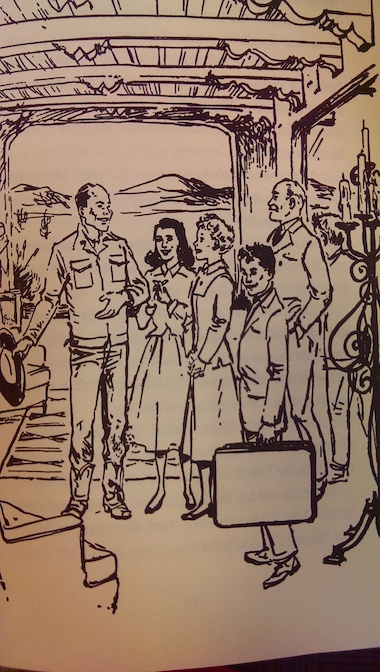
After talking it over some more, they all decide that the two girls, Jessie and Violet, will go to see Aunt Jane without the boys because Jane might find all four children at once to be too overwhelming. Mr. Alden says that if Jane gives them too much trouble, they should go to the neighbors, who are nice and will help them. When the girls get off the train at the town near their aunt’s ranch, they notice that a man gets off at the same time and quickly disappears. They are curious about him and wonder where he went. The townspeople are curious, too, because it’s rare that anybody comes to their little town, let alone a mysterious stranger.

Boxcar Children Mystery Ranch arrival of the girls

When the girls arrive at the ranch, the neighbor, Maggie, helps them get settled. Aunt Jane refuses to get out of bed, and Maggie says that she hasn’t been eating much and won’t let her eat much, either. The girls ask Maggie what’s wrong with Aunt Jane, and she says Jane feels like she doesn’t have anything to live for, so she’s kind of given up. Jessie and Violet insist that they’re all going to eat, and they fix some food. The girls and Maggie eat first, and then, the girls take Jane some orange juice with a beaten egg. Jane finds it difficult to refuse the girls, so she drinks it. Aunt Jane starts asking the girls questions about their brothers and says that she would like to see them.

Aunt Jane begins eating better because she finds these interactions with her young nieces interesting and because they speak more kindly to her than anybody else has for years, and she enjoys the attention. Maggie stays on at the house and continues to help because the girls have money and buy more and better food. Things seem like they’re getting better at the ranch, but when Maggie and the girls return from buying food in town, Aunt Jane says that three strange men came to the house while they were gone, even entering her bedroom, and they tried to badger her into selling her ranch to them. At first, Maggie doesn’t believe that, but Aunt Jane has the paper the men left to prove it. Of course, Aunt Jane refused to sign anything and told the men to go away, but she seems a little shaken by the experience.

Boxcar Children Mystery Ranch Jane and Benny

The girls miss their brothers, and Aunt Jane tells them that the boys can come and stay, provided that they’re not like their grandfather. When the boys come, Aunt Jane likes them, too. To the children’s surprise, she tells them that she’s decided to give her ranch to the four of them because she has no children of her own and she would rather they have it than those men who tried to get her to sell. The prospect is thrilling, but when the lawyer comes to arrange everything, they make sure that the arrangement includes providing for Aunt Jane, too.

As the children explore their new ranch together, they see that things are as their grandfather described to them. The only animal Aunt Jane currently has is an old, black horse that Benny ironically names Snowball. However, they find an old hut that looks like someone has been living there recently. Who has been secretly camping out on Aunt Jane’s land? Is it the mysterious stranger who got off the train or the three tough guys who tried to get Aunt Jane to sell the ranch to them? Why would anybody even want the ranch anyway? The children find it charming, and while the girls like to imagine how they’d like to fix up the house, they know it isn’t worth much monetarily. There aren’t many animals, and while there’s fool’s gold on the land, there’s no real gold. Is there something else on the ranch that they don’t know about?

The book is available to borrow and read for free online through Internet Archive (multiple copies).

My Reaction and Spoilers

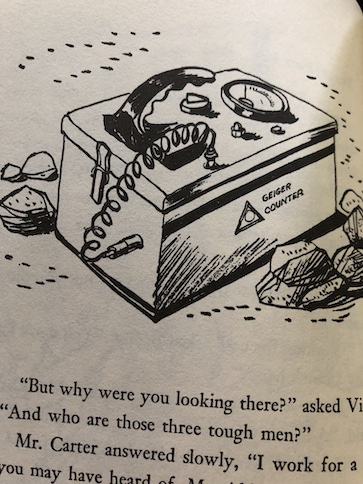
Boxcar Children Mystery Ranch geiger counter

As readers might have guessed, there is a resource on the ranch that the Aldens have overlooked for years, but other people have figured it out. However, more than the mystery, I like this book for the insights into the Alden family’s past. As I said, we never fully find out why Mr. Alden’s son and his wife had a falling out with him years ago and told the children he wasn’t very nice, but his sister’s feelings about him offer some clues to the type of boy and young man Mr. Alden was. Mr. Alden admits that he wasn’t always nice to his sister, and Jane says that he was always “bossy.” I get the feeling that Mr. Alden used to be the kind of man who thought that he knew best about everything and started feeling like he could tell everyone what to do. Perhaps his falling out with his son helped show him that he didn’t really know best about everything, including how to get along with his own family, but admittedly, that’s speculation.

Boxcar Children Mystery Ranch Jane's Presents

Jane also admits to being difficult to get along with in other ways. Her major problem has been her sense of pride, which is one of the reasons why she never wanted to listen to her brother or go to him for help when she needed it. One of their chief disputes had been about the ranch itself. Years ago, her parents and brother were ready to give up the ranch and move east, but Jane felt more attached to it than the others and insisted on staying there and running it herself. Unfortunately, Jane admits that she didn’t really know how to run the ranch properly. There were points when she could have asked for help, but that would have been admitting to the others that she had been wrong to insist on staying, and she couldn’t bring herself to do that. Things gradually got worse over time because Jane wouldn’t listen to anybody or ask for help, which is how the ranch got into its current state.

The discovery of an important resource on the ranch brings more money to the family, greater security for Jane, and a chance for the brother and sister to make up. Jane invites Mr. Alden to the ranch to celebrate her birthday and to help her and the children arrange things. Mr. Alden is careful to arrange the situation so that the resources can be mined while not disturbing the old ranch house, so his sister can continue to live in the house she always loved so much.

Linda Craig and the Clue on the Desert Trail

Linda Craig

Linda Craig and the Clue on the Desert Trail by Ann Sheldon, 1962.

Linda and her friend, Kathy, are exploring Olvera Street in Los Angeles before a horse show when Kathy notices a strange man watching them.  While the girls were shopping, Linda bought a small horse statue that reminded her of her own horse.  As the girls finish lunch, Linda notices an odd symbol on the statue that looks like an arrowhead, but before she can study it more, the man grabs the horse and runs off.  Linda tries to chase him down to get the horse back, but the man drops it and breaks it.  Linda picks up the horse’s head and decides to go back to the shop where she bought it to see if she can get another one.

The shop doesn’t have another horse like the one Linda bought.  It was unglazed, and the others are glazed.  Disappointed, Linda goes on to the horse show, where she is taking part, along with her brother Bob and his friend Larry.  At the show, they see the mysterious man again, and he apparently steals the broken head of the horse statue that Linda had kept.  Bob thinks that maybe the man is some kind of smuggler and that there was something hidden in the head that Linda hadn’t noticed.

Linda goes back to the shop to talk to the owner again, and he tells her that the horse was a special order from Mexico for a man named Rico.  Rico said that he was a traveling salesman and that he would collect the horse at the shop, but when he didn’t turn up to get it, the shop owner decided to sell it. Linda asks the shop owner to send her another horse statue like the broken one if one comes into his shop and reports all of this information to the police.  Then, when she returns to the horse show, she finds a threatening message, warning her to “Beware. Stay away from C. Sello.”  The note is signed with the symbol of an arrowhead, similar to the one on the horse statue.  Linda also reports this note to the police, but she can’t resist trying to figure out who C. Sello is and how this person fits into the mystery of the possible smugglers.

Soon after, the shop owner calls Linda to say that another horse statue did come into the shop and that he has sent it to her but now someone has broken into his shop and smashed every horse statue he has. Realizing that what they wanted was not in the shop, the bad guys are soon on Linda’s trail, even kidnapping one of her friends by mistake, thinking that it’s her. They even try to poison Linda’s horse!

At the end of a desert trail, the Mojave Trail, there is a ghost town with sinister characters and old cliff dwellings with Native American petroglyphs that may hold part of the secret to the mystery.

The story contains some anecdotes about California history, which is interesting. I have to admit, though, that I thought that the warning note for Linda was pretty silly. C. Sello turns out to not be a person but a clue about what the smugglers are smuggling, and they didn’t have to tell Linda what it was because she hadn’t heard about it at that point and wouldn’t have any reason to know what they were talking about. If they really wanted to get her to leave them alone, they could have left a more vague warning that didn’t include any clues like “Go home!” or “Go away!”

The Mystery in Arizona

Trixie Belden

TBMysteryArizona

#6 The Mystery in Arizona by Julie Campbell, 1958.

TBMysteryArizonaRanchDi’s Uncle Monty (the real one, not the fake from previously in the series) has invited her and the other Bob-Whites to spend Christmas at his dude ranch near Tucson, Arizona. At first, Trixie is worried that she won’t be allowed to go with the others because her grades in school are bad and she needs to study. However, her parents finally agree to allow her to go when the boys offer to tutor her over the holidays, and Trixie can get information that she needs on Navajo Indians for her theme. It won’t be easy, though.

From the very start of their visit, problems plague the ranch, and it seems as though everyone has a secret. Most of the members of the Orlando family, who usually take care of cooking, cleaning, and other tasks on the ranch, have mysteriously disappeared, except for Maria and her young son. Maria refuses to say where the others are, but the little boy is unhappy that he couldn’t go with the rest of his family and makes strange comments about skeletons and other frightening things. Also, Rosita, a Navajo girl working as a maid at the ranch, is deeply unhappy and in need of money for reasons that she doesn’t want to explain.

Meanwhile, there is a trio of lonely and unhappy guests in need of cheering up. In an effort to help, the Bob-Whites volunteer to take over the Orlandos’ chores to keep the ranch running during the holidays. As Trixie gets drawn further into the mysteries plaguing the ranch, she finds it difficult to balance her work and her studies. Trixie worries that this might turn out to be a terrible way to spend Christmas, but with some help from the Bob-Whites, things might work out even better than anyone hoped.

One of the things that they discover is that the Orlando family is celebrating a family tradition similar to Dia de Los Muertos (Day of the Dead, similar to All Souls Day and Halloween) but their family celebrates it at a different time of year than is customary because they want their celebration to coincide with the birthday of one of their ancestors.  They left without explaining because they were worried that no one would understand their traditions or approve of them.  Maria Orlando did not go right away because she was worried about leaving her job, but when her son tries to run away and join the rest of the family, she decides that it isn’t fair to keep him away from the family celebration.  After making sure that the Bob-Whites can handle the chores on the ranch, she takes her son to join the others in Mexico.

The three unhappy guests, Jane Brown, Mr. Wellington, and Mrs. Sherman, also have their problems solved.  Jane learns to get over her shyness and enjoy herself.  Mr. Wellington’s children, who had decided at the last minute to spend the holidays with friends, change their minds and come to spend Christmas with their father instead, cheering him up.  After Maria leaves, Mrs. Sherman cooks Christmas dinner for everyone, allowing her to once again do the work she loved when she and her late husband ran a restaurant.  Rosita’s secret is that she feels responsible for an accident that her father suffered when he was working with some  more modern tools that she gave him for his silversmithing work.  She took a job at the ranch to get some money for his medical treatment, but she is worried that she cannot earn all the money she needs during the holidays so that she can return to school.  She sold some of her silver jewelry to Mrs. Sherman, but she refused to take more than $100 dollars for it, although Mrs. Sherman would gladly have given her all the money that she needed.  Rosita is too proud to ask for or accept help from others.  The Bob-Whites solve her problem by giving her the money that they earned working at the ranch as a Christmas present.  In spite of all these distractions, Trixie manages to improve her math and get enough information for her theme on Navajos from Rosita.

This is the last Trixie Belden book written by Julie Campbell, the original author of the series.  From this point on, the series continues with other authors.

The book is currently available online through Internet Archive.

Something Queer in the Wild West

SQWest

Something Queer in the Wild West by Elizabeth Levy, illustrated by Mordicai Gerstein, 1997.

Gwen and Jill go to visit Gwen’s Uncle Dale, who owns a ranch in New Mexico. The girls enjoy learning to ride horses, but Fletcher seems to be interested in an old barn.  C. J., who works on the ranch, tells the girls that the barn is supposed to be haunted by the spirit of a wild horse and that they should stay away from it.  Uncle Dale confirms the old legend, but the girls think there’s more to the story.

They have hear strange sounds coming from the old barn.  Then, the girls notice that Fletcher seems to be sneaking out during the night.  One night, they see a white horse roaming around when Uncle Dale doesn’t own a white horse. Could it be the spirit of the wild horse, or could it have something to do with a recent horse theft?

Fletcher’s odd behavior is a clue, and there is more to the old barn than the ghost story, as the girls suspected.  The “theft” isn’t quite theft, and the thief is actually trying to do something noble.  In the end, the girls decide to help, but they need Fletcher’s help to do it.

This book is part of the Something Queer Mysteries.  It is currently available online through Internet Archive.

SQWestPic2