When Aunt Lena Did the Rhumba

Sophie’s Aunt Lena loves music, dancing, movies, and theater, and she especially loves Broadway musicals. She goes to a musical matinee every Wednesday. After seeing a musical, she comes home, singing and dancing and acting out parts from the play she’s just seen.
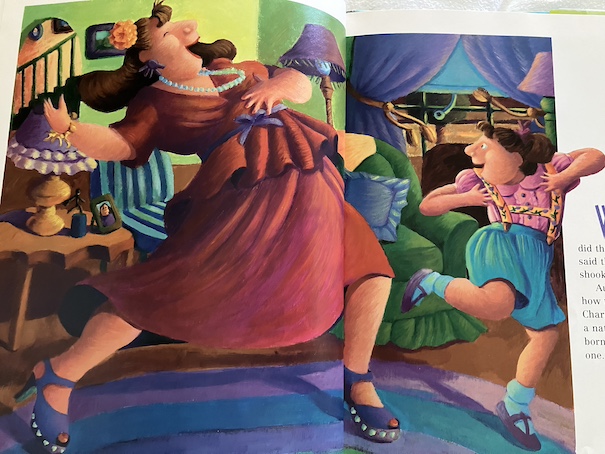
One particular Wednesday, when she’s acting out a particularly dramatic dance in the kitchen, she accidentally slips and sprains her ankle. She has to stay home and rest until her ankle gets better, which means that she won’t be able to go to next Wednesday’s matinee.

Aunt Lena is so sad about missing the musicals she loves that Sophie gets an idea to cheer her up. Sophie recruits other members of her family to put on their own musical to entertain Aunt Lena.
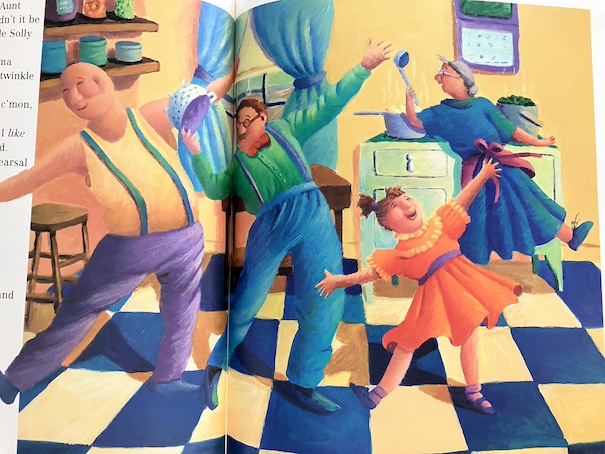
Not everyone is enthusiastic about the idea at first, but when Sophie gets her grandmother to help her put together a costume fit for a Broadway musical and choose some music, they begin drawing other family members in.

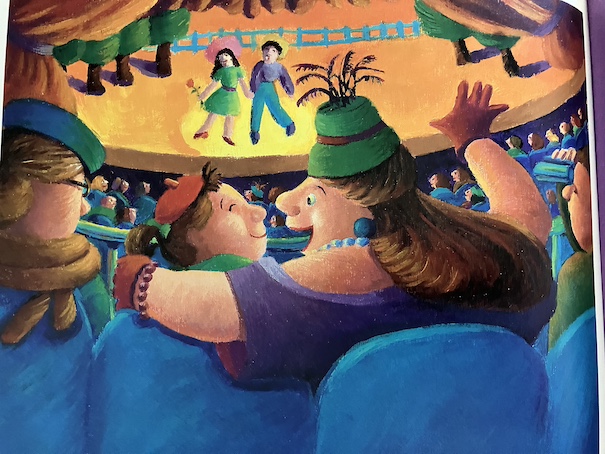
Aunt Lena loves their performance, and when she’s better, she takes Sophie to a matinee so she can see a real Broadway performance, too!
This book is available to borrow and read for free online through Internet Archive (multiple copies). It was also a Reading Rainbow book, and the episode of Reading Rainbow is also available to watch online through Internet Archive.

I didn’t see the original episode of Reading Rainbow that included this book when I was a kid because this book was published after I was too old for that. However, I always liked Reading Rainbow when I was a kid, and later, after I started this blog, I decided to go back and check out some of the books covered by Reading Rainbow after I stopped watching it. If you’re not familiar with Reading Rainbow, it was a children’s television program on public television in the US that encouraged children to read by discussing books and showing children things that were related to the books they were reading. For example, if they were reading books related to animals in an episode, the host, Levar Burton, might take a trip to a zoo and talk to zookeepers about animals in the zoo.

The themes of this particular story and the Reading Rainbow episode are music, dancing, and theater. In the episode, they show a boys’ choir and dancing class and talk about how performing helps the boys and young men develop confidence and maturity. There’s also a comedian who specializes in physical comedy, who talks about how he does his stunts, and an actress who plays one of the cats in the famous Broadway musical Cats.

I love how the aunt in the book shares her love of dancing and theater with her niece. The two of them have similar personalities and interests, so when her aunt is injured, her niece knows how to cheer her up. The ending of the story implies that the niece will now be going to performances with her aunt, or at least, will sometimes go with her. I also liked how the rest of the family participated in the girl’s plans when they saw what she wanted to do, even if they weren’t as enthusiastic about the idea themselves at first. Enthusiasm can be contagious, and I do think that adults sharing their interests with kids can spark lifelong interests in the next generation.

I also noticed that this seems to be an unconventional family, although the family’s living arrangements aren’t the focus of the story. The girl’s parents are never mentioned. She seems to live with just her grandmother, her aunt, and a couple of uncles, and there is no explanation why because it’s not directly important to the story. In any case, it seems to be a happy, close-knit family, with family members caring for each other and supporting each other’s interests.

The pictures in the book are bright and colorful, fitting with the energy, enthusiasm, and theatricality of the story.

Dancing with the Indians

Dancing with the Indians by Angela Shelf Medearis, illustrated by Samuel Byrd, 1991.

I love books with historical background, and this is a fascinating picture book that is based on the history of the author’s family. Like the author’s earlier book, Picking Peas for a Penny, it is told in rhyme, from the point of view of the author’s mother as a child in Oklahoma during the 1930s.

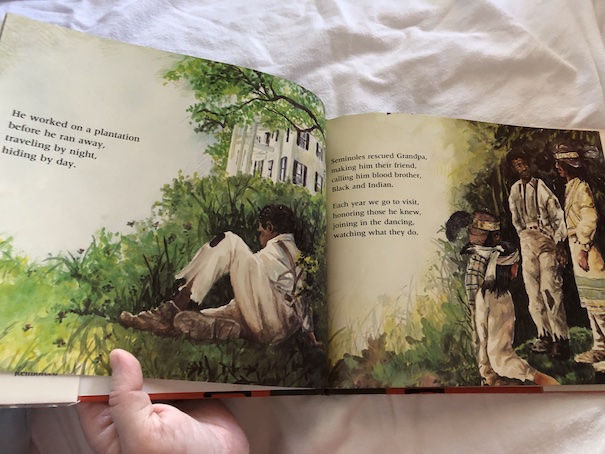
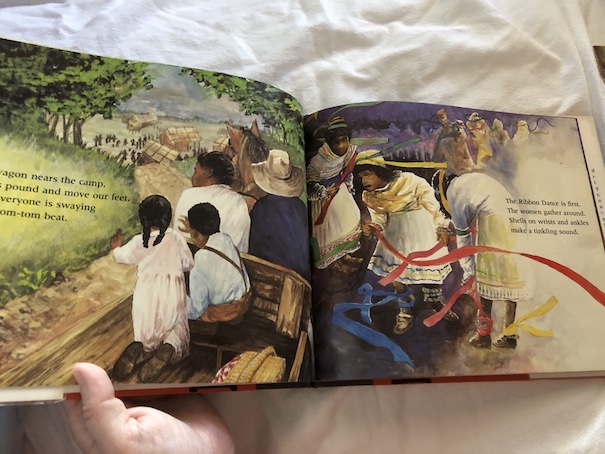
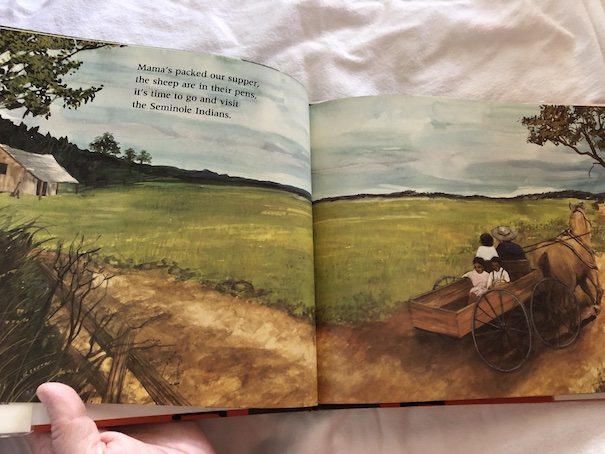
The girl and her brother are going with their parents to visit the Seminole American Indians. As they travel in their wagon, the parents explain to the children the history of their family. Many years before, the girl’s grandfather (the author’s great-grandfather) escaped from slavery and ran away to Oklahoma, where he was accepted by the Seminole tribe. Ever since, his descendants have continued to visit the tribe and join in Seminole celebrations and ceremonies as part of their extended family.

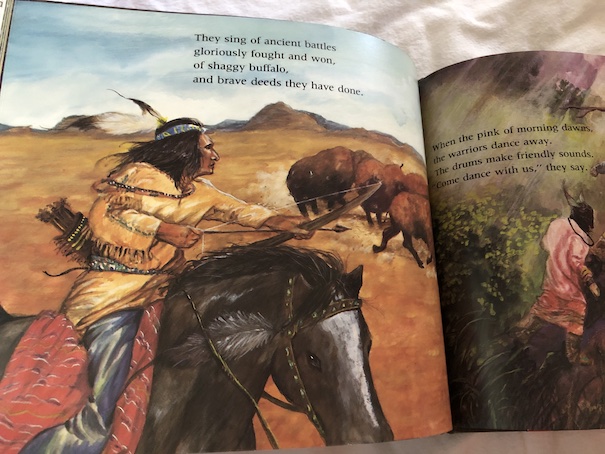
The night is an exciting celebration with dancing, drumming, and songs and stories of past triumphs.

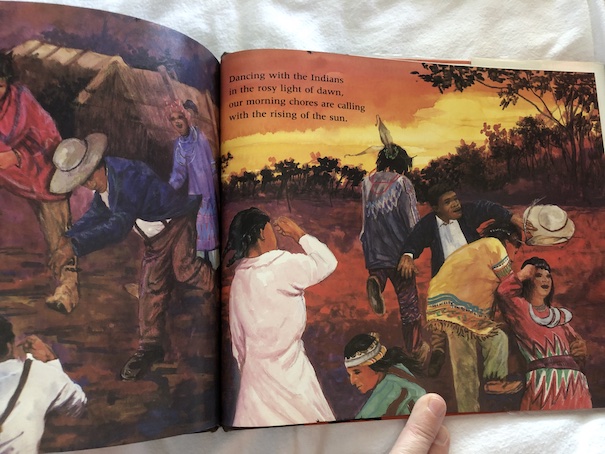
They all dance and celebrate through the entire night, until morning. As the family returns home to tend to their farm, the father promises them that they’ll return to dance with the Indians again.

I liked this book because it explains an aspect of American history that I don’t remember being discussed much when I was in school. In fact, I think that the first time I saw anything that explained that escaping slaves sometimes headed west instead of north before the Civil War was in a Disney Adventures magazine, where they were talking about cowboy, specifically mentioning black cowboys. However, another option was for escaped slaves to join up with Native American tribes. The Seminole tribe of Florida and Oklahoma was one group that was known to accept escaped slaves and adopt them into the tribe, starting in the early 1700s continuing into the 1850s. Some of the escaped slaves married into the tribe. The African Americans who joined the Seminoles and their descendants came to be called Black Seminoles. Parts of the two cultures intermingled. Black Seminoles adopted Seminole traditions, and they also introduced Seminoles to aspects of their traditions. The relationship has had complications as well, and even in modern times, there are debates about how much Black Seminoles count as part of the tribe and how much they should be entitled to certain benefits

This is a Reading Rainbow Book. The book is available to borrow and read for free online through Internet Archive (multiple copies).

Amazing Grace

Amazing Grace by Mary Hoffman, 1991.

Grace loves stories, both hearing them and acting them out. She is imaginative, and likes playing games of pretend and acting out adventures.

When Grace’s teacher tells the class that they are going to perform the play Peter Pan and will be holding auditions for parts in the play, Grace wants the title role of Peter Pan. A couple of the other kids think that it’s odd for her to want to be Peter Pan because she is both a girl and black, which is exactly the opposite of how they usually see the character.

However, Grace still wants to play Peter Pan. When she tells her mother and grandmother what the other kids said, they reassure her that she can get the part if she really wants it and puts her mind to it.

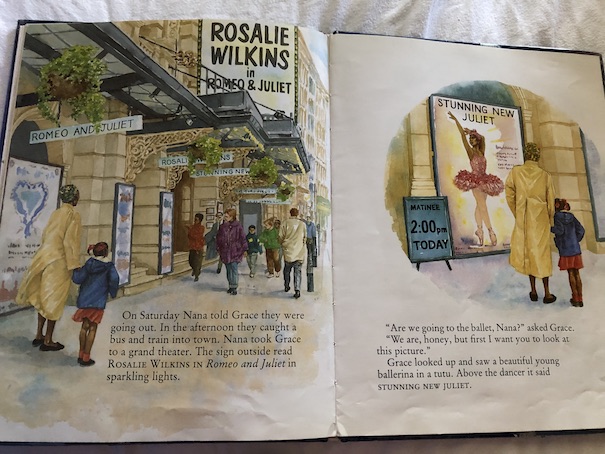
To prove to Grace that a young black girl can get starring roles, her grandmother takes her to see a ballet where the granddaughter of a friend of hers from Trinidad is playing the role of Juliet in Romeo and Juliet.

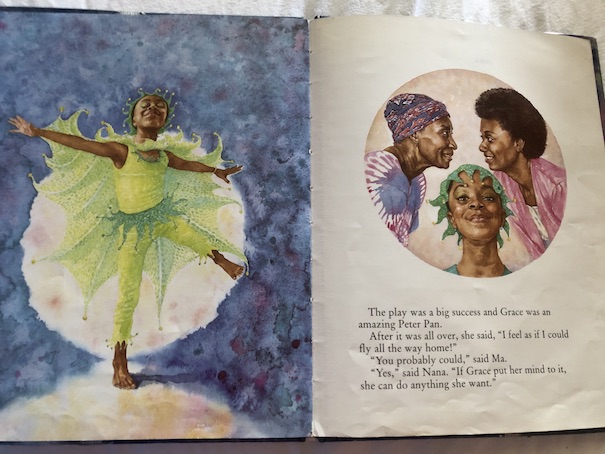
Seeing the performance cheers Grace up and gives her the confidence to audition for the part of Peter Pan. When her classmates see how good she is when she performs, they all agree that Grace should have the role of Peter Pan.

The message that young girls like Grace can do what they set their minds to, even if the roles they want in life aren’t quite traditional, is a good one. As I read the story, I was also thinking that the objection that Grace can’t be Peter Pan actually doesn’t make much sense if you know that Peter Pan, of all roles in plays, is one that is often played by a female. I remember that when I was a kid in elementary school, there was a girl who played the part of Peter Pan, and one of the teachers explained that women sometimes play Peter Pan, especially when the actors are all adults, because women have the higher-pitched voices that the part really needs. I would liked it if the teacher in the story also mentioned that. Also, acting is about capturing the spirit of the character in the story, thinking and feeling like they would think and feel and acting the way they would act. I would have liked it if they had mentioned that. Grace may not look quite the way people might picture Peter Pan, but if she can capture the character in her performance, she’s a good actor.

I liked the pictures in the book for their realism. In a couple of the pictures which show how Grace like to act out fantasies, she is shirtless, but she is very young and it isn’t possible to really see anything, so I don’t consider it inappropriate, but I thought that I would mention it.

This is a Reading Rainbow Book.

Knots on a Counting Rope

Knots on a Counting Rope by Bill Martin, Jr. and John Archambault, 1966, 1987.

The reason for the two copyright dates is that this book originally had somewhat different text and different illustrations.  I don’t have a copy of the original version, so I’m not sure how it compares to the 1987 version.

The story is told in the form of dialog between a young Navajo boy and his grandfather.  The story doesn’t explicitly say that they are Navajo, but they refer to hogans, which are a traditional type of Navajo house.  There are no words in the story other than what the characters say to each other, not even to indicate who is speaking, but you can tell who is speaking based on what they say.

The boy asks his grandfather to tell him the story of when he was born. The grandfather says that he already knows the story, but the boy persuades him to tell the story again.

The grandfather tells him that, on the night he was born, there was a storm, and it sounded like the wind was crying the word “boy.”  The boy’s mother knew that she was going to give birth to a son.  The grandfather quickly brought the boy’s grandmother to be there for the birth, and when the boy gave his first cry, the storm suddenly stopped.

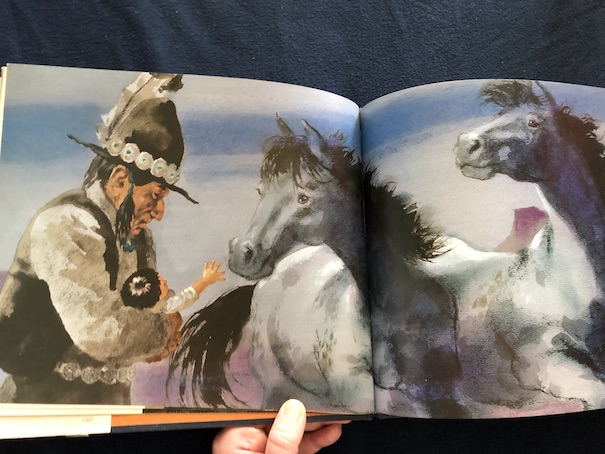
When the boy was born, he was very frail, and everyone was afraid that he would die.  Then, when morning came, the grandfather carried him outside, and although he did not open his eyes to the morning sun, he lived his arms up to two horses that had galloped by and stopped to look at him.  The grandfather took it as a sign that the boy was a brother to the horses and would live because he had the horses’ strength.  The boy did become stronger and was given the name of Boy-Strength-of-Blue-Horses.

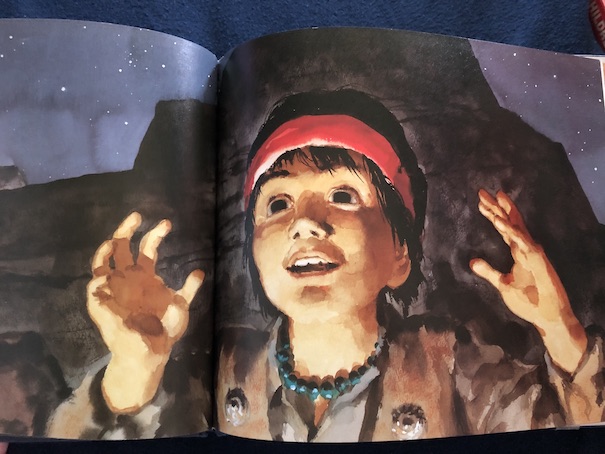
However, the boy was born blind. It is a hardship that he will always have to deal with.  Even though the word “blue” in his name, the boy says that he doesn’t really know what “blue” is or what it’s like because he’s never seen it.  The grandfather describes it as being like morning because the sky in the morning is blue, and the boy says that he understands what mornings are like because they feel and sound different from night to him.

The boy has a horse of his own, and the two of them have a special bond.  The two of them perform well at races, and the horse acts as the boy’s eyes when he’s riding.  His grandfather says that it’s like the two of them are one.

As the grandfather tells the boy stories about himself, he ties knots on the counting rope.  He says that when the rope is full of knots, the boy will have heard the stories enough that he will be able to tell them himself.  The grandfather says that he will not always be there to tell the stories, and the boy is frightened, wondering what he will do without his grandfather. The grandfather says that he will be all right because his love will be with him.

The book is partly about the relationship between the boy and his grandfather and the grandfather preparing his grandson for the day when he will be gone, making sure that he knows the family stories about himself and the knowledge that he will need for the future. It’s also about the boy’s own struggles in life, which the grandfather refers to as the “dark mountains” that he must cross. Because of the boy’s blindness, he lives in a world of darkness, and there are things that are challenging to him that would be less challenging to a person with normal vision. Yet, the boy has innate skills which allow him to do things that some people with normal vision can’t do. Not everyone has the affinity for horses that the boy has. He shares a special bond with horses, and when he rides, he and his horse are a team. Because he has skills and a strong spirit, the grandfather knows that his grandson will be all right in his future, in spite of the challenges of his blindness.

The book was featured on Reading Rainbow, and it is currently available online through Internet Archive.

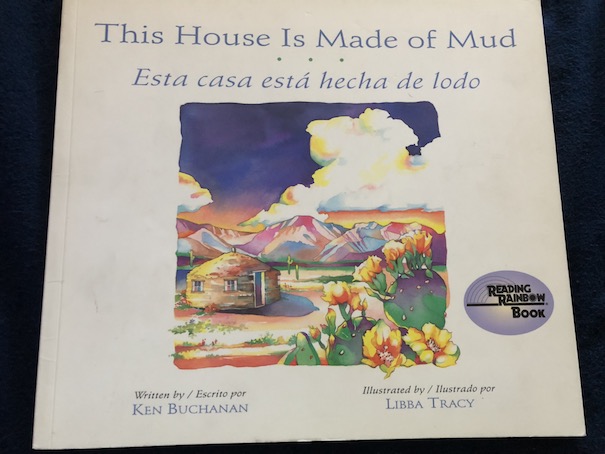
This House is Made of Mud

HouseMud

This House is Made of Mud by Ken Buchanan, illustrated by Libba Tracy, 1991, 1994.

The edition of this book that I have is the bilingual edition with English and Spanish.  Originally, the book was written in just English. I like to use kids’ books for Spanish practice, which is why I like this one.  It’s a Reading Rainbow Book.

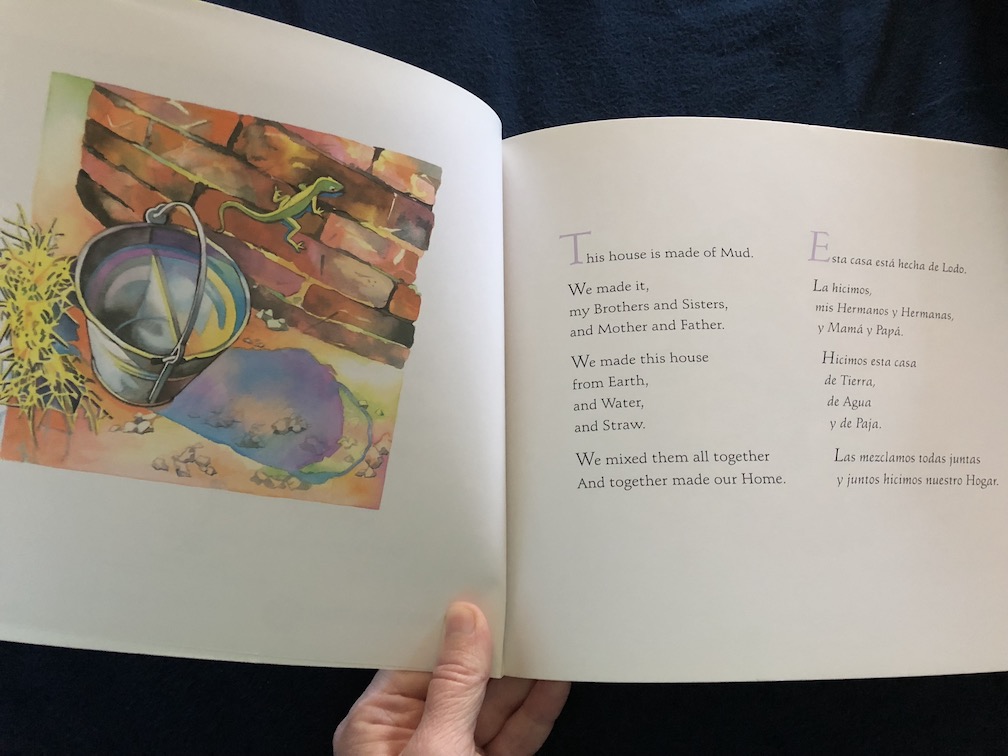
The story is written in a poetical form (non-rhyming), describing an adobe house, which is why it’s made of “mud.”  It’s a traditional way of building houses in the American Southwest, where I’m from.

HouseMudBeginning

As the book describes the house, it compares it to the land around it and the world in general.  Like the Earth, the house is round, which is how some Native Americans build their houses.

HouseMudRound

Aside from the people who live there, animals also share the house, from the family pets to bugs and mice who live in the walls and under the floor.

HouseMudAnimals

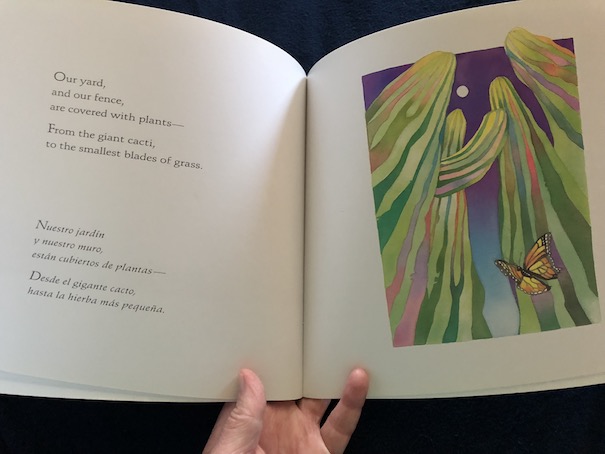
Their yard is the desert, surrounded by mountains and full of cactus.

HouseMudYardCactus

The people who live there have many friends who come to visit, and it is a house full of love.

The book is currently available through Internet Archive.

HouseMudLove

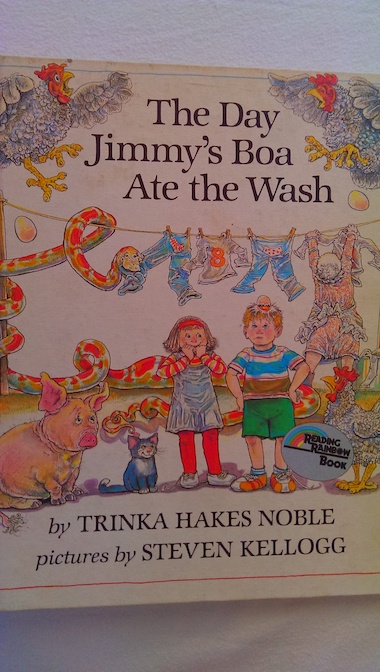
The Day Jimmy’s Boa Ate the Wash

JimmysBoa

The Day Jimmy’s Boa Ate the Wash by Trinka Hakes Noble, pictures by Steven Kellogg, 1980.

The fun thing about this story is the backward way that the girl begins telling it, somewhat resembling The House that Jack Built, or better yet, the old No News Joke. The joke is really closer to the format of the story, with someone explaining the least eventful thing that happened as though it were the most important when it was just the end result of everything else.

A young girl (unnamed) arrives home, and her mother asks her how she liked her class trip to a farm that day. She says that it was boring until the cow started crying. When the mother asks her why the cow was crying, she says that the farmer wasn’t paying attention to where he was driving his tractor and knocked a haystack over on the cow.

As the mother continues to ask her daughter questions about what happened, backtracking through events, the real story begins to reveal itself:

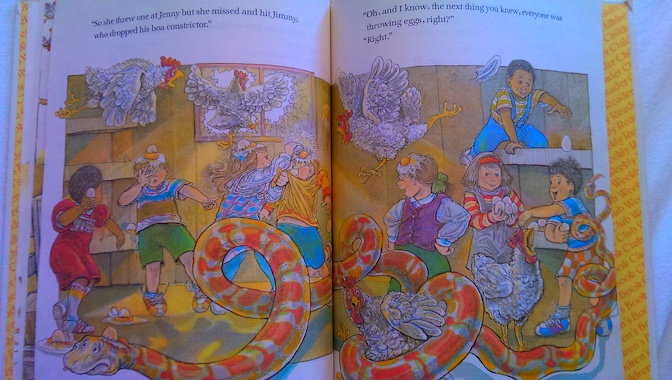
The girl’s friend, Jimmy, had a pet boa constrictor, and he brought it along on the field trip so it could meet all the farm animals.

JimmysBoaFieldTrip

However, the chickens became frightened, and one of them laid an egg on one of their classmates. She thought that someone else threw it at her, so she threw another egg at him, which hit yet another student.

JimmysBoaEggs

From there, it turned into one big food fight, with students throwing eggs at each other, and when they ran out of eggs, they threw corn at each other. The corn was for the pigs to eat, so the pigs wandered onto the school bus and started eating the children’s lunches. From there, chaos ensued until the farmer’s wife suddenly screamed, and the children’s teacher hustled the children onto the school bus to go home.

JimmyBoaLeaving

The children never knew exactly why the farmer’s wife screamed (although the reason is actually in the title to the book), but two things quickly became evident: Jimmy accidentally left his boa constrictor behind on the farm, but he has acquired a pet pig because there was still one left on the bus.

This summary doesn’t quite do the story justice because the backwards way the story starts out is part of the fun. The pictures in the book are hilarious, and the boa constrictor is shown at the end to have become a beloved pet of the farmer and his wife, even making friends with the chickens.

This is a Reading Rainbow Book.  It is currently available online through Internet Archive.

The Purple Coat

PurpleCoat

The Purple Coat by Amy Hest, 1986.

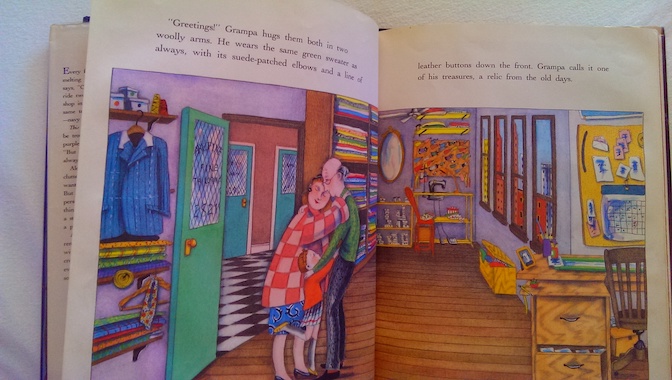
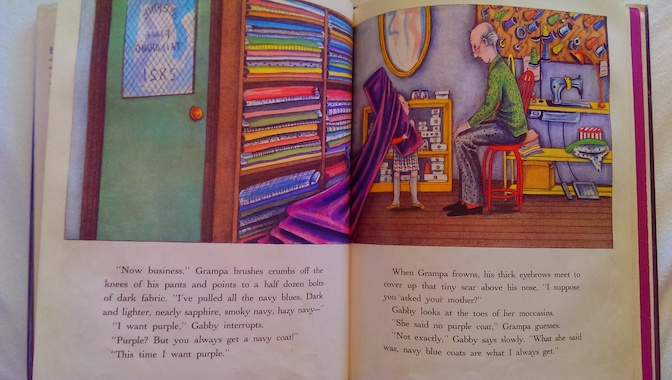
Every year in the fall, Gabrielle and her mother travel to the city to visit her grandfather’s tailor shop. While her mother shops at other stores, Gabby and her grandfather have lunch together (Gabby always eats the same kind of sandwich), and her grandfather makes her a new coat. Gabby always gets the same kind of coat, and it’s always navy blue.

PurpleCoatTailorShop

However, this year, Gabby wants something different. She wants a purple coat! She also wants it in a different style than her other coats, and she wants it to have a hood. At first, her mother and grandfather can’t believe that she really wants something so different from what she usually gets, and they point out that navy coats are classic, but Gabby is insistent.

PurpleCoatRequest

Gabby worries that her mother won’t let her get the coat that she really wants, but her grandfather remembers that when her mother was little, she once wanted something really unusual herself: a tangerine-colored dress. Sometimes, people do want to do different things, just to have a change and try something new. He also thinks of a way to give Gabby what she wants while allowing her to go back to her classic navy when she feels like it. Gabby’s new coat is reversible!

This is a Reading Rainbow book.  It is currently available online through Internet Archive.

Imogene’s Antlers

ImogenesAntlers

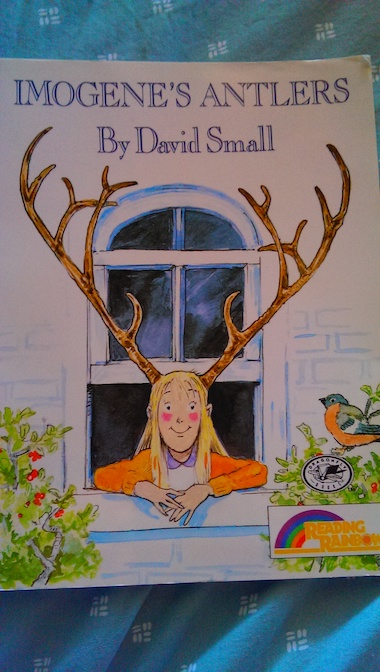
Imogene’s Antlers by David Small, 1985.

One day, a young girl named Imogene wakes up to find that she has sprouted antlers during the night. It comes as a shock to the rest of her family, and she finds that it’s very difficult to do things with large antlers sticking out of her head.

No one seems to know why Imogene has sprouted antlers or what to do about them. Imogene’s mother faints just about every time she looks at her daughter, and her attempt to help Imogene hide them with a specially-designed hat is pure disaster. Imogene’s brother, Norman, thinks that Imogene might be a rare kind of elk now.

However, Imogene still has a lovely day as the family maid uses her as a rack to dry towels and the cook decks out her antlers with donuts to feed the birds.  She even puts candles on her antlers as an elaborate candelabra while she practices her piano lesson.

ImogenesAntlersDonuts

Still, it’s a most bizarre day, and her family is relieved when the antlers are gone the following morning.  But, Imogene’s adventures may only be just beginning.

The book never offers an explanation for why Imogene grew antlers or why she now has a peacock tail, but it doesn’t really matter. This is just one of those books that’s fun to read because it’s silly. While Imogene’s mother panics over her daughter’s condition and tries to hide it under a ridiculously big hat at one point, readers don’t have to worry about the long-term implications of Imogene’s antlers (or any other animal transformations) because she just enjoys them for what they are. The peacock feathers may not have as many practical uses as the antlers did, but one can imagine that Imogene will make the most of them while she has them.  I loved this book when I was a kid!

This book was featured on Reading Rainbow.  It is currently available online through Internet Archive.

The Great Kapok Tree

KapokTree

The Great Kapok Tree by Lynne Cherry, 1990.

The book begins with a letter from the author, saying that she wrote the book in order to explain to people the importance of rain forests and why they should be preserved.

KapokTreeMap

Two men are walking through a rain forest. They are there to cut down the trees (probably for farming). The animals watch as one of the men begins chopping at a great Kapok tree with his axe. It’s hard work, and before the man gets very far with his chopping, he has to stop and rest.

As the man sleeps, the animals come to him and whisper to him not to chop the tree down. The boa constrictor tells him that his ancestors have lived there for generations. The monkeys tell him that if he chops all the trees down, there will be no tree roots to hold the soil in place, and it will wash away, eventually changing the land into a desert. The birds are worried because people use fire to help clear the forest, and it destroys everything. All of the animals are worried about where they will live and what they will eat if the forest disappears.

KapokTreeButterflies.jpg

The animals also point out to the man that destroying this forest would also be destroying his own future and that of his children. The forest produces oxygen for humans to breathe.

KapokTreeChild

Finally, a human child from the Yanomamo tribe that lives in the forest asks the man to wake up and look at him and all the animals. The man is startled and amazed by what he sees. He thinks about continuing his work, but seeing the child and all of the animals staring at him silently, hoping that he won’t, he decides that he can’t bring himself to do it and leaves.

KapokTreeEnd

I don’t remember reading this book when I was a kid, but I remember other stories very much like it.  Environmental issues like this were common topics of discussion when I was in elementary school during the early 1990s.  One of the movies of my childhood, FernGully, came out in 1992, a couple of years after this book was first published.  That movie is also based on a book, although it has even more fantasy elements than this story, which has talking animals.  Both of these stories demonstrate how many children during the 1990s were raised to be environmentally aware.

This is a Reading Rainbow Book. It is currently available online through Internet Archive (multiple copies).

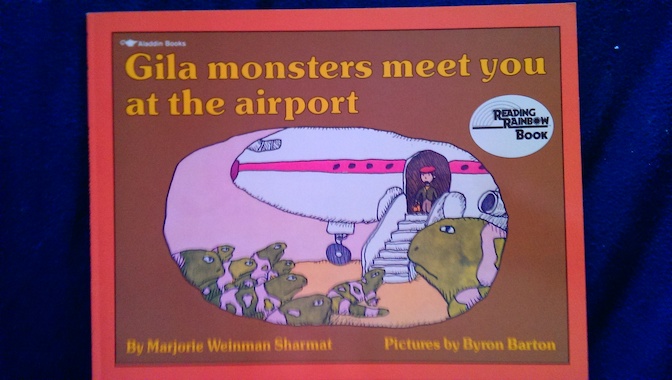
Gila Monsters Meet You at the Airport

GilaMonsters

Gila Monsters Meet You at the Airport by Marjorie Weinman Sharmat, pictures by Byron Barton, 1980.

This is a humorous picture book about a boy moving from one side of the United States to the other and his misconceptions of what he’s going to find when he goes west.

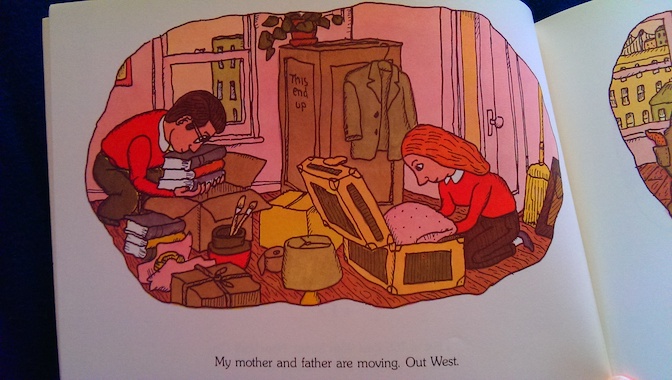
At the beginning of the story, the boy lives in an apartment in  New York City.  As far as he’s concerned, he could live there forever, but his parents decide that they’re going to move “Out West.” (The book never really says what state they’re moving to, but it seems to be somewhere in the Southwestern United States, like Texas, New Mexico, or Arizona.)

GilaMonstersMoving

The boy thinks he’s going to hate his new home.  He thinks of all the things that he’s heard about the West, like there’s cactus everywhere so you hardly know where to sit down, everyone dresses like a cowboy and rides horses everywhere, all he’ll ever get to eat is chili and beans, and he’s bound to die of heat exhaustion in the desert.  His best friend in New York, Seymour, told him that Gila monsters would meet him at the airport.

GilaMonstersCactus

Of course, there aren’t any Gila monsters at the airport when the boy gets there.  Instead, he meets another boy whose family is moving East.  The two boys talk to each other for awhile, and the Western boy starts telling him that he’s not looking forward to heading East because he’s heard that it’s always cold there, the cities are overcrowded and full of gangsters, the buildings are so tall that airplanes fly through the apartments, and there are alligators in the sewers.  He expects to find alligators waiting for him at the airport.

GilaMonstersAirportBoy

Of course, things aren’t as bad as either boy is expecting.  The boy from New York realizes that Seymour and his other friends back East don’t know much about the West, and he starts realizing that things in his new home are actually pretty good, some of them not all that different from home.

GilaMonstersArrival

This book was featured on Reading Rainbow.