The Runaway Bunny

The Runaway Bunny by Margaret Wise Brown, pictures by Clement Hurd, 1942.

A little bunny tells his mother that he’s thinking about running away, but his mother assures him that, no matter where he goes or what he does, she would always come after him because he’s her little bunny, and she loves him.

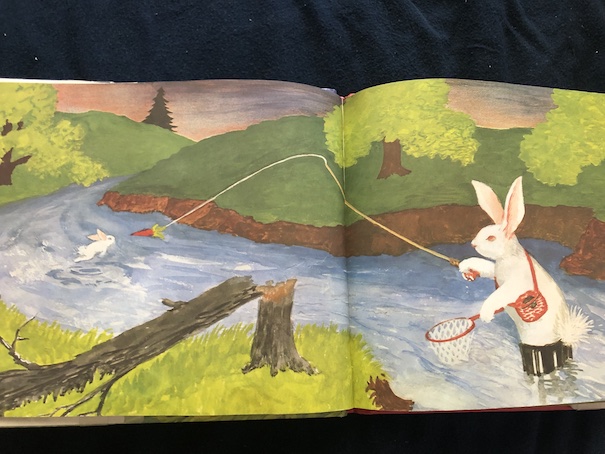
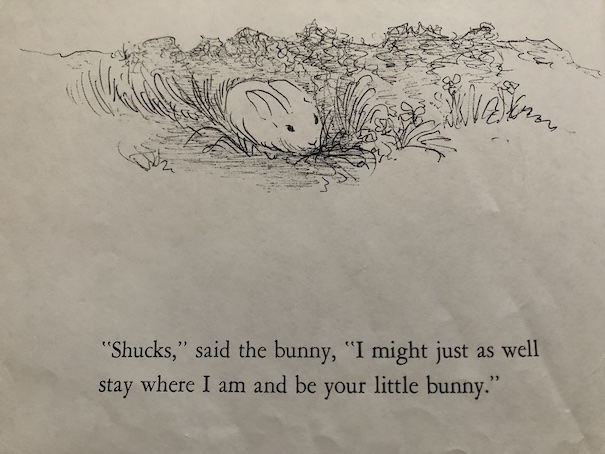
The pictures where the little bunny talks about all of his ideas for running away and evading his mother and where his mother explains what she would do to follow him are in black-and-white.

However, there are large, full color pictures after each of these sections showing what would happen as the mother follows her little bunny.

The little bunny’s plans for running away become increasingly imaginative and outlandish, from going up a mountain and joining the circus to transforming himself into a fish, a bird, or a sailboat.

No matter what the little bunny thinks of for running away and changing himself into something else, his mother assures him that she would find a way to come after him and be there for him. In the end, the little bunny decides that he might as well stay with his mother, just as they are.

The book is available to borrow and read for free online through Internet Archive (multiple copies).

My Reaction

This is a very well-known and much-loved book about parental love and the lengths that parents will go for their children. The mother bunny is determined to be there for her child, even when the child wants to run away. We don’t know why the little bunny was talking about running away from his mother, and without that, it seems just like the little bunny was just trying to provoke his mother to find out how much his mother loves him. When she tells him all the things she would do to reach him if he ran away, he seems reassured and content to remain her little bunny.

This book was originally published during WWII and is a calm and reassuring story that probably comforted many children living through unsettling times. It has never been out of print since its original publication.

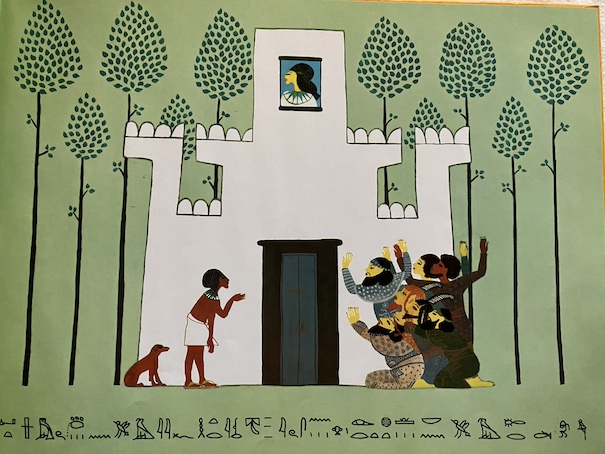
The author and illustrator of this book also later wrote and illustrated Goodnight Moon. The scene where the little bunny imagines himself as a boy in a house and his mother says that she would still be his mother reminds me of the illustrations in that book, and I wonder if the mother and child rabbits in that book came from this one.

Lowly Worm Sniffy Book

Sniffy books or scratch-and-sniff books were a new development during the 1970s, and they remained popular through the mid-1980s, along with scratch-and-sniff stickers. This particular book features characters from Richard Scarry‘s Busytown series, especially Lowly Worm. The first part of the book has Lowly and his friend Huckle Cat looking at a sniffy book and teaching readers how to use the scratch-and-sniff parts of the picture.

The rest of the book takes readers through the four seasons: spring, summer, fall, and winter. In each season, there are different objects and foods associated with the season for readers to scratch and sniff. In the spring, the characters smell violets and bananas that they eat at the circus.

During the summer, there are lemons for making lemonade and chocolate ice cream sticks that they eat at the beach.

During the fall, there are apples and pumpkin pie at Thanksgiving.

The winter parts focus on Christmas, with pine-scented Christmas trees and gingerbread pigs.

Sniffy books and stickers were common features of my early childhood in the 1980s. I think they still exist, although I don’t know if they’re as popular in the 21st century as they were back when they were relatively new developments. This particular sniffy book was a favorite of mine and my brother when we were little kids.

One of the interesting things about finding some of these older sniffy books decades later is seeing which of the scratch-and-sniff patches have held up over the years. They do wear out over the time, especially the ones that have been scratched more than others, meaning that favorite scent patches will wear out faster. Milder scents are also harder to detect years later than the ones that were always strong. In our old copy of this book, I can’t smell the lemon, chocolate ice cream, pumpkin pie, or gingerbread any more, but the violet, banana, apple, and pine are still fine. I think those scents were always the strongest.

Stories of Rainbow and Lucky: Up the River

This is the fifth and final book in the Stories of Rainbow and Lucky series. I’ve already covering the rest of the books this series, and I have to do all five books in a row because the series is set up like a mini-series. That is, none of the books in the series can stand alone; they are all installments of one, longer story. They only make sense together.

It’s an unusual series from the mid-19th century, written on the eve of the American Civil War, by a white author with a young black hero. Rainbow is a teenage black boy who, in the previous installments of the story, is hired by a young carpenter, Handie, who is just a few years older than he is, to help him with a job in another town, working on renovating a farm house that Handie has inherited. The rest of the series follows the two young men, particularly Rainbow, through their adventures leaving their small town for the first time, learning life lessons, getting new jobs, and even dealing with difficult topics like racism. Lucky is a horse who used to belong to a neighbor of Handie’s new farm. Rainbow befriended him, and in the previous book in the series, he managed to buy Lucky on credit. Because he now owns a horse, he is able to take a new job, delivering mail. This final story in the series follows Rainbow as he begins his new job.

The story is unusual for this time period because it was uncommon for black people to be the heroes of books and for topics like racism to be discussed directly. I wouldn’t say that racism is the main focus of the series. It’s mainly a slice of life and coming of age story for Rainbow as he and Handie both set out in life and begin building careers for themselves, and it’s meant to be educational for young readers. However, racism and racist comments are sprinkled throughout the story, with the author calling attention to the fact that these are not good ways to behave or polite ways of speaking, for the benefit of its original audience of 19th century children. It’s also important to point out that our black hero is not a slave, he is not enslaved at any point in the series, and the series has a happy ending for him. People don’t always treat him right, but he does have friends and allies, and he manages to deal with the adversity he faces and builds a future for himself. 

This particular installment in the series focuses on Rainbow’s new job. It has its hardships and adventures, but it sets up a bright future for Rainbow. Keep in mind along the way that there are a lot of pun names in this series and that people’s names are often clues to their characters.

This book is easily available to read online in your browser through NINETEENTH-CENTURY AMERICAN CHILDREN & WHAT THEY READ, I’m going to do a detailed summary below. If you’d rather read it yourself before you read my review, you can go ahead, but some people might want to know what it’s like in more detail.

This story picks up where the previous book in the series left off, with Rainbow back in his home town with his horse, Lucky. He has just accepted the job of delivering mail. The first characters we see are Thomas and Jerry, two teenage boys working in the stable that belongs to the local tavern. Jerry is younger than Thomas and has only just started working there. He is disgruntled because Thomas won’t let him handle some tasks without supervising him closely. Thomas says that he needs to see how Jerry works before he will trust him to work unsupervised. Jerry thinks that Thomas is implying that he’s incapable of doing the work, which is insulting. Thomas says that his own job depends on his ability to make sure that everything is done correctly in the stables, and as a new employee, Jerry is his responsibility, so Thomas needs to make sure that he knows what he’s doing and does a good job.

Rainbow is boarding Lucky at the stable, and the boys talk about the horse and about Rainbow’s new job. Thomas is a little envious of Rainbow for getting the job of delivering mail, but he couldn’t apply for it himself because he doesn’t have a horse of his own, like Rainbow does. Jerry asks how Rainbow was able to afford a horse, and Thomas explains that he bought it on credit. Making a major purchase on credit involves finding someone who is willing to supply the loan, and Thomas is also a little envious that Rainbow managed to do that because he can’t think of anyone who would trust him enough to loan him that amount of money. Jerry says that he’s surprised that a black boy got the job because the black boys he’s known are so “saucy” (meaning flippant or impudent). However, Thomas says that Rainbow isn’t like that and that he’s smart and a good worker. In spite of the fact that Thomas wishes he was in Rainbow’s position, he admits that Rainbow got to this position because he’s a good worker, and employers trust him because he has demonstrated that he is scrupulous in fulfilling his duties to them. That’s how Rainbow finds people willing to hire him and loan him money.

Rainbow comes to the stable to give Lucky a brushing and take him out for a run. He tells Lucky that he’s been able to have fun up to this point, but soon, they will have to seriously begin their work of carrying the mail. They will have to follow a 24-mile route up the river, traveling in all kinds of weather with a heavy mail sack, and there will be a fine to pay if they don’t stick to the route and arrive on time. However, the work will pay off, and Rainbow says that he will see to it that Lucky has a nice, warm stable and good food. Lucky, being a horse, is unconcerned and is mainly interested in neighing at another horse he sees nearby.

When Rainbow and Lucky return to the stable, Jerry tells Rainbow that Trigget is waiting in the tavern to talk to him. Rainbow goes to see Trigget, and Trigget says that he is there to draw up the contract for Rainbow’s new job. They discuss the job requirements and the pay, and Trigget offers Rainbow advice about how fast his horse can travel and how he can make his mail run on time. Because Lucky is still a young horse, Trigget cautions Rainbow not to run him too hard and risk injury. Traveling the full length of his route at a good pace will take about 8 or 9 hours, so Rainbow should plan accordingly. During periods when the weather is bad and traveling will be slower, Rainbow will have to leave earlier in the morning to make sure that he finishes the route at the proper time.

Trigget also tells him that, even though he’s sure that Rainbow will do his best to be on time with his deliveries, there will be times when he will be late despite his best efforts. Sometimes, the weather will be bad, and there’s always the risk of accidents. Because there are government fines for being late with the mail, Rainbow’s pay includes the option to accept extra money that he can use to pay up to four fines per year, if Rainbow chooses to pay his fines himself rather than having the company pay on his behalf. It’s a bit of a gamble to accept this option because, if Rainbow is late more than four times during the year, he will have to cover the additional late fines himself and will lose money. However, if Rainbow is late less than three times during the year, he can keep whatever is left over from that extra money. Rainbow decides to accept this option because he is confident that he won’t be late very often. With the terms settled, Rainbow signs his contract with Trigget and begins his job.

Rainbow and Lucky set off on their route on the morning of November 1. The book explains that the post office in their town is in a small building next to the tavern, and Rainbow enters from the tavern, using a special key kept on a hook. The postmaster prepared mail bag the night before, so it is ready to go. Rainbow just needs to pick it up.

Rainbow and Lucky ride about 5 miles before they reach the first post office on their route. The postmaster there takes the mail bag from Rainbow, removes the mail meant for his office, and returns the bag to Rainbow. Everything goes according to routine at the first stop, and Rainbow and Lucky continue on their way.

Rainbow begins to consider his new schedule as they travel. They will be traveling for most of the week with a stop at post office No. 5 for a couple of days. The stop at No. 5 would be a good time for Lucky to rest, but Rainbow wonders what he’s going to do there for a couple of days himself. He considers whether he could find any side jobs to do there, like carpenter work or hauling wood.

As they continue on their way, Rainbow talks to Lucky about the countryside, the river, and the bridges, noting how high the water under them can get. About every four or five miles, they stop at another post office. As they keep going up river, the post offices become more primitive. One of them is just in a log cabin with a sign written in chalk to designate it as the post office.

At a place called Mix’s Corner, a man named Mix has a farm and a saw mill. His house also serves as the post office and tavern for the few travelers who come that way. Mrs. Mix handles the mail and gives Rainbow some food while her young son, Ephraim, puts Lucky in the barn, where Rainbow can give him some oats. Rainbow offers to make a whistle for Ephraim, but then, he remembers that it’s better to make whistles in the spring, when the barn is easier to separate from a willow or poplar stem. (There is a detailed explanation here about how that works because the new layer of wood formed in the spring, the alburnum, is softer then. After it has matured, it becomes harder, and it’s more difficult to remove. The author/narrator says that Rainbow doesn’t fully understand the scientific principles behind this process, but he knows from hands-on experience that these wooden stems are easier to work with in the spring. “So much for the philosophy of whistle-making.”) Ephraim is disappointed, so Rainbow offers to make him a windmill toy instead and to bring him a whistle from the store the next time he passes. Stores sell whistles for a penny each, so it wouldn’t be too expensive for Rainbow to buy one for the boy. Ephraim accepts the offer, so Rainbow makes him a windmill out of a wooden shingle (we called this toy a pinwheel when I was a kid, and we made them out of paper), and Ephraim runs around in the yard outside with it to make it spin.

As Rainbow continues on his way, he makes it a point to get to know the people along his route and to make friends with them. At the next house he passes, a woman named Mrs. Captain Myers greets him. The narrator says that she even gives him a “courtesy” (what we would call a curtsy). Normally, she probably wouldn’t make such a formal, deferential gesture for an ordinary black boy, but she knows that he’s the new mail-carrier, and this is an important position in this area as mail is the main form of communication. She values the position Rainbow holds, so he gets special consideration.

She asks Rainbow if he is carrying any letters for her, but he says that he doesn’t know. There is a lock on the mail bag he carries, and he can’t open it because only the postmasters at the post offices along his route have copies of the key. This is how they keep the mail secure. Since he can’t open the bag himself, there’s no way that Rainbow can check for letters for specific people. Mrs. Captain Myers lives a couple of miles from the nearest post office, and she says that it’s often difficult for her to get there to pick up her letters. Rainbow says that, if she likes, he can pick up her mail for her and bring it to her on his return trip, and she say that would be very helpful.

As he rides on, Rainbow confides to Lucky that his desire to make friends and help people he meets along the way isn’t entirely out of kindness for its own sake but also cunning. Rainbow knows that this route will become more difficult to travel during the winter, and there will probably be some times when he will need help from people who live in the area. If he has made friends with them and done them a few good deeds, they will probably be more likely to help him later, when he needs a good deed himself. The narrator/author weighs in at this point with some thoughts about how Rainbow needn’t think this form of “cunning” isn’t also kindness:

Rainbow was very much mistaken in supposing that his disposition to be obliging to the people who lived along the road was to be attributed to cunning and not to kindness. If we really entertain feelings of good-will o those around us, and desire to promote their happiness by every means in our power, and take pleasure in doing it, then we are truly and sincerely kind. The fact that we are aware that, by so doing, we make other people ready to show kindness to us in return, and that we are even influenced in what we do by a desire to secure such requitals, is nothing in any sense derogatory. “Cast thy bread upon the waters: thou shalt find it after many days,” is an injunction of the Scriptures, and it implies that it is right for us to be influenced in our efforts to do good by the hope and expectation of receiving at some day or other a beneficial return.

(I can see the point, that a kind act isn’t diminished by the other person’s gratitude or willingness to return the favor. The author might have also considered that there are also less kind ways for people to try to get people’s cooperation than building up goodwill in advance. Some people might simply expect deferential treatment as their due without showing care or consideration to the other people involved, or worse, they might use the threat of bad behavior to make other people do things for them. Rainbow is taking a better path by showing others that he does care about them and is willing to help them when he can, even if they haven’t done anything for him yet.)

The final stop on Rainbow’s route is post office No. 5, which is in Squire Holden’s house. (The book sometimes calls Mr. Holden by the title “squire,” which can have several meanings. Besides the British gentry title, it can refer to the primary land owner in a village, which may be the meaning here, or to someone who holds a legal position, like the lawyer in the first book in the series, who was also called “Squire.” The legal title is still in use sometimes as a courtesy title for lawyers in the form of “esquire“, after a lawyer’s name, frequently abbreviated as Esq.) The village is very small, with only a blacksmith shop, a mill, and a general store. Squire Holden’s house is only one story with an addition built on that doesn’t look completely finished. Since Rainbow has had some carpentry training from Handie (in the earlier books in the series), he thinks that he might be able to get some work helping the Holden family finish it. Squire Holden isn’t at home when Rainbow arrives, but his wife greets him and tells him where to put the mail bag.

According to the arrangement of his route, Rainbow will be staying with the Holdens for a couple of days before beginning the journey back. Trigget discussed with the Holdens before Rainbow began his job, telling them that the new mail carrier would be a black boy. As mentioned in the first book in the series, some people in this time and area might object to having a black person stay with them, so Trigget wanted to make sure that Rainbow would be welcome with them and would have a place to stay. The Holdens have no objection to hosting Rainbow, with Mrs. Holden saying, “that she never cared at all what color a cow was so long as she gave plenty of good milk.” (Meaning that she isn’t concerned about Rainbow’s race as much as his behavior, and Trigget has given him a good character reference, so it’s all fine with her.) The narrator says that Trigget thought that would probably be the case with the Holdens, but he thought that they would appreciate him discussing the situation with them first anyway, since Rainbow would be staying in their home as a guest. The Holdens’ small daughter, Toolie, is very shy of Rainbow when he first arrives, but she warms up to him gradually during his stay. Rainbow helps to win her over by making a little doll for her.

Mr. Holden is out in the woods, cutting down some trees. Rainbow offers to go and help him, if there is an extra axe, but Mrs. Holden says that the only other axe they have is an old, dull one. Rainbow goes to the village store to see if he can buy an axe, but the store is closed. The nearby blacksmith tells him that the store doesn’t sell axes anyway. All they have is axe handles. Rainbow watches the blacksmith making horse-shoe nails for a while, and the narrator describes the process. The blacksmith comments about the horse Rainbow rode there and asks who owns it. Rainbow says that’s a difficult question to answer because he has bought the horse but hasn’t yet paid for him. Since Rainbow doesn’t explain further about buying the horse by obtaining a loan for the purchase and that it’s the loan that he hasn’t repaid, the blacksmith is surprised and doesn’t really believe him.

Rainbow spots an old axe in the blacksmith shop and studies it. He knows more about evaluating the condition of tools than the blacksmith thinks because of his time working with Handie. Rainbow realizes that the axe is old and has been worn down and resharpened many time before. To put it in good repair again, the axe head would have to be removed from the hand and reshaped through a process they call “setting” (which the author describes as one of his detailed explanations of 19th century life). Rainbow negotiates with the blacksmith to purchase the axe and have it set. (The blacksmith quotes him the price of a “shilling.” It surprised me that he called it a shilling because that’s usually a British monetary description, and this is the mid-19th century, well after the Revolutionary War. I didn’t realize that expression was used in the United States that late. The amount of money in the “shilling” the blacksmith expects is also different from the British shilling. The British shilling would be worth 12 pence or pennies or 1/20 of a pound, but the book explains that the blacksmith wants 26 cents.) The blacksmith asks when Rainbow can pay for it because he said that he didn’t pay for the horse he bought, and the blacksmith doesn’t think he really has any money. To his surprise, Rainbow produces the money and pays right away, which makes the blacksmith hold him in higher regard. The blacksmith says that he can have the axe ready for him that evening.

When Rainbow returns to the Holdens’ house, he uses their old axe to split some wood in the yard. When Mr. Holden returns home for supper, he says that Rainbow can help him to clear a piece of land. He offers Rainbow two shillings a day for his help, which Rainbow considers a good wage. Rainbow tells him about the axe he is buying from the blacksmith, which he can use for clearing some bushes while Mr. Holden cuts down trees. However, Rainbow says that he would also like to explore the neighborhood the next day because he has never been in this area before.

After supper, Rainbow returns to the blacksmith, whose name is Mr. Whackhammer. He helps by operating the bellows while the blacksmith works on the axe. Mr. Whackhammer comments that Rainbow seems to have some understanding of tools, and Rainbow explains a little about his work with Handie over the summer. The blacksmith thinks that he’s bright to have picked up some knowledge of tools in such a short time. After the blacksmith finishes setting the head, Rainbow buys a new handle for it and fits the head to the handle. (The author also describes the process for that.)

Rainbow spends the rest of evening talking and telling stories with the Holdens by the fire. When it’s time to go to bed, Mr. and Mrs. Holden talk to each other a little about Rainbow. Mr. Holden says that Rainbow seems like a smart boy, and Mrs. Holden says that he is also pleasant company, noting that, “I’m more and more confirmed in my opinion, that it is of no consequence what the color of a cow is, provided she is not cross, and gives plenty of good milk.”

The next morning, Rainbow goes out to the woods with Mr. Holden and helps him clear the underbrush on the land he is trying to clear. When he does a good job with that, Mr. Holden says that he can try his hand at cutting down trees, which is trickier. A person cutting down a tree needs to cut it in a particular way so that it will fall in the direction he wants it to fall. The narrator explains how this works, and Rainbow follows Mr. Holden’s example. They make good progress before they go home for dinner. (“Dinner” is frequently what they call lunch in the countryside, and that is the case here. They go home for lunch.)

After dinner, Rainbow says that he would like to take a walk and explore the area that afternoon. The Holdens tell him a little about the people who live nearby, including a man named Mr. Dyker, who is building a house. Rainbow says that he might go see him and offer his help. This, unfortunately, leads us to the second use of the n-word in this series. As Rainbow approaches the house, he hears Mr. Dyker say to the man who is with him, “Who is this (n-word) coming, Dan?” When Rainbow hears that, he almost turns around and leaves, wishing that he hadn’t bothered to come. What stops him is that Dan replies, “Don’t call him a (n-word), Joe, till you find out whether he deserves it.” Rainbow decides that he might take a chance on these men since at least one of the two seems willing to give him a chance. (Personally, I might not be so charitable. Rainbow considers Dan a “fair man” for his comment about reserving judgement to see “whether he deserves it”, but to my way of thinking, calling that comment “fair” would imply that there might be people who do deserve that kind of slur, and I’m not convinced. Granted, it’s not as bad as immediately calling a total stranger something bad for no reason, but it’s still not great.) Rainbow still feels indignant about the insult, but he decides to follow his mother’s advice about “overcoming evil with good.”

Rainbow explains that he heard they would be raising a house frame this afternoon, so he came to see if he could help. Mr. Dyker says that perhaps he can. Mr. Dyker doesn’t think too much of Rainbow’s abilities at first, and he also hesitates to let him do too much because he thinks Rainbow might expect payment. He asks Rainbow what kind of wages he expects, but Rainbow says that he doesn’t need any money. He’s just looking for things to do because he is the new mail carrier and will be staying here for a short time before following the route back down the river. Hearing that Rainbow is the new mail carrier catches Mr. Dyker’s attention. Rainbow explains what he can do to help them, and Mr. Dyker and Dan realize that Rainbow has some carpentry experience. Dan suggests that they let Rainbow show them what he can do. When they see that Rainbow knows what he’s doing, they’re happy to let him work with them. As they work, they chat pleasantly with each other, and they begin feeling better about each other.

When Mrs. Dyker begins to lay out supper, Rainbow gets ready to leave, thinking that they might not way to eat with a black person, considering the way Mr. Dyker talked before, but they insist that they would like him to stay and have supper with them, so he does. While they’re getting the supper ready, Rainbow even picks some flowers for Mrs. Dyker, as “the lady of the new house.” The author/narrator says that this gesture pleases Mrs. Dyker, even coming from a black boy (which seems a little back-handed to me). The author/narrator also says that Mr. Dyker adds a prayer of blessing for Rainbow to their prayer before the meal. He says, “Mr. Dyker was perfectly honest and sincere in these invocations, for he was really a good man, although he had been so heartless, or rather so thoughtless, as to call Rainbow at first by an opprobrious name.”

Mr. Dyker compliments Rainbow on his carpentry skills, and Rainbow thanks him, but he says that he doesn’t plan on becoming a real carpenter. Mr. Dyker asks him why, and Rainbow says that he has trouble with the mathematical skills that professional carpenters need to plan what they build. Handie tried to teach him a little geometry, but he found it difficult to understand. The author/narrator praises Rainbow for this honest and accurate assessment of his own skills and limits. Rainbow knows his tools and can carry out some basic carpentry tasks and assist others, but he knows that he can’t plan out the full construction of a building or more complicated projects by himself. Still, Mr. Dyker thinks enough of Rainbow’s skills that he says anytime he has free time, he will pay him to help further with his building project. Rainbow says that he will be free on Friday, and he can work for Mr. Dyker that day, but he can’t make promises beyond that point. He’s still getting a feel for his new job as mail carrier, and he can’t say what other jobs might come up for him on the side.

On Rainbow’s way back down the river from his first trip, he remembers to pick up Mrs. Myers’s letters for her, as he promised before. He also remember to buy a penny whistle for young Ephraim to take with him when he begins his next route up the river. He knows it’s important to keep his promises while building relationships with the people he meets.

As Rainbow continues making trips up and down the river, he starts to become better friends with little Toolie. In particular, Toolie likes the way he answers the questions she asks. The narrator explains that Rainbow is very good at answering the questions of young children because he knows a little more than they do, but not a lot more. Rainbow is still young himself, in his teenage years, and he is just starting to get out in the world and experience more of life, but he isn’t that much more experienced than a kid yet, which the author says is the ideal mindset for explaining things to kids. Often, adults with a lot of knowledge and experience will try to tell kids too much or make their explanations too detailed when talking to young kids, confusing them. Rainbow is one step ahead of them in his knowledge, and one step further is the most a young kid can take at once.

At this point, the author delivers a reprimand to adults who assume that, just because they cannot give a young child a complete, detailed answer to their questions that the child should not have asked the question in the first place. He says that asking questions and trying to understand the world is part of the natural business of childhood and is important for helping the child to prepare for later life, so a child should never be criticized or shut down for doing that. He says that it is unreasonable for an adult to try to stop children from asking questions or reprimand them for their growing young minds simply because the adult finds it difficult to handle and formulate answers. (I have some thoughts about this, but I’ll save them for my reactions section.)

One day, little Toolie asks Rainbow questions about his appearance, trying to figure out why he looks different from everyone else she knows. (Her questions sound awkward and would be insulting, if they didn’t come from a little child who is just struggling to understand something that she has noticed.) She starts by asking him why his face is black. Rainbow simply says that he’s always been like that. Toolie thinks about it a little and then asks if the black would wash off if he washes his face. Rainbow explains that it won’t because his color is something inside himself that just grows there, and it’s not something on the outside of his skin that would wash off. (Rainbow might not know the word melanin, but this basic description is accurate. The scientific explanation is that all humans have melanin in their bodies, but we have it to different degrees. People with a lot of melanin have darker skin, hair, and eyes, and people with less have lighter features. This is an example of how Rainbow, with little formal education, can’t supply some of the more complex, scientific explanations, but he can deliver simple explanations that are accurate and easy enough for a young child to understand.) Toolie further asks Rainbow about his curly hair, and Rainbow says his hair curls like that naturally, although some people use curling tongs to curl their hair. Toolie understands this because her mother also has curling tongs.

Satisfied with this basic explanation, Toolie tells Rainbow about the schoolhouse up the road. Toolie sometimes goes to school there, when her father has the time to take her there, and she asks Rainbow if he will take her there sometimes. Rainbow says that he could take her on Lucky when he carries the mail, making a pun on male/female: “Then Lucky would have a mail and a female on his back.” Toolie is confused because she doesn’t understand the terms male and female yet. Rainbow asks her what she learns at school, and Toolie says she is learning to count, but she can only count up to nine so far. Rainbow jokes about his own ability to count, saying that he counts, “One couple three several, many more enough, plenty, and ever so many.” Toolie doesn’t believe him that this is the right way to count, and they move on to talking about why the sun is so bright and warm before it’s time for dinner.

Toolie’s parents arrange with Rainbow for him to take her to school one day before he leaves with the mail. Rainbow takes Lucky for a brief run before picking up the mail and Toolie because Lucky is very energetic, and he doesn’t want Lucky to act up and scare little Toolie while she’s riding with him. Toolie is very nervous when she gets up on Lucky, and Rainbow tells her that’s fine and normal:

“Yes,” said Rainbow, “every body’s afraid the first time they ride upon a horse. I expected that you would be afraid. But that’s no matter. It does not hurt any body to be afraid, so don’t you mind it.”

(I like that advice better than “All we have to fear is fear itself.” Learning not to be afraid of your own fear sounds like a more positive move.)

The other children and their teacher are surprised to see Rainbow arrive at the school, carrying Toolie on horseback. He introduces himself and explains that he’s the one who carries the mail. Some of them say that they would love it if Rainbow would bring them letters, and Rainbow laughs before he rides off again.

There is a brief interlude at this point that explains that Toolie is one of the youngest children at the school and describes what the youngest children do. It’s a small, one-room schoolhouse, so the teacher divides her attention between the different levels of students. Mostly, the youngest children just practice reciting their letters for the teacher at various points throughout the day, and the rest of the time, they are allowed to play outside, as long as they stay within sight of the school and come inside when the teacher rings the bell.

As Rainbow continues to travel his route, he meets more people and becomes better acquainted with the terrain and how it changes with the weather and changing season. There is one point when he has to ask a strange for directions for an alternate route because he realizes that the water in a stream he crosses is rising too high and that his usual road may become impassable. Later, he befriends some children he meets while watering his house and makes toy boats for them. He calls the children he meets along his route “my children” because he has a soft spot for young children and likes looking after them and making them little toys.

There are times when the route is harsh due to bad weather, which Rainbow knew would happen before he began the job. He still has to get the mail through as best he can, no matter the weather. There is one time when he has to walk the mail across and then his horse across a flooded crossing. The only time when he misses one of his stops is when he gets lost in a snow storm because the roads are covered in snow, and he fails to reach No. 5. When Rainbow realizes that they’re lost, he and Lucky have to camp out in the woods. Rainbow makes them a couple of huts for shelter, and they are able to find their way in the morning.

Rainbow’s most serious problem comes when Lucky is stolen from Trigget’s stable one night by a couple of thieves. At first, Trigget assumes that Lucky simply got out of the stable himself somehow and is lost, so he loans Rainbow another horse that he can ride to make the mail run. Rainbow is very upset, but he has no choice but to start on his route with the borrowed horse. At every stop on his route, he asks if anyone has seen Lucky, but nobody has.

Meanwhile, the thieves are hiding in a house in the countryside, planning to wait until Rainbow has stopped looking for his horse. Eventually, they plan to take the horse to Boston to sell him. To make Lucky less recognizable, they paint white markings on him. However, Lucky doesn’t like the rough shed where the thieves are keeping him. He gnaws throught he rope securing him. Unable to get out of the shed, he lies down behind some barrels, so when the thieves come to feed him the next day, they don’t see him. When they find him behind the barrels, they lead him out of the shed and have a look at his rope. Seeing that he chewed through his rope, they decide that they need to put a sturdier harness on him. While they’re trying to harness him, Lucky breaks free and runs away.

Lucky wanders around and hides in the woods. Getting hungry, he looks for food and eats some hay from a traveler’s sled. He runs away from most of the people he sees. He really wants to find Rainbow, and Lucky recognizes that Rainbow is black, so he runs away from any white person he sees. When he finally sees a black man coming along the road, he follows him, thinking at first the it might be Rainbow. It isn’t, but Lucky continues to follow him anyway because he reminds him of Rainbow.

The black man, whose name is Augustus, lives in a log cabin. Lucky explores around the cabin and finds a supply of hay, so he starts eating it and then goes to sleep. The next morning, Augustus comes to get some hay for his cows and finds Lucky eating it. Augustus calls to his teenage daughter, Rosalinda, to come and see the horse. He asks Rosalinda if she knows who owns this horse, but Rosalinda says that she doesn’t recognize him and doesn’t think he belongs to anybody nearby.

Augustus puts Lucky in his shed and gives him more hay to eat while he decides what to do. Since they don’t know who really owns him, Augustus decides that they should make some advertisements about the horse they found. Rosalinda knows how to read and write, so Augustus tells her what to write on the advertisements, having her make four copies. Augustus’s plan is to take their advertisements to Mix’s Corner and give them to the mail carrier to post in the tavern. Of course, Rainbow is the mail carrier.

When Augustus meets Rainbow and tells him about the horse he found, Rainbow recognizes Lucky from his description, except for the white markings the thieves painted on him. Rainbow goes with Augustus to have a look at the horse, and he realizes that the white markings are only paint. He knows that someone must have taken Lucky and painted him deliberately, although he still doesn’t know the full story behind Lucky’s disappearance. He is grateful to Augustus for finding Lucky and taking care of him, and he takes Lucky home and cleans him up.

Rainbow runs into trouble as winter begins turning into spring. The snow is still high, but it is just starting to melt, which makes it too soft and too deep for Lucky to walk on. People who live along Rainbow’s route help by trying to clear the roads where they can, so Rainbow can get through, but there are still times and places where Lucky has trouble sinking into the snow.

One day in early April, it rains, and this makes the going even more difficult. Rainbow and Lucky make it to Mix’s Corner, but the people tell him there that he shouldn’t try going further because the conditions are bad. Rainbow feels obligated to try to get the mail through anyway, so he decides that he will walk the rest of the way while leading Lucky. However, when he comes to a bridge, a stranger who lives nearby warns him not to try to cross because the bridge is unsafe. Rainbow could try to cross the stream on the ice, but with the thawing, the ice isn’t safe, either. Since there is a saw mill nearby, Rainbow decides that he can get some boards that can help him cross the ice by himself with the mail bag, but he will have to leave Lucky behind.

Rainbow arranges for the stranger to board Lucky in his barn and to help him lay the boards over the ice so he can cross. (The book explains that laying boards over thin ice can reinforce it so it can support the weight of a person when it otherwise wouldn’t. The idea is that the board will distribute the person’s weight more over the surface of the ice. It states this as a fact that young readers may already know, probably from living in areas where people do this. I’ve never lived in a place where it snows, so I’ve never had a reason to try to cross ice, but I understand the principle of weight distribution.) Rainbow says that he could also use a hand-sled to carry the mail further. The stranger doesn’t have one, but Rainbow asks to borrow his tools and makes one for himself. The man watches while Rainbow crosses the ice, and fortunately, Rainbow reaches the other side safely. Rainbow is able to successfully get the mail through, barely on time, which causes Trigget to lose a bet he made with Jerry because he didn’t think Rainbow would succeed in that weather.

This is the end of the five-book series, and the final chapter explains how our characters are doing and what is likely in store for them in the future. We are told that, “Rainbow went on very prosperously after this in all his affairs.” There are difficulties and dangers in his job, but he is successful because he is prudent and plans ahead for the difficulties he may encounter. The people along his route also help him when he needs it because he’s been so kind to them and their children. Before the end of the year, he is able to repay the loan he used to buy Lucky, so Lucky now belongs to him outright.

Because the loan worked so well for buying Lucky, some people suggest to him that he could buy some farmland in the same way. Handie recommends that he wait until he’s a little older before he does that, and if he wants to buy some land, it would be better for him to do it an area with other black people. While Rainbow gets along well enough with white people because he is so helpful, good-natured, and hard-working, Handie knows that white people don’t always treat Rainbow as well as they should, and he thinks that Rainbow would be happier with people who are like him.

Rainbow says that what he would really like to do eventually is to move to Boston and work for Colonel Hammond, the man who loaned him money to buy Lucky. Rainbow thinks he would enjoy taking care of Colonel Hammond’s horses and driving his carriage, and maybe he could buy a little house for himself so he can go to his own home in the evening. He also thinks that he would like to marry Rosalinda some day, although he hesitates to say that part out loud.

Like the other books in this series, and the series itself in general, this story is mostly slice-of-life, giving readers a look at life in the past. Originally, the places and situations in the book would have been familiar parts of daily life for its intended audience of children in the mid-19th century. Its descriptions of daily things like how blacksmiths make nails or the finer points of making wooden whistles would have just added detail to what would have been familiar to 19th century children. To people reading it in the 21st century, it adds color and dimension to the lives of people in the past, allowing us to picture the ordinary things they would do every day and to get a sense of the things they would have known.

There are adventurous aspects of the story, where Rainbow almost meets with disaster, but no matter what the situation, things always turn out well for him in the end. Sometimes, it seemed to me like the author/narrator built up excitement over Rainbow’s predicament, only for the problems to be solved more easily than expected, which can feel a little deflating. However, it is also reassuring that nothing truly disastrous happens to Rainbow and Lucky in the end, making a gentler read.

Although most of the emphasis of these stories is on daily life, and they’re pretty gentle to read, racial issues are always in the background. Rainbow is always aware that white people look at him differently because of his race, and that this can be a source of potential problems. It’s one of the reasons why he goes out of his way to build up good will with other people, so people come to like him and treat him better. For the most part, this strategy works. The author intended the stories to be educational for children, and there is a lot in the series about how to understand and get along with other people.

Sometimes, people say rude things to Rainbow about his race and appearance. There are three instances where the n-word is used in the entire series, once in the third book, Three Pines, and two times in one scene in this final book, although there are also other, lesser derogatory comments. In vintage children’s books, the way people speak can be clues to their character, and the author of this series particularly likes to examine people’s character and motives. In the second book in the series, Rainbow’s Journey, we had the example of a disreputable man who turns out to be a thief. He is the first person who makes derogatory comments about Rainbow and insists that he doesn’t want to sit near him on the stage coach. Trigget, who is driving the stage coach, tells him off for doing that, and other people laugh at him because they know that he is a disreputable and ill-mannered person in general. I’ve seen other vintage children’s books that use derogatory racial language and attitudes as signs that a character is ill-bred or generally ignorant.

What interested me about this particular series is that the people who use the n-word, characterized as the worst possible language to use, are not the worst characters, just as people. I found that interesting because the characters’ badness wasn’t directly proportionate to the bad language they used. The first person to use the n-word, in the third book, does it during a tirade against Rainbow because he has come to deliver Handie’s refusal to loan her his saw. Basically, she throws a temper tantrum, and she uses the worst possible language she can against the messenger while she’s having her fit just because she’s angry and wants to make him feel as bad as she feels. It’s simply childishness. During their interactions with her and descriptions of how well she doesn’t get along with her other neighbors, the author makes it clear that she is a highly emotional person with little or no sense of self-control, what we might call “no filter” today. For whatever reason, she has little or no ability to regulate her emotions or control the way she expresses them, like she’s permanently stuck in her terrible twos as an adult. Other people besides Rainbow also find her difficult to deal with because of the way she acts, and even she sometimes feels embarrassed about the things she says and does. However, she gradually becomes a more helpful and sympathetic character because the kind, controlled way that Handie and Rainbow respond to her inspires her to improve herself and to put forth a better image.

The two men who use the n-word in this story are different from all of the above. The author characterizes them as being merely thoughtless, especially the first man to do it. I partly believe that because, even after getting to know Rainbow better and appreciating his help, they don’t seem to experience any regret or even realize just how aggravating and offensive Rainbow found their language. The first man in particular, who just casually calls Rainbow the n-word when he’s idly wondering who he is the first time he approaches, is totally clueless. The author characterizes him as being a good man who says his prayers and later even adds a prayer for Rainbow because he’s grateful for Rainbow’s help, never even seems to have an inkling of the bad impression he made on Rainbow with just that comment. In the end, he focuses on how pleased he himself is with Rainbow’s help and totally misses that he’s not completely satisfactory in his own behavior. Rainbow is reconciled to that and appreciates when the man behaves better, accepting him for what he is, but it rankles with me because this man is, in fact, a grown man, and grown people without a clue are just plain aggravating. It just never even dawns on him that he’s done anything that anybody even might object to, and that level of obliviousness drives me crazy. Now, some modern readers might just brush this off as “just the way people talked bad then” and that he didn’t put enough thought into it to really mean anything by it, but I’m not buying it in this instance, for two reasons. In the first place, not everybody is talking like this. Some people realize that this is an ill-mannered and inappropriate way to talk, and they say so. Second, the second man’s comment adds a qualifier on this word that implies that there was more thought behind this comment that even the author of the book isn’t going into.

After the first man makes that off-handed slur, the second man uses the n-word himself, but he does it in the context of telling the first man not to say that until he finds out “whether he deserves it,” meaning whether Rainbow deserves it. It’s this qualifying statement, which is never explained, that makes me uneasy about the assertion that these guys are just “thoughtless.” In order for there to be an evaluation of who “deserves” this language and who doesn’t, there has to be a certain amount of thought into what the term implies and some kind of standard to judge who fits this term and who doesn’t. Rainbow takes the second man’s comment as reassuring, that the man is giving him a chance to prove himself without judging him immediately, but it doesn’t reassure me because I can tell that there is some standard being applied here, it’s a standard that both of the men seem to understand and believe in, I think it’s a negative standard, and I don’t have confidence in their ability to accurately assess other people.

There are reasons why Rainbow and others feel especially insulted by this word and why it’s considered even worse than other words that are also considered rude. To put it mildly, the n-word implies highly unfavorable things about the person being described, and it implies them to a greater degree even that other insulting words. In general, it carries connotations of worthlessness and a sub-human, animal-like state. I know that the men in the story are definitely thinking about some of the unfavorable implications and evaluating them seriously because the second man says that they will see if Rainbow “deserves” the term in a way that says he realizes that the first man may be insulting Rainbow needlessly. I guess it’s nicer to give Rainbow a chance to show his true character before they render judgement, but it’s still troubling because this conversation reveals that these characters do believe that some of the implications of the n-word are accurate about some people and that they think themselves accurate judges of that. It bothers me because I don’t believe either of those things. While I don’t like some people, I don’t think that calling someone sub-human or worthless, particularly just based on race. Also, I have no confidence in the standards or abilities of these people to accurately assess the relative worth of their fellow human beings in general. To be blunt, I believe that self-awareness is a prerequisite for understanding other people, and I don’t think either of these men have much self-awareness. The fact that both men have totally missed the affect that their attitudes have on Rainbow and the effort he has to make to work with them for free just to help them that day makes me think that neither one of them has the capacity to be accurate in their general understanding of other people or to read any individual in particular, even though they have appointed themselves as the judges of the situation. Even after spending all afternoon with him and seeming to get along with him, even noting his initial hesitation to accept the offer to stay for dinner, they still don’t get it. They just never give it a second thought.

You might wonder why does that bothers me so much, if they all managed to get along well enough anyway. I’ll tell you why. How many other people do you suppose they’ve labeled n-words before because those people reacted negatively to them, specifically because they’re clueless and provoked them, and they’ve just never had the self-awareness to realize that they caused it all themselves? I don’t know the overall number, but I could guess that the percentage is likely 100%. Because they have no self-awareness or situational awareness, they casually create bad impressions with the first words out of their mouths. The casual nature of their behavior indicates that this is habitual with them. They are completely comfortable with doing something that makes everyone else uncomfortable because they do it often and think nothing of it.

The author somewhat implies that these men are likely to provoke negative reactions from black people they just casually meet by pointing out that Rainbow could have turned around and walked away at the first mention of the n-word. The only reason why he didn’t do that and leave them there, probably saying that he must have been an n-word, is that he decided to give them a second chance when they didn’t even know that they’d blown the first impression. Rainbow didn’t really have to give them that chance since he was planning to volunteer his services to them, and he didn’t owe them his time or work. Many other people, including me, probably would have walked away with maybe a dirty look and not a single word, and these guys wouldn’t have had a clue why. These guys would probably mutter “What’s their problem?” to that reaction, never realizing that the only problem is their behavior. It bothers me that, even after getting to know Rainbow better, they still don’t know that they almost drove him away or why, and they don’t seem to have any regrets about what they said or realize that Rainbow ever had a problem with it. Because they don’t realize that their behavior is a problem, they’re probably going to do it again with someone else because no real lessons have been learned here. While they have apparently labeled Rainbow as “not an n-word” kind of black person in their minds, nothing has changed the notion that they still have that other people are, so they will probably repeat this process with other black people they meet, cluelessly provoking others and probably blaming them for being provoked. Until someone lays it out for them, they’re just not going to get it, and even then, they might still not because they feel justified and don’t see themselves as others see them.

I’ve said it before that some of the world’s most judgemental people often forget that other people can also look back at them and make their own evaluations of their behavior and character. The author of the story may consider these men as basically good but thoughtless, but bringing up the subject of who “deserves” to be called certain things also raises the question of who really deserves the label of “good.” “Good” is a relative term that comes with levels and gradations. I’d like to to make it plain that, while these men may be good in some ways, I don’t see them as being as good as other characters who also do good things but without talking the way they do. While I’m sure that they’re more law-abiding than the thief from the second book in general character, they rank behind many other characters in my evaluation. Handie, Trigget, and the Holdens all come before them in my estimation, for several reasons. Not only are these characters demonstrably ethical in their dealings with other people, but they give Rainbow a chance to demonstrate his good side to them without making it clear that they were factoring his race/appearance into their assessment of his character. In fact, they explicitly make it clear that they will not do that. More than that, each of them also stands up for Rainbow and/or shows consideration for his well-being. The take his feelings and situation into account, where the men we’re discussing are mostly concerned with what Rainbow can do for them. Even though they later pray for him, the prayer is based around what Rainbow did for them. While I like the fact that they’re showing gratitude for what they’ve received, which is a positive trait, that sense that they’re approaching it from the angle that Rainbow turned out to be a pretty good guy for someone who might have been just an n-word takes the shine off the apple.

It occurs to me that, in pointing out that these men are “good” in spite of their bad/thoughtless behavior, in a way, the author is almost repeating the sentiment of the man who said that they shouldn’t use derogatory language against Rainbow until they see whether or not he deserves to be regarded in a derogatory way. The author seems to be trying to look on the positive side and to encourage readers to find the positive side of other people, even ones who behave badly, but at the same time, there does seem to be an acknowledgement that they did behave badly and that it would take extra effort to get past that bad behavior to their better sides and to see that they might not be totally bad. Yes, these men are acting like rude and clueless racists. However, there is apparently more to their personalities than that. The author would like us to reserve judgement on these men long enough for them to show their true natures and demonstrate that, in fact, they are thoughtlessly rude and clueless and also seem to have some racist attitudes, but they can make exceptions to their racist preconceptions to accept good deeds from particular individuals whom they might otherwise have disdained for their race and remember to be thankful for what they have received and say their prayers.

The second part of that is good, but the first part of that hasn’t gone away. Maybe that’s less bad than if the sum total of their personalities was to swagger around and dish out the slurs and crude language, but less bad isn’t quite the same as “good.” They show gratitude after receiving something but not graciousness on meeting. To me, their up sides just doesn’t make me feel that much better about them, especially since these guys don’t seem to have learned anything from the experience and seem likely to repeat it. At least, Mrs. Blooman learned something and improved. These guys just managed to get through an afternoon and make a business deal for continued services for their project. I can see that the author is trying to demonstrate how issues like this can be smoothed over with good behavior on the part of other people so that people can get along, but I just find it difficult to buy the assertion that these men are that much better than they first seem to be when their good sides don’t seem to have an affect on their bad ones, and they don’t demonstrate a change in thinking or behavior.

After all my analyzing and ranting, what do I think of this book’s potential to teach us more about racial attitudes and interactions during the mid-19th century?

First, I like the fact that the author examines different types of characters who have different motives for their behavior. Human beings have wide-ranging personality types, and I can believe that each of the characters in the story represents the behavior and personality type of people who really existed. I can believe that a genuinely shady person, like the thief, would also have crude manners or racist beliefs due to a bad upbringing or general anti-social attitudes. (I’m guessing that someone who makes their living by taking advantage of their fellow humans and their belongings generally doesn’t hold other people in high regard and might have disdain for particular groups of people.) I have seen people with temperamental natures and poor impulse control, like Mrs. Blooman, and I can believe that someone like her could say some pretty awful things without necessarily meaning them seriously just because she’s lashing out at others during a tantrum. I could believe that the author might have based her on someone he’d seen in real life. I do also believe that the descriptions of the men using the n-word in this book could be realistic, even though I’ve already explained (ranted) about how I don’t look at them quite the way the author does. I believe that they are thoughtless and that they don’t realize the real problems with their behavior or the effect they have on others because they don’t examine their own motives or look at their behavior from someone else’s perspective. They probably also think that they are basically okay because they’re religious, even while provoking people and testing their patience (including mine). All of these types of people seem realistic enough, and some even remind me of people I’ve seen.

However, the second point to keep in mind that the author’s main goal is to write educational stories for children. He’s always in the role of teacher, whether he’s explaining the fine details behind daily things, examining people’s characters, or offering advice on how to behave or deal with someone else’s behavior. Because he is trying to demonstrate the ways that people should act and how people can be influenced to improve their behavior, even the problem people Rainbow meets can generally be managed, and some of them really do improve, at least to some degree. The author is trying to encourage positive behavior and positive outlooks in his young readers.

While I think that his attempts to set good examples are excellent, part of me knows that, in real life, not everybody really does change for the better from the kind behavior of people they disdain. In fact, some people can become increasingly resentful when someone they don’t like seems to be behaving better than they are because they feel like the other person is just acting that way to show them up, so they act contrary to good behavior the other person is showing just to make it clear that the other person can’t influence them. (In modern terms, “vice-signalling” as a response to “virtue-signalling.” ex. “Oh, you don’t like the Confederate flag? Well, I’ve got it waving outside my house, and I’m gonna get it painted on my truck and wear a shirt with it every day! I’ll show you!”) Mrs. Blooman changes her behavior because she feels ashamed of her lack of control and inspired to improve by seeing how well Handie and Rainbow behave. However, in real life, other people might double down on their bad behavior because they feel like they’ve got something to prove, like they’re “strong” for not being influenced by anybody, not even for the better, or because they want to show that they’ve got contempt for other people, no matter what they do. The examples of people and behavior that the author shows throughout this series tend to lean toward the milder side, although there are small implications that Rainbow has seen worse before and that worse and less manageable people are out there.

There are some instances where the author references more difficult and more racist people without directly showing them in the story. For example, we know from the first book in the series that Rainbow wasn’t allowed to go to the small school in his small town because people made it clear that he wasn’t welcome there. Yet, we don’t really see the people in his town abusing him, and people generally seem to like him for being good-natured. Even though we don’t see the people in his town being bad to him or disliking him, we know that they don’t fully accept him and that some have particularly excluded him. When the lawyer managing Handie’s inheritance tells him that he might run into trouble while traveling with Rainbow because some people might not be willing to rent a room to a black person or have a black person dine with them, I expected that this would happen at some point in the story, but it never does. There’s never an instance where they have to try more than one inn, tavern, or boarding house because they are refused service at the first one they tried. There is just that acknowledgement that some people are like that and that it causes problems, but the author doesn’t provide examples of some of the people with the worst behavior.

Overall, my feeling is that the books demonstrate not how everyone behaved during the mid-19th century but how the author would like young readers to behave and how they should respond to examples of poor behavior from other people without becoming angry and overly negative. I think these are useful lessons, and I’d like to think that at least some of the author’s young readers benefited from them. Some pieces of advice that the author provides make sense to me, like maintaining your own good behavior and kindness even in the face of provocation and leaving other people with the echoes of their own bad words rather than returning a flippant comment that might turn negative attention on yourself. The author does provide some insight on how people thought and behaved during the 19th century and how they wanted to inspire the next generation to behave for the better. However, I do know that, in real life, there are even more variations of people that the author doesn’t delve into, particularly some of the more harmful kinds, who do more than just use a bad word, and the kinds that are less likely to change. I think that a modern version of the same story would probably feature some of these darker elements of human behavior, although I also think it would do a disservice to the nature of the story to go too far in the negative direction and forget the positive side that the author wanted to promote. In general, I prefer a balanced approach that includes both the more negative aspects of humanity and the positive ones because I think reality does combine both.

There is one final issue that I’d like to discuss, and that’s the author’s thoughts aobut adults who don’t want to answer children’s questions or try to prevent children from asking questions about difficult topics. The author points out that some adults feel like the children aren’t ready to hear the answers for the questions they’re asking, but the truth is that the questions themselves are the children’s attempts to gain knowledge and make themselves ready for growing up and living in the world. Often, the adults’ insecurity with their ability to handle difficult questions from children that are the problem. It does matter how you answer children’s questions at their level of understanding, and I think the author is correct that it’s best to take things in steps. My own thought is that if kids are ready to ask a question, they are ready to hear an answer, although as the author points out, it doesn’t have to be the most detailed or complete answer. Partial ones can do for a beginning with more details provided later. You can figure out the steps to take by talking to the children and figuring out where they are in their current understanding, but if you shut down their discussion and questions, you’ve closed off that insight into what the children know and really need to understand.

I think that this issue of what children are ready to ask or to learn relates to children’s literature in modern censorship issues. Some adults want more control over what their children read because they think that they aren’t ready for certain things or that certain things will never be appropriate for their kids. Yet, if the kids didn’t have enough understanding about particular topics to be curious about them and want more information or have the reading level necessary for books on these topics, maybe the case is more that the kids are more ready to tackle the tough issues of life than the parents are to see their kids starting to understand these things.

I really don’t have any personal experience of adults censoring my reading when I was a child. My own parents never restricted the books I read or told me that I couldn’t read certain things. They weren’t hanging over my shoulder all the time while I was looking up books at the library or looking through what I selected before I checked it out, although they did talk to me about what I was reading. That wasn’t just because they were playing the Knowledge Police; it was more because my parents just generally liked to talk to me and to know what I was thinking about and what was going on in my life. As an adult looking back, I think that my parents just being interested in my thoughts and approaching issues as part of a conversation instead of a lecture probably did more for me in terms of increasing my range of understanding and methods of expressing myself than if they had tried to be authoritarian and controlling.

My parents also liked to read, and they would tell me about books they were reading, so I would tell them about what I was reading. We could and did talk about things that bothered me or questions I had. The way I evaluate books on this blog or rant about issues and characters I don’t like are pretty much the way I’ve always talked about these things with my parents and friends and, really, anybody who would sit still long enough. Generally, my family is full of people with strong opinions, and we are not usually the type to keep things to ourselves when there are things that bother us. We also do not tend to let go of things we don’t understand, at least not easily. Because my parents and I talked to each other, they generally knew what was going on with me, when there was a complicated issue bothering me, and if I had questions about things. Because they liked to explain things as much as I do, I typically would get an answer to whatever I asked. If I brought up a topic that they didn’t approve of, they would just tell me why they didn’t like it, just like I now explain the parts of books I don’t like. The more I think about it, the more I think that my wide-ranging interesting and the way I express myself in writing are really reflections of what I was allowed to read and talk about when I was young. At this point, I could well imagine that people who don’t like some of the things that I have to say or how wordy I am when I say them taking this as evidence that shutting down children’s conversation and limiting their range of knowledge and self-expression may have some benefits, but that’s the risk we all take.

Stories of Rainbow and Lucky: Three Pines

This is the third book in the Stories of Rainbow and Lucky series. I’ve already started covering this series, and I have to do all five books in a row because the series is set up like a mini-series. That is, none of the books in the series can stand alone; they are all installments of one, longer story. They only make sense together.

It’s an unusual series from the mid-19th century, written on the eve of the American Civil War, by a white author with a young black hero. Rainbow is a teenage black boy who, in the previous installments of the story, is hired by a young carpenter who is just a few years older than he is to help him with a job in another town. The rest of the series follows the two young men, particularly Rainbow, through their adventures leaving their small town for the first time, learning life lessons, and even dealing with difficult topics like racism. (Lucky is a horse, and Lucky enters the story in this installment!) The story is unusual for this time period because it was uncommon for black people to be the heroes of books and for topics like racism to be discussed directly. It’s also important to point out that our black hero is not a slave, he is not enslaved at any point in the series, and the series has a happy ending for him. People don’t always treat him right, but he does have friends and allies, and he manages to deal with the adversity he faces and builds a future for himself. Keep in mind along the way that there are a lot of pun names in this series and that people’s names are often clues to their characters.

This particular installment in the series focuses on their arrival at their new town and what their neighbors are like. There is a racial slur in the story. Although there are hints in the earlier books, this story does particularly contain a lesson about the polite words to use when talking about black people by mid-19th century standards. I’ve explained this before, but the terms that they considered polite in the mid-19th century aren’t quite the same as what we would consider polite by 21st century standards, and the main reason for that was a cultural shift that took place in the mid-20th century with the Civil Rights Movement. Up to that point, “black” was unconsidered impolite and unflattering, and the terms “Negro” or “colored” were preferred. You can see remnants of this is the name of organizations formed prior to the Civil Rights Movement, such the National Association for the Advancement of Colored People (NAACP) and the United Negro College Fund (NCF), although those terms sound outdated today. During the Civil Rights Movements, people wanted to distance themselves from the older racial terms because they came with a lot of emotional baggage attached to them, and they wanted a fresh start. Because of that, from the late 20th century to the 21st century, the term African American has been considered the polite, formal term (some call it “politically correct”, but I think “polite” covers it well enough) and “black” has been used as the informal, generic term. One point this particular story makes, which I think applies to all eras and circumstances, is that the best policy is to refer to people by whatever terms the prefer themselves and to never call anyone something you think they wouldn’t like. One of the characters says that to do otherwise makes for “ill blood.”

This book is easily available to read online in your browser through NINETEENTH-CENTURY AMERICAN CHILDREN & WHAT THEY READ, I’m going to do a detailed summary below. If you’d rather read it yourself before you read my review, you can go ahead, but some people might want to know what it’s like in more detail.

The story picks up where the previous installment left off, with Tolie taking Handie and Rainbow into Southerton by wagon. On the way, Handie asks Tolie questions about the farm that he’s inherited, which is called Three Pines. The farm used to be much finer, but it has become run down, and Handie will have plenty of work fixing it up with Rainbow’s help. Handie’s plan is to get a room at the local tavern for a day or two, where he and Rainbow can stay until they get a chance to see the farm and fix it up enough for them to live there for the next two or three months, while they’re working there. His backup plan, if they can’t get a room at the tavern, is to make up beds from straw for them to sleep on at the farm because he doesn’t expect to find any furniture there. Tolie confirms that there probably won’t be any beds, but there won’t be any straw there, either. The place has been empty for some time, and it was probably cleaned out by the neighbors. They stop at a farm that Tolie knows nearby, which belongs to Mr. Workworth, to buy some bundles of straw, just in case they need it, and Tolie tells them a little more about the Three Pines farm’s neighbors.

Tolie says that the woman who lives next door to the Three Pines farm is Mrs. Blooman (Tolie calls her “Ma’am Blooman”), and he describes her as “the crossest and ugliest old vixen in town.” They pass her farm on the way into town, and they see her looking out of the window at them.

When they come to the Three Pines farm, they decide to go up to the house to have a look at the place and drop off the straw. The house at Three Pines is painted red, and there’s a broad field between it and the Blooman farm. There’s also a little yard around the house, surrounded by a fence, and the yard is full of litter. Tolie doesn’t see how they can get in because it looks like the house is all locked up. (I don’t know why the lawyer didn’t provide Handie with a key to the house or tell him where to find one.) Handie looks over the situation and decides that their best bet is to try one of the windows on the upper floor because he thinks that they’re less likely to be locked. They look around the barn and the shed to see if they can find a ladder, and they find a jar of wheel-grease. When Handie sees the grease, he comments that this will be useful, and he comes up with an alternate plan. With Rainbow’s help, he removes one of the doors to the shed from its hinges. They prop this door against the house, and Handie uses it to climb up to an upper window and get inside and open a door for Rainbow.

Once they get into the house, Handie says that they should make a fire in the kitchen fireplace “to drive the spooks out of the house.” The story says that neither of them really believes in “spooks” as in ghosts, but the house has a lonesome atmosphere from being empty for so long, and they know that a cheery fire will make the place feel more cozy and lived-in. Handie sends Rainbow out into the yard to pickup some chips and kindling from the yard litter that they can use to start a fire.

Since they got into the house successfully and have straw to make beds for themselves, they decide to forgo renting a room at the local tavern and just camp out in the house instead. Handie has Rainbow fetch a few things that they found while exploring the shed and barn, including the jar of grease and an old tin mug, and he uses them to make a primitive oil lamp so they will have a light while they explore the rest of the house. He explains to Rainbow what he’s doing as he works on the lamp. It’s sort of a thrown-together lamp with a short wick, but it will do for one night, and Handie promises that they will get a better lamp later.

Handie says that they will explore the house together before they go to bed. Rainbow is relieved that they will have a look around, not because he thinks the house might be haunted, but because it occurs to him that there might be some trespasser hiding somewhere, like a drunk, a crazy person, or criminals hiding out. He knows he will feel better if they look in all the rooms and make sure that there’s nobody else there. Handie is less worried about trespassers and more generally curious to see what the house looks like, so he goes first in their exploring.

The house is generally a mess, with broken floor boards, a door with a half-broken hinge, signs of a leak in the roof, and litter everywhere. Handie can see that they have their work cut out for them, getting the house in shape. However, Handie is generally pleased with the layout of the house. There is a bedroom that connects to both the kitchen and parlor, and he thinks that, when he’s old enough to get married and come to live here with his wife, she will be pleased with that room and how easily it connects to the rest of the house.

They are startled by a cat, which dashes from the house out to the barn and shed. Handie asks Rainbow to try luring the cat back to the house with some cheese, which is the only food they have that might interest a cat. Rainbow is very good with animals, and he makes friends with the cat. Handie says that cats tend to belong to places rather than people, and they tend to stay in their territory, even if the people leave. He figures that the cat just belongs to the house, and he invites Rainbow to give the cat a name, something that would be appropriate to the Three Pines farm. Rainbow decides to call the cat Pineapple. The narrator reflects that pineapples don’t come from pine trees, which are the source of the farm’s name, but Handie and Rainbow are satisfied that the name has “pine” in it.

The next morning, Handie gets up early to meet the stage coach, which delivers their luggage and his tool box. Then, he and Rainbow begin setting up for the work that they’re going to do on the farm. They start cleaning up the yard and setting up Handie’s new workshop in a back room of the house. They haven’t even had breakfast yet, so they go into town to get some food at the tavern. After they eat, Handie sends Rainbow back to the farm while he goes to see the local lawyer. As explained in the first part of the series, the lawyer who is handling Handie’s inheritance until he is old enough to take full possession of the farm himself has made arrangements to send money from his uncle’s estate to him so that he can buy what he needs to fix up the farm and to support himself and Rainbow while they’re working on the project. 

When Handie returns to the farm, he tells Rainbow to start sweeping the house while he starts to prepare some wood to make a workbench for himself. They don’t have a broom, and they hate to bother the neighbors to borrow one, but Rainbow says that he knows how to make one himself from hemlock, and there is hemlock growing nearby. Handie sends Rainbow to collect the hemlock and says that he will make a handle for the new broom. When Rainbow returns with the hemlock, he says that he met Mrs. Blooman. She asked him who was at Three Pines and what they were doing there. Rainbow explained to her who they were, and Mrs. Blooman gave him a kind of wild look before saying that she hoped that Handie Level would have a good time working on the farm and went away. She behaves very oddly, and Handie says she is probably unhappy because people don’t like her. Handie thinks that they should do something nice for her when they have the chance so they can make friends with her and cheer her up.

They finish up their first day on the farm by walking around the grounds and taking note of all the things they will have to do. The garden has many good plants, but it will need weeding. There’s an old summerhouse that’s in such bad condition that Handie decides they will just have to pull it down. To their surprise, they see that someone has been mending the fence at the end of the lane, but they’re not sure who did it. 

As they approach the three pine trees that give the farm its name, they see a black colt that looks shaggy and wild. They wonder who owns the colt, and they notice an old man fishing nearby with a boy, so they decide to ask him. This leads to the part of the story I mentioned earlier, the conversation about the polite way to describe black people, by mid-19th century standards. The old man, called Old Uncle Giles by most people, is fishing with his grandson, Jerry. Old Uncle Giles is blind, and Jerry is helping him. When he hears someone approaching, Old Uncle Giles asks Jerry who is coming:

“I don’t know who they are, grandfather,” said he, after gazing at Handie and Rainbow a moment intently. “One of them is a black fellow.”

“Call him a colored fellow, Jerry,” said the old man. “They all like to be called colored people, and not black people. Every man a right to be called by whatever name he likes best himself.”

“But this is a boy,” replied Jerry.

“The same rule holds good in respect to boys,” added the old man. “Never call a boy by any name you think he don’t like; it only makes ill blood.”

Handie greets them and introduces himself, and Uncle Giles tells him more about the history of Three Pines farm. The story behind the three pine trees is that they were planted by the young daughter of a former owner of the farm. The man’s wife died, and he was so upset that he nearly gave up the farm and moved away. However, he had a young daughter to support, so he decided to keep the farm and tend it as best he could. As he was clearing trees from the land to plant fields, he brought his little daughter along with him because there was now nobody to take care of her at the house. His daughter asked him why he was cutting down all the pretty trees, and he explained how they had to make space for planting crops. However, his daughter saved three very small pine trees and planted them in a special little garden she made for herself. She made her father promise not to touch those three little trees, so he left them for her and protected them. That was over 70 years ago, and now, the three pine trees are tall and strong. The girl herself grew up and moved away, and how she’s 80 years old, about 5 years younger than Uncle Giles is.

A few days later, a little boy comes to the Three Pines farm and says that his “ma’am” asks to borrow a saw. When Rainbow and Handie try to question him about who is “ma’am” is and why she needs a saw, he doesn’t seem to know quite what to say. The little boy says that his name is Tom and points in the direction of Mrs. Blooman’s house when they ask him where he came from. Rainbow expects that Handie will lend Mrs. Blooman a saw because he said that he would like to do Mrs. Blooman a favor, but instead, Handie explains to the boy that he doesn’t have the kind of saw Mrs. Blooman needs. Handie’s saws are special carpenters’ saws, not the ordinary wood saws that someone might use for cutting up old lumber or firewood. They would be dulled if they were used for that purpose because that kind of wood probably contains old nails or sand and dirt. The boy seems a little confused, so they can only hope he understands well enough to repeat Handie’s message to his mother.

Rainbow knows that Handie could easily resharpen one of his saws if Mrs. Blooman dulls it, but Handie explains to him that’s not the point. He says that it wouldn’t really be doing someone a favor in the long term to humor an unreasonable request, and this particular request is unreasonable. She’s asking to use tools which are important to him and his work in a way that they are not intended to be used and which would damage them. Yes, he could repair the damage, but he doesn’t want her to get in the habit of thinking that it’s okay to use his tools in this way. There are limits to what another person can ask for and what favors Handie is willing to grant. ”We must help our neighbors all we can, but we must not let them loll upon us and make us carry them, instead of doing what they can for themselves.” He fully expects Mrs. Blooman to argue with him about his refusal to loan her a saw, but he also knows that’s because she doesn’t understand the nature of his trade and tools and doesn’t know how unreasonable her request is. He expects that she will come to understand and accept it eventually, and then, the neighborly relationship between them will improve.

A short time later, Tom returns and tells them that his mother says that Handie’s type of saw will do. Handie and Rainbow puzzle over what she means by “that’ll do.” Handie says maybe they’ve misunderstood what kind of task Mrs. Blooman is trying to do, since Tom isn’t able to describe it well. Since Handie is busy, he tells Rainbow to go over to Mrs. Blooman’s farm with Tom and see what the task is. If it’s a simple task that would be appropriate for a carpenter’s saw, like cutting a piece of clean lumber, they can can do that for Mrs. Blooman. If it isn’t the right kind of task for the saw, like cutting up old wood for firewood, he should explain to Mrs. Blooman herself why that type of saw isn’t appropriate for the job.

Rainbow goes over to Mrs. Blooman’s with Tom, who doesn’t really talk the entire way, even though Rainbow tries to talk to him. When they reach Mrs. Blooman, Rainbow explains the situation to her, and she reacts angrily, becoming the only person to use n-word that has appeared so far in the series:

She called Handie and Rainbow all manner of hard names, and wound up by telling Rainbow himself never to dare to show his sooty face upon her premises again. “For if there is any thing in the world that I absolutely hate,” she said, “it is a nigger.”

She is being deliberately insulting, and when she’s done with her tirade, she turns around and goes straight back inside her house. Rainbow returns to Three Pines farm and tells Handie what happened. Handie says that he is relieved that Rainbow didn’t give her any retort or that she didn’t allow him the chance to do so. Some people think that having a clever retort to crush someone who has said something rude or cruel is the best response, but Handie disagrees:

“The best thing to do when any body says any thing angry or cruel to us is not to make any reply, but to leave the sound of the words which they have spoken remaining their ears, without doing any thing to disturb it. If we say any thing ourselves we take the sound away, whereas, if we leave it there them to hear and think of, it makes them feel worse than any thing we can possibly say pay them back.”

Handie assumes that Mrs. Blooman, left alone with her own words echoing in her ears, will regret what’s she’s said and will be more civil the next time they meet her. Rainbow says that this might be likely, but he doesn’t care whether she is not. The truth is that he’s angry about the way Mrs. Blooman talked to him, although he doesn’t want to say so out loud. He is not eager to try to make friends with Mrs. Blooman.

While Handie and Rainbow are talking, the narrator says that Mrs. Blooman is feeling guilty about her behavior. It’s not because she thinks that she was unreasonable so much as she realizes that Rainbow was just the messenger for the person who refused her demands. It occurs to her that Handie is the one to blame for not lending her the saw, and it was just Rainbow’s bad luck to be the one who had to tell her. This doesn’t mean that she has any better feelings toward black people, just that Rainbow isn’t the person to blame for the immediate problem, and that she should make it up to Rainbow for that reason. Using another slur mentally, she thinks, “I need not have scolded poor blacky about it, after all … It was not his fault, I suppose, that the young curmudgeon would not lend me a saw.”

A few days after this nasty incident with Mrs. Blooman, Rainbow sees Mrs. Blooman running down the road, trying to stop the black colt that they saw earlier. She calls to Rainbow to help, but he is also unable to catch the colt. Mrs. Blooman doesn’t blame him for this. She says that the colt, whose name is Lucky, has a habit of escaping, and it’s always difficult to get him back. Eventually, he will be caught by someone and taken to the pound, and then, she’ll have to pay to get him out again. (The narrator adds the information that Lucky’s behavior is Mrs. Blooman’s fault. She has encouraged Lucky to jump fences into other people’s pastures to graze or to just to graze along the roadsides. She has not just allowed him to be free roaming but actually encouraging in this, so she has encouraged him to develop habits that are causing problems with her neighbors, creating situations that have caused her neighbors to be angry with her.)

Rainbow volunteers to go after Lucky anyway and either try to catch him or drive him in the direction of home, provided that Handie is willing to let him go. Mrs. Blooman doubts both whether Handie will let Rainbow off work and whether Rainbow will be able to accomplish the task, but Rainbow is determined to try. As established in the previous book in the series, Rainbow loves horses and knows how to handle them. Handie allows Rainbow to go in search of the colt and lets him take some bread with him to try to lure him.

Rainbow has some strong cord, and he uses it to make a kind of halter for Lucky. When he finally spots the colt, he approaches him very carefully. He’s just making some progress with the colt when a group of boys comes along. They recognize Lucky and think it would be fun to drive him toward the pound. Rainbow speaks up and says he already has charge of the horse. The boys argue a little about it, but they finally leave Rainbow alone with the colt. Gradually, Rainbow begins feeding some bread to Lucky. He talks to him, saying:

“Now, Lucky … why can’t you and I be good friends at once, without any more playing off and on? … I’m a colored boy, it is true, Lucky; but then you can’t complain of that, for you are blacker than I am, and nobody likes you the less on that account. I am not heavy to carry, and then I shall never whip you unless you really deserve it, and then, you know, it will be for your good.”

That last part didn’t sound very reassuring to me, the reader. However, Rainbow is able to get his harness on Lucky. When Rainbow gets up on Lucky’s back to ride him home, Lucky starts running in the opposite direction from home. Lucky tries to throw Rainbow off or scare him at first, but when he realizes that Rainbow isn’t scared and loves being on his back, Lucky begins to calm down and enjoy the ride himself.

Eventually, Rainbow is able to take Lucky back to the Blooman farm. Mrs. Blooman is glad to see that he has caught Lucky and offers to pay him for his help, but Rainbow refuses. Instead, he asks if he can lead the horse around while Tommy rides him. Mrs. Blooman isn’t sure that’s safe at first, but Rainbow says it will be fine and Tommy wants a ride, so she allows it. Then, she invites Rainbow into the kitchen and gives him a big piece of pie. Rainbow is a little surprised at how tidy the kitchen is and how good the pie is, and the narrator says:

“it was very natural that he should be so, for when we find that a person is marked with bad or disagreeable qualities of one kind, we are very apt to form an unfavorable opinion of him in all respects. But when we do this we usually make a great mistake, for good and bad qualities are mixed together in almost all human characters, and nothing is more common than for a woman who is rude and selfish, and makes herself hateful to all who know her by her ugly temper and her perpetual scolding, to be very neat in her housekeeping, and an excellent cook.”

Yes, Mrs. Blooman is a definite pain-in-the-butt, obviously rude and selfish, outwardly hateful and bad-tempered to her fellow human beings, but at least, she knows how to cook and keep her house clean. I guess that’s some consolation, although I can’t help but think that the ability to make a pie doesn’t matter much in situations where you don’t actually need a pie but just need to be able to communicate with someone without them flying off the handle and becoming verbally abusive.

Mrs. Blooman asks Rainbow where he got the halter for Lucky. When Rainbow says he made it, Mrs. Blooman asks him if she can keep it for Lucky. Rainbow says that the cord he used wouldn’t be strong enough to prevent Lucky from breaking it, but he could make another one, if she has some stronger rope. She says that all she has is the rope she uses for clothesline. Rainbow has a look at it and decides that it looks strong enough, so he makes her a new halter.

There is another house near the Three Pines farm, and that’s the house that belongs to Mrs. Fine. Mrs. Fine’s house is on the edge of Southerton, and unlike Mrs. Blooman, Mrs. Fine is a very polite woman. However, beneath her politeness, she is also cunning and scheming. It’s more that she has discovered that having pleasant manners can help her to get what she wants.

One day, Mrs. Fine wants to go somewhere in her wagon, but the man who works for her isn’t there, and she can’t harness the horse to the wagon by herself. She happens to see Rainbow passing the house on an errand for Handie, and she decides to get him to help her. Instead of just explaining the problem and asking him for help, she starts by chatting with him in a friendly way and offers him some flowers because she knows that Handie is replanting the garden at his house. Rainbow is reluctant to stop on his errand, but he feels that he has to because she’s being friendly and offering something for Handie. Then, while they’re looking at the flowers, Mrs. Fine comments that she knows Rainbow likes horses, and she invites him to come look at her horse. Rainbow says that he really needs to continue with his errand, but Mrs. Fine says that it won’t take long. Rainbow can tell immediately that the horse is difficult to handle, and then, Mrs. Fine brings up that she would like to go somewhere but can’t manage the horse herself. After all this maneuvering, Mrs. Fine could finally ask Rainbow if he can help her harness the horse, but she draws it out, step by step, first getting him to lead the horse out of the barn for her, and then, asking him if he would put on the horse’s collar. At this point, Rainbow cuts to the chase:

“If you wish to have the horse harnessed, ma’am, I can harness him for you just as well as not,” said Rainbow. “If you had told me so at the gate, I should have been perfectly willing to come and do it.”

Rainbow does harness the horse for Mrs. Fine, and later, he tells Handie about the incident. Handie thinks that it’s very funny, although Rainbow is impatient with Mrs. Fine’s roundabout way of asking for what she wants or needs. He says that, between the two of them, he thinks he likes Mrs. Blooman better than Mrs. Fine because at least she’s straight-forward. 

The narrator agrees with Rainbow on this point. Mrs. Fine is in the habit of pretending that things are better than they really are, and she pushes other people to agree with her in what she pretends. Her children are often the targets of this behavior. She will often offer them something great in exchange for them doing chores, but what she gives them isn’t as good as what she promised. Then, she just pretends that she gave them what she promised. She also often assigns difficult or distasteful chores in a way that, at first, makes it seem like she’s doing them a favor or letting them have a treat. She has a smooth manner, but she takes advantage of people, even her own children. The worst part is the deceptiveness. Nobody (again, not even her own children) can trust her when she’s being nice or promising something because there’s probably going to be a catch somewhere.

While they’re talking about the differences between Mrs. Fine and Mrs. Blooman, Handie asks Rainbow what he thinks about Mrs. Blooman’s cooking. Since Rainbow liked Mrs. Blooman’s pie, Handie is thinking about making arrangements with Mrs. Blooman for them to buy their meals from her instead of going to the tavern in town all the time. They can’t really cook at the Three Pines farm, and if they could get their meals next door, it would save them a lot of time going back and forth to town. Rainbow agrees that Mrs. Blooman’s cooking is good and the plan to buy meals from her would work for him.

Handie goes to see Mrs. Blooman about arranging to buy meals from her. When he gets there, Mrs. Blooman is immediately suspicious about his reasons for visiting, bracing herself for some complaint, because that’s usually why people come to see her. She invites Handie inside, and he compliments her about how neat her house is. His compliments soften her a little, but she’s still suspicious and raises the question with him about whether or not he’s come to complain about something. Handie asks her what he could complain about. Mrs. Blooman isn’t sure, but people do often complain to her, mostly about Lucky getting into their pastures. (As established earlier, this is her fault.) Handie says he’s not complaining about anything and that he thinks she’s a good neighbor. He says he’s looking forward to living next door to her when he’s old enough to take full control of his farm, although he speculates that she might have married and moved away by then. Mrs. Blooman is surprised by that comment, but Handie says he doesn’t see why she shouldn’t marry. To his mind, the only thing stopping her is her obvious capability and independence, that she seems to be managing things on her own and wouldn’t be interested in marriage. Handie is young yet, too young to get married himself, but he offers this thought about what men are looking for in a wife:

“You see, when a man looks out for a wife, he wants somebody to take care of, not somebody to take care of him. He likes to have his wife a little timid and gentle, so that she will lean upon him, and look to him for help and for protection. When a woman shows that she is perfectly able to go alone, and fight her own way through the world, he lets her go. He wants one who will lean upon him, and look to him, and let him fight for her.”

(I also think it’s important to point out that we don’t really know much about Mrs. Blooman’s backstory. We know that she must have been married at some point because she’s a “Mrs.” and she has a little boy, but we don’t know what happened to Mr. Blooman. Pressumably, Mr. Blooman is dead, and Mrs. Blooman is a widow. Since she was married once before, I wouldn’t think that the idea that she could marry again would be so surprising. She has a child, which might be a complication if she wants to remarry, but my idea is that her biggest barrier to remarriage is that she has a uncontrolled temper. I’ll have some further thoughts about Handie’s assessment of her marriage prospects in my reaction below. )

Since Mrs. Blooman brought up the subject of Lucky getting into the pasture, they discuss putting up fences, although Handie says that he will allow Lucky to graze in the pasture at regular intervals. Then, Handie brings up the topic which he really came to discuss, which is buying meals from Mrs. Blooman.

Mrs. Blooman is surprised about Handie’s request to buy meals from her, but she agrees to the arrangement. Handie will pay her regular amounts of money on top of allowing Lucky grazing time in his pasture, and Mrs. Blooman says that he and Rainbow can come to her house for their meals.

This arrangement works out well for all of them. Handie and Rainbow enjoy her cooking, and they notice that Mrs. Blooman starts dressing better and taking more care of her appearance when they come to her house. She doesn’t often receive visitors (as previously established), and Handie and Rainbow make it a point to dress as nicely as they can when they call at her house, making her feel like she should take more care to look nice as well. Handie also makes it a point to compliment Mrs. Blooman on her appearance when she looks nice, to encourage her to continue to take care of her appearance. (This is similar to how he encouraged his mother to take better care of their clothes and house in the first book by showing his appreciation every time she did something nice and complimenting the behavior he wanted to encourage. He’s using positive reinforcement.) The narrator points out:

“This is the true way to promote improvement in those who, though within the reach of our influence, are not in any sense under our control. It is not by pointing out their faults and exhorting them to amend, but by noticing what is right, and commending it, and thus encouraging them to love and to cultivate the virtue, whatever it is that you wish them to acquire.”

Handie and Rainbow also help Mrs. Blooman with some repairs to her house and yard while they’re there, and they encourage young Tommy by giving him some simple jobs to do to help and praise him when he does well. Rainbow also takes the opportunity to become better friends with Lucky. He gives him little crusts of bread as a treat, so Lucky always looks forward to Rainbow coming.

There is an upsetting incident where Rainbow comes to Handie and tells him that someone has shot a couple of robins he was caring for near the pine trees. Rainbow is so angry and upset about the deaths of the robins that he wishes he could shoot the shooter himself. Handie is alarmed, and Rainbow amends that to saying he would shoot the person in the legs with salt. It’s all talk because Rainbow doesn’t have a gun, and Handie is relieved about that. Handie says that he doesn’t think shooting someone would teach them to behave better, and Rainbow agrees, but he still feels like there should be some punishment for this.

When the shooter comes along, they see that it’s a boy who lives in the area named Alger. Handie and Rainbow confront him about what he did, Handie saying that it was a “good shot” in the sense of accuracy but not in the sense that it was a good thing to do. They explain that those two robins were parents, and they had a nest with babies in it. With the parents gone, the babies will starve if they don’t help them. Alger says that he didn’t know about the babies and wouldn’t have shot the robins if he had known. Handie and Rainbow say that Alger should get the nest and raise the babies since he made them orphans. Alger doesn’t think he can get to the nest when Rainbow points out where it is, but Rainbow helps get it down.

Alger is charmed by the babies when he sees them, and Rainbow makes him promise to take care of the baby birds and feed them properly. Alger agrees, and he plans to make pets of them. Unfortunately, he carelessly puts the nest where a cat can get at it when he gets home, and the cat eats the babies. Alger feels terrible about this, realizing that, with one shot, he destroyed an entire family of adorable birds. If he hadn’t shot the parents, they wouldn’t have taken the babies out of the tree, and if they were still in the tree, they wouldn’t have been eaten by the cat. Alger thinks to himself that he’ll never shoot another robin. “Thus, although Handie’s mode of managing the case proved unhappily unsuccessful, so far as saving the lives of the little birds was concerned, it had the effect of awakening the dormant sentiments of humanity in Alger’s bosom …” Alger’s sadness at seeing the full, awful consequences of his actions directly teaches him an important lesson about thinking before he does things and understanding that his actions affect other living creatures, something that the author reflects, he couldn’t have learned by getting shot in the legs.

The narrator tells us that other boys in Southerton didn’t like Rainbow when he first arrived in the area, presumably because he’s black. However, Rainbow is generally a friendly and helpful person, and he gradually won them over by helping them with problems that they had. Rainbow is physically strong and also clever, and the local boys discovered that he could help them do things that they couldn’t do themselves, causing them to turn to him when they need help with things and develop a friendlier relationship with him.

One day, some younger boys come to Three Pines farm and ask Rainbow for some wood shavings from Handie’s carpentry work because they want to make a bonfire. Rainbow asks them where they plan to make this fire, and they say that they want to make it out in the street. Rainbow says that’s too dangerous because a fire in the street would scare horses that might come along. Instead, he says that he will help them make a space in the garden for their bonfire. He takes them to a clear space in the middle of the garden and gives them some wood shavings and some matches. Then, he goes back to his work and lets them have their fire. (This sounds dangerous, too, leaving them unsupervised with matches and fire, but fortunately, nobody gets hurt or burns anything down.)

When Rainbow sees how much the younger boys enjoy the bonfire, he thinks that he should make a large one for them some evening. He plans a bonfire party and starts inviting other boys, but he only invites boys who are twelve years old or younger. The younger boys are relieved that the older boys aren’t invited because the older boys give them a hard time. Rainbow doesn’t tell them about the bonfire right away, either, because he wants that to be a surprise. He just tells them that he wants to have a party, and he says that they should bring some bread and butter for their supper because the kitchen at Three Pines still isn’t set up for cooking. When Rainbow discusses his plans with Handie, Handie approves of the party and buys some gingerbread in town for the boys’ dessert. Mrs. Blooman, whose son Tommy is also part of the party, lets the boys take some milk from her cow when they ask.

The story describes how the boys set up their bonfire, and the boys play hide-and-seek until it’s dark enough to light the fire. Everyone has a good time, and the bonfire is impressive. When the fire has burned out, Rainbow gives the boys rides on Lucky. Generally, the party goes well, nothing goes wrong, and it’s just a pleasant interlude in the story.

The narrator says that, all the time that Handie and Rainbow have been at Three Pines, they spend an hour in the evening helping Rainbow to improve his writing skills. Sometimes, Rainbow writes letters to his mother or works on accounts, but other times, he copies quotations with some moral lesson, which he often decorates with little drawings and hangs on the walls of the room where he’s staying. One day, Rainbow asks Handie about a poem by Pope, which says:

“Teach me to feel another’s woe,
To hide the fault I see:
That mercy I to others show,
That mercy show to me.”

Rainbow asks Handie if he thinks they should always hide other people’s faults. Handie, says, yes, unless there’s a good reason for calling attention to them. As an example, he reminds Rainbow of how he revealed when he saw a thief hiding a bag with the stolen goods in the last book in the series. In that case, he had to tell what he saw so that the stolen goods could be return to the owner. However, in lesser circumstances, there is no good reason to point out every little, petty fault in other people. The narrator agrees with the principle, although he notes that it can sometimes be difficult to tell when there might be a good reason to reveal someone else’s fault or wrong-doing.

“On the other hand, in respect to the ordinary faults and foibles of our friends and acquaintances, it is plain that we ought to do all in our power to conceal them. They who take pleasure in talking over these faults and in setting them out in a strong and ridiculous light among each other, merely for amusement, evince a very unchristian and a very hateful spirit, and do very wrong. But then there is a third class of cases, in which a conscientious person is sometimes quite at a loss to know whether a certain act of wrong-doing which has come to his knowledge ought to be divulged or concealed.”

This brings us to the incident with the “torpedos,” which tests that principle and presents a case where Rainbow wonders whether or not he should tell what he knows. The story explains that “torpedos” are small explosives that some of the local boys make for fun. They roll up fulminating powder (which is highly volatile) in some paper with sand and lead shot. Because the fulminating powder is so volatile, the torpedos explode with a loud bang when the boys just throw them on the ground.

One day, little Tommy Blooman sees some other boys setting off torpedos for the first time. He doesn’t know quite how they work, but he’s fascinated. He asks the boys to set off more for him, but the other boys need to go home, so they just give Tommy a couple of torpedos for himself. Tommy thinks at first that they need to be lit with a match, like “India crackers” (I think they’re referring to fire crackers), so he puts the torpedos in his pocket and plans to go ask Rainbow for a match to set them off. When he asks Rainbow for a match, Rainbow thinks that he’s going to make another little bonfire, like the local boys sometimes do, and gives him one. Tommy wraps the match up in his pocket with the torpedos, planning to light them later. (You can see the disaster impending, can’t you? See, this is why we, as a society, discourage children from playing with matches, especially unsupervised. You just can’t make assumptions about what kids are going to do with them.)

When Tommy gets home, Joseph, the man who works for his mother, is taking Lucky into the barn. Joseph asks Tommy to help him spread some straw for Lucky, and Tommy does, but somewhere, he loses the little paper bundle he made with the torpedos and the match. Tommy returns to the yard and the barn later, looking for it, but he doesn’t see it anywhere. Fortunately, he leaves the barn door unlatched when he leaves, so Lucky is able to get out later.

Lucky accidentally steps on the bundle with the torpedos in it because it’s in his stall, and he sets them off. The loud bang scares him, and he bolts, running for the Three Pines farm. Meanwhile, the explosion and Lucky treading on the match starts a fire in the Bloomans’ barn.

When Lucky runs to the Three Pines farm, he goes to the place along the porch where Rainbow usually gives him some food, and he begins pawing with his hooves to get Rainbow’s attention. Rainbow is asleep, but he wakes up when he hears the horse and wonders why Lucky is there in the middle of the night. He looks out the window and see the fire at the Blooman barn, and he wakes up Handie. The two them rush over to the Blooman farm to help.

When they get there, Mrs. Blooman is in a panic, and Joseph is starting to work on the fire. Handie clams Mrs. Blooman down, and they help Joseph fight the fire. Eventually, they manage to put it out. Mrs. Blooman and her son go back to bed because it’s still night, and Joseph sits up to keep watch, in case there are still sparks smoldering, which can start a new fire. Handie and Rainbow go back to their own farm. In the morning, they return to the Blooman farm to see how things are.

By this time, Rainbow has had time to think, and he remembers Tommy asking him for matches. Thinking that Tommy’s request might have something to do with the fire, Rainbow questions him about what he did with the matches. Tommy reluctantly admits that he lost them and tells Rainbow about misplacing the bundle with matches and torpedos. He thought he dropped them in the yard somewhere, but Rainbow correctly realizes that Tommy lost them in barn, and that’s how the fire started. 

However, Rainbow is reluctant to tell anybody what he knows. After all, Tommy didn’t start the fire on purpose, and Rainbow realizes that everyone might be really mad at Tommy for being careless with matches. On the other hand, though, Rainbow has to admit that Tommy was careless with the matches and should never have taken them into the barn. When Rainbow lets some of the boys have matches, he warns them to be careful. But, now that the fire is over, what good would it do to tell everyone about it? It’s not like the fire can be undone now. Rainbow has good intentions, although the narrator points out that there is a selfish motive in Rainbow’s concealment of what he knows because, as the person who let Tommy have matches, he is also partly to blame.

Handie later tells Rainbow that the damage done to Mrs. Blooman’s barn isn’t the problem. Mrs. Blooman had insurance, so she’s going to get some money to take care of rebuilding the barn. The real problem now is that the thinks Joseph is responsible for the fire. She thinks that he was smoking his pipe in the barn and got careless, since as far as she knows, Joseph was the last person in the barn before the fire. She is planning to send Joseph away because of his carelessness. Now, Rainbow is worried about Joseph losing his job and being falsely accused because he didn’t speak up about what he knows about Tommy and the matches.

To make sure that he really has the story straight, Rainbow talks to Tommy one more time, and Tommy admits that he went out to the barn to find the torpedos and matches after Joseph left, but he never found them. Tommy also admits that he’s the one who left the barn door unlocked because he was too short to latch it again, although he’s glad he did that now because that allowed Lucky to get out of the barn when it caught fire. Satisfied that he now understands the full situation Rainbow realizes that he needs to tell Handie what really happened so Joseph won’t take the blame. Rainbow is also willing to face whatever criticism he gets for supplying Tommy with the matches. First, Rainbow tells Handie what he knows, and then, Handie speaks to Mrs. Blooman about the situation.

Fortunately, neither Handie nor Mrs. Blooman are angry with Rainbow or Tommy. Handie believes that Rainbow has learned a lesson from this experience and doesn’t feel the need to lecture him. Mrs. Blooman no longer blames Joseph for the fire, and actually, she’s not really upset about the fire because it has allowed her the opportunity to rebuild her barn with some improvements, so she doesn’t lecture Tommy. (Personally, I thought she ought to talk to Tommy at least somewhat, pointing out that the fire shows him how dangerous fires can be and how she wants him to be careful with matches and explosives, regardless of whether or not the ones he had caused the fire. It’s not just about the fire in the barn but the future fires Tommy might cause, if he doesn’t understand that how he treated those matches and explosives was dangerous.)

With this incident behind them, Handie continues work on repairing his farm. In a few more weeks, it’s in pretty good shape, and he soon finds a suitable person to rent the farm. Before he and Rainbow return to their home town, Handie also works on the new barn for Mrs. Blooman. There are just a couple more matters to attend to. One of them is the cat, Pineapple. At first, Rainbow wants to take the cat home with him, but sadly, Pineapple is killed in an accident when a wood pile falls on her. The author describes how the accident was caused by the careless way a local girl removed wood from the bottom of the pile, probably a warning to child readers of the story. The other matter is the horse, Lucky. Rainbow has become extremely fond of Lucky, and now Lucky has a new barn to live in, but there’s more to the story between him and Rainbow, which the author promises to tell in the next installment in the series.

The story is episodic, like other installments in this series. Within the book, there are smaller stories and incidents. Overall, I liked it, and the author’s analysis of human nature and behavior are thought-provoking. I don’t agree with him on everything, but he does a good job of examining the feelings and motivations of his characters.

The criminal we met before, in the previous book, spoke contemptuously of black people and didn’t want to ride inside the coach with Rainbow, but Mrs. Blooman is even more over-the-top in her reaction to being told that she can’t borrow one of Handie’s tools. So far, she is the only character in the book to use the n-word. I’ve read other vintage and antique children’s books where characters’ language, including their choice of racial language is a clue to their personal character. Sometimes, as with the criminal in the previous book, it indicates a bad upbringing and a disreputable character. Mrs. Blooman’s language is also a clue to her character, but the author takes it in a somewhat different direction, and he also introduces another woman, whose behavior is opposite to Mrs. Blooman’s, to provide further insight into both of them.

Is Mrs. Blooman actually a racist? She certainly sounds like one, and she explicitly states that she doesn’t like black people, in very crude terms. On some level, she might be, but there’s more going on with her than that. Basically, Mrs. Blooman’s worst problem is that she’s bad-tempered and has little or no impulse control. In modern terms, she has no filter, and she lacks it pretty badly. Whenever something happens that gets her angry, even if it’s a situation that she created herself (maybe even especially when she’s caused the problem herself), she lets loose with the worst, most insulting language she knows. It might be debatable how much she means what she says literally, but she certainly means the emotion behind it, and that emotion is that she wants to hurt other people’s feelings whenever she feels bad.

Handie seems to see what’s behind Mrs. Blooman and her behavior, and he uses a kind of positive reinforcement with her to draw out her better nature. He finds parts of her behavior and her nature that he wants to encourage, and he makes it a point to praise her for them repeatedly, giving her an incentive to do more of what is pleasant and less of what is unpleasant. Through this technique, Mrs. Blooman’s behavior gradually improves, and she becomes helpful to both Handie and Rainbow.

One of the points that I find difficult to believe is the idea that Handie puts forth is that Mrs. Blooman probably regrets the nasty things she says to Rainbow soon after she says them and that, if she is left to consider them, she will probably change her behavior out of embarrassment over the way she acted. Personally, I have doubts about this. I don’t doubt that such a person might feel badly or embarrassed about saying something rude; I just don’t expect that their behavior will improve that quickly because of that embarrassment. I’ve seen similar people before just dig themselves in deeper, doubling down on their bad behavior, because they feel like they have something to prove. What they do indicates that they think that, if they make any attempt to change their behavior, they would be tacitly admitting that they were wrong to do what they did, and they can’t or won’t do that because it would compromise their egos. To avoid that, they often increase their bad behavior, trying to prove that there’s nothing wrong with what they’ve done, that nobody can stop them from acting any way they choose, and because nobody can stop them or give them any consequences for their behavior, they must have been right to do what they did all along. Even if nobody else buys it, they’ll do it if they can use that to convince themselves. I’ve seen this often enough that I would have expected Mrs. Blooman to behave the same way for the same reasons, doubling down on the bad behavior save face and/or prove that nobody can control her when she can’t control herself. Like other people I’ve seen, Mrs. Blooman has ingrained bad habits and a sense that she’s entitled to take out her own bad feelings on other people. So, if she’s feeling bad again, even if it’s because she’s feeling bad about her own behavior, I would expect her either to take it out on someone else or double down on her previous behavior to try to prove to herself and everyone else that she can do what she wants and not feel badly about it. Even if she does actually feel badly about it, she still might try to repeat the behavior to prove to herself that she doesn’t need to feel bad. Lather, rinse, repeat ad nauseum.

However, I did like the author’s suggestion that it’s best to make no reply to such people when they’re being rude and nasty. Handie’s idea is that it leaves their own rude words echoing in their ears with no one’s retort to distract them from what they said themselves. I do think there’s something to this idea. In modern times, a lot of people put their emphasis on having a good comeback to crush the offender, but those can be difficult to think of in the moment, and also, there are many offensive things a person can say which just don’t have any good response. The offender can also use any rude or harsh reply that someone might make to try to blame the other person for their own attitude problems or to try to prove that the other person is no better than they are. Handie is correct that this is likely to compound the problem and distract from the real issue, which is the original rudeness. I don’t take it as a guarantee that the person will come to their senses and realize that their behavior was inappropriate, but offering no reply would at least not add any potential distractions from the real issue or fuel for further arguments.

Mrs. Fine is the opposite of Mrs. Blooman in many ways. She is far more polite in her outward behavior than Mrs. Blooman, and she is far more controlled and calculating. Mrs. Blooman lashes out without a thought, while Mrs. Fine is a schemer. Mrs. Fine’s polite veneer is a tool to get people to do what she wants, and she’s not above lying to provoke people’s sympathy and get her way. When Rainbow realizes that’s what she’s doing, he says that he actually prefers Mrs. Blooman to Mrs. Fine. Yes, Mrs. Blooman is temperamental and offensive, but with her total lack of impulse control, she couldn’t scheme or manipulate to save her life. Rainbow appreciates that, as difficult as she is, at least he knows where he stands with her. Mrs. Fine uses politeness and promises to make people feel like they can’t refuse to do what she wants, but the worst part is that she is deceptive. She often misrepresents what she wants or doesn’t fulfill her promises to the people who help her, even her own children. I would argue that she’s not fooling people as much as she thinks because people who have dealt with her before are on to her tricks. It can still be difficult to refuse her because of the way she uses what seems like politeness to make people feel obligated to go along with her, but at the same time, people who are accustomed to her behavior can tell when she’s stringing them along, that she isn’t likely to follow through on promises, or that there’s going to be a catch somewhere in any offer or request she makes. Rainbow catches on after one encounter, and Mrs. Fine’s children don’t really believe anything she says to them anymore.

Handie and Rainbow interact more with Mrs. Blooman than with Mrs. Fine in the story, so Mrs. Blooman’s behavior is examined more, and Handie finds a solution to dealing with her. They don’t deal more with Mrs. Fine, Mrs. Fine’s behavior isn’t examined as much, and Mrs. Fine doesn’t change during the course of the story. I developed a few theories of my own regarding why Mrs. Fine acts the way she does. My main theory is that Mrs. Fine’s behavior is probably a reflection of the family that raised her. I suspect that her family probably insisted on good behavior in the sense of being polite and agreeable, or at least faking it, but also made it difficult for her to ask for things she wanted and needed openly. I think that she probably developed her behavior as a coping mechanism because she felt like it was the only way for her to get what she needed from other people when she couldn’t directly ask. She still uses it when she thinks that she can’t get her children to cooperate with her just by asking them or telling them what she wants them to do. Because she doesn’t expect people to accept her real requests or her real reasons, she invents them. It wouldn’t surprise me if her own mother did that or had the habit of pretending that bad circumstances are better than they actually are to cover up for some unpleasant realities. We don’t know for sure because the book doesn’t provide her background details, but I base that theory somewhat on times when I’ve been around people who were disrespectful to me and wouldn’t accept what I said when I was voicing real opinions or concerns. Those types of circumstances can lead a person to become a bit cagey to work around difficult people. It can be awkward and embarrassing, but as I said, there are some things and some people who simply have no good response. Maybe Mrs. Fine could learn to be a little more sincere if people made it clear that they want to know what her real needs are, that it’s safe for her to be honest with them, and that they refuse to play along with her when she pretends that things are other than they really are, but that’s just my theory.

So, do I agree with Rainbow’s assessment that blunt Mrs. Blooman with the faulty filter is easier to get along with than the slick Mrs. Fine? Actually, I didn’t like either of them. Mrs. Blooman improved her behavior, which made it easier to follow her the rest of the story, but I refuse to accept the premise that there’s a choice to be made between these two women just because they were both neighbors of Handie’s and their behavior was juxtaposed. Mrs. Blooman and Mrs. Fine are both examples of extreme behavior, just in opposite directs. Mrs. Fine is too controlled and too controlling where Mrs. Blooman represents a lack of control and self-awareness. Neither trait is really appealing. While the two are represented as a comparison with a choice between them, neither of them makes an easy neighbor when taking as individuals. Between Neighbor A and Neighbor B, my preference is for Neighbor C, someone different and more moderate in their behavior. In this case, Neighbor C is really represented by Handie himself.

Handie does use some flattery and politeness to smooth things over with Mrs. Blooman, but what makes his behavior less manipulative than Mrs. Fine’s is that it contains no deception. Being honest doesn’t have to mean being rude and nasty, which is a concept that Mrs. Blooman struggles with. Handie is just honest about the things he finds appealing, emphasizing the positive, but he didn’t lie about what he finds positive about Mrs. Blooman. Mrs. Blooman also hasn’t made the connection that her own negative behavior provokes the negative interactions she has with other people, while Handie understands that positivity brings out more positive reactions in other people. Mrs. Fine has a sense of that as well because she knows that politeness and a smooth manner bring cooperation, but she doesn’t use that technique in an honest way. Handie makes business arrangements with Mrs. Blooman that suit his needs, but he’s honest about what he wants and what he has to offer her in the arrangements, and he follows through on his promises, which Mrs. Fine never does. Of course, Handie is the most balanced character in the story because he’s the one who is meant to demonstrate to Rainbow and young readers of the stories how to behave and how to get along with other people. He’s not entirely perfect because the author has established that he sometimes tries too hard, but he is meant to set a good example.

I’m pointing out Handie’s role as the good example to follow because I’ve noticed that many people tend to like “no filter” people, seeing them as the alternative to people who are a bit too smooth and manipulative, like Mrs. Fine. I think it’s important to realize that the Mrs. Bloomans and Mrs. Fines of the world are the extremes they actually are, and most of life isn’t about choosing between them. They both have their problems, and Mrs. Blooman only becomes a helper when she changes her behavior in response to the opportunity that Handie gave her. Handie is more the ideal, balanced person, someone who has control of himself and his responses to other people but not in a deceptive way. He uses his abilities to promote positive outcomes and considers the benefits to everyone involved rather than merely using people for his own purposes or taking out his frustrations on them. Life isn’t about picking between Team A or Team B any more than everyone is neither Neighbor A or Neighbor B. It’s about trying to be something better than either of the extremes and maybe bringing out the best of everyone.

I was amused by Handie’s thoughts on the subject of marriage, especially because he is a nineteen-year-old who has never been married, and he was delivering them to a woman who had evidently been married before. I don’t fault him for having thoughts on what he’s looking for in a wife, and I think a nineteen-year-old can have a sense of what other young men are looking for in a wife, but Mrs. Blooman is a Mrs. with a young son, after all. It’s not like she hasn’t had a man in her life before. Handie uses his thoughts about marriage to flatter Mrs. Blooman, in a way, by pointing out that there are positive qualities that a man might see in her, but I just think that she probably knows that since at least one man has married her in the past.

One of the striking parts of what Handie says about marriage is that a man wants a woman he feels would need him to protect her and take care of her, whereas he might feel that a woman who is strong and independent wouldn’t need him in her life. I can see that a person likes to feel that their partner needs them and that they have a definite role to play in the other person’s life. However, it did strike me as odd that Handie would characterize Mrs. Blooman’s level of capability as the major barrier to her remarrying. 

As far as barriers to remarriage go in Mrs. Blooman’s life, there are far more obvious ones that Handie doesn’t mention. I considered whether or not Mrs. Blooman’s son might be a barrier to her remarriage. It’s debatable. Some men might be reluctant to commit to being an instant father, but on the other hand, there might be some men who would appreciate her son and also take it as a sign that they might have other children together. The biggest obstacles I can see for Mrs. Blooman come from herself and her own behavior. I think Handie doesn’t mention them because he’s trying to stick to promoting positives, but her temperament nature and lack of self-control are the first, most obvious aspects of her character that would make her difficult for another person to live with. Mrs. Blooman provokes other people with her bad behavior, lack of self-awareness, and lack of consideration for other people. She overcomes this by absorbing Handie’s emphasis on her positive qualities and changing her behavior to match his positivity and level of effort to put forth her best image, but she doesn’t change to become more dependent on him or any other man beyond her basic business arrangements. In fact, it’s her capability that gets Handie to make his business arrangement with her about meals for himself and Rainbow.

Farm wives have to be capable people because there are many jobs to be done on a farm, and everyone has a role to play. Like other farm wives, Mrs. Blooman has learned to cook and care for her house and her child. She has hired a man to work for her to help run the farm and manage the animals, but she’s still in charge as his employer. Even if Handie marries a woman to share his life on the farm and he sees himself as taking care of her by running the farm well, she will also have to do her part in taking care of the farm house, the cooking, any children they have, and possibly Handie himself during times when he might become sick or injured. Although the historical view would be that the man is the head of the household, providing for his family, the day-to-day reality is that everyone in the family is providing something for each other because everyone has a part to play. I know that, one day, Handie might well be grateful for a woman who will let him lean on her occasionally as well as her leaning on him because everyone needs someone to depend on for something. The image of a capable woman might sound like a modern one that evolved as more women started working outside the home or needing to work to provide an extra income, but women back then were workers as well, just not in a paid, official capacity, and their ability to do what they needed to do for their families was necessary. Handie might not be thinking about that right now because he is probably envisioning himself as the strong hero to the young woman of his dreams, but I think he might come to appreciate that aspect of a woman’s role in his life eventually.
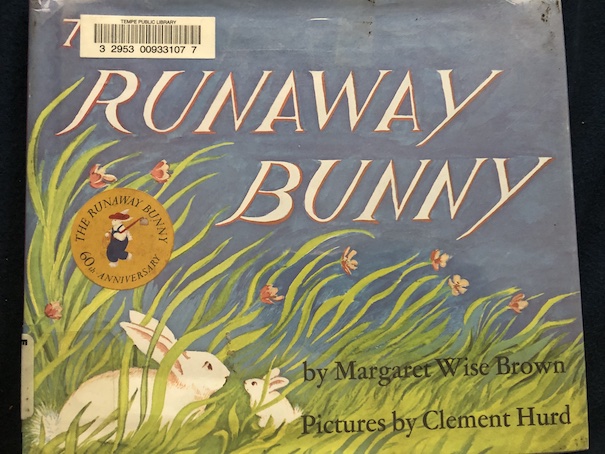
The Prince Who Knew His Fate

This picture book is a retelling of an Ancient Egyptian story (sometimes called The Tale of the Doomed Prince) about a prince and a prediction regarding his death with an unknown ending. The only known original version of the story is incomplete. For this book, the author has given the story an ending.

An Egyptian king wishes for a child, but when his son is born, the seven Hathor goddesses offer a prophecy for the prince’s fate. They say that, “He is destined to be killed by a crocodile or a snake or a dog.”

The king is distressed by this prediction for his son’s fate, and he decides to protect him from it as best he can. He has a special house built for the prince, where he grows up, attended by servants and given all sorts of good things to keep him happy. The king wants his son to stay in this house, where he will be safe. 

However, as the prince gets older, he becomes more interested in the outside world. One day, he sees a man passing the house with a dog, and the prince wants a dog of his own. The king relents and allows his son to have a dog, in spite of the prophecy.

The prince further demands that his father allow him to leave the house and travel. After all, he says, if his fate is already determined, it won’t matter if his father tries to protect him from it. He says that, if he must die eventually, he might as well live his life to the fullest while he can. The king allows his son to have a chariot and to hunt and travel the Nile. Everywhere the prince goes, he brings his dog with him.

Eventually, he comes to the country of the Chief of Naharin, who only has one daughter. The chief keeps his daughter in a special house with a single window, high off the ground. He says that he will allow his daughter to marry the man who can jump up to that window. The prince manages to make the jump, and he marries the chief’s daughter.

After they are married, the prince explains to his wife the prophecy about his fate. His wife wants to kill the prince’s dog, but he refuses to allow it because he’s had the dog since it was a puppy. His wife begins to watch over him, to try to prevent him from being killed. She manages to kill the snake that comes for the prince, and the prince manages to make a deal with the crocodile, but can he truly escape his fate?

There is a section at the back of the book that explains more about the original story, which was written over 3000 years ago and is “one of the oldest fairy tales known today.” There is also some information about Ancient Egypt and the carvings that were the inspiration for the illustrations in the story.

I always enjoy folklore, and this story is fascinating because the original ending is unknown. The author of this book, Dr. Lise Manniche, who was a Danish Egyptologist, translated the story from the original hieroglyphics and added an ending to the story. I thought that the ending fit well enough, and I was pleased that it was a happy ending, even though it holds to the idea that the fate must be fulfilled. I also enjoyed the illustrations, based on Ancient Egyptian carvings from around the time that the story was created, and the addition of the hieroglyphs of the original story along the bottom of the pages.

I first heard about the folktale in this book in a mystery book for adults called The Snake, the Crocodile, and the Dog by Elizabeth Peters. It is part of the Amelia Peabody mystery series, about a Victorian era woman who is married to an archaeologist. Elizabeth Peters is a pen name for Barbara Mertz, who was an Egyptologist herself. Because this folktale featured prominently in that mystery novel, I was thrilled to find this version of it!

Aliens for Dinner

This book is part of the Aliens for Breakfast Trilogy, a short, easy chapter book series for elementary school children.

Richard Bickerstaff is unhappy because his mother has started dating a man named Bob Baxter. Richard thinks that Bob is weird, and he has an annoying habit of repeating himself. Then, one evening, when Bob is having dinner with Richard and his mother, Richard’s small alien friend, Aric, arrives with their Chinese food, hidden in a large fortune cookie. Aric is a commander of the Interspace Brigade, and they operate on a shoestring budget, so they often transport Aric in some form of food to save money.

Richard manages to slip away from his mother and Bob and takes Aric to his room, where Aric tells him about his latest mission. Earth is in danger from aliens from a planet called Dwilb. Dwilbs have a bizarre love of pollution, and pollution problems have gotten bad enough on Earth to attract their interest. The Dwilbs want to make Earth even more polluted so they can turn it into a pollution-themed amusement park for themselves called Toxic Waste Funland. Aric says that they’re so confident in their plan that they’re already running advertisements. Aric will need Richard’s help to stop them!

Richard asks Aric questions about what the Dwilbs are like. Aric says that they look like humans, but they have an odd habit of saying everything twice, and the repetition seems to have a hypnotic effect. Richard thinks that sounds familiar, and he remembers why when his mother and Bob come to say goodnight to him. Bob repeats himself! Richard starts to think that his mom might be dating an alien!

Meanwhile, the Dwilbs have caused a major oil spill nearby as part of their plan to pollute the planet further. Local people have been trying to help with the cleanup, but it seems like it’s just getting worse. Richard goes to take a look and sees Dwilbs splashing about in the oil, having fun! They love the oil spill, the exhaust from cars, and everything that’s dirty.

Richard asks Aric what they can do to stop the Dwilbs, but as often happens when Aric travels in the bizarre ways that Interspace Brigade sends him, has trouble remembering the Dwilbs’ weak point. While Aric struggles to remember, the Dwilbs start influencing the kids at Richard’s school, getting them hooked on a treat they call Sludgies. Under their influence, the kids start littering and stop caring about the environmental efforts their teacher is trying to talk to them about. Even Richard’s friend, Henry, is under their power and in no state of mind to help Richard.

Fortunately, there is a secret weapon right there at Richard’s school: the school principal and his ability to bore everyone almost to death. In the case of the Dwilbs, boredom is a serious threat!

The books in the Aliens for Breakfast Trilogy are humorous sci-fi stories, and the solutions to defeating the aliens always have some comic twist. The solution in this case is getting the school’s principal to speak to them and bore them out of their minds. Richard has to arrange for his principal to speak at a place where he knows all the aliens will hear him.

Richard has run into situations in previous books where strange people he knows turn out to be sinister aliens in disguise, and in this case, he thinks that Bob is one of the Dwilbs. However, there is a twist to this story. Bob isn’t one of the aliens. He’s a little odd, but he’s a human. His quirks just happen to resemble the Dwilbs. He has a habit of repeating himself, but he’s not at all bored by the way the principal speaks or the way Richard speaks when he imitates his principal. Bob is often a little boring himself. By the end of the book, Richard feels better about Bob when he discovers that Bob likes comic books as much as he does. The two of them start bonding by sharing comics. Bob has a collection of older comics that Richard has been wanting to read, and he lets Richard borrow them.

I like the references in the story to real franchises that fans of science fiction and comic books would know. Richard has a collection of X-Men comics.

The book was published in the 1990s, when I was still in school. I remember my teachers talking to us about environmental issues back them, especially about pollution and the importance of recycling. They often urged us to get involved and do our part to recycle and not litter. The environmental messages in this story, especially the ones Richard hears at school, bring back memories for me.

A Watcher in the Woods

The Carstairs family is moving from Ohio to a small town in Massachusetts because Professor Carstairs will be taking a new job as head of the English department at the local college. Fifteen-year-old Jan knows that she will find the move harder than her parents or her younger sister. Her father will be busy with his work, and her mother will make friends with the wives of other faculty at the college. Jan knows that her little sister, Ellie, is still very young and in elementary school, and she won’t find changing schools as difficult as she will. Jan isn’t looking forward to trying to fit in at the local high school.

The family’s first difficulty in moving is finding a house in this new town that they like. Because it’s a small town, their options are limited, and it seems like there’s something wrong with each of the houses they see. Then, their realtor suggests that they view the old Aylwood place outside of town. Living there would mean a longer distance to drive to the college and the girls’ schools, but it’s a nice, big house with some land attached to it. The land includes woods and a pond. Elderly Mrs. Aylwood can’t afford to maintain the place anymore, but she has been reluctant to sell the house. She is very attached to it and she wants to make sure that, if she sells, that she will sell it to the right kind of people, who will take care of the land and woods.

From the first time that Jan and her family visit the house, it gives Jan a strange feeling. She has the oddest feeling that someone (or something) is watching them from the woods, and it frightens her. However, when she tries to explain her uneasy feelings to her mother, her mother thinks that it’s her imagination. Jan can’t deny that the house and wood give her the feeling of a fairy tale and that Mrs. Aylwood reminds her of a fairy tale witch.

For some reason, Mrs. Aylwood becomes more welcoming to the Carstairs family after she sees Jan, and she begins asking Jan some rather odd questions about herself. Mrs. Aylwood admits that Jan reminds her of her own daughter, Karen, who she lost 50 years ago when she was only 15 years old. Jan begins to understand that Mrs. Aylwood’s attachment to the house is because it’s a link to her daughter’s memory, but she soon begins to realize that there’s more to it than that. Mrs. Aylwood asks Jan what kind of person she is and makes a cryptic comment about how Jan is a human but there are other things besides humans.

Jan’s uneasy feeling of being watched continues, and mirrors in the house are inexplicably broken in an x-shaped pattern. When she befriends a neighbor, Mark, and talks to him and his mother about the house, she learns that Karen did not die but that she disappeared 50 years ago. She apparently went out for a walk to the pond in the woods one summer morning and simply vanished with no explanation. Searches for her never lead anywhere. Most of the local people believe that Karen ran away from home, although it would have been out of character for her to do that. Jan begins to wonder if the watcher she senses in the woods could be Karen, somehow hiding out or having returned after all these years, although Mark says that doesn’t make sense. Then, remembering Mrs. Aylwood’s comment about things that aren’t human, Jan wonders if the watcher could be Karen’s ghost. What if she died all those years ago, and her spirit haunts the woods?

It seems like someone or something is communicating with Ellie. Ellie seems to hear something speaking or humming when Jan can’t. Something even suggests to Ellie that she name her new puppy Nerak, which Jan realizes is “Karen” spelled backwards. Is Karen trying to communicate with them, or is it something else?

The book is available to borrow and read for free online through Internet Archive. This book has been made into movie versions twice, but the Disney movie from 1980 is more faithful to the original story. I’ll explain why below, but it involves spoilers.

When talking about my opinion of this book, I really need to include some spoilers. This is a very unusual book because it isn’t obvious until about halfway through what kind of story it really is. From the beginning, it’s set up like a ghost story, with Karen’s mysterious disappearance, the sense of something watching the house and family from the woods, and something trying to communicate through Ellie. It’s very suspenseful and mysterious, but this is not actually a ghost story. It’s really science fiction.

Karen isn’t dead, but she has been trapped in an alternate dimension since she disappeared 50 years ago. A being from that other dimension has also been trapped in our world since then. This other being is the mysterious watcher in the woods. Jan correctly senses that this other being is also female and a child, although beings of its kind live extraordinarily long lives because time works differently in their dimension. What has been 50 years for everyone else has only seemed like a day to her. She wants to return home, but she has had to wait for conditions to be right. She also wants to help Karen, and she has been struggling to communicate with Mrs. Aylwood and Jan and her sister so she can tell them what they need to do.

In the Disney movie, there are a couple of major changes from the original book. The first is that the location is changed from the US to England, although Jan and her family are Americans. It also features a kind of initiation ritual that Jan was undergoing just as her switch with the creature from the other dimension happened, adding an element that seems supernatural, although it is still science fiction. At the very end of the Disney movie, Jan brings Karen back from the other dimension, but in the book (Spoiler!) Mrs. Aylwood goes to join Karen in the other dimension instead.

In the book, Jan’s mother worries about what life would be like for Karen if she returns, aged 50 years in what must have seemed like only a day, having lost most of her life, or what it would be like if she has not changed at all but her mother has aged 50 years, and the world has been through so many major changes since she left. It isn’t clear whether or not Karen has aged in the other dimension, but Jan’s mother’s point is that the world she came from has definitely changed. Karen can’t go back to her old life, and there is some sadness about that and about what Mrs. Aylwood has been going through since Karen disappeared. However, Mrs. Aylwood decides to join Karen in this other world, where she’s been. We don’t really know what Karen’s condition is in the other dimension because we don’t see her. She may have aged very fast there, although I think they imply that she has not aged at all because time works differently in the other dimension. Since time works differently there, it seems like they either won’t age further there or will do so much more slowly than they would on Earth.

Between the two movie versions, the Disney movie version of this book from 1980 is more faithful to the original story because it maintains the concept that this is a science fiction story and that the watcher in the woods is a being from another dimension. The movie version from 2017 turns the story into a ghost story with no science fiction elements. In the ghost story version, Karen is also still alive and hasn’t aged after being gone for many years, but the watcher in the woods is a ghost who is holding her captive. It’s a spookier version, but I think the logic of the original book, with its science fiction theme, makes more sense. 

The premise of the ghost story didn’t make as much sense to me because the ghost’s motives seem confused. First, the ghost takes Karen captive because she was staging a stunt for some friends where she appeared to be mocking the way he died. Then, he seemed to want to keep a girl for company, which is weird because it doesn’t seem like he interacts with Karen while he has her. He tries to make a bargain where he would be willing to release Karen in exchange for Ellie, but in the end, it turns out that human company isn’t really what he wants. (Spoiler!) He wants a ritual for his death that he was deprived from having when he was killed. The story just seemed to be all over the place with the ghost’s motives and desires. Is he out to punish Karen for her disrespect, lonely without human company, or just trying to get attention from the living to fulfill his final wishes? Even he doesn’t seem clear about that, which is why I prefer the sci-fi version. 

I also thought that the premise of the sci-fi story was more original, and I enjoyed the twist of a story that seems like a ghost story but really isn’t. If any sufficiently advanced technology might look like magic to someone who had never seen it before, as Arthur C. Clarke said, it makes sense that any being who was sufficiently different from the human experience might appear to be some kind of supernatural creature to human beings who didn’t know what they were perceiving.

The Disney version from 1980 actually has multiple endings because the first endings they filmed didn’t quite work and didn’t get a good reaction from audiences. If you’re curious about what the three endings are like, Jess Lambert explains them in her YouTube review of the movie.

Double Trouble

Faith and Phillip are twins and the only members of their immediate family who are alive. Their parents and their older sister were killed in a car accident. Faith was taken in by their aunt, but their aunt didn’t think that she could manage to care for two children, so Phillip was sent to a foster home. The story is written in the form of letters to each other (this is called epistolary style) after their separation.

Separating is cruel, especially when they’re orphans, but there is something about Faith and Phillip that other people don’t know. They have psychic powers, and they have the ability to communicate their feelings to each other with their minds. They have to communicate specific information to each other in writing because their psychic abilities only communicate their general mood and circumstances, but their psychic link to each other makes them feel less alone when they’re apart. Apart from dealing with their grief over the loss of their parents and the changes to their lives, each of them is also in a troubling situation.

In her first letter to Phillip, Faith tells him about a disturbing encounter with a teacher at her new school. Faith was selling candy with another classmate, Sue Ellen, to support the school band. Sue Ellen gets the idea of going by Mr. Gessert’s apartment. Mr. Gessert is their social studies teacher and is considered one of the cool teachers in school. Faith can tell that Sue Ellen has a bit of a crush on him. He buys one of their candy bars, and Sue Ellen asks to use his bathroom. When Sue Ellen seems to be taking awhile, the teacher goes to see if everything is okay, and he catches Sue Ellen snooping around. He gets especially angry when Faith is about to touch his cane near the door. He grabs both girls by the arm and throws them out of the apartment. Although snooping in someone’s private rooms is rude, the girls are startled by how angry Mr. Gessert is. Faith asks Sue Ellen what she saw in his apartment, and Sue Ellen says that she didn’t see anything. She had just started to open the door to a room when he found her. The next day, Sue Ellen brags to other kids at school about having been in the teacher’s apartment, but Faith is still concerned about how angry Mr. Gessert was.

When Phillip replies, he says that he can understand why the teacher would be annoyed at someone snooping through his stuff, and he tells Faith about his new foster parents, the Wangsleys, Howard and Cynthia. He’s now living in Seattle, about 50 miles from where Faith is living. Phillip also got picked on at school by a bully, but a girl named Roxanne spoke up for him. He thinks Roxanne is pretty, and he describes her aura as being indigo. (The twins also have the ability to see people’s auras and use them to learn things about other people.) His new foster parents don’t take his vegetarianism seriously, trying to convince him to eat meat. They say that God put animals on Earth for people to eat and that he has to eat like they do. Their house is shabby, and Howard keeps Cynthia on a tight budget. That surprises Phillip because he thinks Howard must be making decent money at the shipyards. He wonders how Howard spends his money, if it’s not on his wife or home. He knows that Howard and Cynthia belong to some kind of religious group and that, whenever they return from one of their meetings, they act strangely, and their auras are weird. He’s still grieving their parents and sister, and with all the stresses of his new home, the only time he feels better is when he’s using astral projection, to get away from it all.

The twins learned their psychic skills from their sister Madalyn and Madalyn’s friend, Roger, who is an archaeologist. Faith doesn’t quite have Phillip’s ability with astral projection, but she can sometimes get visions of other people and what they’re doing. She uses this ability to try to learn more about Mr. Gessert, and she sees that his cane is actually a gun. She watches him loading it. Why would a teacher have a cane with a hidden gun?

Faith is still angry that her aunt didn’t take Phillip, too. She also hesitates to ask her aunt for things she needs because she doesn’t want to seem like a charity case. She has a part-time job taking care of her neighbors’ dogs while the neighbor is on vacation, and she uses the money to buy a pair of second-hand boots. When Aunt Linda finds out that Faith bought second-hand shoes, she says that Faith should have told her that she needed shoes because she doesn’t want people thinking that she isn’t taking care of her niece. Still, after she cleans them up, they don’t look bad, and she gets compliments on them at school.

The next time she sees Mr. Gessert in class, he seems normal at first. He gives the class a lesson on the Donner Party of pioneers, who were trapped by a snowstorm and resorted to cannibalism to stay alive. (This is actually described in gruesome detail in the book. Some kids like a good gross-out, but I never did.) After Mr. Gessert describes all the gory details in class, one of Faith’s other classmates comments that Mr. Gessert seems crazy. Faith knows that he was telling them the truth about what happened, but she finds it disturbing how much he seemed to enjoy recounting all the grossest parts, and other classmates agree. Phillip is concerned about Faith’s description of the teacher, so he uses astral projection to spy on him, and he agrees that Mr. Gessert gives off weird vibes.

Both Faith and Phillip connect with other kids at their schools who have an interest in psychic abilities. Faith meets a boy named Jake, who is intrigued because his father has been reading a book about remote viewing, which is what Faith does. As Phillip becomes friends with Roxanne, who is interested in the topic of astral projection. When Phillip confides in her about his astral projection abilities, she asks him to teach her how to do it.

One day, when Phillip and Roxanne are at the library, they see Mr. Gessert there. Mr. Gessert has an interest in Spanish treasure, and there is a special exhibit at the library with some very valuable pieces. Soon after that, the Spanish treasure is stolen from the library. It doesn’t take a psychic to see that Mr. Gessert, who has already been established as creepy and suspicious, might have a motive to steal it, but he’s not the only suspect. Working separately, with the help of their friends, Phillip and Faith use their special mental abilities to get to the bottom of Mr. Gessert’s secrets.

The book is available to borrow and read for free online through Internet Archive.

There are a lot of metaphysical themes to this story with the kids exploring their psychic abilities. It is revealed that their old family friend, Roger, is a kind of archaeologist/treasure hunter, but he is regarded as unorthodox by his colleagues because he uses his psychic abilities to guide his discoveries. Roger is the one who taught the twins and their older sister how to use their abilities.

In the story, the people who are open to developing their psychic/spiritual/metaphysical sides are the heroes, and they thrive when they connect to other, like-minded people and share what they know with each other, helping each other to develop. However, there are unhealthy forms of spiritual development in the story. Phillip is unnerved about the Wangsleys and their religious group from the beginning because the Wangsleys always act strangely after one of their meetings. Initially, I was concerned that this group might be doing drugs or something like that, but that’s not the case. It’s a little vague exactly what group the Wangsleys are part of, but it seems to be a very conservative Christian group with a cult-like devotion to their leader, and the the Wangsleys have an unhealthy relationship with it.

I don’t think it’s an unhealthy group for being Christian, but it seems like devotion to this particular group encourages overly harsh discipline and emotional manipulation and that Howard and Cynthia’s relationship with each other is troubled because of disagreements about their level of devotion to the group’s standards. I sometimes think that people who don’t have a religion imagine that all Christian groups are like that, but I’ve been to various Christian churches throughout my life, and most are not like this. There are some extreme groups like this, but this is definitely an extreme group. It seems to be an isolated group that isn’t part of a larger denomination. It seems to have just one charismatic leader. I think it’s implied, although not directly stated, that the reason why Howard isn’t spending more money on keeping up his house is that he’s contributing a large portion of his income to this religious group. I’m a little suspicious about the money issue and the long periods that the group’s leader seems to spend in Hawaii, ostensibly on religious business. While it isn’t stated explicitly, and I could be wrong, I think there are some implications about the Hawaii trips and the money of this group that make them seem suspicious.

Besides the metaphysical elements, there are themes of children adjusting to loss and trauma and major life changes with the deaths of the twins’ parents and their adjustments to their new homes. Initially, Faith doesn’t have a very good relationship with her aunt. She’s angry that her aunt didn’t accept her twin brother and sent him into the foster system, and she finds her aunt’s manners cold. She doesn’t trust her aunt enough to ask for the things she needs, even basic clothing, and her aunt gets upset about that. Things improve between them when they learn to communicate more openly with each other. Aunt Linda does care about Faith, but she’s also dealing with her own feelings and uncertainties about raising her niece. She has never married or had children, and while she does want Faith living with her, becoming a single parent is a major adjustment for her.

The Wangsleys are completely unsuitable as guardians for Phillip. They don’t accept his vegetarianism and complain about having to make special things for him. They keep trying to convert him, both to eating meat and to their religious group. I feel like their religious affiliation should have been disclosed from the beginning and that there should have been some discussion between them, Phillip, and Phillip’s caseworker about the differences between their lifestyle and the lifestyle that Phillip is accustomed to living, so they could all reach an understanding about what living together would mean for them before he actually went to life in their house. Phillip does describe some meetings with the Wangsleys and his caseworker during his time with the Wangsleys, where the caseworker tries to mediate circumstances between them and offer suggestions, such as ways they can deal with Phillip’s vegetarianism. Cynthia does make some efforts to accommodate Phillip’s eating habits, but they’re kind of half-hearted, and the Wangsleys absolutely cannot accept that Phillip doesn’t want to join their religious group. They heavily pressure him to convert, and when they discover Phillip’s astral projection activities, they’re convinced that he’s having visions given to him by the devil and demons. They tell Phillip’s caseworker that they want to adopt him, but Phillip finally speaks out about what life with them is really like. In the end, Roger decides that he will take Phillip, and the Wangsleys are forced to relinquish him to his caseworker.

From now on, Phillip will be living with a family friend who understands him and shares his lifestyle, and there are even hints of a possible romance between Roger and Aunt Linda. The hints of romance with Roger and Aunt Linda feel awkward, partly because the kids know that Aunt Linda is about 10 years older than Roger, a significant although not insurmountable age gap. Mostly, it just feels awkward to me because it seemed like there had been a romance relationship between Roger and the twins’ deceased elder sister. Switching attention from the niece to the aunt, even if the niece is now dead, just feels odd. Although, it’s not definite that their relationship will really be romantic. It might just end up being friendly.

The authors, Barthe DeClements and Christopher Greimes, are a mother and son team, and the inspiration for this story came from their own shared interests in psychic phenomena and “nontraditional methods of expanding awareness.”

I remember reading this book when I was a kid, and I was fascinated with the idea of communicating psychically with other people or being able to do astral projection. I don’t really believe in all of the metaphysical ideas that the book presents, but I think most children go through a phase where they’re interested in things like ESP and try to test themselves to see if they can do it. I actually had an English teacher in middle school who tested the whole class for ESP after we read some science fiction or fantasy story, just for fun. I can’t remember which story that was now, although I don’t think it was this one. I think it might have been a story about a typewriter that predicts the future, although I can’t remember the name of that one. I didn’t do very well on most of the tests, although there was one in particular where I did pretty well. After thinking it over for about 30 years, I’ve decided that it wasn’t because I had any significant psychic ability. The one test I did well involved predicting another person’s actions, and I think anybody could do that fairly well if you know something about the other person’s personality. The teacher did say that people do this activity much better if they do it with close friends, implying that friends have a special connection to each other, but I think it’s more the case that friends understand each other’s thinking better.

I can’t remember whether I read this particular book before or after I was tested for ESP, but I think it was after. I still had an interest in the subject, and I remember, one night, I tried my own experiment in astral projection. When I did it, I had a vision of space aliens. It was probably because I was dozing off in bed at night, and I was going through a sci-fi phase at the time, but I got spooked. You see, the punchline to this story is that I grew up in Arizona, and the night of my experiment happened to be the night of the Phoenix Lights. I was so creeped out the next day, when people were talking about UFOs that I stopped the astral projection experiments. Although I’m sure that it was all a coincidence, just a dream brought on by my own fascination with science fiction and space aliens, I decided that, while I was curious about how such things worked, I didn’t really want them to work for me. I might have been a cowardly child with a habit of spooking herself, but I was also a cowardly child who decided that there was no point in continuing to do things that she knew would spook her. I had my fun with that phase, and then it was time to move on to my next obsession.

Cold Chills

Fourteen-year-old twins Ryan and Chris Taylor are on a ski trip in Colorado with their parents, their eight-year old sister Lucy, and their friend, Billy Maguire. Although Billy is a friend of both of the twins, he’s really closer to Chris because the two of them are interested in sports. Ryan is more of an intellectual than either of them, and they tease him about not being as good at sports as they are. When the three of them get together, Ryan often feels left out, although he argues with them that he can do decently well at physical activities; he just cares more about other things.

The ski resort where they will be staying is called Moosehead Lodge. It used to be a very exclusive resort, but it’s fallen on hard times in recent years. The reason why they’re going there is that the current owner is an old friend of Mr. Taylor’s from college, and he’s asked Mr. Taylor to write a travel article about the lodge for a magazine to attract new customers.

It turns out that Dede and Wendy, two girls who attend the same school as the boys, will also be staying there over winter break. The twins have crushes on the girls, but they’re also at the age where they still think girls are weird or likely to spoil their fun, so they have mixed feelings about the girls joining them on the ski trip. The boys consider trying to avoid the girls for the entire trip and make them wonder what happened to them, but Ryan thinks that sounds like something a little kid would do. Billy says that, if the twins are going to hang around with girls, he wants a girl for himself, too.

When they arrive at the lodge, the girls greet them right away, so the hiding scheme definitely won’t work. The girls are enthusiastic that there will be a lot of fun things for them all to do. The lodge includes several stores for the guests to shop in, which the girls and Mr. and Mrs. Taylor find intriguing. However, the boys think that the lodge looks haunted. With all the old-fashioned furniture and paintings, it reminds them of something from a movie.

At their first ski lesson, Chris brags that he doesn’t really even need lessons because he’s such an athlete. However, skiing doesn’t come as naturally to him as soccer does. In spite of his bragging, he is clumsy at his first attempts. He apologizes to the instructor, saying that he’s just eager to get going because he knows that they’ll only be staying there a short time. The instructor says that he understands but that the instructions he’s giving them are important for keeping them safe while they have fun.

When the boys return to the lodge, Mrs. Taylor is very upset because a pearl necklace that’s a family heirloom is missing! When Mr. Taylor and the boys go to the manager to report the loss of the necklace, they find out that other pieces of jewelry have been stolen from other guests. The manager has hesitated to contact the police about it because he’s been hoping that the jewelry was merely misplaced and would turn up. The lodge is suffering financially, and if they have a bad season, they might have to close down. Mr. Taylor likes the lodge and wants to help his old friend, but the thefts have to be cleared up for the lodge to continue functioning. The twins decide that they’re going to be the ones to find their mother’s necklace, bring the thief to justice, and save the ski lodge!

The book is available to borrow and read for free online through Internet Archive.

I liked this book better than the last book I read in the series. It’s more of a mystery than the last one, although there’s still plenty of excitement and adventure. Unlike the other book I read, where the boys know right away who the villains are, in this story, the boys have no idea who the thief is for much of the book. They have to investigate different suspects, and their first suspects turn out to be completely wrong. The boys undertake a deliberate investigation into their suspects, moving from person to person. There are enough potential suspects with apparent odd behavior to keep readers guessing along with the amateur detectives. A skiing accident and a blizzard and avalanche add excitement and adventure to the story.

When the girls argue with the boys about one of their subjects, the boys say that girls would be more likely to fall in love with a jewel thief than to either be a jewel thief or catch one themselves. The kids turn their investigation into a contest, boys against girls, to see which of them can solve the mystery first. The competition between boys and girls gets carried over to the adults, and it even influenced some of my theories about the identity of the jewel thief. Part of what I suspected turned out to be true, but saying what it was would be a spoiler. 

The boys do solve the mystery before the girls, although the solution does disprove some of what the boys said earlier. Considering some of what they said, I would have liked to see more acknowledgement about that, but the book ends a little abruptly after the final solution is revealed. Overall, I liked the story, but I could see some room for improvement in the ending. Although I understand that part of the premise of this series is that the twins can sense each other’s thoughts, that doesn’t really enter into the story, either, which was also a disappointment.

The Secret of Grey Walls

Lone Pine Series

The Secret of Grey Walls by Malcolm Saville, 1947.

It’s shortly after Christmas, and Petronella (called “Peter” by her friends) is home from boarding school for the holidays. She has a strange dream about running through the woods with an unfamiliar girl and finding a house with gray walls, but she’s not sure where it is or what the dream means. She wakes up when there’s a fire in her dream.

Petronella and her father live by themselves in the countryside because her mother died when she was a baby. Her father misses her when she goes away to school, but he knows that it’s important for her to go, and although he would like to spend all of their holidays together, he also knows that it’s important for her to spend time with her friends.

When Petronella goes to visit her friends, the Mortons, Mr. and Mrs. Morton and their housekeeper, Agnes all receive news that changes the children’s plans for the remainder of their vacation. (This is after Mr. Morton is home from the war after serving in the RAF.) Mr. and Mrs. Morton have to go to London to see a lawyer about some business, although they’re vague about the reasons why. Agnes’s news is that her sister is sick and in the hospital. With all of the adults leaving the Mortons’ house at Witchend, Mr. and Mrs. Morton wonder who they can have looking after David and the twins until they return. They consider different people they can ask, but Agnes says that all of the children can come to the village of Clun with her. Her sister has a very big house, and she’s been worried about not having anyone to look after the house while she’s in the hospital. There will be plenty of room for all of them, and Agnes says that she would appreciate the company in that big, old place. The children can even invite the other members of the Lone Pine Club to join them.

At this point in the series, not all members of the Lone Pine Club have actually met each other. David invited Jon and Penny, a pair of cousins, to join the club while visiting the hotel that Jon’s mother, who is Penny’s aunt, owns in another town. This trip will be an opportunity for the whole club to get together and get to know each other. Jon and Penny are very excited about the trip, especially Penny, who is a talkative girl who enjoys meeting new people.

On the train to meet the others, Penny strikes up a conversation with a man named Alan Denton, who brought a dog onto the train. Denton recently left the Navy and is heading home to manage his family’s sheep farm near Clun. He is very surprised when Penny says that they are also going to Clun because it’s a very small town, and few people visit there during the winter. The old house where they will be staying is usually run as a boarding house for summer visitors, but there won’t be anyone else there during the winter. The old house is called Keep View because it has a view of a crumbling old castle. There isn’t much else left of the castle other than the old keep. The children are fascinated as Denton describes the castle and other points of interest in the area, like a circle of standing stones. He says that visitors sometimes dig for old flint arrowheads.

The other kids are going to Clun by bicycle, except for Peter, who is riding her pony, Sally. Along the way, the kids meet up with a caravan of gypsies they know from a previous book. (Yes, this is a mid-20th century British children’s mystery adventure story, so of course, there are gypsies. The book spells it “gipsies,” and they also call themselves “Romany.” In the case of this series, the Romany are friends of the kids, not suspicious characters, as in many other children’s books from around this time.) The kids tell the Romany where they are heading, and they say that they’ve just left Clun. Ordinarily, they like the area, but there’s been some trouble there lately. Someone is stealing sheep from some of the sheep farms. The Romany know that people are often suspicious of Romany, so they thought that they’d better leave the area before someone accuses them of being involved with the thefts. Before the kids leave the Romany, the Romany remind them about the special whistle that they gave to Peter, saying that if she blows it, any Romany who hears it will come to help.

Peter, meanwhile, has a disturbing encounter on her trip to meet the others. She meets some men whose truck has broken down. The men behave oddly, and although the truck says that it’s a furniture truck, Peter is sure that she hears the baaing of sheep inside.

The kids don’t start to put together pieces of what’s going on until they reunite in Clun. While they are getting to know each other and exploring the area, they suddenly meet up with Alan Denton, who is distraught because his sheep farm has been the latest victim of the sheep thefts. Peter mentions to the others about the strange truck with the sheep sounds, although Denton dismisses the idea that Peter might have encountered the sheep thieves on her way to Clun because he doesn’t think that the thieves would have been able to load all the sheep onto a truck without being noticed.

Meanwhile, a strange man called Mr. Cantor rents a room at Keep View from Agnes. The boarding house doesn’t usually get boarders in the winter, and the children had counted on having the house to themselves during their stay. Mr. Cantor says that he’s recovering from an illness and needs some peace and quiet, which is disappointing to the children because that means that they’ll either have to spend most of their time outside or being very careful not to disturb Mr. Cantor. Although the children like being outdoors, it is cold, and they know they can’t be outdoors all the time, and a houseful of children isn’t usually quiet. Mr. Cantor seems a little strange, and some of the kids get the feeling that he isn’t quite what he seems to be, but he knows a great deal about the history and landmarks of the area. He entertains the children with stories about local history and ancient burials, and they begin feeling better about him.

However, something happens that causes them to becomes suspicious of Mr. Cantor. After a visit to Mr. Denton’s sheep farm, the children get lost. They find a strange grey house and try to ask directions there. Nobody answers their knocks or calls even though the children are sure that someone is watching them from inside the house. Then, they realize that someone is also watching them from the woods. They briefly see this person leaving, and this person has a bicycle that rattles badly. When the children get back to Keep View, they realize that the bicycle they heard belongs to Mr. Cantor because it makes that same distinctive rattle. Was Mr. Cantor spying on them? Who was in the house, and why didn’t they want anyone to see them. Does any of this have something to do with the sheep thefts?

The book is available to borrow and read for free online through Internet Archive.

My Reaction

I’m new to this series of mid-20th century British mystery adventure books. This is the first book I’ve read, so I’m really getting to know them as some of them are getting to know each other. I was a little disappointed that this particular book seems to be set after WWII is over because I knew that the series started during the war and that the war was part of the story, but that does put this book contemporary to the time when it was written.

This story and the series in general does have a similar feel to other British children’s mystery adventure stories and series written around the same time, especially the Enid Blyton books, such as Enid Blyton’s Adventure Series and The Famous Five Series. Like the characters in the Enid Blyton books, the members of this friendship club attend boarding schools and have outdoorsy adventures on school holidays. The Romany appearing in this book is also a common element found in Enid Blyton books and other children’s books written around the same time. In all such books, there are stereotypical elements surrounding the Romany characters, although I think the Romany in this book were treated more kindly than the ones in Enid Blyton books. The use of the word “Romany” as well as “gipsy” is one element of understanding, but also the Romany characters in this book are friendly and helpful characters, not suspicious ones. There are people who are suspicious that the Romany are involved in the sheep thefts, but our heroes know that isn’t the case, defend them publicly, and help to expose the real thieves.

I really liked the addition of Mr. Cantor in the story. Like other kids’ mystery books of this type, there is more adventure in the story than mystery, but the appearance of Mr. Cantor adds that needed element of mysterious. For much of the story, it’s difficult to say what Mr. Cantor’s motives are and whose side he’s on. The kids have the feeling from the beginning that he’s not quite what he seems to be, but they find themselves having mixed feelings and debating back-and-forth about him as the story continues. When he’s nice to them and telling them stories about the history of the area, they decide that they like him and that they were silly to be suspicious before. Then, when he seems eager to agree with the authorities that the Romany are responsible for the sheep thefts, they look at him suspiciously again. There are some funny moments when the youngest members of the group, the twins Dickie and Mary, make friends with Mr. Cantor and try to distract him and keep an eye on him while the others do some investigating. The twins are irritated at being left behind by the older kids, but they do throw themselves into the roles of spies and put a lot of effort into making Mr. Cantor their special friend, guilting him into spending time with them. Mary gets Mr. Cantor to entertain them by telling them fairy stories and acts sweetly enthralled, while Mr. Cantor struggles to come up with story ideas to keep the kids happy, and Dickie thinks that the whole thing is stupid and little-kiddish.

I was a little surprised at the way characters in the book talked to each other at times, both children and adults, although I suppose I really shouldn’t have been. They use words that sound rough and insulting, like “stupid” and “ass” in very casual ways, both in describing themselves and each other. I’ve heard that before in British movies and television shows, but it always surprises me because it sounds so ill-mannered. Nobody in the book or in any of the shows I’ve seen seems to mind it, though. It’s just surprising when you hear someone who seems like they’re from the upper classes or who is supposed to have some of the refinements of a boarding school education throwing around words that sound rude and insulting with no thought about it.

There is a foreword at the beginning of the book that says Clun is a real town, but the author took some creative liberties with the landmarks in the story.