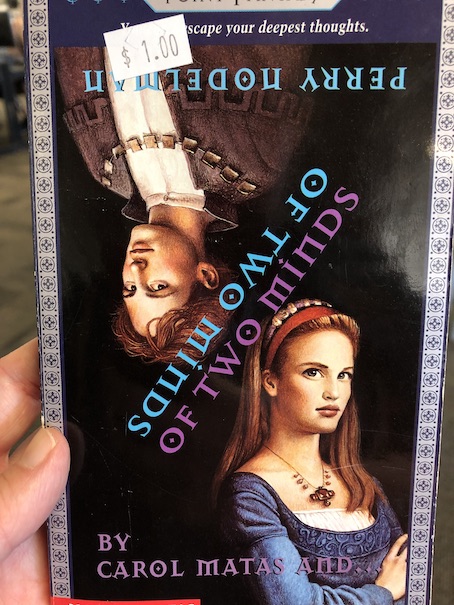
Of Two Minds

Of Two Minds by Carol Matas and Perry Nodelman, 1995.

Princess Lenora lives in a world where people can make things from their imaginations real just by thinking about them. This is a common “gift” that everyone in her country has, but the thing that really upsets Lenora is that people aren’t allowed to use their “gift” whenever they want to. Lenora’s parents are frequently upset with her for disrupting their calm, orderly world with her wild fantasies. They remind her that the reason why they have these rules was that their world was in chaos before people learned how to use their “gift”, and the chaos was only resolved when everyone agreed to maintain the same reality so they could all live in a safe, stable world that makes sense. They call this maintaining “the balance.” However, Lenora thinks that this stable world is boring and laments that there are never any technological developments or anything really interesting or exciting, like in the fantasy books she reads.

At this point, I pause to reflect that, in real life, we don’t have a world where people can change the nature of reality just by picturing something, and in spite of living every day in a common reality, our world still doesn’t completely make sense, people can have very different interpretations of things that are happening as if they lived in completely different realities of their own making, the idea that everyone could agree on one shared reality to create for any length of time sounds unbelievable, and when “exciting” things happen in world events, they are often not “interesting” or pleasant. Lenora is a teenage girl who doesn’t have a lot of experience yet in worlds that her people maintain in order to stay safe and sane or that she has not created herself and had control over. That’s about to change.

While everyone in Princess Lenora’s world has mental “gifts” that allow them to make imaginary things real, Lenora’s abilities are stronger than most, and her parents worry that her powers are getting much stronger. Lenora has trouble resisting the urge to imagine things and make them real, and although she loves doing it for the excitement and sense of power it gives her, it’s starting to scare her because it feels like her fantasies are starting to control her instead of her controlling them. Her fantasies have started to take darker turns, and frightening things are starting to become real, and she’s not even sure if they’re really coming from her mind or not. Because Lenora is turning seventeen years old, her parents are in the process of arranging a marriage for her to a prince from a neighboring kingdom, and they hope that marriage will help settle her down. However, Lenora isn’t so sure about the marriage or her increasingly difficult to control powers. When she talks to the healer, Lufa, about it, Lufa says that it’s not unusual for young people to experiment with their mental powers and that Lenora’s disturbing fantasies are coming from a dark part of her own mind that she will have to learn to control. She offers to spend some time working with Lenora and helping to develop her control.

Meanwhile, Prince Coren, Lenora’s betrothed, is having his own doubts about the impending wedding. In the first place, he thinks that he isn’t very handsome and isn’t sure that Lenora is going to like him. In the second place, he doesn’t really like change. Change makes him very nervous, although he doesn’t like the way things are in his kingdom and has felt for some time that things really need to change. People in his kingdom, like in Lenora’s, have special mental gifts, but they work in somewhat different ways. The people in Lenora’s kingdom, Gepeth, have the ability to change the nature of reality with their imaginations but often restrain their abilities in order to live in a common reality. In Coren’s kingdom, people have the ability to make things they imagine look and seem real, but they cannot actually change the nature of reality itself. They don’t bother to restrain their abilities at all, preferring to live in their imaginations. They don’t bother to keep their homes and buildings in good repair, just imagining that they live in opulent mansions and sleep in soft beds when their buildings are actually crumbling and they sleep on the ground. More than anything, Coren wants to build and enjoy something real instead of living in this imaginary world that he knows is not real at all. Also, Coren’s people have the ability to read each other’s minds, and they do it all time. The mostly talk to each other directly in their minds, not out loud or face to face, and they’re also in the habit of snooping and eavesdropping on each other’s thoughts. Coren tries not to be so obtrusive, and while his parents have some concerns about him marrying a girl who can’t speak mentally, Coren finds the idea a relief. Still, he’s not quite sure what to expect of Lenora or sure that she’s going to approve of him.

As Coren and his family approach Lenora’s kingdom, and he thinks and worries about meeting Lenora, he begins accidentally joining Lenora’s thoughts and fantasies. He begins getting a taste of what goes on in Lenora’s thoughts and imagination, and for a person who craves stability as much as he does, it’s unsettling.

It turns out that, although Lenora’s parents have mentioned marriage to her before, she has not been informed that her intended husband is on his way until he actually arrives. She is shocked and angry when her father suddenly springs Coren on her without warning, and Coren’s parents are dubious about this marriage when they discover that Lenora was not even informed that it was going to take place. They read the Lenora’s father’s mind and learn about Lenora’s previous antics with her powers. Coren begins having serious doubts about this marriage, and so do his parents, although they kind of admire Lenora’s imagination since they live in their imaginations much of the time.

Lenora, in a desperate panic to escape this unwanted marriage, tries to figure out what to do. She thinks about imagining a change in the world so that she won’t have to get married, but she knows that her father is still powerful enough to stop her. Then, she thinks about creating a world of her own with her imagination that she can jump into, but strangely, Coren ends up playing a role in everything she imagines. Even though she doesn’t want to like Coren, she feels strangely drawn to him. Since she can’t seem to escape thinking about Coren, she decides to physically run away and visit other countries, but she’s caught before she gets out of the palace.

Lenora’s father informs her that, because of her reckless behavior and increasing powers, they’ve arranged for her to marry Coren the very next day, and after their marriage, they will go to live on an island their kingdom controls with guards to prevent her from leaving or using her powers to escape. Lenora and Coren are to live on the island until after the birth of their second child, in the hopes that Lenora will settled down and get control of herself through her family responsibilities.

It seems like Lenora is trapped, but during the wedding ceremony, a portal to another world opens up. Lenora feels like someone, although she doesn’t know who, is offering her a chance at escape and decides to take it. However, as she goes through his portal, Coren tries to stop her, sensing that it’s dangerous, and he’s pulled in with her. The two of them find themselves in a world with an unknown creator, and for the first time in her life, Lenora’s powers don’t seem to work, so she can’t get them home. At first, Lenora is charmed by this seemingly perfect world full of interesting people and with the promise of newfound freedom. However, Coren is dubious and, although his powers are also gone, has the troubling feeling that they are in danger. What is this world, and who wants them there? If they’re ever going to return to their own world, they will have to face a dangerous enemy … and the darkest corners of Lenora’s own mind.

The book is available to borrow and read for free online through Internet Archive. It’s the first book in a series.

My Reaction

I first read this book when I was in my early teens, back in middle school, and I think that’s the right age group for this book. Princess Lenora is a daydreamer, like many teenage girls, but unlike most teenage girls, she has the ability to make the things she daydreams about become reality with just a thought. It’s pretty normal for people to imagine all kinds of things, just as passing thoughts, even dark things. If Lenora lived in our world with fanfiction.net, FictionPress, and Wattpad and similar sites for amateur writers, my guess is that she’d be spending much of her time writing stories to post online, like fan fiction and creepypasta, and few people would think anything of it because she would have friends doing the same thing. In a few years, they would probably either graduate to newer sites, like Inkitt, start their own blogs, work on getting books published, or just get busy with their lives, college, and career and let the hobby go for awhile. Instead, because Lenora lives in a world where people’s imaginations change the shape of reality itself, Lenora’s unchecked imagination poses a real threat to people around her and the fabric of reality itself.

Lenora’s parents try to rush her into marriage and family life in the hope that it will curb her dangerous tendencies and teach her some self-control (like people getting married too young never backfires horribly) and get her over this self-insertion fantasy stage she’s in, but in a way, that’s exactly the problem. Many of Lenora’s fantasies, especially the dark ones are about control. I didn’t think of that much when I first read the book as a young teenager. Mostly, I just liked the concept of a world where people could change reality just by thinking about things and the exploring the concept of what that ability could lead to. Much of the story is about that, but also, many of Lenora’s darkest fantasies are about power and control, things that she both resists in her daily life and craves for herself. A lot of teenage rebellion is about control – who has power over whom and where the boundaries lie.

Teenagers are at that phase of life where they’re almost legal adults. Physically, they can do most of the things that full adults can do, like drive cars and get themselves around town to go places they want to go, but yet, they can’t legally consent to certain things, and they’re still required to ask their parents’ permission before making even basic decisions about their weekend plans, and their parents are often telling them what they think they should do for their futures in the way of jobs and education. It can be a frustrating experience, knowing that you have the ability to go out, have adventures, and explore what life has to offer but yet not really being allowed to get out there and do things. There are practical reasons why teenagers can’t act on every whim that enters their heads. For one thing, life requires money. There are few things that don’t cost anything, and you need some time to build resources. For another, people won’t hire you for just any job because you showed up and said you wanted to try it. Most jobs require a certain level of education and/or experience, and teenagers just haven’t had time to acquire it yet. They have to find lesser jobs first and continue their education or get some professional training. Also, when it comes to marriage and other deeply personal decisions, there are serious life consequences to the choices you make. Adults hope by making young people wait for things and build their lives gradually, they’ll get a better sense of who they are, the lives they want to lead, and the consequences of the decisions they’ll make. It doesn’t always work because I’ve seen even older adults make some pretty weird decisions, but that’s largely the goal.

People have a tendency to try to control those who don’t seem to have the ability or desire to control themselves, and that’s really the phase that Lenora is in. Lenora’s young powers are growing, and she wants to test them and see what she can do with them, to explore her deepest thoughts and express herself and make her mark on the world, but her parents and the society she lives in actually can’t let her do that as much as she wants because of what it would do to everyone around her and the very world they live in. Most people, teenagers or not, have some private thoughts or fantasies that they would never want to share with the world, but Leonora’s fantasies become the world around her. They don’t stay private because they don’t stay only in her mind. When Lenora’s fantasies come to life, she pulls real people into them, giving them a genuine stake in having some say over them and trying to limit or stop them. It’s not just that she disrupts people’s lives and inconveniences them, but she can put them in very real danger and actually poses a threat to their very existence. Lenora doesn’t fully consider what her flights of fantasy do to other people, such as when she temporarily sends her mother into a gray void at the beginning of the book so she can pretend that she has the family’s castle to herself or when she briefly considers a fantasy where her parents would be living in poverty at her mercy and charity so she could control them instead of the other way around, until she finds herself at the mercy of someone she can’t control. Sometimes, people don’t understand what they put others through until they have to live it themselves. You’d think, with as much of an imagination as Lenora has, she could put herself in someone else’s place, but she doesn’t develop that kind of empathy until she sees what it’s like to deal with a person who completely lacks it.

If Lenora could have a creative outlet for her energies, getting her ideas out on paper, writing stories to share, or exploring her visions through art, her life would be different, and she probably would feel less frustration. The purpose of imagination and daydreaming are to let people explore concepts and consider different things that might happen, both good and bad, without acting anything out in the real world. It gives people a chance to think things through and consider what could happen without risking bad consequences from actually doing anything. I’m not a very adventurous person in real life. I don’t like camping or hiking, I’m afraid of heights, and there are things that I actually can’t do physically. But, I don’t mind vicariously experiencing things through stories, where I can have a safe kind of adventure. However, Lenora has that problem where, if she imagines things too hard, they become real. Her people call it a “gift”, and she doesn’t always see it as a problem, but it really is because it removes that important safety net between thinking and acting, and when Lenora’s darker thoughts take over, it poses a danger to everyone. Since Lenora has fantasy books that she likes to read, it does seem like her people have a sense of creative writing and the arts, and there are times when Lenora considers things that she could make real but doesn’t, so her people can apparently control their thoughts enough to pick and choose what to make real and what to leave as fiction. It seems that Lenora does have the option of writing stories as a creative outlet, but this craving for a sense of power and control and the ability to make some real change in the world are what keep Lenora from just writing fan fiction and tempt her to play with the nature of reality itself.

Spoiler:

The spoiler for this story is that Lenora’s greatest enemy is another version of herself, the dark version from the back of her mind who can’t be controlled, who doesn’t care about other people, and insists on getting everything his way. (Lenora’s dark version is a man, the idea being that this Lenora turned herself into something completely opposite to what she used to be in order to have a more powerful image.) What Lenora and Coren both need to find is the Balance that Lenora’s society tries so hard to maintain. She comes to have more respect for the people and worlds that she has created, seeing them as real beings with feelings instead of playthings to be cast aside when she becomes bored of them.

Coren also turns out to be a nice counterpart to Lenora. In the beginning, all he wants is a safe, stable, comfortable life in the real world instead of the world of imagination, where his parents live. In the end, he realizes that he needs to find a balance between the two himself. Although Lenora’s imagination is what gets them into trouble, he comes to realize that not all of what she created is bad. Lenora (and even her dark side) comes up with genuinely good ideas. Coren’s praticality and Lenora’s flair for adding a dash of excitement and color to life complement each other well, and in the end, they decide that they love each other. They would make good life partners because of their ability to bring out positive traits in each other and provide some balance to each other’s lives, but the book ends with them deciding that they want to get to know each other better before actually getting married, which is a practical thought.

The Vanishing Scarecrow

The Vanishing Scarecrow by Phyllis A. Whitney, 1971.

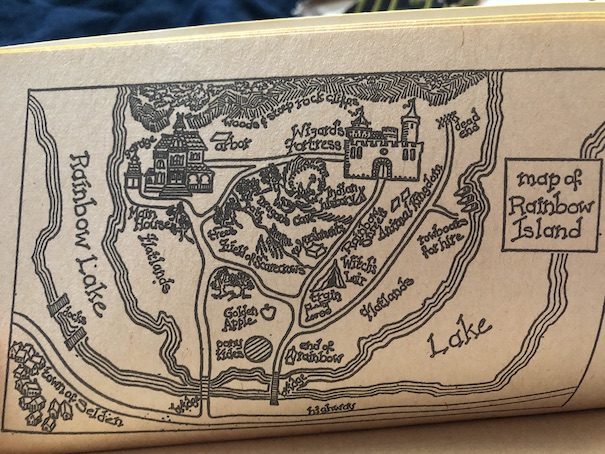
Joan Lang and her mother are moving from their town in Connecticut to Rainbow Island, where Joan’s Great Uncle Agate Benson owned his own amusement park. However, the move is sad because Great Uncle Agate’s death in a skiing accident has so closely followed Joan’s father’s death from a long illness. Joan and her mother knew that they were going to have to move to a smaller house because they could no longer afford their bigger one, and Uncle Agate’s sudden death means that they will inherit his house on Rainbow Island and the amusement park that goes with it. Joan and Uncle Agate had been writing letters to each other since her father’s death, and he made her feel less lonely, so Joan knows that she will miss him, but she is looking forward to seeing the amusement park that he had described to her.

However, the terms of Uncle Agate’s will are unusual, and his lawyer is vague on some aspects of them. What they know is that they must live at Rainbow Island and manage the amusement park for three years in order to gain full ownership. If they decide to leave before that time, Uncle Agate has another plan for the amusement park, but the lawyer refuses to tell them what it is immediately.

When they arrive at Rainbow Island, they meet Mrs. Fuller, who works at the amusement park’s gift shop and lives there with her two sons, Peter and Kent. Mrs. Fuller hopes that Kent and Joan will be friends because they’re close in age. Kent doesn’t seem particularly friendly at first, and when Joan confronts him about that, he says that he’s just trying to figure out what she and her mother are going to be like. Kent, like other people who live and work at Rainbow Island, was very attached to Uncle Agate. He appreciated his vision and imagination, and he misses him now that he’s gone. He has trouble believing that things will ever be like they were with Uncle Agate.

Mrs. Fuller and Kent both mention strange things that have been happening at the amusement park recently, including a scarecrow that frightened Mrs. Riddell, the wife of Wilson Riddell, who manages the park, but she says that she’d better let Mr. Riddell explain the situation. When Joan and her mother go to Uncle Agate’s old house to begin unpacking their things, Mr. Riddell comes to talk to them. He doesn’t seem particularly welcoming, either. Joan’s mother tries to ask him about the scarecrow incident, and he explains that someone, possibly a teenage prankster, has been pulling tricks around the park lately. Earlier that day, someone ran right through the Riddell house, terrifying Mrs. Riddell. Mrs. Riddell is described as being a very nervous person who is somewhat unwell, so Mr. Riddell seems uncertain whether his wife actually saw a person dressed as a scarecrow, as she described, or if that was her imagination. Earlier, she also claimed to see a witch. The idea of someone in a scarecrow costume is plausible because the amusement park includes a field of scarecrows, and they do have a spare scarecrow costume that they’ve used in the past to make it look like one of the scarecrows has come to life, to give guests a bit of a thrill. However, the employee who normally wears the costume hasn’t worn it for some time, and it seems like the recent scarecrow sightings are the work of a prankster.

As Kent shows Joan around the amusement park, they meet up with Peter in the Wizard’s Fortress, where he points out that someone has been messing around with the dioramas of historical scenes, moving some of the little figures around to scenes where they don’t belong. In the dungeon of the fortress, Joan meets up with Mr. Riddell’s daughter, Sheri, who is also about her age. Sheri has found the costume the scarecrow was wearing under some straw. Joan isn’t sure that she trusts Sheri because of the strange way she acts and how she seems to be sneaking around, keeping secrets, and playing weird pranks and tricks.

Could Sheri have something to do with the mysterious scarecrow, or could it be Emery Holt, the man who did odd jobs for Uncle Agate and sometimes wore the scarecrow costume as an act in the park? Another suspect could be Jud Millikin, an escaped convict who used to live in the area and who still has family living nearby. Joan and her mother hear people whispering about him, wondering if he might have come back to see his sick daughter, although people say it isn’t likely that he’d show his face in town since the police are looking for him. But why would he want to sabotage the Rainbow Island amusement park? Joan considers that there might be an answer closer to home when she learns that the Riddells and the Fullers don’t really get along, and there seems to be a silent power struggle between them for control of the park. Either of the families might want the other to leave, plus Joan and her mother, so they can be in charge.

Joan finds a message and an audio recording left behind by Uncle Agate for her, in which he seems to have had a premonition of his impending death and saying that the reason why he wants Joan and her mother to manage the park with Mr. Riddell is that the park needs someone with a fresh imagination to keep creating new exhibits and keep the park interesting for new generations of children. Joan wants to find out who is sabotaging the park and to keep Uncle Agate’s vision for the park alive, but her mother isn’t so sure that the situation is going to work for them.

Joan does have a fantastic imagination. She loves writing and making up stories, and she finds the atmosphere of the amusement park inspiring. However, Joan’s mother worries sometimes that Joan lives too much in her stories and doesn’t face up to reality enough. When Joan accuses her of not liking her stories, her mother says it’s not that, it’s just that writers also need a grounding in real life and the real world, and that it’s not good to use fantasies as a way of ignoring real life. She says that Uncle Agate was like that. Uncle Agate and his sister were orphaned from a young age, and while his sister was adopted by a family, Uncle Agate remained in the orphanage for the rest of his youth. When he grew up, he became successful in the toy industry, which was how he gained enough money and expertise to start his amusement park. However, Joan’s mother believes that much of what he did with the park was trying to live out childhood fantasies from his deprived youth and forget the hard realities of it. Joan’s mother says that she finds the real world outside of the amusement park more compelling, and she doesn’t want Joan to live too much in fantasy.

Joan is attracted to fantasy, but she’s realistic enough to know that there won’t be any hope for the park until she learns the true identity of the mysterious scarecrow that is trying to sabotage it. In the recorded message he left for Joan, Uncle Agate refers to a “right place” where Joan will find instructions that will tell her what to do. As Joan explores the the amusement park, familiarizing herself with the attractions and exhibits, she searches for the place that Uncle Agate referred to. Along the way, she has frightening encounters with someone dressed as a witch and the dangerous scarecrow among the regular figures in the exhibits.

My Reaction and Spoilers

The atmosphere of the story is great, and the author does a good job of making everyone Joan meets look like a potential villain or accomplice. All through the book, I kept changing my mind about who the real scarecrow was, and there are red herrings in the form of other people dressing up in costumes. Joan is never sure who to trust. There is a major twist toward the end of the book that turns the entire situation on its head. The rest of the ending after the scarecrow’s identity was revealed seemed a little abrupt to me, but the story has a good overall message.

At the beginning of the story, Joan does actually look at the amusement park on Rainbow Island as a kind of fantastic sanctuary from her problems, where she can escape from the sad loss of her father and uncle and the problems she’s been having at school. However, she learns that the amusement park isn’t really a sanctuary because it has problems of its own and the people associated with it also have their problems. However, these are problems that Joan is more motivated to solve because they are more exciting than her problems back home, and the stakes are high.

Joan and her mother have a frank discussion about facing up to life’s problems, and Joan points out that her mother’s impulse to run away from the park isn’t that different from her reluctance to face up to her problems with her schoolwork. Joan’s mother doesn’t find the park as interesting as Joan does, so she’s not as interested in trying to save it as Joan is. It’s similar to the way that Joan was unmotivated to work harder at school because it bored her, it was less imaginative than the creative writing she likes to do, and she was preoccupied with other major changes in her life. Joan’s mother acknowledges the truth of that, that it’s easier to try to solve a problem when you’re more motivated to work on it, and the two of them agree that, whatever else they do with their lives, they can’t just abandon the park without trying to catch the saboteur.

All of the characters in the story get new perspectives on their lives from this adventure, seeing how the park and their problems fit into a much bigger picture of life. Joan comes to understand that there are some problems that she’ll still have to face up to, like her school problems, no matter what else happens, and she sees that understanding the real problems that real people have is what will give her characters and stories greater depth.

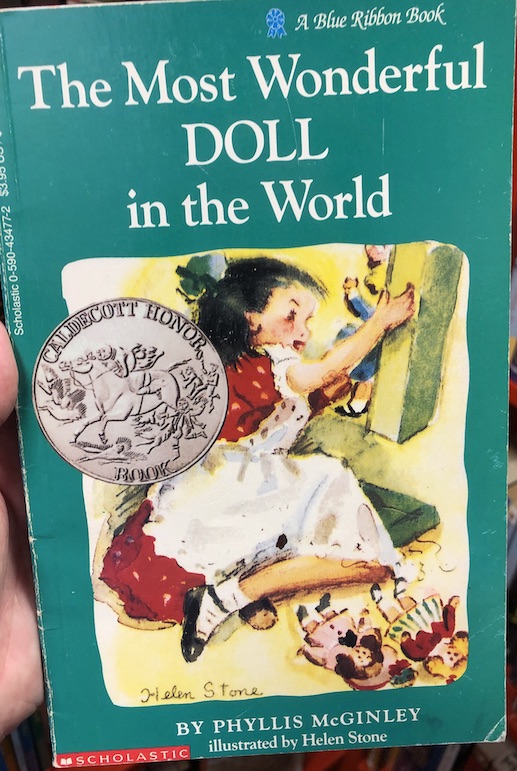
The Most Wonderful Doll in the World

The Most Wonderful Doll in the World by Phyllis McGinley, 1950.

Dulcy is a little girl who is rarely satisfied by anything. She has a big imagination, and is always wishing for something better than what she has. Dulcy has an impressive collection of dolls, but even though she loves all of her dolls, she can’t help but think sometimes that some of them would look better with a different hair color or with different clothes or with some other small detail changed. No matter how good something is, it’s never completely perfect.

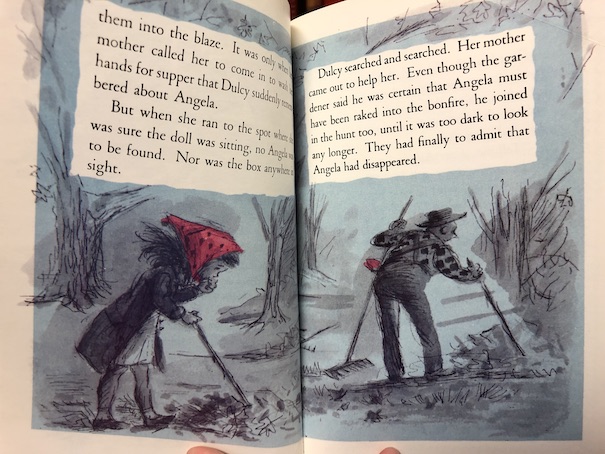
Then, one day, an elderly friend, Mrs. Primrose, gives Dulcy a doll named Angela. Dulcy likes Angela, although her immediate thought is that Angela would be even better if she had dark hair instead of blonde, finding a tiny fault as she always does. But, by accident, Dulcy loses Angela on the way home. She sets Angela’s box down when goes to help rake leaves into a bonfire, and when she goes to retrieve her, she can’t find her.

Once Angela is gone, Dulcy’s attitude changes. Dulcy is upset about the loss of Angela, realizing that Angela really was a precious and special doll. Her mother offers to get a replacement doll that looks like Angela, but Dulcy can’t imagine that any doll would be as special as Angela. As Dulcy describes the doll to her mother, she says that Angela was blonde with a blue dress and pinafore and eyes that could open and close. Those aren’t terribly unusual qualities for a doll, but Dulcy also adds that Angela had shoes with heels and could say “Mama” and “Papa” and sing Rockabye Baby. Those are more unusual, and Dulcy’s mother agrees that she probably won’t be able to find a doll that does all that.

However, readers soon begin to notice that Angela becomes increasingly wonderful each time that Dulcy describes her. When her father offers to buy her another doll, Dulcy adds that Angela could also walk and wave her hand. Dulcy tells her teacher about Angela’s little purse and gloves. She tells her friend Margery about Angela’s raincoat and umbrella.

The more Dulcy thinks about and talks about her wonderful doll, the less satisfied she is with her other dolls. None of them can compare to the amazing Angela! When her Aunt Tabitha gives her a skating doll, suddenly the missing Angela acquires the ability to skate as well. No doll that Dulcy has or ever could have could compare to the missing Angela!

Other children at school are fascinated by Dulcy’s descriptions of Angela and all of the marvelous things Angela had and Angela could do, which get more and more wonderful every time Dulcy tells the story. Then, people start getting tired of hearing about Angela. Dulcy’s friends don’t like hearing that their dolls aren’t as good as Angela, and people stop giving Dulcy dolls as presents because she always says that they’re not as good as Angela.

Then, one day, when Dulcy is playing with a new girl in the neighborhood, they find the box with the missing Angela. When Dulcy sees how the real Angela compares to the one that she dreamed about and imagined when she was lost, Dulcy comes to a greater understanding of the power of her imagination and the need to appreciate things being just the way they are.

Dulcy doesn’t completely give up imagining things and dreaming of perfection, but she does learn that part of growing up is remembering the difference between what she imagines and what is real. She realizes that when she was moping about the doll she didn’t have, she kept herself from having fun with the dolls she did have and discouraged people from giving her other nice dolls. Dulcy saves all the of the amazing qualities that she dreamed of for Angela and gives them to an imaginary doll called Veronica. Dulcy keeps Veronica as her perfect doll in her imagination, and she knows that Veronica is imaginary. As long as she can have her imaginary doll to be as amazing and perfect as she wants, she can be happy with her other dolls being just the way they are, and they make her happy, too.

The book is a Caldecott Medal winner. It is available to borrow for free online through Internet Archive.

Blair’s Nightmare

BlairsNightmareBlair’s Nightmare by Zilpha Keatley Snyder, 1984.

Now that school has started in the small town of Steven’s Corners, the Stanley family kids are dealing with the problems that kids have, handling teachers, friends, and the local bullies.  David has become the new favorite target of Pete Garvey, the bully in his grade in school. (At one point, he compares managing his time around Garvey to that old riddle about crossing a river where the boatman (a teacher, in this case) can’t leave one of the things he’s transporting alone with the other because one of them will eat the other – David sees himself as the prey and Garvey as the predator. Only, David, the prey, has to be the one to manage the maneuvering because the boatmen/teachers don’t.)  Blair, David’s younger brother, also seems to be suffering from school stress, reverting to an old habit of walking in his sleep at night.  Blair keeps saying that he’s getting up to see a nice dog who visits at night, but everyone thinks that he’s just dreaming while sleepwalking.  David thinks that having a dog actually sounds nice and is hoping that he can somehow convince his dad of that, too.

Mrs. Bowen, Blair’s teacher, isn’t amused by his stories about the dog or some of the other things Blair has been saying at school, like his friend “Harriette”, whom no one else has been able to see but apparently lives in the Stanleys’ house (see The Headless Cupid).  She thinks that Blair is “out of touch with reality,” and that his family should work on teaching him the difference between reality and fantasy.

In the middle of all this, things have been disappearing around Steven’s Corners, and people think that it might be the work of escaped prisoners.  The police have been looking for some escaped prisoners in the area, although they haven’t found anything, and the prisoners might not really be around.  David thinks that the things that have disappeared don’t really sound like the kinds of things that prison escapees would steal.  He thinks it’s more likely that Garvey and his trouble-making friends took them.

Then, David starts hearing that, for some reason, the sheriff’s dog has become afraid of going near the woods.  When they brought him out there to sniff for the escapees, he suddenly smelled something that seemed to make him very afraid, and now he shakes when they try to take him back to the area.  Janie, David’s younger sister, has also become very interested in the story of the escapees and seems to be trying to start her own investigation into the matter.

Part of the story has to do with the differences between perception and reality.  Amanda, David’s stepsister, proves to be an unexpected help in dealing with Garvey, taking it upon herself to punch him in the face when he tries to pick a fight with David.  However, it makes David embarrassed that Amanda feels like she has to stand up for him, and it’s further complicated by the fact that Amanda and Garvey seem to have a mutual crush on each other.  Life is full of mixed emotions, and David begins to discover that people’s personalities are more complicated than he once thought.  Some of Garvey’s bullying and trouble-making is really a bid for attention.  Garvey later admits that he didn’t really have intentions of beating David up; he was mostly hanging around David as an excuse to see Amanda and maybe do something that would get her attention.  However, learning that being mean and threatening isn’t the best way to get the kind of attention he wants from people isn’t a bad lesson.

David also learns that Amanda’s feelings toward him are more complicated than he originally thought.  Amanda and David fight a lot, and David thinks that she still doesn’t like having step-siblings, but she says that the reason she punched Garvey was that she suddenly realized that she couldn’t let anyone treat her brother badly.  It surprises her as much as David that, somewhere during their past couple of years of living together as siblings, having adventures, and having fights and arguments, she has come to think of him as her brother.  She shrugs it off as a sign that people just change over time.  She also tells him not to worry about their parents getting divorced when her mother, Molly, argues with David’s father about Blair’s sleepwalking and “dream” dog.  She says that their arguments are nothing like the ones that Molly used to have with her father and that it’s just human for people to fight once in a while.

As you might have guessed, there is also a lot more to Blair’s “sleepwalking” and his dog than his teacher suspects.  One night, while Garvey is over with David and Amanda, they learn how very real (not to mention extremely huge) Blair’s dog is.  For a time, all the kids in the family keep the dog a secret because they’re worried that their father will just send the dog to the pound.  All the while, David’s father and stepmother argue about whether discouraging Blair’s “fantasies” is healthy for him or not.  Molly doesn’t think it’s bad for a six-year-old child to daydream and have imaginary friends, but Blair’s father thinks that they should do as Blair’s teacher says and punishes the other children by revoking their allowance whenever they talk about Blair’s dog.  They have no idea that they’re actually the ones who have the least sense of what the true reality of the children’s situation actually is, and the children find themselves having to accept their punishments without argument in order to keep the secret, seeing it as a noble sacrifice for the safety of their dog.

Eventually, the secret does come out after the dog, now called Nightmare, helps to save the children when they finally encounter the escapees.  (You just knew they were hiding somewhere nearby, didn’t you?)  Nightmare’s backstory is rather sad and involves animal abuse.  His former owner actually tried to kill him, and he is injured.  When the kids’ parents finally learn the full truth, David’s father tries to insist that his rule about no new pets applies until Molly says that having Nightmare around would actually make her feel safer.

Personally, I think that the father could have been a little more apologetic.  He admits that the children were “not guilty” and that they can have their allowances back, but I would have liked to hear him actually say that he was “wrong”, using that word, and maybe add the word “sorry” to it.  It feels like the father is still dodging the reality of his own actions himself, especially considering that the lessons that he was basically instilling in the children were that the “truth” is whatever the people with authority and the ability to punish you decide it is; if that doesn’t happen to be the real truth, you’re not allowed to speak up and say so or argue with them to have some compassion; and if you need to handle real-life problems that they’re denying exist, you have to do so in secret, behind the backs of authority, which is basically there to be part of the problem, not a source of help or solutions.  Real life might sometimes work that way, but I don’t think it’s good to teach children that it’s the way things are supposed to be and that it’s the way they should behave themselves when they become the adults.  Lots of things could have been cleared up much faster if the father had allowed open discussion or asked further questions or even done a little investigating on his own to figure things out.  Parents not listening is a plot device used in a lot of children’s mysteries to set things up for the children to do their own investigating, but it always pains me a little because I’m the type to ask more questions.  I like to be sure of my ground before I stand on it, and I don’t leave things alone if I think there’s a real problem.  It also seems oddly out of character for the father of this story, considering that, in the first book, they established that he had never had a problem in the past with the kids keeping little animals that they found, like lizards and snakes.  So, why wouldn’t he even entertain the notion that Blair might have really found a dog and started feeding it at night?  If it had been me, given the kids’ history with animals and doing things in secret, I would have checked on what was really happening at night, just to be sure.

The matter of “Harriette”, who is a carry-over from the first book in the series (and may possibly be a ghost), is never cleared up.  Blair says that Harriette helped lead him to Nightmare and told him that everything would be all right.  The books in the series imply that Blair is psychic and that he can communicate with a girl who used to live in their house years ago, but it’s never established for certain.  At the end of the story, David, who has been been considering the issue of perceptions vs. reality decides that who or what “Harriette” is – ghost or just Blair’s imaginary friend – may also be just a matter of perception, and that it is probably best left that way.  Other than Blair’s occasional comments about Harriette, her presence is not felt by anyone else in the family, and there are no unexplained supernatural happenings in this story.  There are, however, some dated references to ’80s celebrities, like Magnum and Burt Reynolds.

The book is currently available online through Internet Archive.

The Dastardly Murder of Dirty Pete

DirtyPeteThe Dastardly Murder of Dirty Pete by Eth Clifford, 1981.
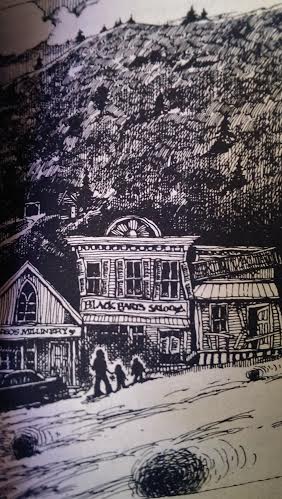
Mary Rose Onetree is starting to think that her father really likes her younger sister, Jo-Beth, better than her.  Her father seems to like Jo-Beth’s dramatic flights of fancy, and he likes to say things to make her laugh.  Mary Rose, on the other hand, is the sensible, practical one, and her father keeps getting irritated with her advice, especially when she frequently turns out to be right.

On their latest car trip, going to visit their Grandmother Onetree on the West Coast, Mary Rose warns her father not to leave the main road (something that he loves to do because he’s a newspaper man and can’t help being curious), and he does so anyway.  Mary Rose warns him that she can’t even find this little side road on the map, but when he sees the sign that says, “Inn of the Whispering Ghost on Skull Valley Road.  Two miles right at the first crossroad ahead,” nothing can stop him from going further to investigate.

DirtyPetePicHarry Onetree and the girls find a ghost town with a hotel, an opera house, and several other buildings.  Although Harry only means to look around for a little while, he forgets to set his parking brake (something else Mary Rose warns him about, which he ignores), and their car rolls backward into a ditch.  Since it’s getting dark, they’re stranded in the ghost town for the night.  But, they’re not alone there.

They find some food in the hotel’s kitchen, and one of the chairs is warm, as if someone had just been sitting there.  In an old newspaper at the hotel, they read about Sorehead Jones, who murdered the hotel owner, Dirty Pete, back in 1905 in order to get his hidden treasure of gold.  But, Dirty Pete wounded Sorehead before his death, and Sorehead died shortly after, swearing that he’d seen the ghost of Dirty Pete.  Supposedly, Sorehead is also a ghost who wanders through the town whispering, “Where is the gold?”

Could the ghost be the mysterious person in the hotel?  But, why would a ghost need food?  Then, Harry realizes something about the town that changes everything, but they still need to confront the whispering ghost before they can leave.

The solution to this one concerns the difference between fantasy and reality, and the lengths that someone might go to in order to make someone else happy.  Mary Rose also comes to realize how much her father really loves her.

This is part of the Mary Rose and Jo-Beth Mysteries series.  It is available to borrow and read for free online through Internet Archive.