
The Ravenmaster’s Secret by Elvira Woodruff, 2003.
Forrest Harper is the son of the Ravenmaster of the Tower of London in 1735. The story begins by explaining the tradition of keeping ravens at the Tower of London because of the superstition that the Tower would be conquered by its enemies if the ravens ever abandoned it. This superstition led to the creation of the job of Ravenmaster, who looks after a flock of ravens that live at the Tower with wings clipped so that they can’t fly away.
Forrest Harper lives at the Tower with his parents and sisters, training to become a Ravenmaster, like his father. He likes the ravens, and they like him. He is pretty good at caring for ravens, but there is something that bothers him: he thinks that he isn’t brave enough and that others think that he is a coward, too. He is smaller than the other boys and is often teased. He has trouble cutting up the squirrels that the rat catcher’s boy (his only real friend, although his mother doesn’t approve of him) brings to him to feed to the ravens. Even though it’s necessary, Forrest doesn’t like the sight of blood and feels kind of sorry for the squirrels. Worse still, when Forrest’s family attends the public hangings (which were treated as a kind of festival day with music and entertainment in Forrest’s time), Forrest is unable to look at the criminals who are being hanged. The one time he does try it, he throws up, and again, the other boys tease him mercilessly for it. Forrest’s problem, as readers will see, isn’t so much that he’s a coward as he has more empathy than the other boys, both for animals and people, and that isn’t really as much of a problem as he believes. His father tells him to ignore the bullies because they are foolish, and their foolishness will show in time.
Forrest sometimes dreams of going out into the wider world, beyond the Tower, where he could do something brave that would impress everyone. The rat catcher’s boy, whose real name is Ned although most people just call him Rat, also dreams of running away because he is an orphan, treated harshly by his master and always in danger of being turned over to the chimney sweep to be used as a climbing boy. He doesn’t think that Forrest has a real problem because his life at the Tower is pretty good, living comfortably at the Tower with his parents, whatever the local bullies say. Still, the two boys often imagine what it would be like to go to sea together and have adventures. When there is an announcement that a new prisoner will be arriving at the Tower, a Scottish Jacobite rebel, Forrest thinks that helping to guard a dangerous rebel will make the Tower bullies respect him.
To Forrest’s surprise and embarrassment, this rebel actually turns out to be a girl. She is the daughter of the rebel Owen Stewart, who is being held in a different tower at the Tower of London (the Tower of London is actually a fortress with multiple towers – she is imprisoned in Bloody Tower and her father is in Bell Tower). She has been charged with treason, along with her father and uncle. Forrest isn’t happy about being given the task of taking food to a girl prisoner.
However, Madeline McKay Stewart, the girl prisoner, is pretty tough in her own right. Although Maddy’s been separated from her father and uncle and all three of them are likely to be executed, she is being pretty brave about it. She talks to Rat and Forrest. She is interested in Forrest’s pet raven, Tuck, and tells him about how she used to feed baby owls back home. She talks about her life and family in Scotland, and Forrest realizes that he’s starting to think of her as a friend instead of an enemy to be guarded.
While Forrest is used to hearing English people criticize the Scots for being “savage,” he is astonished and a bit offended when Maddy talks about English people being “evil.” For the first time, it makes him think of the situation from the other side. He knows that not all English people are evil and realizes, having seen that Maddy actually has refined manners, that Scottish people aren’t “savage.” One day, at Maddy’s request, he takes a message to her father in exchange for her ring, which he plans to sell in order to buy Ned back from the chimney sweep after the rat catcher loses his term of indenture to the chimney sweep in a game of cards, sparing him from the horrible life and health problems that the young climbing boys suffer. Then, Owen Stewart gives Forrest a message to take back to Maddy. Without really meaning to, Forrest realizes that he has suddenly become a go-between for the rebels and could be considered a conspirator under English law.
As Forrest considers the fate that lies ahead for Maddy and the nature of war between England and the Scottish rebels, it occurs to him that the adults in his life have often done the opposite of the things that they have always taught him were important. His father always emphasized fairness, yet the war and Maddy’s possible execution are unfair. Maddy shares Forrest’s feeling that the world might be a better place if people didn’t become adults and abandon their values.
Then, Maddy’s father and uncle are shot while attempting to escape, and Maddy is left completely alone. Forrest feels badly for Maddy. Soon after, he is unexpectedly approached by a carpenter who seems to know that he has become friends with Maddy. The carpenter, who is a stranger to Forrest, tells him that Maddy will soon be executed by beheading but that he has a way to save her life. Forrest has to decide if he is willing to trust the stranger and save Maddy, knowing that doing so would make him a traitor himself.
One of the parts of this story that interested me was how Forrest noted the hypocrisy in the adults around him as he was trying to decide what he should do. Qualities that adults often praise and try to instill in their children are often ignored in the way that the adults live and even in how they treat other children, like Ned and Maddy. Abandoning values, even the ones that they really want their children to have, isn’t something that adults have to do as they grow older, but it is something that some adults do if they think they must in order to live as they want to live or accomplish something that they want to accomplish. The adults who think that Maddy should be beheaded would probably say that they were doing it for the greater good in promoting their cause against the rebels. However, treating Ned as a piece of disposable property is something that they mostly do because they can and because they know that there is nothing that Ned can do to stop them. Ned actually tries to repay his indenture legally with money that Forrest gives him, but although the sweep accepts the money, he refuses to let him go, saying that no one will take Ned’s word over his and that he could always use the money to make sure that Ned is hung as a thief if he tries to make trouble. It is this type of attitude and situation that make the children realize that they are on their own to solve their problems and that working within the law is not going to be an option for them because the law is not just and it is not on their side. It’s a frustrating situation, and I often feel frustrated when I encounter this type of thing in books, but fortunately, things do turn out well in the end.
This is one of those coming-of-age stories where a boy must decide what he stands for and where he really belongs. Through Maddy and the inscription on her ring, which means “Face Your Destiny,” Forrest comes to understand the destiny that is right for him as he helps both Maddy and Ned escape to a better life elsewhere.
The book also includes some interesting historical information. There’s a map of the Tower of London in the front of the book, and in the back, a short history of the Tower with information about famous prisoners and escapes. There is also a glossary of English and Scottish words that modern children (especially American children) might not know, such as breeches, wench, loch, and tattie-bogle (scarecrow).

The book is currently available online through Internet Archive. (To borrow a book through Internet Archive, you have to sign up for an account, but it’s free, and then you read the book in your browser window.)
Spoiler: In the last chapter of the book, it explains what happened to the characters after the story ends. Forrest does become the Ravenmaster after his father, realizing that it is the right kind of life for him and that he no longer desires to have adventures outside the Tower. He has a wife and daughter, and years later, he receives a message from Ned, who says that he has become a captain in the Royal Navy and that Maddy has gone to live in the colonies with other Stewarts (something that my own Jacobite ancestors did, which is how I got to where I am now).
 ColSec Rebellion by Douglas Hill, 1985.
 The Caves of Klydor by Douglas Hill, 1984.
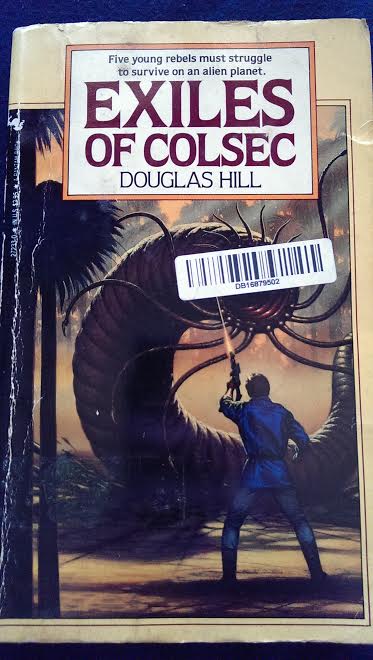 Exiles of ColSec by Douglas Hill, 1984.
 Jestress's Forgotten Books and Stories