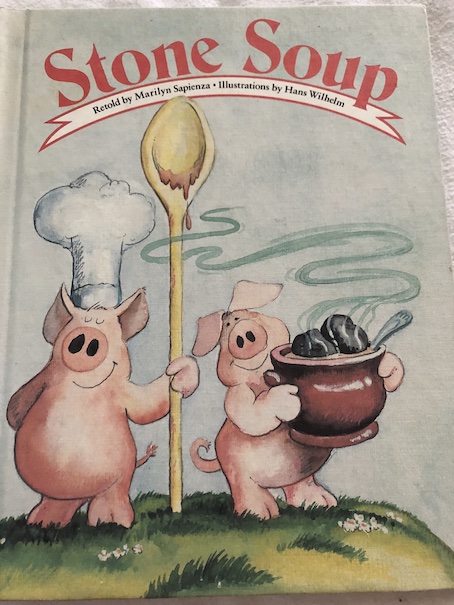
Stone Soup retold by Marilyn Sapienza, illustrations by Hans Wilhelm, 1986.
This is a retelling of a traditional folktale, sometimes called Stone Soup and sometimes Button Soup (and other names). The basic story is the same, but sometimes, it uses a stone and sometimes a button. All of the characters in this particular version of the story are represented by animals. Some of the pictures are in color, and some are black-and-white.

Max and Molly are backpacking across country, and they are getting tired and hungry when they spot a village. Hoping to get something to eat there, they decide to approach the villagers and ask for food.
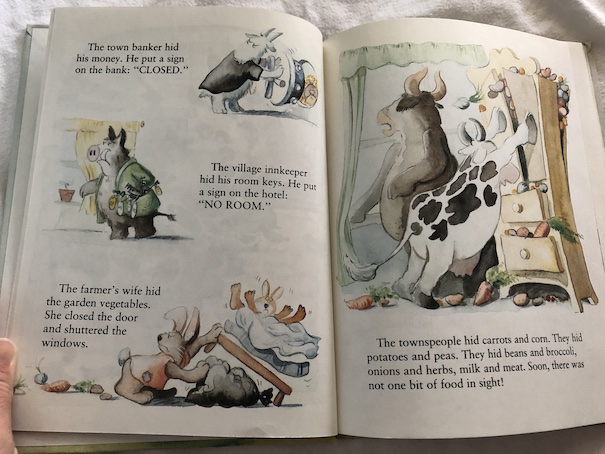
However, the villagers are not friendly, and the last thing they want is to share their food or anything else with strangers. As soon as they see Max and Molly coming, they quickly hide their food and anything else the travelers might want them to share. (I’m not sure why the innkeeper closes his hotel as soon as he sees potential customers coming. You can’t stay in the hospitality industry very long like that.)

When Molly and Max get into town, all of the villagers pretend like they’re starving and refuse to help Molly and Max. However, they see through the villagers’ act and come up with a plan of their own.
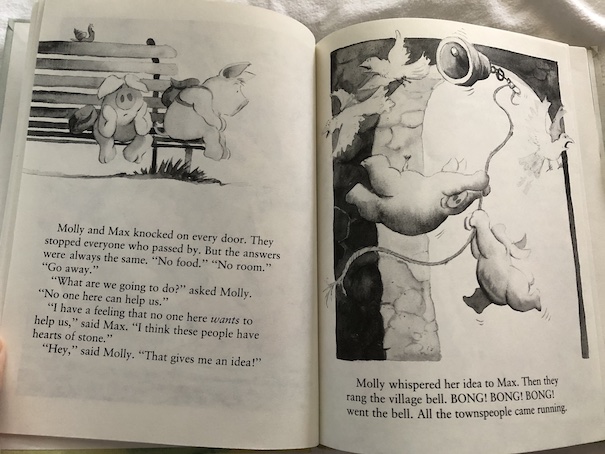
They ring the village bell to call of the people in the village. At first, the villagers are irritated because the bell is only for use in emergencies, but Molly and Max say that having no food is an emergency and that they have a plan to solve it. They are going to teach the villagers to make Stone Soup.
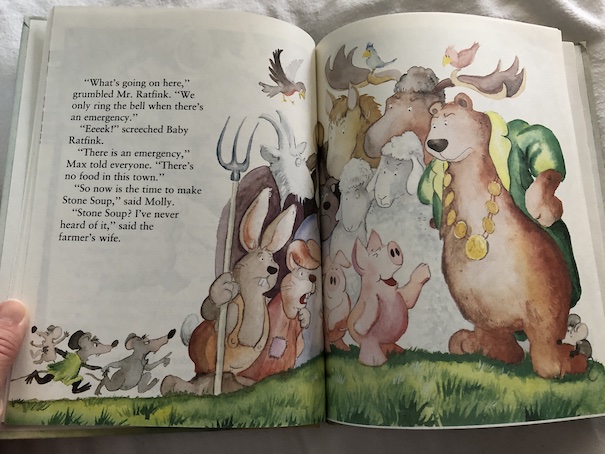
The villagers say that they’ve never heard of Stone Soup, and Molly says that it’s a secret recipe that she’s willing to share. It starts with a pot of hot water and some stones. Molly makes a show of tasting the “soup” and says that it’s good, but it’s even better if you make “the fancy kind.”
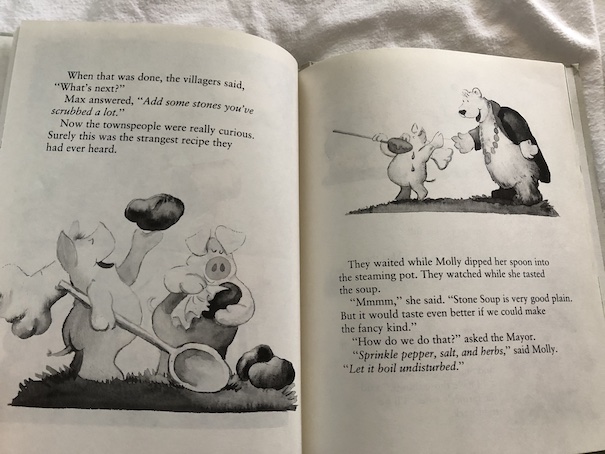
When the villagers ask how to make the fancy kind, she asks for some salt, pepper, and herbs. After the mayor’s wife supplies those, Molly asks for some carrots and onions. When she says that she supposes that they’ll have to do without them, the farmer’s wife steps up and offers some.
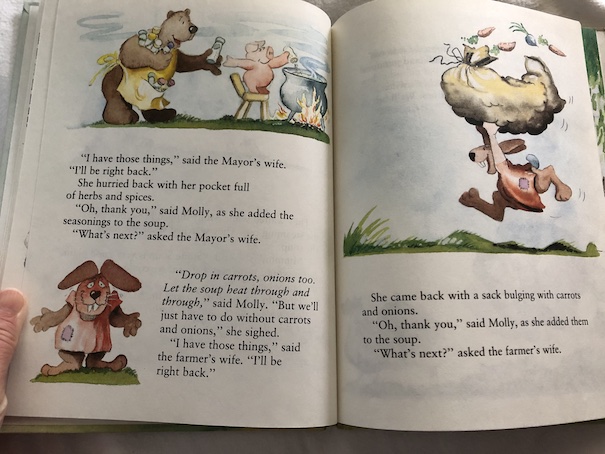
Little by little, Molly and Max coax the villagers into supplying other ingredients, almost without realizing what they’re doing. In the end, the Mayor of the village says that it’s the best soup he’s ever tasted, and it’s amazing, considering that it was only made with stones and water.

The moral of the story is that everyone benefits when people are wiling to share. Everyone gets a share of the soup, but when they start serving it, the villagers also provide other food to eat alongside it, and they all have a feast. The innkeeper gives Molly and Max a room for the night, and when they leave in the morning, they remind the villagers to “Share Stone Soup with everyone.”

In the back of the book, there is the complete recipe for Stone Soup, with rhyming steps. It doesn’t have details, like amounts and cooking times and temperatures, but I suppose someone could use these general guidelines to make an improvised soup. Really, I think the meat should be precooked if you’re adding it as a final ingredient. Otherwise, the veggies would be overdone before the meat is fully cooked.
There are many different versions of this story that have been made into picture books. I haven’t been able to find a copy of this particular book available to read online, but you can find various versions other versions of the same story online through Internet Archive.






 A boy called Nicky and his mother are looking for a new place to live somewhere in New England. The mother wants to buy an old cottage with the idea of turning it into a tea room. At first, they have trouble finding a place, but finally they buy an old house that badly needs fixing up, not knowing that there is an old witch living there.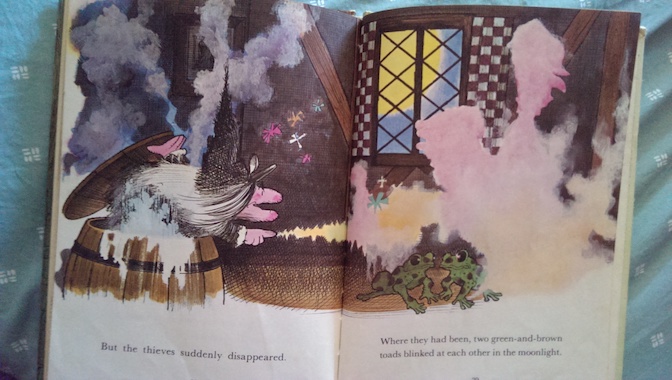




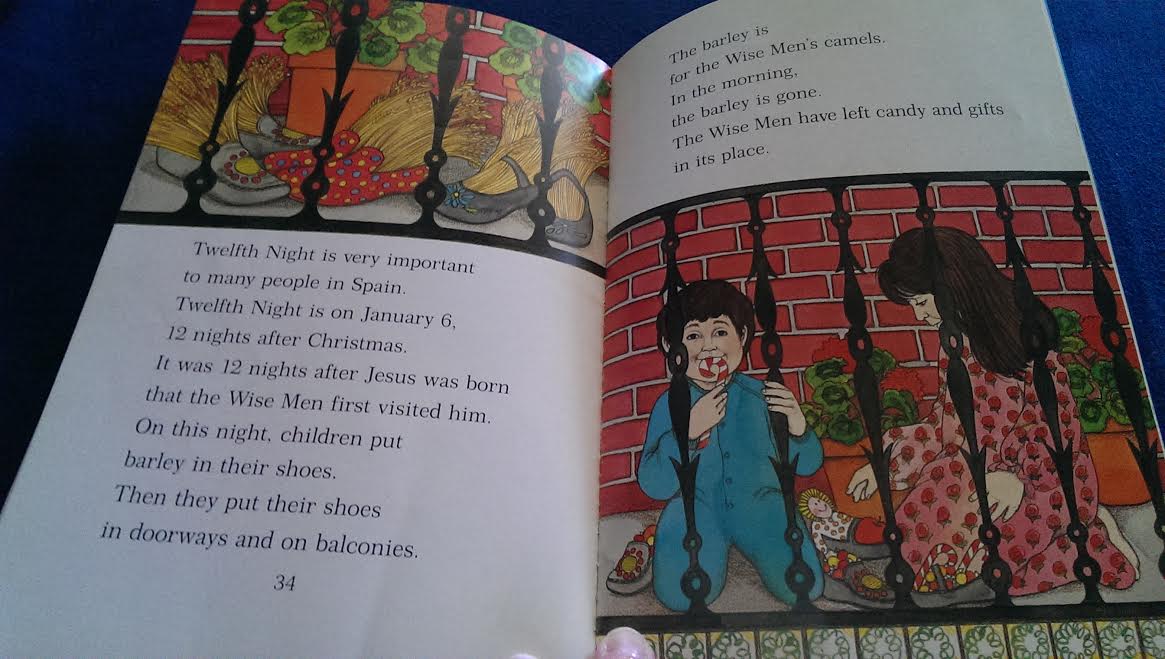
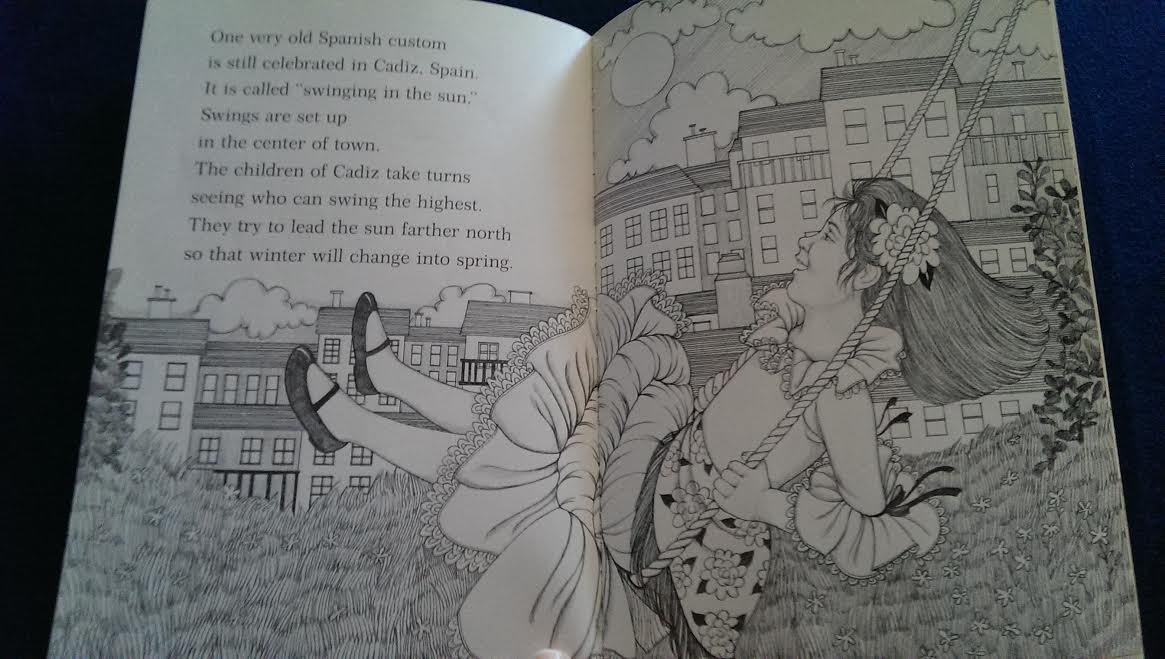
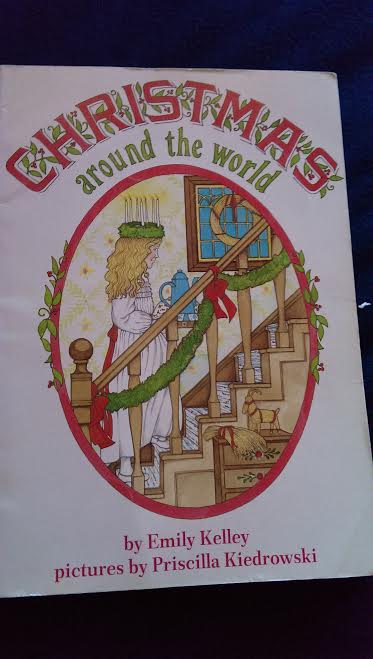 Christmas Around the World by Emily Kelley, 1986.

 Cranberry Thanksgiving by Wende and Harry Devlin, 1971.

 Jestress's Forgotten Books and Stories