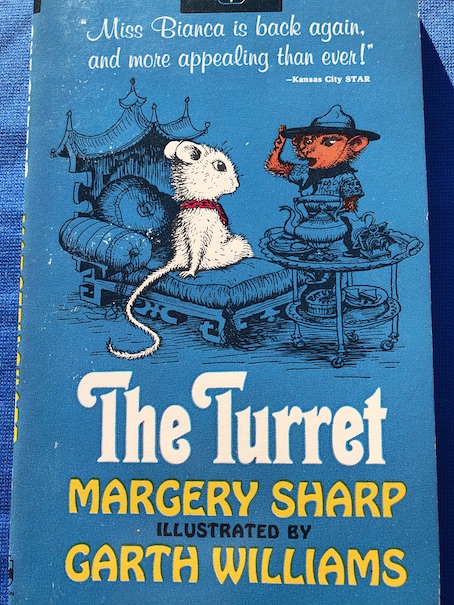
The Turret by Margery Sharp, 1963.
Miss Bianca has decided to resign as Madame Chairwoman of the Mouse Prisoners’ Aid Society. She has never felt particularly drawn to public life, really preferring her quiet life as a pet of an Ambassador’s son (whom she always calls “the Boy”), keeping him company during his lessons and writing poetry in her spare time. During the times when she is away from the Boy, undertaking rescue missions for the society, she knows that the Boy pines for her and worries about where she is. She has started to feel a little guilty that she might be neglecting her Boy.
Bernard, the Secretary of the society, actually feels a little relieved by her decision to resign. While he thought that she made a great chairwoman, he has always worried about the dangerous nature of their missions, afraid that something might happen to Miss Bianca. (Miss Bianca is a little annoyed that he seems so eager for her to resign, and his comment that “you’re too beautiful to be allowed into deadly peril” makes a weirdly chauvinistic compliment – like it would be okay for her to risk her neck if she were ugly because it would be less of a loss? – but Miss Bianca takes it in the spirit in which it seems to be offered.) The two of them reminisce about some of their past missions. Bernard thinks that the worst villain they’ve faced was the head jailer in the Black Castle (from the first book in the series), but Miss Bianca thinks that the worst was Mandrake (from the last book) because the target of his cruelty was a defenseless child.

The society plans to throw a special dinner for Miss Bianca, and Miss Bianca suggests that she would like a picnic by water. The ideal place for it would be the moat around an old tower outside of the city. Miss Bianca enjoys the picnic and is fascinated by the crumbling old turret. Then, she notices something white in the window. Thinking that it’s a piece of litter, one of the mouse boy scouts goes to retrieve it. It turns out to be a small piece of linen, and after the boy scout takes it, it’s replaced by another. Miss Bianca comes to the conclusion that there is someone in the turret and that the person could be a prisoner, signaling for help. When she studies the scrap of linen more closely, she also realizes that she knows who the prisoner is because it has the name Mandrake on it!
After the events of the previous book, the evil Duchess had Mandrake locked in the turret. To Bernard, it sounds like a just punishment for Mandrake, but Miss Bianca feels a responsibility to rescue him, in the hope that he might reform. However, Bernard is skeptical about that possibility, thinking that they would just be letting a criminal lose if they tried to free Mandrake, and Miss Bianca is unable to persuade the other members of the society to undertake the mission.

However, Miss Bianca is unable to give up on Mandrake and goes to see him in his turret. Mandrake is a shadow of his former self. She introduces herself to him as a member of the Mouse Prisoners’ Aid Society, and it turns out that he’s heard about it from friends of his who have been in jail (having had many disreputable associations over the years). In order to test how likely Mandrake would be to reform, Miss Bianca asks him what he would do if he were freed from captivity, and he says that he’d like to be a gardener at an orphanage. He feels badly about the child slaves he helped to abuse while serving the Duchess, and he’d like to see children happy, making their garden a beautiful place. Miss Bianca is satisfied with this and sets about planning his escape. (She’s free to undertake this mission because her Boy is having his tonsils out and won’t miss her for awhile.)

At first, Mandrake doesn’t know how people even bring him food, since his room in the turret doesn’t seem to have a door and food just seems to arrive during the night. Miss Bianca stays up at night to see what happens and learns that there is a hidden staircase in the turret that his jailers use. Before Mandrake can escape, though, he needs to be stronger because he’s badly under-nourished. Miss Bianca recruits the mouse boy scouts to bring him vitamins to help make him healthier and tries to figure out how the secret passage works and think of some way to create a distraction so that Mandrake can escape.
Shaun, the leader of the boy scouts, helps her to come up with a plan. (The book says that Shaun is half-Irish and thinks of himself as being a “handsome boy-o.” Stereotypical.) Shaun has figured out that the jailers watching Mandrake are actually grooms by trade, and he knows of a race horse, Sir Hector, who could provide a good distraction for them. Miss Bianca approves of the plan and persuades Sir Hector to help them.
Meanwhile, the members of the Prisoners’ Aid Society are getting fed up with their strict new chairwoman, who only seems interested in forcing them to participate in group exercises. Members are starting to avoid going to meetings, and worse still, someone suggests to Bernard that the bossy chairwoman particularly likes calling committee meetings because she’s in love with him and wants the excuse to see him. The thought horrifies Bernard, but he’s afraid to say anything to Miss Bianca because he doesn’t want her to feel obligated to try to become the chairwoman again in order to solve the society’s problems (or his), not knowing what she’s actually been up to in her free time.

In the end, everything works out well. When Mandrake is rescued, he actually does become the gardener for an orphanage. The members of the society find out Miss Bianca’s daring mission, undertaken with just a handful of boy scouts, and feel badly that they didn’t take part. They complain to the new chairwoman that she was just wasting their time with exercises instead of real missions, and she resigns, saving Bernard from her attentions. Miss Bianca does not return to the society as its chairwoman, but the next chairwoman is more competent.
This is the third book in the Rescuers series, and it is currently available online through Internet Archive.
 Jestress's Forgotten Books and Stories