
Song and Dance Man by Karen Ackerman, illustrated by Stephen Gammell, 1988.
A grandfather likes to tell his grandchildren stories about when he was a young man and he was a vaudeville performer, a “song and dance man.” Back before the invention of television, live vaudeville performances were a major form of public entertainment in the United States during the late 19th century and early 20th century. A typical vaudeville performance in the United States was like a variety show with short skits, music, singing, dancing, comedy routines, juggling, magic acts, ventriloquists, and various other stunts, acrobatics, and miscellaneous acts.

When his grandchildren come to visit, he likes to take them up to the attic, where his old costume pieces and tap shoes are stored, and he gives them a private performance of his old vaudeville act.
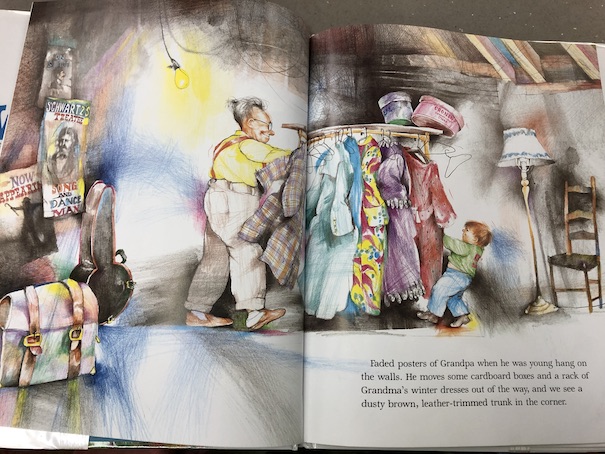

He sings songs, plays the banjo, tells jokes, and also does small magic tricks for the children, like pulling coins out of their hair.
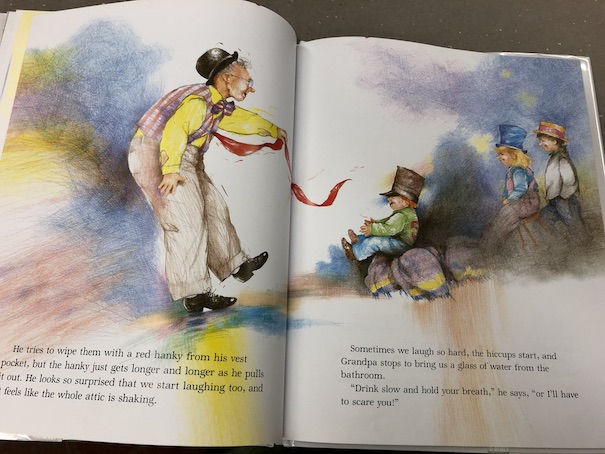
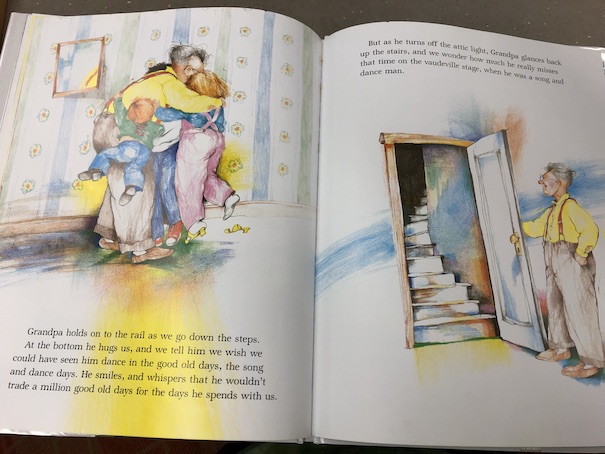
The grandfather loves performing for his grandchildren, and they love seeing him perform. The children can tell that he misses the “good old days” when he was a performer, although he says that he wouldn’t trade the time he has with his grandchildren for his life in the past.
In a way, the fact that the children’s grandfather was a former vaudeville performer dates this story. In the early 21st century, children’s grandparents are mostly people who were born in the mid-20th century, probably between the 1940s and 1970s, depending on the age of the grandchildren and how old the grandparents were when they were born. By the mid-20th century, vaudeville had already gone out of fashion, declining in popularity during the late 1920s and early 1930s, around the time when sound movies were first being produced, although some earlier vaudeville performances actually included short silent films among the other skits and acts. The book talks about television ending vaudeville’s popularity, but it was really movie theaters that were the main competition for vaudeville. Some movies produced during the 1930s and into the mid-20th century carried on some of the vaudeville traditions, like certain types of comedy and song and dance routines, as former vaudeville performers, including Fred Astaire and Bob Hope, transitioned into movie performers. Vaudeville elements show up frequently in Shirley Temple movies, and the Road series of movies with Bob Hope, Bing Crosby, and Dorothy Lamour also features many call-backs to vaudeville variety acts, which is part of the reason why they’re so episodic, light on over-arching plot, and punctuated with song and dance routines. The people who were adults when vaudeville was still big would have been the parents or grandparents of modern, early 21st century grandparents. I first saw this book when I was a child, and my grandparents would have been among those old enough to remember vaudeville. The book was published in the late 1980s, a little over 30 years ago. The children in this book would be from my generation, about the age I was when this book was new, not the current 21st century generation of children. Even so, it is a fun glimpse at the past and can be a good opportunity to introduce children to the idea of changing tastes in entertainment and occupations that used to exist but either don’t exist now or have taken different forms in modern times. Modern grandparents could still use this book to talk about family history and memories of the past.
This book is a Caldecott Medal winner. The book is available to borrow for free online through Internet Archive.
 Jestress's Forgotten Books and Stories