
Five Secrets in a Box by Catherine Brighton, 1987.
This story is about Virginia Galilei (1600-1634), the eldest child of Galileo Galilei, and her perception of his work and equipment as a young child. The book has sections of historical information about Galileo and Virginia in the front and the back inside cover, although the story itself is just about Virginia exploring Galileo’s study.
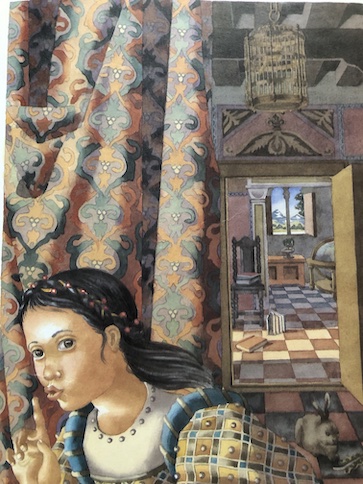

Virginia, as a young child, knows that her father stays up late at night, studying the night sky, while she is asleep. During the day, she must be quiet to let him sleep. She is not really supposed to touch his scientific instruments, but she can’t resist the temptation to take a look. In her father’s study, she finds a box with five mysterious objects in it, and she investigates what they do.

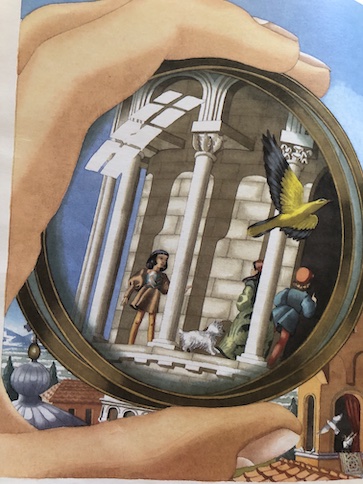
One of them is a lens that makes small things look bigger. Another is a lens that makes things that are far away look closer. There is another lens that makes everything look blue and another that makes everything look red. Then, there is also a plain, white feather.

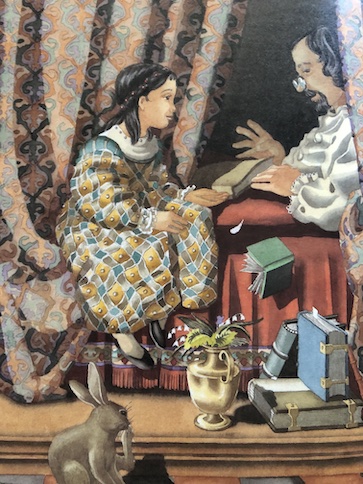
Virginia wonders what the purpose of the feather is, and she asks her father about it. He tells her that it is important to his work.
The book is available to borrow and read for free online through Internet Archive.
My Reaction
According to the historical information provided, little Virginia’s mother left Galileo and married someone else while Virginia was still young. Virginia remained living with Galileo and was close to her father. When she was 12 years old, her father sent her to a convent, which was a fairly common way for upper-class girls at that time to get an education. However, Galileo probably intended for his daughters to join the Church as nuns rather than marrying when their education was complete. The book doesn’t explain this, but Virginia and her younger brother and sister were born out of wedlock. Because they were illegitimate (born outside of a legally-recognized marriage – the word “illegitimate” literally refers to someone born outside of the law and legal standing with implications about both the legal status of their parents’ union and the child’s possible future inheritance, depending on the laws of that particular society), their social status was compromised from birth. Galileo believed that it would be difficult for his daughters to find husbands, so joining a convent and becoming nuns would provide the girls with stable lives and careers as well as an education, which is what both of them did. Virginia remained at the convent as a nun, taking the name of Sister Maria Celeste, and unfortunately, died relatively young at the age of 34. The book doesn’t say why, but it was because she contracted dysentery, which is caused by consuming tainted water or food.
The story itself doesn’t really explain the purpose of the five special objects that Virginia examines in her father’s study. Some of them are obvious because readers will recognize what they are and the way they work. The purpose of the feather is left a little mysterious at the end, but readers get the full explanation by reading the section of historical information. Galileo was studying gravity, and apparently, he dropped objects off of the leading tower of Pisa to study how long it took them to fall. A feather will take longer to reach the ground than a stone, but that’s because of air resistance. One of Galileo’s premises was that, if there were no air to produce that air resistance, the stone and the feather would fall at the same rate of time due to gravity. I think I would have preferred to have Galileo explain some of this to his daughter when she asks him about the feather, but the story ends kind of abruptly at that point, with Virginia just playing with the feather. I felt like the ending isn’t exactly an ending without that explanation.
The pictures are the main reason why I really liked this book. They are colorful and realistic, and I thought they did a great job of showing the scientific instruments of the past. I also liked some of the little details of the house included in the backgrounds of the pictures. There is a crucifix hanging on the wall behind the telescope in Galileo’s study because this is a religious household, even though some of Galileo’s assertions about the way the world works clashed with Church teachings and got him placed under house arrest. (The book says that he was “sent to prison”, but he was actually placed under house arrest rather than being sent to a prison because he was elderly and in bad health by that point in his life.)
The book doesn’t go into detail about Galileo’s arrest because that happened later in his life, but he was basically considered a heretic for his belief in Copernicus‘s theory that the sun is the center of the solar system instead of the Earth. That sounds like a rather petty charge, and you might wonder why it matters or what different it could make to religion. It wasn’t a new idea because others had reached that conclusion long before him. Copernicus was never arrested for his ideas, partly because he didn’t live very long after he published them, but his book was placed on the restricted list by the Inquisition.
The reason why the relative positions of the sun and the Earth mattered depend on whether particular Biblical passages are meant to be interpreted literally or figuratively. Under a strict literal interpretation, which was the interpretation approved by the Church at that time, the conclusion was that the Earth was the center of the solar system, so saying otherwise would be to go against the Bible and Church teaching, making it a heresy. It wasn’t so much that the relative positions of the sun and the Earth were that important by themselves so much as the act of apparently contradicting the Bible. The Renaissance era was also the era of the Reformation, where Protestants were breaking away from the Catholic Church, partly because of the questions of literal interpretation of the Bible and Church doctrine. The Catholic Church’s response to that during this period was to become more strict in enforcing moral and doctrinal standards in the Counter-Reformation, so anything that seemed to challenge these aspects of the faith was taken far more seriously during this period. This stance would shift again later in history.
The background and aftermath to this story is far more complex than the story itself, although I think part of the charm of the story is it’s simplicity. This is one particular day and a small incident, seen through the eyes of a child, even though adult readers know that there are bigger events surrounding it.


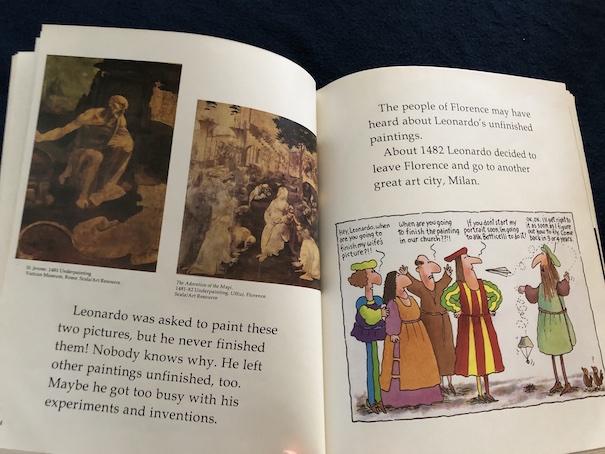


 This book is part of the
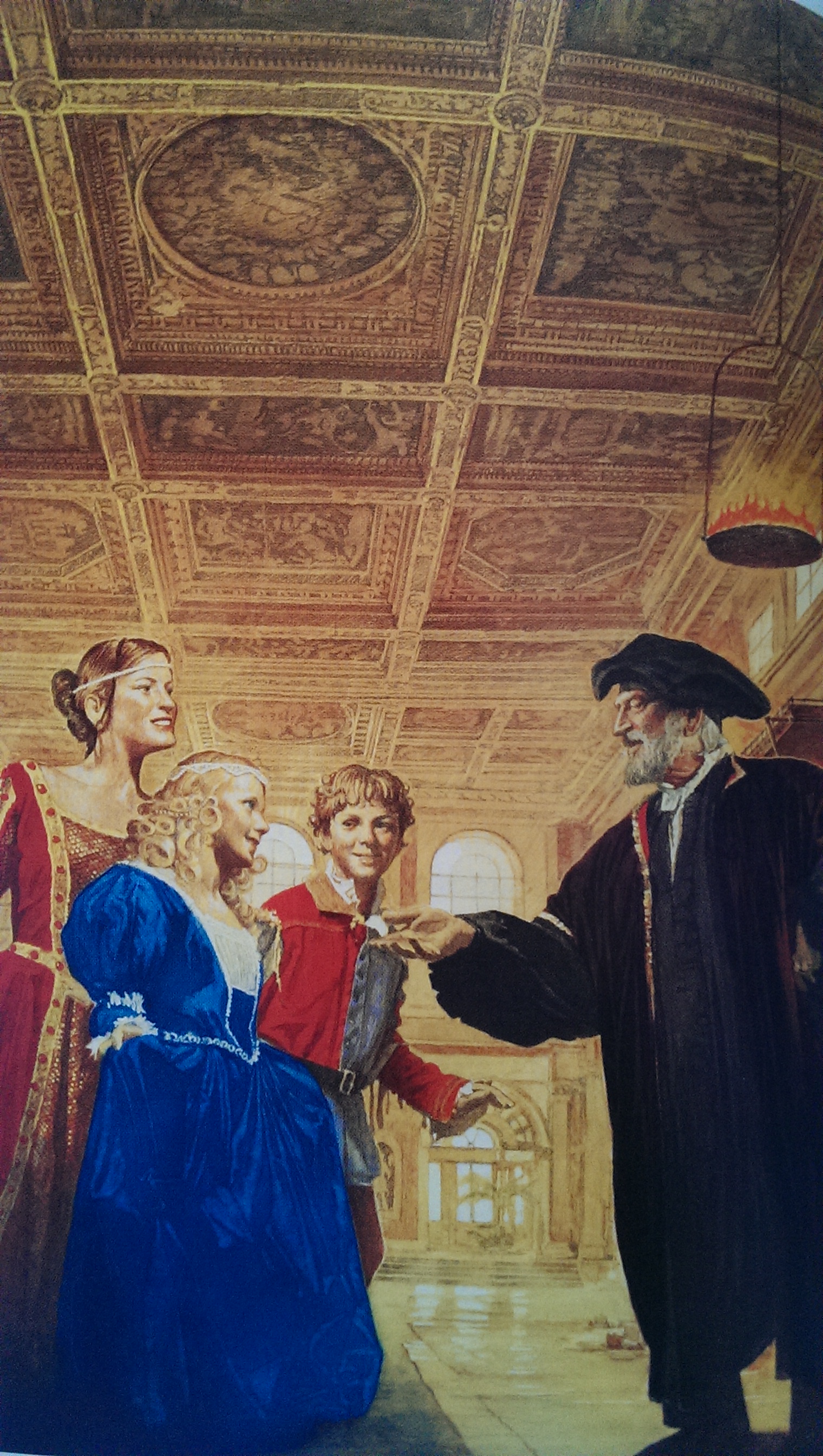
 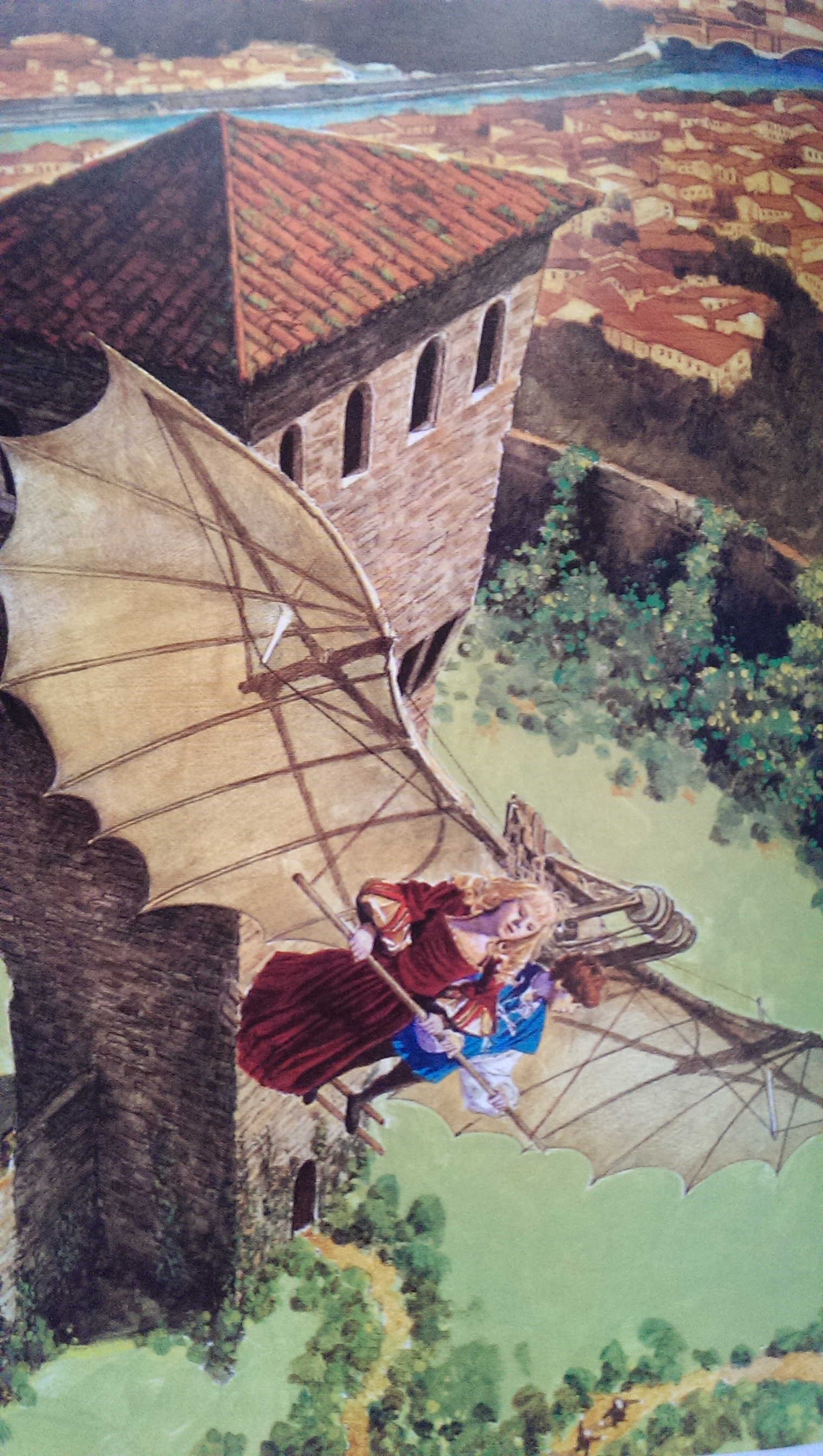 Besides being a great artist, Leonardo da Vinci is also a scientist, and along with his notes on art, there are sketches and plans for possible inventions in the notebooks. Kat and Pietro go to return the notebooks the next day, but before they can get to Leonardo’s studio, the same thief who tried to steal Signor Millori’s papers steals the notebooks.
 Jestress's Forgotten Books and Stories