Madeline’s Rescue by Lugwig Bemelmans, 1951, 1953.
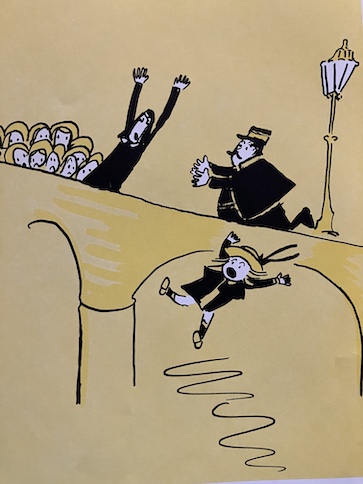
The Madeline stories are considered children’s classics, and this is one of the best-known books in the series. It starts out much like the first book in the series, introducing the old house in Paris where Madeline and her classmates stay for boarding school and describing how brave Madeline is. However, at the part that explains that Madeline knows how to frighten their teacher, Miss Clavel, Madeline falls from a bridge over the river while she’s trying to walk on the edge.
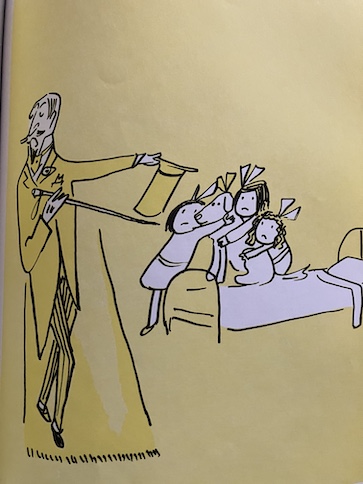
Fortunately, Madeline is saved from drowning by a dog that jumps into the water to save her. Miss Clavel and the other girls take Madeline and the dog back to the school, dry them off and put them to bed. The girls keep the dog and name her Genevieve. Genevieve is a smart dog, and soon, she’s a very pampered and happy pet.
However, when the trustees of the school come for an inspection, they raise a fuss about the girls keeping a dog in the school and turn Genevieve out! The girls are very upset, so they immediately go out and search for Genevieve.
Fortunately, Genevieve returns, and there is a surprise for the girls that finally settles all the arguments they’ve been having about whose bed the dog will sleep in that night!
The book is available to borrow and read for free online through Internet Archive (multiple copies).
My Reaction
As with the other books in the Madeline series, the beginning of the story echoes the first Madeline book, but this one expands on Madeline’s habit of walking on the edge of the bridge and frightening Miss Clavel, showing that Miss Clavel has reason to worry about Madeline’s stunts.
I remember reading this book when I was a kid and being really worried about what would happen to the dog, Genevieve! I always loved dogs, and I was worried about her when the trustees turned her out of the school. After Genevieve returns to the school, there’s no follow-up on how the trustees react and whether or not they approve of her and her puppies staying at the school, but it seems like everything will be okay. With plenty of puppies for the girls at the school, they no longer fight about who gets to sleep with Genevieve or give her attention. Staying at a boarding school where every girl gets a puppy of her own to look after would be a dream for many girls!
Something I noticed in this book is that the style of the pictures varies between cartoon style in black and yellow and a more impressionistic style with full color. This is also true in other Madeline books. The more colorful pictures tend to show more emotional or dramatic moments.
Bob and Becca are going to stay at their aunt’s cabin in the mountains in California with their mother. Becca has been upset since she found out that her best friend, Elaine, will be moving to another state with her family. This trip is partly to get Becca’s mind off of losing her best friend, but Becca keeps thinking about how much she would have liked having her friend along on the trip. The only bright spot for Becca is that she might be able to write to Elaine about how nice the cabin, called Lantern Lodge, is or about the interesting things they might find to do. It’s not as good as having Elaine there to share the experience, but it’s better than nothing.
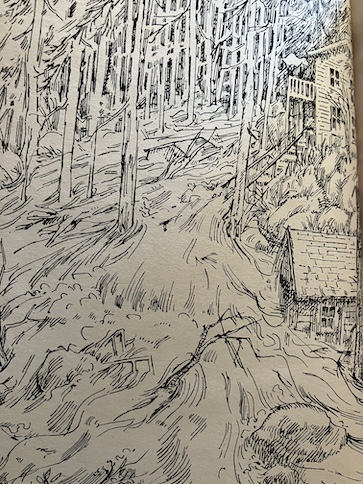
Lantern Lodge was originally built to be a guest cabin for friends of the movie star who once owned the mansion at the top of the hill. Now, the mansion is owned by an old man whose grandson is staying there with him. Bob wonders what the grandson is like and if he might want to go fishing sometime. There used to be a staircase leading up the hillside from the cabin, but it’s overgrown with brambles now.
Becca finds her way up the hillside by following a friendly Siamese cat, who shows her how she can use a cherry tree to reach the portion of the old stairs that is still climable. When she gets to the top of the hill, she admires the greenhouse where the old man grows orchids. She also discovers that Bob got to the top of the hill before her and has already met the old man’s grandson, Dan. Without revealing herself to the boys, she listens to what they’re saying. Dan explains that he’s taking care of his grandfather’s house and plants while his grandfather is in the hospital with pneumonia.
There’s a weather report on the radio that there’s a storm coming and that people in vacation cabins should watch for flash floods. Bob asks if that means his family should leave Lantern Lodge, but Dan says that there shouldn’t be a problem because the lodge is well-constructed. However, Dan says that Bob should wait until after the storm to go fishing. Bob agrees and heads back to the cabin. Becca, who still hasn’t shown herself to the boys, decides to stay longer because she’s curious about the old mansion and wants to look around more.
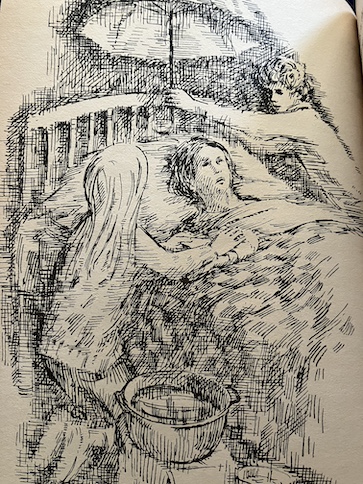
Becca heads back to the cabin when it starts to rain, although it’s difficult to get down from the stairs and tree when they’re wet and slippery. Becca manages to do it unharmed, but her mother slips and hurts her arm when she comes outside to look for her. When her mother’s arm swells up, Becca goes to look at the plants where she fell and realizes that there’s poison oak or poison ivy there. The rain has gotten worse, and the road has flooded, so they can’t leave the cabin, even if their mother was able to drive with her injured arm.
Fortunately, the phone at the cabin still works, and Dan calls them to see how they’re doing. They explain about their mother’s injured arm, and Dan gives them the name and number of a doctor to call. He also gives them other advice for dealing with the situation, recommending that they cook as much food as they can and bring it upstairs in case the lower floor of the cabin floods. They should also fill everything they can with clean water for drinking and prepare candles in case they lose electricity. They follow Dan’s instructions and call the doctor’s office. The nurse on duty gives them some instructions for caring for their mother’s arm and says that they’ll try to send a messenger with some medicine.
Dan calls again later to tell them that cabins in the area are being evacuated, and he thinks they should leave their cabin, too. Bob tries to explain that they can’t leave because the road is flooded and help hasn’t come for them, but the phone line goes dead. He doesn’t know how much Dan understood. They know that there is an emergency crew helping with the evacuations, but without a phone, they can’t call for help. There’s only one way left to communicate with the outside world, and that’s the old flagpole that’s been there since before the telephone was installed. A white flag run up the pole is supposed to signal distress, but the rope is rotten, and they can’t raise the flag. Their mother is now feverish and not very aware of what’s going on. What are Bob and Becca going to do?
The book is available to borrow and read for free online through Internet Archive.
My Reaction and Spoilers
I’ve never been a fan of disaster movies or survival stories, but I did enjoy this one. At one point, Bob says that he used to like seeing disasters movies, but it’s very different from experiencing one in real life. The children are scared, but they try to stay practical and do everything they can to deal with the situation and keep themselves and their mother safe.
It’s not a very long book, but it has some useful information about dealing with disasters. After the phone line goes dead, the kids find a book in the cabin about dealing with disasters. Most of the information in the book doesn’t apply to them, but they make use of the parts they can.
Dan eventually reaches them, but the tree he tied his boat to falls over, trapping him in the house with the kids and their mother. The situation is still dangerous at that point, but the kids realize that there is now one more person to help them. Although Dan was sure that the cabin would be solid, they soon realize that it’s starting to break up, and they have to get out fast. Because he has assisted with other rescues, Dan has the experience they need to help the kids get themselves and their mother to safety. Also, don’t worry about Becca’s pet mouse. I was afraid at first that the mouse wouldn’t make it, but the mouse is okay in the end!
Having survived a real disaster puts the more minor disaster of Elaine moving away into perspective for Becca. It’s sad when a friend moves away, but there are far worse things, and she and her family have come through them together.
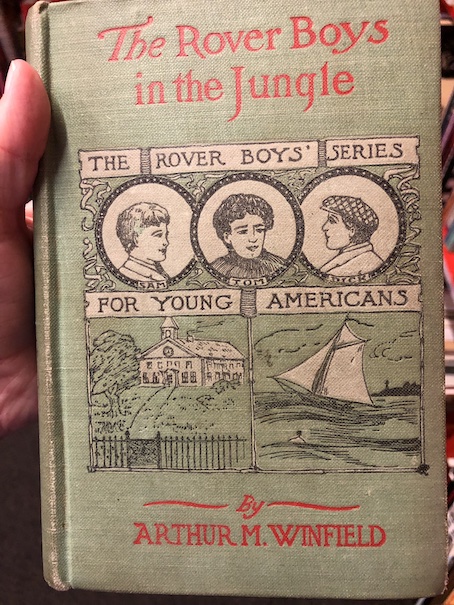
The Rover Boys in the Jungle by Arthur M. Winfield (aka Edward Stratemeyer), 1899.
My Foreword
I wasn’t particularly eager for this book after the first one in the series. I didn’t think the Rover Boys was as much fun as later Stratemeyer Syndicate books and there are some instances of racial language that are uncomfortable to explain. However, this is the book where the boys actually go to Africa in search of their missing father, and it resolves one of the major problems that the first book in the series set up, and I wanted to see it end.
As the book says at the beginning, the boys’ father went to Africa before the beginning of the series to look for gold mines and hasn’t been heard from since. The boys don’t know if their father is alive or dead, and meanwhile, the boys’ enemies from the first book in the series are still hanging around. The Baxters were put in prison for attempting to kidnap Dora at the direction of Josiah Crabtree in the book immediately before this one, but Dan Baxter escapes early in this book, and Crabtree is still around somewhere. The introduction and first chapter to the book brings readers up to date on developments from the previous books, sort of like the introductions to episodes of movie serials that didn’t exist at the time these books were written. Books in this series really need to be read in order, and if you skip any, like I did, you really need the introduction to bring you up-to-date.
The Story
There is a new boy at school, Hans Mueller, who is from Germany. This book was written before World War I, so there is nothing critical or derogatory about Germans, but the boys decide to tease Hans a little by playing up myths of the Wild West to scare him. They tell him that the school will be teaching them how to fight Indians (Native Americans) and that he’ll have to learn how to scalp people. Hans doesn’t know what they’re talking about at first, and when they explain it to him, he’s alarmed. (Good, Hans. That’s a sign of sanity.) Hans says that the only time he’s seen American Indians was at a traveling Wild West show that came to Germany, and he thought they looked scary. The other boys have a laugh about spooking poor Hans and drop the matter.
I mentioned in my last Rover Boys review that early Stratemeyer Syndicate books had archaic racial language and sometimes questionable racial attitudes that was later rewritten when various series were reissued. This early series hasn’t been revised. This first scene with Hans isn’t really so much a slur against Native Americans as prank with the boys playing up Wild West stories, but the book is just starting out.
Hans becomes the boys’ friend, but they prank Hans again later, scaring him with Tom wearing a Native American costume as he threatens to scalp him to continue their earlier joke, and they use the term “red man.” (We haven’t even gotten to Africa yet, so I was cringing at this point at what might be in store.) When Hans realizes that it was all just a prank, he tries to get the better of Tom by taking away the gun that Tom was using as a prop to scare him, and Tom tells him that the gun is too old to fire and isn’t dangerous. He just found it in the barn, and it’s all rusty. Tom tells Hans to pull the trigger and see that it won’t fire, which is the dumbest thing that anybody can do with a random old gun they just found somewhere. The gun explodes in Hans’s hands, knocking both Hans and Tom unconscious and scraping them with shrapnel. The other boys are scared, but they finally manage to bring them both around. Tom is horrified when he realizes what happened, saying that he’s been playing with that gun for awhile and pulled the trigger a dozen times himself, which is why he thought that the gun was unloaded and harmless (meaning he did the dumbest thing that anybody can do with a random old gun they just found somewhere repeatedly because, up to this point, dumb luck was on his side). He is shocked to realize that he’s lucky that he hasn’t shot somebody before and that he and Hans weren’t killed by the exploding gun. He apologizes to Hans and promises that this is the end of the pranks. Tom was always the lead prankster in earlier books, but he grows up a little here, realizing that reckless pranks have consequences.
At school, the boys participate in a kite flying contest, and Sam is almost pulled over the edge of a cliff by his kite. (Seriously.) Dora tells Dick that her mother had a dream that Crabtree tried to shoot him in a forest. (Prophetic?) The boys also have a run-in with Dan Baxter, who is still lurking around and swearing revenge.
Then, the boys turn their attention to a thief at school. Sam witnesses someone, who is probably the thief, sneaking around at night. Unfortunately, he didn’t see the person’s face, only describing this person as tall. Captain Putnam comes to believe that Alexander “Aleck” Pop, a black man who works for the school, is the thief because he receives an anonymous note that says he’s guilty. Sam doesn’t trust the anonymous note and tells the Captain so, saying that he can’t believe anyone as good-hearted as Aleck is would be a thief. However, the Captain insists that Aleck’s belongings be searched, and some of the objects that have been stolen turn up among his stuff. It’s a pretty obvious frame, and Alexander protests that he’s innocent, but Captain Putnam doesn’t believe him. There’s some ugly racial language used during this part. The word “coon” is used twice, and when the students at the school discuss the situation, one says the n-word. Fortunately, our Rover boy heroes aren’t the ones using that language, and Tom even tells the boy who used the n-word that he’s just resentful against Aleck for catching him doing something he shouldn’t have done earlier. The boy who used the n-word, Jim Caven, is portrayed as mean and unreasonable, and he gets into a fight with Tom in which he almost hurts him very badly. I was uncomfortable with the language in this scene, although I was somewhat reassured to see that it was used to characterize the ones using the worst of it as being the bad characters. My reassurance wasn’t complete because that’s not the only questionable racial language in the book.
Captain Putnam sends someone to escort Aleck to the authorities. He says that he supposes that the boys think he’s being too harsh with him, but he’s also suspicious of Aleck because he knows that members of his family have been in trouble with the law, too. The boys say it isn’t fair to blame him for things his relatives did and that they still don’t think he’s guilty. However, Aleck escapes before they reach the authorities, and they hear rumors that he went to New York City and boarded a ship to go overseas somewhere. The boys are sad, thinking that maybe they’ll never see him again. (You know they will.)
It’s not much of a surprise when the Rover boys later learn that Jim Caven has sold some things that match the description of other objects that have been stolen. Apparently, he’s been the thief all along and deliberately framed Aleck to get revenge on him. (I partly expected that the thief might be Dan Baxter, considering that he’s escaped from jail and is hanging around somewhere, probably needing money.) When the other boys confront Jim Caven, he flees into the woods. The other boys explain the situation to Captain Putnam, and he searches Jim Caven’s belongings, finding the rest of the stolen items. (You know, they could have just conducted a general search of the school and everyone’s belongings before this. This is a military academy, so a surprise dorm inspection wouldn’t be out of character, and it would have settled the matter much earlier.) Aleck’s name is cleared, but since he’s fled, they don’t know how to find him and tell him. Captain Putnam is sorry that he didn’t believe Aleck before.
However, they don’t have much time to consider it because the boys are soon summoned home by their uncle because he’s had news of their father. A ship captain has written Uncle Randolph a letter saying that his crew rescued a man who was floating on a raft off the Congo River. The man died soon after they brought him aboard their ship. They don’t know who the man was, but he was carrying a letter from the Rover boys’ father saying that he found a gold mine in Africa but was taken captive by King Susko of the Bumwo tribe (not a real African tribe, I can’t find anything about it) in order to prevent him from telling the secret of the mine to outsiders. Specifically, the tribe is afraid that the English and French colonizers will come to loot the mine and kill them. (Actually, a depressingly reasonable fear.) Anderson Rover explains in the letter that they don’t understand Americans. (That wouldn’t help, Anderson. Your boys attend a school run by a man who served with General Custer, and if this tribe knew what happened to Native Americans when gold was discovered on their land, they wouldn’t be reassured at all.) Anderson Rover is in fear of his life and asks his brother Randolph to come and rescue him if he can, but the letter is dated a year ago, so his family still doesn’t know if he’s alive now or not.
Uncle Randolph tells the boys that he wants to go to Africa to find his brother and asks Dick to come with him, as the oldest of his nephews. Dick, of course, agrees to go, but Tom and Sam refuse to be left behind. They decide that all of them will go.
On the ship to Africa, they meet an English adventurer named Mortimer Blaze, who is going to Africa for big game hunting. Tom asks him what will happen if the big game decides to hunt him instead, and he just says that it will be a “pitched battle.” (Doesn’t sound appealing to me.) When they talk about the people in Africa, they use the word “native” a lot and not in a flattering way. The general attitude seems to be that the “native” Africans are not very civilized (I was expecting they would say that because of the time period of this book), and Mortimer Blaze tells stories about tribes of people who are either very tall or very short. (I think he’s really referring to people from folktales, which I covered in the Encyclopedia of Legendary Creatures.) At one point, the characters say that the warm climate is the reason why Africa hasn’t made more progress toward civilization, that the warmth makes people want to be lazy. The adults in the story shock the boys by saying that not only is there no Christianity but that people there don’t really believe anything in particular, putting them even behind people Christians would consider heathens. They also make a shocking comment at one point about unwanted children being fed to crocodiles. They conclude that “civilization” can’t come soon enough to Africa, even if it has to be forced in with weapons. (Wow. I knew there was bound to be a lot of generic “native” and “savage” talk when I started this book because of the time period, but these matter-of-fact slights and accusations sound like they came straight out of Mrs. Mortimer’s books about Countries of the World Described, which heaps criticism and accusations of violence and immorality on pretty much all of the people of the world. Mrs. Mortimer’s books are much older than any Stratemeyer Syndicate books, and I wonder if Edward Stratemeyer read them in his youth. It wouldn’t surprise me because the attitudes match, and here he is, passing it all on to the next generation of kids in the form of an exciting adventure story.)
In a stroke of good luck, they end up rescuing Aleck, who was stranded at sea from the ship he boarded during his earlier escape. Aleck is glad to see the boys again, and they tell him that his name has been cleared and the real thief was caught. Aleck is glad to hear that, but he’s worried when he finds out that the ship that picked him up is headed for Africa. Aleck reflects that he always heard that his ancestors came from the Congo region of Africa, but he doesn’t really want to go there because he’s used to life in America and wouldn’t know what to do in Africa. (The Rover boys and Aleck go on for awhile about how great the United States is, and I know they were trying to sound patriotic, but the way they said it felt oddly like a sales pitch to me. I felt like saying, “You don’t need to sell me on the place. I already live here.”) The boys explain how they’re going there in search of their father. Aleck decides that he’d rather join their expedition than stay on the ship, and he offers his services as a valet. Uncle Randolph and the boys are glad to accept his help, and Uncle Randolph says it might be useful to have a black man with them who they know and trust in case they need someone to blend in with the native population and spy for them.
In a surprising twist, the boys also run into Dan Baxter on their arrival in Africa. When they ask him what he’s doing there, he says that he got drunk and was Shanghaied onto a ship, forced to work as a sailor. He was treated cruelly on the ship and ran away as soon as he had the chance. Now, he’s alone and has no money and no way home. The Rover boys feel sorry for him and give him money for him to buy his passage back to the United States. Dan Baxter asks to join their expedition, too, and they consider it as a sign that Dan is starting to reform because of his expedition. However, Dan is still a bully and an opportunist, and when he gets a counter-offer from someone else who is willing to hire him to make trouble for the Rovers, he accepts that instead, still holding a grudge against the Rovers because his father always told him that Anderson Rover stole a mine from him years ago that would have made them rich.
When I reviewed the first book in this series, I complained about the various unresolved story lines and miscellaneous villains still running around at the end of the story, still left to work on their individual plots against the Rover boys and their friends. In this book, every unresolved story line and villain from the first book collides with each other in Africa. Not only is Dan Baxter in Africa coincidentally at the same time as the Rovers, but Josiah Crabtree is also in Africa, for completely unrelated reasons from either the Rovers or Dan Baxter. He does attempt to kill Dick, but Dick survives. He is even rescued from a lion by one of his brothers.
So, is there true resolution with the main villains of the story, Dan Baxter and Josiah Crabtree? Not really. I looked up summaries of other books in the series, and even after they get some comeuppance, they continue to come back in sequels.
What is resolved by the end of the story is that the Rovers find their father alive. They rescue him from the village where he was being held captive, taking some of the women and children from the village with them as hostages to keep the village warriors from attacking them. They say privately that they wouldn’t have really hurt the women and children, but they tell the men that they’ll kill them if they don’t let the rescue party go. (This was another shocking part for me because I wouldn’t have thought of any of the usual Stratemeyer Syndicate heroes doing this. Somehow, I can’t picture the Hardy boys going this far, taking women and children hostage and threatening to kill them.) Once the rescue party is sure that they’re safe, they release their hostages and head for home. Anderson Rover says that he did find a gold mine, and someday, he’ll come back and loot it, er, mine it, but right now, all he wants to do is go home with his boys. It would be heartwarming if I didn’t know that he’s going to come back someday for gold on land that belongs to someone else who would never willingly sell it to him, and his boys are talking revenge on the king of the tribe that held their father captive.
This book is in the public domain and is easily available online in various formats through Project Gutenberg and Internet Archive (which has an audiobook).
My Reaction
I already gave much of my reaction to this book during the description of the plot because much of my reaction had to do with the racial language of the book. I knew there were going to be problematic portions before I even started, but frankly, there were too many of them for me to go into detail on all of them. What I described gives the broad strokes. I won’t say the book is deliberately trying to be insulting to black people. Aleck is portrayed as a good character who was wronged by a white boy by being framed for theft. However, there is a kind of casual racism in the story, like the casual references to how “uncivilized” Africa is and the characters’ off-hand supposition that it’s probably due to the climate there. I wouldn’t say that the characters or author hate black people (except maybe the non-Christian ones who feed children to crocodiles, which sounds like things Mrs. Mortimer accused various people of doing in the worst parts of Countries of the World Described), but I would say that there is a kind of condescension and dismissiveness that everyone, characters and author, seems to take for granted.
I can’t recall any of the characters using the phrase, “you know how they are”, but that’s the vibe I was getting. I got the feeling like the characters were saying things to each other and the author was saying things to his child readers with that sort of knowing tone, like “we all know these things.” No. “We” don’t. I know that Stratemeyer probably got a lot of this from a combination of old minstrel shows and Mrs. Mortimer or something very similar because I’ve seen Mrs. Mortimer‘s books, and I know how she talks. I also know why she says the things she does, and I’m not putting up with her attitude, even when it’s coming from someone else. Maybe the Rovers boys as characters and their child audiences would have read her books or similar ones before and nodded along with what Stratemeyer says because it confirms “information” they’ve seen before, but I’ve had more than my fill of wild accusations and crazy conspiracy theories, and I have no more patience left for any of it.
Mrs. Mortimer portrayed her book series as a factual introduction to world geography and the habits of people in different countries, but the truth behind her criticism, condescension, outspoken rudeness, and many of the wild accusations she makes about badly-brought-up children, dead bodies floating in rivers or just left in the street (depending on nationality), or the “antics” of “savages” around the world is her religious agenda (and, I think, probably some personal emotional and self-esteem issues, but that’s just a guess). She used missionaries with their own agendas as references for anecdotes in her books and tried to make people of various religions around the world sound evil and crazy on purpose to emphasize why “the Protestant” is the best religion (her words – she was specifically Evangelical and downright pushy about it). I would say that she also never hated black people … except maybe non-Christian ones, who as I recall, she claimed didn’t know what religion they were and were given to “antics”, dancing around and yelling or something. She wasn’t too clear on that point, probably because she didn’t know what she was talking about herself. On the other hand, she seemed inclined to be sympathetic to black people in the US who were victims of ill treatment, probably because they were Christian and most likely Protestant, which would have made all the difference in the world to her. She probably would have been okay with Aleck because he’s a Christian who was born in the US and has definitely never fed a baby to a crocodile in his life. She did not approve of the the concept of slavery at all and wouldn’t have tolerated physical cruelty of anyone due to race, which is to her credit, but none of that stopped her from spreading stories and rumors of violent savagery and teaching children that anyone who believed anything other than Protestant Christianity was “ignorant”, “savage”, and “wicked”, all words she actually used in describing people from various countries around the world because that’s what she wanted young children to “know” about other people. Mrs. Mortimer’s religious prejudices probably would have gone over the heads of the children who were these books’ original readers, especially if it echoed the talk of the children’s parents, but that’s how we end up with generations of children who grow into adults with casually racist ideas, thinking nothing of it, throwing around racist language without a clue or a care for the consequences. It’s in the book because it’s what “we” all “know”, dear Mrs. Mortimer said as much before, and Stratemeyer is just saying what “we” were all thinking, right? I think that’s about how that goes.
Let me bring you into the real world. If readers want to know what was really happening in Africa during the 19th century, there are far better sources. Africa is an entire continent, and there were many complex events happening all over, particularly related to European colonization. Outside forces were claiming territory in Africa, not so much for benefiting the people there and bringing them “civilization” as accomplishing their own personal aggrandizement and enrichment. (You know, rather like a man who is already rich in his own country coming to find and claim a gold mine that’s on someone else’s land because he’s addicted to the thrill of the hunt and acquisition and uses that thrill to hide from his own personal problems that he doesn’t want to face at home, like dealing with the loss of his wife and the raising of his boisterous sons. Just saying.) There were wars, famine, and disease in various parts of Africa during this period, partly due to internal power struggles among different African groups and leaders. I don’t know if anybody ever fed anyone to a crocodile on purpose, but infanticide is part of the dark side of humanity that comes out when times are desperate and hopes of survival in general are low. It’s a symptom of a society that’s suffering, and societies have suffered in that way many times around the world. If someone is likely to die soon after birth anyway, the hopeless parents might say, why even try? I suppose some might be tempted to say that having a religion that forbids killing children would help, but it hasn’t always, and having food also helps. I don’t blame 19th century missionaries for attempting to help people, but those who came in with a sense of self-importance, deciding ahead of time what would help without understanding the situation they were walking into, often didn’t help. Missionaries sometimes ended up getting killed in the middle of the unrest and power struggles. Some were even actively deceptive, using trickery and their position to gain advantages for themselves or the governments they represented at the expense of the people they were supposedly trying to help. But, the 19th century wasn’t all war, famine, and exploitation in Africa. The missionaries who were serious about doing some good and set up practical schools did provide useful centers of learning that helped educate future leaders and professional people and gave them tools they could use to build the lives they wanted. African societies did continue to build their own nations and identities. Overall, the colonization of Africa was more of an intrusive, disruptive force, providing additional hardships and obstacles to success more than solutions to any problems that Africa had before, not the glorious “civilizing” force that prevents people from feeding children to crocodiles that the book described.
So, now that I’ve talked about the historical and cultural influences behind the more uncomfortable parts of this book, I think it’s pretty obvious why early Stratemeyer Syndicate books had to be rewritten and revised in the mid-20th century. I knew this book was going to be cringe-worthy in places, but I have to admit that I was surprised at just how bad certain parts got. I hadn’t even considered that the word “coon” might appear. I never heard that word growing up and didn’t even know what it meant until I was in college, so I was pretty taken aback that a just-for-fun book for kids would use it, even one from the late 19th century. I suppose having grown up with the tamer, revised versions of books from the Stratemeyer Syndicate, I underestimated what the older series were like. I can only hope that I’ve made it pretty clear for people reading this review what the problems with this series were.
I debated about whether or not to even post this review, but I’ve talked about some uncomfortable books before (and said many highly critical things in my earlier rant about Mrs. Mortimer, my favorite example of a very popular bad influence in children’s literature – if you only know about her from The Peep of Day, you haven’t seen anything yet, even though the first chapter of that book is one of the most disturbing things I’ve ever read that was intended for small children). I’ve been planning a page discussing Stratemeyer Syndicate series books because they have been an important force in American children’s literature for so long, and it seemed only right to talk about their first series. So, now I’ve talked about it, and nobody else has to suffer through this book if they don’t want to. I found the characters, language, and situation aggravating, and the rewards for perseverance were inconsequential. This is certainly not something to spring on suspecting people, especially modern children, who might try using certain words for the attention-getting shock value without really understanding what they mean. I would say that this series should be primarily for adults interested in the history of children’s literature and others who know what they’re reading, understand what’s behind it, and can draw the line between fictional book and real life.
I’m not sure if I want to read any further books in this series because the unresolved problems of the stories get on my nerves, and there will probably be further issues with racial language, and I’d just have to repeat all the same explanations I’ve already given. I’m not saying a firm “no” to the rest of this series because there are indications that some people would like to see more coverage of them, but if I do any more, it’s probably going to be awhile and will only be delivered in small doses.
I wasn’t quite expecting to have these Mrs. Mortimer flashbacks from this book, but in honor of that experience, I might as well say that even though I’m leaving the Rover boys behind for now, I’m planning to go read many other useless novels “about people who have never lived”, which Mrs. Mortimer despised, and because I have access to some of them in audio book format, I can listen to them while knitting something completely unnecessary just because I want to. (If you read my rant/review about Countries of the World Described, you know what I’m talking about.) I’m not going to do it just because it would annoy Mrs. Mortimer. It’s something that I enjoy and do routinely anyway. I would do it even if it was something I thought Mrs. Mortimer would actually like. It’s more that knowing that she would have disapproved and can’t do anything about it makes me feel like we’re even because that’s the way I feel about her books and others like them.
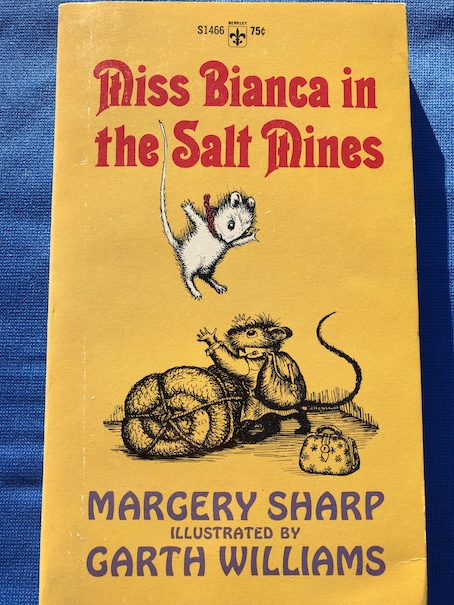
When this story begins, Miss Bianca, who is Perpetual Madam President of the Mouse Prisoners’ Aid Society, is evaluating candidates for the Tybalt Stars award, which is given for mice who are brave in the face of cats. Bernard, the secretary of the society, is helping her. Each of the candidates is undeniably brave, but Miss Bianca notices that each of them also had a self-serving motive behind their bravery, which seems disappointing for a benevolent society. When they stop for lunch and Bernard goes to fetch some salt for them, he finds a note in the salt that says, “Someone please get me out of the salt mines.” The note is signed “Teddy (age 8).” Naturally, Miss Bianca is eager to help the poor boy! Bernard is a little more doubtful about the mission because the salt mines are about a thousand miles away, extremely dangerous, and extremely well guarded. Nevertheless, the Mouse Prisoners’ Aid Society cannot refuse to help a prisoner, and neither can its President.
Soon, Miss Bianca has members of the society trying to learn anything they can about a missing boy named Teddy, but apparently, no one has reported a boy by that name or age as missing. Bianca uses the lessons of the boy who owns her to learn more about the salt mines and how to get there. In order to get to the salt mines, they’d have to go by train, and it’s a very dangerous route. At the next meeting of the society, Miss Bianca asks for volunteers to go rescue Teddy, but everyone is reluctant to go, and many members of the society don’t like it that Miss Bianca doesn’t even seem to have any facts about Teddy or his situation that could help them. Miss Bianca says that, even though she can’t be more specific about Teddy’s background or how he came to be in the salt mines, the important fact is that he shouldn’t be there, and he needs help getting out. Since no one else wants to volunteer for the rescue mission, Miss Bianca says that she’ll go herself, and of course, Bernard insists on coming with her.
To Miss Bianca’s surprise, her biggest opponent, a curmudgeonly mouse called the Professor (his real name is George) who teaches mathematics, also volunteers to join the mission. Bernard and Miss Bianca are even more surprised when the Professor insists on bringing his friend Caerphilly along. Caerphilly is very elderly, but he’s also a professor of geology. Caerphilly has never actually been to the salt mines before, but he’s always wanted to see them and study them. Bernard and Miss Bianca aren’t sure that Caerphilly is up to handling the dangers that they’re likely to encounter on the mission. Miss Bianca reminds Caerphilly that this is supposed to be a rescue mission, not a scientific expedition. Caerphilly is unconcerned, saying that they can handle the rescue, and he’ll handle the science. Miss Bianca says that the Professor should warn his friend just what risks a rescue mission involves, but the Professor is also unconcerned, saying that the geology department at the university thinks too much of itself, and he wouldn’t mind seeing his friend chased by bloodhounds. (Some friend he is.) Miss Bianca is concerned both because of the danger and because their self-serving motives are just what she was concerned about before.
In spite of that, they decide to proceed with the mission, bringing the two professors. They take some time to make their preparations. Bernard and Bianca research the trains they’ll need to take. The Finance Committee allows them to take along the society’s Treasure – there’s only one, a single gold coin they found in a ruined building. Teddy might need this to pay for his train fare after they get him out of the mines. The Ladies’ Guild also knits mittens for the unfortunate boy because the salt mines are reportedly very cold. Miss Bianca tells the boy she lives with not to worry if he doesn’t see her for a week or so because she’s going to be writing an epic poem and needs privacy.
As they finally set out on their mission, the Professor is pessimistic, but the train journey is uneventful. When they arrive at the salt mines’ train station, it’s a very bare and gloomy building. Bernard finds a wooden door with some steps heading down.
At the bottom of the steps, they find themselves in an underground cavern filled with stalactites and stalagmites. There is also an underground lake surrounded by crusts of salt. The Professor realizes that they have entered the salt mines through a disused and forgotten entrance. In the distance, they hear the sounds of prisoners mining the salt.
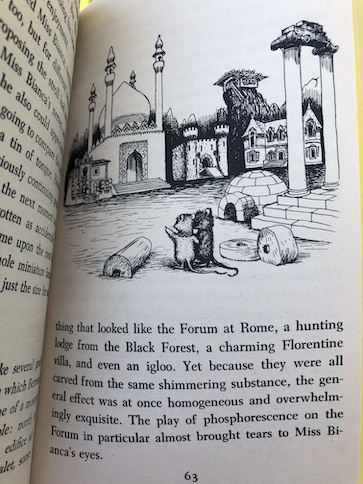
It’s a long walk to the active part of the mine, but along the way, they make an important discovery – a mouse-sized city carved out of salt! Each of the buildings in the miniature town are unique and resemble famous buildings from around the world. Miss Bianca thinks that the buildings were probably carved by prisoners who made buildings to resemble the places where they used to live. It’s the perfect place for the mice to stay, though.
Bernard, inspired by this strange place, tries to write a poem for the first time in his life, which isn’t very good. Miss Bianca tries to be nice about it, but he can tell that she doesn’t like it. Bernard is upset enough to try to drown himself (that part of the story struck me as rather shocking, although it’s handled so matter-of-factly as just a product of the weird atmosphere of this place), but he can’t because he just floats in the salt water. It seems like most of the members of the expedition temporarily forget about Teddy. Only Miss Bianca isn’t affected by this strange little town because she lives in a porcelain pagoda at home that her boy gave to her, so these buildings are very much like what she already knows.
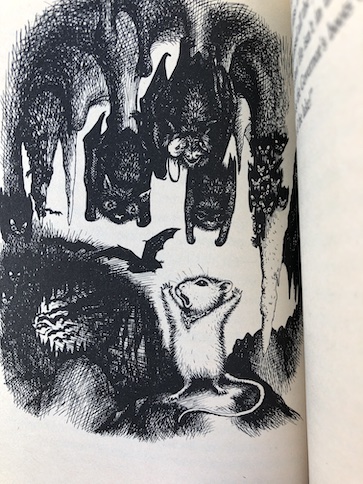
Fortunately, the expedition gets some help from some friendly bats who live in the mines. The younger bats in the group say that they’ve seen little Teddy serving the governor of the salt mines, who tends to stay apart from most of the prisoners because the prisoners have attacked him before. This is fortunate news because it means that Teddy is closer to the little salt town than they thought, and it won’t be as difficult to find him as they anticipated. He’s on an island in the middle of the lake of salt water, and that’s not too difficult to reach because Bernard has already proven that it’s easy to float in salt water.
Once they find Teddy, they also have to get him onto a train to get him away from the salt mines, which may not be as easy.
The book is available to borrow and read for free online through Internet Archive (multiple copies).
My Reaction and Spoilers
I generally prefer the plots of the Disney movies to the original books in this series, but this was still a fun story. I was a little disappointed that they never actually used the two professors’ specialties. I thought at first that they would use the geology professor to spout some interesting and useful facts about caves or mines, but they didn’t, and there was nothing in the story where a mathematics professor would be particularly useful. It just seems like a missed opportunity there.
There were some funny moments in the story. I liked the part where one of the bats, not really seeing Bianca clearly because bats are near-sighted, comments to another that, whatever it, if it moves, you should salute it, and if it doesn’t, you should paint it. Bianca takes that as a sign that this particular bat has completed his National Service, also noting that being near-sighted isn’t a barrier for bat National Service because, if it was, no bat would be able to participate.
In a twist at the end of the story, it turns out that Teddy used to live with his uncle and that Teddy’s uncle is the tutor for the boy that Miss Bianca lives with. Once Teddy is restored to his uncle, he comes to the house with his tutor and becomes friends with Miss Bianca’s boy.
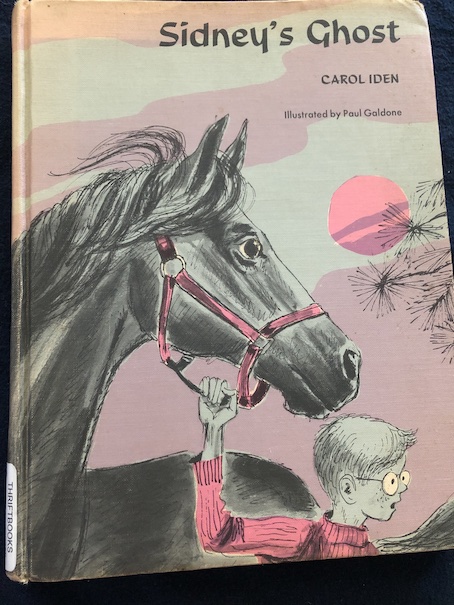
Sidney’s Ghost by Carol Iden, illustrated by Paul Galdone, 1969.
Nine-year-old Sidney Robinson’s best friend is a girl named Megan McKenna. The two of them have many interests in common, including fishing, cars, ghost stories, and horses. Megan’s father owns a stable, and Sidney envies Megan for having her own pony. Because Megan’s father sells horses to other people, the kids are used to seeing horses come and go. When Megan’s father can’t find a buyer for a horse, he’ll try to sell it at public auction. However, if he can’t sell a horse at auction at all, he sometimes sells it to the slaughterhouse, where they use the horse parts for glue and dog food. It’s sad, but the kids accept this as part of life until Megan’s father acquires a retired police horse whose former owner died, and Sidney realizes that he can’t let this beautiful black horse suffer this terrible fate.
The horse, officially named Sergeant O’Hara but called Uncle Charley by Megan’s family is a beautiful animal with a gentle temperament. Sidney wishes that he could persuade his parents to buy the horse for him. He is easy to ride and obeys commands, and he has an excellent history of his time as a police horse.
Megan’s father isn’t completely honest as a horse seller. The book goes into some detail about how he prepares horses for sale, painting on dapples and filing their teeth down to make them seem younger than they really are. Even Sergeant O’Hara gets this treatment, although Sidney worries that it hurts the horse. (I looked it up, and it turns out that it can be beneficial to file the sharp points off of a horse’s teeth, which is called teeth floating. However, this is something that should only be done by someone who has been trained to do it because it can hurt the horse to file the teeth down too much.)
Sidney and Megan love to watch the horse auctions and pretend they’re bidding on the horses, but Sergeant O’Hara is auctioned off as planned. Megan’s brother Michael let him loose in the paddock when he was supposed to be watching him, and he got all dirty, so he isn’t fit to be shown. Then, to Sidney’s shock, Megan tells him that her father is planning to just sell Sergeant O’Hara to the slaughterhouse instead of trying again at the next auction. If Sidney and Megan are going to save poor Sergeant O’Hara’s life, they’ve got to do something, fast!
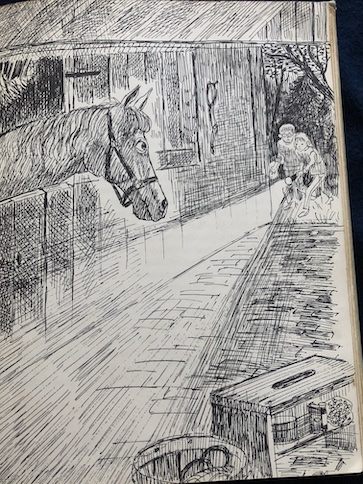
Megan tells Sidney that she’s thought of a plan to save Sergeant O’Hara. The two kids sneak out and take the horse in the middle of the night and hide him in an old barn. As they go to hide the horse, they see a shadowy figure near the barn. Megan is afraid, and Sergeant O’Hara wants to chase the figure because of his police training, but Sidney stops him.
However, even with the horse safely in the barn where hardly anybody ever goes, there is the very real worry that they’ll be caught. The horse will need exercise, so Sidney will have to go ride him at night or when they’re sure nobody else will be around. Still, they feel like they need to come up with an additional plan in case the horse is spotted. Then, Sidney takes a hint from the way Mr. McKenna painted dapples on a horse earlier and suggests that they could paint Sergeant O’Hara a different color so he won’t be recognized. Megan thinks that’s a great idea, and they decide to paint him white, like the Lone Ranger’s horse, Silver.
They get the painting supplies from Sidney’s father’s hardware store, but Sidney grabs a can of paint labeled “Super Glo – White.” It turns out that it’s not just a really bright white; it’s a glow-in-the-dark white. The kids don’t figure it out until they’ve already painted half of the horse. When Sidney sneaks out to feed and exercise Sergeant O’Hara again, he’s frightened when this big, glowing thing comes out of the darkness at him. Somehow, the horse got out of the barn and scared him by running out in the dark, glowing. Sidney realizes after a moment of panic that’s what happened. Because they only painted half of the horse before they stopped, one side of Sergeant O’Hara is glowing white, and the other is pitch black. When the horse gallops back and forth, he looks like a glowing ghost that vanishes with each turn. It’s a neat effect, but having a ghost horse certainly isn’t inconspicuous.
One night, Sidney accidentally frightens his old teacher, Miss Winthrop, when she’s walking home from visiting a friend. Soon, she spreads the story of her ghost sighting all over town. Most people think that she’s getting a touch of senility in her old age, but Mr. McKenna thinks it over and notices Sidney’s comings and goings in the area. When he goes to the old barn to investigate what Sidney’s been doing. Seeing the horse and the glow-in-the-dark paint, he realizes what happened. He appreciates that Sidney and Megan wanted to save the horse and sees the humor in their unintentional ghost act.
Since the kids feel that strongly about wanting the horse and are taking good care of him, Mr. McKenna decides to let them continue to do so, but there’s still one thing that nobody has answered: Who was that mysterious figure they saw around the barn? The answer comes when this mysterious person sets fire to the McKenna’s stables and Sergeant O’Hara has the opportunity to show his skills as a police horse.
My Reaction
When I first read this book as a kid, I was expecting it to be a mystery. It kind of is, but the mystery isn’t about the horse or about any ghost. There are hints from the very beginning of the story that there is a thief in the area, but the story doesn’t really focus on that until near the end. Sidney and Megan hear people talking about a prowler, and they do see the mysterious prowler around the barn, but they’re too busy with their plans to save the horse to pay too much attention. Fortunately, their horse and his ghostly appearance help them to catch the the thief, and the reward money for catching him straightens out a lot of problems so Sidney can keep Sergeant O’Hara.
The gimmick of the “ghostly” painted horse has stayed in my mind for years since I first read this story, but it’s not the only memorable part of the book. One of the things that I remembered best about this book from when I read it as a kid was the difference in Sidney and Megan’s homes and families. The book puts some emphasis on the difference in their family lives, and it’s shown when each of the kids has dinner at each other’s home. Megan has several siblings, and their house is always noisy and boisterous. Sidney is Sidney is a fussy eater at home, but he just eats what’s put in front of him at the McKennas’, like the other kids do. Megan gets a rap on the knuckles from her father for starting to eat before Grace is said. One line from the book that stuck with me for years was when Megan’s brother, Frank, says Grace with this joking prayer: “We thank the Lord for the next meal – we’re sure of this one.” I still think of this whenever someone says Grace aloud.
By contrast, dinner at the Robinson house is much calmer, quieter, and more formal. Sidney is an only child, and his father owns a hardware store, so the Robinsons can afford nicer things. Megan is impressed at the nice tile in the bathroom, and the table is set with embroidered placemats and matching cloth napkins. Megan accidentally bites into one of the cloves in the ham, and when it burns her mouth, she spits the bite of food into her cloth napkin, feeling terribly guilty about it because the napkin really seems too nice for that sort of thing.
I could identify with the feelings the children have about being in houses where people have different habits. There were times when I was young when I felt a little out of place because they were either more formal than I was accustomed to being or more boisterous than I feel comfortable being. People always feel more comfortable with what they’re used to.
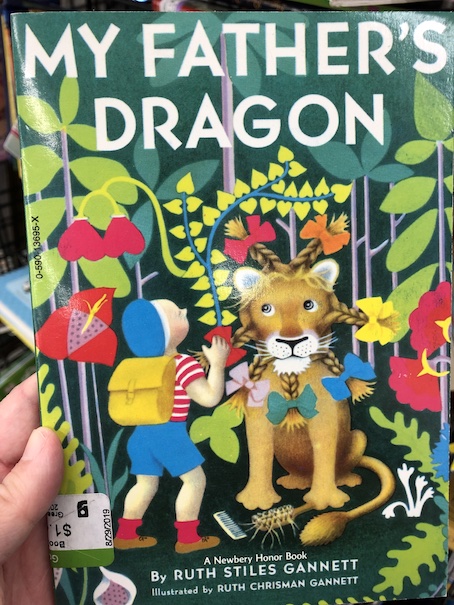
My Father’s Dragon by Ruth Stiles Gannett, illustrated by Ruth Chrisman Gannett, 1948.
This is a fantasy book where the author tells a story about her father’s adventures rescuing a dragon when he was a boy.
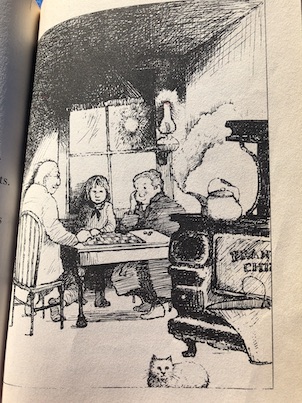
It all starts when the boy, Elmer Elevator, brings home an alley cat that he found. However, his mother doesn’t like the cat and doesn’t want Elmer to keep her. When he tries to feed the cat secretly, she throws the cat out and punishes Elmer. The boy and the cat take a walk in the park together, and the boy confides his wish to learn how to fly airplanes when he grows up. The cat says that he doesn’t have to wait until he grows up to learn how to fly.
The cat explains that she has traveled a great deal, and not too long ago, she visited the Wild Island, which is inhabited by wild animals. The island is divided in half by a river inhabited by crocodiles. Normally, the animals have to take the long way to get around the river to avoid being eaten by the crocodiles, but a few months before the cat visited the island, a baby dragon fell of his cloud and landed next to the river with an injured wing. The other animals on the island captured the poor baby dragon, and when his wing healed well enough for him to fly, they started forcing him to carry passengers and cargo over the river. They work the poor baby dragon too hard and mistreat him. The cat made friends with the little dragon and wanted to help him but didn’t know how because she couldn’t untie the rope that holds the dragon prisoner. The cat suggests to Elmer that the dragon would probably be happy to give him a ride if he helps to free him, and Elmer decides to do just that. Besides, he’s angry with his mother for mistreating the cat and doesn’t mind leaving home for awhile.
The cat decides that she’s too old to travel, so she stays behind, but she helps Elmer to prepare for the trip. Elmer stows away on a ship to the nearby Island of Tangerina and gets to the Wild Island by climbing over the rocks between them. When he reaches the Wild Island, he decides to look for and follow the river, but he has to be careful of the animals on the island.
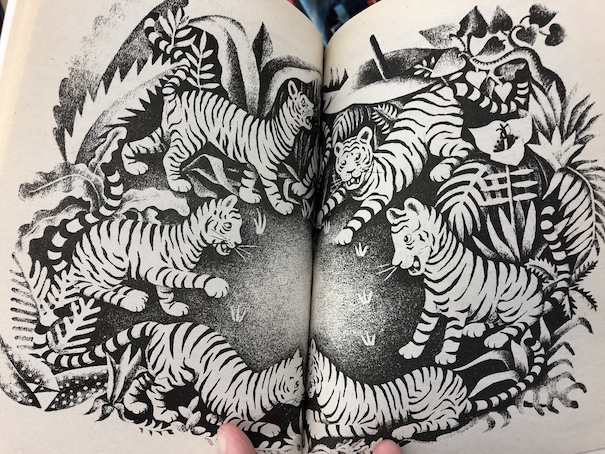
Elmer is found by some tigers who say that they’re hungry and curious to know what little boys taste like. However, remembering some of the cat’s advice, he offers the tigers some chewing gum because (apparently) tigers love it. He also tells them that it’s special chewing gum that will change colors when they chew it, and then, they’ll be able to plant it in the ground to grow more chewing gum. The tigers fall for it and forget about Elmer, who sneaks away.
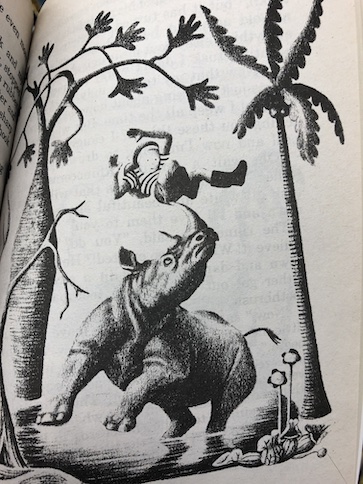
Elmer also has a dangerous encounter with a rhinoceros after he drinks from his “weeping pool.” The rhino wants to toss Elmer into his pool to drown him, but Elmer asks him what he has to weep about. The rhino says that he’s upset that his tusk is no longer as white and pretty as it used to be, and Elmer gives the rhino his toothbrush and toothpaste. The rhino lets Elmer go and begins using the toothbrush to clean his tusk, but by now, the boars have realized that there is someone on the island who doesn’t belong.
Elmer continues onward, helping a lion with a messy mane and a gorilla with fleas and befriending the crocodiles by offering them all lollipops, until he finally finds the dragon and rescues him. They fly away from the island together, but it’s not the end of their adventures.
There’s a reason why the author and illustrator’s names are very similar but not identical. If you read their short biographies, they explain that the illustrator was the stepmother of the author.
This book is a Newbery Honor Book, and it’s also the first in a trilogy about Elmer and the dragon and their adventures together. It’s available to borrow and read for free online through Internet Archive (multiple copies).
Anna, Grandpa, and the Big Storm by Carla Stevens, 1982.
The story takes place during the Great Blizzard of 1888. Anna’s Grandpa is visiting her family in New York City, but he thinks the city is boring. He says that there isn’t much there for him to do. One day, Anna is worried about getting to school because it is starting to snow heavily. Anna’s mother says that she can stay home, but Anna is supposed to be in a spelling bee, and she doesn’t want to miss out. Grandpa volunteers to take Anna to school on the elevated train.
As the two set out, Anna begins to get scared because the storm is getting worse. Grandpa urges her on, and the two make it onto the train. Before they can go very far, the tracks freeze over, and the train gets stuck. Anna and her Grandpa are trapped in the train with a bunch of strangers, waiting for rescue.
Anna and Grandpa make friends with the other people on the train, finding ways to keep themselves moving and warm while they wait for help to arrive, like playing “Simon Says.” Even though Anna doesn’t make it to school for the spelling bee, their adventures turn out to be good for the people they are able to help and the new friends they make. Grandpa sees a different side of life in the city and decides to stay for awhile longer so he can spend time with some new friends.
The story is based upon actual accounts of the famous blizzard when many other people were trapped on the elevated trains around the city. The book is available to borrow and read for free online through Internet Archive.
Jeffrey lives with his widowed mother in a Medieval village (not a realistic one, this is a fairy tale type story), where his mother supports the both of them by selling her knitting. However, when his mother breaks both of her arms after falling off of a cart, eleven-year-old Jeffrey must find a job and earn some money. As a young boy from a poor family, there aren’t many options for him at first, and he doesn’t try very hard for the ones that are available because what he really wants to do is to be a knight. As a boy from a non-noble family, it isn’t likely that he’d ever actually become a knight, but it’s all that Jeffrey has ever dreamed of.
One
day, after Jeffrey has failed to get the jobs that were available in a nearby
town of Axington, he is walking home, sad and worried about what his mother
will say, he meets a knight. In fact, it’s
not just any knight but a famous one, Sir Walter! Jeffrey is thrilled to meet him. Sir Walter asks Jeffrey for directions and
invites him to join him for supper.
The two
of them discuss what it’s like to be a knight.
Sir Walter tells Jeffrey that it’s not all as glamorous as people think
it is. Some parts are very difficult,
and he has to travel a lot on his various assignments, keeping him away from
his family for extended periods. Unlike
real, historical knights, who would work for a lord, Sir Walter works for an
agency in Axington called Free Lance Rescue Services Limited, which gives him
his assignments. They send knights like
Sir Walter to rescue damsels in distress or deal with dragons or ogres. Although it’s not easy work, Jeffrey likes
the sound of it!
When Jeffrey returns home and his mother finds out that he didn’t get a job, she is upset. Jeffrey tells her about his meeting with Sir Walter, and she points out that, even though it’s exciting, he really needs to focus on finding work because they’re running out of money. Seeing his mother so upset, Jeffrey lies to make her feel better, telling her that Sir Walter has recommended him for a job with his rescue agency. His mother is doubtful at first, knowing that knights are usually from noble families and that her small son hasn’t had any training or shown any fighting ability. Jeffrey reassures her that he’ll probably just be helping in the office until he gets more training. To Jeffrey’s shame, his mother believes him and is proud of the job that he doesn’t have.
The
next day, after his mother sends him off to his first day on his new “job,”
Jeffrey decides that the only thing to do is to go to the agency in Axington
and try to find out if he can get a job there, or failing that, anywhere he can
in order to make things right with his mother.
When he gets to Axington, he is hungry, so he asks at a food stand in
the marketplace if he can help out for a while in exchange for some food. He spends the morning peeling potatoes in
exchange for lunch. However, although it’s
boring work, Jeffrey does get a good meal out of it, and he catches the eye of
a leatherworker, who compliments him for working hard. Jeffrey confides in the leatherworker that he’s
really hoping to get a job at the rescue agency, and the leatherworker tells
him that his fiancé is the secretary there.
He gives Jeffrey a message to take to the secretary, and Jeffrey sees it
as his opportunity to ask for a job.
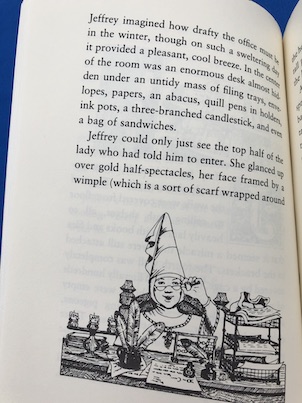
When Jeffrey delivers the message to the secretary (which is an invitation to join her fiancé for lunch), the secretary tells him that the rescue agency has no job openings at the moment, but that she’ll pay him a penny to watch the office and her mother’s rambunctious dog, Lancelot, while she’s at lunch. It’s not much, but a penny is enough to buy his mother a nice dinner, so Jeffrey takes the job. The secretary tells him a little about how the office works, but she doesn’t expect anything to happen while she’s at lunch because nothing ever does.
However,
while the secretary is away, a message comes in that Sir Walter is in
trouble! Sir Walter is in the cave of an
evil ogre and needs help at once! Jeffrey
tries to find the secretary to tell her and ask what to do. When he can’t figure out where she went to
lunch, Jeffrey decides that there’s no time to waste and that he must rescue
Sir Walter himself!
Although Jeffrey is eager to help Sir Walter, he does worry about the lies that he has told his mother about his new “job”, the fact that he isn’t really qualified for what he’s doing and doesn’t even have permission to be doing it, that the ogre might well end up eating him as well as Sir Walter, and that he left a mess in the office when he ran off on his rescue mission and is currently in possession of a dog that doesn’t belong to him. The book is a fun adventure story, but it makes some good points about truthfulness and responsibility as well.
Although Jeffrey really only brought the dog along because he had nowhere else to leave him, it is really Lancelot who defeats the ogre, partly by accident. At first, Jeffrey is tempted to claim the victory for himself, but he decides to be honest and admits the truth about the ogre’s defeat to Sir Walter. Still, Sir Walter is grateful and offers to sponsor Jeffrey for knight school and give him a part-time job polishing his armor. Jeffrey accepts, and he also gets to keep Lancelot, who needed a new home anyway, although his mother says that he will have to be responsible for the dog and its training.
The book is available to borrow and read for free online through Internet Archive.
This is both the fourth book in the Enchanted Forest Chronicles and the first book in the series that was written. The author wrote this story before the others and then wrote the other three to explain how the characters got to this point. The first three books in the series focus on Princess Cimorene and her adventures, but this book focuses on her son, Prince Daystar.
Partly
because this series is kind of backwards, with the last book being the first
written, I’m going to start with a spoiler.
When the book begins, Daystar is unaware that he is a prince and that
his father is the king of the Enchanted Forest.
He grew up in an ordinary cottage on the edge of the forest, so he is
accustomed to the presence of all kinds of fantasy creatures and fairy tale
characters. He thinks of himself and his
mother as ordinary poor folk. However,
his mother has taught him not only reading and writing but other skills that
are more unusual for peasants, like music, fighting, and even a little magic.
When
Daystar is 16 years old, a wizard named Antorell comes to their house. Daystar’s mother, Cimorene, seemed to know him,
and he knows her. Antorell demands “the
sword” and the boy, and Cimorene casts a spell to melt him. (“’No! Not again!’ he screamed.” If you’ve read the other books, you already
know why. But, again, this book was
written first.)
The
next day, Cimorene gives Daystar a sword that he’s never seen before but which
seems to draw him to it, and she starts giving him instructions. The instructions are vague, but Cimorene
insists that Daystar is to go into the Enchanted Forest and not to come back
until he can explain why he had to go in there in the first place. Also, he is not allowed to draw the sword
from its scabbard unless he really needs to use it. Cimorene says that she can’t explain more
because it might “ruin everything.” Not knowing
what else to do, Daystar starts into the Enchanted Forest. When he glances back, Cimorene and the cottage
have suddenly disappeared. Daystar has
no idea why, but he has no choice but to keep going.
In the
forest, Daystar meets a talking lizard called Suz, who claims to know
everything about the Enchanted Forest and what goes on there (a tall claim, considering
everything that goes on there). When
Daystar asked him if he knows anything about the mysterious, magical sword that
his mother gave him, Suz tells him that it’s the Sword of the Sleeping King and
that everyone has been looking for it.
Daystar knows nothing about it, which surprises Suz. To Daystar’s surprise, both the sword and
Daystar’s lack of knowledge agitate Suz, who says that he must get Kazul, who
will know what to do. Before he then
runs off, leaving Daystar wondering who Kazul is, Suz tells him that he’s going
to have to learn about the sword by himself because there are certain rules
associated with magic, but that he should follow the sword to find out.
The
next person Daystar meets is a red-haired girl who is stuck in a hedge. She is surprised by how easily Daystar can
get into the magical hedge, and at first, she thinks that he is a wizard. She is relieved when she finds out that he’s
not. The girl, Shiara, tells Daystar
that wizards have been chasing her because she burned the Head Wizard’s staff. Most people could never accomplish that
because wizards’ staffs are extremely powerful and have protective spells on
them, but Shiara is a fire-witch.
As the
two of them talk, Daystar learns that, while fire-witches are extremely rare
and powerful come by their powers naturally, Shiara’s abilities are more
unpredictable than most. She has trouble
casting spells on purpose, but when she gets mad, she can do some extremely
powerful ones without really trying. Fire-witches
tend to have tempers, and Shiara is no exception. Because of that, she doesn’t have many
friends. Most people are afraid to be
around her because they never know when she’ll lose her temper and accidentally
set things on fire. Even worse, for
Shiara, is knowing that most fire-witches are able to do very impressive spells
and are almost invulnerable, but yet, she can’t even burn her way through a
hedge when she tries it. The wizards are
very interested in her because most fire-witches are immune to their spells. When they learned that she was a fire-witch who
couldn’t cast her own spells, they tried to kidnap her in order to study her
magic, which she how she ended up setting the Head Wizard’s staff on fire.
Daystar
and Shiara finally get out of the magical hedge when Daystar suggests that
Shiara try being polite to it instead of losing her temper. Creatures and objects in the Enchanted Forest
tend to respond well to politeness. When
they’re out of the hedge, a wizard shows up and tries to kidnap Shiara again,
but Daystar defends her with his sword.
However, Daystar’s hand is injured when he tries to pick up the pieces
of the wizard’s staff, and it explodes.
Daystar
and Shiara seek help from Morwen, a witch who lives nearby. It is from Morwen that Daystar begins to get
a sense of what his sword is capable of doing.
He also meets up with Suz again, who tells him that he should go to the
castle and that Kazul will meet him there.
Daystar still doesn’t know what he’s walking into, but missions in the
Enchanted Forest can’t be ignored, and he has a mission to complete that everyone
has been waiting for since before he was born.
By the end of the story, Daystar has learned what he needs to do to rescue his father, and Cimorene and Mendanbar are reunited. Shiara ends up getting what she wants, partially, because she gains the ability to use her powers, but is forced to be polite in order to do so, which really irritates her. She becomes Kazul’s new princess, where she will learn both the personal skills and magical skills she needs to control both herself and her ability. Cimorene believes that Shiara will end up marrying Daystar eventually and becoming the next queen of the Enchanted Forest. However, the series ends here, and the future is left to the imagination. Morwen also decides to marry Telemain, a character from the previous books.
Like other books in this series, this book contains a lot of humor and parodies on popular fairy tales and fairy-tale creatures. Personally, I like the first two books in the series the best, but this one is also fun. There is a mild touch of romance to it, which is also nice.
The book is currently available online through Internet Archive.
There is one more story after this series, a short story in the collection Book of Enchantments that features Daystar and both of his parents but does not have Shiara.
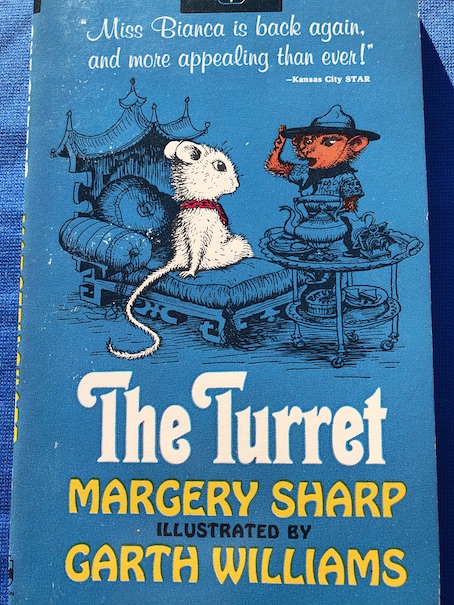
Miss Bianca has decided to resign as Madame Chairwoman of the Mouse Prisoners’ Aid Society. She has never felt particularly drawn to public life, really preferring her quiet life as a pet of an Ambassador’s son (whom she always calls “the Boy”), keeping him company during his lessons and writing poetry in her spare time. During the times when she is away from the Boy, undertaking rescue missions for the society, she knows that the Boy pines for her and worries about where she is. She has started to feel a little guilty that she might be neglecting her Boy.
Bernard, the Secretary of the society, actually feels a little relieved by her decision to resign. While he thought that she made a great chairwoman, he has always worried about the dangerous nature of their missions, afraid that something might happen to Miss Bianca. (Miss Bianca is a little annoyed that he seems so eager for her to resign, and his comment that “you’re too beautiful to be allowed into deadly peril” makes a weirdly chauvinistic compliment – like it would be okay for her to risk her neck if she were ugly because it would be less of a loss? – but Miss Bianca takes it in the spirit in which it seems to be offered.) The two of them reminisce about some of their past missions. Bernard thinks that the worst villain they’ve faced was the head jailer in the Black Castle (from the first book in the series), but Miss Bianca thinks that the worst was Mandrake (from the last book) because the target of his cruelty was a defenseless child.
The
society plans to throw a special dinner for Miss Bianca, and Miss Bianca
suggests that she would like a picnic by water.
The ideal place for it would be the moat around an old tower outside of
the city. Miss Bianca enjoys the picnic
and is fascinated by the crumbling old turret.
Then, she notices something white in the window. Thinking that it’s a piece of litter, one of
the mouse boy scouts goes to retrieve it.
It turns out to be a small piece of linen, and after the boy scout takes
it, it’s replaced by another. Miss Bianca
comes to the conclusion that there is someone in the turret and that the person
could be a prisoner, signaling for help.
When she studies the scrap of linen more closely, she also realizes that
she knows who the prisoner is because it has the name Mandrake on it!
After the events of the previous book, the evil Duchess had Mandrake locked in the turret. To Bernard, it sounds like a just punishment for Mandrake, but Miss Bianca feels a responsibility to rescue him, in the hope that he might reform. However, Bernard is skeptical about that possibility, thinking that they would just be letting a criminal lose if they tried to free Mandrake, and Miss Bianca is unable to persuade the other members of the society to undertake the mission.
However, Miss Bianca is unable to give up on Mandrake and goes to see him in his turret. Mandrake is a shadow of his former self. She introduces herself to him as a member of the Mouse Prisoners’ Aid Society, and it turns out that he’s heard about it from friends of his who have been in jail (having had many disreputable associations over the years). In order to test how likely Mandrake would be to reform, Miss Bianca asks him what he would do if he were freed from captivity, and he says that he’d like to be a gardener at an orphanage. He feels badly about the child slaves he helped to abuse while serving the Duchess, and he’d like to see children happy, making their garden a beautiful place. Miss Bianca is satisfied with this and sets about planning his escape. (She’s free to undertake this mission because her Boy is having his tonsils out and won’t miss her for awhile.)
At
first, Mandrake doesn’t know how people even bring him food, since his room in
the turret doesn’t seem to have a door and food just seems to arrive during the
night. Miss Bianca stays up at night to
see what happens and learns that there is a hidden staircase in the turret that
his jailers use. Before Mandrake can escape,
though, he needs to be stronger because he’s badly under-nourished. Miss Bianca recruits the mouse boy scouts to
bring him vitamins to help make him healthier and tries to figure out how the
secret passage works and think of some way to create a distraction so that Mandrake
can escape.
Shaun,
the leader of the boy scouts, helps her to come up with a plan. (The book says that Shaun is half-Irish and
thinks of himself as being a “handsome boy-o.”
Stereotypical.) Shaun has figured
out that the jailers watching Mandrake are actually grooms by trade, and he
knows of a race horse, Sir Hector, who could provide a good distraction for
them. Miss Bianca approves of the plan
and persuades Sir Hector to help them.
Meanwhile, the members of the Prisoners’ Aid Society are getting fed up with their strict new chairwoman, who only seems interested in forcing them to participate in group exercises. Members are starting to avoid going to meetings, and worse still, someone suggests to Bernard that the bossy chairwoman particularly likes calling committee meetings because she’s in love with him and wants the excuse to see him. The thought horrifies Bernard, but he’s afraid to say anything to Miss Bianca because he doesn’t want her to feel obligated to try to become the chairwoman again in order to solve the society’s problems (or his), not knowing what she’s actually been up to in her free time.
In the end, everything works out well. When Mandrake is rescued, he actually does become the gardener for an orphanage. The members of the society find out Miss Bianca’s daring mission, undertaken with just a handful of boy scouts, and feel badly that they didn’t take part. They complain to the new chairwoman that she was just wasting their time with exercises instead of real missions, and she resigns, saving Bernard from her attentions. Miss Bianca does not return to the society as its chairwoman, but the next chairwoman is more competent.





















 Jestress's Forgotten Books and Stories