The Log Cabin Quilt

Elvirey’s granny loves quilting, and she always saves scraps of cloth from old clothes in a flour sack for her quilts. After Elvirey’s mother dies, her father moves the family to Michigan, traveling by covered wagon. When Elvirey tries to pack some of her mother’s things to bring with them, her father insists that they leave them behind, saying that they don’t have room for them. However, Granny insists on bringing her sack of quilting scraps, saying that she will sit on them in the wagon.

When the family finally reaches their destination, it’s just a clearing in a wooded area. They camp near a spring, and Elvirey’s father and brother begin building a cabin for the family. Elvirey and her sister add the chinking to the log walls of the cabin, packing the gaps with a mixture of mud and grass to keep out the wind.

However, the cabin still doesn’t feel like home to Elvirey. They don’t have her mother’s books, and there aren’t any flowers growing nearby to decorate the house like her mother would.

Then, one cold day, Elvirey’s father goes out hunting. He says that he will back before dark, but he doesn’t return. The night is very cold, and Elvirey and her family suddenly realize that it’s more than unusually cold in the cabin. The chinking they put in the walls of the cabin has frozen and fallen out, and the cold is getting in. Worse still, it’s starting to snow.
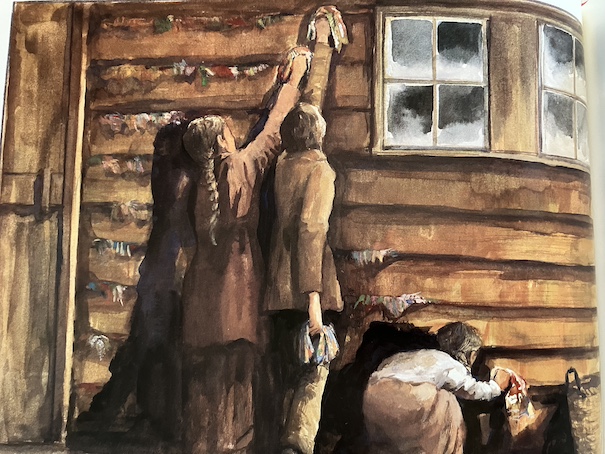
They’re worried about what happened to their father, and they’re worried about what they will do with the cold getting into the cabin. Then, suddenly, Elvirey has an inspiration. There is something they can use to fill the cracks in the cabin walls: Granny’s quilting scraps. With scraps from everyone’s clothes suddenly decorating the walls of the cabin, the cabin begins to look like it has turned into a quilt itself. When Elvirey’s father returns, he tells her that her mother would be proud of her, and for the first time, the cabin starts to feel like home to Elvirey.

The book is available to borrow and read for free online through Internet Archive.
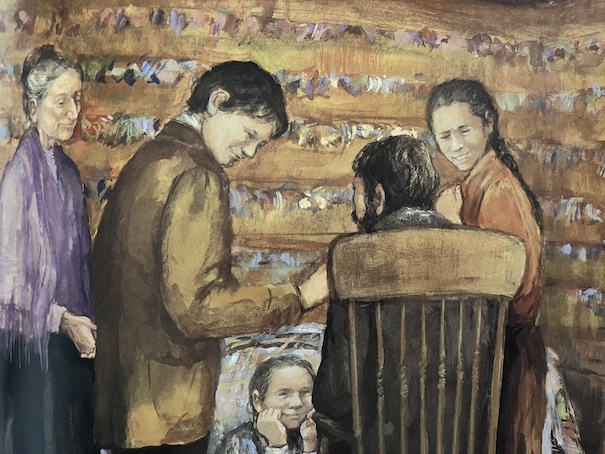
There’s a pun in this story that people who don’t know the names of quilting patterns might miss. There are many patterns that the squares of a quilt can have, and Log Cabin is a traditional quilting pattern. When Elvirey and her siblings stuff the quilting scraps into the walls of their cabin, their Granny laughs about them creating a “log cabin quilt”, and it’s not just that she’s amused that they’ve made their cabin walls look like a quilt with all the scraps; it’s a pun on the name of the quilting pattern.

Although the story is about a family of pioneers, the focus of the story isn’t really their journey by covered wagon or the building of their cabin. It’s about loss and change and about what makes a new place feel like home. At first, Elvirey doesn’t feel like their cabin is their home because they no longer have the familiar things that belonged to her mother, and she can’t do some of the things that her mother used to do, like decorating the home with flowers. Even the quilt scraps and their associated memories don’t quite make her feel like home, although they do add a needed touch of color and hominess to the cabin. What finally makes Elvirey feel like home is when her father mentions her mother. Since her mother died, her father hasn’t smiled and hasn’t talked about her mother at all. When he sees what they did with the quilt scraps, he does both, and that makes Elvirey finally feel like they’re home. She really needed that sense of her mother’s presence or her memory to really get a feeling of home.

Elvirey is an unusual name, but I think it’s a nickname or variation of Elvira. Elvira is an unusual name in modern times, and in the United States in modern times, it usually reminds people of Elvira, Mistress of the Dark, a character portrayed by Cassandra Peterson and known for hosting horror movies since the 1980s. That reference has no relation to the story. Elvira/Elvirey is just an interesting and unusual name.

The Best School Year Ever

BestSchoolYearThe Best School Year Every by Barbara Robinson, 1994.

This year at school, Beth’s teacher has assigned everyone a year-long project to think about good points about their classmates, but it’s difficult when one of your classmates is Imogene Herdman.  The Herdmans are generally awful.  They lie, steal, set things on fire, bully other kids, and have been kicked out of almost every building in town for one reason or another.

Mr. Herdman deserted the family years ago, and Mrs. Herdman works long hours at the shoe factory, so the six awful Herman kids are left to do pretty much anything they want most of the time, even if what they want to do is to walk off with Louella’s baby brother Howard and draw pictures on his bald little head and charge other kids a quarter to see the amazing “tattooed baby” like some kind of sideshow freak.  It’s difficult for the adults in town to tell them off because they never listen or punish them because no punishment ever seems to stick.  Mostly, when the Herdmans are around, the adults seem to focus on damage control.

So, Beth struggles to find anything good to say about awful Imogene, the oldest girl in an awful family, but throughout the school year, Beth does begin to notice that Imogene does have other sides to her personality.  The book is more of a collection of short stories about the Herdmans’ various antics and escapades and Imogene’s role in them than one single story as Beth thinks about the things Imogene does.  Imogene can’t really be called “nice,” and she definitely causes her share of chaos, but she does have occasional moments when she’s helpful or does something in the name of justice, like giving her old blanket to Louella’s little brother to replace the one he lost so he wouldn’t be sad.

Some of Beth’s compliments to Imogene at the end are somewhat generic because Beth struggles to get around some of Imogene’s genuinely awful behavior, but when she considers what Imogene’s best trait is, she finds something that really captures Imogene’s spirit, a quality that Imogene genuinely admires and may lead her on to better things in her life.

This is the second book in The Herdmans Series.  The books are funny because of the chaos that the Herdmans cause wherever they go, although you can’t help but feel a little sorry for them at times, too.  It’s part of that awful dilemma when you think that someone deserves a good spanking for what they’ve done but, at the same time, you see that it wasn’t entirely their fault.  While the Herdmans are responsible for the things they do, they’re also victims of neglect.  Their parents aren’t really raising them, and the other adults have mostly given up on them.  They do what they do because they can and because no one is there to make sure that they’re doing the right thing.  No one even really expects them to do the right thing, so if they do something right, it’s completely up to them.

Beth’s observations about Imogene show that there is hope for her.  Imogene has some good traits as well as bad ones, and occasionally, she does do good deeds as well as bad.  Beth realizes that Imogene could do some great things in her life because of her resourcefulness (a quality that Imogene likes when Beth points out that she has it), but she realizes that what Imogene eventually turns out to be is still in her hands, whether she uses her abilities to rob banks or run for President.  Adults will know that Imogene’s reality is likely to be something in the middle, but the point is that Imogene has more good points than it appears at first and more possibilities in her life than just being a trouble-making Herdman.

As in the first book in the series, there is also something of a contrast between Imogene and Beth’s friend Alice.  Alice is the perfect child (at least in her mother’s eyes, and her mother lets everyone know it), but she is also often shallow, bragging up her looks, talents, and perfect behavior to get attention and feel important (which is what Beth thinks is really the best compliment to give Alice because it’s the one she would most value).  When Alice is nice, it’s not so much because she is a nice person as she likes the praise she gets for doing it.  Really, neither Alice nor Imogene are especially nice; they’re just not nice in different ways and for different reasons (although both have good points, too, which is the point of the story).  When Alice gets a compliment, she sees it as merely her due for her perfection, but for Imogene, compliments come as a surprise because she doesn’t hear them much and she knows that she is far from perfect.

The book is currently available online through Internet Archive (multiple copies, actually).