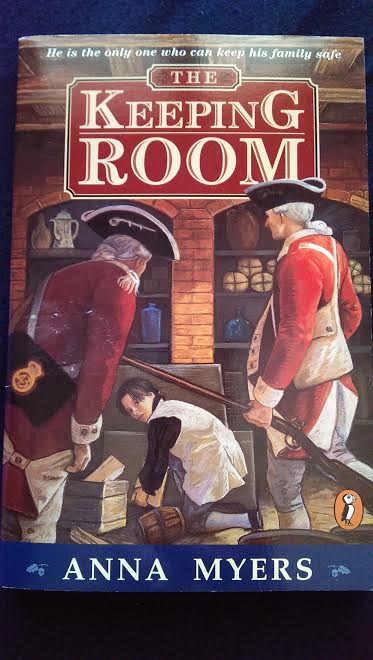
 The Keeping Room by Anna Myers, 1997.
Joey was named after his father, Colonel Joseph Kershaw, a wealthy businessman in Camden, South Carolina during the Revolutionary War. Joey is like his father in many ways. He idolizes him and does everything as his father wishes. When his father marches off to fight on the side of the revolutionaries, he tells twelve-year-old Joey that he must be the man of the house while he is away and look after his mother and the younger children. Joey takes pride in his new position as man of the house, but he is soon to undergo hardships that will turn him into an older and wiser person.
Joey’s father and his troops lose their battle and are captured by the British. Soon, the whole town is taken by the British troops, and they commandeer the Kershaw house, the biggest house in town, as their headquarters, keeping Joey and his family as prisoners. Joey can only watch in helpless anger as the British set up gallows in his family’s garden and hang rebels, his father’s surviving troops.
Joey’s mother was a Quaker before her marriage, and so is Joey’s tutor, Euvan. They do not believe in the violence of war or harboring hate. Although Joey seethes with anger at his father’s imprisonment, his family’s captivity in their own home, and the death and destruction he sees around him, they make efforts to remind him that British soldiers are human too, some good, some bad, and not all monsters. However, how can Joey see the British as anything but monsters when he has seen their cruelty, when he and his family have suffered at their hands, and when he has watched them put many good men to death?
Before the British captured the house, Joey managed to hide away his father’s pistol. It isn’t enough to fight an army, but Joey knows that he will use it to fight if he gets the chance.
Throughout the story, Joey undergoes a transformation, not just from a boy to a man, but from his father’s little copy into his own person. From the beginning, Joey identifies himself mainly as his “father’s son.” He loves his father and truly idolizes him. He wants to be just like him, and his father is grooming him to take over his businesses one day, to do everything the way he does. Joey loves how respectful everyone is toward his father, a wealthy and successful man, and how respectfully they treat him when he is with his father. He hangs on his father’s words and adopts all of his beliefs. But when his father is gone, things are different. People who were respectful of him because of his father now regard him as just a boy, a little spoiled and not really knowing or understanding much.
Joey struggles to grow into his new role as man of the house, to really be a man as his father would have wanted. But along the way, he comes to realize that there are many things that his father didn’t really understand himself and that he was wrong about many things.
Joey’s father didn’t believe in educating women beyond basic reading and writing. His sister Mary has defied their father’s wishes before by borrowing Joey’s books, and although he didn’t want to tattle on his sister, Joey could never bring himself to support her studies openly because he didn’t want to go against what his father wanted. However, during their captivity, Joey comes to appreciate his sister Mary’s courage and intelligence. She gives him great support through their harrowing circumstances. He is proud of her and realizes that she is worthy of the studies she craves.
Similarly, Joey comes to question his father’s beliefs about slavery. Although his father railed against British tyranny, claiming that he would never be a slave to them, he kept slaves of his own. When Joey had previously questioned him about that, his father told him not to worry about it because it was part of “the order of things.” But, Joey’s own experiences in captivity make him think differently. He also comes to appreciate the two slaves who stood by the family to help them through their captivity, learning more about their lives and history. Because of his experiences, he decides that he will never be a slave owner himself.
Most of all, Joey finally sees the truth of what his mother, Euvan, and even Biddy and Cato (the two slaves who remained with them) tried to tell him about hate and killing when one of the British soldiers gets killed while saving Joey’s life.
As Joey reacts to the frightening circumstances around him, doing what he can to protect his mother and younger siblings, he realizes that he must rely on himself and his own judgement, not his absent father’s, to handle the situation. In the end, he decides that, although his still loves his father and eagerly waits his return home, he does not really want to be like his father anymore. He has truly become his own man and is ready to stand up for the man he has become, even though his father may no longer want him to run his businesses.
This book is currently available online through Internet Archive.
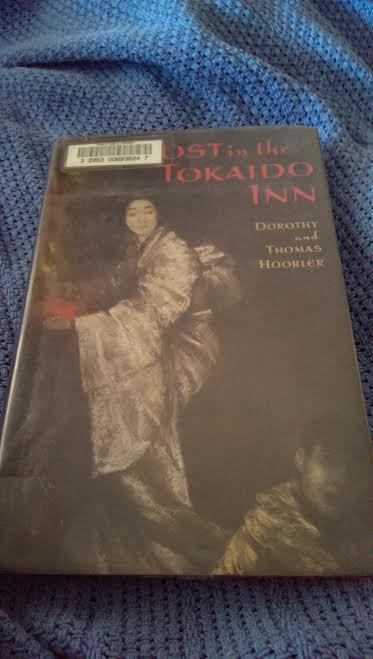 The Ghost in the Tokaido Inn by Dorothy and Thomas Hoobler, 1999.
 Jestress's Forgotten Books and Stories