Sharing the Bread by Pat Zietlow Miller, illustrated by Jill McElmurry, 2015.
This is a charming picture about a family preparing for an old-fashioned Thanksgiving. The story is told in rhymes as the family begins preparing and cooking their feast.
Every member of the family gathers in their kitchen, which appears to be a late 19th century or early 20th century kitchen, with a wood-burning stove.
Everyone, including the children and grandparents, has something to do, from preparing the turkey to making bread, cranberries, and pumpkin pie and washing dishes. The children also make place mats in the form of pilgrim hats.
As they set the table, everyone is a little tired but pleased with their feast. Then, they all say grace and enjoy the feast that they have prepared, thankful for what they have and the family who made it all with love!
The book is available to borrow and read for free online through Internet Archive.
My Reaction
I thought that this story was sweet, and it had fun and simple rhymes for kids. Everyone in the family has something to do to get ready for Thanksgiving, and adults reading the book with kids can point out how each of the family members relate to each other – grandfather, grandmother, father, mother, son, daughter, brother, sister, aunt, uncle, etc.
The pictures are charming, and I love the look of the old-fashioned kitchen where this story mainly takes place! Adults can also point out to kids how this old-fashioned kitchen is different from the kitchens in modern homes, with its pump at the sink, the wood-burning stove, and the herbs hanging on the wall.
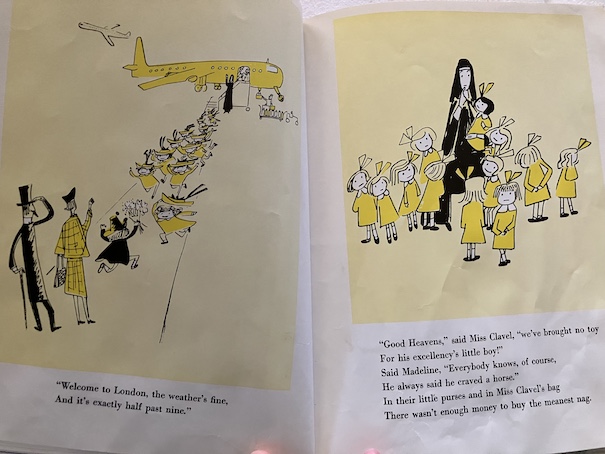
This book is part of the Madeline series about a little girl at a small boarding school in Paris. The son of a Spanish Ambassador, Pepito, lives next door to the girls. He’s a menace to them at first, but the girls make friends with him. However, in this book, Pepito moves to London because his father has been relocated for his job.
When Pepito and his parents go to London, Pepito is unhappy there because he’s lonely for Madeline and the other girls from the boarding school. With Pepito growing thin and depressed from his unhappiness, Pepito’s father arranges for the girls from the boarding school to visit for Pepito’s birthday to cheer him up.
When Miss Clavel and the girls arrive in London, there’s a happy reunion, but then, they remember that they didn’t bring Pepito a present for his birthday. Madeline remembers that Pepito has always wanted a horse, and they find an old, retired army horse who is still healthy and gentle.
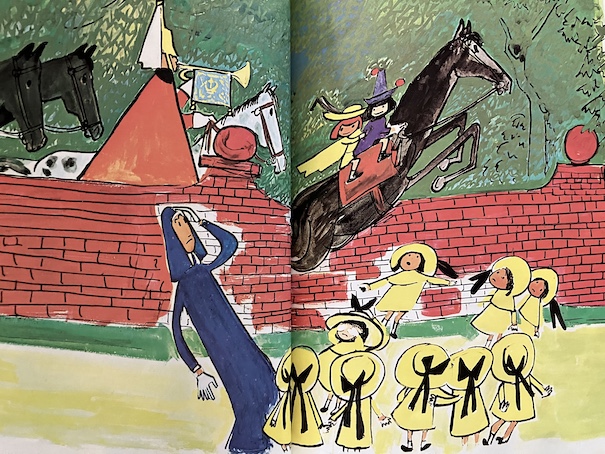
However, when they give the horse to Pepito, they quickly discover that there are complications to owning a horse as a pet. The horse hears a trumpet, and reacting to his army training, he runs off with Pepito and Madeline on his back to join a parade.
Then, they forget to feed him, so he eats everything in the garden, making himself sick. It seems like the embassy in London is no place for a horse, but Madeline and her friends may have room for one at their school!
The book is available to borrow and read for free online through Internet Archive (multiple copies).
My Reaction
Giving someone a horse for a present without checking with their parents or making sure that they have what they need to take care of a horse isn’t something that people realistically do, but the Madeline books rarely worry about the practicalities of a situation. It’s all fun and adventure!
I was seriously worried about the horse after they forget to feed him and he helps himself to random plants in the garden, especially when they find him with his feet up in the air. Fortunately, everything works out okay, which is characteristic of Madeline books, too. How the trustees of Madeline’s school will react when they find out that the girls now have a pet horse, since they raised a fuss earlier about the girls having a dog, is anyone’s guess, but the story doesn’t worry about that, either.
Like other books in this series, the pictures in the book alternate between limited color images, mostly in black and yellow, and full color images.
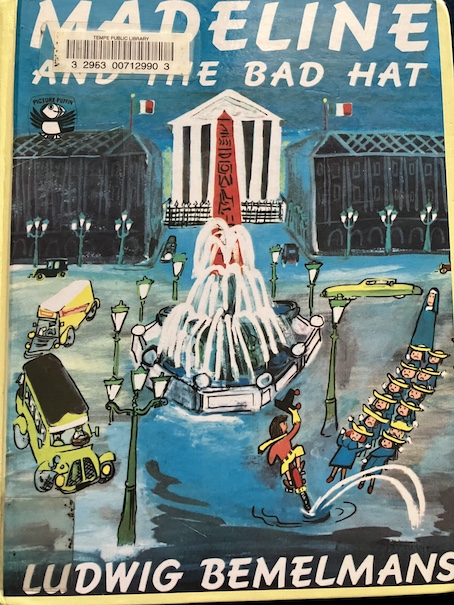
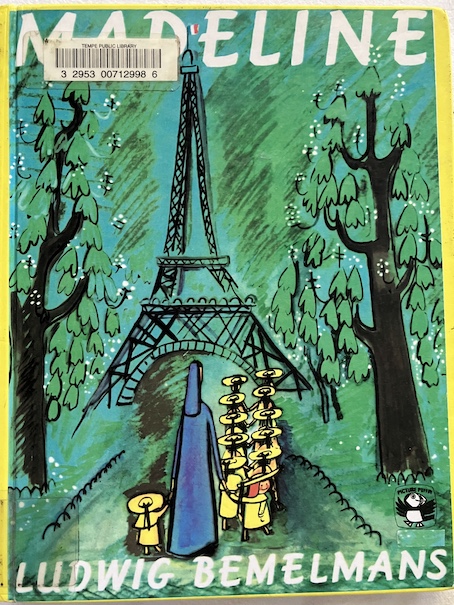
Madeline and the Bad Hat by Ludwig Bemelmans, 1956.
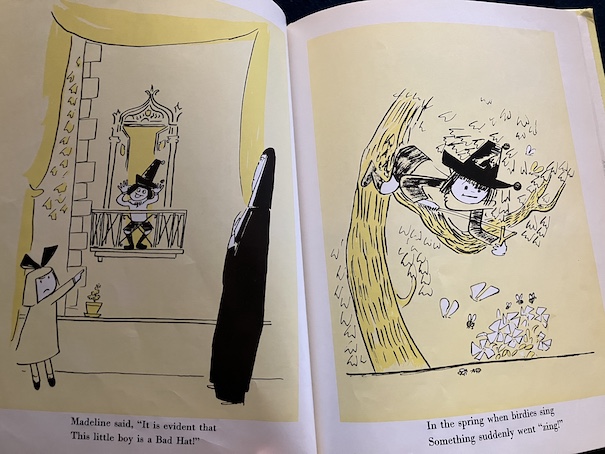
Madeline is a little girl at a small boarding school in Paris. The Spanish ambassador moves into the house next door, and the girls at the boarding school get to know his son. However, his son, Pepito, is a wild boy who Madeline starts calling the “Bad Hat.” He teases the girls, scares them by playing ghost, and worst of all, is cruel to animals.
However, Pepito is actually lonely, and he wants the girls’ attention. He tries to win them over by being polite and doing things to impress them. Unfortunately, his idea of what impresses people can be horrific, like building a guillotine for the chickens the cook will prepare and playing practical jokes.
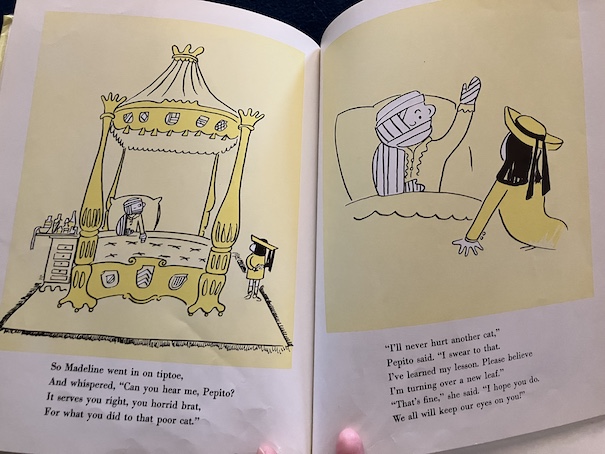
One day, he goes way too far and tries to release a cat into a pack of dogs! The cat tries to evade the dogs by getting on top of Pepito’s head, so the girls and Miss Clavel have to rescue both the cat and Pepito himself from the dogs!
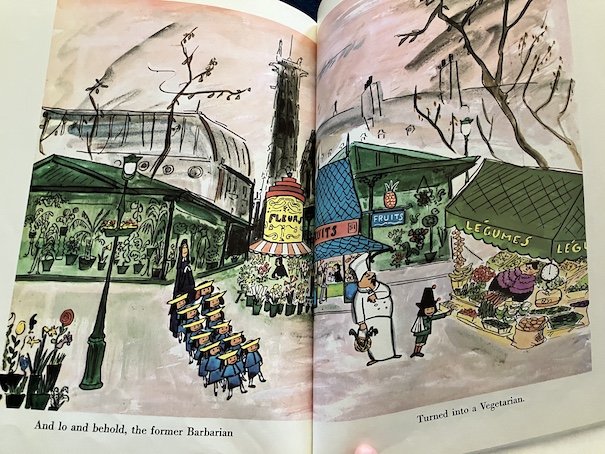
Because Pepito has now gotten hurt himself by one of his pranks, he swears to Madeline that he’s learned his lesson, and he won’t do anything to hurt another animal. He even decides to become a vegetarian!
The book is available to borrow and read for free online through Internet Archive (multiple copies).
My Reaction
I didn’t remember much about this book from when I was a kid. I vaguely remembered that Pepito was a troublemaker who played pranks and teased the girls, but I didn’t remember that he was cruel to animals. Actually, I was kind of horrified by the guillotine for distressed chickens and the cat that he attempted to feed to the dogs.
Pepito only learns his lesson when he gets hurt himself and discovers what it’s like to be on the receiving end of pain. I didn’t mind him showing off a bit or playing pranks like dressing up like a ghost. The cruelty to animals part, though, I found distressing, even as an adult. I don’t think I’d read this book again because of that.
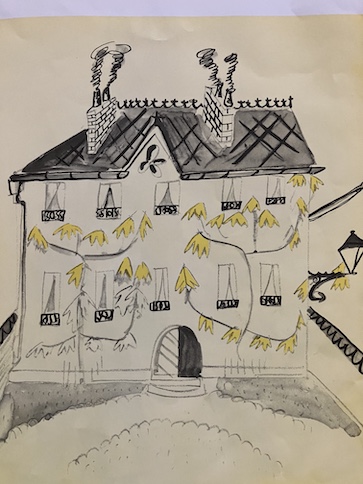
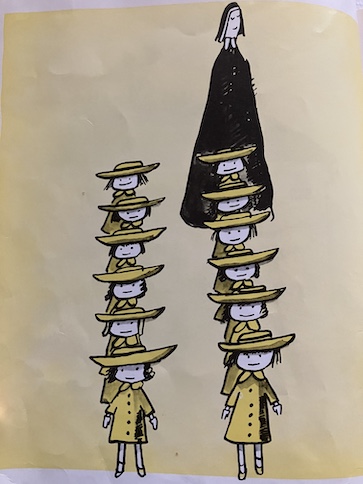
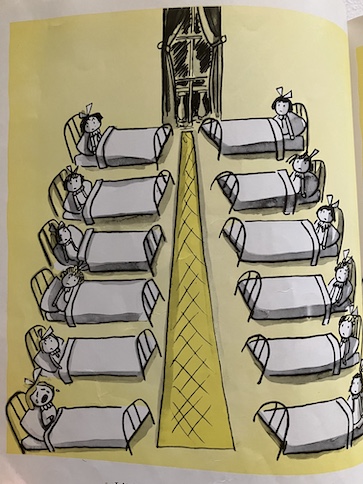
“In an old house in Paris that was covered with vines lived twelve little girls in two straight lines.”
The Madeline stories are considered children’s classics today, and these words, which are the opening lines in other books in the Madeline series, introduce Madeline’s school. Madeline is a little girl who lives in a small boarding school in Paris, tended by Miss Clavel.
Madeline is the smallest girl at the boarding school. She’s a brave girl, who isn’t scared of either mice or lions at the zoo, and she sometimes does daring stunts that frighten Miss Clavel.
One night, Miss Clavel wakes up because Madeline is crying. She calls the doctor, who examines Madeline and rushes her to the hospital because she needs to have her appendix removed.
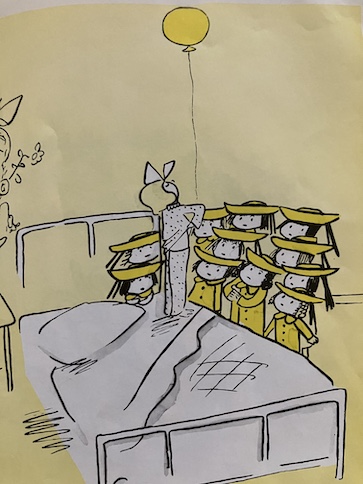
After the operation, Madeline has to stay in the hospital for a while. Miss Clavel brings the other girls from the school to visit her, and they are impressed by all the candy and presents that Madeline has received from her family. Even more impressive, Madeline now has a scar that she shows to the other girls.
After the other girls return home and go to bed, Miss Clavel wakes up to find them all crying. Madeline has made having her appendix out look like so much fun, they all want to do it!
My Reaction
I wouldn’t say that I was a particular fan of Madeline as a kid, but I did read at least some of the books in the series. As an adult, I had forgotten that they were told entirely in rhyme, even though I still sometimes get those opening lines stuck in my head.
I remember thinking as a kid that I wouldn’t want to have my appendix out! Even if you get presents and an impressive scar, having an operation always sounded awful to me. It didn’t occur to me until I was older, but the Madeline cartoons and movie tended to portray Madeline as an orphan, but she isn’t. She’s just a student at a small boarding school. This book is one of the stories that mentions her family, with her papa sending her a dollhouse as one of the presents she receives while she’s in the hospital.
I also didn’t realize, until I was researching this series for the blog, just how old the first Madeline book was. It was originally published in 1939, on the eve of WWII. I don’t think the books ever have anything in them to tie the stories to any particular events, and they seem almost timeless, although I suppose that the girls’ school uniforms are a little old-fashioned. This timeless, idealized portrayal of Paris was popular with the book’s original audience of Americans during WWII.
I was curious about the author, Ludwig Bemelmans. He was born in Austria and grew up in Austria and Germany during the late 19th century and early 20th century. As a young man, he was apprenticed to his uncle, who owned a hotel, but Bemelmans was difficult to manage and got into trouble while working there. He later told a story about shooting and wounding a headwaiter who whipped him, although that might have been just a tall tale. Eventually, however, his uncle decided that he couldn’t deal with him, so he told him he would either have to go to reform school or go to the United States, where his father was living after having left him and his mother years before. He moved to the United States and lived there during WWI. He spent some time working in a series of hotels and restaurants. He eventually joined the US Army in 1917, although they wouldn’t send him to Europe because the US was at war with Germany, and he was German. He became a US citizen in 1918, and he developed an interest in art. He worked as a cartoonist before writing and illustrating children’s books. He wrote the first seven of the Madeline books, and the last one was published after his death. Since then, his grandson, John Bemelmans Marciano has written other Madeline books.
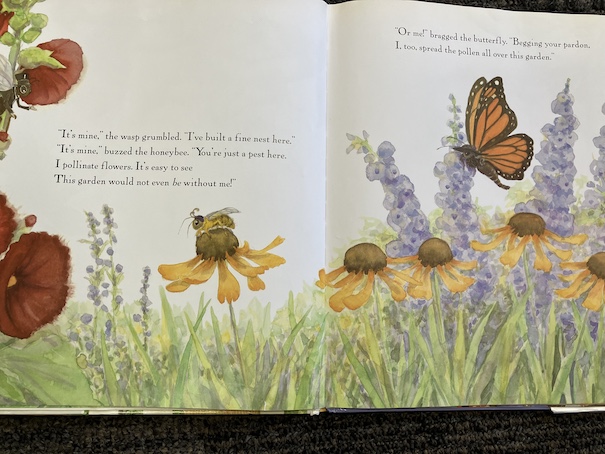
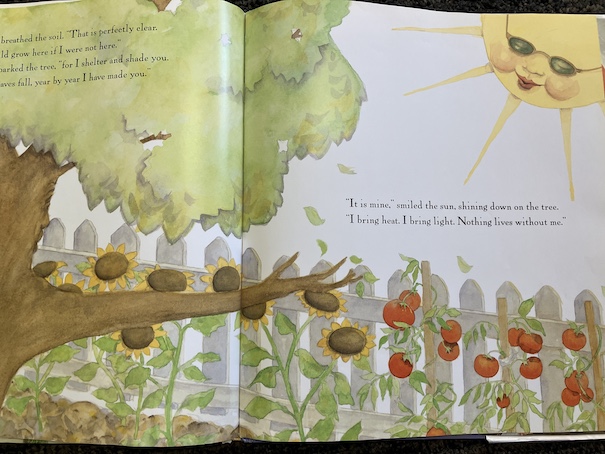
Whose Garden Is It? by Mary Ann Hoberman, illustrated by Jane Dyer, 2001.
This is a cute picture book, told in rhyme, about who is the real owner of a garden.
One day, Mrs. McGee goes for a walk and passes a beautiful garden. She wonders aloud whose garden it is. Of course, the owner of the garden, who is tending the plants speaks up, but he’s not the only one.
A small rabbit also tells Mrs. McGee that the garden belongs to him because he’s lived there his whole life, and he eats the vegetables. Then, a woodchuck says that’s nothing because he eats everything that grows in the garden. A bird chimes in, saying he eats the worms from the garden. Then, a worm says that worms are there to make the soil in the garden better, so he’s the real owner of the garden.
Various other creatures, big and small speak up, each of them pointing out that they live in the garden, what they’ve done for the garden, and what the garden has done for them. The bees and butterflies pollinate the flowers.
But what about the plants in the garden? They have a strong argument that they are what makes the garden a garden. Then again, the soil is where the plants grow, and the plants need the sun and rain to grow. Also, all plants grow from seeds, so the garden exists for the seeds that will be the future plants.
It seems that the answer to Mrs. McGee’s question isn’t as easy as she might have thought.
My Reaction
This is a charming story about how various plants, animals, creatures, and forces of nature are interconnected. The book doesn’t use the word “ecosystem“, but that’s the concept being described here. The garden’s ownership and the reason for its existence is much more than the gardener who owns the land and planted and tended the garden; it’s everything that’s growing in it, everything that contributes to its growth, and everything that depends on the garden. Without all of these creatures and natural forces put together, the garden wouldn’t be what it is.
The book doesn’t attempt to get scientific about the details of this garden ecosystem, and the animals wear clothes and talk, so the story isn’t meant to be entirely realistic. However, it is thought-provoking about how many different parts of nature affect each other. It could be a good book for introducing the topic to young children before teaching them about the science of ecosystems later. The rhyme scheme makes the story fun to read.
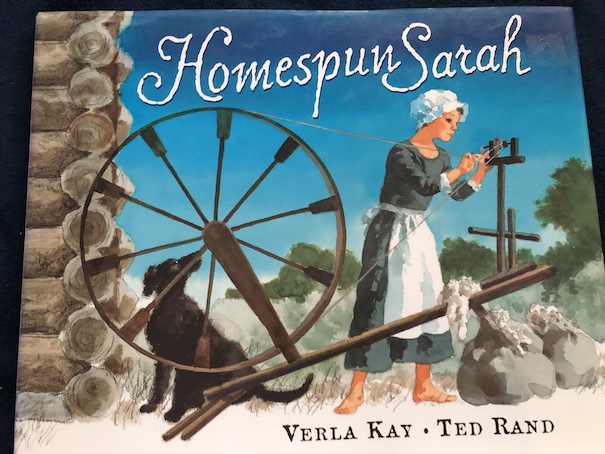
Homespun Sarah by Verla Kay, illustrated by Ted Rand, 2003.
This picture book tells a story in rhyme about a girl living in 18th century Pennsylvania and what she and her family do to make her a new dress when she begins outgrowing her old one.
As Sarah gets dressed one morning, her old dress is noticeably tight, and it’s beginning to get too short for her. Because her family lives on a farm, they must produce most of what they need themselves, and that includes clothing. For Sarah to have a new dress, they must make one themselves entirely from scratch, which is what “homespun” means – they make the dress from homemade cloth from yarn that they have spun themselves.
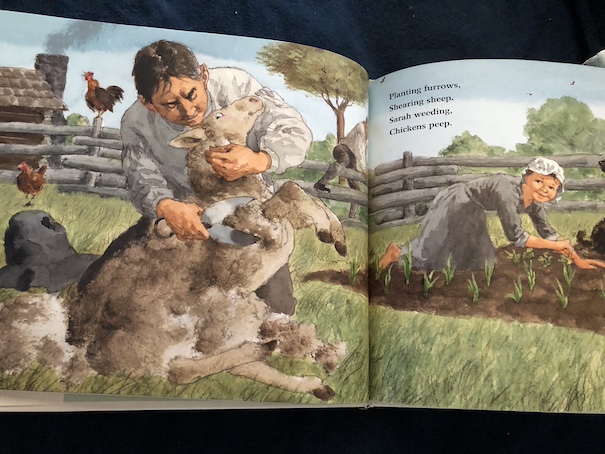
Various family members carry out different household chores, and as the story continues, readers see how everything they do is not only a part of the family’s daily life but also contributes to the creation of the new dress. The family raises sheep, so they must start by sheering the sheep to get the wool for the dress.
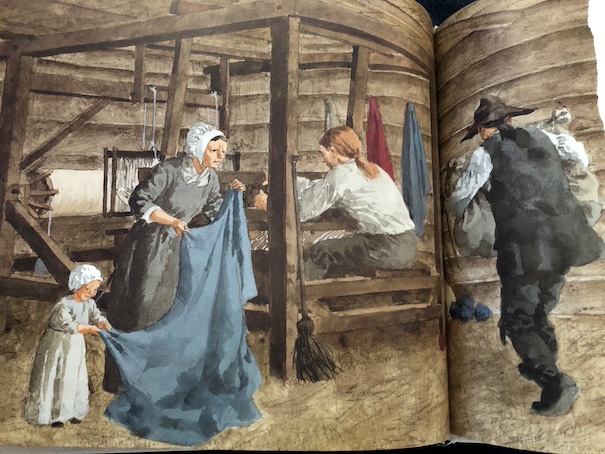
In between doing routine chores, like doing the laundry and making new candles, they card and comb the wool and spin it into yarn with their spinning wheel. The family also owns a large loom, which is how they weave the wool yarn and flax into cloth called linsey-woolsey. The cloth they make is blue and red, dyed using plants that they have produced and gathered.
Once they’ve made the homespun cloth, Sarah’s mother measures her to plan the size of the dress and sews the dress. Sarah gets a new red dress, while her younger sister gets a blue one. Sarah is excited about her new dress, which fits her much better than the old one, and spins around to show it off!
The author’s note at the beginning of the book says that the story is set in Pennsylvania during the 1700s, and she wanted to show how people lived during that time, having to produce everything or almost everything they used by themselves. It also shows various aspects of family life, from where and how they slept to what they ate. The characters in the book, even the children, are shown drinking beer, but the author explains that is because water wasn’t considered entirely safe to drink. The beer they drank back then was very weak and “barely alcoholic”, which was why the children could have it. (We have water treatment facilities and devices available in the United States in modern times to ensure the quality of the water, so this isn’t something that we typically do now, especially with children, and I have more to say about this in my reaction.)
The book is available to borrow and read for free online through Internet Archive.
My Reaction
When I was a kid, I often skipped over prefaces and author’s notes because I just wanted to get to the story, but the author’s note really adds some historical depth and helps to clarify some aspects of the story that children might misunderstand. For example, I thought that the clarification about the mention of the characters drinking beer was important. Alcohol, chemically speaking, is actually a mild poison. It’s mild enough that humans can have it in small amounts without dying or even becoming ill (although we can get sick or die from large amounts, and some people have a greater or weaker natural tolerance to it, compared to each other), but even weak alcohol might kill germs in water and make it safer for humans to drink. This is the way it’s being used in this book. Because this book is for children, it’s helpful to explain this so that child readers understand that what the characters have isn’t quite the same as modern beer and that it’s not okay for children to drink modern beer in the same way. I think this is good book for parents or other adults to read with kids, so the adults can point this out to kids and help them to understand other historical elements of the story that they might miss or misunderstand.
The author’s note also explains that, because people during the time the story is set, had to make their own clothes by hand, and making was a very time-consuming, labor-intensive process, people had far fewer clothes back then than they do now. It was common for someone to have only one set of clothes that they wore every day until they were no long usable. Getting a new set of clothes was an exciting occasion, and that’s what the story in the book tries to capture. When readers see what this family goes through to create just one new dress for a girl who is outgrowing her last one, they can understand how much that dress means to the girl who receives it.
I love books that show how things are made, so I appreciated this book for the process it shows. However, because the story is told in short, simple rhymes and focuses on the how the process would look to a casual observer without getting too detailed, I felt like there were many parts of the process that were implied rather than stated. For example, they don’t explicitly mention that the red and blue dyes for the cloth came from the red berries the girls gathered or the blue flowers of the flax plant, but it’s implied by the earlier mentions of these plants and the way the book showed the characters gathering them. That could be enough for a casual reader, but I’m the kind of person who likes hearing the details of the process, so I would have liked more detailed explanations.
I did appreciate the way the book showed aspects of daily life in the 18th century. Some of them are explained in the author’s note, but there are also other parts of daily life to notice in the pictures. One of my favorite ones was the way that the youngest child in the family is tied to her mother or older sister’s apron strings to keep her from wandering away and getting into trouble while they’re doing their chores.
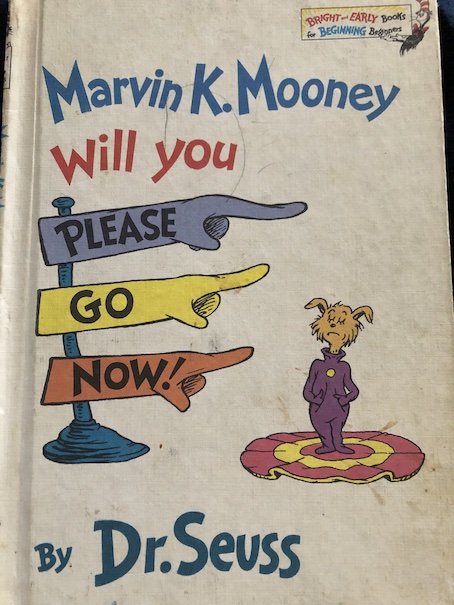
Marvin K. Mooney, Will You Please Go Now! by Dr. Seuss, 1972.
It’s time for Marvin K. Mooney to go, but he absolutely refuses. Where is going? We don’t know because the book doesn’t say. I imagine that he’s supposed to go to bed because it’s bedtime. He looks like he’s wearing footie pajamas, and the large hand that points for him to go looks like it might be a parent’s hand, but that’s just a guess. This book is just a nonsense rhyme.
The owner of the hand repeatedly tells Marvin to go, telling him that he can go in any way he chooses, as long as he goes.
In the tradition of Dr. Seuss books, all the suggested methods of going are nonsensical, and there are a few made-up nonsense words and devices thrown in.
Eventually, when the owner of the large hand insists, Marvin decides that it really is time for him to go.
The book is available to borrow and read for free online through Internet Archive (multiple copies).
My Reaction
I’m not a big fan of Dr. Seuss. I wasn’t even as a kid, mainly because my early introduction to Dr. Seuss was The Cat in the Hat and Green Eggs and Ham, two of the major ones people think of when they think of Dr. Seuss. I thought that the Cat in the Hat was way too pushy, and I was very concerned about the welfare of the pet fish in the story. When my teachers made the requisite eggs and ham and dyed them with green food coloring, I absolutely refused to eat them. I didn’t mind it when they turned milk bright green with food coloring for our earlier green-themed day because milk turned the color of mint ice cream looked good, but nothing that turns the shade of green of those green eggs and ham looks appetizing. Knowing that it was just food coloring didn’t help. Speaking of becoming more accepting of new experiences, Sam I Am really needs to learn how to take “no” for an answer.
Anyway, my early Dr. Seuss experiences didn’t appeal to me much, so I didn’t seek out Dr. Seuss books as a kid. I never encountered this particular Dr. Seuss book until I was an adult, and the one thing about Dr. Seuss that really appeals to me now is the knowledge that The Cat in the Hat was specifically meant to be a more interesting alternative for beginning reader than the Dick and Jane readers that were popular in the mid-20th century century. All Dr. Seuss books contain a limited range of simple vocabulary with a few made-up words thrown in to make it interesting, and they’re all meant to be funny and somewhat bizarre to keep young readers interested.
As I said, I don’t know for sure who is telling Marvin to go in this story or where he’s supposed to go. I think it’s probably bedtime, and he’s supposed to go to bed. It would be just like a parent to use a child’s full name to tell them that they’re supposed to do something when they’re not listening. But, it doesn’t really matter. There are some Dr. Seuss books that have a moral to them, but this isn’t one of them. It’s just supposed to be a simple story that’s fun for young children to read. You can imagine where Marvin goes yourself!
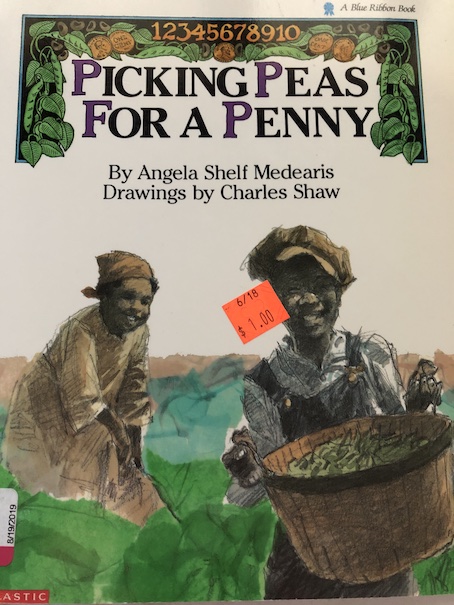
Picking Peas for a Penny by Angela Shelf Medearis, drawings by Charles Shaw, 1990.
This picture book is based on stories from the author’s family and is told from the point of view of her mother, when she was a child in Oklahoma in the 1930s. The story is told in rhyme with a kind of sing-song counting from one to ten as they pick peas and put them in their baskets.
The 1930s was the time of the Great Depression. Many people were out of work, but this African American family has a farm and makes money by growing and harvesting crops. It doesn’t pay much, and everyone needs to help, but because times are hard, they are glad that they are able to do the work and earn the money.
It’s hard work that takes all day in the hot sun, but the girl telling the story says that she and her brother have a little fun while they’re doing it, too. Their grandmother tells them not to goof off because they work to finish. The grandfather of the family offers the children a penny for every pound of peas they pick and says that he’ll take them into town to spend it, so the children start a pea-picking race with each other.
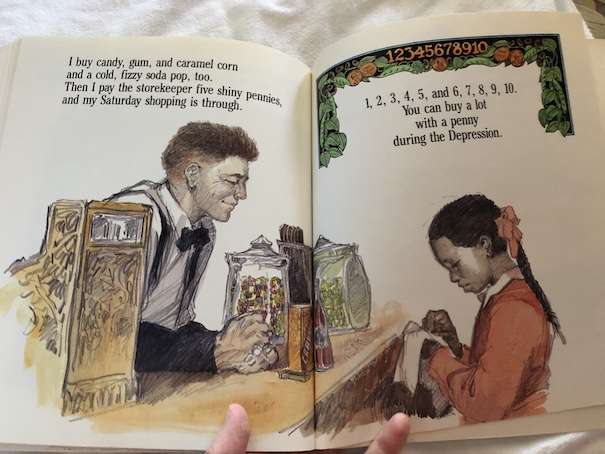
After the work is done, they visit the general store in town, and the children have the opportunity to buy treats for themselves. They only have pennies, but it’s enough to buy some penny candy and soda pop. After the hard work they’ve done, it feels like a rich reward.
In the back of the book, there’s a picture of the author’s family. Although the story itself doesn’t mention it, the name of the girl in the story is Angeline.
The book is available to borrow and read for free online through Internet Archive.
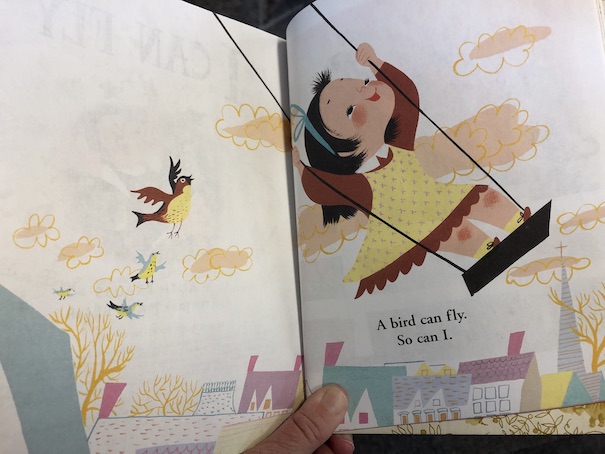
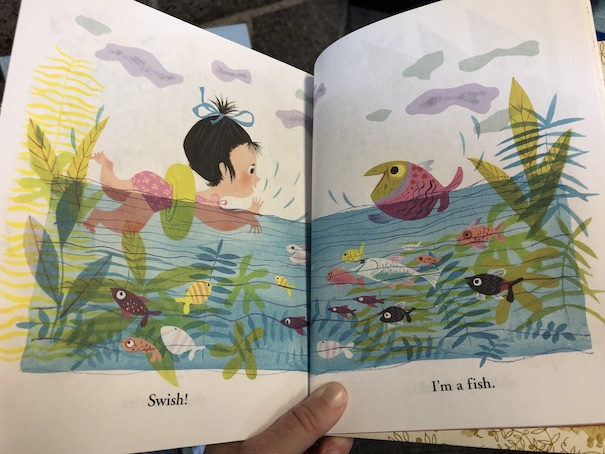
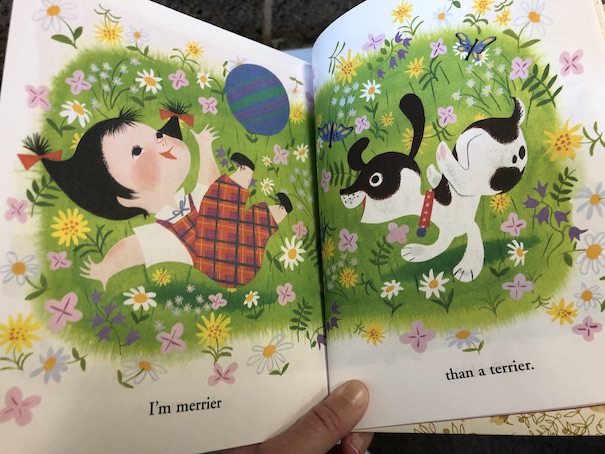
This is a cute Little Golden Book about a little girl playing.
As she plays, she compares herself to various animals. When she’s on her swing, she feels like she’s flying like a bird, and when she swims, she feels like a fish.
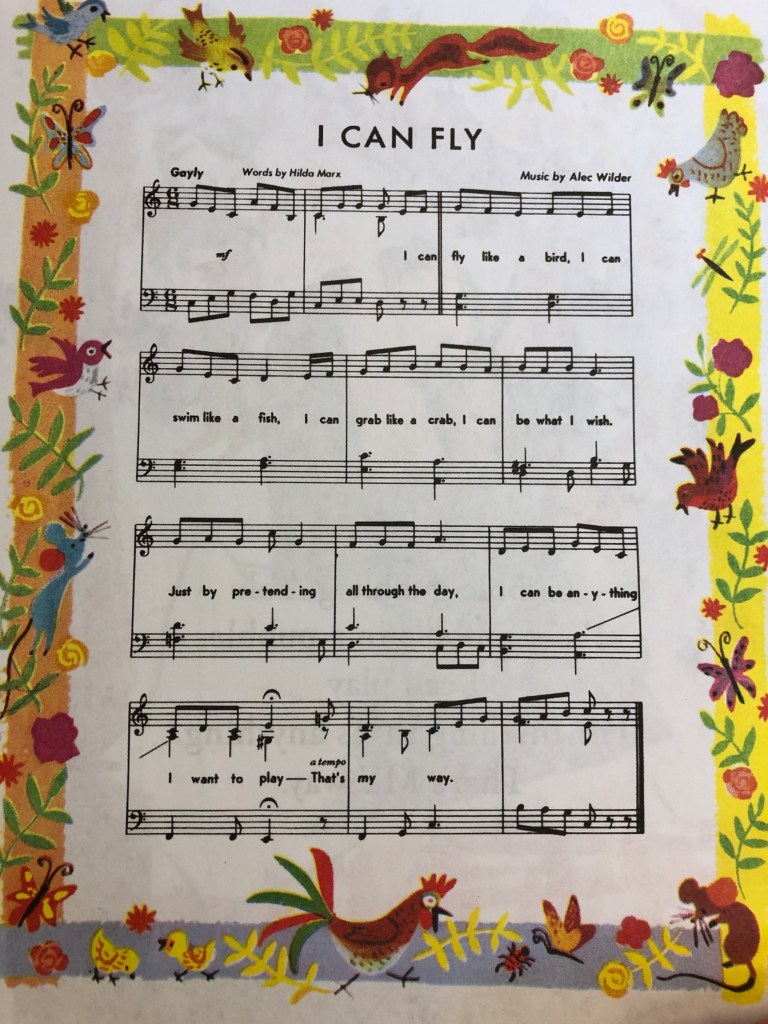
The story is told in rhyme, and in the back of the book, there is actually music so you can sing the rhyme as a song.
There are different printings of this book, some with different illustrations. The different versions also have different words, and it looks like the newer one includes both a boy and a girl and doesn’t have the music for the song. One of the newer versions is available to borrow for free online through Internet Archive.
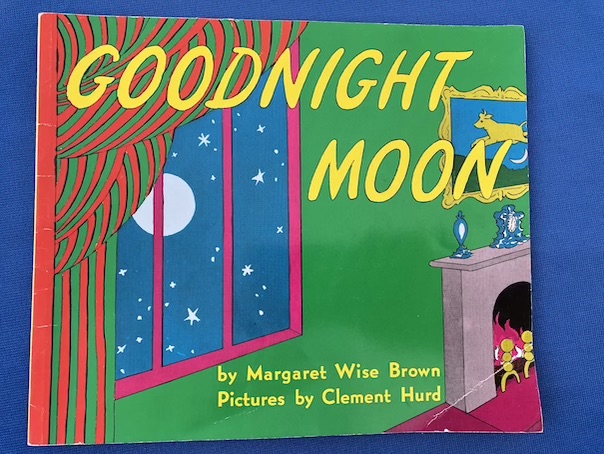
Goodnight Moon by Margaret Wise Brown, pictures by Clement Hurd, 1947.
This is a classic children’s bedtime book and has been for generations!
It all starts with a green room that has a red balloon. The book describes everything in the room in rhyme. There are kittens and mittens and a picture of bears in chairs. It’s a cozy, peaceful room.
Then, the book says “goodnight” to everything in the room (and some things outside, like the moon), one thing at a time.
It’s just a cute, gentle book that is perfect to read to children who are going to bed. Reading it slowly can be very soothing. The book never says it, but the “people” in the story are rabbits.
The book is currently available online through Internet Archive.




















 Jestress's Forgotten Books and Stories