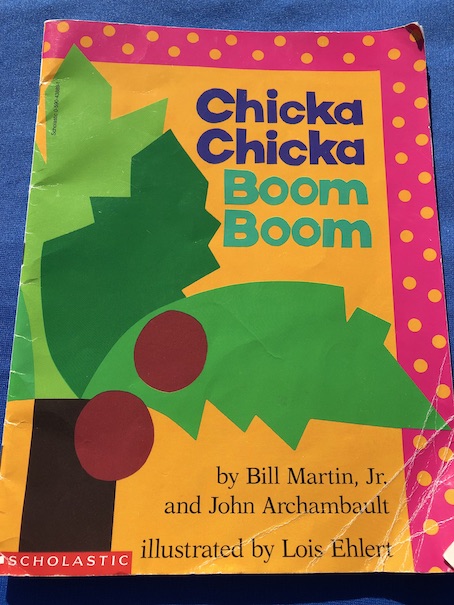
Chicka Chicka Boom Boom by Bill Martin, Jr. and John Archambault, illustrated by Lois Ehlert, 1989.
This is an alphabet book for young children, but it’s not like most alphabet books. Most alphabet books try to tie letters of the alphabet to words that young children know, to emphasize the sounds that the letters make, like in A, My Name is Alice or the letter-themed tongue twisters in Animalia.
In Chicka Chicka Boom Boom, the letters of the alphabet decide to climb to the top of a coconut tree. (Why not?) They go up the tree in alphabetical order.
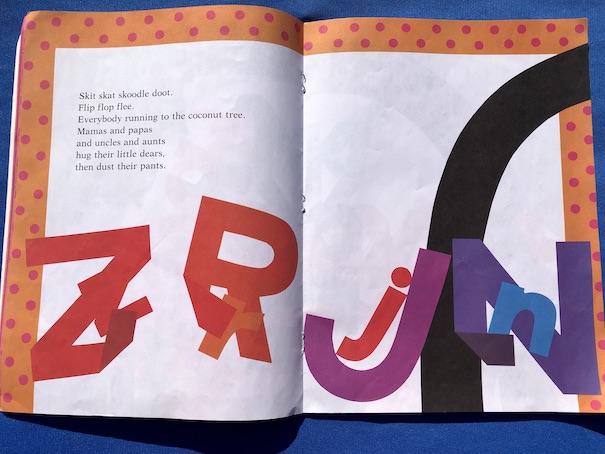
But, by the time they reach the end of the alphabet, there are too many letters in the tree, and they all fall out.
The uppercase versions of the letters are the adults of the story, like parents and aunts and uncles, and they comfort the lowercase letters who fell out of the tree.
At the end of the book, the letter ‘a’ tries to convince the others to climb the tree again.
As I said, this book struck me as unusual for an alphabet book because it doesn’t try to tie any of the letters to associated words. Mostly, it just emphasizes the order of the letters, first in the order that they go up the tree, and then in the order that they recover from falling out.
The story is told in rhyme, and the “Chicka Chicka Boom Boom” part is just sounds that fill out the story/rhyme, like it’s part of a song. At the end of the book, there’s a page with all of the letters of the alphabet, both upper and lowercase.
The book is currently available online through Internet Archive.
Ten Little Rabbits by Virginia Grossman and Sylvia Long, 1991.
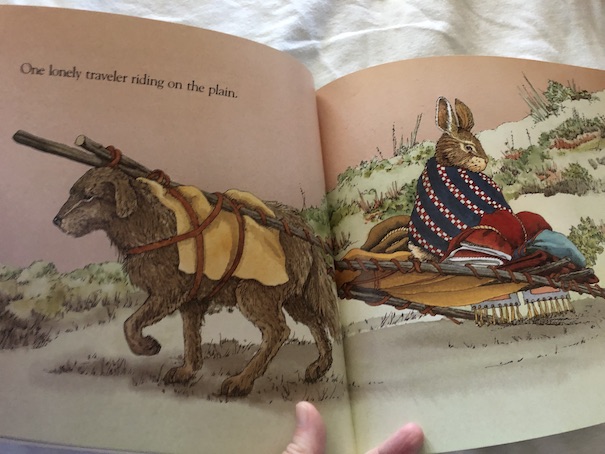
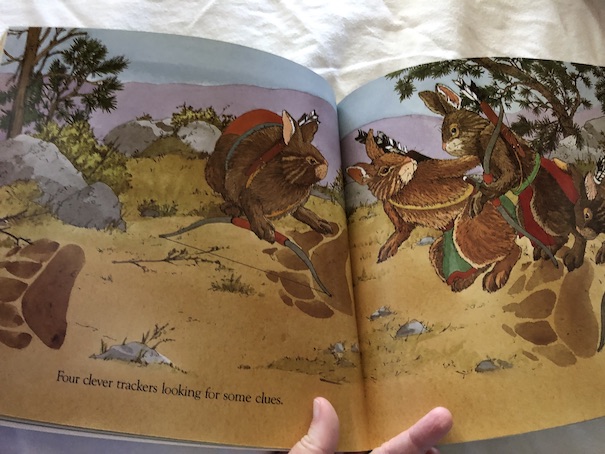
This picture book is loosely based on the Ten Little Indians counting rhyme, but with a twist. Instead of “Ten Little Indians,” it’s ten little rabbits. The rabbits in the pictures are dressed in traditional costumes from different Native American tribes. Also, unlike in some versions of the Ten Little Indians rhyme, none of the characters are eliminated during the course of the rhyme. The rhyme simply counts upward from one to ten.
The pictures are beautiful and detailed, and they do a good job of showing the rabbits in the poses of humans.
The book intentionally shows the rabbits acting out aspects of traditional Native American culture. Very young children might not fully appreciate what the book is trying to depict, but there is a special section in the back that explains which tribes the rabbits are supposed to belong to and what they are doing in the pictures.
The book is available to borrow and read for free online through Internet Archive.
The Secrets of the Pirate Inn by Wylly Folk St. John, 1968.
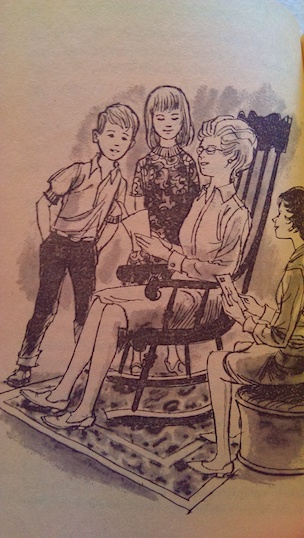
One day, Jack, Amy, and Sally’s mother receives some surprising mail for her deceased father. The children never met their grandfather, who died before they were born, but the letters concern their grandfather’s Uncle Will. Uncle Will is an 88-year-old man, and one of the letters is from Miss Dibble from the Welfare Department in Port Oglethorpe, Georgia, the seaside town where Uncle Will is living. Miss Dibble is concerned that Uncle Will is no longer in his right mind and not capable of taking care of himself, and she is hoping that his family will persuade him to go live in a retirement home.
The children’s mother says that Uncle Will was an adventurer and a wild character even in his younger years, always playing games and doing eccentric things, so the situation may not be as bad as Miss Dibble thinks it is. The mother has never met Uncle Will, either, because her grandmother disapproved of him and discouraged him from hanging around the rest of the family years ago. She knows that her father always thought of him as being a fun uncle and that he used to own some land in North Georgia, where he found a priceless diamond.
The
second letter comes from Uncle Will himself.
It contains a strange rhyme and a letter to his deceased nephew, saying
that he sold his land and that the money from that sale and his diamond will go
to him upon his death. Uncle Will says
that Miss Dibble is pressuring him to turn over his money to the state and to go
live in the old folks’ home. He’s been
resisting her efforts, but he admits that he has gotten absent-minded and has forgotten
where he hid his money and diamond. He
knows that the rhyme he wrote down is a clue that he made to remind himself of
the hiding place, but now he’s confused, and he’s hoping that his nephew can
help him figure it out because it’s based on a game they used to play years
ago. Because it’s been so long since he
last spoke to the family, he has no idea that his nephew has died. Uncle Will also says that he is currently
living in an old pirate’s inn near Port Oglethorpe that has its own secret
passage where pirates used to shanghai sailors.
The children think that Uncle Will and his pirate’s inn sound exciting, and they’d like to go meet him. Their mother says that she’ll have to talk to their father about it, but she thinks that it might be a good idea for them to go and check up on Uncle Will and talk to Miss Dibble. She makes up her mind when Miss Dibble sends an urgent telegram in which she says that Uncle Will is under the delusion that someone is now hiding in his house and trying to kill him for his money. The mother and the children decide to go see Uncle Will, although the father of the family can’t go because he has a business trip.
Of course, Uncle Will isn’t delusional, and there is someone after his hidden money. The old inn where Uncle Will lives is called The Bucket of Blood. When the children and their mother arrive, Uncle Will pretends to be an old pirate parrot, calling out “Pieces of eight! Pieces of eight!” (Yes, he’s definitely an eccentric, and it’s a little more understandable why Miss Dibble thinks he might not have all of his faculties.) They introduce themselves to Uncle Will, and Uncle Will is sorry to hear that his nephew is dead, but he is pleased to meet his nephew’s daughter and her children. The children tell him that they want to help him to solve the rhyme and find his money.
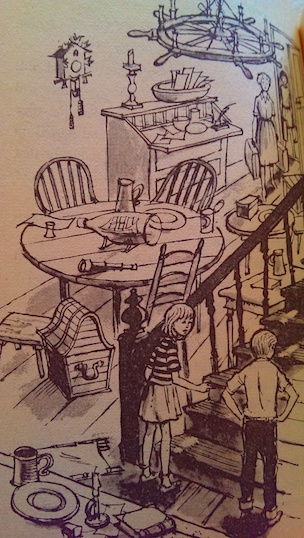
The inn is full of fascinating things, although it’s lacking in modern conveniences. The mother asks Uncle Will if they can stay there, saying that they’ve brought sleeping bags with them. Uncle Will tells them that they can use the bedrooms upstairs but warns them that he’s worried that someone might be hiding somewhere upstairs (as Miss Dibble had said earlier). Uncle Will rarely goes upstairs these days because he finds it difficult to climb up there. However, the children realize that Uncle Will is not deluded when they notice footprints in the dust on the stairs, meaning that someone has been there recently. However, the footprints seem to be only going up, not down. When the search upstairs, they don’t find anyone. Where the footprints left by a ghost? Was someone really hiding in the inn, and if so, how did they leave?
There is a live action made-for-tv Disney movie based on this book. You can see the entire movie online at Internet Archive. The movie is different from the book in a number of ways. In the movie, there are three children, but it’s two boys and a girl (a brother and sister and the brother’s friend) instead of two girls and a boy (all siblings), and none of them are related to the old Irish sea captain living in the old inn. (Note: The child characters in the movie, Scott, Tippy, and Catfish, also appeared in another made-for-tv Disney movie called The Strange Monster of Strawberry Cove, which was also based on a book for children, The Mad Scientists’ Club, but that book was written by a different author, and none of those children actually appeared in either this book or that one.) The old captain in the movie has recently inherited the inn from his brother. The location was moved to Louisiana instead of Georgia, and the treasure they’re looking for was hidden by the pirate Jean Lafitte. There are rhyming clues to the treasure’s location, but they’re not the same as the rhymes in the book. The money and the diamond are also hidden in separate locations in the book. In fact, although the bulk of the money is in one place, some of it is hidden in other places.
In the book, there are also extra characters, a man named Miles who is staying with Uncle Will while he’s working on writing a book and a young runaway nicknamed Hop who is afraid that he will be sent to another foster home like the one he ran away from if Miss Dibble catches him. At first, I suspected one of these characters of being the villain of the story, trying to steal Uncle Will’s money. However, the real villain is someone we don’t really know until the end, although he has connections to other people in the story. This is different from the movie, where the villain is a suspect we meet and see often before his guilt is established. Because of this, I think that the movie was playing more fair with the readers about the mystery.
Near the beginning of this book, the characters reference The Joyous Season by Patrick Dennis (also the author of Auntie Mame), which was published only a few years before this book was. Sally thought that the book was hilarious, but Jack thought that it was boring because the boy in the story, who was his age, “didn’t have a thing to do every day but listen to grownups talking.” I think this is meant to be a sign that the children’s parents are pretty modern and progressive, letting their children read a book about divorce and mixed-up family life in the 1960s. At one point, the mother tells Jack not to use euphemistic swear words like “Cripes!” just because characters in books to it. It gets on the mother’s nerves because she thinks that “They sound even worse than the words they’re being used to avoid.” She actually tells Jack, “When you’re old enough to swear by any words you like, I hope you’ll manage without euphemisms.” I mentioned in my page of 1960s children’s books that the 1960s were a turning point both in society and children’s literature, and this is an example of people’s changing attitudes. Sally, the oldest of the children, is allowed to wear lipstick, and Amy, who is twelve, is also allowed to wear it, although she thinks of it as being too much trouble to bother most of the time. (I can relate. I still sometimes throw out old make-up that I just plain forgot that I had because I’m too busy and preoccupied most of the time to think about it.)
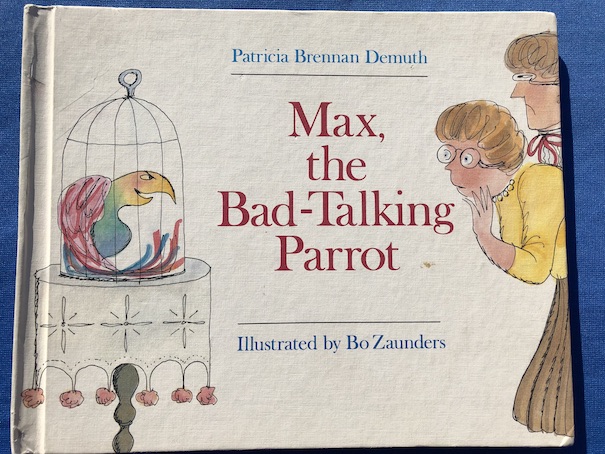
Max, the Bad-Talking Parrot by Patricia Brennan Demuth, illustrated by Bo Zaunders, 1986.
Don’t worry, Max’s “bad” talk isn’t really that bad.
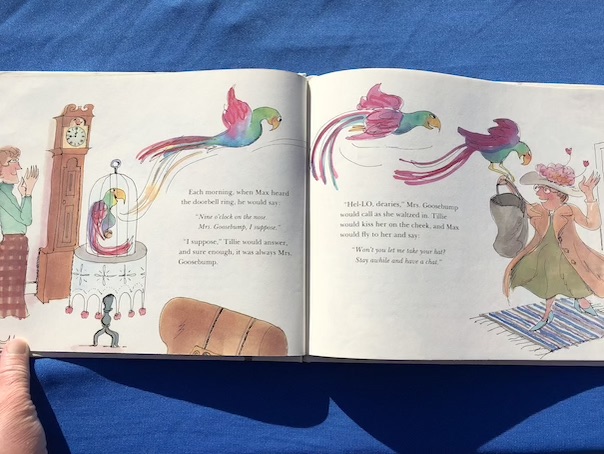
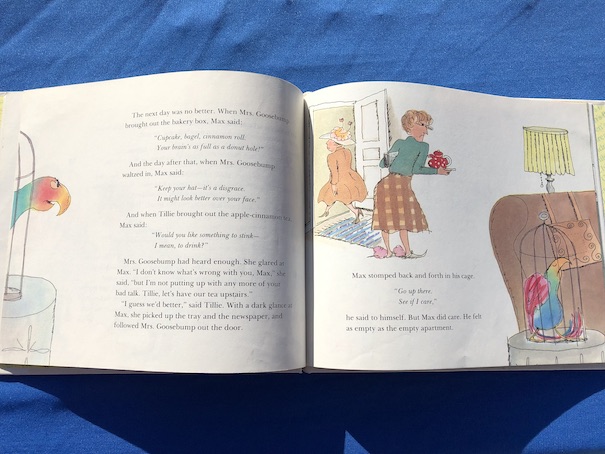
Max is a parrot who belongs to a woman named Tillie. They live in a house that has been made into two apartments. The woman who lives in the apartment above them is Mrs. Goosebump. Mrs. Goosebump is Tillie’s friend, and Max likes her, too.
Because Mrs. Goosebump works the night shift in a toll booth, she always comes to see Tillie and Max in the morning, when her shift is over. Max always greets her with one of his rhymes. Everything Max says is a rhyme.
However, one day, as Max is dozing on Mrs. Goosebump’s shoulder during one of her visits, he thinks that he hears her calling him an ugly bird. Max gets upset and returns to his cage, not ever saying goodbye to Mrs. Goosebump when she leaves. He feels badly about the insult, and when Mrs. Goosebump visits later, he only gives her insulting rhymes, like, “Cupcake, bagel, cinnamon roll, Your brain’s as full as a donut hole!”
Mrs. Goosebump and Tillie have no idea why he’s so angry. The only thing that they can think to do is ignore him.
Later that night, a burglar breaks into Tillie’s apartment and starts stealing some of her things, including Max! Max is scared, but by coincidence, the burglar stops to pay at Mrs. Goosebump’s tollbooth. When Max recites some of his rhymes for her, she recognizes one of his usual rhymes and calls the police.
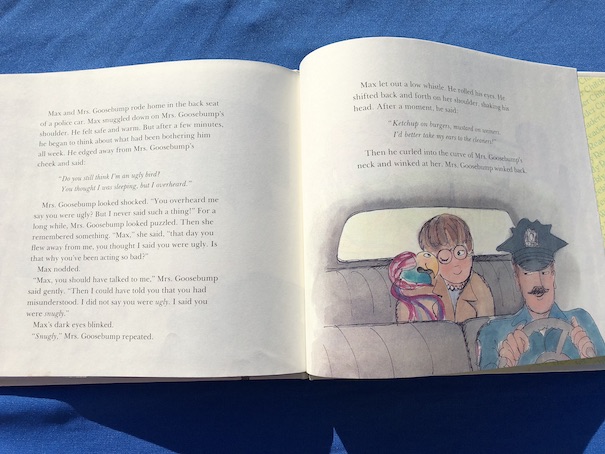
After Max is rescued, he finally tells Mrs. Goosebump why he was so angry, and Mrs. Goosebump explains that she actually said that he was “snugly”, not ugly. With the misunderstanding cleared up, the two of them become friends again. Max is also considered a hero for alerting Mrs. Goosebump about the robber.
When I
was a kid, I thought that Max’s rhymes were funny, and the scene with the
robber at the tollbooth is funny because Max tricks Mrs. Goosebump into
believing that the burglar is insulting her before he says the rhyme that Mrs.
Goosebump recognizes. The book is also a
good lesson about the importance of talking to people about what you’re feeling
in order to clear up misunderstandings.
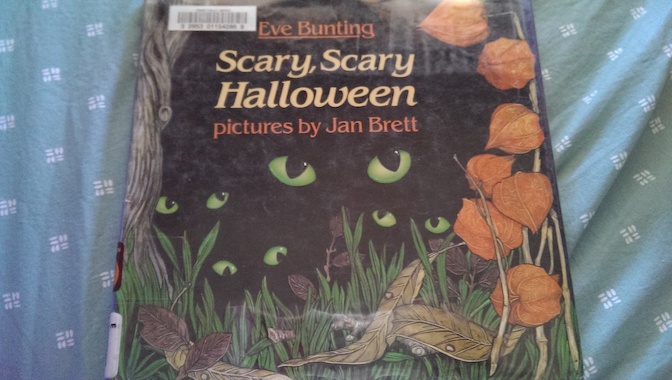
Scary, Scary Halloween by Eve Bunting, pictures by Jan Brett, 1986.
I love the pictures in this book and enjoy the rhyming text of the story. It’s a cute concept for Halloween, and young children will enjoy the repetition in the story.
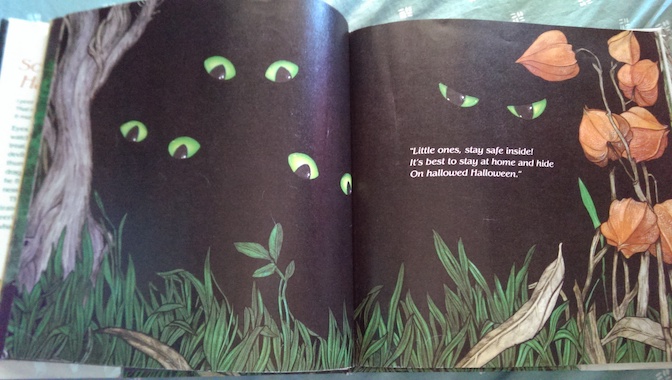
One Halloween night, unseen watchers observe children in costume trick-or-treating. The mother cautions her children to remain hidden because of all the strange creatures that are out and about on Halloween.
Readers will know that the monsters are simply children in costume, but the watchers do not because they are cats, which is only revealed at the end of the story. Throughout most of the book, they only appear as green eyes as they hide under the porch of a house.
When all the trick-or-treaters are gone, the mother cat and her kittens are free to roam the night themselves.
I thought that it was cute how the mysterious tone of the book was due to the cats’ understanding of Halloween. At first, it may seem very mysterious to young children as well, but completely understandable as it becomes more and more obvious that all the monsters are only trick-or-treaters and the little family hiding from them are cats, who think of themselves as being pretty fierce in their own right.
The book is available to borrow and read for free online through Internet Archive.
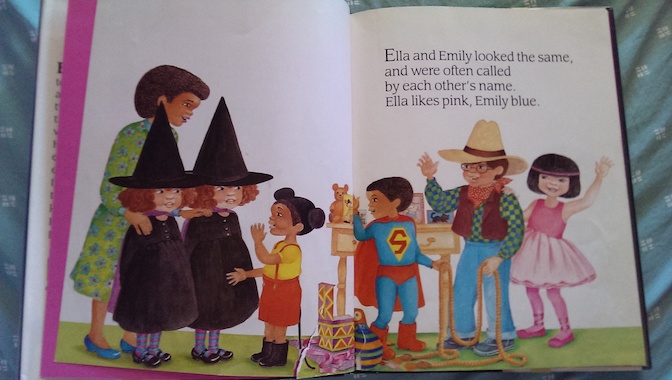
This is a cute picture book/puzzle book. A pair of twins, Ella and Emily, are invited to a friend’s costume party, but they come dressed as witches in identical (or nearly identical) costumes. Throughout the party, as the girls play party games, eat the party snacks, and give presents to their host, readers are invited to figure out which twin is which.
The main clue to the girls’ identities is that Ella’s favorite color is pink while Emily prefers the color blue. Things that the girls have in those colors or objects that they select give away their identities
However, there are also other hints, like we are told what each of the girls ate at the party so that we can use the crumbs left on their plates (or the lack of crumbs) to determine which witch is which.
The text of the book rhymes. The illustrations are cute, and it’s a good book for teaching children how to notice details.
The book is available to borrow and read for free online through Internet Archive.
















 Jestress's Forgotten Books and Stories