 Mystery of the Roman Ransom by Henry Winterfeld, 1971.
This is the sequel to Detectives in Togas, a mystery story about a group of boys in Ancient Rome. Like the first book, it was originally written in German and translated into English.
On Xantippus’s birthday, his students decide that they want to give him a special present because they think he’s turning 50. Actually, it turns out that they did their math wrong because Xantippus (whose real name is Xanthos and only known as Xantippus as a nickname among his students) was born in Athens, and the Greeks use a different dating system from the Romans. His Roman students forgot even after he had explained that in their history lessons, which really annoys him. He is also really annoyed that the special present they decided to give him was a slave of his very own so that he can concentrate on his studies while the slave does all of his chores. Xantippus points out that, far from being a present, slaves are actually a burden because there are extra expenses for owning them and it would end up costing him more money than he could afford (much like the “free” cars that Oprah Winfrey gave to some of her audience members), and Xantippus wants no part of it. He gives the boys the day off from lessons to reward them for being thoughtful (although, not quite thoughtful enough), and tells them to return the slave to the dealer who sold him and get their money back. But, it turns out that this slave isn’t just any ordinary slave.
 When they return to the slave dealer’s home, he is gone, and the place is boarded up. An elderly slave who was left behind said that all of the other slaves were sold, and then the dealer simply fled, abandoning him. He also says that there was someone else who had come to see the dealer, demanding that he hand over the slave called Udo (the one that the boys had already bought). This man was a former gladiator with only one eye, and he was very angry that Udo was gone. He swore that he would he would get Udo one way or another, dead or alive. He threatened the dealer, saying that he would return later and kill the dealer and all of his slaves if Udo was not among them then. The slave dealer, not knowing the names of the boys who had bought Udo or where he could be found and therefore unable to get Udo back, fled in fear of the former gladiator’s threats.
During this time in Rome’s history, crime rates were high because gangs of ex-gladiators, runaway slaves, and criminals roamed the city, robbing and terrorizing the citizens. The boys soon learn that the dealer’s fears were well-founded when the ex-gladiator finds them in the marketplace while they are trying to decide what to do with Udo. He tries to take Udo from them by force, but they fight with him and manage to escape by dumping a pail of honey over his head.
Once the boys are safely away and in their secret hideout with Udo, he reveals his true story to them. At first, they had believed that Udo was deaf and mute because he acted like he couldn’t speak, but he tells them that he was afraid to do so because he is a hunted man. He was the slave of a powerful Roman army commander now stationed in Germania. He was sent to Rome by his master in order to deliver an important letter, but upon learning that he would be killed after handing over this letter, he did not complete his mission.
The meeting was to take place in a cemetery at midnight, and when Udo arrived, he became frightened and hid. Then, he overheard his contacts, two men who did not seem to even know each other, talking about how he would be eliminated after passing on his message. Now, these men are looking for him for the message that he did not give to them, and Udo cannot go back to his master because his master would probably kill him for disobeying orders.
Udo discovered that the letter contained instructions for an assassin to murder an important Roman senator, and upon learning that, all of the boys are immediately worried because they are all the sons of senators. They demand to know which senator will be murdered, but Udo cannot tell them because that information was in the letter, and he lost it after he fled from the cemetery. He thinks that it’s in a cellar where he hid and spent the rest of the night before he was found by a group of gladiators who sold him as a slave the next day. Now, he’s not quite sure where that cellar was. Udo also says that his master will arrive in Rome himself in three days and will probably just pass on the name of the intended target to the assassins then when he learns that Udo didn’t. With time running out and their fathers’ lives possibly on the line, the boys and Udo struggle to find the letter and stop the assassination plot before it’s too late!
In Ancient Rome, slaves were common among the wealthy, and owners had the power of life and death over them. They could punish a slave severely for even a small mistake, abandon them if they were sick or elderly, and even sell them to the gladiatoral arenas, where they would have to fight for their lives or die as public entertainment. To the boys in the story, such things are simply facts of life as they have always known it. Rome in general was a violent place.
The book is available to borrow and read for free online through Internet Archive.
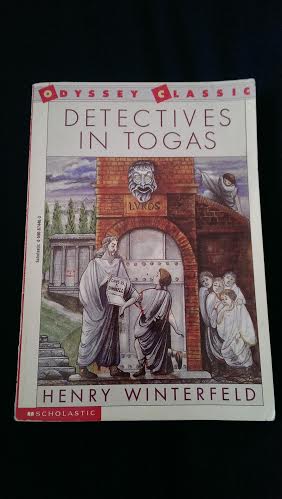 Detectives in Togas by Henry Winterfeld, 1956.
 The next day, when the other boys arrive at school, they discover that their teacher has been attacked and robbed during the night. Worse still, when they go to Rufus’s house to visit him, they learn that someone has written “Caius is a dumbbell” on the side of the Temple of Minerva, which has been dedicated to the emperor. Defacing a temple is a crime, and soon Rufus is arrested and sent to prison (being young and part of an important family does not guarantee him special treatment). Rufus swears that he was not the one who defaced the temple, but who else could have done it?
 Jestress's Forgotten Books and Stories