The Reluctant Dragon

This picture book, with its illustrations, is from the 1980s, but the story by Kenneth Grahame is much older, from 1898. It was always a short story, originally published in a collection called Dream Days. In the original version, there’s an opening part that isn’t included in this picture book, where a girl name Charlotte finds large footprints from a reptile, and a man tells her the story of the dragon.
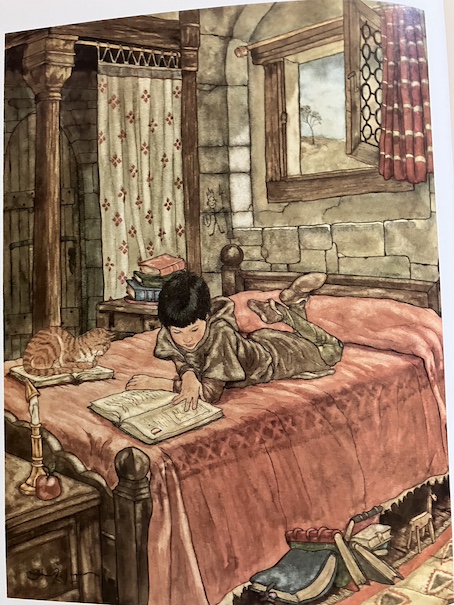
There is a shepherd whose son loves to read, borrowing books from a friendly member of the gentry who lives nearby. Not all parents from their class value book learning, but the boy’s parents appreciate it and support their son for spending time reading. One day, the shepherd comes home and tells his wife and son that he’s had a terrifying experience. While he was out with his flock, he heard a strange snoring nose, and when he went to investigate, he found a frightening-looking creature with scales, with its head sticking out from the cave.

The shepherd’s son isn’t as alarmed as the shepherd. He merely identifies the creature his father saw as a dragon. He knows about dragons because he’s read about them, and he’s thought for some time that the cave was probably a dragon’s cave. Rather than being surprised or alarmed about the dragon, his father’s discovery merely confirms what the boy already suspected, that a dragon might have lived in the cave once and that it would be a suitable dragon’s home. Furthermore, the boy says that dragons are quite sensitive creatures, so he might look in on this one at some point.

When the boy goes to visit the dragon, the dragon tells him he won’t put up with any rough stuff, like hitting or throwing stones. The boy says he wasn’t going to do any of that, and the two of them start to talk. The dragon hasn’t been staying in the cave for very long, and he’s not sure if he’s going to stay or not. It’s a nice place, but he’s not sure if he’s ready to settle down or not. He admits that he’s lazy, compared to other dragons. Other dragons do things like rampaging, chasing knights, and eating damsels, but this dragon would just prefer a quiet life with regular meals and time to snooze and make up poetry. The boy and the dragon talk about poetry and how it seems like nobody else around them appreciates it the way they do or understands why they like it.

However, the boy can see that there would be problems with the dragon settling in this area. Dragons and humans just don’t mix, even though this dragon isn’t interested in rampaging or doing the other things that would be likely to make enemies of the local population. Once word has gotten around that there’s dragon here, there are bound to be people who will try to hunt it with spears and swords because they’ll only see the dragon as a monster. The dragon has trouble grasping the idea that he could even potentially pose a risk to the human population or that anybody might see him as a danger.
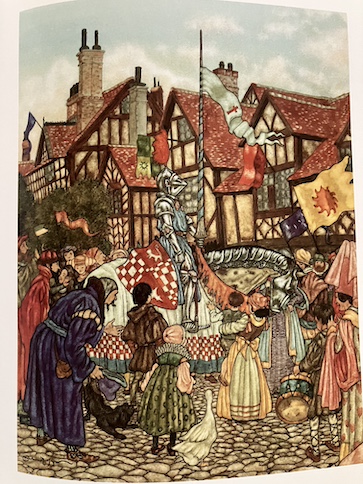
Eventually, word does get around that there’s a dragon living in the cave. The people in the village are both thrilled at this exciting thing happening to their village and plotting to rid their land from this supposed scourge, although the dragon has spent the entire time with his poetry and hasn’t been scourging anything. The village attracts the attention of St. George, the famous dragon slayer, and he comes to deal with the apparent problem.

The boy goes to the dragon and warns him that St. George is in town and that he’s got to prepare to face him and fight. Everyone in town is expecting him to, and they’re all excited about it because it’s the most exciting thing that’s ever happened there. However, the dragon says that he doesn’t like violence, and he doesn’t want anything to do with St. George. The boy worries that, if the dragon won’t take the threat seriously and fight, St. George will simply kill him, but he can’t seem to impress on the dragon just how much danger he’s in.
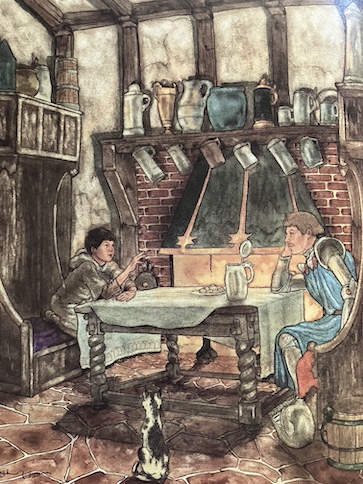
The boy tries to go to St. George and explain the truth about the dragon, but St. George doesn’t take him seriously at first. Everyone else in the village has been telling him tales of horror about the terrible things the dragon has been supposedly doing. The boy explains that the people in the village aren’t telling the truth because the truth is that they only want a fight. This is a quiet, boring little village, the villagers want excitement, and fights are a primary source of excitement for them. They don’t care at all that the dragon doesn’t like fighting and doesn’t want to be involved; they just want to stir things up with their stories and give St. George a reason to go over the dragon so they can watch the entertainment. When the boy explains that, right now, the villagers are taking bets on the upcoming fight, and so far, they’re favoring the dragon to win, St. George begins to think that maybe he’s been too quick to believe the villagers. He agrees to go with the boy to meet the dragon and talk things over.

Both St. George and the boy think the best thing might be to have a fight and get it over with because that’s how things typically go with dragons, and it’s what everyone is expecting. St. George even says that he wouldn’t have to hurt the dragon much in the course of the fight, as long as it looks good to the spectators. The dragon isn’t thrilled with the plan because he still doesn’t like violence, and he doesn’t want to be hurt or even kind of hurt. The boy realizes that the dragon won’t be getting out of the experience, either. St. George would get the glory for the fight, but what’s in it for dragon? Fortunately, the dragon knows what he wants – to be the guest of honor at the victory banquet!

The book is available to borrow and read for free online through Internet Archive. The original story of The Reluctant Dragon was made into a cartoon film (with some slight changes to the story) by Walt Disney in 1941, and it was used as a vehicle for a film tour of the new Walt Disney Studios in Burbank, California.
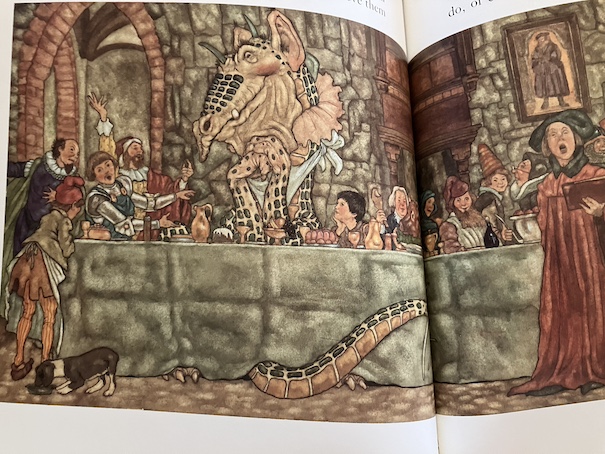
This story is fun because it’s sort of a parody on folktales, especially St. George and the Dragon, subverting everyone’s expectations. The dragon in this story isn’t particularly fearsome and just likes poetry and a peaceful life, and the villagers, who are supposedly being terrorized, are actually the bloodthirsty ones. St. George is rather disappointed when he realizes that the villagers have been duping him with their stories, but he also realizes that they have to find a way to give the people what they want while sparing the dragon and making it so the dragon won’t be victimized later. Although the boy feels like they have to have a fight of some kind to appease the villagers, he also doesn’t want his dragon friend hurt, and he realizes that they have to consider what the dragon really wants.

The three of them work out a way to give the villagers a good show during their “fight” without the dragon getting really hurt. Then, St. George declares that the dragon has been defeated, and there is no need to cut off his head as the villagers have asked because the dragon has seen the error of its ways and repented, so there is no further need for vengeance. St. George’s victory speech also makes it clear to the villagers that he won’t put up with any more stories about the dragon’s terror because he knows that they can’t be true, that they should drop their prejudices because it’s pretty clear that they don’t know everything even if they act like they do, and that it’s wrong to make up stories about things that haven’t actually happened just for the excitement of doing so. I particularly like that last part of his speech/lecture: “And he warned them against the sin of romancing [in the sense of dramatizing and romanticizing things], and making up stories and fancying other people would believe them just because they were plausible and highly coloured.”

I feel like this is a lesson that more people could stand to remember this modern era of conspiracy theories, social media, and Internet rumors. Yeah, I’m particularly thinking of the stories about immigrants eating animals in Ohio. I’m never going to let that one go because everyone who fell for that and helped spread it was acting like the villagers in this story. They were irresponsible and attention-seeking, causing trouble and danger for people who did nothing to deserve it just for their own excitement and hysteria. It doesn’t help if people based some of their belief on old stories about other groups of immigrants eating pets. That actually makes it much worse because I know those stories were debunked decades ago, so they have even less of an excuse to fall for that now.

If you’re thinking at this point that the matter of rumors of pet-eating immigrants is unrelated to the story, I would argue that it fits in very well because, in both the story and in the real-life rumors, social acceptance is a major issue. The dragon wants to be socially accepted so he and stay in the cave that he now considers his home. He wants to be left in peace to compose his poetry but at the same time have the ability to have company and join in local festivities so he won’t feel too lonely. The problem is that the village people have their own expectations and plans to use the dragon as their personal source of excitement, uncaring about whether that costs the dragon his life or if it costs the knight his life while attempting to kill the dragon. They honestly don’t care who gets hurt or even killed as long as they get to see it, knowing that the stories they invent to tell St. George are necessary to make it all happen. Immigrants also want social acceptance and to be allowed to live their lives peacefully and go about their business in their new homes. People sometimes tell wild stories about them, things they made up themselves, knowing that they’re untrue and uncaring about the consequences for other people, for their own purposes.

The very first time I heard of the Springfield pet-eating hoax, I immediately thought of Janie’s Private Eyes, which I reviewed here years ago and contained references to similar accusations about immigrants. I read Janie’s Private Eyes when I was a kid, and since it dealt with the dangers of rumors and prejudice, specifically rumors about immigrants eating pets, I grew up figuring that these were things that adults should just understand and that only had to be explained to kids, who hadn’t heard about them yet. I don’t suppose everyone has read Janie’s Private Eyes, but I always thought, surely, by adulthood, they would have read something or had somebody clue them in at some point.

There was just no chance of me ever being impressed about humors of Haitian immigrants supposedly eating pets as an adult after hearing about long-debunked rumors about Chinese immigrants supposedly eating pets and Vietnamese immigrants supposedly eating pets and Mexican immigrants supposedly eating pets (I live in a border state, so other parts of the US may or may not have gotten around to that one). After all, how many sets of immigrants can you hear this about before it just becomes eye-rolling routine, like those dumb chain emails that used to be popular in the early 2000s or those supposedly shocking but highly improbable kidnapping stories you’re supposed to warn every young woman in your life about but which are almost direct rip-offs of badly-misspelled fan fiction from Wattpad that was written by teens around that same time period? In all those cases, they’re the some wild stories, just retold with a few minor details and the names of the characters changed.

Stories do matter. The ones we hear when we’re young live in our heads and influence the way we look at things when we’re older and how we respond to some of the questionable things that other people are bound to tell us later in life. In a way, I think it really helps to hear some of this bunk when you’re young, under circumstances where you can tell it’s bunk or with someone cluing you in, so you can get some of these ideas out of your head earlier in life and be better able to tell what’s old-fashioned, sensationalist bunk from someone playing up for attention when you’re an adult. I think that The Reluctant Dragon, although it can be taken in a lighter fashion as parody or satire by people who know the type of stories that are being parodied, also offers the opportunity to talk about the power of stories, how they change people’s views and motivate people to action, and the serious consequences of rumors.

Maybe some of the people spreading the Internet rumors really were ignorant and gullible, easily alarmed and manipulated by a wild story, and maybe some of them just wanted in on the excitement to get attention for themselves and never cared whether it was true or not as long as they could latch on to the attention the story was getting and make themselves part of it. I’m pretty sure that the people starting them and passed them on wanted excitement and attention. There is a certain thrill to passing on rumors, feeling special because you “know” something other people don’t know yet and maybe even wanting praise as well as attention for passing the story along. Maybe some of those people also wanted to get some kind of petty revenge on the immigrant population by saying something bad about them, they expected that people would believe them if they made the stories seem dramatic and plausible (like St. George said in the story), and like the villagers in the story, they did not think or care about what would happen to the people who were the subjects of their libel.

It’s the same sort of thing with most social media rumors, which often contain little truth and can do a lot of harm by people believing them and continuing to spread them, which is why I’m against them all in principle. I urge everybody, when you hear any sensational story through Facebook or any form of social media, to pause and do a little fact-checking before you send that story to anyone else. If you can’t verify it or if you find evidence against it, make no other comment on it other than a link to the evidence against the story (if possible) and a message saying that you don’t want to see any more rumors or conspiracy theories. (At least, I sincerely hope you don’t. I’m telling you, they’re only trouble, and real people get hurt because of fake news.)

In real life, I doubt most people, being told off, even in a nice way, for making up stories and getting caught in lies, would behave with as much grace as the villagers in the story. In real life, people get defensive when they know they’ve been caught and “fight back”, but the villagers just accept it as part of the excitement they wanted and focus on getting to the party they know they’re going to have. During his speech, along with his other admonishments, St. George lets the villagers know, subtly, that he’s discovered that they’ve also been staging animal fights and that this practice is going to have to end, and the villagers all know that he’ll personally be checking on that. At the end of St. George’s speech, there is “much repentant cheering”, and they all go to enjoy the banquet. If people are feeling a little awkward about their behavior or the situation, they’re still determined to enjoy themselves and this remarkable event as much as possible. Everyone relaxes at the banquet because the major event is over, everybody has had a taste of excitement and the spectacle they were craving, and St. George’s speech is over, so there’s nothing left for anybody to plan or worry about. Everybody has a good time at the party, and the dragon is pleased that he’s been accepted into society, so he will be allowed to stay in this peaceful place and even have some company, which was what he really wanted.
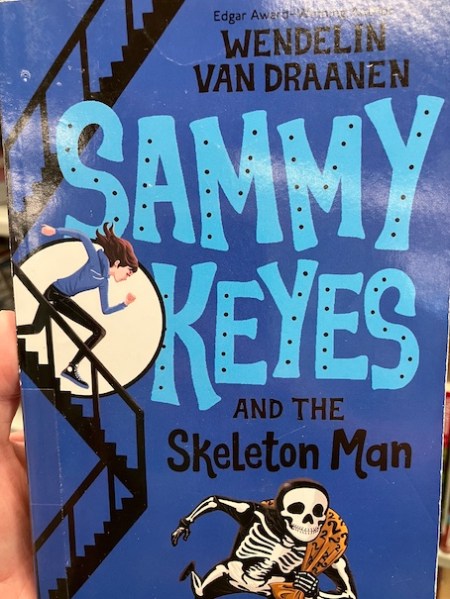
Sammy Keyes and the Skeleton Man

Sammy Keyes

Sammy Keyes decides that she wants to go trick-or-treating even though her grandmother thinks that she’s getting too old to do it. She’s still living secretly in her grandmother’s apartment in an apartment building that’s intended only for seniors, so she jumps at the chance to go out with friends on Halloween night. Dot (real name Margaret/Maggie), a new girl at school, invites her and Marissa to come over to her house to get ready before going out trick-or-treating, which works well for Sammy.

As Dot’s house, Dot is painting herself yellow as part of her bee costume. Sammy is going to color herself green so she can be a marsh monster (something she made up, but it sounds like a swamp monster from old movies). When Marissa comes, she brings Sammy a green sweater that she borrowed from her mother that would be good for a marsh monster costume, and the other girls help Marissa wrap herself in toilet paper for her mummy costume. As the girls set off to trick-or-treat, Sammy gets the idea to go by the old Bush House. The Bush House isn’t haunted, but it is a creepy place and there are stories about the crazy Bush Man who supposedly lives there and will jump out of the tangled bushes that surround the house and kill people. Sammy’s grandmother says that the stories are just stories and the old man who lives in the house is just a lonely old man, but Sammy thinks that it would be thrilling to visit the house and see it up close on Halloween.

As the girls approach the house, they almost collide with someone in a skeleton costume who’s running away. He looks bigger than the girls are, and he’s carrying a pillowcase that looks pretty full. The girls are startled, but Sammy is determined to go up to the Bush House and just knock on the door once for the experience of it. What Sammy sees when she knocks on the door is even more startling.

The door of the house just swings open, and there’s a pile of newspapers on the floor inside that are on fire. Sammy calls out to see if there’s anybody in the house. There’s no answer, so Sammy rushes inside and manages to put out the fire by smothering it with her marsh monster sweater. As the girls are about to leave, Sammy sees someone in a Frankenstein costume in a chair, and they scream and run outside. Then, Sammy realizes that the Frankenstein mask was on sideways, and it’s not easy to breathe in a sideways mask, when the nose and mouth holes don’t line up, so she decides that she has to go back and see if the person wearing the costume is really alright. It’s definitely a human in a costume, and not a dummy. When Sammy removes the mask, she at first fears that the person in the costume is dead because he’s so still, but it turns out that the person under the mask is the Bush Man. He’s tied up, has a head injury, and is barely conscious. He begs the girls for help. The Bush Man is having trouble talking, so after the girls untie him, he writes a message down on paper, asking the girls to go next door and call the police. He also wants to know if the girls saw the skeleton man.

The Bush Man’s real name is Chauncy LeBard, and the reason he can’t talk is that he’s had surgery on his throat because of smoking-related throat cancer. He needs a device held up to his throat to really speak in an electronic voice (an electrolarynx, I’ve seen one used before). While Dot and Marissa run next door and call the police, Sammy stays in the house with him. When the police come, Sammy uncomfortably recognizes the police officer who knows her from the previous book in the series, Officer Borsch. Last time, she and Marissa told him that Sammy is Marissa’s foster sister so they wouldn’t have to reveal where Sammy is actually living. Dot is confused when Marissa refers to Sammy as her “sister”, but she doesn’t give them away.

Mr. LeBard explains that the man in the skeleton costume had forced his way into the house and tied him up, but he doesn’t know who the man is or why he did it. The girls can’t fully describe the man because he was wearing a full-body costume, although they agree that he seemed like a full adult, not just a tall teen. It seems like the skeleton man was a thief because Mr. LeBard’s wallet and a pair of candlesticks are missing.

After the night’s adventures are over, Sammy winds up spending the night at the house of an elderly friend, Hudson Graham, because her grandmother’s nosy neighbor is awake, trying to find proof that Sammy is illegally living with her grandmother in their apartment building. Hudson agrees to let Sammy stay with him, and it turns out that he’s also an old friend of Chauncy LeBard. Mr. LeBard used to be a political science professor at the local college, and Hudson was one of his students. The two of them liked to get together and have political debates. Then, Mr. LeBard’s mother died, leaving him her estate. The local rumors say that’s when Mr. LeBard went crazy and became the Bush Man. The reality is that he developed health problems because of his smoking and didn’t want his old friends to know. Chauncy also has a brother, who was disinherited by their mother because she disapproved of his wife, but nobody knows why the mother didn’t like her.

Sammy can’t forget about what happened with Chauncy LeBard, even if she wants to. She at least has to go back to the Bush House to get Marissa’s mother’s sweater, which turns out to be worth a lot more than either of them thought. Marissa tells her that, even though her mother never wears that old green sweater, she did notice that it was gone and was upset because it turns out that it was a designer sweater that she bought for $500. Sammy is horrified because, having put out a fire with that sweater, she’s pretty sure that it’s done for, and if she has to come up with $500 to replace it, so is she! When Sammy goes to see Chauncy about the sweater, she starts learning more about him and how his inheritance from his mother turned out to be more of a curse than a blessing. Sammy also starts to wonder whether theft was really the motive for what happened on Halloween. If Chauncy didn’t have that hole in his throat from his surgery, the sideways mask might have smothered him. Did the skeleton man want Chauncy dead?

The mystery of the skeleton man and the ruined $500 sweater aren’t Sammy only problems, though. At school, there’s a nasty rumor going around that Sammy has been calling a boy name Jared, trying to get him away from his girlfriend, Amber. Amber is angry with Sammy, and Sammy’s school nemesis, Heather, has been gleefully making sure that everyone in school knows about it in order to embarrass her as much as possible. Sammy knows that she has never called or even spoken to Jared in her life and doesn’t care about him, but it’s not easy to convince everyone else of that. So who really has been calling Jared? Sammy is sure that it’s really Heather, pretending to be her and saying embarrassing things to get her in trouble. It would certainly be in character for Heather to do that. The rumors are get so out of hand even in a day that one of Sammy’s teachers even suggests that maybe she should talk to a school counselor about her issues with Jared so it won’t affect her schoolwork.

Because the characters are middle school kids, Sammy decides that the best way to get evidence that Heather is her phone imposter is to crash her Halloween party. With everyone in costume and the whole class from school invited (except for Sammy, of course), Sammy, Marissa, and Dot are pretty sure that Sammy can sneak in with them, posing as Dot’s cousin “Nikki.” What could possibly go wrong?

The book is available to borrow and read for free online through Internet Archive (multiple copies).

There are characters in the Sammy Keyes series who smoke, which was becoming uncommon in children’s books in general when I was young in the 1980s and 1990s because adults didn’t want to set a bad example for children. In the last book, the fortune teller character smoked, and it kind of surprised me, but it seems that the series follows the unspoken rule for children’s books that include smoking, that the only characters who do it are either villains or oddballs, not cool people to be imitated. This book confronts the issue of smoking more directly, with Chauncy LeBard’s throat cancer. Mean girl Heather also turns out to be a secret smoker who bribes one of her friends to spy on Sammy and her friends by giving her cigarettes. Sammy later finds out that Chauncy’s mother was also a smoker who died of lung cancer. Between Chauncy’s throat cancer and his mother’s death, the story helps illustrate the hard realities of long-term smoking. Chauncy seems to be living in reduced circumstances, without heat or electricity in his house. My first thought was that his mother’s medical expenses and subsequent funeral and Chauncy’s surgery drained his funds. Medical expenses have wiped out people’s savings before in the US, and I remember that one of the stories they told us to discourage smoking when I was in school years ago was about a woman who was forced to sell her family’s heirlooms to cover her cancer treatment. When Sammy meets Chauncy’s brother, Douglas, she finds out that Douglas was trying to get his mother and brother to quit smoking, but neither of them would, and that’s part of the reason for the family rift. Douglas says that if Chauncy has suffered health problems and blown through the family’s money, it’s really his own fault. It’s true that Chauncy should have taken the hint and quit smoking a long time ago, and he might have spared himself a lot of pain and misery if he had, but it turns out that he didn’t sell the family heirlooms to pay for his medical expenses. There was something in his house that was worth a great deal of money, something that Chauncy couldn’t bear to part with even to improve his own living situation because of the sentimental value. The thief is one of the few people who understood what Chauncy had and how to take it without him even noticing that it was gone right away. In a way, what the thief really stole is as much of a mystery for most of the book as who the thief was. The skeleton man turned out to be one of the people I suspected, but not my first suspect, so I was actually in suspense for most of the book.

As for the side plot with Heather calling Jared as Sammy: Oh, criminy! This is one of those ridiculous tween problems that seems so impossibly complicated when you’re in middle school but pretty dumb when you’re not. I appreciate that the math teacher is concerned when Sammy seems distracted in class and her work suffers, but I have trouble believing that an adult teacher would really be interested in rumors about who at school is calling who. I can’t remember any of my teachers ever caring about that stuff because adults usually know that rumors are wrong and that this kind of school drama passes faster if you don’t feed it. I don’t recall any massive rumor campaigns getting the attention of teachers when I was a kid, and I can’t imagine any of my old teachers giving rumors much weight or interest. I think my teachers would have just told us to stop being drama queens, focus on our work, and save the gossip for after school. A few of the more outspoken and direct communicators on the faculty would have flat out told us that gossip isn’t worth anything, that most of it is wrong anyway (that was actually the subject of a play I was in at school once), and that everyone will have gotten bored of whatever it is and moved on in a week or two because nothing we were talking about was really that earth-shaking and we all had the attention spans of chihuahuas on a sugar rush.

If I had to say something to these kids about this situation, I might just tell Sammy not to go calling people who don’t want to speak to her (if I were to assume that she was doing that) because it’s just going to annoy everyone. As for Amber, it’s not really her business to control either her boyfriend or the person calling him, whoever it is. Her decision is whether or not she’s satisfied with how Jared is responding to the situation and if she wants to still be his girlfriend when he acts that way. I’d make it a point to tell Jared, as the center of this drama, that if he doesn’t want to talk to somebody on the phone, he should just hang up without saying anything. You don’t need to stay on the line with someone who’s bothering you. With today’s caller IDs and cell phones that identify everyone who calls, it’s even easier because you don’t have to pick up the phone in the first place if you recognize a number you don’t want to answer. I can’t remember if they had those in the late 1990s, or if that was more an early 2000s development, but I know we definitely had answering machines, and I knew people who would just let the machine answer most of the time, only picking up if they recognized the voice leaving a message. Either way, just because someone calls you doesn’t mean that you have to take the call. On the other hand, if Jared likes being called by a girl other than his girlfriend, it might be time for him to rethink his relationship and decide what he really wants. That seems to be where Jared is. The book describes him as not being too bright and going on an ego trip from whoever keeps calling him. Actually, if I were one of the teachers, the people I’d really want to talk to the most would be Jared’s parents because I think they’d have more power to stop the situation than anybody, no matter who the caller was. Jared’s a kid who still lives at home, so his parents could answer the phone first and find out who wants to talk to him or let the machine record a message that could be used as proof against a prankster who’s bothering him if it gets excessive. Most child pranksters would give up if they called a few times and only got the boy’s parents, especially if the parents sound annoyed or angry when they answer. If Jared’s family got the call on a landline (probable for the 1990s), an annoyed parent could also *69 to last-call return the prankster’s number or look it up on their phone bill if they want to confront the prank caller or talk to the prankster’s parents. It’s annoying to deal with a prank calling kid but not really that hard. I didn’t have access to my parents’ phone bill as a kid, but everyone knew how to *69. Of course, if people in the book handled the situation sensibly, the book would probably be less exciting, and we wouldn’t get the payoff of seeing Sammy get the best of Heather.

There are some laughs when Sammy finds a clever way to record Heather making one of her calls and play the recording for the whole school. It was the sort of victory moment that I would have loved when I was about twelve. However, Sammy’s secret life living in her grandmother’s apartment complicates any problems that Sammy has with the authorities and school administration. After she turns Heather into a public spectacle during a school assembly, the vice principal insists that Sammy’s mother attend a parent-teacher conference. Since Sammy’s mother isn’t available, her grandmother has to attend instead, risking the exposure of their secret.

There is a little more insight into Heather when Sammy sees what Heather’s home and mother are like, but understanding doesn’t equal approval. Heather’s life isn’t perfect, and she lets slip at her party that her mother is a 40-year-old who dresses really inappropriately and flirts with much younger men, possibly including some of her daughter’s teenage classmates. She doesn’t appear to know about Heather’s smoking habit or the truth about any of the other things Heather does. Knowing that her mother is odd and may have really inappropriate taste in men/boys doesn’t make Heather any more likeable, though. At the end of the book, Heather’s outbursts in front of the vice principal may lead to the school insisting on counseling for Heather, which is a hopeful sign, but since Heather remains a bully mean girl for the rest of the series, it’s not that hopeful. You can lead a person to professional help, but you can’t make them internalize it and make use of it.

For me, one of the best parts of this book was the further development of the relationship between Sammy and her grandmother and Hudson Graham. There are hints that Hudson is romantically interested in Sammy’s grandmother, and he treats Sammy like his granddaughter. He seems to be in on the secret of Sammy living with her grandmother and is one of Sammy’s best protections against getting caught. He willingly aids and abets Sammy’s investigations, giving her knowledge and guidance whenever she needs it, and at the end of the book, he gives Sammy and her grandmother a ride to the parent teacher conference.

The ending of the story sets up the beginning of the third book in the series with Sammy being given the assignment of completing some volunteer hours to make up for the disruption that she caused at school.

Mystery of the Witches Bridge

Mystery of the Witches’ Bridge by Barbee Oliver Carleton, 1967.

Thirteen-year-old Dan Pride is an orphan. His father was an international correspondent, and during his early years, Dan lived in different European countries, as his parents traveled around to his father’s assignments. However, three years ago, his parents died in a plane crash. Since then, Dan has been living in a British boarding school. Now, he has returned to the United States to live with his father’s brother, Uncle Julian. Dan doesn’t know what to think about his new town because it’s very different from everything that he’s known before, but he likes the idea of belonging to a family once again because he has been lonely since his parents died.

The Pride family lives in a New England seacoast town. They were one of the founding families of the town in Puritan times, but Dan discovers that the local people aren’t particularly friendly with the Pride family. Billy Ben Corey, a man who works for his Uncle Julian, explains that the Pride family has been rather stand-offish with the townspeople, and there are also rumors and stories about witches that go back to Puritan times. Billy Ben says that most of the modern locals don’t really know all the details of the witch incidents, but the vague rumors that have circulated about the Pride family have caused the townspeople to treat them with suspicion.

This sounds like a somewhat sinister beginning to Dan’s life in York, Massachusetts as he comes to understand how much of life there is governed by the past relationships between the oldest families of the area. Billy Ben tells him that the Coreys have worked for the Prides for generations, but relations between the Prides and the Bishop family haven’t been good and that Dan should avoid them.

Dan presses Billy Ben for more information, and Billy Ben tells him the story of how one of his ancestors, Samuel Pride, was accused of witchcraft back in Puritan times. Some unfortunate happenings at the time, which were probably just the result of bad luck and bad weather, were blamed on him because he was kind of an odd, temperamental person. He was known for playing the fiddle extremely well, and people said that he used it to summon up the devil in the form of a black dog out of the marsh. The person who made the accusation and who led the group that came to arrest Samuel Pride was an ancestor of the Bishop family. Samuel came out to meet the group that came to apprehend them on the old stone bridge that leads to the island in the marsh where the Pride family has their house and farm, Pride’s Point. The story goes that when Samuel met the mob on the bridge, he placed a curse on them, that doom would come for them out of the night, out of the fog, and out of the marsh. Samuel and his wife were executed for witchcraft, and not only after, there was a terrible fog and a sickness that killed many people in town. People said that it was the result of Samuel’s curse. That’s why the Prides and the Bishops have a bad relationship even though they’re neighbors, why the townspeople are still a little suspicious of the Prides, why the Prides are somewhat standoffish of the townspeople (When you think about it, who really wants to be outgoing and friendly with people whose ancestors not only killed yours but who are not welcoming or friendly themselves because they have continually looked at you and your family with suspicion for generations, like you’re the weird ones? The townspeople basically created this situation and have been perpetuating it ever since, yet they act like the problem is with the Pride family instead of themselves. Gaslighting is a relatively new term from the 20th century, but the concept has been around forever, used even by people who don’t know what it is and that it’s what they’re really doing.), and why people in the area are afraid of the stone bridge that they call the Witches’ Bridge, the place where the curse was supposedly delivered. Even into modern times, people in the area see strange lights in the marsh and hear mysterious fiddle music or dog howls that they think might be Samuel’s ghost.

There is still more to come because the mysterious misfortunes of the Pride family have continued even into modern times. Dan is named for his grandfather, Daniel Pride, who died suddenly under very mysterious circumstances, something that still haunts his Uncle Julian. Young Dan learns the story from Mrs. Corey, a relative of Billy Ben’s, who is Uncle Julian’s housekeeper. Daniel Pride had been working to change the family’s image in the eyes of the local people, debunk all the old ghost and witch stories, and lay past quarrels to rest. To try to make peace with the Bishop family and restore the Pride family’s former fortunes, Daniel had been trying to arrange to buy the shipyards that the Bishop family owned, which had formerly been owned by the Pride family. The Bishop family initially agreed to the sale, and one foggy night, Daniel went to see the Bishops to finalize the sale. What happened after that is still a mystery. Daniel was found dead the next day near the old chapel with a look of terror on his face. It’s known that he had a heart condition, so he apparently had a heart attack, but from the marks on the ground, it also appears that he had been running before he collapsed, possibly deliberately frightened to death. Also, there were marks on the ground nearby where his briefcase fell, but the briefcase containing the sale papers was never found. The superstitious people in the area think that Daniel’s death was another symptom of the family’s curse, but it might also have been deliberate murder and theft. The Bishop family insist that they never finalized the sale of the shipyard with Daniel before his death, but Uncle Julian believes that the sale was finalized and that the Bishops are lying to take advantage of his father’s sudden death, just like their ancestors arranged the execution of Samuel for their own advantage. Uncle Julian remains suspicious and bitter about what has happened, just as the townspeople continue to look at the Prides suspiciously.

All of this makes York seem like it’s not the best place to raise a sensitive young orphan, and that’s basically what Uncle Julian says to Dan when Dan arrives at Pride’s Point. Uncle Julian seems elderly and physically frail, and Dan senses that he is a deeply troubled man. Uncle Julian tells Dan that the family and the old family home have a troubled history. That’s why Dan’s father decided to go away and live his life traveling to different places, and that’s why Uncle Julian delayed sending for Dan for so long after his parents’ deaths. Uncle Julian doesn’t seem to think that Pride’s Point is a very healthy place, and he hints at buried secrets. However, he does say that, now that Dan is there, there are going to have to be some changes.

Dan doesn’t think this sounds too hopeful, and he’s lonely and disappointed that he hasn’t found the happy family and home he was hoping for and that he doesn’t even seem particularly welcome there. He can’t even really enjoy playing his violin because of the connection people there seem to have between “fiddle” music, witchcraft, and his supposedly sinister ancestor. As Dan is looking around his new bedroom that night, he suddenly spots a mysterious flashing light from his window, outside in the marsh. It’s creepy because it not only supports all the ghost and witch stories that Dan has just heard but because he recognizes the patterns in the flashes of light as Morse Code … and the message being sent is his own name: D-A-N P-R-I-D-E.

Dan doesn’t believe that any supernatural force was using Morse Code to flash his name at night. It was obviously some human person, but who would do that and why? What is the truth about his grandfather’s death? Is Uncle Julian right that the Bishops caused Daniel Pride to die and then lied about the sale of the shipyard to cheat the Pride family? Or is someone else responsible?

The book is available to borrow and read for free online through Internet Archive.

My Reaction

I stand by my earlier statement that there is basically inter-generational gaslighting of the Pride family going on. It’s gone on for so long that the townspeople have trouble recognizing what they’re doing or stopping themselves from doing it, even though some of them seem to have the feeling that it isn’t right. At one point, some of the townspeople who come out to Pride’s Point to help fight a fire make jokes about the Pride curse. I could sense tension in them, and I think it was an attempt to lighten the mood, but under the circumstances, it wasn’t really appropriate for them to joke around, especially not about something that’s been a sensitive topic for the Prides, something that has literally caused members of their family to die and others to be persecuted for generations. Keep your audience in mind, and learn how to read a room, people of York!

Uncle Julian hates the stories and rumors that have circulated about his family since before he was born, but he doesn’t know what to do to stop it, and he sometimes wonders if it wouldn’t be better for the family to simply leave their old family home and start up again somewhere else. Mrs. Corey tells Dan that every single time anything bad happens in the area, people either look at the Prides suspiciously or find a way to blame them, even though they didn’t have anything to do with whatever it was. Dan can tell that Uncle Julian is so accustomed to having people blame him and his family for things and repeat scary stories about them that he halfway believes the stories in spite of himself, and he’s overly sensitive anytime it looks like the townspeople might be trying to blame the Prides for something yet again. That’s what makes this situation gaslighting, because the community’s constant untrue stories have warped even the Prides’ sense of reality and views of themselves. The community of York as a whole has created a situation that makes it difficult for the Prides to make friends with other people and get reality checks, and the most dangerous part of it is that among the few people that the Prides are in the habit of trusting is someone who turns out to be the person they should fear the most.

I couldn’t help but notice that there was someone in the story that Dan trusted too much in the beginning. It’s partly because Dan is young and in a situation where he is just getting to know the circumstances and people involved, but even when this person says things that are untrue, contradictory, or just plain mean, he doesn’t call him on it or seem to question within himself why this person is talking like that, at least not until about the middle of the book. Gaslighters will do this to a person, playing mind games, lying, alternately being friendly and praising their victim and then putting down their victim and/or trying to blacken their name to other people, discouraging them from getting close to people who care about them and might actually help them, acting like normal things that the victim does or feels are somehow weird or abnormal, trying to keep their victims in a constant state of confusion, unsure of what the reality of the situation really is. Although I found myself angry with the people of York in a general way for perpetuating something awful that their ancestors did for generations and for being apparently oblivious to what they’re doing in modern times, there is a definite villain in the story who is both deliberately and concretely evil.

There is a parallel drawn in the story between Uncle Julian’s big, black dog, Caliban, who is disfigured from an old injury and the Pride family themselves. Dan is afraid of the big dog, and Billy Ben tells him that it attacked him once, but Uncle Julian says that Caliban is just distrustful because he was badly abused and injured in his earlier life. People are like that, too. I understand that because I used to volunteer at an animal shelter, and that’s where I got my dog, Betty. (If you look at my About page, you’ll see a picture of Betty.)

I’ll never know Betty’s complete history because she was found wandering alone without a collar before she was brought to the shelter. However, I’m pretty good at reading between the lines, and I can read at least part of the story from her behavior. Betty is afraid of anyone, even me, walking behind her, and I’ve noticed since her shelter days that sometimes, her back end looks a little off-center when she runs. Her tail has an odd, permanent bend at the very tip that we didn’t discover until we had the hair on it trimmed. I think she’s been kicked hard from behind before, hard enough to leave permanent injury. She’s not as scared of things as she used to be after having lived with my family for a few years, but she used to be terrified of newspapers or anybody standing over her with anything in their hands, so I think she’s been hit with things before. Betty also gets scared when people laugh. She’s not as scared as she used to be because she’s gotten used to us laughing at something funny on tv, but there are times when she’s cringed and slunk away with her tail between her legs from people when they laugh and she can’t figure out why they’re laughing. Betty’s fear of laughter actually disturbs me because I think I know why it scares her. Based on her reaction, I’ve think that it’s likely that whoever hurt Betty before laughed when they did it. I think Betty has an association between laughter and pain, and that’s why she takes laughter as a bad sign, reacting fearfully to it when she thinks it might be directed at her. Laughing while inflicting pain is a sick thing to do, the product of a sick mind. There are stories in Betty’s reactions, and I’m disturbed by the mental picture I have of the person who had Betty before.

I have to admit that my own history has also both colored/given me insight into Betty’s behavior. If it isn’t obvious from comments in my previous reviews, I don’t see teasing as a positive thing. I’ve reacted to it in the past much like Betty does to sudden, unexplained laughter, which is why I understand the feeling behind it. Some people say that they like to tease their friends and people they like, but I just don’t like it, and I’ve learned to be more open and honest about how I never will like it. I do not have good feelings about people who tease others for fun, and I deeply resent being told that I have to like it because the people doing it are “just having fun.” It’s not a bonding activity, not with me, no matter who says it is. I absolutely refuse to “bond” with anyone who does it. Anyone telling me that I have to change myself to like people who tease is 100% guaranteed to get on my bad side. I have a bad history with teasing and bullying, I have a bad history with the people who do it, and I just don’t want to be around it. Teasing involves getting a laugh at someone else’s expense, benefiting from their discomfort, and getting a good feeling from making someone else feel bad. I don’t think any of that is right, and it doesn’t take much for it to get way out of hand, especially when people have the impulse press harder to get the reaction they want to their “jokes”, like the other person just didn’t get it, instead of cutting it out when their “jokes” just aren’t funny. It’s always awkward when it comes from people who don’t know the sore spots that they shouldn’t poke at and try to act like they’re special friends who should be cut some slack when the reality is that we don’t really know each other that well, we’re not really close friends, and no such special relationship actually exists between us. Real friends understand and demonstrate respect for each others’ feelings, and they don’t intentionally poke at a friend’s sore spots, like the people of York did to Uncle Julian with their jokes in this story.

What ties all of this together is that Betty’s reaction to laughter is like Uncle Julian’s reaction to the townspeople and their jokes and comments; it’s a conditioned response from long-term negative association. The townspeople are uneasy because Uncle Julian doesn’t laugh with them, but Uncle Julian doesn’t laugh with the townspeople because none of it was actually funny. By perpetuating these witch stories, even in the form of “jokes”, they’re constantly feeding the myths and ghost stories and making the situation worse, and they don’t seem to care about how he or his family feels or how it affects their lives. You can tell who respects you and who doesn’t by seeing who tries to treat you the way you want to be treated. The people of York were making jokes to soothe their own feelings, sharing in-jokes that they’ve had with each other at the Prides’ expense, and they got really uncomfortable when suddenly confronted with Uncle Julian’s, feelings that they helped to provoke and didn’t want to deal with.

Don’t worry about Betty. It’s sad that she’s been afraid of things and it’s kept her from being more outgoing and friendly, but we’re working through it. In non-pandemic times, I take her to places where I know she’s welcome, and she has acquired a fan club of people who like to see her and say hi whenever we visit. Anytime she seems uneasy because we’re laughing about something, I sit next to her, pet her, and praise her for being a Good Girl so she knows that nobody is trying to be mean to her and that we value her. When someone has been programmed through negative reinforcement, positive reinforcement is needed for balance. I’m trying to build more positive associations for her. It’s working, and she’s improving. She behaves very well and is very happy little dog when she’s treated well. Don’t worry about me, either. I’ve had some bad experiences, but I’m not the only one who’s had to deal with this stuff. There are lots of different kinds of people in the world, and I’ve learned some things about finding the kind of people I want to be around and making it clear how I want to be treated. I just gripe and vent now and then because I don’t like mean behavior or seeing others in these situations, and I’m all out of patience for it. I’ve learned what to do to help remedy such problems, but that doesn’t stop me from resenting the people who create problems that need to be solved.

The way both people and animals behave offers clues about what’s been happening with them. Sometimes, they offer warning signs of people to avoid, and sometimes, they are signs that the person or animal is in distress and needs some outside help and support. Caliban’s behavior in the story is more defensive than aggressive. That is, Caliban is reacting, not instigating … and if I saw what Dan saw in the story, I would know immediately to be very suspicious of the person Caliban hates the most because it explains where the source of harm in his life is. In a similar way, the Pride family is mostly reacting, not instigating. They have been harmed, both physically and psychologically, for an extended period of time, and while they seem to have the sense that’s the case, they’ve been too close to the problem for too long to see what the source of the greatest harm really is. But, about halfway through the book, Dan does learn to correctly read the people around him and comes to realize who is really his friend and how isn’t, based not on how others talk about them but by how they each actually treat him. When you pay attention and think about people’s actions in context, you can see who really has your best interests at heart and who doesn’t.

Dan spends much of the story, particularly at the beginning, feeling like he is unwanted, both in York and at Pride’s Point. At first, he thinks that his Uncle Julian doesn’t want him, but he gradually realizes that’s not it. There is someone else who doesn’t want Dan there, for reasons of their own. As I was reading, I noted times when this person said and did things that manipulated Dan’s feelings, even actively trying to make Dan feel bad while carefully seeming “honest” or “helpful” so Dan would continue to listen. I felt so much better when Dan finally realized the truth about this person. I have to say that I was really angry with Uncle Julian when I discovered that he was fully aware of who hurt his dog and that he still trusted this person. For me, the first hint of that would have caused me to permanently sever the relationship because it’s sick behavior and a sign of a disturbed mind, but I can only suppose that he felt unable to because he had been dependent on this person for too long, largely shunned by the wider community, who could have given him a reality check if they’d had a firmer grasp on reality themselves.

Dan, who had never heard of the Bishops before arriving in York, finds himself becoming angry and resentful of them, hating them for what they’ve done to his family for generations. His uncle even warns him not to get involved with the family, but that’s exactly what the real villain wants. When Dan makes friends with a boy named Pip Cole and his twin sister, Gilly, he confides his anger at the Bishops and how he blames them for this whole mess and for perpetuating it for generations, but Pip knows more about the situation than Dan suspects, and he has seen a different side of the problem. Pip tells Dan his family would have less problems if they would just forgive the Bishops, but Dan doesn’t believe it at first because, the way he sees it, the Bishops are the villains, who have actively profited from their villainy all along. I appreciate Dan’s situation. Pip doesn’t fully appreciate that, for Dan and his uncle, it’s not just about the past because they’re still actively suffering from the townspeople’s stories, rumors, and suspicions about them. It’s hard and maybe impossible to forgive something that’s ongoing from people who see no problem with the situation and aren’t particularly sorry. On the other hand, the resolution of this situation requires at least one of the parties involved to make the first move. Dan’s grandfather was trying, but his mysterious death prevented his mission from being completed. Even Uncle Julian reveals that he had been prepared to forgive the Bishops and marry their daughter, but some of the circumstances of his father’s death led him to believe that his fiance actually had a hand in it, and that apparent betrayal is what has left him such a haunted man all of these years.

The stories that Dan has heard about his family are not the complete story. Dan eventually comes to realize that the Prides and the Bishops each have only half of the real story, and because of their reluctance to associate with each other, the Bishops partly out of continued superstition and guilt, not knowing how to deal with the Prides’ anger, and the Prides, because they are both justifiably angry and accustomed to unfair treatment and being shunned by the community. However, it’s important that they do talk to each other because it’s the only way for each of them to get the complete picture of what’s really been happening and learn the real villain’s true motives.

The key to establishing the truth is in the missing briefcase, and both Dan and his enemy are searching for it. Dan needs to make peace with his family’s past, and he finds some help from a mysterious hermit called Lamie, who lives alone in the marsh. Lamie is another outcast of the York community. People avoid him because he has a reputation for being weird. People in this community in general may be “normal” in the sense that their behavior is fairly uniform, but uniformity by itself isn’t a virtue. When you’ve got an entire community doing something they shouldn’t, being the odd one out can be a good thing. Lamie helps Dan when he needs it, and Dan discovers that Lamie is actually a very kind and understanding person. Lamie’s solitary lifestyle is rather unorthodox, but he’s actually happy in his solitude because he knows who he is, he takes care of himself, he’s comfortable with himself, and he’s living the kind of life he likes, in touch with the natural world. When Dan talks to Lamie, he realizes that Lamie is comfortable with his own identity and at peace in his own mind in a way that his uncle isn’t. Even more importantly, Lamie sees things from a different perspective because he isn’t part of the groupthink of this community.

Lamie was friends with Dan’s grandfather, and he tells Dan about a hidden chamber built by the Prides’ ancestors, where Dan’s grandfather kept important family papers. However, Lamie tells Dan that he isn’t sure that he should look for it if his only motive is revenge. Dan does have a desire for revenge after all of the stories of injustice toward his family that he’s heard and what he’s suffered himself since he arrived in this area. Lamie helps to calm Dan’s desire for revenge by quoting from St. Francis of Assisi, emphasizing the importance of forgiveness instead of revenge. The part about truth speaks to Dan, and he comes to realize that what he really wants, more than revenge, is to know the truth about what happened to his grandfather. Lamie tells him that he saw some of what happened the night his grandfather died, from a distance. Because of the fog, he couldn’t see everything, but he knows that the Bishops were telling the truth that Dan’s grandfather didn’t make it to their place that night to complete their deal, defusing Dan’s anger at them for their supposed lies. Lamie’s memories also give him clues about the true identity of his grandfather’s attacker and the location of the secret hiding place. However, to find it and to evade his enemy, Dan will need the help of the very people his uncle has forbidden him to associate with.

I found the parts about the gaslighting of the Pride family and the poisonous duality of their true enemy frustrating and anger-inducing, but once Dan speaks to Lamie (really, my favorite charcter in the story) and begins to sort out who he can trust and who he can’t, I felt a lot better. The story is very atmospheric, with a grand old house and property, surrounded by a foggy marsh, and even when the characters know who their enemy really is, they are kind of trapped with him in a dangerous cat-and-mouse situation as they both race to find what they’re really looking for. By the end of the book, all of the old mysteries are wrapped up, including the source of the the mysterious “fiddler” music.

Gila Monsters Meet You at the Airport

GilaMonsters

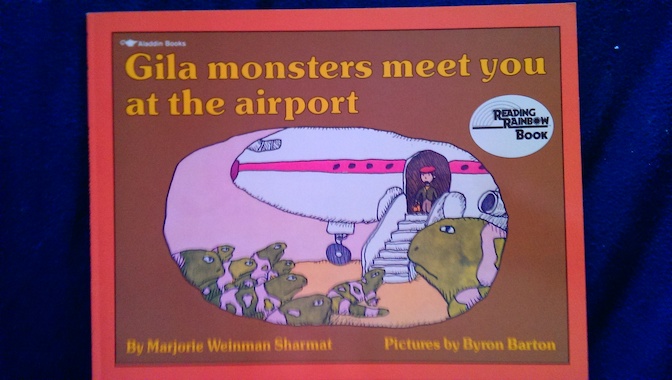
Gila Monsters Meet You at the Airport by Marjorie Weinman Sharmat, pictures by Byron Barton, 1980.

This is a humorous picture book about a boy moving from one side of the United States to the other and his misconceptions of what he’s going to find when he goes west.

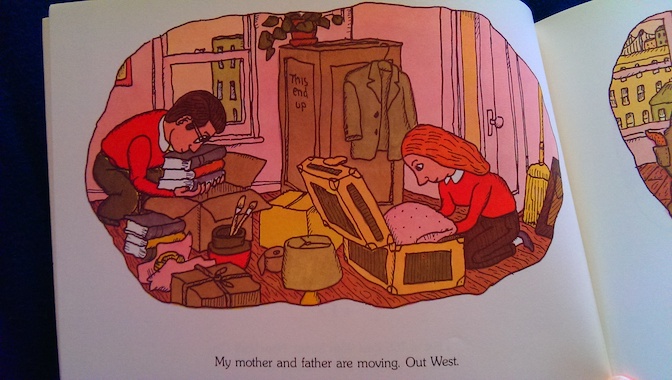
At the beginning of the story, the boy lives in an apartment in  New York City.  As far as he’s concerned, he could live there forever, but his parents decide that they’re going to move “Out West.” (The book never really says what state they’re moving to, but it seems to be somewhere in the Southwestern United States, like Texas, New Mexico, or Arizona.)

GilaMonstersMoving

The boy thinks he’s going to hate his new home.  He thinks of all the things that he’s heard about the West, like there’s cactus everywhere so you hardly know where to sit down, everyone dresses like a cowboy and rides horses everywhere, all he’ll ever get to eat is chili and beans, and he’s bound to die of heat exhaustion in the desert.  His best friend in New York, Seymour, told him that Gila monsters would meet him at the airport.

GilaMonstersCactus

Of course, there aren’t any Gila monsters at the airport when the boy gets there.  Instead, he meets another boy whose family is moving East.  The two boys talk to each other for awhile, and the Western boy starts telling him that he’s not looking forward to heading East because he’s heard that it’s always cold there, the cities are overcrowded and full of gangsters, the buildings are so tall that airplanes fly through the apartments, and there are alligators in the sewers.  He expects to find alligators waiting for him at the airport.

GilaMonstersAirportBoy

Of course, things aren’t as bad as either boy is expecting.  The boy from New York realizes that Seymour and his other friends back East don’t know much about the West, and he starts realizing that things in his new home are actually pretty good, some of them not all that different from home.

GilaMonstersArrival

This book was featured on Reading Rainbow.