
When I Was Young in the Mountains by Cynthia Rylant, illustrated by Diane Goode, 1982.

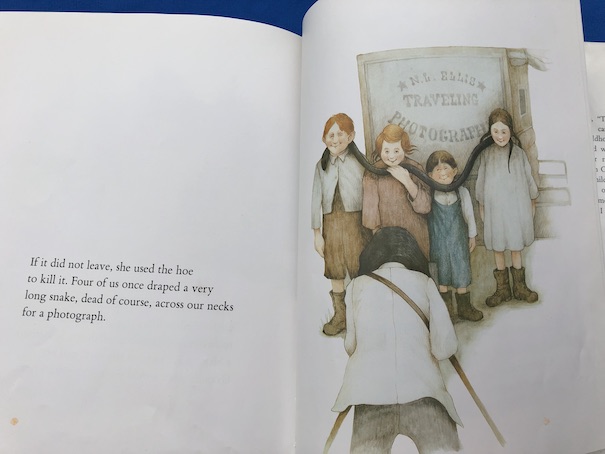
This nostalgic picture book is based on the author’s experiences living with her grandparents in West Viriginia when she was young. It paints a vivid picture of Appalachian life in the past. The story doesn’t give any particular years to describe when it takes place, but the author apparently lived with her grandparents during the 1960s, although from the pictures, it would be easy to believe that the story takes place in a much earlier time. Partly, the style of the clothes and stoves give that impression, but for me, it was really the cloth cover over the camera that made me think it was during the first half of the 20th century. You can still get these covers, but they’re not as common in modern times.
In the story, the author describes various aspects of Appalachian life, starting each section with “When I was young in the Mountains . . .” She remembers her grandfather coming home after working in a coal mine and how they would all have cornbread, fried okra, and pinto beans for supper.
For fun, the kids would go swimming in the swimming hole. They would also use the swimming hole for baptisms. They would also use the schoolhouse as their church.

She describes the general store where her family would go for groceries and how they would have to heat water on the stove for baths.
Sometimes, they had to deal with snakes, and once, when their grandmother killed a particularly big one with a hoe, they took a picture of the children with it.
Overall, the story is about enjoying the simple pleasures in life in a place you love, surrounded by people you care about.
This is a Caldecott Honor Book. It is currently available online through Internet Archive. Sometimes, you can also find people reading this book aloud on YouTube. I particularly like this reading because I think the reader has a good accent for reading this story, and she comments on her own experiences growing up in the country.
 Soup by Robert Newton Peck, 1974.
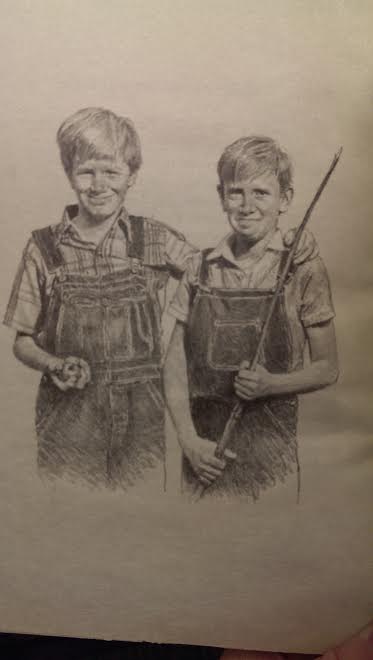 Some of the stories are laugh-out-loud funny, and some of them have kind of a moral lesson to them, like the time when Rob realized that he didn’t have the heart to lie to his mother even if it would allow him to escape punishment for talking back to the school nurse, the time when Soup and Rob tried to cheat Mr. Diskin out of some money so they would have enough to go to the movies but ended up feeling guilty, and how the boys made themselves sick by attempting to smoke cornsilk. Others are just stories of childhood events and friendship, like the story of how Rob and Soup played football and how Soup loaned Rob his new shoes when his were ruined. Even though Soup often got Rob into trouble, he really was a good friend and went out of his way to make Rob feel better when he needed it the most.
 Jestress's Forgotten Books and Stories