#124 The Pumpkin Head Mystery by Gertrude Chandler Warner, 2010.
The Aldens are getting ready for Halloween, and they go to the Beckett farm to get some pumpkins. Mr. Beckett has been having trouble this year because he broke his leg. He’s been letting a hired assistant, Bessie, handle the pumpkin patch, but she is short-tempered and not very good with customers. Mr. Beckett fired her once before, but he had to take her back this year because he was desperate for help.
Mr. and Mrs. Beckett’s daughter, Sally, has been trying to persuade them to sell their farm and come live near her and her children in Florida. She thinks they’re getting too old to manage the farm by themselves and that this recent injury of Mr. Beckett’s proves it. The Becketts say that they don’t want to give up their farm and that they’re not ready to retire. Then, one of the farm hands, Jason, says that Mr. Beckett broke his leg while chasing a pumpkin-headed ghost, but Mr. Beckett denies that it exists.
Later, someone trashes the pumpkin patch and smashes a lot of pumpkins, and for some reason, Bessie faints. The real estate developer who is pressuring the Becketts to sell their farm, Dave Bolger, shows up again and tries to persuade the Becketts to sell. Sally thinks her parents should take the offer, but they still refuse. The Aldens help clean up the pumpkin patch in time for the next hayride, so the Becketts won’t have to cancel it, and Sally tells them that the farm is haunted and that the stories Jason has been telling about the pumpkin-headed ghost are true.
A glowing pumpkin has been seen floating through the fields at night, seemingly with no body underneath it. When it appears, they hear scary voices, telling them to leave the farm and leave the spirits in peace. Mr. Beckett did injure his leg while trying to chase after it on his horse. The Aldens think this sounds scary, and they ask Sally if the farm was always haunted. Sally admits it wasn’t, but she is serious that she thinks her parents should sell the place and move closer to her and her family.
The Aldens want to help the Becketts, and they start doing some seasonal work at the farm, making flyers for their hayrides and dressing up in costumes as part of the spooky attractions. Then, someone steals the scarecrow that Benny made from the Aldens’ house, and a new pumpkin-headed ghost appears on the farm!
Are there actually any ghosts, or is someone pulling a trick on the Becketts? Is it one of the people trying to pressure the Becketts to sell the farm or someone else, for a different reason?
My Reaction
I enjoyed this spooky mystery! The author did a good job of making multiple characters look like good suspects for playing ghost on the farm. Mr. Bolger and Sally both want the Becketts to sell the farm, and scaring farm workers and visitors away from the farm would add pressure to the Becketts. Bessie isn’t very good at her job, but the Aldens discover that she needs money because her husband is sick. Could she have been paid to commit some sabotage on the farm or could she be trying to get back at the Becketts for firing her last season? Jason has worked on the Becketts’ farm for years and seems to love the place, but he’s been arguing with Mr. Beckett about the way he runs the farm. Maybe Jason wants the farm for himself! There are some good possibilities for suspects.
There were some clues that I thought were obvious, like the connection between the disappearance of Benny’s pumpkin-headed scarecrow and the sudden appearance of a new pumpkin-headed ghost on the farm, but child readers may find the mystery more challenging. Even though I thought some parts were obvious, because there were several suspects, each of which seems to be doing something sneaky that they want to cover up, I wasn’t sure whether some of them might be working together or not.
The book has the right amount of spookiness for a Halloween story without being too scary for kids. In some ways, like with all Scooby-Doo style pseudo-ghost stories, I thought that it was a little silly for the plot to frighten people away from the farm to succeed. My reasoning is that, since this story is set in the Halloween season and some parts of the farm are deliberately set up as haunted attractions with people running around in costumes, I would think most farm workers and visitors would just attribute the pumpkin-headed ghost to either a Halloween prank or just part of the act at a spooky attraction.
One of the possible motives that they never discuss in the story is that the ghost act could be a publicity stunt to draw more visitors to the park. While the premise of the story is that people are being scared away, in reality, there are a lot of curiosity-seekers who would want to go to a supposedly haunted attraction to see what all the fuss is about. Publicity isn’t the real motive of the fake ghost, but I’m just saying that it could have been a real possibility that was overlooked. There are a lot of places, like hotels and restaurants in historic buildings, that capitalize on any potential ghost stories to attract curious thrill-seekers.
Something I appreciated is that the real estate developer is Dave Bolger, which is a homage to Ray Bolger, who played the role of The Scarecrow in the 1939 movie of The Wizard of Oz. Is that a hint? I’ve decided not to spoil the solution of the mystery!
#43 The Mystery on Stage by Gertrude Chandler Warner, 1994.
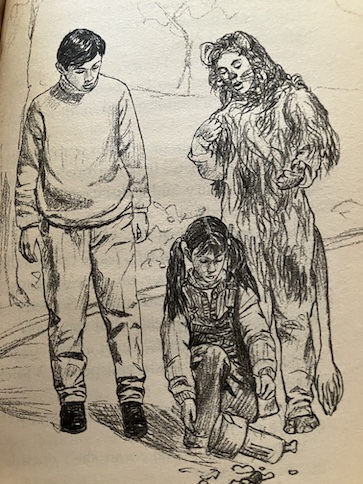
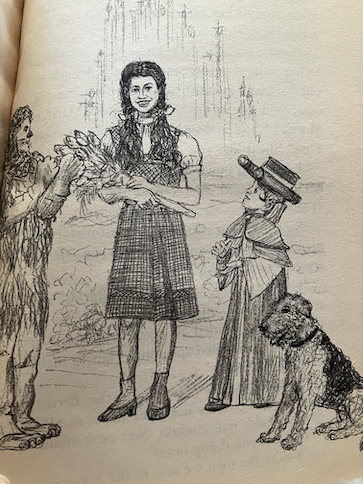
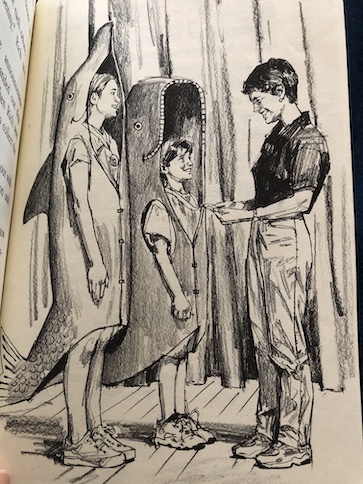
Jessie decides that she wants to try out for a part in a local stage play of The Wizard of Oz. She wants to try for the role of Dorothy, but many other girls also want that part. A spoiled rich girl named Melody is sure that she will get the part because she’s had professional training, and her mother is very pushy. Another girl, Sarah, ends up getting the role by giving an excellent, heart-felt performance. However, Jessie gets the role of the Cowardly Lion, and Melody is offered the role of the Scarecrow. Melody is very upset about not getting the role of Dorothy, but she takes the role of the Scarecrow anyway. The other Alden kids also help out with the play in various ways, like building scenery and making costumes.
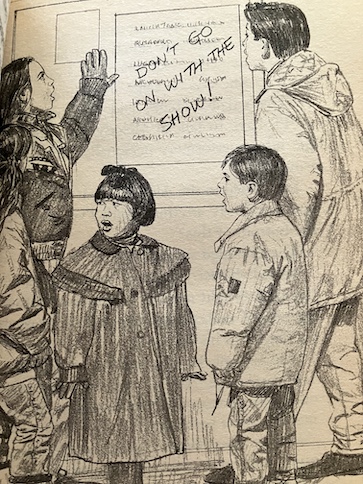
Soon, strange things start happening at the theater. Someone calls the play’s director and threatens that something bad will happen if he directs the play. Then, someone crosses Sarah’s name off a casting list and writes a note saying not to go on with the program. Props are stolen, a costume is destroyed, and lettering on a poster is changed. So many things are going wrong, people are starting to wonder if this play is going to happen after all.
Who could be responsible? Was Melody so upset about not getting the lead that she or her mother have decided to sabotage the whole play? Could the grumpy actor playing the Wizard have a reason to want to shut down the play? What secrets is Sarah hiding? Why does she seem to disappear suddenly at times? Or could more than one person be responsible for what’s happening? And why does the actor playing the Tin Man never want to remove his helmet?
My Reaction
I thought the mystery was pretty good, and the author did a good job of making a number of people look guilty. I had the feeling from the beginning that Sarah didn’t have her parents’ permission to be in the play, and that’s why she seems to run off or disappear suddenly, because they wouldn’t approve of what she’s doing. I was partly right, but it’s more complicated than that, and it’s important to the mystery.
I laughed out low at one point when the Aldens were talking about the grumpy and fussy actor who is playing the wizard, saying how he seems good at his part, but “it’s too bad about his personality.” It sounds like a serious slam, and honestly, there are some times when I’ve had similar thoughts about some people. In a way, though, that’s a sort of secondary theme to the story. There are some people involved with the production of the play who are really difficult to work with. They’re very good at what they do, like how Melody has had acting and singing lessons and does well on stage, but at the same time, they’re also disagreeable, self-centered, or pains to work with.
Another theme of the story is the idea that things that seem like a disappointment can work out for the best. Jessie is a little disappointed at first that she didn’t get the role of Dorothy, but she turns out to like being the Cowardly Lion, and she realizes that she’s actually having more fun with that role than she would have with the role of Dorothy. Melody almost refuses to take the part of the Scarecrow because it isn’t the starring role of the play, but she does anyway. She likes it better than she thought she would, although she still wishes that she had a part where she could wear a pretty dress, like Dorothy.
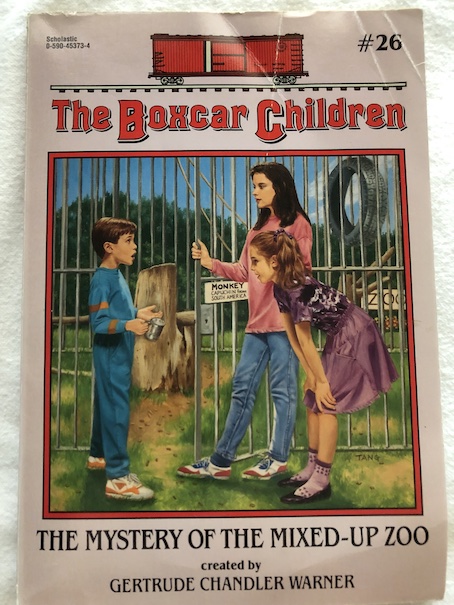
#26 The Mystery of the Mixed-Up Zoo by Gertrude Chandler Warner, 1992.
The Aldens are visiting an old friend of their grandfather’s, who owns a zoo. The friend, Edward, lives alone and isn’t very organized, so the Aldens offer to help him straighten up the house and do some cooking. Edward is pleased with their help and few home-cooked meals. However, strange things start happening at the zoo.
First, someone switches around all the signs identifying the animals, so each sign is next to the wrong animal. It looks like a silly prank, but then more things happen. Then, someone sabotages the electricity, making it difficult to keep and prepare the food for the animals. It gets worse when someone sabotages the temperature controls in the animals’ habitats, making it too hot for some animals and too cold for others. The Aldens help the zoo staff to fix the temperatures because the animals could actually be killed by being kept at the wrong temperature! Finally, someone steals the zoo’s monkey! Who could be behind these things?
The man who owns the local bookstore helps the Aldens find books about animals, but he seems oddly reluctant to talk about the zoo. A local woman, Helen Brooks, thinks that the zoo should be shut down because supporting it costs too much money for taxpayers. She doesn’t care what happens to the animals, and although many local people love the zoo, she plans to bring up the issue at the next town council meeting. When someone tries to sell the monkey to the local pet store, the Aldens start to get the answers they’re looking for.
My Reaction
I thought the mystery was all right, but I had some mixed feelings about the way the villain was handled. We see the villain and get to know the villain’s other role in the story before we know it’s the villains, but I just thought there could have been more build-up about the villain’s connection to the zoo before the person is revealed as the culprit. The attempted sale of the money kind of clinches the identity of the culprit without the Aldens really having to figure out why first.
I did think the book was interesting for the way they explain both how some of the pranks at the zoo are actually seriously dangerous to the animals’ health, like changing the temperatures in their enclosures. It also explains how the Aldens help the zoo employees to help take care of the animals, so the book has some educational quality.
#7 The Mystery of the Haunted Lighthouse by Elspeth Campbell Murphy, 1995.
Sarah-Jane’s parents have been planning a trip, and her cousins, Titus and Timothy are coming, too. At the request of an old family friend, Ned, they are going to visit him and take a look at an old lighthouse that he is thinking of buying. He wants to turn the lighthouse into a bed and breakfast.
However, strange things have started happening at the lighthouse. Someone has vandalized the outside, and Sarah-Jane sees a frightening face up in the tower. Could the old lighthouse be haunted?
The theme of the story is faithfulness.
The book is available to borrow and read for free online through Internet Archive.
My Reaction and Themes
Since this is a Christian-themed mystery, readers can guess that there won’t be any real ghosts. This is more of a light, pseudo-ghost story, like Scooby-Doo mysteries, with another explanation for what’s happening.
There’s more than one kind of haunting. People can be haunted by memories, and living humans are also attached to the places associated with their happy memories. There is someone who has an attachment to the lighthouse and is unhappy that it’s being sold. This person needs to reconcile their feelings to the situation.
Some Christians don’t like the concept of ghost stories at all. In the book, Sarah-Jane likes hearing ghost stories, although she admits that she doesn’t like remembering them later, when she’s alone at night. She enjoys a little spooky excitement, as long as she knows it’s just a story, and she’s hearing it in a safe setting.
The Case of the Tricky Trickster by Laura Lee Hope (Stratemeyer Syndicate), 1992.
Before I begin, I’d like to acknowledge Sean Hagins, for supplying me with photos of this book! Usually, I take pictures of books myself, but I just couldn’t find a physical copy of this one. Sean is a big fan of the Bobbsey Twins, particularly the New Bobbsey Twins mysteries, and you can see some of his video reviews as well as videos about his photography work on his YouTube channel, SJHFoto. Thanks, Sean!
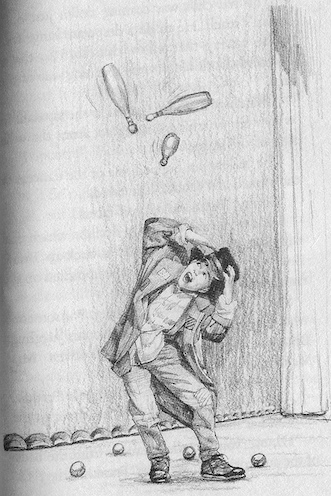
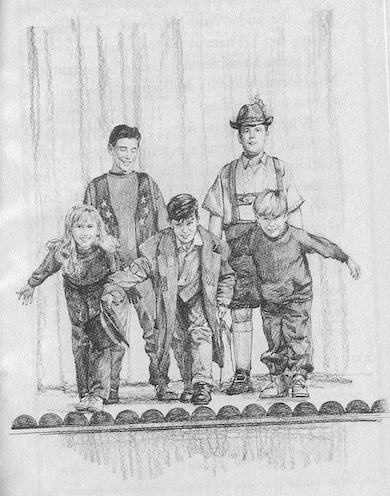
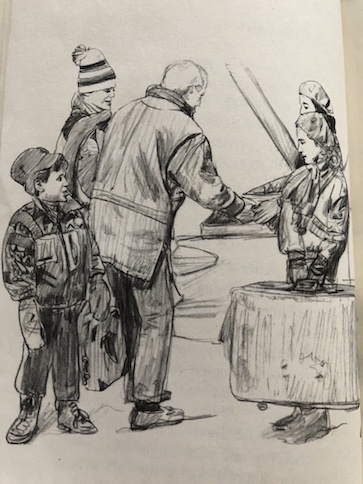
The PTAs at the schools the Bobbsey Twins attend, elementary and middle school, are holding a variety show to raise money, with students showing off their talents. A boy in Freddie and Flossie’s class, Brian, is going to put on a juggling act, but Freddie and Flossie are going to help another friend, Teddy, with his magic act. Nan and Bert have a rock band with some friends called the Aliens, and they’re going to be performing, too. Danny Rugg, the school bully, even has an act where he’s going to play the accordion.
However, things soon start going wrong with the show. During the rehearsal, someone turns on the Aliens’ amplifier, making a loud sound that startles everyone. Then, a pole falls and almost hits a student while she’s singing. Then, Brian slips on some floor wax. Freddie and Flossie suspect Danny of playing pranks on everyone because he was near the places where the pranks occurred, and it seems like the kind of thing he might do, but there are other suspects.
Some of the other students seem nervous about performing their acts or think that the show won’t really be that good. Could someone be trying to sabotage the show to get out of performing? Then again, there seems to be some kind of rivalry between the music teacher who is directing the show and Mr. Horton, the fifth grade teacher. Mr. Horton seems resentful that he wasn’t given the chance to direct the show, and he keeps trying to prove that the music teacher is doing things wrong and that he could do them better. Just how far would he go to prove that he would be the better director?
The book is available to borrow and read for free online through Internet Archive.
My Reaction and Spoilers
I thought that the mystery was good, although I also thought that the culprit was obvious about halfway through the story. It might take kids longer to figure out who it is, but there is one person who gets more than their share of the sabotage, and some of the tricks are ones that a person could only play on themselves. There is a student who is trying to get out of having to perform, but once the Bobbsey Twins figure out why, they manage to work things out so that the student is able to go ahead with their act.
The story reminded me a little of The Tap Dance Mystery in the Eagle-Eye Ernie series, although the mysteries aren’t the same. What reminds me of the other book is that both stories involve family expectations. Performing in front of classmates is enough to make anyone nervous, but having family with high expectations present puts a great deal of pressure on a child performer. There is a bit more than that because there are reasons why the student doesn’t think they can live up to everyone’s expectations, but fortunately, a little help from a friend can go a long way!
The Mystery in the Snow by Gertrude Chandler Warner, 1992.
The Alden children are disappointed because there is still no snow this winter, and they’ve really been looking forward to snow. Their grandfather tells them not to worry because, soon, they’ll have all the snow they want. A friend of his, Mr. Mercer, owns a ski lodge and has been urging him to visit and bring his grandchildren. There’s going to be a winter carnival there. The children are eager to go and have fun in the snow!
At the ski lodge, the Alden children meet a boy named Jimmy. Jimmy is a regular visitor to the lodge, but for some reason, he says that his parents never stay. There is also a girl called Freddie, which is short for Fredrica. Her parents aren’t at the hotel, either, because they’re visiting her sister, but she says that they will come later. Freddie could have gone to visit her sister, too, but she didn’t want to miss the fun at the ski lodge. She and Jimmy are both team captains for the winter games, which include skiing, skating, sledding, snow sculpting, and ice carving. Strangely, when the team captains get the box where kids are supposed to submit their names to join the teams, they can’t find the keys. The loss of the keys is worrying because, if they can’t find them, they won’t be able to get into the equipment shop for the equipment they need for the games. They still manage to put together the teams, and the Alden children also join.
Then, Mr. Mercer discovers that all four of the tires on his truck are flat. Grandfather Alden offers to drive him into town to get a pump for the tires and to talk to a locksmith about getting into the equipment shop.
While the adults tend to that, the kids talk about the try-outs for different events. The Aldens are all excited about different events. Violet notices that one girl, Nan, isn’t enthusiastic about the events at all and doesn’t want to try out for anything. Violet asks her why, and Nan says that joining in the games was her parents’ idea, not hers. They say it will be fun, but she never really enjoys herself at these things. She doesn’t think there are any events she can do, and she’d hate to be the one to lose an event for her team. To encourage her and build up her confidence, Violet suggests that they both sign up for the ice carving event, which doesn’t require a try out. Violet says that she doesn’t know how to do ice carving, and Violet says that’s fine because she doesn’t, either. She says that it would just be fun to try it out together. Nan points out that they would be competing against each other because they’re on opposite teams, but Violet says that doesn’t matter because they’re both equals, neither one of them knowing what they’re doing. Nan is cheered by Violet’s friendliness and signs up for ice carving.
Nan isn’t the only unhappy child involved in the games, and the Aldens begin to feel that the focus on competition instead of simply having fun in the snow is partly to blame. A boy named Pete is upset that he didn’t get selected for any of the events he tried out for, and he says he doesn’t want to be the time team’s time keeper, which is the default position. Pete says he no longer wants to be involved in any of it. Freddie is angry because she and Jimmy drew names for their team members at random, and she thinks that Jimmy ended up with most of the really good team members. She wants a way to even things out. When the Aldens ask Jimmy if his parents will come to the awards dinner at the end of the games, he seems upset and doesn’t want to talk about it much. They’re not sure if Jimmy is more upset about his parents not being there than he pretends or if he’s worried about the awards ceremony in general.
It soon becomes apparent that someone is intentionally trying to sabotage the winter games. Someone smashes the snow sculptures that the Aldens made for their team. Then, someone steals a skier’s skis and ruins the ice sculpture made by the other team. The entire skating event has to be postponed when someone ruins the ice.
Who is doing these things and why? It could be someone who’s trying to make their team win the competition, but the sabotage has been aimed at both teams and at the event in general. Is it a kid who is unhappy with the contest or their position on their team? Jimmy seems eager to cancel events every time something goes wrong. Can the Boxcar Children figure out who is responsible?
The book is available to borrow and read for free online through Internet Archive (multiple copies).
My Reaction
There are themes in the story about competition and family. The Aldens aren’t accustomed to thinking competitively about other people because they’re used to doing things with each other cooperatively, as a team. Because they’re accustomed to thinking cooperatively, they are friendly with people on the other teams, like Nan, and they’re more focused on the fun of the events than on winning. That makes them different from some of the other kids, who are concerned about winning, but there are other issues in the book besides competition that matter more.
There are indications in the story that the parents of the children in the competition don’t always want the same things that their children want. Nan, for instance, didn’t even want to join contest, but her parents urged her to do it. Also, some of the children aren’t as good at others at conveying to their parents what they really want. When the most troubled child in the group finally manages to say what they really want, many things get straightened out.
I feel like there are many stories where the conflicts revolve around people who don’t really communicate with each other. In this story, there’s a character who blames others for not understanding how they feel, but even they have to acknowledge that they haven’t actually explained their feelings. They’ve just been expecting everyone else to know what they’ve been feeling. Some honest communication straightens out the problem, and that’s a good life lesson for kids and families.
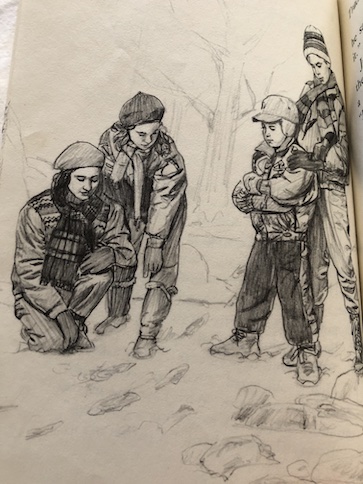
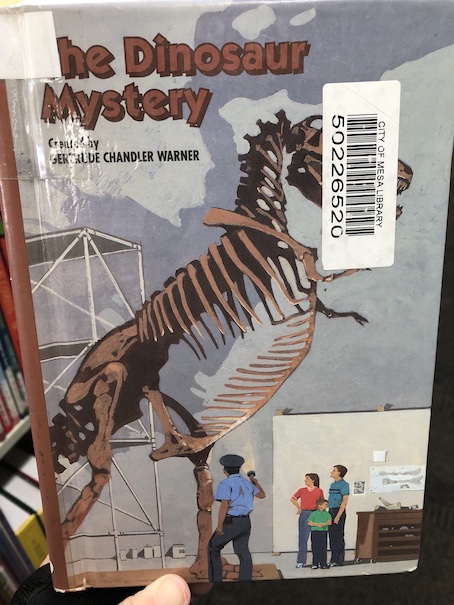
The Dinosaur Mystery by Gertrude Chandler Warner, 1995.
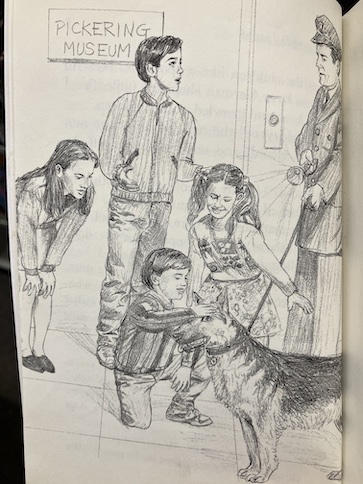
The Alden children and their cousin Soo Lee are visiting the Pickering Natural History Museum to help Mr. and Mrs Diggs, who are on the museum’s board of directors, to set up a new dinosaur exhibit. They will be staying in the Diggs’s apartment, which is connected to the museum by a tunnel. The children love the rooms where they will be staying because they’re decorated with spare exhibits from the museum!
However, very quickly, they notice that strange things are happening at the museum. The alarms seem to go off sometimes for no reason. The night watchman, Pete, is new at the museum and acts oddly. He seems to like having fun with the exhibits more than paying attention to security. On their first night there, Jessie sees a light in the museum windows, in the dinosaur room, where nobody is supposed to be, and she thinks that she sees the shadow of the dinosaur skeleton moving.
The next day, the Aldens meet the other staff at the museum. Dr. Eve Skyler operates the planetarium, and she’s very protective of it. She’s been upset because renovations at the museum have messed up the planetarium. When the Diggs tell her that the Alden children are there to help clean up, Dr. Skyler is dubious and worries that the children will damage the equipment, but the Diggs tell them that the children have worked in museums before.
After the children clear the planetarium and take a lunch break, they catch Dr. Sklyer moving some things that they had thrown out back into the planetarium! When they confront her about what she’s doing, she denies everything, and it ends up taking the children almost twice as long to finish the task. The children don’t know what Dr. Skyler’s problem is and why she would want to sabotage their cleaning of the planetarium when she had badly wanted it cleaned.
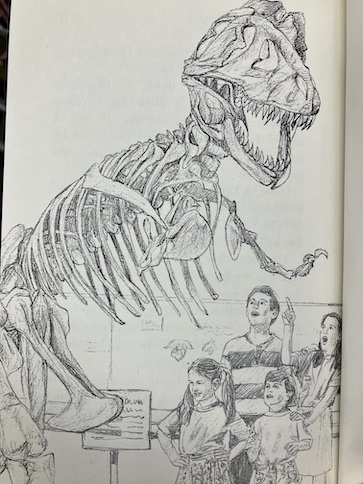
When Dr. Titus Pettibone, who is the fossil expert in charge of the dinosaur room, returns from a trip, he discovers that bones are missing from the tyrannosaurus skeleton! Benny and Soo Lee are sure that Dr. Pettibone was the man they saw sneaking around the museum the night before. Dr. Pettibone avoids their questions about sneaking around the museum and is every bit as opposed to the children working on the new dinosaur exhibit as Dr. Skyler is about the children helping to clean the planetarium.
Then, someone removes all the posters that the children put up about the new dinosaur exhibit. Mrs. Diggs knows that someone removed them on purpose because, when she asks people at the places where the children put them up, they say that a woman took them, saying that she wanted them as souvenirs. In spite of that, everyone in town knows about the new exhibit because word about the missing dinosaur bones has spread. Is someone trying to drive people away from the new exhibit, or are things that have been happening part of a publicity stunt? The children known that someone is sneaking around the museum, especially at night, and both Dr. Skyler and Dr. Pettibone seem to have something to hide.
The book is available to borrow and read for free online through Internet Archive.
My Reaction
One of the first things that I noticed about the book is that many of the characters have pun names – Mr. and Mrs. Diggs, who operate the natural history museum; Dr. Sklyer, who is in charge of the planetarium; and Pettibone, who is the fossil expert.
The book does a good job of making everyone look equally guilty. From the beginning, I suspected that was because there are multiple people doing multiple things for different reasons, and it helps to make the mystery more complicated and involved, keeping readers guessing.
This is another instance of the Alden children having the opportunity to do something unusual and build work experience because of their grandfather’s connections. Their grandfather knows Mr. and Mrs. Diggs and arranges for the children to stay with them, and their previous experiences with museums, like in one of the later books, The Mystery of the Mummy’s Curse, were also due to Mr. Alden’s connections. Although the children’s grandfather allows the children to have independent adventures without him, he is usually the one who sets them up in the stories. Most real children never get opportunities like this and may not be allowed to do some of the things the Alden children do because of rules regarding volunteers, especially juvenile volunteers, due to insurance liabilities. I would have loved to work in a museum when I was a kid, but my family never had the connections that the Aldens do.
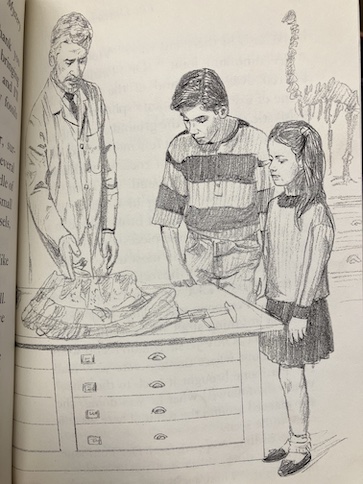
I can understand why children aren’t allowed to do certain jobs. Dr. Pettibone is correct that there are certain tasks that require specialized knowledge and delicacy. After he warms up to the kids more, he begins showing the children some of the details of his work and what his equipment does. He lets Violet do some of the delicate work after he shows her what to do because she does artwork and plays the violin, so she is accustomed to fine, detailed work. In real life, though, I don’t think that a 10-year-old child would be allowed to do this kind of work as quickly or as well as Violet does in the story. The Aldens have to learn to do things quickly in the interest of time in their stories, and they rarely make the kinds of mistakes that beginners do at anything they try.
I have done volunteer work in museums as an adult, and one thing that they don’t tell you in this book is that, when you see an assembled dinosaur skeleton in a museum, it’s probably all or partly a plaster model of the bones rather than the real bones. That’s because fossilized bones are no longer actual bone. They are petrified, so they are as heavy as other stones. When you have stones the size of large dinosaur bones, it’s extremely difficult to mount them so that they stand up, like the dinosaur would in real life. Sometimes, plaster models also fill in for bones that are missing from an incomplete skeleton. Complete skeletons are very, very rare. There were only two places where there were real dinosaur bones on exhibit in the last museum where I volunteered. One was a dinosaur thigh bone that visitors were allowed to touch to learn what fossilized bone feels like. The other was a collection of pterosaur wing bones mounted on a wall, where no one could touch them, and it wasn’t a complete wing. Some museums have exhibits marked so you know which bones are models and which are real fossils.
I also liked the art style in this book. Boxcar Children books vary in art style because they were produced over multiple decades, but my favorite illustrations are the ones that look the most realistic. I think realistic illustration styles are best for this book in particular because they show the details of the dinosaur skeleton realistically.
The Summer Camp Mystery by Gertrude Chandler Warner, 2001.
Grandfather Alden is taking the Boxcar Children to Maine to go to summer camp. Henry and Jessie are going to be junior counselors. Violet will be an overnight camper, and because he’s younger, Benny will be a day camper, staying with Grandfather Alden at a nearby inn overnight. The camp is located on an island and can only be reached by boat. It used to be owned by the Pines family, but the family lost of a lot of money trying to keep the camp going and had to sell the camp to Ginny and Rich, who run things differently. The camp activities used to be mostly sports, but Rich and Ginny have added other activities and special awards for other things because not all the campers are good at sport. They want more variety, and they want to give every camper to have a chance to participate in activities that they really enjoy.
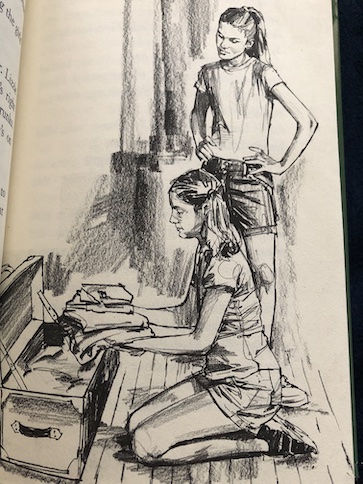
However, things go wrong from the beginning. Kim, one of the other counselors, is mean. She stops the Aldens from loading their own trunks on the boat to go to the island, saying that she’ll take care of it, but she doesn’t. She leaves their trunks behind on the dock and makes a big deal about the Aldens being incompetent and not even taking care of their own belongings. The Aldens are embarrassed, and they don’t even call attention to the fact that Kim stopped them from handling their own trunks.
The missing trunks create more problems because the camp has a running competition between different teams of campers. When the Pines family owned the camp, the competition was entirely based on sports, but the new owners offer points to teams for different projects and events, even incorporating being neat and responsible into the contest, so the Aldens have lost points for their teams by leaving their trunks behind.
Because the teams are randomly assigned, three of the Aldens are on one team, and Violet is by herself on Kim’s team. Kim makes no secret of the fact that she doesn’t like Violet, and because there is a rule that different teams can’t talk to each other about what they’re doing for different parts of the contest, Violet feels even more isolated from her siblings. Also, the Pines children, Zack and Lizzie, who still attend the camp, aren’t happy with their team. Lizzie really wanted to be on Kim’s team because she looks up to Kim. She was on Kim’s team the previous year, when the camp was all sports stuff, and they won every event. Violet thinks that the best solution is for her and Lizzie to switch teams, so Lizzie can be with Kim, and she can be with her siblings, but Ginny says that switching teams is against the rules.
Meanwhile, Zack is resentful of Henry because Henry has been given his usual job of flag raising at the camp. Ginny and Rich say that they’ve reduced the number of things that Zack does at the camp because they want him to experience and enjoy the activities at the camp instead of working and doing all the little jobs he used to do when his family owned the camp. Also, Henry can play the bugle, providing a live bugle performance instead of just using the old bugle recording the camp has been using.
However, besides the incident with the Aldens’ trunks being left behind, someone steals the camp’s flags before the flag raising. Henry looks incompetent when he can’t find them, although Jessie’s cabin comes to the rescue by quickly drawing some new ones as emergency replacements. Then, the missing flags later appear on Henry’s bed, and he has no idea how they got there. The Aldens lose points for this incidents, and Kim’s team also steals Jessie’s cabin’s idea for a good deed event, even submitting it to Rich and Ginny before Jessie does. Jessie isn’t sure how she knew what her cabin was planning, but Kim even gave her event idea the same name. It can’t be a coincidence.
The Aldens are having a frustrating time at camp, and they have to figure out exactly what’s going on and prove that they’re not the ones messing things up.
The book is available to borrow and read for free online through Internet Archive (multiple copies).
My Reaction
Not Much of A Mystery
This mystery story isn’t really a “whodunit” kind of mystery so much as “howdunit” and “how are our heroes going to prove it?” The culprits were really obvious from the very beginning and every step of the way. There are no other suspects. It’s definitely Kim, Lizzie, and Zack, and the rest of the story is how the Aldens prove what they’re doing. There is a slight element of “whydunit” because the Aldens don’t really understand why the three of them are doing all these things, although I thought at least part of that was obvious, too.
I understand that Kim, Lizzie, and Zack weren’t happy about how the camp changed after the Pines family had to sell it, but that’s no excuse for treating other people the way they do. To me, at least at first, it looked like they weren’t so much sad about change as angry that they weren’t the favored, “special” campers anymore. Lizzie and Zack were no longer special for being the owner’s kids and getting to perform special duties the other campers couldn’t do, and Kim was no longer special for winning everything all the time because she’s good at sports. The new owners of the camp got Henry and Jessie to be junior counselors and help with some of the chores around the camp, like the flag raising, because they thought that Lizzie and Zack could use more time to enjoy the fun activities, but instead of having fun, they’re just angry that they lost another status symbol. I didn’t like or feel sorry for Kim, Lizzie, and Zack at all. To me, they were just mean, selfish, and entitled. Because I hate one-upmanship so much, it just made me angry.
There were a couple of points that softened my feelings a bit, but not by a lot. I felt a little less angry when Zack talked about how the flag-raising ceremony had special, sentimental value to him because members of his family have always done that job at camp, and the bugle recording the camp always used for the flag-raising ceremony was made by his uncle. He misses the feeling that he’s following in his family’s footsteps. In the end, he acknowledges that Henry’s live bugle playing is better than his uncle’s recording, but his uncle’s recording was always good enough for them before, and that he’s still attached to it because it’s his uncle on the recording, giving it that personal connection. Emotional attachment and that sense of family and tradition are more understandable and easier to sympathize with than just selfishness and status-seeking.
Lizzie also says that they were resentful of the Aldens because three of them got to be overnight campers, something she’s always wanted to do but was too young to do before. The Pines kids were angry that Rich and Ginny somehow managed to find room in the cabins for three of the Aldens but told them that the overnight slots were full, and they would have to be day campers instead, like Benny. The story doesn’t make it clear whether the camp owners actually bumped the Pines kids to make room for the Aldens as overnight campers or if the Aldens just submitted their request before the Pines kids. If Rich and Ginny canceled the Pines kids’ overnight reservations just to give the Aldens special treatment, that would be bad, and the Pines kids would have a genuine complaint. However, I think that the Pines kids’ father, who runs the ferry to the island where the camp is, probably just didn’t settle their overnight reservations in time because he took it for granted that they would be given places, forgetting that they don’t own the camp anymore and would have to register, just like everyone else.
Competitiveness
Kim is a major part of the reason why I didn’t feel sorry for the culprits. She’s not a member of the Pines family, so she doesn’t really have sentimental reasons behind her behavior. She’s just all about winning, and she’s sore because she used to win all of the camp’s sports events. Now that the camp isn’t just all about sports, sports, sports, she can’t take it for granted that she’s going to win everything, and that makes her angry. She feels entitled to the activities that she’s good at and resentful that she now has to take part in activities where other people are better than she is and where she might lose. She says that leaving the Aldens’ trunks behind was an honest mistake because she was just so busy on the dock, but once she realized the mistake, she didn’t do anything to correct it, just using it to her advantage in the competition. She also encouraged Lizzie to slip away from Jessie and come talk to her, both getting Jessie in trouble for losing track of one of her campers and pumping Lizzie for information about what their team was doing, so she could steal their ideas. She complains that she had to do it because she knows that she’s only good at sports, not the creative things that the Aldens do, and that she had no chance of winning if she didn’t cheat. I think that comment points to what was wrong with the camp under the Pines’ leadership, and probably, why the camp was failing and losing money.
I think the Pines’ camp was probably losing popularity with campers because it mainly catered to the Pines’ interests and those of a select group of sports nuts, like Kim. As Rich and Ginny observed, the camp was all about sports. People who were good at sports won everything, all the time. Kim got used to what she thought of as her guaranteed victories because all the activities were geared to her interests and talents, but most of the other campers felt left out and possibly resentful of the favored ones. To me, it sounded like the Pines’ camp had become like this little clique where certain, favored campers won everything and had everything their way, and nobody else could do much of anything. It was like most of the camp was just along for the ride while certain people did the things they liked and continually won at everything. It was getting to be the same every year. People who were very sportsy and competitive might still have enjoyed the camp, but it was just so niche in its focus that a lot of other campers probably just lost interest. Enrollment in the camp fell because it wasn’t fun anymore for a lot of campers. That’s probably why Rich and Ginny wanted to change things, because they could see how people were feeling left out and tired of the same old things with the same “winners” every time.
What Kim really resents is other people being given the chance to win something and show what they’re good at. She doesn’t care if other people are frustrated at being made to do only activities that she’s good at so she can always “win” against them because she hates being made to do things where someone else is better and she’s less likely to win. In other words, what she really hates and fears is being treated exactly how she treats other people. That’s why she feels compelled to “fix” things, so she gets put in what she views as her rightful place as the eternal winner. I didn’t like her or sympathize with her as a character at all. She’s extremely self-centered and controlling, not even trying the new activities. Because she’s not a creative or thoughtful person, it never even occurs to her that she has an entire cabin full of campers who may be more creative and thoughtful than she is. She shuts down her own teams’ ideas as not being good enough so she can just use her stolen idea. She never even gives her own team a chance because she feels like she, personally, has to be the winner who does everything, and nobody else should even be allowed to contribute. She refuses to even help her campers in their efforts in activities and actively ignores them to focus on what she wants to do.
Kim reminds me of Kate in Color War in the Camp Sunnyside Friends series, although perhaps it’s more accurate to compare her to her rival in that book because of the cheating. When I reviewed that book, I was frustrated with the way Kate was declared the winner of the camp contest. It’s true that she didn’t cheat, like her rival, but they both behaved badly and were terrible sports. (Not terrible at sports, just really bad sports in the sense of being bad teammates, bad attitudes, and bad winners and bad losers.) It’s just really hard to like anybody whose biggest fear is other people treating them the way they treat others. However, I like the way this Boxcar Children book treats the contest better than the way the Camp Sunnyside Friends did. When I reviewed the other book, I wished that the camp counselors had just declared the contest a tie, both because that would have been fair and would have pleased most of the other campers while blowing the little win-monsters’ minds. This book takes a completely different approach, but I still appreciated it.
Spoilers
We never learn who wins the overall contest at camp. The book ends before the contest is finished. Once the Aldens realize how Kim is getting her information and stealing their ideas, they set a trap for her. They let her and Lizzie think that they’re going to do a particular theme for the camp’s costume contest when they’re actually doing something else. They write a letter to Rich and Ginny before the contest, telling them what they’re doing, to prove that Kim is cheating and stealing ideas.
Once the cheating is exposed, Kim, Zack, and Lizzie talk about their motivations. Rich and Ginny point out to the kids that they haven’t changed all the old camp traditions. They used to go to this camp when they were kids, and they preserved parts of the camp that they and other campers always liked, such as the camp legends about a monster on the island and offering points for campers who don’t scream during scary stories, events, and pranks. They also decide to allow Zack to retain some of the jobs he loves so much since that’s part of what makes camp fun for him, and they promise Lizzie that she can be an overnight camper next year.
When they have to decide who wins the costume contest, they don’t want to immediately declare Kim’s team the loser for her cheating because none of the other campers on her team were aware that she stole the idea for their costume theme and they honestly made their costumes themselves (without Kim’s help because she was too busy with her own costume and made Violet help the other campers instead). Since Kim’s team was competing honestly even though Kim wasn’t, Rich and Ginny think they deserve to be judged on their efforts and not on Kim’s. The Aldens agree that’s fair, and they suggest that the audience of camp visitors who came to see the event should be the judges of the contest since they’re only seeing the kids’ costumes and don’t know about the other things that have happened. They decide to let the audience vote for the team with the best costumes, and the story ends there, without saying what the results of the vote were.
I liked it that they found a fair, impartial way of settling the contest and that we never find out who won. If the story ended with a known winner, it would feel like the author was using who “wins” to declare who was on the side of right in the story. To declare the Aldens’ team the winners would reward hard work and not cheating, which is good, but Rich and Ginny have a point that Kim’s teammates aren’t responsible for Kim’s cheating. To not let them have their own, honest chance would be to punish them for having a bad leader, which isn’t fair. On the other hand, if it ended with Kim’s team winning, it would suggest that it doesn’t matter if you cheat or not as long as people let you win anyway to keep your teammates from being hurt, which would also be a bad lesson. Personally, I would still favor not having a “winner” at all because, in this type of situation, it’s just really awkward whichever way it goes. Not knowing who won or lost or if it turns out that the audience declared a tie also works. The focus of the story is kept where it should be: not on who won but how they each played the game.
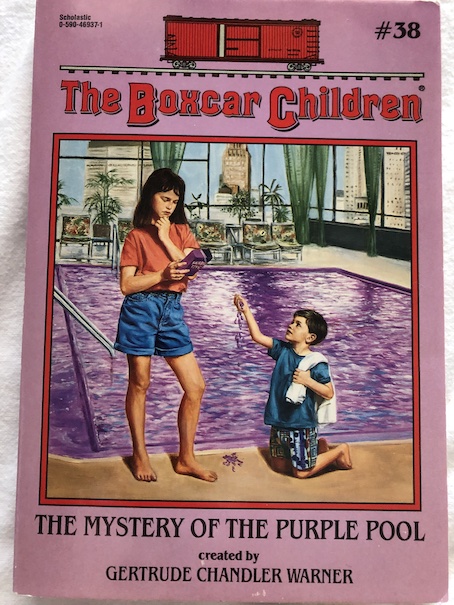
The Mystery of the Purple Pool by Gertrude Chandler Warner, 1994.
The Boxcar Children are all bored, especially Benny. Grandfather Alden tells them that he has to go to New York City on business, and the children can come with him and see the city. That sounds like just the kind of excitement the kids need! Their grandfather calls the hotel where he’ll be staying and reserves a suite of room for all of them. Then, he tells the children to look through some guidebooks for the city and decide what they want to see there. He says that, during the time when he’ll be working, the two oldest children, Henry and Jessie, will be in charge. The children start looking through the guidebooks and talking about things they want to see in New York.
When they arrive at the Plymouth Hotel in New York, the children’s grandfather notices right away that the service isn’t how it usually is at this hotel. For some reason, their reservation was canceled, although they are still able to get rooms. Then, there are no bellhops to be found to carry their bags, and even the hotel management doesn’t know where they are. As they go to their room, they hear another guest complaining that his room wasn’t cleaned, even though the maid said that she’d cleaned it.
All of these things could be mistakes or signs of bad hotel management, but it soon becomes apparent that someone is deliberately trying to sabotage the hotel. When the children try to swim in the hotel pool, they find out that someone dyed the pool purple! Then, someone switches the sugar and salt in the hotel restaurant, ruining everyone’s breakfast. When the kids come back from sight-seeing, they see a crowd of people in the lobby, all complaining about various things missing from their rooms, like pillows and shower curtains. Then, the children get stuck in the hotel elevator when someone turns it off and have to call for help.
The Alden children have another mystery on their hands! Who could be the mysterious saboteur, and what would they want to harm the hotel? There’s a mysterious man who seems to be lurking around when bad things happen. There’s also a maid who is angry about her brother being fired from the hotel. The hotel manager isn’t always on hand to deal with things when they go wrong. There’s also an unfriendly woman who doesn’t like kids (named Karen before that name started to be used as a slang word for a disagreeable, complaining woman) and is always scribbling in her notebook, never letting anybody see what she’s writing. Any of them could be the culprit, or it could be someone they haven’t even thought to suspect.
The book is available to borrow and read for free online through Internet Archive (multiple copies).
My Reaction
I remember reading this book and liking it when I was a kid. One of the hallmarks of The Boxcar Children series is that the children are always allowed their independence in their adventures. Their grandfather lets them explore the city completely on their own, even though the oldest child in the family is only 14 years old. Few people would let their children roam around New York City completely on their own these days, and they didn’t when I was a kid in the 1990s, either. Another guest at the hotel even lets his young son go sight-seeing with the Alden children when they haven’t known each other very long.
The kids have fun exploring the amenities at the hotel, too. The book draws attention to various aspects of staying at hotel, like suites with kitchenettes, hotel restaurants, pools and exercise rooms, and the snacks and toiletries you might find in your hotel room. I thought it was interesting how the book explains how you can call for help in an elevator if it gets stuck. Its a useful thing for kids to know.
One thing that occurred to me when I revisited this story was that it doesn’t mention the World Trade Center. They characters could have visited the original World Trade Center in the story because the book was published 7 years before it was destroyed in the September 11, 2001 terrorist attack, but the World Trade Center was not one of the sights that the children went to see. If it had been, it would have dated the story, but I can’t think of anything the children saw or did in the book that really dates it. The things they mention still exist in New York, and this story could still be set in the early 21st century.
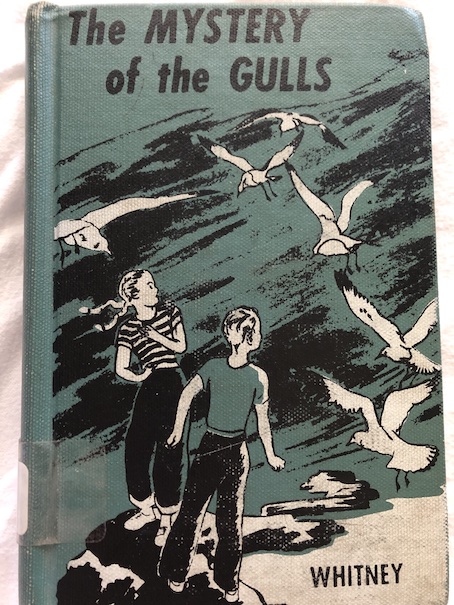
The Mystery of the Gulls by Phyllis Whitney, 1949.
Taffy Saunders and her mother are heading to Mackinac Island for the summer while Taffy’s father is in the hospital, recovering from a car accident. Taffy’s mother’s Aunt Martha has recently passed away, and she left the hotel she owned to Taffy’s mother. It’s a strange bequest because Aunt Martha hadn’t gotten along with her niece for years because she had disapproved of her marriage. There is also a condition on the inheritance. In order to retain ownership of the hotel, Taffy’s mother has to run it herself for a summer. Taffy thinks that it all sounds strange and mysterious, but her mother says that her aunt was an eccentric, and it was often difficult to understand why she did some of the things she did.
Taffy’s mother worries that something will go wrong over the summer that will prevent her from owning the hotel. It isn’t really that Taffy’s mother wants to be a hotel keeper, but since Taffy’s father’s accident, they’ve spent most of their money on medical bills. When he gets out of the hospital, he won’t be able to do his old job, which involved a lot of travel, so they’re going to have to settle down in a new city. Taffy is happy about living a more settled life than they used to live, but they’re going to need all the money they can get to buy a new home. Taffy’s mother is hoping to sell the hotel to pay their bills and buy a new home, but she can’t do that unless she can prove that she can manage the hotel first. Mrs. Saunders is hoping that her aunt’s long-time housekeeper, Mrs. Tuckerman, will help her make this summer a success, while Taffy is hoping that Mrs. Tuckerman’s daughter, Donna, will be a friend for her. Because their family has moved a lot, Taffy hasn’t had many opportunities to make and keep friends.
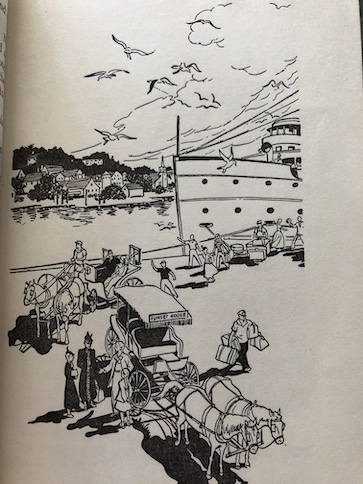
On the boat ride to Mackinac (which they point out is pronounced “Mackinaw” by locals), Taffy meets a boy about her age, David Marsh, who is going to Mackinac to visit his grandmother, and they talk about the sights to see on the island. There is an old fort on the island that is now a historic site for tourists, and David offers to show Taffy around. He tells her where his grandmother’s house is and says that she can come see him there, or he’ll come to the hotel, Sunset House, to see her.
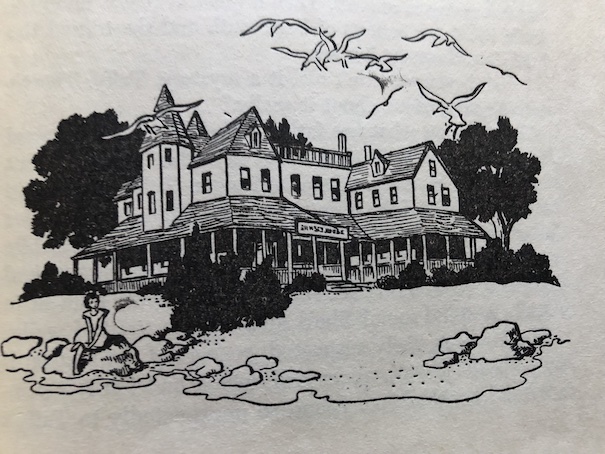
When Taffy sees Sunset House, she thinks it’s charming. The hotel is a large, old house with turrets, cupolas, and a widow’s walk. Mackinac Island in general seems charming. Cars are not allowed on the island, so people get around with horses, carriages, and bicycles. Taffy’s mother talks about wanting to “wake this place up”, but Taffy thinks that the calm, sleepy atmosphere is right for the house and doesn’t want to disturb it. Since Taffy has moved a great deal with her parents because of her dad’s job, she has lived in many hotels and apartments, and she finds the old-fashioned and comfortable furniture at Sunset House to be homey. Taffy thinks that the home-like atmosphere of Sunset House is a nice change and that she will like it there. The room she shares with her mother is beautiful, also filled with old-fashioned furniture and a charming alcove with a lovely view.
It seems like Aunt Martha’s usual guests prefer the place quiet, too. The first guests that they meet are the Twig sisters, a pair of elderly ladies who are at first concerned about a new child in the house. Until Taffy arrived, the only child at Sunset House was Donna, who is described as a quiet child. Aunt Martha only rented rooms to adults with no children. Taffy learns that Donna, who is about her age, is usually never even allowed to bring other children to visit her. Taffy feels sorry for Donna and hopes that she will want to be friends as much as she does.
Besides Mrs. Tuckerman, the housekeeper, there is also a cook named Celeste. When Taffy and her mother first arrive, they are told that Celeste hasn’t prepared lunch because she’s been seeing “omens.” Apparently, this is something that she does periodically, and Mrs. Tuckerman thinks that, this time, it’s just because she’s upset about Mrs. Saunders arriving. There are three other people who also work in the kitchen, but they all seem pretty useless without Celeste’s direction. Fortunately, Mrs. Saunders is a woman of action, so she immediately takes charge of making sandwiches for lunch. To speed things up, she even offers to let guests come to the kitchen to make their own sandwiches, any kind they want, if they wish to. Although Mrs. Tuckerman isn’t sure that will work, lunch turns out fine. However, Taffy has a strange encounter with Celeste in the garden.
In the garden, Celeste asks Taffy what word the gulls are saying. Taffy did have the feeling before that the gulls are saying a word, and it sounds like the word “help” to her. Celeste says that’s what she thought, and she says that’s a sign that a storm is coming. Her fear of the bad storm coming is why she feels like she can’t cook, and it bothers her that nobody else seems to understand, implying that there is impending doom. Taffy shows Celeste a map that David drew to his grandmother’s house, which she is having trouble understanding. Celeste explains to her how to get to the house, and she also mentions a shortcut, but she warns Taffy not to take the shortcut after dark because it goes through a “goblin wood.”
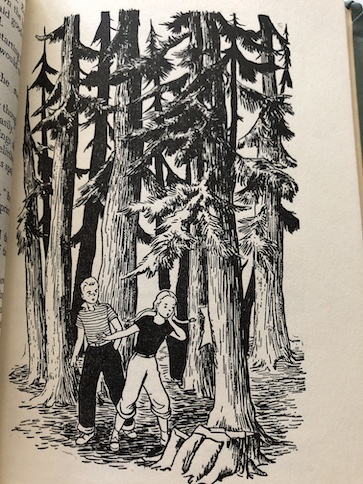
Taffy meets Donna for the first time at lunch. Donna is a shy girl, but she is glad that Taffy is there because she has spent much of her time alone since children are not usually allowed at Sunset House. Taffy asks Donna about Celeste and what she means about the “goblin wood.” Donna explains that Celeste and her family have lived on Mackinac for a long time because they are descended from fur traders (this is why Celeste has a French name, although the book doesn’t mention it directly) and Native Americans (the book uses the word “Indians”). Because of this heritage, Celeste has a lot of superstitions about the island and the spirits that supposedly inhabit it. Taffy doesn’t believe in spirits, but she can’t resist taking the shortcut to David’s grandmother’s house, just to see what it’s like. She has an odd encounter in the woods with a Native American boy (called an “Indian”) wearing overalls, who refuses to speak to her and seems hostile toward her.
When Taffy sees David, she tells him everything about Celeste and her encounter in the “goblin wood.” David says that he’s taken the shortcut through the woods many times without a problem, and he never had any reason to think that it might be haunted. Taffy is a little insulted at his comment that maybe girls get scared easier than boys, and David explains that the boy might not have been as unfriendly as she thought because her imagination might just have been fueled by Celeste’s stories, so she was primed for something scary or sinister to happen. They reconsider that theory when the two of them walk back through the “goblin wood” and find a note left on a tree, telling her that she’s not wanted on the island and that her presence makes the “manito” angry. David says that the “manito” is one of the Native American gods or spirits who supposedly inhabit the island. (This is a real concept in Native American lore, but I’ve seen it spelled “manitou.”) Whoever wrote the note was trying to scare Taffy, but why?
David is intrigued by what Taffy has told him about Celeste and her “omens” and the “goblin wood”, the note left for Taffy, and the unfriendly boy in the overalls (who Taffy sees again, talking to Donna, when she and David try out his grandfather’s binoculars), and he says he is willing to help her investigate further. The two of them work out a code, where Taffy can hang things of different colors in the window of her bedroom to send him messages.
The mystery deepens when Taffy’s mother tells her that there are two vacancies in the hotel after Taffy heard Mrs. Tuckerman turn away a man who wanted a room. There is also a locked room off of Aunt Martha’s old office that Donna says no one is supposed to enter. She says that they can’t even find the key, that no one has seen it since Aunt Martha died. When Taffy talks to her mother, she says that the locked room is a library and that the boy in overalls she’s been seeing is named Henry and that he does odd jobs for the hotel. Taffy tells her mother that it seems like people don’t want them on the island, including Henry, Celeste, and Mrs. Tuckerman. Even Donna has been acting strangely. Even though she said that she was glad Taffy was there, she’s been strangely unfriendly, and she’s been telling her mother that Taffy is the unfriendly one! Taffy thinks that’s really unfair, but her mother thinks that it’s just because everyone is adjusting to the changes since Aunt Martha died. Donna isn’t used to being with other children, and Celeste and Mrs. Tuckerman may be worried about their jobs since the ownership of the hotel depends on how well Mrs. Saunders manages it this summer and what she plans to do with it when she takes full ownership. Taffy and her mother don’t even know what will happen to the hotel if Mrs. Saunders can’t prove that she can manage it well enough. Aunt Martha’s will deliberately keeps the alternate heir secret until the end of the summer.
This is only the beginning of the mysteries and puzzles. Taffy learns that the man Mrs. Tuckerman turned away from the hotel was actually an old friend of Aunt Martha who has worked in hotels in Asia and says he would like to own a hotel of his own. The storm that Celeste predicted comes, and a baby seagull crashes into the window of the Twigs’ room. Celeste thinks that’s another bad omen and that Taffy and her mother should leave. Then, someone leaves a bat skeleton in Miss Twig’s bed. Donna says that Aunt Martha used to collect things like that and that maybe her spirit put the skeleton in the bed because she’s not happy. Of course, Taffy doesn’t believe that. Too many living humans seem unhappy that she and her mother are there. Donna admits that Aunt Martha was originally going to leave the hotel to her mother before the two of them had a quarrel, and Aunt Martha changed her will. Whether Mrs. Tuckerman might still be the alternate heir to the hotel is still unknown. Donna thinks the alternate heir might be some bird society because Aunt Martha was an amateur naturalist with a fondness for birds. Could there be another heir who is hoping to drive Taffy and her mother away so they can have the hotel? Could Donna and her mother still be hoping that the hotel will come to them? Could Celeste or Henry be trying to drive them away for their own purposes?
The book is available to borrow and read for free online through Internet Archive. Like other Phyllis Whitney books, this book is something of a collector’s item now, and copies are not cheap through Amazon.
My Reaction and Spoilers
I’ve been to Mackinac Island before, when I was in my teens, and I didn’t know about the pronunciation until I read this book. I had even forgotten about the horses and carriages since I’ve been there (which might seem odd, but I only spent one day there and I was obsessed with the fudge), but Mackinac Island is still car-free today. Reading this book revived some old memories for me, and it makes me want to go back and spend more time there! I didn’t stay overnight while I was there last time, but there are plenty of hotels there, including ones that resemble the one in the story, with turrets, cupolas, and widow’s walks.
Culture and Folklore
The book mentions that there are many Native Americans living on Mackinac Island, but it doesn’t mention a specific tribe. Even though some of the spooky and ominous things that happen in the story appear to have their roots in Native American folklore and superstition, I’m not completely sure how accurate the descriptions of the folklore aspects are. From what I’ve read, it seems that manitous (or manitos) really are a part of Native American folklore in that region, but there are a couple of aspects of it in the story that I haven’t been able to verify. As a slight spoiler, we eventually learn that Aunt Martha used to collect not only animal skeletons but dead birds, which she would turn into taxidermy. Celeste didn’t think that this was fully respectful to the spirits of the creatures, although she did seem to think that Aunt Martha had some kind of special connection to the spirits of birds because she was so good with them, living, injured, or dead. Because the author, Phyllis A. Whitney spent her youth in Asia because of her father’s job, she also has a habit of introducing Asian elements to most of the books she wrote at some point. In this one, although the main focus is on aspects of Native American folklore, there is also an Asia folklore story about a Chinese gong in the hotel, which seems to have a connection to birds or winged creatures, and that complicates the situation. The effect is that Taffy sometimes feels like she is dealing with forces that she doesn’t understand, which adds some suspense, although she is also sure that there’s a person behind it all because she doesn’t really believe in all the folkloric superstitions and physical objects are being used for the strange things that are happening.
One thing that I like about Phyllis A. Whitney’s juvenile mysteries is that they do frequently include history and folklore of different places and people around the world, and they do seem generally well-researched and presented with empathy. This book and other she wrote were published in the middle of the 20th century, around the same time that other books I’ve read were also published. Some mid-20th century books for kids lean into racial or cultural stereotypes, but Whitney’s book often subvert that or show characters rethinking some of their preconceived notions. The book does use the word “Indian” instead of Native American, which isn’t preferred, but apart from that, Taffy’s attitudes and ability to look at things from someone else’s point of view are good. Taffy is characterized as a very imaginative girl, and one of the ways she uses her imagination is to picture what other people think or how they would feel about different things. At one point, David says that Celeste is crazy for all of her superstitious talk, but Taffy defends her, saying that she’s not crazy. Taffy doesn’t believe in Celeste’s superstitions, but she recognizes that Celeste believes and acts the way she does because she has spent her whole life being steeped in stories of the history of spirits. These stories don’t make sense to Taffy and David, but Taffy recognizes that they make sense to Celeste. Celeste is wrong about the spirits being responsible for everything weird that’s happening, but being wrong about something isn’t the same as being crazy.
Later in the story, the kids form a club for exploring the island and giving hotel guests tours of some of the scenic spots. Taffy, David, and Donna ask Henry to be their “Indian guide” for the tours, and Henry sarcastically asks if they’re expecting him to wear feathers. The others quickly reassure him that they’re not asking him to be the guide because they want him to put on a kitschy show for the tourists or anything embarrassing like that. They just think he would make the best guide because he knows the island better than the rest of them and all the history and stories of the island. They want to call him an “Indian guide” to emphasize his Native American heritage and provide a credential for his knowledge for the sake of the tourists, but they say they would still want him to be part of the tours even without that, just because they want to be friends and include him. This explanation satisfies Henry, and he joins their tour club. For those who would like to learn more about the history of real Native American life on Mackinac, I recommend the Biddle House Native American Museum.
Time Period and Atmosphere
This book is set contemporary to when it was written, the in late 1940s. Readers will notice that Taffy periodically mentions whether or not women are wearing slacks instead of skirts, and that’s because that was a modern fashion trend in her time. Taffy’s mother is very much a modern woman, and she wears slacks from the beginning. However, Taffy can see that many women who stay at Sunset House (although not all) are older and more old-fashioned women, who wear skirts, like the Twig sisters. At first Taffy worries about whether her mother is dressing appropriately for her new job, managing the hotel, but it works out fine.
Taffy and her mother have different views on the hotel from the beginning. Taffy thinks that the old-fashioned hotel is charming and that the quiet atmosphere really suits the place. However, Taffy’s mother thinks that the place seems depressing and wants to “wake it up” a little. Taffy worries that her mother’s attempts to “wake it up” might ruin the quietness and quaintness that appeals to their customers. This is one of the reasons why people who work at Sunset House are concerned about what Taffy’s mother plans to do with the hotel. On the one hand, they didn’t always like the way Aunt Martha did things, but Taffy’s mother is a newcomer, who might not understand which parts of the hotel’s atmosphere should be preserved.
It’s true that people often visit places like this hotel specifically for their atmosphere, and the kind of people who choose to stay at Sunset House are looking for exactly that quiet and quaint atmosphere. When she was alive, Aunt Martha cultivated that time of atmosphere and a client base who likes that. With Aunt Martha’s death, Sunset House is at a transition point, where the new ownership will set the tone for its future. I think Taffy is right that the old-fashioned charm of the house should remain because even modern people like to visit quaint and charming places that are very different from the places where they live the rest of the time, but at the time time, Aunt Martha’s ways were unnecessarily strict, and there is some room for relaxing the atmosphere without ruining the quaintness. Allowing families with children wouldn’t be bad, and when Taffy’s mother learns that Donna’s passion in life is dancing (something that Aunt Martha disapproved of), she arranges for Donna to do an evening show for the guests, which Donna and the guests love. A little live music and dancing is a way of adding some life to the old house without ruining the charm because Donna’s ballet and tap dance are also charming and tasteful.
For some context between Taffy’s mother and her Aunt Martha, I’d like to point out that, because this book takes place in the late 1940s, Taffy’s mother’s youthful visits to her aunt’s Mackinac Island hotel took place before her marriage, which was probably in the mid-1930s, given Taffy’s age. That means that she was there as a kid during the 1920s or early 1930s. Culturally, the 1920s and 1930s, post-WWI, was the beginning of the modern era, with flappers pushing the boundaries of women’s dress and behavior, and women needing to take on greater roles in working and supporting their families during the Great Depression and WWII. Taffy’s mother would have been growing up, coming of age, and marrying and having a child of her own during all of these changes, and I think this helps explain her practical, modern outlook on life and personal habits. (Remember, she wears slacks. Other women don’t, especially the older and more traditional ones.) As a member of the previous generation, Aunt Martha would have been a product of the late 19th century and early 20th century, which I think helps explain the Victorian/Edwardian style of her home and her apparent attitude that children should be seen and not heard, an attitude which seems to be shared by the Twig sisters. Not all Victorian era adults felt this way, and many parents genuinely loved and indulged their children whenever they could, but it seems like Aunt Martha clung to the strict aspects of Victorian upbringing. In fact, her resistance to listening to the needs of the young people is a central part of the mystery. In fact, it is the reason for the mystery, and we learn that Aunt Martha’s behavior wasn’t solely a matter of her upbringing but her own mercurial personality and moods.
Aunt Martha (Spoilers)
Understanding Aunt Martha is key to understanding the entire mystery because she is literally the one who set everything up. Although she is dead before the story begins, we actually do get more explanations of her thinking in her own words than almost anyone else, except for Celeste, because she left behind journals that explain everything. I got angry with Aunt Martha when I realized that her manipulation of everyone was deliberate and planned. Aunt Martha wasn’t just strict; she was controlling and vindictive. She expected everyone to consult her about everything going on in their lives and to do everything she said, just based on her say-so. Whenever anybody resisted that control because their lives were their business and not hers, she would get angry, and that’s when she would withdraw affection and support and renege on promises she had made, seeking to punish them for their resistance. As Taffy later observes, Aunt Martha was not a nice person, and in her journals, she even said that she distrusted people who were too nice and too liked by other people because she never was herself. Her hotel was charming, but she wasn’t.
The terms of Aunt Martha’s will were not so much designed to benefit someone as to punish them all. She didn’t leave the hotel to Mrs. Tuckerman, as she had originally planned, to punish her for not following her orders on how to raise Donna, even though Mrs. Tuckerman had previously let her control things for both her and Donna. Leaving the hotel to her niece wasn’t meant as a nice gesture, either. She thought her niece was an idiot whose decision to marry a man she didn’t approve of was a sign of ingratitude for all that she had done for her (whatever that was – apart from letting her visit during summer, we don’t know of anything else she did), so she expected that she would fail at managing the hotel and would be publicly embarrassed by the failure. Aunt Martha purposely set up a situation where some people would have to ensure that others would lose in order to “win” something because she liked the thought of them fighting among each other and having problems because of her.
While understanding other people’s thinking is important, I also think that it’s important to recognize that understanding does not equal approval. We can understand that Celeste’s superstitions make sense to her without believing that everything has a supernatural cause, and we can also understand why and how Aunt Martha decided to use her will to get back at everyone for defying her in some way while recognizing that everything she did was toxic and done out of malice. What eventually stops it all is the revelation of Aunt Martha’s thinking and the understanding of the motives of the people doing all the strange things at the hotel. Taffy and one other person realize that, in spite of Aunt Martha’s manipulation, there is still a way for everything to work out well for everyone, with no “losers” in the situation. Once they figure that out, they are able to explain things to the others and get them to cooperate.
There is a theme in the story about good people who do bad things, but that applies more to the people Aunt Martha manipulated than Aunt Martha herself. Aunt Martha was good to birds and helped them heal when they were injured, but she wasn’t so kind to her fellow human beings. Some of the characters in the story think that they have no choice but to do what they’re doing because of the way Aunt Martha set things up, and it’s very hurtful to Taffy because she thought they liked her and she liked them, yet they were plotting against her and her mother the whole time. Taffy’s mother says that they did like them and feel badly about what they did, that they just felt trapped. I was bothered by some of the characters talking about how likeable these characters were because I don’t like people letting others off the hook for doing harmful things just because they can be pleasant and charming sometimes. There are serious abusers who too frequently get off the hook for those reasons. Heck, people let Aunt Martha get away with many of the things she did because she was nice to birds and could be charming and helpful sometimes, but her journals explain detail how little she thought of other people and how she schemed to manipulate and control them. Her last act was to do something she knew would hurt and embarrass the people close to her and cause them problems with each other.
Fortunately, even though the offenders are otherwise nice and likable, the book doesn’t let them off the hook for their behavior. I was gratified that Taffy’s mother and other characters say that people need to take responsibility for their choices, even if they’re “all mixed up inside”, and that doing things that harm others can’t be excused. Even the miscreants just saying that they understand now that they were wrong about what they were thinking and doing doesn’t get them completely off the hook. Instead, the characters make the offenders each pick a way to punish themselves and make amends for the trouble they’ve caused, to show everyone that they’re genuinely sorry and really mean to make things right. I like it because, as Taffy points out, their behavior makes her wonder about their entire relationship. How much of their previous likeability was just an act while they were scheming against them behind their backs, and what is their relationship going to be now? Can they still be friends, or is that all over because they were plotting harm the entire time? The punishments they give themselves are a gesture to show that they really do regret what they did and that they are going to follow through on that regret and change for the better. Nobody gets away with causing problems just because they put on an outward show and come across as likeable. In the end, they’re not trying to insist on everyone letting them go because that’s what they want, and they’re not acting as though they’re entitled to anything or deserving of being treated as special exceptions. It’s just them, taking responsibility for themselves and owning their feelings and motivations, as Aunt Martha never fully did outside of her journals. As Mrs. Saunders says, “like anyone who does wrong, they’ll have to take their punishment.” Their willingness to do that and to admit that they were wrong and make amends is what paves the way to repairing their relationships with the others.
I was disappointed, though, that we don’t really get to see the miscreants explain themselves. The Taffy’s mother and others talk to them without Taffy being present, saying that they want to handle the matter privately, even though Taffy is the main character and the one who was investigating the mystery all along. It’s sort of weird that the main character was shut out of the final discussion. Because she’s not there, readers don’t get to “see” exactly what happened or hear the miscreants’ explanations in their own words. Taffy’s mother just tells her about it afterward, and that feels like a cheat. “Show” is generally better than “tell.”
A Touch of Cottagecore
I think this mystery story about a summer spent in an enchanting place, with an old-fashioned hotel and an island with horse-drawn carriages, might appeal to fans of the Cottagecore aesthetic. The kids in the story have some independence in where they go and what they do. Taffy is allowed to spend some time exploring the island with David, seeing the sights and enjoying the beauty of the island. The garden around the hotel has pretty flowers, and Taffy starts learning some of their names. She never had the opportunity before to learn much about flowers because she’s been living in hotels and apartments. She thinks that, when her family finally has their own house, she also wants her own garden with flowers.
Some characters in books make up their own special words which are only used in their story, and the word for this book is “exasper-maddening”, which Taffy and her father use to describe her mother’s behavior at times. The mother is a woman of action, which can be good when someone needs to take charge of the situation. However, she is also impulsive and stubborn, given to doing things as soon as she gets the notion to do them and sweeping everyone else along with her, and she also has a tendency to focus on whatever seizes her attention in the moment instead of what’s concerning someone else.




















 Jestress's Forgotten Books and Stories