The Secret at Sleepaway Camp

The Bobbsey Twins

The Secret at Sleepaway Camp by Laura Lee Hope (Stratemeyer Syndicate), 1990.

Before I begin, I’d like to acknowledge Sean Hagins, for supplying me with photos of this book! Usually, I take pictures of books myself, but I just couldn’t find a physical copy of this one. Sean is a big fan of the Bobbsey Twins, particularly the New Bobbsey Twins mysteries, and you can see some of his video reviews as well as videos about his photography work on his YouTube channel, SJHFoto. Thanks, Sean!
The Bobbsey Twins are headed to Camp Evergreen this summer! Before they leave for camp, their mother, who is a part-time reporter for the local newspaper tells them that she was just covering a story about a baby polar bear who disappeared from the local zoo. Flossie is upset about it because she’s fond of the polar bear, Snowflake, and likes to see her when she goes to the zoo. Nobody knows exactly how Snowflake got out of her enclosure. All they know is that the gate was found open, and Snowflake was gone. Mrs. Bobbsey recommends that the kids forget about it for now and concentrate on having fun at camp.

Nan and Bert are going to be counselors’ helpers at camp, and all the kids are looking forward to activities like swimming, horseback riding, and archery. The only downside is that Danny Rugg, local bully and troublemaker, will also be there as a counselors’ helper. (Danny is a long-standing nemesis in the Bobbsey Twins series, from the original incarnation of the series. See The Bobbsey Twins of Lakeport.)

Strange things start happening at camp right from the moment that the Bobbsey Twins arrive. Tanya, the head counselor, tells them that, for some reason, all of the camp’s rowboats are leaking. When the kids investigate, they discover that someone has deliberately drilled holes in all of the boats.

The first thought that the Bobbsey Twins have is that Danny is responsible because he has a history of playing mean pranks, although he denies it. Danny does say that he doesn’t see why everyone else at camp should have fun while he’s miserable. His job as a counselors’ helper is working in the kitchen, and he hates it because it’s hot in there, and he thinks the cook is weird.

When Freddie goes to unpack in his cabin, he meets another boy named Ian. Ian is from the city and has never been to the countryside before. He’s a little nervous and homesick, and he says that the camp’s cook has told him that the camp is haunted. Freddie says that he’s sure there’s nothing to worry about and that they’ll have fun at camp.

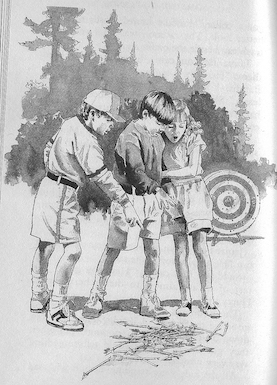
Arts and crafts goes fine, and the kids enjoy meeting the camp’s mascot, a tame raccoon named Bandit. Tanya explains that they found Bandit when he was just a baby and that the kids should never try to play with wild raccoons. However, when the kids arrive at the archery range, they discover that someone has snapped all the arrows in half! Because of the stories the camp cook has been telling everyone, some of the campers think that it’s the work of the camp’s ghost. The Bobbsey Twins still suspect Danny, and they offer their services to Tanya, to investigate and find out who’s really causing all the trouble at camp.

Danny isn’t the only suspect. Nan overhears the cook, Sal, telling the kids about a hungry, child-eating bear in the woods who is supposedly friends with the camp ghost. Does he just like scary stories, or does he have a special reason for wanting to frighten the kids at camp? Even Tanya seems to have something to hide, getting mysterious notes and meeting someone in secret.
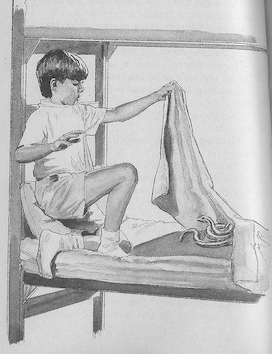
Soon, other strange things happen at camp. Someone puts a snake in Freddie’s bed, and the kids see strange lights in the woods at night. Then, someone steals all the ponies out of the corral and smashes the kids’ clay art projects. Some of the kids think that it’s the work of the ghost Sal has been talking about, but the Bobbsey Twins are sure that someone only wants them to think that. What are all the pranks and sabotage really about?

The book is available to borrow and read for free online through Internet Archive.

My Reaction

I was pretty sure I knew right away who was behind the camp sabotage, but this is one of those stories where there’s more than one person doing things that are unrelated. Danny eventually admits to playing some of the pranks, like the snake in Freddie’s bed, but not all of them. I was also wrong about who the main villain was. The missing polar bear at the beginning does figure into the mystery of the things happening at camp. I figured it would be important, but I didn’t guess how and why.

One of the clues the kids find is a lucky rabbit’s foot keychain. The kids comment that those used to be popular good luck charms, but not many people have them anymore. I have to admit that I had a pink one when I was a kid that I got from a novelty shop. I don’t think I realized at first that it was a real rabbit’s foot. I think I assumed that it was fake because I bought it in a place that sold magic tricks and costume props, so I figured it was imitation, like everything else. I figured it out eventually, and then, I didn’t feel quite so lucky about it. I’m sure that those keychains fell out of popularity because other people felt the same way I did about them, and they were concerned about animal cruelty. I believe it’s still possible to buy real and faux rabbit’s foot keychains, but it’s been a long time since I last saw them displayed at a store, so I think the kids were probably right about them not being as popular as they once were.
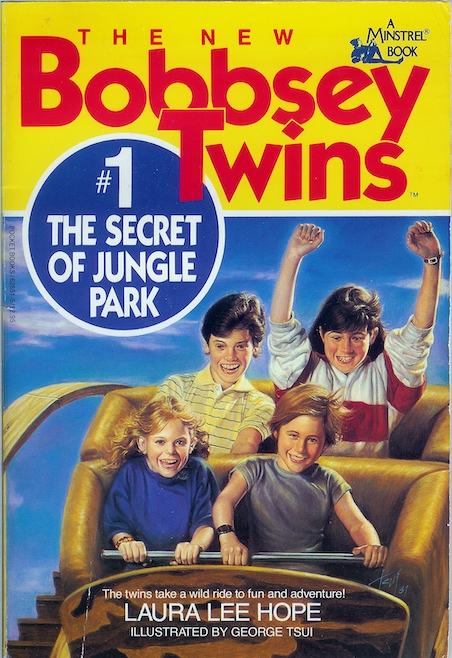
The Secret of Jungle Park

The Bobbsey Twins

#1 The Secret of Jungle Park by Laura Lee Hope (Stratemeyer Syndicate), 1987.

Before I begin, I’d like to acknowledge Sean Hagins, for supplying me with photos of this book! Usually, I take pictures of books myself, but I just couldn’t find a physical copy of this one. Sean is a big fan of the Bobbsey Twins, particularly the New Bobbsey Twins mysteries, and you can see some of his video reviews as well as videos about his photography work on his YouTube channel, SJHFoto. Thanks, Sean!

Twelve-year-old twins Nan and Bert Bobbsey are part of a rock band with some of their friends. They call themselves The Aliens, and they’re participating in a Battle of the Bands at the amusement park Jungle Park. Nan plays the keyboard, Bert plays the drums, and their friends, Jimmy and Brian, play guitars. Flossie, their younger sister, wishes that she could join the band, too, but she’s still too young. Flossie and her twin brother, Freddie, are there to help their older siblings get ready and watch them perform. (And, the case of the boys, use some fake blood to play a trick on the girls.)

While they watch the first bands perform, they see some smoke. At first, they think that it’s just a stage effect, but it becomes thicker, and they realize that something is really wrong! Most of the audience flees, but Bert stays behind to save his band’s equipment. Nan tells him it was a dangerous thing to do, but Bert says that he doesn’t think it was a real fire. Fire fighters come, and so does their police officer friend, Lieutenant Pike. Lieutenant Pike also tells Bert that he took a foolish risk, but he agrees with Bert’s impression that the smoke was actually caused by a smoke bomb. Even though a smoke bomb isn’t real fire, setting one off in a crowded auditorium can still be very dangerous because someone could have been hurt in the panic when everybody rushed out.

Lieutenant Pike confides in the children that the police have been called to the park three other times recently for other apparent accidents and problems. He says that if things like this keep happening, they might have to shut down Jungle Park due to safety concerns. The four Bobbsey Twins don’t think that’s fair. They love Jungle Park, and they want to catch the person who set the smoke bomb!

Lieutenant Pike lets the kids look around after the police and fire fighters are finished with the auditorium. There are two clues that they find: a black eye patch and a swizzle stick. Bert doesn’t think that the swizzle stick is much of a clue, but Freddie thinks it might mean something. The eye patch points to two possible suspects that the kids know about: a member of a rival band in the contest and a man the girls saw who was lurking around the dressing room area. Bert thinks that the rival band was trying to disrupt the contest so they would win, but the others aren’t so sure. It turns out that the guy with the eyepatch was hired by one of the owners of the park to make some repairs, but could he have been hired to do more than that? Could one of the owners have a reason to make sure the park closes? What about the woman who takes care of the animals at the park? She doesn’t seem happy about the conditions they’re kept in.

As the kids investigate their suspects, they get chased by elephants, hunt for a suspect in a fun house, tackle someone in a gorilla suit, and win the band contest!

The book is available to borrow and read for free online through Internet Archive.

My Reaction

Like Sean, this particular Bobbsey Twins series was the one that I read as a kid. I didn’t even know the difference between the New Bobbsey Twins series and the earlier series until I was older. The Bobbsey Twins series, like other Stratemeyer Syndicate series, is typically set contemporary to when the stories were written, so the New Bobbsey Twins series is set in the late 1980s and early 1990s, when they were originally written and published.

That time period was when I was a kid myself, so things that the kids did in the New Bobbsey Twins series were very like things kids my age were doing when I was a kid. A lot of kids wished that they could be part of a band. At one point, Flossie talks about something she saw in a teen fashion magazine. Flossie isn’t a teenage herself, but as I recall, teen magazines were largely popular with pre-teens (or “tweens”), who wanted to look like teenagers. Later, she pretends to be collecting signatures for Save the Whales, which was a popular and well-known cause at that time.

The mystery in this book was pretty good. I was sure from the beginning that the kid from the rival rock band wasn’t the park saboteur, but I wasn’t completely sure which of the adults was responsible for much of the book.

Susannah and the Purple Mongoose Mystery

Susannah and the Purple Mongoose Mystery by Patricia Elmore, 1992.

This is the third book in the Susannah Higgins mystery series.

It’s summer, and Lucy has been helping Susannah practice for the Black Poetry Recitation contest. She’s not expecting the summer to get any more exciting than that because her father has told her that he can’t afford summer camp for her this year.

One day, Lucy and Susannah go to visit a friend of Susannah’s grandmother, Mrs. Quigley. Mrs. Quigley, often called Quiggy, says that she has a surprise for them. The “surprise” turns out to be that Quiggy has taken in a foster child, a girl named Theresa. Theresa is about the same age as the other girls and will be going to school with them in the sixth grade. Theresa tells the other girls that she likes Quiggy, but she doesn’t like Ruth, Quiggy’s cousin who lives with her. Ruth is a fussy woman who doesn’t like kids much, and Lucy tells Theresa that she’s like that with everyone. The only people Ruth really seems to like are Quiggy and her dog, Pipsqueak.

However, the girls are also shocked when they see that Quiggy’s garage has burned down. Fortunately, the fire didn’t spread to her house, but the garage is destroyed, and it looks like arson. Susannah tries to question Theresa about the fire, but Theresa says that she was asleep until Quiggy smelled smoke and woke her. Lucy thinks that the fire reminds her of when a girl she knew in second grade tried to set fire to a storage shed on the playground. Then, Lucy suddenly realizes why Theresa looks so familiar to her – Theresa was that girl from the second grade. Susannah doesn’t remember Theresa or the shed incident because she was going to a different school then.

Lucy is quick to suspect that Theresa is the one who set the garage on fire because of her firebug past, but Susannah is more doubtful. She wants to learn a little more about Theresa’s past since the second grade, where she’s been living, and whether she’s continued her firebug habit in other places she’s lived.

However, Theresa falls under suspicion again when another fire destroys Quiggy’s back porch, deliberately set by lighting a pile of newspapers on fire. Quiggy and Ruth were out at the time, and Theresa was home, but she says that she went to the park and didn’t know about the fire until she got back. Ruth is quick to accuse Theresa, saying that she knew that she’d be trouble from the beginning.

Mrs. Weinberger, the woman who called the fire department, said that she noticed the smoke right away because she was working in her garden around the time the fire started. When Susannah asks her if she was in the garden the whole time, she says that she did leave for awhile because she got an unexpected delivery of roses from a secret admirer, and the delivery boy even sang “You Are My Sunshine.” It sounds suspicious, like someone who knew Mrs. Weinberger’s normal habits deliberately tried to distract her so she wouldn’t see the arsonist arrive. Mrs. Weinberger describes the delivery boy, saying he looked about 18 years years old, he was blonde, and he had a tattoo on his arm. Also, both his shirt and his bicycle were purple. All she can remember about the name of the florist is “Mongoose”, which is a pretty odd name for a flower shop. The roses make it seem less likely that Theresa would have been the arsonist. Roses would be an expensive gift/distraction for a recently-arrived foster child to send.

When the girls learn from a boy Theresa used to live with in another foster home that she was sent away for trying to set a fire there, it looks bad for her. The girls talk to Theresa and suggest that she needs professional help, but Theresa denies ever setting any fires at all, at least, not on purpose. The fire at her last foster home was just a cooking accident, and Theresa wasn’t sad to leave there because the family wasn’t nice to her. As for the shed in the second grade, Theresa explains that she wasn’t actually trying to light the shed on fire. She was living in a foster home back then, too, and she’d just gotten a bad report card and a letter from her teacher that she was afraid to show to her foster family. She was trying to destroy them, and things just got out of control. Theresa insists that she would never want to do anything to hurt Quiggy or make her mad because she’s been nicer to her than any of her previous foster parents have, and she really wants to stay with her.

Theresa isn’t the only suspect for the arsonist, though. Could Ruth have somehow arranged the fires to get rid of the child because she didn’t want to share a home with her? What about Mr. Reid, the cranky next door neighbor who is annoyed about the sound of kids playing? There’s also Toby, Quiggy’s handsome nephew, who does handyman work for his aunt. He has access, but does he have a motive? What about George Peterson, who wants to buy Quiggy’s house? What about Arthur Featherstone from Theresa’s former foster home? Could he be holding some kind of grudge? It seems like the key to finding the real arsonist is finding the boy who delivered the flowers on the purple bike with the name “Mongoose” printed on it.

The book is available to borrow and read for free online through Internet Archive (multiple copies).

My Reaction

One of my favorite things about this series is that the author does a good job of making a number of people look like equally good suspects. In the beginning, I had multiple theories about who the real arsonist could be, and I honestly wasn’t sure who it was for much of the book. One of my early theories turned out to be correct, but I changed my mind two or three times along the way.

Something else that I’d like to mention is that, at one point, the characters go to the library to do some research, and they use microfiche to read some old newspaper articles. When this book was written, the Internet and the World Wide Web were just starting to evolve into something that the general public could use, but most people didn’t have access yet. Even libraries didn’t have the rows of Internet-capable computers they have now. Some may have been starting to get them by this point, but it was a gradual process, and I don’t think my local library had them until a few years later. In fact, I think this was around the time that my school’s library replaced the old card catalog with the new computer catalog, and it wasn’t an online catalog; it was just a database stored on the computer in the library. Remembering things like this makes me feel old, but I was part of that 1980s/1990s generation of kids (the very oldest of the Millennials) who were first taught to use more manual forms of data storage before being gradually trained in more digital forms as we moved up through the grades in school.

Because, in those days, in the 1980s and into the early 1990s, there was no ability for most public libraries and other institutions to scan documents, like newspapers, and upload them to the Internet for easy sharing, or just write them directly to the Internet in the first place, they would convert printed materials to microfiche, which are essentially smaller film images taken of the documents. In order to read them, you would have to use a microfiche reader, physically load the images you want on sheets of transparent film, and look at a magnified version of them on the screen, scrolling through them until you found the information you were looking for. There was no way to make the process go faster with a keyword search. It was a royal pain. I had to do it a few times for various school reports, and I never thought it was fun. If you look at this video of people demonstrating how to use a microfiche reader, you see how they have to turn the dial to get the image aligned properly so they can read it, and also when they physical move the piece of film in the opposite direction to the way the image scrolls on the screen. I always thought that was annoyingly counter-intuitive. I know why it does that, because it’s about where the viewer is positioned over the image, not where film is moving, but I remember being annoyed with it when I was a kid because I’d move it in the wrong direction and get mixed up. Maybe it’s just how my mind works. When you find the image/page you want on the microfilm, there is a way to print it out on paper. Some libraries still use microfiche (which is why this video exists), and it can be useful for looking at old records, but online archives are starting to replace this method of data storage. When my local library underwent renovations in the early 2000s, they decided to replace their old microfiche area with a new teen center and more computers. I think they sent the microfiche machines and archives to the local university library. I’m not even 40 yet, and I feel old.

The Vanishing Scarecrow

The Vanishing Scarecrow by Phyllis A. Whitney, 1971.

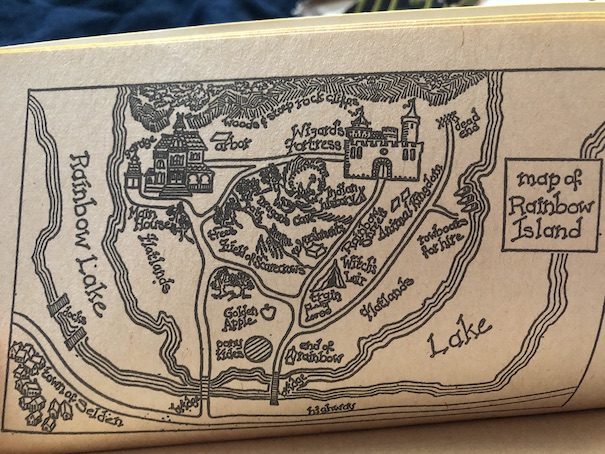
Joan Lang and her mother are moving from their town in Connecticut to Rainbow Island, where Joan’s Great Uncle Agate Benson owned his own amusement park. However, the move is sad because Great Uncle Agate’s death in a skiing accident has so closely followed Joan’s father’s death from a long illness. Joan and her mother knew that they were going to have to move to a smaller house because they could no longer afford their bigger one, and Uncle Agate’s sudden death means that they will inherit his house on Rainbow Island and the amusement park that goes with it. Joan and Uncle Agate had been writing letters to each other since her father’s death, and he made her feel less lonely, so Joan knows that she will miss him, but she is looking forward to seeing the amusement park that he had described to her.

However, the terms of Uncle Agate’s will are unusual, and his lawyer is vague on some aspects of them. What they know is that they must live at Rainbow Island and manage the amusement park for three years in order to gain full ownership. If they decide to leave before that time, Uncle Agate has another plan for the amusement park, but the lawyer refuses to tell them what it is immediately.

When they arrive at Rainbow Island, they meet Mrs. Fuller, who works at the amusement park’s gift shop and lives there with her two sons, Peter and Kent. Mrs. Fuller hopes that Kent and Joan will be friends because they’re close in age. Kent doesn’t seem particularly friendly at first, and when Joan confronts him about that, he says that he’s just trying to figure out what she and her mother are going to be like. Kent, like other people who live and work at Rainbow Island, was very attached to Uncle Agate. He appreciated his vision and imagination, and he misses him now that he’s gone. He has trouble believing that things will ever be like they were with Uncle Agate.

Mrs. Fuller and Kent both mention strange things that have been happening at the amusement park recently, including a scarecrow that frightened Mrs. Riddell, the wife of Wilson Riddell, who manages the park, but she says that she’d better let Mr. Riddell explain the situation. When Joan and her mother go to Uncle Agate’s old house to begin unpacking their things, Mr. Riddell comes to talk to them. He doesn’t seem particularly welcoming, either. Joan’s mother tries to ask him about the scarecrow incident, and he explains that someone, possibly a teenage prankster, has been pulling tricks around the park lately. Earlier that day, someone ran right through the Riddell house, terrifying Mrs. Riddell. Mrs. Riddell is described as being a very nervous person who is somewhat unwell, so Mr. Riddell seems uncertain whether his wife actually saw a person dressed as a scarecrow, as she described, or if that was her imagination. Earlier, she also claimed to see a witch. The idea of someone in a scarecrow costume is plausible because the amusement park includes a field of scarecrows, and they do have a spare scarecrow costume that they’ve used in the past to make it look like one of the scarecrows has come to life, to give guests a bit of a thrill. However, the employee who normally wears the costume hasn’t worn it for some time, and it seems like the recent scarecrow sightings are the work of a prankster.

As Kent shows Joan around the amusement park, they meet up with Peter in the Wizard’s Fortress, where he points out that someone has been messing around with the dioramas of historical scenes, moving some of the little figures around to scenes where they don’t belong. In the dungeon of the fortress, Joan meets up with Mr. Riddell’s daughter, Sheri, who is also about her age. Sheri has found the costume the scarecrow was wearing under some straw. Joan isn’t sure that she trusts Sheri because of the strange way she acts and how she seems to be sneaking around, keeping secrets, and playing weird pranks and tricks.

Could Sheri have something to do with the mysterious scarecrow, or could it be Emery Holt, the man who did odd jobs for Uncle Agate and sometimes wore the scarecrow costume as an act in the park? Another suspect could be Jud Millikin, an escaped convict who used to live in the area and who still has family living nearby. Joan and her mother hear people whispering about him, wondering if he might have come back to see his sick daughter, although people say it isn’t likely that he’d show his face in town since the police are looking for him. But why would he want to sabotage the Rainbow Island amusement park? Joan considers that there might be an answer closer to home when she learns that the Riddells and the Fullers don’t really get along, and there seems to be a silent power struggle between them for control of the park. Either of the families might want the other to leave, plus Joan and her mother, so they can be in charge.

Joan finds a message and an audio recording left behind by Uncle Agate for her, in which he seems to have had a premonition of his impending death and saying that the reason why he wants Joan and her mother to manage the park with Mr. Riddell is that the park needs someone with a fresh imagination to keep creating new exhibits and keep the park interesting for new generations of children. Joan wants to find out who is sabotaging the park and to keep Uncle Agate’s vision for the park alive, but her mother isn’t so sure that the situation is going to work for them.

Joan does have a fantastic imagination. She loves writing and making up stories, and she finds the atmosphere of the amusement park inspiring. However, Joan’s mother worries sometimes that Joan lives too much in her stories and doesn’t face up to reality enough. When Joan accuses her of not liking her stories, her mother says it’s not that, it’s just that writers also need a grounding in real life and the real world, and that it’s not good to use fantasies as a way of ignoring real life. She says that Uncle Agate was like that. Uncle Agate and his sister were orphaned from a young age, and while his sister was adopted by a family, Uncle Agate remained in the orphanage for the rest of his youth. When he grew up, he became successful in the toy industry, which was how he gained enough money and expertise to start his amusement park. However, Joan’s mother believes that much of what he did with the park was trying to live out childhood fantasies from his deprived youth and forget the hard realities of it. Joan’s mother says that she finds the real world outside of the amusement park more compelling, and she doesn’t want Joan to live too much in fantasy.

Joan is attracted to fantasy, but she’s realistic enough to know that there won’t be any hope for the park until she learns the true identity of the mysterious scarecrow that is trying to sabotage it. In the recorded message he left for Joan, Uncle Agate refers to a “right place” where Joan will find instructions that will tell her what to do. As Joan explores the the amusement park, familiarizing herself with the attractions and exhibits, she searches for the place that Uncle Agate referred to. Along the way, she has frightening encounters with someone dressed as a witch and the dangerous scarecrow among the regular figures in the exhibits.

My Reaction and Spoilers

The atmosphere of the story is great, and the author does a good job of making everyone Joan meets look like a potential villain or accomplice. All through the book, I kept changing my mind about who the real scarecrow was, and there are red herrings in the form of other people dressing up in costumes. Joan is never sure who to trust. There is a major twist toward the end of the book that turns the entire situation on its head. The rest of the ending after the scarecrow’s identity was revealed seemed a little abrupt to me, but the story has a good overall message.

At the beginning of the story, Joan does actually look at the amusement park on Rainbow Island as a kind of fantastic sanctuary from her problems, where she can escape from the sad loss of her father and uncle and the problems she’s been having at school. However, she learns that the amusement park isn’t really a sanctuary because it has problems of its own and the people associated with it also have their problems. However, these are problems that Joan is more motivated to solve because they are more exciting than her problems back home, and the stakes are high.

Joan and her mother have a frank discussion about facing up to life’s problems, and Joan points out that her mother’s impulse to run away from the park isn’t that different from her reluctance to face up to her problems with her schoolwork. Joan’s mother doesn’t find the park as interesting as Joan does, so she’s not as interested in trying to save it as Joan is. It’s similar to the way that Joan was unmotivated to work harder at school because it bored her, it was less imaginative than the creative writing she likes to do, and she was preoccupied with other major changes in her life. Joan’s mother acknowledges the truth of that, that it’s easier to try to solve a problem when you’re more motivated to work on it, and the two of them agree that, whatever else they do with their lives, they can’t just abandon the park without trying to catch the saboteur.

All of the characters in the story get new perspectives on their lives from this adventure, seeing how the park and their problems fit into a much bigger picture of life. Joan comes to understand that there are some problems that she’ll still have to face up to, like her school problems, no matter what else happens, and she sees that understanding the real problems that real people have is what will give her characters and stories greater depth.

Who’s Haunting the Eighth Grade?

Junior High Series

JHHaunting

#13 Who’s Haunting the Eighth Grade? by Kate Kenyon, 1988.

A group of eighth graders are going on a field trip to see a Shakespeare play in another town, but right from the start, everything seems to be going wrong. The teachers who are accompanying them on their trip are in a foul mood and spend a good part of the trip arguing with each other, which bothers the kids because they know that the teachers have recently become engaged to each other. Then, the bus breaks down in a small town before they can reach their destination.  The entire class is going to have to spend the night somewhere in the small town.

At first, things look like they’re going to improve when the group decides to spend the night at a local bed and breakfast in a big, beautiful, old house. However, their spirits are almost immediately dampened again when they are told that the house is haunted and that anyone who tries to stay there is scared away by the ghost. Still, they proceed with their plan to stay there in order to avoid staying at the dumpy local motel, the only other choice of accommodation.

Needless to say, before the night is over, the ghost puts in an appearance, and strange things start to happen.  By then, the students have come to feel sorry for the owner of the bed and breakfast, a nice older lady who grew up in the house but can’t really afford to keep it unless she can make her inn a success. Can the eighth graders catch the ghost, stop the hauntings, save the bed and breakfast from having to close, patch up the relationship between their feuding teachers, and still make it in time to see the play?

The book takes place in the 1980s, and the kids in the story are 14 years old. They mention the decade somewhere during the course of the story, and the descriptions of the clothes and some pop culture references make the time period fairly obvious. It also has some of the stock characters that books for pre-teens and early teens in the 80s have (ex. a boy-crazy space cadet, a level-headed health nut, a class clown, and a couple of young punks). Still, even though there are some things about the book that are a bit dated, it is still pretty enjoyable. The author has a sense of humor, and she plays with the characters’ stereotypes a bit. The class clown is secretly quite sensitive and even a bit perceptive. There are also a couple of fun scenes when the girl who is only interested in boys is shocked to discover that the boys are more interested in the mystery than in her.

McGurk Gets Good and Mad

McGurkMad

McGurk Gets Good and Mad by E.W. Hildick, 1982.

The members of the McGurk Organization have been planning a kind of open house in order to show the other kids from the neighborhood the kind of mystery-solving work they do. However, someone seems to be doing their best to ruin it.

It starts with the mice that the members of the Organization find in their headquarters, which have already gnawed some of the exhibits for the open house. It quickly becomes obvious that the mice didn’t find their way in by accident when someone posts a sign warning people away from the open house because of the mice. There’s no way anyone could have found out that there were mice, especially not that quickly, unless they had planted them there deliberately. The mysterious sign is signed “Agent 93,” but who is that?

While Brains works on a way to get rid of the mice, the others begin thinking about who could have it in for the McGurk Organization. They consider past cases they’ve solved and villains that they’ve unmasked as well as some of the kids they know generally from school who don’t like them or were offended when they weren’t allowed to join the Organization.

By the time of the open house, they still don’t know who the saboteur is, and when it’s time to unveil the real police handcuffs that Patrolman Cassidy gave them as an award (the highlight of the open house for the McGurk Organization), they are suddenly and inexplicably replaced by a pair of fake mice and another note from “Agent 93.”

Whatever it takes, McGurk is determined to find the guilty person and get those handcuffs back!

The book is currently available online through Internet Archive.

In the Kaiser’s Clutch

KaisersClutchIn the Kaiser’s Clutch by Kathleen Karr, 1995.
After their father’s death during World War I  (then called The Great War), the Dalton twins’ mother started supporting their family by writing.  It’s the summer of 1918, and Dorothy Dalton is now writing the scripts for a silent movie serial starring the fifteen-year-old twins, Nelly and Fitzhugh.  Times have been tough for them without their father’s support, but the serial means steady work and salaries for all three of them for the entire summer, enough to support them and buy school supplies for the fall, and maybe even enough to buy back some of the things that their mother pawned to keep their family going when they had to move out of New York to a less expensive town in New Jersey.

The movie serial, called In the Kaiser’s Clutch, is about a pair of wealthy American twins (played by Nelly and Fitz) who find themselves battling German spies.  The serial is part adventure story, part American war propaganda.  It’s also a subject that hits close to home.  The Dalton twins’ father wasn’t killed while fighting overseas.  He was in charge of the security force for the piers of Black Tom Island, just off the coast of New York, the port where most of the weaponry destined for the war in Europe was being shipped.  However, a massive explosion destroyed the port at Black Tom and killed Mr. Dalton.  Fitz wishes that he were old enough to fight directly in the war, but failing that, he wants to find the people who killed his father because he is sure that his father’s death was due to deliberate sabotage, not an accident.  However, it’s possible that the saboteur himself is looking for the Dalton family.

Strange things start to happen which the twins realize may have some bearing on their father’s death.  Someone has been spying on the family, listening by the window of their apartment.  Then, the director of their movie serial hires a new, part-time actor to play one of the villains, and this man is oddly similar to the fleeing figure of the man who was spying on them.  This new actor is German, and he seems to have some weird grudge against the twins, muttering insults in German and taking advantage of the stunts they have to perform in the movies to hurt and frighten them.  There are plenty of opportunities for the twins to get hurt on the movie set because each episode of the series has to end with a cliff-hanger scene, and there are no stunt doubles.  (Early silent movies in real life typically didn’t have stunt doubles, and the stunts were difficult and dangerous for the actors themselves.  This YouTube video explain how Buster Keaton, a famous silent film actor, performed his own stunts.)  From fist fights to car chases to quicksand to a cave-in to a giant pendulum with a mysteriously sharpened edge to sudden explosions, the Dalton twins are constantly teetering on the edge of disaster, not all of it planned by their writer mother.

Mrs. Dalton admits to the twins that, shortly before their father died, he told her that he was close to uncovering something that would be a much better story than anything she could make up.  Unfortunately, he never told her what it was.  He did tell her that he was making notes about it, but those notes were never found and may have also been destroyed in the explosion.  The only odd thing that Mrs. Dalton found after her husband’s death seemed like an ordinary shopping list: “cigars, eggs, dumplings, coal, pencils.”  However, Mrs. Dalton realized later that it has to mean something else because her husband didn’t smoke.

Could this somehow be the clue to what her husband was investigating before his death?  Are there real spies operating in the area?  Is there some other clue to their identity that they are now searching for, something that the Daltons still have in their possession?  Will the Dalton twins manage to find the spies before the spies eliminate them?  Will the family finish the serial and collect their salaries?  Find out in this exciting installment!  (There’s only one installment here because this is just a single book, not part of a series, but you get the idea.)

My Reaction

World War I books aren’t quite as common in children’s literature as World War II stories, so I found this interesting, and movie serials are also a fascinating thing of the past.  The movies that the kids are acting in are black-and-white silent films, so there are interesting discussions of the techniques they use to make things show up properly on black-and-white film (makeup, dyeing the water black for Nelly’s near-drowning scene, etc.) and conveying emotion when the actors’ voices will not actually be heard.  It’s a fun and fascinating story with spies, government agents, and the kind of movie stunts that I’m sure a lot of kids wish they could do for their summer jobs!

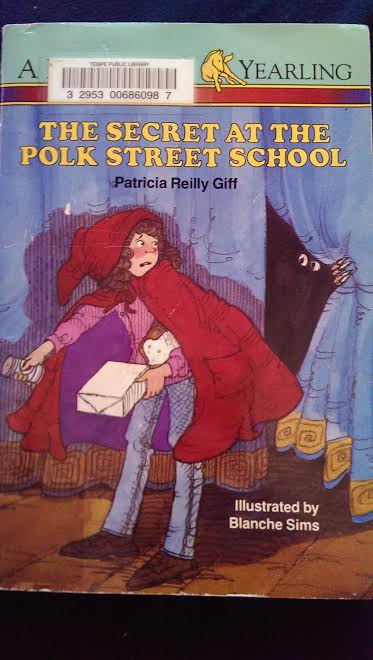
The Secret at the Polk Street School

The Polka Dot Private Eye

SecretPolkStreet#3 The Secret at the Polk Street School by Patricia Reilly Giff, 1987.

Dawn’s class is competing against other classes in a contest to see which class does the most for the school.  All of the classes are working on their own special projects, trying hard to keep them a secret until the judging.  Dawn, as the class’s resident detective, suggests that she could solve a mystery on behalf of the class, but unfortunately, there is no mystery for her to solve.  Yet.

Instead, Ms. Rooney’s class decides to put on a play for the rest of the school.  It’s Little Red Riding Hood, and Dawn is playing the starring role.  Jason gets to be the Wolf, borrowing an old wolf costume from his sister without her permission.

At the class’s rehearsal, Dawn gets mad when someone dressed in the wolf costume tries to scare her, and she thinks that it’s Jason, goofing off.  But, it turns out that Jason wasn’t even there, and the wolf costume is missing.  Suddenly, Dawn has a mystery!

Dawn starts receiving messages from “The Wolf” saying that someone is going to get her and Jason.  Then, someone takes a bite out of the loaf of bread that Dawn has been using as a prop (the food that she’s taking to “Grandma’s House” in the play).  Could “The Wolf” be someone in a rival class, hoping to sabotage their play so they can win the contest?

The book is currently available online through Internet Archive.

The Mystery of the Haunted Trail

MysteryHauntedTrailThe Mystery of the Haunted Trail by Janet Lorimer, 1989.
Brian Kelly wasn’t too excited at first when his teacher assigned his class to write letters to students at a school in Hawaii.  He doesn’t really like to write, and the whole thing sounded boring, but it turned out to be pretty fun when his new pen pal, Alani, wrote back.  Brian discovered that he and Alani had a lot in common, and he even got to meet Alani when his family came to California on a trip.  Then, best of all, Alani’s family invited Brian to spend part of the summer with them in Hawaii!

Brian loves Hawaii from the moment he arrives.  Alani’s family lives in a rural area near Kalawa.  All of the families in the area raise their own vegetables and keep animals.  They depend on what they earn from selling food although some of them, like Alani’s mother, who is a nurse, have other jobs as well.  Alani’s father, like Alani’s grandfather, is primarily a farmer.  Alani’s grandfather lives with him on land that the family has owned for generations.

Alani and his family enjoy showing Brian around their island and talking about the history of the place.  Brian particularly likes the stories that Alani’s grandfather, who they call Kupuna, tells them, although some of them are frightening.  At the luau that the family and their friends have to welcome Brian to Hawaii, Brian overhears people talking about the Night Marchers.  They say that the Night Marchers have been seen recently and that bad things have been happening in the area, like crops dying and the nearby stream starting to dry up.  Some people seem to think that it’s a sign of bad luck and that maybe they should move away from the area.

According to Kupuna, the Night Marchers are a ghostly parade of the ancestors of the people who have lived there for generations.  Sometimes, it’s just ordinary people and sometimes it’s the souls of warriors.  Sometimes, Hawaiian gods may even walk among them.  But, when they march, any living person must either flee from them or, if that is impossible, they must lie down and hide their eyes.  At the head of the Marchers is a ghostly spearman who will strike down any living person who sees them, unless that person is related to one of the Marchers themselves.  They spare members of their own families.  People who are struck by the spear of the Marchers appear to have died of a heart attack.

The place where the Marchers supposedly walk is an old trail that leads to a sacred place where Alani’s ancestors are buried.  Brian is curious to see the place, but Alani warns him away, saying that they are not allowed to go there because it’s too dangerous.  However, Brian soon sees the Marchers himself one night in Alani’s family’s fields, and the next day, their crops are dead.  When Brian notices strange footprints in the fields as well, he realizes that some living people may be responsible for the awful things that have been happening in the area, but the only way he can prove it would be to explore the haunted trail himself and track the “ghosts” to their lair.

Janet Lorimer’s books are interesting because they are often a combination of mystery and ghost story.  There are logical explanations and living villains who are responsible for the things that are happening to Alani’s family and their neighbors, but there is also a definite supernatural element to the story as well.  Telling you where one ends and the other begins may be saying too much.  It may be more fun to let you find out yourself.

The book is currently available online through Internet Archive.

Something Queer in the Cafeteria

SQCafeteria

Something Queer in the Cafeteria by Elizabeth Levy, illustrated by Mordicai Gerstein, 1994.

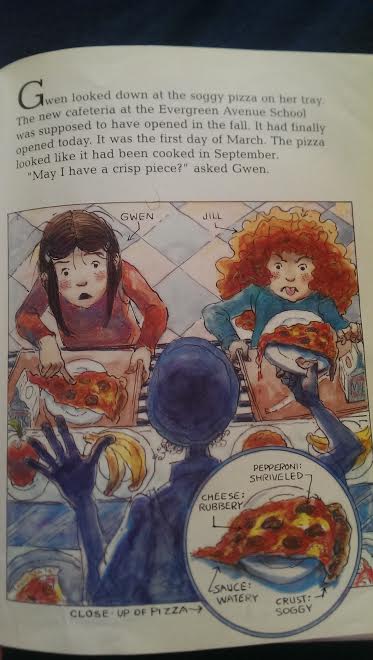
SQCafeteriaPic1Ms. Lensky, the cafeteria lady at Gwen and Jill’s school, is just plain mean. All of the food that the cafeteria serves is yucky, even though the cafeteria is new. There will be a party to celebrate the opening of the new cafeteria, and even the kids’ parents and the mayor are invited. Gwen and Jill are happy because their class will get to help decorate the cake. However, Ms. Lensky, the M.C.L. (Mean Cafeteria Lady), doesn’t like the girls, and she blames them for a number of accidents that happen in the cafeteria.

The first accident was caused by the M.C.L. herself when she was chewing out the girls for being messy (really, the food was messy), and she bumped into other students, causing a food fight to break out.  The M.C.L. blames Jill and Gwen, of course, for starting the fight.  As punishment, the girls are assigned to clean in the cafeteria.  While they’re cleaning up, the M.C.L. blames them when a faucet breaks.

SQCafeteriaFoodFight

Later, when their class visits the cafeteria to prepare for decorating the cake, a counter collapses, throwing frosting all over Gwen.  Then, the girls get in trouble again for criticizing the food.  When the cake burns at the party, and it looks like Fletcher the dog’s bandana is in the burned mess, the girls are blamed once more.

SQCafeteriaFrame

Is the cafeteria jinxed, or is the M.C.L. just out to get the girls?  Or is there another explanation?

This book is part of the Something Queer Mysteries.  It is currently available online through Internet Archive.