 Mystery at Camp Triumph by Mary Blount Christian, 1986.
A year ago, sixteen-year-old Angie was blinded in a car accident. It was shocking and devastating for her, especially since she was planning to become an artist. She loved painting, and she feels like all of her dreams have died since she became blind. Many of her friends no longer speak to her (partly because she has become angry and bitter and they don’t know how to cope with it), and she refuses to return to her old school, partly because of her fears of not being able to cope and largely because she doesn’t want to be the subject of ridicule or pity because of her new disability. Her mother has been tutoring her at home, and her parents argue frequently about what’s best for her.
On the advice of a psychologist who has been trying to help Angie during her difficult adjustment, Angie’s parents have decided to send her to a special camp for children with disabilities called Camp Triumph. Angie makes it plain that doesn’t want to go. She feels that going to the camp with other disabled kids will just a painful reminder that she’s no longer “normal”, and she can’t imagine that there will be anything fun that she can do at a camp now that she can no longer see. She knows that she’ll never be able to paint again, so she thinks arts and crafts are out, and how can she possibly ride a horse or go on nature walks? However, her parents are firm with her, telling her that this is for the best. There are things Angie needs to learn that they can teach her at camp.
Angie’s first days at the camp are miserable. The other campers try to make friends with her, although she tries their patience with her bitterness and complaining that she doesn’t want to be there. Then, someone messes with the guide ropes put up to help the blind children find their way around, sending a frightened Angie plunging into the river on her way back to her cabin. Although she isn’t hurt, she becomes convinced that the camp is dangerous. Everyone else thinks it was just a mean-spirited prank by one of the other campers.
Then, while visiting the doctor in town, Angie overhears a conversation between people she whose voices she doesn’t recognize, learning that what happened to her wasn’t just a prank. Someone is deliberately committing acts of vandalism and sabotage at the camp, trying to get it shut down. But why? Angie flees the scene when she realizes that the people who were talking have heard her. Unfortunately, she drops her cane as she flees. Her cane has her name and address on it, and Angie later finds it lying on her bed in her cabin at camp. Whoever these mysterious people are, they know who she is and can find her at any time. Can Angie convince the other campers of what she heard and find the culprits before something worse happens?
Angie is terrified as she tries to solve the mystery, feeling helpless against her unknown enemies, who can see her while she can’t see them. But, with the help of her new friends at camp, she comes to realize that she isn’t as helpless as she thinks she is. Her experiences give her a new perspective on her life. It’s true that things will never go back to being as they were. Her life won’t be an easy one, and there are certain things that she can no longer do. But, she comes to realize that there are still many things she can do, and there are other types of art that are still open to her. In the end, Angie has friends she can count on, a life that’s worth living, and a better future ahead of her than she thinks.
Along with the story, the book describes some of the techniques that Angie has to learn to cope with her blindness: picturing a “clock” to remember the positions of objects around her (ex. “Your suitcase is at two o’clock.”), following the guide ropes with notches in them to know which path she’s on, listening for clues about her surroundings (she and other blind people recognize the sound of clinking from the flagpole at the center of camp and use that to orient themselves when things get confusing), putting notches in the tags of her clothes so that she knows which pieces of clothing match, using her sense of touch to make clay sculptures, etc.
Besides addressing Angie’s feelings and how she copes with them, the story also touches on how disabilities affect the people who are close to the disabled person. At first, Angie’s parents don’t know how to help her, struggling themselves with coming to terms with what’s happened. Her mother feels guilty because she was driving the car when they had their accident, and she wasn’t as badly hurt. Her guilt leads her to baby Angie more than is good for her. Angie’s father is a stern businessman with high ambitions, failing at first to understand and accept Angie’s feelings and the way her life has changed, reacting with impatience while Angie struggles. Angie’s parents also had marital problems before the accident, which only added to the tension between them. In the end, coming to terms with what has happened to Angie not only helps Angie to improve but helps her parents to improve their relationship with each other.
The book is currently available online through Internet Archive.
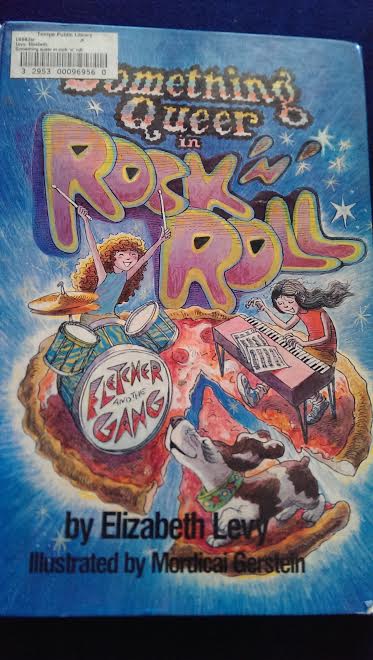
 Gwen and Jill join a couple of other friends in forming a rock band. They want to enter a rock contest run by a local tv station. In order to enter, they have to have an original rock song, so they write one about Jill’s dog, Fletcher. They discover that Fletcher loves pizza so much that he gives a spectacular howl when they offer him some. They make Fletcher and his wonderful howl part of their act.
 Fletcher is all right, but now, he suddenly hates pizza! It seems that Fletcher’s abductor fed him nothing but pizza until he started to hate it. Did someone do that on purpose to ruin their act for the contest? How would this person have even known about their act? Also, what can they do about the contest now that Fletcher is more likely to run from the sight of pizza than howl for it?
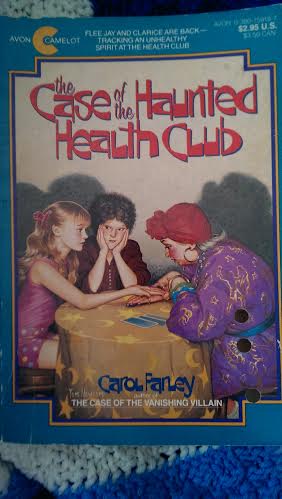 The Case of the Haunted Health Club by Carol Farley, 1991.
 Flee Jay thinks this is spooky, but Clarice doesn’t believe in spirits. In order to investigate further, the two girls accept part time jobs helping the fortune teller and her nephew to clean up the building so they can move in new exercise equipment. “The spirits” continue sending warnings in the form of red dye in the Jacuzzi and threatening messages. Clever Clarice uses logic to point out how most of these things were accomplished but is surprised when Flee Jay reveals something that she overlooked.
 Jestress's Forgotten Books and Stories