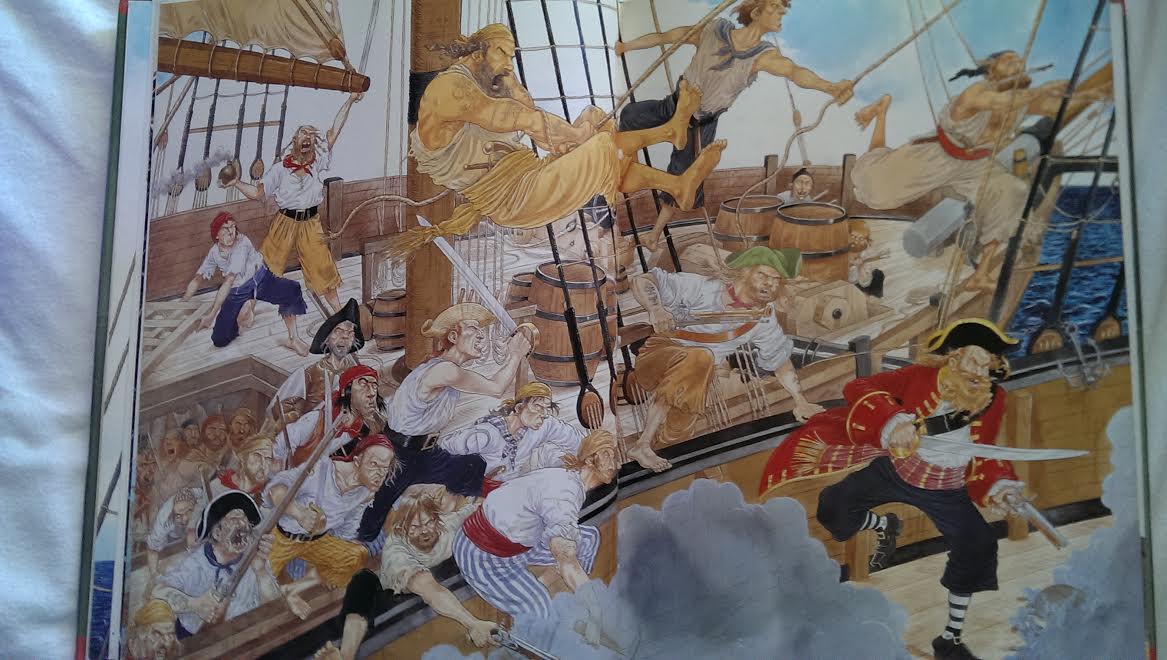
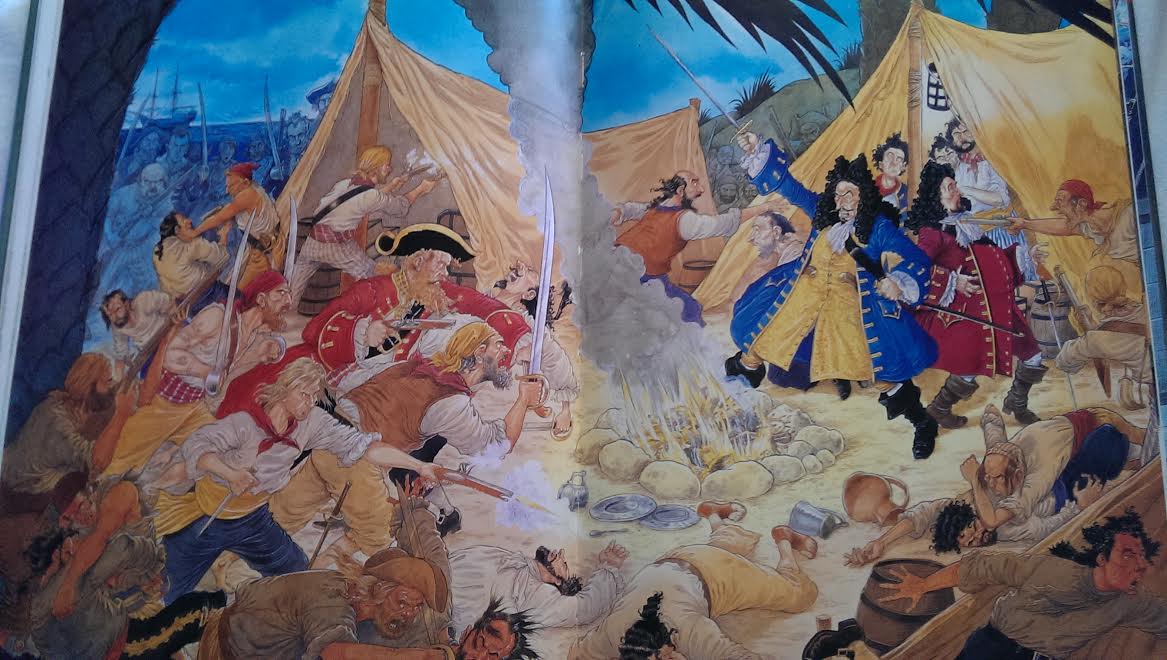
Pirates

Magic Tree House Research Guide
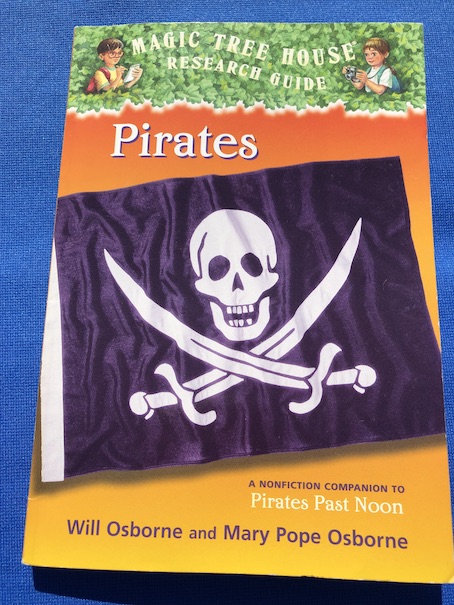
Pirates by Will Osborne and Mary Pope Osborne, 2001.

This book is the nonfiction companion book to Pirates Past Noon, part of the Magic Tree House Series. While the Magic Tree House Series is a fantasy series that involves time travel, there are companion books to some of the novels with nonfiction information related to the stories. The fantasy series is meant to introduce children to different historical periods and encourage an interest in reading, but the companion research guides take children further into certain subjects.

This book focuses on pirates throughout history, explaining how pirates functioned from the time of Ancient Greece and Rome, into the Middle Ages with Vikings, and beyond. It explains that, while legends and adventure stories make the lives of pirates seem fun and exciting, the realities of their lives were more harsh. Throughout the book, Jack and Annie, the characters from the main series, appear in illustrations and side notes to define certain terms or tell the readers fun trivia.

There is a chapter about New World pirates that explains the buccaneers and privateers that preyed on Spanish treasure ships in the Caribbean. The Golden Age of Piracy was in the late 17th and early 18th centuries. It was a period of intense pirating activity as governments recruited privateers to attack the ships of enemy nations. Pirates also attacked ships that traded with American colonies as they increased in size and number. The Golden Age of Piracy ended in the 1720s, when governments began instituting harsher punishments for pirates and sending more warships to confront the pirates. The book includes a Gallery of Pirates where it gives brief biographies of famous pirates, like Henry Morgan, Sir Francis Drake, Blackbeard, and “Calico Jack” Rackham with Anne Bonny and Mary Read.

There are chapters that describe the lives that pirates lived on their ships. One chapter talks about the types of ships that pirates used, how to distinguish between different types, and the trade-offs between size and speed. For example, sloops could move faster, but schooners were larger and could carry more. Although pirates operated outside of the law, they had rules for themselves to establish order and resolve conflicts on their ships, and there were punishments for people who broke the rules. People also had different jobs on pirate ships.

Part of the book also talks about legends of buried treasure and sunken ships. There is some truth to the legends, although mostly, pirates tended to spend their loot shortly after getting it instead of hiding it for later.

At the end of the book, there is a guide for doing further research which suggests research tips, other books to read and documentaries to see, and websites to visit. Of the websites listed in the book, only one still exists as of this writing: Maritime Pirate History. Another one, Treasure Island, pops up thanks to the Wayback Machine. It might be possible to find the others through the Wayback Machine by actually searching the Wayback Machine for them, but with so many other new sites and books that are probably equally as good, it might not be worth the time.

You Wouldn’t Want to Be a Pirate’s Prisoner

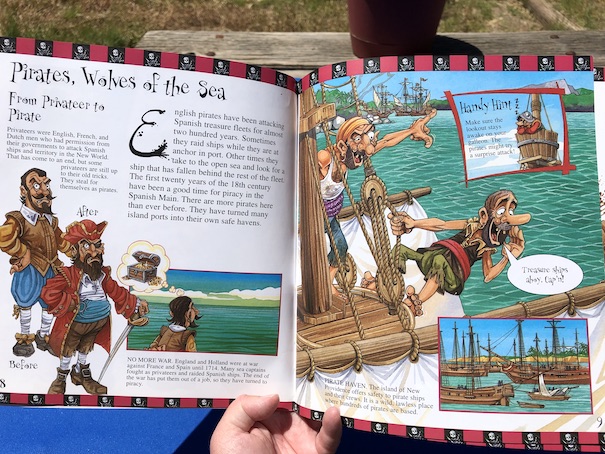
You Wouldn’t Want to Be a Pirate’s Prisoner by John Malam, 2002.

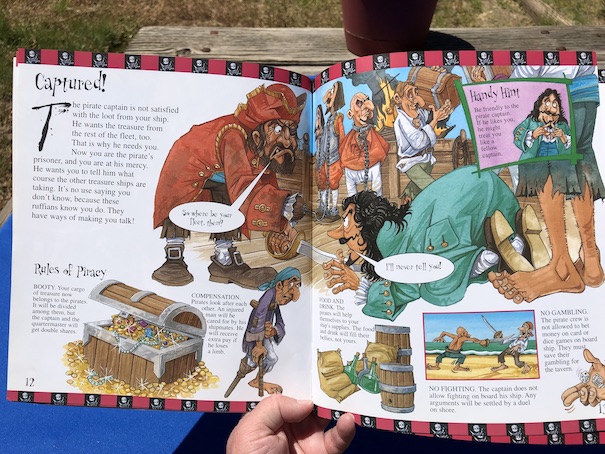
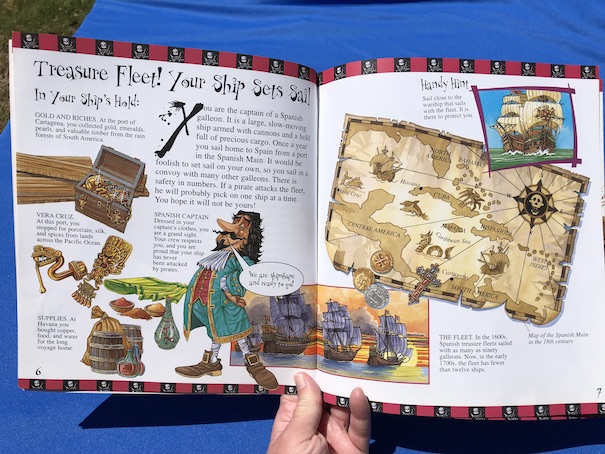
This picture book, which is part of a series, explains what it would have been like to be a pirate’s prisoner in the 18th century.  It sets the stage by casting the reader in the role of a Spanish ship captain in 1716.

The reason why the reader is cast as a Spanish captain, captured by English pirates, is because England and Holland had been at war with Spain until 1714.  During the war, the government of England (as well as Holland and France) authorized some ship captains to act as privateers, conducting raids on Spanish ships and outposts.  When the war ended and the privateers were dismissed from service, some of them continued to act as independent pirates.

The book explains the geography of the “Spanish Main,” the area between the southern coast of North America and the northern coast of South America – basically, the Caribbean Sea and its islands and the Gulf of Mexico.  Spanish galleons in the 18th century carried gold and treasures from the Americas to Spain as well as timber from the rainforests and goods that were transported to the Americas across the Pacific Ocean, such as spices and silk.  All of these goods made Spanish treasure ships tempting targets for English pirates.

As a Spanish ship’s captain, there were a few precautions that you could take against pirate attack.  One of the most basic was traveling as part of a convoy because pirates would be more likely to attack a lone ship than one that was part of a group.  A fleet of ships would have a warship traveling with them for protection, and the closer your ship sailed to the warship, the less likely a pirate ship would try to separate you from the group and attack.

If the worst situation happened and the ship was taken by pirates, a captain could try to dress like other members of the crew to disguise his rank, but that didn’t always work.  The captain of the ship was in danger of being taken captive because he might have information that the pirates would find useful, like the exact route of other ships in a convoy.

The gruesome part of this book (and the source of the title, because this series basically focuses on the gruesome parts of history) is the part where they describe different forms of torture that pirates might use on a ship’s captain to convince him to tell them what they wanted to know.  Besides the direct physical abuse, pirates could also keep a captive in squalid conditions to make him weaker, more vulnerable, and exposed to disease.  In the end, they might simply decide to maroon the captive somewhere, even if they got the information they were after.

However, pirates could also face gruesome fates if they were caught. They could be hung and their bodies displayed publicly, as a warning to others.

The Best Book of Pirates

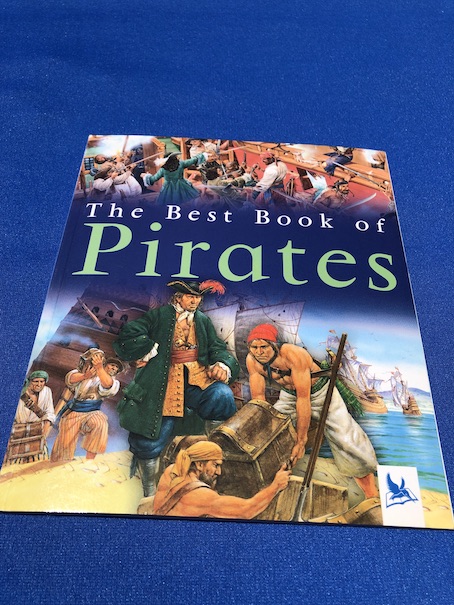
The Best Book of Pirates by Barnaby Howard, 2002, 2006.

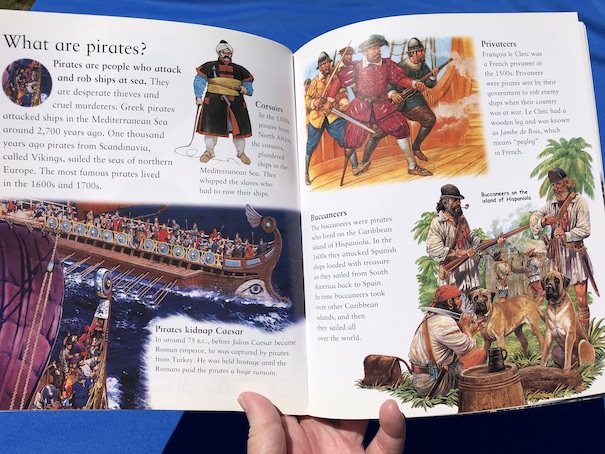
This is an easy and informative non-fiction picture book about pirates.  Rather than focusing on any particular time period or geographic area, the book gives a broad overview.  In the beginning, it explains a little about different groups of pirates through history, including Vikings, Corsairs, Buccaneers, and Privateers.  There is also a brief explanation of the Pirate Round, a sea route often taken by pirates during the late 17th century and into the 18th century.  The route led from North America and the Caribbean to Africa, circling the coast of South Africa to Madagascar and on to the Middle East and India.  (If you’ve seen the movie Cutthroat Island, the crew will basically be taking this route when the movie ends, heading from the Caribbean to Madagascar.)

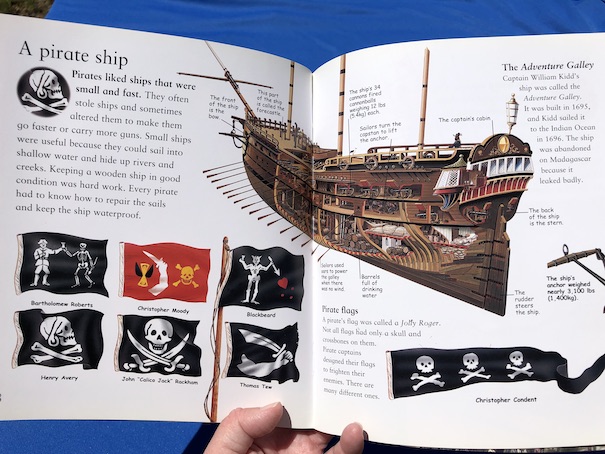
There is a diagram of a pirate ship from the late 17th century, showing what it would have looked like on the inside, and there are also examples of Jolly Roger flags, which were designed by individual pirates as personal identification, typically including skulls and skeletons to frighten their victims.  There is also some general information about what life would be like on board a pirate ship and the types of weapons they might have.

Then, the book begins to focus more on groups of pirates that operated in specific geographical areas and some of the more famous pirates from history.  The Barbary pirates (also called Barbary corsairs) were Muslims who raided Christian ships along the coast of North Africa and the Mediterranean during the 1500s.  Among the most famous Barbary pirates were a pair of brothers called Barbarossa (“Red Beard”).  Sometimes, European and American pirate ships that went to Africa to find gold and ivory also entered the slave trade.

In the section about the Spanish Main, it explains how privateers and pirates raided Spanish ships taking Aztec treasures from Mexico to Spain.  Buccaneers were specifically pirates who raided ships in the Caribbean.  Their name came from the type of fires they used when cooking meat (boucan or buccan).

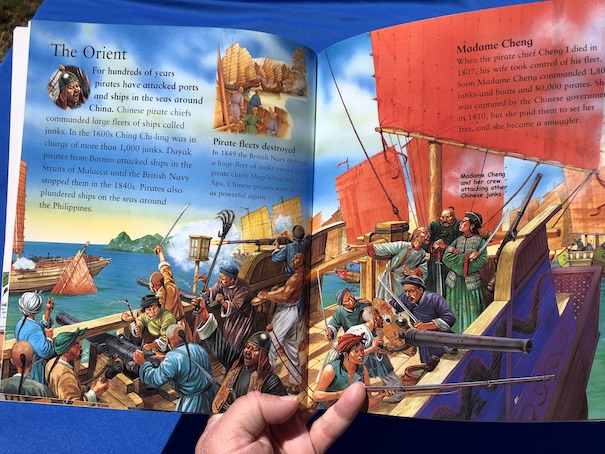
There were also Asian pirates who raided the coasts of China and the Philippines and areas around the Indian Ocean.  Chinese pirates and Dayak pirates from Borneo were powerful in the region until the 1840s, when the British Navy destroyed many of their ships.

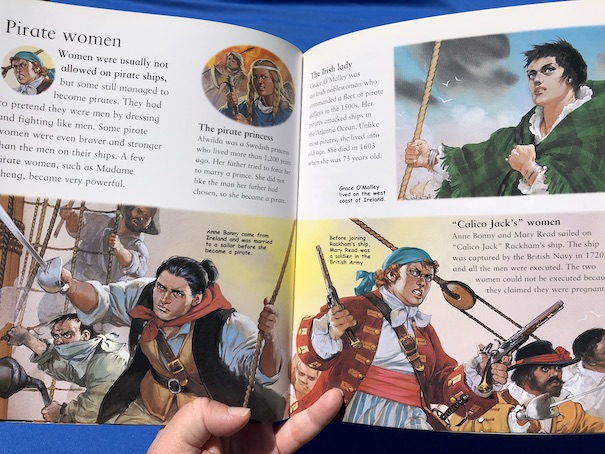
There is a section in the book specifically about female pirates.  Mary Read and Anne Bonny, who sailed with “Calico Jack” Rackham, were famous.  Grace O’Malley was a famous Irish pirate who was also an Irish noblewoman.  Madame Cheng was a Chinese pirate who took over her husband’s fleet after his death (but because this is a children’s book, it doesn’t mention her previous career).  Alwilda was a Medieval Swedish princess who turned pirate after her father tried to make her marry a man she did not want to marry (although her story may only be legend).

The book also talks about the famous stories of pirates burying treasure, although it says that pirates would usually spend their money quickly, sell items for money they could spend, or gamble it all away.

At the end of the book, there is a short section about modern pirates and how their goals and tools of the trade have changed.

The book isn’t very long, but I think that it provides a good, general overview of the subject of pirates throughout history, and the pictures are fascinating and detailed.

The book is currently available online through Internet Archive.

Meet the Men Who Sailed the Seas

Meet the Men Who Sailed the Seas by John Dyment, 1966.

This book is part of a series of historical biographies for children. Unlike other books in the series, the book doesn’t focus on a single person, talking about the lives of many famous sailors and explorers with some historical information about sailors and sailing ships in general.

When I was a kid, I went through a phase where this was a favorite book my mine, and I carried it around and read it constantly. It’s a little surprising that I became so attached to this particular book because I grew up in Arizona, in the middle of a desert, miles from the nearest ocean. I was seven years old before I even saw an ocean and a sailing ship in real life, and even then, it was a matter of years before I saw these things a second time. Because of that, as a child, I wasn’t particularly attracted to boats or interested in ocean travel. I wasn’t even a very good swimmer (liked it, just not good at it because I didn’t get a chance to do it much when I was young), and I was kind of afraid of deep water. We learned about Christopher Columbus in school, but I thought that Columbus Day was the most boring holiday on the calendar (there was no candy and no dressing up in costumes, and I’m not even sure that we got that day off of school, which were my requirements for what made a really good holiday), and Christopher Columbus was not remotely my most favorite historical character. So what was it about this book that caught my attention? Why did I like it so much?

There are a number of things about this book to like. When I was a young kid, I wasn’t fond of nonfiction books because it was a little too much like school, but this book was different. It was one of the first nonfiction books that I really wanted to read. The large, friendly type is encouraging to younger children who are just starting to read nonfiction chapter books, and the detailed drawings are fascinating. Best of all, it’s a journey through time as well as across oceans. I always liked history.

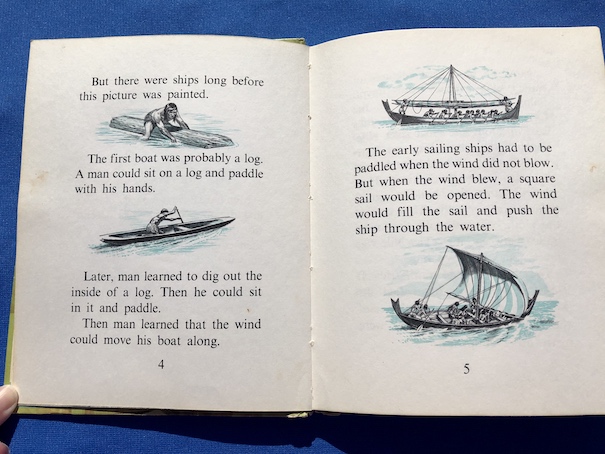
The book starts off by explaining how early sailors might have traveled. It speculates that people first realized that they could travel by water by floating on logs and then realizing that they could carve those logs into canoes and paddle them to move in the direction they wanted to go, eventually adding sails to move even faster with less effort.

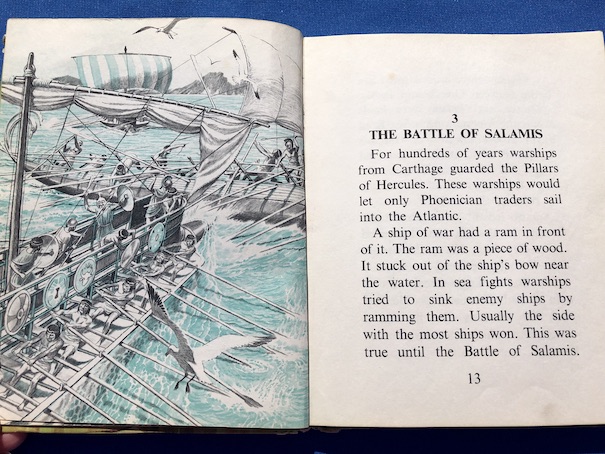
It then describes how ancient civilizations such as the Egyptians and Phoenicians traveled by ship. There is a chapter about Hanno of Carthage, a Phoenician who commanded a fleet of ships and was known for sailing around the coast of Africa. (That section and the next one use the old name for the rocks at the Strait of Gibraltar, the Pillars of Hercules.) The next chapter describes the Battle of Salamis between Greece, led by Themistocles, and Persia, led by Xerxes. This battle is particularly notable because the Greeks defeated the Persians through a clever trick even though they were out-numbered, proving that a good battle strategy could allow even smaller fleets to gain the upper hand in battle. There is also a chapter about Pytheas, a Greek sailor who sailed to Britain in search of tin and “Thule” (it’s not completely clear what he meant by Thule, although it was apparently a place north of Britain) and wrote a book about his travels.

In the early Middle Ages, Viking raiders began attacking Britain. The chapters about Vikings describe Eric the Red and his adventures in Iceland and Greenland, where he founded a colony of people from Iceland. Vikings also established a colony in the Americas that they called Vinland. However, they eventually abandoned Vinland because of conflicts with the people they called Skraelings (Native Americans). (The exact location of Vinland was in dispute for some time, and some people speculated that it might actually refer to multiple locations, but the likely site is at L’Anse aux Meadows in Newfoundland.)

The other explorers and adventurers described in the book are Marco Polo, Christopher Columbus, Ferdinand Magellan (known for sailing around South America to the Pacific), Francis Drake (his section includes an account of the battle with the Spanish Armada), and Captain Cook (known for sailing to Australia and New Zealand and claiming them for England and for insisting that his sailors eat cabbage and onions to prevent scurvy, later killed in Hawaii).

The book also discusses the Mayflower and Pilgrims, and there are chapters about American ships and sailors, like John Paul Jones, and the roles they played in the American Revolution and the new United States shortly after. Because the focus of the book focuses on sailing ships, it ends with Robert Fulton‘s steam ship, the Clermont, and Joshua Slocum, who sailed around the world alone.

So, the reason why I’m still kind of attached to this book, which was old even when I first read it, is that it was my introduction to a world that I wasn’t even really interested in at first, a world that became more interesting after seeing the history and other countries connected to it. I’m still more of an armchair explorer than anything else, but this book added a dimension to my early armchair travels that probably wouldn’t have occurred to me before. As a side note, I don’t think that the book mentions that the navigation instrument that one of the men on the front is holding is an astrolabe, but I now own one of these myself. If you want to try one, you can make a simple version at home yourself. They can be used on land as well as sea!

Pirate Diary

PirateDiary

Pirate Diary: The Journal of Jake Carpenter by Richard Platt, 2001.

Young Jake Carpenter lives with his father in North Carolina in 1716.  His mother is dead, and his father is a medical doctor.  His father wants him to become a doctor as well, but he has decided that it’s important to the boy’s education that he see something of the world first, so he is allowing Jake to go to sea with his uncle, Will, who is a sailor.  Jake is excited about the prospect, and Will has told him many stories about the sea.

PirateDiaryPic1

Jake isn’t allowed to bring much with him because there is limited space on board the ship for personal belongings, and there are many things that Jake has to get used to, like sleeping in a hammock, the names for all the different parts of the ship, seasickness, the poor quality of food on the ship, and using the horn lanterns which are safer for candles on board ship but don’t cast much light.  Jake makes friends with Abraham, the cook’s boy, who promises him extra food in exchange for teaching him to read.  Jake’s main job on the ship is to help the carpenter, so he begins learning his trade.

When the ship is underway, Jake and his uncle learn that the captain is running from debts and that the ship is carrying contraband.  Jake doesn’t think that smuggling is a very serious crime because the main purpose is to avoid paying extra taxes on certain types of goods, and other members of the crew say that it isn’t fair for Americans to continue paying taxes to England when the king doesn’t really care about them or what they want.  The ship sails the Caribbean, but crew members say that they try to avoid docking at English-controlled ports, like the ones in Jamaica, so they won’t have to pay the customs fees. Abraham says that even if they were caught with their contraband, the authorities would likely look the other way if they offer them a share.  Will tells Jake that the captain of the ship will most likely hold back their wages in order to keep them with the ship for as long as possible, like he does with other sailors.

Discipline on board the ship is harsh and arbitrary, according to the captain’s whims.  When Will speaks up to save Jake from a harsh flogging, he himself is flogged and abandoned in a small boat.  Jake believes that his uncle will die because they left him at sea with no provisions!

Then, the ship is captured by pirates!

PirateDiaryPic2

Far from making things worse, Jake’s situation and that of the rest of the crew actually improves because of the pirate attack.  With the captain captured, his cruel punishments are over, and members of his crew eagerly join the pirates in the capture.  The pirates ask the crew about the treatment their captain has given them, saying that it will help them to decide what to do with him, and crew members explain the cruelties they have suffered, including what the captain did to Will.  They end up marooning the captain and his equally-cruel second mate on an island with drinking water.

As Jake’s father predicted, Jake gets to see a lot and learn a lot about life and death during his time at sea, perhaps even more than expected while under the command of the pirates.  He gets some experience in dealing with injuries as he has to help the ship’s carpenter saw off the leg of a man whose wound was too infected to treat in any other way, although the man later died anyway.  Later, the pirates join up with other pirate ships, and Jake participates in a raid on a Spanish treasure fleet!

PirateDiaryPic3

It’s not all excitement, and Jake spends some time talking about the routine chores that sailors did and how they would pass the time on board ship when nothing else was going on.  He does get to see St. Elmo’s Fire on the upper rigging of the ship, and the crew spots a “mermaid” once on a misty day.

An offer of amnesty for those willing to give up pirating allows Jake and other members of the crew to return home where he learns that his uncle has managed to survive after all!

PirateDiaryPic4

In the back of the book is a section with historical information.  It explains the history and geography of the American Colonies, where Jake lived and the history of piracy from the first known pirates to the privateers and buccaneers that led to the golden age of piracy in the 18th century.  Jake is a fictional character, but some of the pirates that Jake met in the story were real people, and the section in the back explains more about them.  The book is part of a series of historical picture books.