The Pumpkin Head Mystery

The Boxcar Children

The Aldens are getting ready for Halloween, and they go to the Beckett farm to get some pumpkins. Mr. Beckett has been having trouble this year because he broke his leg. He’s been letting a hired assistant, Bessie, handle the pumpkin patch, but she is short-tempered and not very good with customers. Mr. Beckett fired her once before, but he had to take her back this year because he was desperate for help.

Mr. and Mrs. Beckett’s daughter, Sally, has been trying to persuade them to sell their farm and come live near her and her children in Florida. She thinks they’re getting too old to manage the farm by themselves and that this recent injury of Mr. Beckett’s proves it. The Becketts say that they don’t want to give up their farm and that they’re not ready to retire. Then, one of the farm hands, Jason, says that Mr. Beckett broke his leg while chasing a pumpkin-headed ghost, but Mr. Beckett denies that it exists.

Later, someone trashes the pumpkin patch and smashes a lot of pumpkins, and for some reason, Bessie faints. The real estate developer who is pressuring the Becketts to sell their farm, Dave Bolger, shows up again and tries to persuade the Becketts to sell. Sally thinks her parents should take the offer, but they still refuse. The Aldens help clean up the pumpkin patch in time for the next hayride, so the Becketts won’t have to cancel it, and Sally tells them that the farm is haunted and that the stories Jason has been telling about the pumpkin-headed ghost are true.

A glowing pumpkin has been seen floating through the fields at night, seemingly with no body underneath it. When it appears, they hear scary voices, telling them to leave the farm and leave the spirits in peace. Mr. Beckett did injure his leg while trying to chase after it on his horse. The Aldens think this sounds scary, and they ask Sally if the farm was always haunted. Sally admits it wasn’t, but she is serious that she thinks her parents should sell the place and move closer to her and her family.

The Aldens want to help the Becketts, and they start doing some seasonal work at the farm, making flyers for their hayrides and dressing up in costumes as part of the spooky attractions. Then, someone steals the scarecrow that Benny made from the Aldens’ house, and a new pumpkin-headed ghost appears on the farm!

Are there actually any ghosts, or is someone pulling a trick on the Becketts? Is it one of the people trying to pressure the Becketts to sell the farm or someone else, for a different reason?

I enjoyed this spooky mystery! The author did a good job of making multiple characters look like good suspects for playing ghost on the farm. Mr. Bolger and Sally both want the Becketts to sell the farm, and scaring farm workers and visitors away from the farm would add pressure to the Becketts. Bessie isn’t very good at her job, but the Aldens discover that she needs money because her husband is sick. Could she have been paid to commit some sabotage on the farm or could she be trying to get back at the Becketts for firing her last season? Jason has worked on the Becketts’ farm for years and seems to love the place, but he’s been arguing with Mr. Beckett about the way he runs the farm. Maybe Jason wants the farm for himself! There are some good possibilities for suspects.

There were some clues that I thought were obvious, like the connection between the disappearance of Benny’s pumpkin-headed scarecrow and the sudden appearance of a new pumpkin-headed ghost on the farm, but child readers may find the mystery more challenging. Even though I thought some parts were obvious, because there were several suspects, each of which seems to be doing something sneaky that they want to cover up, I wasn’t sure whether some of them might be working together or not.

The book has the right amount of spookiness for a Halloween story without being too scary for kids. In some ways, like with all Scooby-Doo style pseudo-ghost stories, I thought that it was a little silly for the plot to frighten people away from the farm to succeed. My reasoning is that, since this story is set in the Halloween season and some parts of the farm are deliberately set up as haunted attractions with people running around in costumes, I would think most farm workers and visitors would just attribute the pumpkin-headed ghost to either a Halloween prank or just part of the act at a spooky attraction.

One of the possible motives that they never discuss in the story is that the ghost act could be a publicity stunt to draw more visitors to the park. While the premise of the story is that people are being scared away, in reality, there are a lot of curiosity-seekers who would want to go to a supposedly haunted attraction to see what all the fuss is about. Publicity isn’t the real motive of the fake ghost, but I’m just saying that it could have been a real possibility that was overlooked. There are a lot of places, like hotels and restaurants in historic buildings, that capitalize on any potential ghost stories to attract curious thrill-seekers.

Something I appreciated is that the real estate developer is Dave Bolger, which is a homage to Ray Bolger, who played the role of The Scarecrow in the 1939 movie of The Wizard of Oz. Is that a hint? I’ve decided not to spoil the solution of the mystery!
The Mystery of the Runaway Scarecrow

Three Cousins Detective Club

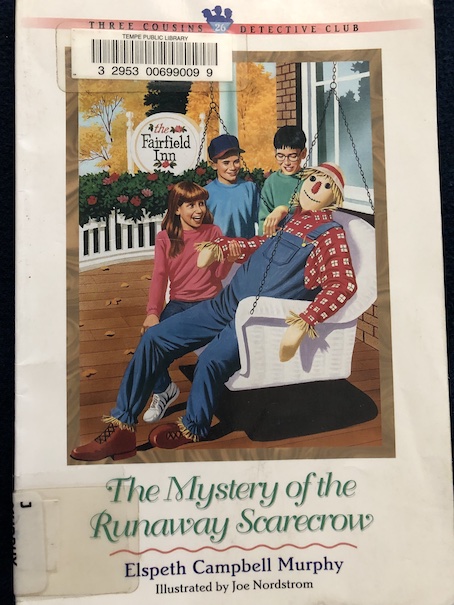
#26 The Mystery of the Runaway Scarecrow by Elspeth Campbell Murphy, 1999.

Sarah-Jane astonishes her cousins when she tells them that Buster, the scarecrow her mother made, which has been sitting outside of a local restaurant, has gone “on vacation. Scarecrows don’t just get up and go on vacation, and when they say that, Sarah-Jane says that Buster left a note saying that he had gone on vacation. The boys don’t believe scarecrows can write notes any more than they can go on vacation. Sarah-Jane admits that scarecrows don’t write notes, but someone else wrote a note on Buster’s behalf and left it behind when Buster disappeared. The note says that Buster is going on vacation and will be back when someone figures out where he’s gone. That’s weird enough, but Sarah-Jane says that Mr. Wesley, who owns the restaurant where Buster was, has been receiving pictures of Buster on his trip in the mail since he disappeared.

It seems like someone is playing a bizarre prank or maybe setting up some kind of treasure hunt involving the scarecrow. The town mayor says that Buster’s “vacation” has created more publicity for the town’s upcoming Fall Festival, so it could even be a publicity stunt. However, it’s been a few days since the last pictures of Buster arrived, and Mr. Wesley is inviting Sarah-Jane and her cousins to investigate Buster’s disappearance and find him because he knows that they like to solve mysteries.

The kids study the pictures for clues to Buster’s whereabouts, but the pictures are pretty generic. They show him outside a motel, at a gift shop, and at a gas station, but the locations aren’t very distinctive and could be found in any number of cities. The postmarks on the envelopes that pictures came in are all still in the area, so it seems like Buster didn’t go very far. They need to hurry if they’re going to find Buster in time for the town’s parade because the parade is tomorrow!

Then, Sarah-Jane reveals that something else mysterious has happened in the area recently. Someone stole a rare coin from Mr. Clark. This is also an intriguing mystery, but they don’t have many clues to start. Mr. Clark isn’t exactly sure when the coin disappeared because he doesn’t get out his coin collection very often.

For some strange reason, an older boy in Sarah-Jane’s neighborhood, Billy, seems very concerned about whether Sarah-Jane and her cousins have made any progress in finding Buster. Could Buster’s disappearance also have something to do with the missing coin?

Theme of the Story:

“The land has produced its harvest; God, our God, has blessed us.”

Psalm 67:6

The book is available to borrow and read for free online through Internet Archive.

My Reaction and Spoilers

I liked the way the person who took the scarecrow used the pictures to provide clues to their treasure hunt. Readers won’t be able to figure it out right away without explanation from the characters because the book doesn’t show all the pictures, but I liked the concept for how the culprit worked a series of clues into the pictures. There’s also a fun backstory behind the scheme. The prankster doesn’t have a sinister motive. The scarecrow caper is meant as a kind of prank/game/harmless publicity stunt.

I guessed pretty quickly who had taken the scarecrow, based on motive, but I liked the addition of Billy and the coin because it complicated the story and provided a second mystery on top of the first. There is a genuine crime in the story, but it’s not the one that the kids start out investigating.

The story takes place during October, but it’s not on Halloween. The town’s Fall Festival just seems to kick off the fall season in general.

The Mystery of the Sinister Scarecrow

The Three Investigators

#29 The Mystery of the Sinister Scarecrow by M. V. Carey, 1979.

Jupiter Jones is going on a buying trip with Hans and Conrad, the men who work for his uncle’s salvage yard, to see someone who had some things to sell to his uncle. Jupiter’s friends, Bob and Pete, go with them, but they’re all stranded when their truck blows a tire. They look around for a place where they can call the salvage yard to explain their situation and get help, and they see a large house with a cornfield nearby.

However as Jupiter approaches the house to ask to use the phone, he is suddenly tackled by a man with a jagged rock in his hand! Hans comes to his defense, and the man is surprised and sorry when he realizes that he’s just tackled a boy. It turns out that the man is nearsighted and has lost his glasses on the ground. He starts to explain that he thought that he was tackling a scarecrow, and then, he suddenly stops and says that he’s been having trouble with trespassers. Jupiter asks him what meant when he talked about the scarecrow, but the man dodges the question. Instead, he asks them why they’re there, and they explain about wanting to use the phone.

The man invites them into the house to use the phone. The man isn’t really a farmer. His name is Dr. Wooley, and he’s an entomologist who’s working on a book. He’s studying army ants, which are carnivorous. He shows them the colony he’s studying, but the sight of all those ants just encourages them to finish their call and leave fast.

However, Jupiter is still intrigued about why Dr. Wooley seemed to attack him because he thought he was a walking scarecrow. He persuades Bob and Pete to return to the area with him to investigate. When they stop in a cafe, a man there hears them talking about the scarecrow, and he says that he’s seen the walking scarecrow himself. He works in the area, doing security for a nearby museum. The boys ask him for details about his sighting of the walking scarecrow, and he says that he saw it near the Radford house, which is where the boys met Dr. Wooley.

When they go to the place where the man saw the scarecrow, they meet a woman named Leticia. Leticia asks them what they’re doing, and they explain about looking into a sighting of a walking scarecrow. Suddenly, Leticia gets very excited. She has seen the scarecrow herself, but no one will believe her. She asks the boys if they will come to the house and explain to Mrs. Chumley that she really did see a walking scarecrow.

Leticia Radford is a jet-setting heiress who lives in the mansion by the cornfield. Mrs. Chumley has been with her family a long time as a secretary and housekeeper, but she’s been confined to a wheelchair for years after being in a car accident. Leticia spends most of her time traveling in Europe, but she returns home periodically, usually after one of her disastrous romances. She has phobias of both insects and scarecrows. Actually, her fear of scarecrows is related to her fear of insects and other creepy-crawly things. Leticia explains that, when she was a child, a scarecrow fell on her when she visited a pumpkin patch one Halloween, and when it broke apart, it had spiders in it, so she always associates scarecrows with bugs. Until the boys explain that other people have seen the walking scarecrow, Mrs. Chumley had thought that Leticia had imagined it.

Leticia blames Dr. Wooley for the walking scarecrow because he made a scarecrow after he moved into the cottage on the estate property to do his research on the ants. Dr. Wooley makes her nervous because she associates him with both bugs and scarecrows. Leticia says that the scarecrow seems to be targeting her because it has shown up multiple times, seemingly looking for her, and once, it hid in her car and threw bugs on her.

While the boys are in Leticia’s mansion, explaining to the other people in the house that Leticia hasn’t imagined the scarecrow, Dr. Wooley shows up, angrily accusing the boys of faking their car trouble the day before just to get into his lab. Dr. Wooley says that someone dressed as a scarecrow entered his lab, hit him on the head, and stole a jar of some of the ants he’s been studying. It doesn’t take them long to figure out where the ants went because Leticia finds them in her bedroom, along with the jar from Dr. Wooley’s lab.

It’s obvious that someone is purposely trying to frighten Leticia by dressing as a scarecrow and tormenting her with bugs, the two things guaranteed to terrify her. The boys are surprised when Dr. Wooley is the one who hires them to find the person tormenting Leticia. Dr. Wooley says that he isn’t responsible for frightening Leticia, but he can see that it all looks bad for him because he was the one who made a scarecrow and the ants in Leticia’s room were his ants. He doesn’t want his professional reputation ruined, and he also feels sorry for Leticia. Leticia can’t figure out why anyone would target her because she’s never been a threat to anyone, but she may be more of a threat to someone than she knows.

My Reaction

The combination of a mystery involving scarecrows and insects and someone who is afraid of both scarecrows and insects is a little strange, but I thought the author did a good job of explaining how the two are related in this story. Leticia’s two fears are connected because she thinks of scarecrows as being homes for bugs.

One of my questions during the mystery was wondering whether someone is trying to convince Leticia that she is crazy (“gaslighting” her, like in the movie of the same name) or just trying to drive her away from the house. I had a couple of theories about what could be going on. Some of what I considered turned out to be right, but someone I suspected turned out to be completely innocent.

At first, I also wondered if there would be an unexpected romance between Leticia and Dr. Wooley because the story establishes that they are both single, and there are points when they hang out together when they don’t have to. However, the story doesn’t end with any clear romance. Leticia is still afraid of insects at the end, which would make romance with an entomologist awkward. She does allow Dr. Wooley to continue his work on her property, though. The boys also notice that Leticia seems to branching out and finding new interests at home rather than running off to Europe again, so that might represent some new developments in her character and a possible turning point in her life.

The Vanishing Scarecrow

The Vanishing Scarecrow by Phyllis A. Whitney, 1971.

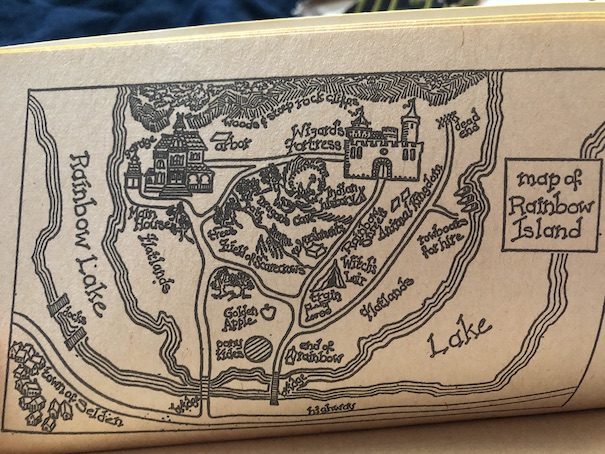
Joan Lang and her mother are moving from their town in Connecticut to Rainbow Island, where Joan’s Great Uncle Agate Benson owned his own amusement park. However, the move is sad because Great Uncle Agate’s death in a skiing accident has so closely followed Joan’s father’s death from a long illness. Joan and her mother knew that they were going to have to move to a smaller house because they could no longer afford their bigger one, and Uncle Agate’s sudden death means that they will inherit his house on Rainbow Island and the amusement park that goes with it. Joan and Uncle Agate had been writing letters to each other since her father’s death, and he made her feel less lonely, so Joan knows that she will miss him, but she is looking forward to seeing the amusement park that he had described to her.

However, the terms of Uncle Agate’s will are unusual, and his lawyer is vague on some aspects of them. What they know is that they must live at Rainbow Island and manage the amusement park for three years in order to gain full ownership. If they decide to leave before that time, Uncle Agate has another plan for the amusement park, but the lawyer refuses to tell them what it is immediately.

When they arrive at Rainbow Island, they meet Mrs. Fuller, who works at the amusement park’s gift shop and lives there with her two sons, Peter and Kent. Mrs. Fuller hopes that Kent and Joan will be friends because they’re close in age. Kent doesn’t seem particularly friendly at first, and when Joan confronts him about that, he says that he’s just trying to figure out what she and her mother are going to be like. Kent, like other people who live and work at Rainbow Island, was very attached to Uncle Agate. He appreciated his vision and imagination, and he misses him now that he’s gone. He has trouble believing that things will ever be like they were with Uncle Agate.

Mrs. Fuller and Kent both mention strange things that have been happening at the amusement park recently, including a scarecrow that frightened Mrs. Riddell, the wife of Wilson Riddell, who manages the park, but she says that she’d better let Mr. Riddell explain the situation. When Joan and her mother go to Uncle Agate’s old house to begin unpacking their things, Mr. Riddell comes to talk to them. He doesn’t seem particularly welcoming, either. Joan’s mother tries to ask him about the scarecrow incident, and he explains that someone, possibly a teenage prankster, has been pulling tricks around the park lately. Earlier that day, someone ran right through the Riddell house, terrifying Mrs. Riddell. Mrs. Riddell is described as being a very nervous person who is somewhat unwell, so Mr. Riddell seems uncertain whether his wife actually saw a person dressed as a scarecrow, as she described, or if that was her imagination. Earlier, she also claimed to see a witch. The idea of someone in a scarecrow costume is plausible because the amusement park includes a field of scarecrows, and they do have a spare scarecrow costume that they’ve used in the past to make it look like one of the scarecrows has come to life, to give guests a bit of a thrill. However, the employee who normally wears the costume hasn’t worn it for some time, and it seems like the recent scarecrow sightings are the work of a prankster.

As Kent shows Joan around the amusement park, they meet up with Peter in the Wizard’s Fortress, where he points out that someone has been messing around with the dioramas of historical scenes, moving some of the little figures around to scenes where they don’t belong. In the dungeon of the fortress, Joan meets up with Mr. Riddell’s daughter, Sheri, who is also about her age. Sheri has found the costume the scarecrow was wearing under some straw. Joan isn’t sure that she trusts Sheri because of the strange way she acts and how she seems to be sneaking around, keeping secrets, and playing weird pranks and tricks.

Could Sheri have something to do with the mysterious scarecrow, or could it be Emery Holt, the man who did odd jobs for Uncle Agate and sometimes wore the scarecrow costume as an act in the park? Another suspect could be Jud Millikin, an escaped convict who used to live in the area and who still has family living nearby. Joan and her mother hear people whispering about him, wondering if he might have come back to see his sick daughter, although people say it isn’t likely that he’d show his face in town since the police are looking for him. But why would he want to sabotage the Rainbow Island amusement park? Joan considers that there might be an answer closer to home when she learns that the Riddells and the Fullers don’t really get along, and there seems to be a silent power struggle between them for control of the park. Either of the families might want the other to leave, plus Joan and her mother, so they can be in charge.

Joan finds a message and an audio recording left behind by Uncle Agate for her, in which he seems to have had a premonition of his impending death and saying that the reason why he wants Joan and her mother to manage the park with Mr. Riddell is that the park needs someone with a fresh imagination to keep creating new exhibits and keep the park interesting for new generations of children. Joan wants to find out who is sabotaging the park and to keep Uncle Agate’s vision for the park alive, but her mother isn’t so sure that the situation is going to work for them.

Joan does have a fantastic imagination. She loves writing and making up stories, and she finds the atmosphere of the amusement park inspiring. However, Joan’s mother worries sometimes that Joan lives too much in her stories and doesn’t face up to reality enough. When Joan accuses her of not liking her stories, her mother says it’s not that, it’s just that writers also need a grounding in real life and the real world, and that it’s not good to use fantasies as a way of ignoring real life. She says that Uncle Agate was like that. Uncle Agate and his sister were orphaned from a young age, and while his sister was adopted by a family, Uncle Agate remained in the orphanage for the rest of his youth. When he grew up, he became successful in the toy industry, which was how he gained enough money and expertise to start his amusement park. However, Joan’s mother believes that much of what he did with the park was trying to live out childhood fantasies from his deprived youth and forget the hard realities of it. Joan’s mother says that she finds the real world outside of the amusement park more compelling, and she doesn’t want Joan to live too much in fantasy.

Joan is attracted to fantasy, but she’s realistic enough to know that there won’t be any hope for the park until she learns the true identity of the mysterious scarecrow that is trying to sabotage it. In the recorded message he left for Joan, Uncle Agate refers to a “right place” where Joan will find instructions that will tell her what to do. As Joan explores the the amusement park, familiarizing herself with the attractions and exhibits, she searches for the place that Uncle Agate referred to. Along the way, she has frightening encounters with someone dressed as a witch and the dangerous scarecrow among the regular figures in the exhibits.

My Reaction and Spoilers

The atmosphere of the story is great, and the author does a good job of making everyone Joan meets look like a potential villain or accomplice. All through the book, I kept changing my mind about who the real scarecrow was, and there are red herrings in the form of other people dressing up in costumes. Joan is never sure who to trust. There is a major twist toward the end of the book that turns the entire situation on its head. The rest of the ending after the scarecrow’s identity was revealed seemed a little abrupt to me, but the story has a good overall message.

At the beginning of the story, Joan does actually look at the amusement park on Rainbow Island as a kind of fantastic sanctuary from her problems, where she can escape from the sad loss of her father and uncle and the problems she’s been having at school. However, she learns that the amusement park isn’t really a sanctuary because it has problems of its own and the people associated with it also have their problems. However, these are problems that Joan is more motivated to solve because they are more exciting than her problems back home, and the stakes are high.

Joan and her mother have a frank discussion about facing up to life’s problems, and Joan points out that her mother’s impulse to run away from the park isn’t that different from her reluctance to face up to her problems with her schoolwork. Joan’s mother doesn’t find the park as interesting as Joan does, so she’s not as interested in trying to save it as Joan is. It’s similar to the way that Joan was unmotivated to work harder at school because it bored her, it was less imaginative than the creative writing she likes to do, and she was preoccupied with other major changes in her life. Joan’s mother acknowledges the truth of that, that it’s easier to try to solve a problem when you’re more motivated to work on it, and the two of them agree that, whatever else they do with their lives, they can’t just abandon the park without trying to catch the saboteur.

All of the characters in the story get new perspectives on their lives from this adventure, seeing how the park and their problems fit into a much bigger picture of life. Joan comes to understand that there are some problems that she’ll still have to face up to, like her school problems, no matter what else happens, and she sees that understanding the real problems that real people have is what will give her characters and stories greater depth.

The Little Old Lady Who Was Not Afraid of Anything

OldLadyNotAfraid

The Little Old Lady Who Was Not Afraid of Anything by Linda Williams, 1986.

“Once upon a time, there was a little old lady who was not afraid of anything!”

This is a cute picture book based on word and sound repetition.

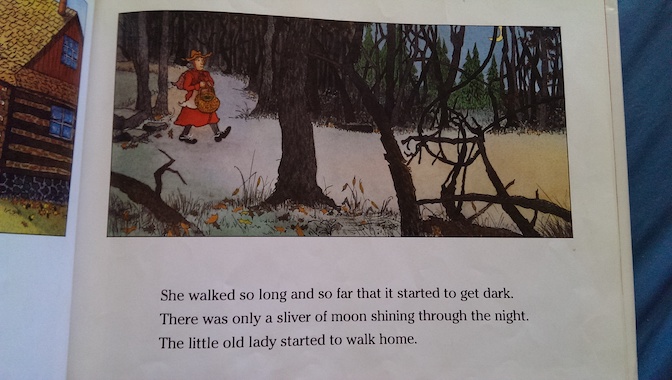
A brave lady ventures out into the woods one day, and as she makes her way home again when it gets dark, she begins to encounter some strange things.

OldLadyWoods

First, a pair of shoes with no one in them begin to follow her.  Then, she meets a part of pants with no one in them, and a shirt joins the parade of  clothes.  But, as weird as it is, nothing frightens the lady, not even the addition of a living jack o’lantern.

OldLadyClothes

OldLadyRun

When everything fails to frighten the woman (although she does look a little scared at one point), she has to help this strange collection of living clothes and pumpkin head to find a new purpose for themselves.

The book is currently available online through Internet Archive.

OldLadyScarecrow