The Lottery Rose

LotteryRoseThe Lottery Rose by Irene Hunt, 1976.

Young Georgie Burgess has been abused his entire life by his mother, Rennie, and her boyfriend, Steve (who is not Georgie’s father, whose identity is unknown, Rennie says that she is a widow).  Rennie is an alcoholic, and she and Steve (who is the source of most of the violence in Georgie’s life) once deliberately burned the side of Georgie’s face when he was a baby because he wouldn’t stop crying and they were angry that they had run out of whisky.  Sometimes, they tie him up in a closet for days at a time with no food.  Other times, they beat him, even leaving scars.  When Rennie is confronted by the school nurse about Georgie’s injuries, she claims that Georgie is a problem child who gets into fights.  Georgie’s teacher believes that because Georgie is always acting up and doesn’t appear to learn anything, although he is actually smarter than he pretends to be.  Because the other adults in Georgie’s life either do not see his condition for what it is or do not want to acknowledge the truth of it, it is a long time before he gets the help he really needs.

Georgie’s early life is bleak, and at first, his future seems equally bleak.  The only people who seem to care about him at all are the school librarian and Mrs. Sims, who works at the grocery store.  Georgie’s real love in life is flowers.   He likes to borrow a book from the school library about flowers, and one day, he enters a drawing at the store and wins a rose bush of his very own!

It’s the best thing that ever happened to Georgie, but shortly afterward, Steve beats him so badly that the police are finally called.  Georgie is taken away from his mother, and for the first time, his life becomes different.  Georgie insists on bringing his precious rose bush with him when the police take him away, and it becomes instrumental in helping him reshape his life.

For a time, Georgie has to stay in the hospital to recover from his injuries, and then he stays with Mrs. Sims.  Unfortunately, as much as Mrs. Sims and her husband care for Georgie, they can’t afford to take care of him.  Instead, Georgie is sent to a Catholic boarding school with his new teacher and guardian, Sister Mary Angela.  Sister Mary Angela assures Georgie that he will be taken care of at the school and so will his rose bush.

Georgie thinks the school is ugly, but there is a beautiful house nearby with a beautiful garden.  It belongs to Mrs. Harper, who lost her husband and one of her sons in a tragic car accident.  Although Georgie isn’t supposed to go there, he can’t help himself.  It seems like the the perfect place for his rose bush . . . and maybe even for himself.

The tragedies and descriptions of child abuse in this story make it inappropriate for young children.  This would be a good book for kids at the middle school level, probably age twelve and up.

Georgie, who has never really known kindness in his life, blossoms like a rose at the school, making new friends for the first time and coming to terms with his past.  At the same time, Mrs. Harper, who is still suffering from the loss of her husband and son and also loses her other son (a child with developmental disabilities) during the course of the book, finds her heart warmed by Georgie.  Georgie has desperately needed a mother who acts like a real mother and really loves him, and Mrs. Harper comes to realize that she also needs a boy like Georgie to love.  While he is not a replacement for the sons she has lost, he does help to fill an empty place in her life, and the two of them become the family that each of them needs.

The book is currently available online through Internet Archive.

Arthur’s Valentine

Arthur’s Valentine by Marc Brown, 1980.

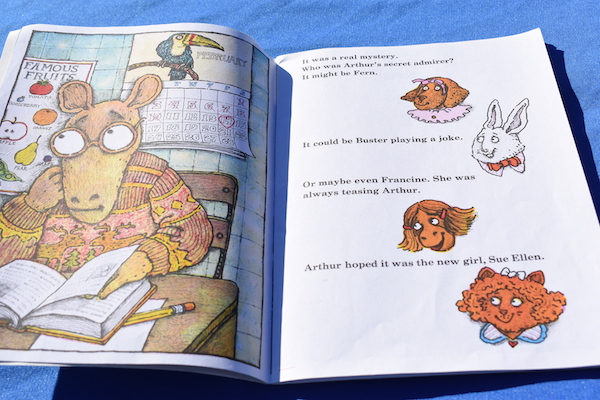
During the week before Valentine’s Day, someone keeps leaving unsigned valentines for Arthur.  He wonders who it is, thinking about the different girls in his class at school. On the other hand, maybe someone is just playing a joke on him.

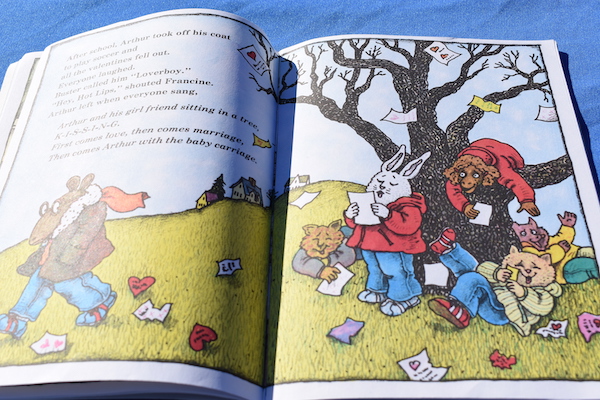
When his friends find out about his secret admirer, Arthur gets a lot of teasing.  At one point, he thinks that he knows who the secret admirer is, but when he writes a valentine of his own for her, it turns out that he’s wrong, and it leads to more embarrassment.

However, Valentine’s Day isn’t over yet. Arthur’s secret admirer gives him a movie ticket, saying that she’ll meet him at the theater.  With this last message, Arthur realizes who is secret admirer is and arranges a surprise of his own.

This is just a fun, cute Valentine’s Day story, part of the Arthur Adventure Series.

Thomas’ Snowsuit

ThomasSnowsuit

Thomas’ Snowsuit by Robert Munsch, 1985.

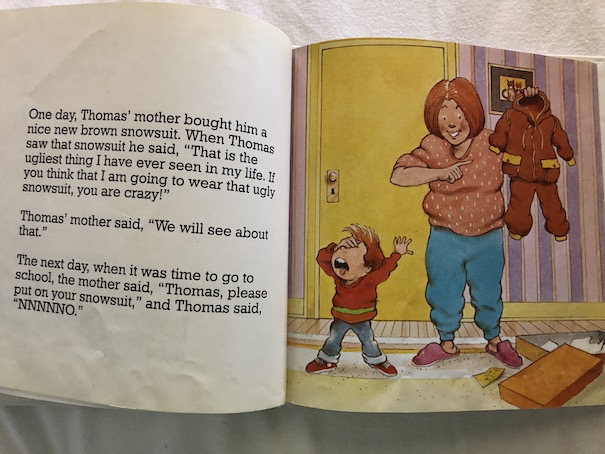
Thomas absolutely hates the new snowsuit that his mother bought him.  He thinks it’s ugly.  When it’s time for him to go to school, his mother has to wrestle him into it because he refuses to put it on himself.

ThomasSnowsuitNew

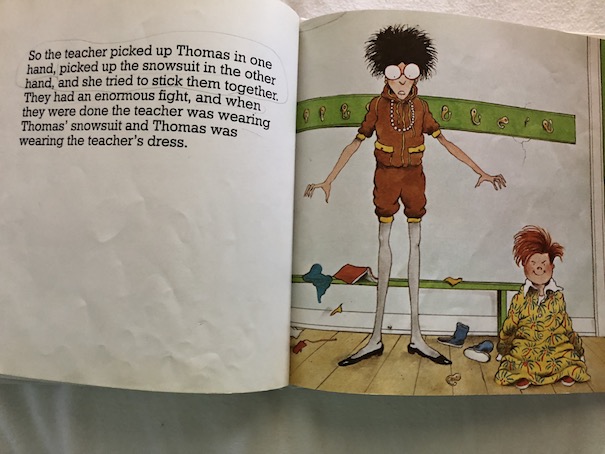
That’s fine until it’s time for Thomas to once again put on his snowsuit so he can go outside for recess.  His teacher insists that he has to wear it, but he refuses.  When the teacher tries to wrestle Thomas into his snowsuit, the results are hilarious!

ThomasSnowsuitTeacherSwitch

Thomas and his teacher end up getting their clothes all mixed up.  When the school’s principal tries to help, it only makes things worse.

ThomasSnowsuitTeacherPrincipalSwitch

Finally, Thomas is persuaded to put on his snowsuit when a friend of his wants him to come out and play.

ThomasSnowsuitFixed

Thomas eventually helps set the teacher and principal right again after recess, and the principal decides that it’s time to retire to Arizona, so he won’t have to deal with snowsuits again.

ThomasSnowsuitArizona

Like all Munsch books, the storyline is bizarre and hilarious, and half the fun is watching it unfold in the pictures!

The book is currently available online through Internet Archive.
Molly’s Pilgrim

MollysPilgrim

Molly’s Pilgrim by Barbara Cohen, 1983.

Molly has been unhappy since her family moved to the smaller town of Winter Hill, New Jersey so that her father could get a better job. In New York City, there were other Jewish girls like her, and she didn’t feel so strange and out-of-place. The Winter Hollow girls don’t understand her at all and don’t like her. Molly’s family fled Russia to escape persecution, and they’ve only been living in America for about a year.  Molly still has a Yiddish accent and doesn’t quite speak proper English yet.  Molly is constantly teased about the way she talks and her unfamiliarity with American habits.

MollysPilgrimSchool

One girl in particular, Elizabeth, makes up rhymes to make fun of Molly, even following her home from school like a creepy stalker, to continue singing them at her. The other girls follow Elizabeth’s lead because they kind of admire her and because she is always giving them candy.

MollysPilgrimBullies

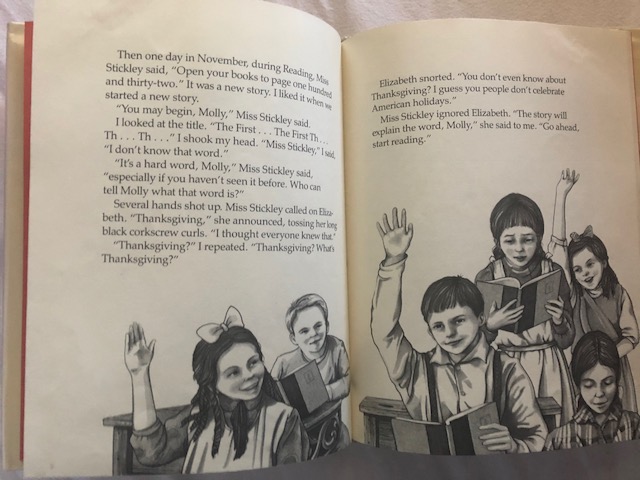
Then, one day, the girls’ teacher begins teaching them about Thanksgiving. Of course, Elizabeth makes a big deal about the fact that Molly has never heard about Thanksgiving before. But, Molly finds the story about the pilgrims interesting. The teacher says that for their Thanksgiving activity, instead of making paper turkeys like they usually do, the children are going to make clothespin dolls to look like American Indians and pilgrims, so they can create a scene like the first Thanksgiving.

MollysPilgrimClass

When Molly gets home and explains the assignment to her mother, she has to tell her mother what a “pilgrim” is. She explains it by saying that they were people who came from across the ocean in search of religious freedom. Her mother understands that and offers to help Molly with the doll.

However, when Molly sees what her mother has done with the doll, she is worried. The doll is beautiful, but her mother has dressed the doll in the clothes of a Russian refugee, like Molly’s family, not in the traditional Puritan garb of the pilgrims. At first, Molly is sure that she’ll be teased more than ever at school when she shows up with a doll wearing the wrong clothes and that people will think that she’s stupid for not understanding how pilgrims dressed.

MollysPilgrimDoll

But, Molly’s mother is correct in pointing out that their family are modern pilgrims, coming to America for the same reasons that the original pilgrims did. Molly does get some teasing from Elizabeth (that’s not a surprise, since it’s Elizabeth, after all), but when the teacher asks Molly about the meaning of her doll, it leads everyone to a better understanding, both of the holiday and where Molly and her family fit in with their new country and its history.

Molly’s teacher points out that the holiday of Thanksgiving wasn’t entirely an original idea that the pilgrims invented all by themselves but that they took their inspiration from a much older Jewish tradition from the Old Testament.  Human beings do not exist in a vacuum, and we all regularly take ideas that we’re exposed to and build on them in our own lives.  Although Puritans were generally known for their belief in religious “purity” (hence, their name) and noted for their intolerance to different religions and beliefs, they also strongly believed in education, which frequently involves taking past ideas and knowledge and applying them toward new situations.  Their Thanksgiving celebration was just an example of that, an older idea that they used for their own purpose, adapted to the lives of the people who adopted the tradition.  It was their celebration, but not their sole intellectual property.

The book is currently available online through Internet Archive (multiple copies).

There is also a sequel to this book called Make a Wish, Molly, in which Molly learns about birthday parties in the United States.

My Reaction and Additional Information

The book doesn’t mention it, but the word “pilgrim” itself is also much older than the early Puritan colonists in America.  Before the development of the America colonies, it referred to any religious traveler on their way to a holy place, and many people still use it in that sense.  A person on a pilgrimage could be just about anyone from anywhere going to anywhere else as long as the journey has spiritual significance.  The Puritan colonists used that term for themselves to emphasize the reasons why they were seeking new homes in a new land.  For them, it was a kind of pilgrimage to a place where they could start again.  Molly’s family came to America in search of religious freedom, just as the Puritans did.  Their journeys weren’t quite the same, but they shared a common purpose and ended up in the same place (more or less).

By showing the links between Molly and her family and the pilgrims, Molly’s mother and her teacher help the other students to understand that Molly really does fit in, that her being there makes sense, and that she has a place in their class and in their celebration of Thanksgiving.

This story was also made into a short film. I remember seeing it in school when I was a kid in the early 1990s.  I checked on YouTube, and there are trailers posted for this film.  One thing that I hadn’t remembered from when I was a kid was that the time period of the book was earlier than the film.  In the film, the characters are shown to be contemporary with the time the film was made, but the style of dress of the girls in the book’s pictures and the things that Molly’s mother says about why the family left Russia indicate that the book probably takes place during the late 19th century or early 20th century, possibly around the same time as the events in the famous play/movie Fiddler on the Roof.

As a side note, if you’re wondering why the girl is named Molly, which doesn’t sound particularly Russian, Molly is typically a nickname for Mary and other, similar-sounding, related names.  Molly’s mother also calls her Malkeleh, which may be her original name or perhaps another variant, if her original name was Malka, as another reviewer suggests.

In spite of the warning on that last site I linked to about reading a book with your child that may be covered in class, I say to go ahead and read it anyway.  It’s hard to say what books may or may not be used in classes by individual teachers, and if your child’s teacher doesn’t happen to use this one, it’s still a good story.  Perhaps just warn your child not to say something that would spoil the ending for their classmates who haven’t read it yet.

Eat Your Poison, Dear

EatYourPoisonDear

Eat Your Poison, Dear by James Howe, 1986.

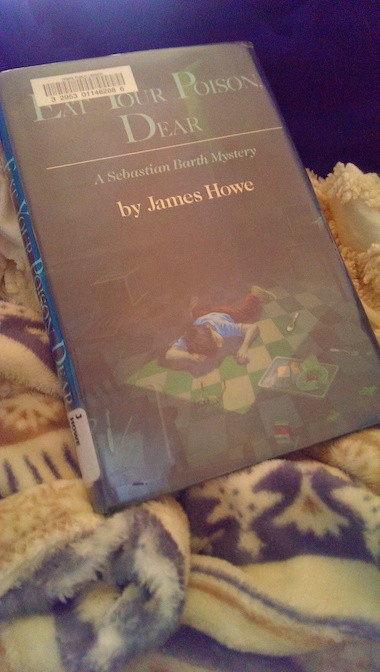
Milo Groot is the editor of the school paper at Sebastian Barth’s school. Milo is something of a social outcast at school, but after he gets extremely ill eating in the school cafeteria, Sebastian and his friend David begin to wonder if there’s been some foul play. Although everyone thinks it’s just a bad case of the flu at first, it’s strange how Milo’s symptoms only come up after eating lunch at school.

Milo recently wrote an editorial for the school paper, criticizing a group of boys at school who have adopted kind of a “greaser” look, wearing leather jackets, smoking cigarettes, wearing temporary tattoos (so badass), and calling each other by biker-style nicknames. The biker boys, who like to call themselves the Devil Riders (they don’t actually have motorcycles, but they like to stand around and look at pictures of them a lot), have been kind of mean to other kids, even former friends, but the school’s principal says that there’s no school rule against simply wearing leather jackets, so there’s nothing he can do about their biker persona. Milo starts up a petition against them, though, trying to get the principal to crack down on their little group. Could one of them be behind Milo’s poisoning?

Then, suddenly, two more kids at school get sick in the same way. The school cafeteria has always gotten good health ratings, leading Sebastian to think that whatever is harming people at school must be deliberate. Soon, whatever is harming the students affects a large part of the student body, with seventy-seven students all getting sick on the same day. But, still, who is doing it and what is their motive?

The book is currently available online through Internet Archive.
My Reaction and Spoilers

The story gets somewhat philosophical about the nature of hurt and why people hurt each other. Sebastian asks his friend Corrie’s father, Reverend Wingate, for his opinion about why people hurt others. Sebastian’s grandmother thinks that people hurt others because of some hurt that they have themselves. This is part of the reason why the Devil Riders act the way they do. It is revealed that the leader of the little gang, Harley (not his real name, that’s his “biker” nickname) has a very unhappy home life that he often lies about to others. Acting tough with his friends and pushing other people around is his way of dealing with it. One thing that Reverend Wingate notes is that “There is no way for people to stop hurting one another except to stop.” He relates it to the arms race of the Cold War (contemporary with when the story was written), saying:

“If we justify building up our own arsenals because they have more weapons, then we only heap one folly on top of another. There comes a time when we must say, ‘Enough! I don’t have to have more toys than you. I don’t need the last word. I will turn the other cheek.’”

In other words, some battles aren’t worth fighting because the cost is too high, higher than the gains of victory, and in those cases, it’s better just to move on. In a way, both Sebastian’s grandmother and Reverend Wingate are correct; the villain that they’re looking for is someone who’s been harboring hurt for a long time and hasn’t yet realized the cost of getting revenge.

I found it interesting when Harley (who is not the villain, even though he is the primary suspect for a time) tells Sebastian that a person who is less popular than others is at a disadvantage when they do something wrong. Harley says that his social worker tells him, “. . . everybody makes mistakes. She says, you make a mistake on the blackboard, what do you do? You erase it and try again. I say to her, sometimes somebody writes on the blackboard with a magic marker, just to be mean, and everybody sees it and nobody can erase it away. It’s always there, and always will be the rest of your life.”

Popularity can make other people more willing to forgive a wider range of behavior, however I think that the situation that Harley describes is less a matter of popularity and more of method and intent. When someone does something “just to be mean,” it’s always going to leave a mark, at least emotionally, and “magic marker” isn’t meant to be erased, so it’s a bad choice for someone airing only temporary feelings.  If he had chosen chalk, then yeah, whatever mean or rude thing he wrote would have been erased and forgotten, but Harley didn’t do that, and that’s his own fault. If his aim was to hurt people, he can’t legitimately complain that people got hurt because all that happened was that he succeeded in what he deliberately set out to do. He also can’t legitimately complain about lasting consequences when he deliberately chose a lasting form of inflicting that hurt.  Some people just have poor priorities and bad strategy, and that’s what gets them into trouble.  Harley is still blaming other people for his own bad choices, and he’s going to continue having problems until he realizes that he, and he alone, is the one responsible for the thing he does and only he can change what he decides to do.

That being said, some things that are apparently permanent aren’t really, if you know how to clean up after yourself and have the will to do it.  You can even get permanent marker off of a chalkboard, if you have some rubbing alcohol.  People have figured out how to do that because there are times when they’ve had the need to do it, and they tried ways to fix the situation until they found what worked.  Life is like that.  You can gripe about things being wrong and unfixable, or you can try ways of fixing things before you decide that they’re impossible to fix.  People also appreciate people who make an effort.  Harley needs to learn both how to behave himself in the first place and how to clean up after himself in the second.  He could use a practical adult who understands how to fix things, and he needs to develop the mindfulness to keep himself from creating more problems to solve.

Before the story is over, Sebastian himself makes a big mistake, accusing the wrong person because he made a false confession. However, Sebastian is willing to face up to the apologies that he will owe others after he learns the truth, realizing that a false accusation was part of what the real villain was hoping for. Anger is also a kind of poison. Truth can hurt at first, but unlike poison, it can make things better.

Blossom Culp and the Sleep of Death

BlossomSleepDeathBlossom Culp and the Sleep of Death by Richard Peck, 1986.

This book starts shortly after the previous book in the series ends.  After Blossom’s old history teacher was run out of town for his scandalous behavior, he was replaced by Miss Fairweather.  Miss Fairweather is a tough, no-nonsense woman who pushes her students to study hard and take history seriously.  Unexpectedly, she comes to appreciate Blossom, an outcast from a poor family, because Blossom demonstrates some knowledge of Ancient Egypt.  Little does Miss Fairweather know that Blossom’s comments in class were inspired by one of the visions that Blossom occasionally gets because of her psychic gifts.

Blossom experiences a visitation from the spirit of an Ancient Egyptian princess who says that she needs Blossom’s help.  Years ago, her mummy and some precious objects were stolen from her tomb.  The princess doesn’t seem to know exactly where her “earthly form” is now, but she’s sure that it’s somewhere nearby.  She’s very concerned because she senses that archaeologists in Egypt are digging to find her tomb and knows that when they finally reach it, they will discover that she isn’t there.  Rather than being concerned about her tomb being violated by the archaeologists, the princess senses that they are searching for her remains in order to venerate them, that if they find her mummy, they will take it to a place of great beauty where it will be treated with the utmost care and respect (a museum).  She wants that and fears that she will miss her chance at the kind of immortality that this form of glorification, care, and study will provide.  So, she asks Blossom to find her earthly remains and inform the searchers of her true whereabouts.  At first, Blossom has no idea how she can accomplish that, but the princess threatens her with a true Egyptian curse if she doesn’t try.

Then, Blossom receives a clue to the mystery in the form of a beautiful Egyptian scarab that her mother found one day while she was out scavenging.  If Blossom can find the place where her mother found the jewel, she can also find the princess’s mummy.  Fortunately, Miss Fairweather has assigned the class special projects about Ancient Egypt, and she is thrilled when Blossom says that she wants to study grave robbers.  Blossom sees this as a good way to collect some extra information about grave robbers that she can use to find the princess’s mummy as well as get a good grade in Miss Fairweather’s class.  It also proves to be an excellent way to draw Alexander Armsworth into her search for the mummy.

Alexander still denies to Blossom that he has real psychic abilities like hers, even after their previous adventures together.  He insists that it was just a phase that they were going through, one that he wants to leave behind.  He’s been busy flirting with Letty, the class snob, and he’s trying hard to get into a prestigious fraternity so that he can give Letty his fraternity pin.  Not only does Blossom think that the boys in the fraternity are a bunch of idiots who do stupid things, but the idea of Alexander giving Letty his pin as a sign of their relationship is just sickening.

Blossom is reluctant to admit her real feelings for Alexander, but the two of them are close in ways that Letty and Alexander never will be because of their shared abilities and adventures, and Blossom has a sense that their futures will be intertwined as well.  Alexander is angry that Blossom is roping her into yet another supernatural escapade, but he has to go along with her project idea because he has already gotten on Miss Fairweather’s bad side and needs to do well on the project to save his grade in class.

Along with the supernatural adventure, there is also a look into the past, the world of 1910s America as well as Ancient Egypt.  First, there are the traditions of stunts associated with Alexander’s initiation into his fraternity and the tradition of giving a girl a fraternity pin as a precursor to engagement (“engaged to be engaged”).  Then, they discover that Miss Fairweather is a suffragette, which is the reason why she left her previous teaching job.  Her feminist ideals cause problems for her in her new, small town when they become known, but with Blossom’s help, she wins over some of the influential women in town as well as a male admirer.

The book is currently available online through Internet Archive.

The Dreadful Future of Blossom Culp

DreadfulFutureBlossomCulpThe Dreadful Future of Blossom Culp by Richard Peck, 1983.

This book is part of the Blossom Culp Series.

It’s 1914, and Blossom Culp is just starting high school. Although the principal of her old school tells her that this is a chance for her to make a fresh start, it looks like Blossom’s future is going to be very much a continuation of her immediate past.  In high school, she’s still a social outcast, looked down on by girls from better-off families, like Letty, the class president.  Also, despite her principal’s assertion that Blossom’s previous forays into the occult were imaginary, the product of the mental confusion that accompanies puberty, and that she is bound to grow out of them, Blossom knows that her psychic abilities are a natural gift and will not be ignored.

Blossom begins high school friendless because Alexander Armsworth has been ignoring her lately because of his important new position as class vice-president, his infatuation with Letty, and his friendship with a couple of local hooligans, Bub and Champ. Alexander is looking forward to his role in planning the school’s Halloween Festival, telling Blossom that he’s over their earlier, childish occult escapades and the Halloween pranks he used to pull.  Meanwhile, all of the other girls in school are infatuated with their handsome history teacher, Mr. Lacy, and so is the girls’ gym teacher, much to Blossom’s disgust.  Blossom thinks that Mr. Lacy is full of himself and denies that she has any such silly crush on Alexander.

Blossom makes an unexpected friend in a girl called Daisy-Rae, a girl from the country who has brought her younger brother into town to attend school and hoped to get an education herself but has been too afraid of the big town to actually attend classes.  Daisy-Rae hides in the school during the day and lives alone with her brother at night in the old chicken coop at the abandoned Leverette house.  It is through Daisy-Rae that she learns that Alexander and his friends aren’t so above childish pranks as they claim to be.  Blossom also discovers that Mr. Lacy has been romancing her old principal.  Mr. Lacy isn’t quite what he appears to be and has some unsavory secrets in his past.

Matters come to a head when Alexander (at Letty’s urging) tries to persuade Blossom to dress up and become the fortune teller for the haunted house that the freshmen class is doing for the Halloween Festival.  The haunted house is also a fundraiser, and Letty figures that they can get extra money from people if they’re willing to pay to have their fortunes told, and who would be better for the job than Blossom?  However, Blossom isn’t one to go out of her way to please others, especially Letty, and it turns out that they’re holding the haunted house in the Old Leverette place.  For some reason, that old house makes Blossom’s mother uneasy.  She seems to think that it’s haunted, but in an unusual way.  Blossom tells Alexander that she will not agree to be their fortune teller until he agrees to check out the house with her before Halloween and find out what’s wrong with it.  She figures that, since both of them are psychic, they can learn what’s so unusual.

As Blossom learns, her abilities don’t confine themselves to the past and people who have died but extend to the future and the people who haven’t yet been born.  Inside the Old Leverette house, Blossom suddenly finds herself entering the distant future, the 1980s.  In the 1980s, the Leverette house is once again lived in, and Blossom meets a boy named Jeremy who is a lonely social outcast, like herself.  Jeremy is a computer nerd, living with his divorced mother.  He takes Blossom on a tour of their town as it is in Blossom’s future, much larger than it used to be and with many familiar landmarks missing.  However, what Blossom sees in the future gives her the inspiration she needs to solve her problems in the past and hope that things will improve.  In return, she also proves to Jeremy that he is far from alone and has had a friend for longer than he ever imagined.

The time travel to the 1980s comes off as being a little corny (or so it seemed to me), but the writing quality of the book is excellent.  The author has an entertaining turn of phrase, and the book, like others in the series, is humorous and a lot of fun to read.

Besides being a kind of fantasy story, there are some interesting tidbits of history in the book, showing how people lived in the 1910s.  Blossom explains about the things she and her classmates did at school, like wearing beanies on their heads to show which year they were (freshmen, future graduating class of 1918).  At one point in the story, Blossom takes Daisy-Rae and her brother to their first movie, a silent film with an episode of The Perils of Pauline serial.  While Blossom worries about the future, readers can get a glimpse of the past!

As for what Blossom learns about her own future, she avoids finding out too much because she’d rather not know the details.  However, there are implications that she and Alexander may eventually marry and live in his family’s old house.

The book is currently available online through Internet Archive.

Molly Learns a Lesson

MollyLesson

Molly Learns a Lesson by Valerie Tripp, 1986.

MollyLessonHideoutIn 1944, everyone is concerned with finding ways to help the war effort.  In Molly’s third grade class at school, her teacher announces that their class is invited to participate in the Lend-a-Hand contest.  The class will be divided in half, and each half will compete against the other to find the best way to help the war effort.  The class decides to make the contest boys against girls, and Molly immediately starts trying to figure out a spectacular idea that will impress everyone.  Unfortunately, one of the other girls says that the girls in class should knit socks for soldiers, and the teacher accepts that as the goal for the girls’ team, before Molly can say anything.

MollyLessonCollectingMolly is appalled at the idea of knitting socks.  It’s partly that she had wanted to be the one to come up with the best idea, and it’s also partly because she has tried knitting before, and she knows that socks are difficult, time-consuming projects, especially for beginning knitters.  Molly is sure that the other girls are going to find it too difficult and that, in the end, they’ll have nothing to show for their project.  Her friend Susan doesn’t think that the project sounds so bad, but Linda also dreads the idea of knitting because she’s not very good at it.  Talking it over in their secret hideout in the storage area of Molly’s garage, the three girls decide that they’ll work on a secret project by themselves, something that will save the day when the other girls’ project falls through.

At first, the idea of doing something in secret sounds exciting.  However, coming up with a good secret project and seeing it through turn out to be more difficult than they expected.  All they can think of to do is to collect bottle tops for scrap metal, and as they go door to door in the rain, asking for them, they learn that most people have already given theirs to the Boy Scouts who were collecting scrap metal.  Tired, wet, and discouraged, the Molly and her friends decide to look in on the other girls and see what progress they’re making.

MollyLessonBlanketThe other girls are certainly a lot more comfortable, knitting inside.  However, as Molly predicted, they are finding their project harder than they thought it would be.  None of them has completed an entire sock yet; all they really have are the square shapes at the top of the sock, and they’re getting discouraged.  That’s when Molly gets a better idea: why not take the squares they’ve made and turn them into a blanket?  Simple squares are much easier to make than socks, they can make a lot of them quickly with everyone helping, and the girls who can’t knit well can sew the squares together.  A blanket is still a good war effort project because Molly’s father has told her that the hospital where he works is always in need of blankets for the wounded soldiers.  With this new idea, the other girls become much more excited, and they make more progress.

The theme of this story is that working together and sharing ideas benefits everyone more than working alone or trying to be too competitive.  Molly’s first ideas weren’t very good by themselves, and neither was the sock-knitting idea.  However, when Molly and her friends join the other girls, Molly finds a way to help them build on the idea that they already had (knitting) and take it in a better direction.  Molly and her friends also explain to the other girls about the bottle tops they were trying to collect, and some of them think of other places where Molly and her friends didn’t go for their collecting.  All of the girls working together manage to finish the blanket and collect 100 bottle tops in a single day, surprising and pleasing their teacher.

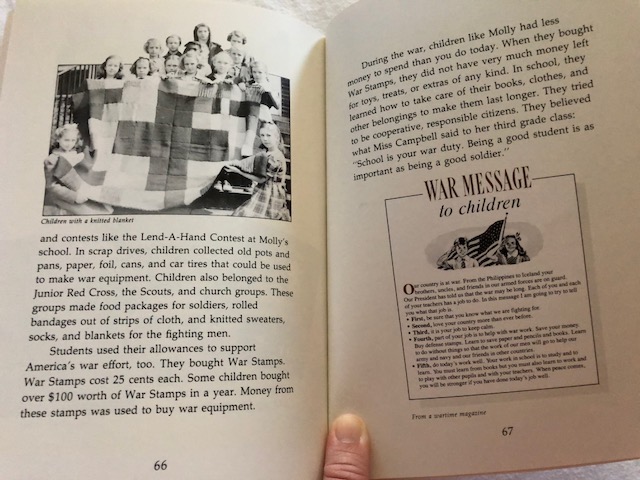
In the back of the book, there is a section with historical information about what it was like to go to school in America during World War II.  Discipline was more strict than it was in schools during the late 20th century, and there was also more separation between boys and girls.  Sometimes, boys and girls going to the same school and attending the same classes played on completely separate playgrounds, and sometimes, they even had to enter and exit the school through different doors (this is something that was also mentioned in the book Cheaper By the Dozen, which takes place during the late 1910s/early 1920s).  Teachers emphasized patriotism and taught the children about the war, why soldiers were fighting, and what life was like in other countries that were involved in the war.  It was common for schools to have drives to collect scrap metal or other materials to help the war effort.  Special projects like knitting clothing or blankets for soldiers were also popular.

The book is currently available online through Internet Archive.

MollyLessonHistory

Queen of the Sixth Grade

QueenSixthGradeQueen of the Sixth Grade by Ilene Cooper, 1988.

This is part of The Kids From Kennedy Middle School series.

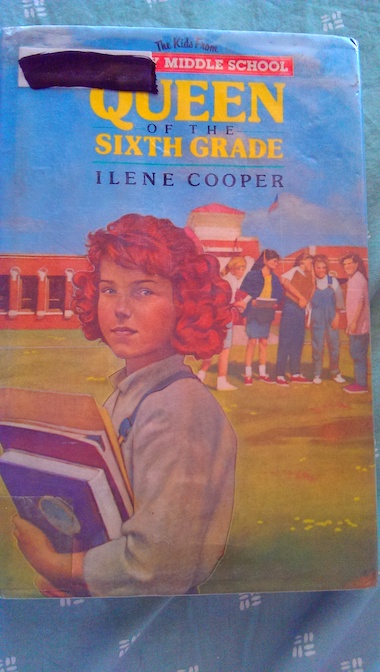
Robin Miller has been best friends with Veronica for years, although it hasn’t always been the easiest friendship. Veronica can be exciting. She gets lots of interesting ideas and her apparent confidence in herself can be contagious. Unfortunately, she isn’t really a nice person, not even to her closest friends. She likes to call Robin “Curly” because of her hair, which Robin hates, but she tolerates the nickname for Veronica’s sake. The way Veronica teases and bullies other people makes Robin uncomfortable, too, but Robin hesitates to speak up about it both for the sake of maintaining her friendship with Veronica and because she doesn’t want to get on Veronica’s bad side herself. However, now that the girls are in sixth grade, things are about to change.

Veronica has decided to start a kind of club with some of the girls in their class called the Awesome Kennedy Girls (or AKG for short). Of course, Robin is a member. Veronica chooses the other members herself from the girls in the class that she thinks are the coolest, at least by her standards.

Then, Veronica tells Robin that she has a crush on Jonathan Rossi, a cute boy in their class. Robin likes him herself. In fact, she’s had a serious crush on him for some time, although she’s never told Veronica about it. It’s been Robin’s good fortune that she and Jonathan have been assigned to be partners for an oral book report in class. While working on the project together, Robin and Jonathan discover that they have some interests in common and start becoming friends. However, somewhat like the love triangle in Cyrano de Bergerac, Veronica asks Robin to use her influence with Jonathan to tell him that Veronica likes him and wants him to be her date for the Halloween party she’s planning. Because she always does what Veronica wants, Robin does attempt to do so, even though it pains her. But, Jonathan really likes Robin and misunderstands what Robin is saying, agreeing to be Robin’s date for the party. That’s when Robin’s real problems begin.

Veronica is used to getting what she wants and having people do thing her way. Instead of accepting Jonathan’s decision that he likes Robin completely on his own, she decides that Robin has “stolen” Jonathan from her. Immediately, Robin goes from being Veronica’s best friend to her worst enemy. Worse still, Veronica starts spreading terrible rumors about Robin to the other girls in class. Soon, no one in class wants to be friends with Robin, and the other girls in the AKG go out of their way to make life miserable for her with their bullying.

At one point in the story, Robin remembers back to when she and Veronica first became friends in the third grade. Before she met Veronica, she was friends with Gretchen, a fat girl who is now one of Veronica’s favorite people to bully. While Robin is on the outs with Veronica and shunned by most of the rest of the girls in class, she tries to become Gretchen’s friend again out of loneliness, but to her surprise and shame, Gretchen tells her that she is no longer interested in her friendship. Gretchen correctly realizes that Robin is still too much attached to Veronica and the way she does things. There were many times when she could have stood up to Veronica and defended Gretchen, but she chose not to. Gretchen points out to Robin that if Veronica decided that she wanted to be friends with her again, she’d be off like a shot after Veronica, dropping Gretchen and forgetting all about her like she did when they were younger. Robin is ashamed when she realizes that everything Gretchen says is true. In becoming friends with Veronica, Robin lost part of the nice person she used to be. Although she is not as mean as Veronica, Robin isn’t completely nice and, in some ways, has become rather shallow. If getting dumped and bullied by a former best friend hurts, it hurts even more when Robin realizes that she partly deserves it because of the kind of person she’s been and the type friendships she’s chosen.

However, there is hope for Robin in realizing the mistakes she’s made. She comes to admire Gretchen for her ability to put up with the bullying she’s endured and for continuing to stand on her own, not come crawling to the first person who offers her friendship. Gretchen is sometimes lonely and she did once fall for a trick of Veronica’s when she pretended to offer her a place in the AKG, but Gretchen still respects herself, in spite of the bullying she’s endured. In a way, she has better self-esteem than Robin does. Gretchen has her problems, but she doesn’t define herself solely by her relationships with other people, like Robin does at first. When Gretchen can’t find friends who appreciate her, she simply does the best she can without them, pursuing her own interests by herself. In a way, that attitude becomes the solution to Robin’s problems. At her mother’s urging, Robin begins pursing new interests in life.

Robin’s mother correctly points out that Robin needs to develop her own interests for her own sake and to look for friendship beyond her cramped little circle of “cool” kids. There are many other options for good friends around her, but Robin has been stuck in a mindset that hasn’t allowed her to see them. By getting out, finding new interests, and learning to be her own person again after spending the last few years mainly being Veronica’s sidekick/puppet, Robin develops new confidence and new insights on herself and the people around her.

Robin is successful at finding new friends when she takes a drama class. She even connects with another girl from her school who was neither part of the in-crowd nor the bullied ones in her class, Sharon. For a time, Robin still feels badly about what happened to her friendship with Veronica, but the more time they spend apart, the less Robin misses her and the more she begins to see Veronica, her behavior, and the problems in Veronica’s life for what they are. In the process, she begins to recover a bit of her old self, the nicer, freer person she was before she became Veronica’s friend.

When a drama project allows Robin to meet a celebrity, she becomes something of a celebrity in her class. Suddenly, people who had shunned her before are anxious to be her friend again, making Robin feel awkward because she knows their motives are self-serving, not honest or sincere. At the same time, Veronica’s controlling behavior and the one-upmanship she encouraged in her little club backfire on her. The other girls get fed up with her behavior, and Veronica is put in the uncomfortable position of appealing to Robin for help. With her former best friend and tormentor at her mercy, Robin has to decide if she will use the opportunity to take revenge or if she will go forward with her efforts to be a better person and use her new popularity for good instead of evil. There is power in popularity, but there is also power in knowing who you are and what you really stand for.

The book is available to borrow and read for free online through Internet Archive.  I’d also like to give special kudos to this book for mentioning other books that Robin likes, including Where the Wild Things Are, The Wolves of Willoughby Chase, and The Westing Game (the book Robin and Jonathan use for their book report, which they both like).
Miss Nelson Has a Field Day

NelsonFieldDay

Miss Nelson Has a Field Day by Harry Allard and James Marshall, 1985.

Everyone at school is disappointed in the school’s football team.  Even the team itself thinks that they’ll never have a chance at winning, so they don’t bother to practice.  They refuse to listen to their coach and spend all of their time goofing off.  Finally, the coach starts to crack mentally from the strain, and Miss Nelson decides that something needs to be done.

NelsonFieldDayTeam

Some of the kids mention that if Viola Swamp, the  meanest substitute teacher ever, were there, she’d know how to deal with the team.  Not knowing how to contact The Swamp, the principal tries to turn himself into Viola Swamp, but his outfit is just goofy . . . then the “real” Viola Swamp shows up to coach the team.  As usual, she takes no nonsense from anyone.

NelsonFieldDayFake
NelsonFieldDayCoachSwamp

The Swamp undeniably gets results, however, the principal has started to wonder who Miss Swamp is and how she always knows when to show up.  Unlike in previous books in the series, Miss Nelson is teaching her class as usual while Coach Swamp is out on the field with the team.  Since the previous books pretty well established that Miss Nelson and Miss Swamp are the same person, how is this possible?

NelsonFieldDayTwoPlaces

The book is currently available online through Internet Archive.
My Reaction and Spoilers

The story doesn’t contradict the other books, and Miss Nelson is still Viola Swamp, but there is one more surprising thing about Miss Nelson that nobody knows which can allow her to appear to be in two places at once . . .  she has a twin!

NelsonFieldDayVictory

Stories with a secret twin can sometimes feel like a bit of a cop-out, but this one is funny because this is the first and only time Miss Nelson has called on her twin to help her with her double act as Viola Swamp. Miss Nelson’s twin sister is actually the one who’s teaching the class as the nice teacher while Miss Nelson is out on the field coaching as Viola Swamp. There is a moment at the end of the book where the twins are together and Miss Nelson explains to her sister why Viola Swamp is necessary. Sometimes, students need a little tough love and discipline, but by using her alter ego to dish it out when necessary, Miss Nelson gets to keep her reputation as the nice, sweet teacher she really is.

Even though readers know what’s going on with Miss Nelson and Viola Swamp from the previous books, Miss Nelson’s twin adds a nice twist to the plot. The fun of the Miss Nelson books is watching how Miss Nelson carries out her identity swaps. In this book, I also loved the principal’s hilarious attempt to play the part of Viola Swamp in a Halloween witch costume!