The Best Halloween Ever

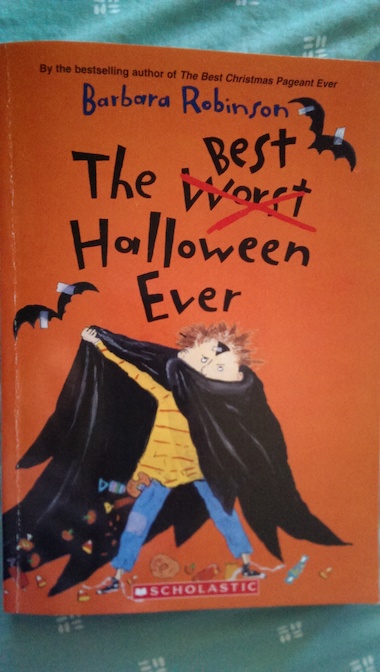
BestHalloweenEverThe Best Halloween Ever by Barbara Robinson, 2004.

Every year on Halloween, the Herdmans, who are the wildest, most awful kids in town, run amuck, vandalizing things, stealing, and bullying other kids out of their Halloween candy.  This year, the mayor has decided that he’s had enough of the chaos they cause, so he’s just going to cancel Halloween all together.  Although he doesn’t specifically name the Herdmans as the source of all the Halloween destruction, everyone in town knows that they are.  So, to the shock and dismay of all the other kids, there will be no trick-or-treating this year.

Instead, there will a safe, well-supervised (boring), school Halloween party.  The principal, who always hated Halloween anyway, isn’t happy about it, but admits that it would be better to have a party for the kids at school, with their parents present and helping out, than having them run wild in the streets with the Herdmans on the loose.  But, as every kid knows, running wild in the streets is really the heart of Halloween.  They long for the freedom of roaming the streets without adult supervision, for collecting candy to sort and trade (and, admittedly, lose to the Herdmans eventually), for staying up late, and for the surprises and magic of a real Halloween.

There isn’t going to be anything surprising or magical or even really scary about Halloween at the school.  All the kids already know that the monsters are just their parents and teachers in costume.  The only real benefit that they see to the event is that the Herdmans won’t be there because they say it sounds too boring.  But, with the Herdmans, nothing is ever what anyone would expect, and they not only show up but find a way to turn the event into something that brings back some of the surprises and real Halloween spirit that were missing from a party that was too well-organized and predictable.

Although the Herdmans are a large part of the reason why Halloween is difficult for everyone and the adults try so hard to control it, they manage to redeem themselves a little in the eyes of the other children by taking the events of the night out of the adults’ hands.  Before the other kids know it, strange things start happening at the party with a cat on the loose, worms in the witches’ brew, and children starting to disappear.  As the kids puzzle about these things and wonder where some of the other kids went, things start getting scarier (like they should on Halloween), and they find themselves following mysterious figures through the school in the middle of a black-out with a special surprise waiting for them . . .

I don’t think that this book was quite as good as the others in the series, but it was still fun.  Beth, the narrator, is correct in saying that the well-supervised Halloween party was really more for the adults than the kids.  To the adults, Halloween is kind of a bother, and sometimes, they act like all the kids, not just the Herdmans, get in their way even as they plan the school Halloween party.  At one point, Beth’s mother reminds Alice’s mother that the whole idea of the party is to do something for the children, not the adults.

The adults are so worried about keeping things orderly, safe, and convenient that they become too controlling.  Even on normal Halloweens, some of them have a tendency to overrule the kids on what they want to wear as costumes, with parents often insisting on costumes that are the least amount of bother for them to help with.  Louella’s mother insists that Louella be a pilgrim year after year just because she won a free costume once, even though Louella hates it. Really, what most of the kids like about Halloween is that it is usually a night for them, not the adults.  The kids chafe as the adults insist that they go to their orderly Halloween party and like it.  In real life, most adults know that forced fun isn’t really fun at all.

In the end, the Herdmans return all the candy that they had taken from the other kids over the last Halloweens.  Although the other kids find the Herdmans’ secret candy stash a treasure trove, much of the candy is stale.  They can eat some of it (which grosses me out, considering how old it probably is), and they have fun sorting and counting the rest.  But, the best treat for the kids was adding a sense of unpredictability and suspense to the night to bring back the real Halloween feeling.

The book is currently available online through Internet Archive.

The Magic School Bus Inside the Human Body

MSBHumanBody

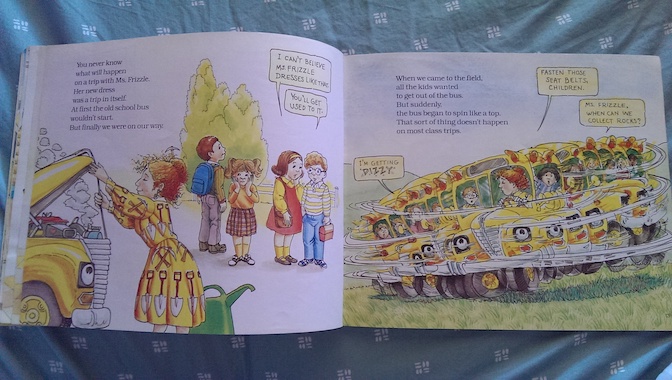
The Magic School Bus Inside the Human Body by Joanna Cole, 1989.

Ms. Frizzle’s class is now studying the human body, and they are going to take a trip to the science museum to see an exhibit about how bodies digest food for energy.  Of course, this is not going to be a normal field trip, but it is weirder than anything the students could have expected.

MSBHumanBodyFilm

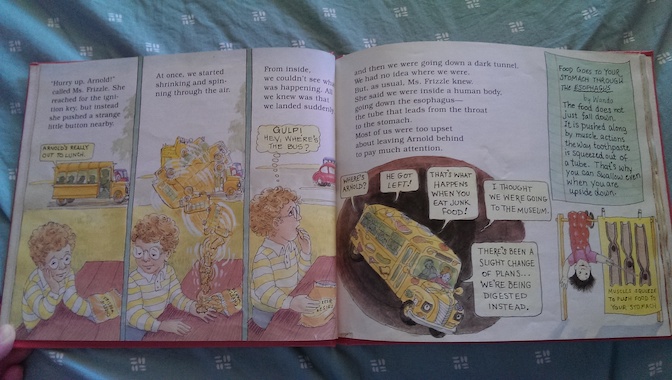
After the class stops at a park for lunch, Arnold is accidentally left behind, and before they can go back for him, the bus shrinks small and is accidentally swallowed by Arnold.

MSBHumanBodySwallow

While his classmates take a trip through Arnold’s body, Arnold panics at being left behind and makes his way back to school by himself, accompanied by a sympathetic bird, not knowing where the rest of the class went.

MSBHumanBodySneeze

The book ends with a section of true and false questions that point out the impossibilities of the class’s field trip inside a student’s body, but also points out that the information about the human body itself is true.

The book is currently available online through Internet Archive.

The Magic School Bus Inside the Earth

The Magic School Bus

MSBEarth

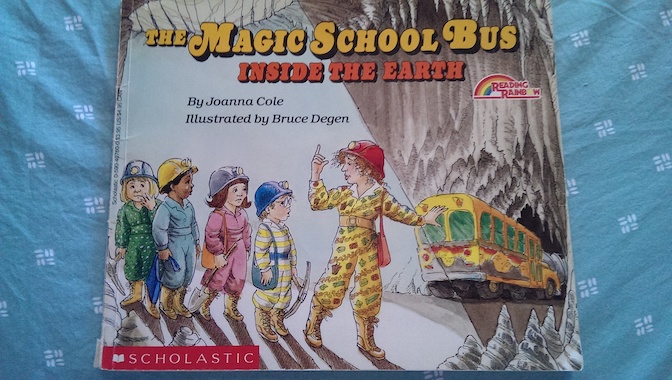
The Magic School Bus Inside the Earth by Joanna Cole, 1987.

Ms. Frizzle’s class has a new student, Phoebe, who is about to discover that Ms. Frizzle is no ordinary teacher and that her class trips are nothing like any other field trip.  Ms. Frizzle’s class is studying the earth and rocks, and she assigns the students homework to find a rock and bring it to class.

MSBEarthHomework

However, even though it sounds like an easy assignment, only one person actually brought a real rock to class.  The others either didn’t bring anything or brought in pieces of old Styrofoam, bits of broken glass, or chips of concrete from the sidewalk.  With only one real rock for the class’s rock collection, Ms. Frizzle decides that the class should to on a trip to collect more.

MSBEarthFieldTrip

She takes the class on a field trip to a real field, but they’re not just going to collect rocks that they find lying on the ground.  The bus changes itself into a steam shovel, and Ms. Frizzle passes out shovels and jackhammers to the students.  They start digging down into the earth, uncovering new layers of rock as Ms. Frizzle explains what types of rocks are in the layers and how they formed.

MSBEarthDigging

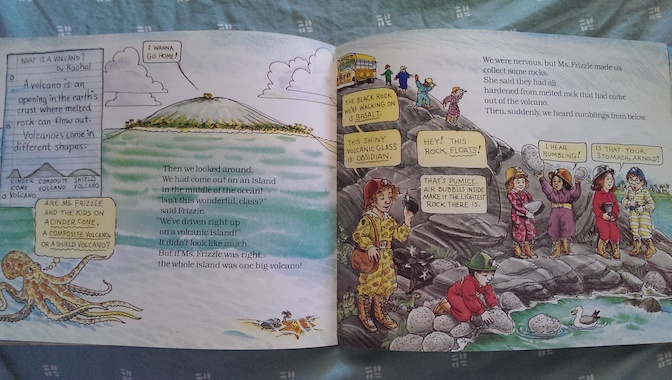
Before the field trip is over, the school bus, along with all the students, falls through the ground and into a massive cave.  They continue traveling all the way down through the center of the earth and out the other side, ending up on a volcano, where Ms. Frizzle calmly explains about volcanic rocks.

MSBEarthVolcano.jpg

I like the picture at the end of the book, after the kids return to school, which points out that there are things all around them that are made out of the different kinds of rocks and minerals that they learned about on their trip.  Each type of rock is also shown in the class’s rock collection along with notes about the type of each rock and how it can be used.

MSBEarthReturn

The book ends with a mock phone conversation between a reader and the author and artist about the impossible things that happen in the book but noting the factual information contained in the story.  The book was featured on Reading Rainbow.  It is currently available online through Internet Archive.
MSBEarthRockCollection

The Candy Corn Contest

The Kids of the Polk Street School

CandyCornContest#3 The Candy Corn Contest by Patricia Reilly Giff, 1984.

As Ms. Rooney’s class prepares for the upcoming Thanksgiving holiday, she gives them a contest: students can win the jar of candy corn on her desk if they can guess how many pieces of candy corn are in it (or get the closest to the right answer).  Richard “Beast” Best wants to win very badly because he loves candy corn and his mother never lets him eat many sweets at home.

The only problem is that students can only earn the ability to make guesses by reading books.  They get one guess for each page they read.  Richard has always been a slow reader, so he knows that this contest is going to be hard for him.  One day, while studying the jar of candy corn, trying to plan out his guess to make the best use of it he can, Richard gives in to temptation and eats three pieces.  Now, he doesn’t know what to do.  Ms. Rooney knows exactly how many pieces of candy there were in the jar, and if three are missing, she’ll find out.

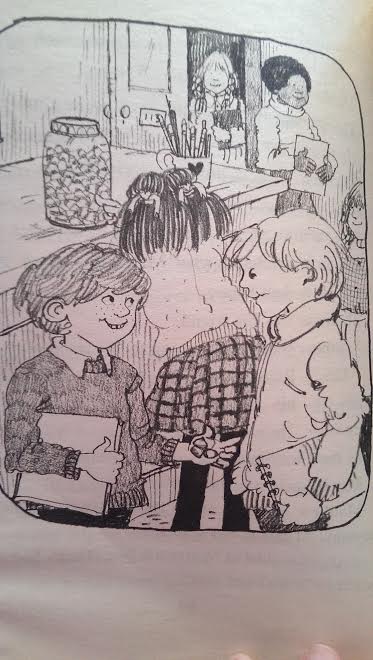
CandyCornContestPic2While Richard is worrying over his mistake, he’s also worrying about the sleep-over party his parents are letting him have over the Thanksgiving break.  At first, he was looking forward to it, but some of the other boys in class can’t come and some of those who said they could are concerned because Matthew is coming.  Matthew and Richard are friends, and people in class generally like Matthew, but everyone knows that Matthew still wets the bed.  Some of the other boys are worried that they’ll have to sleep next to Matthew at the sleep-over.  As much as Richard likes Matthew, it feels like his problem is going to ruin the party, and when Matthew is nice to him, it only makes Richard feel worse.

For awhile, Richard is short-tempered with Matthew and says some things that he later regrets.  His mean comments make Matthew decide not to go to his party, but Richard feels terrible because he realizes what Matthew’s friendship really means to him. Richard’s apologies later help to fix the situation.  It also helps that Richard admits to Matthew that he ate three pieces of the candy corn.  Richard’s confession that he did something wrong (more than one thing, actually) and that he wants to fix it helps Matthew to forgive him.  Matthew helps Richard to decide how to solve his candy corn problem honorably, and Matthew’s mother gives Matthew a suggestion that will help him to avoid problems at the sleep-over.

The book is currently available online through Internet Archive.

Fish Face

The Kids of the Polk Street School

FishFace#2 Fish Face by Patricia Reilly Giff, 1984.

When there’s a new girl in Ms. Rooney’s class, Emily Arrow is happy at first that she’ll be sitting next to her and thinks maybe they’ll be friends.  However, that feeling doesn’t last very long.  Dawn Bosco doesn’t seem interested in making friends.  She doesn’t respond to the compliments that Emily gives her.  Instead, she brags about herself, saying things that Emily learns later aren’t true.  Worst still, she steals Emily’s toy unicorn, Uni.

Uni is Emily’s best friend, and she’s convinced that he brings her good luck.  Without him, everything seems to go wrong.  Emily even has trouble sleeping because she always sleeps with Uni.  When she tries to get Dawn to give Uni back, she denies taking him, but Emily knows that Dawn is hiding him in her pencil box.  She saw him there, but she just can’t get to him.  Will Emily ever get Uni back?

The book is currently available online through Internet Archive.
My Reaction and  Spoilers

FishFacePic1The title of the story comes from the fish faces that Emily was making, imitating the classroom pet fish.  She shows Dawn her fish face when she’s trying to joke with her, but Dawn just thinks it’s weird.  Dawn worries that she’s not making friends, but at the same time, she also seems determined not to like things and people at her new school and stealing Emily’s unicorn and lying about it was a sure way to make her angry.

I didn’t like this book as well as others in the series.  The kids in the series don’t always explain their actions or completely understand them, which is somewhat true to life.  Young children don’t always understand their true feelings or motives because they don’t have the words or the experience to explain what they feel.  However, this book felt more unexplained than normal.

Dawn steals Emily’s toy unicorn just moments after they first meet, while sitting in the desk next to her in their classroom.  Emily doesn’t get help getting her unicorn back right away, and by the time she does, it’s too little help, and Dawn gets away with keeping the unicorn.  We’re supposed to believe that Dawn did it just because she felt awkward in a new place with no friends, but that’s shaky because even a second-grader would know that stealing something isn’t going to win friends.  The kids later find a letter Dawn was writing to a friend at her old school, saying that she’d done something bad but that Emily was mean and that she was upset about not having friends.  So, she understands that she did something wrong, but still thinks Emily is mean for trying to recover her stolen property?  Children can say and do some odd, sometimes contradictory, things, but Dawn’s feelings seem to be all over the place and her character difficult to pin down.

It’s difficult to tell what, if any, lesson to take away from this story.  That if someone steals your stuff, it’s because they’re lonely and you just don’t understand them?  Things partly get resolved because Emily is interrupted in searching for her unicorn and ends up taking Dawn’s reader out of her desk.  Returning the reader seems to be what causes Dawn to have a change of heart, maybe because missing it made her understand Emily’s feelings about the loss of her unicorn, but we never really find out.

Fortunately, Dawn does become a more distinct character in other books, and later, because she wants to be a detective, she gets her own series of mysteries.  One of the mysteries in her spin-off series references this story because something else disappears in class, and Dawn is suspected because people know that she stole something before.  In that book, Dawn has to figure out the mystery in order to clear herself of suspicion.

One thing I did like about this book was that, although losing Uni was very hard for Emily at first, she does come to realize that she can do without him, that he is not her sole source of good luck, and that she can sleep without him at night.  She is pleased when Dawn agrees to give him back, but she does recognize that learning that she can be okay on her own is a sign of growing up.

The Beast in Ms. Rooney’s Room

The Kids of the Polk Street School

BeastMsRooney#1 The Beast in Ms. Rooney’s Room by Patricia Reilly Giff, 1984.

It’s the start of a new school year, and Richard Best (nicknamed “Beast”) is embarrassed to find himself in Ms. Rooney’s room once again because he was held back a year for his poor reading skills.  Everyone he knows has moved on to the third grade, and he’s still in a second grade class with kids who were first grade babies last year.  He feels awkward, being the tallest, oldest person in class, and kids in his old class tease him and refuse to let him play baseball on the playground with them because he’s a pathetic “left-back.”

At first, Beast tries to pretend that it was all a horrible mistake that will be straightened out soon, but that just makes him feel bad for lying.  The kids who are now in the same class he is, who he still thinks of as “babies,” try to make friends with him, but he doesn’t accept them at first because of his embarrassment at being older and still not as good at reading as some of them are.

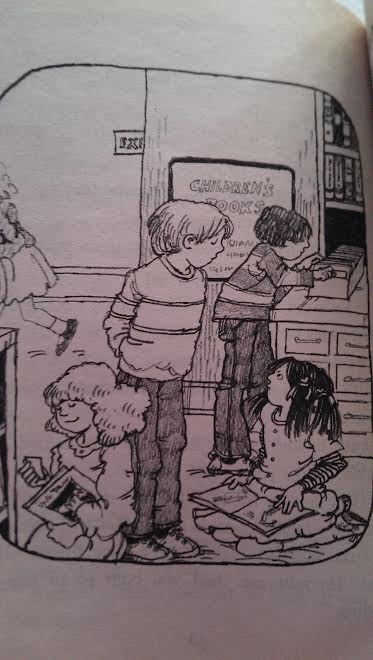
BeastMsRooneyPic1However, even though he’s embarrassed at having to attend special reading classes with Mrs. Paris while most of the rest of his class has normal reading, these special classes really help him, not just to improve his reading skills, but to connect with other kids in his new class who have the same reading difficulties he does and who understand how he feels.

Beast discovers that it’s no shame to not know something or to have trouble doing something because everyone has different skills and it can take some people longer to learn certain things than others.  Emily Arrow, the girl who now sits next to him in class is a whiz at math but has as much trouble reading as he does.  Beast learns some new skills from his new, younger classmates and realizes that they’re not really babies.  They also really appreciate him and help him see some of the good things about himself.

The book is currently available online through Internet Archive.

Going to School in 1776

School1776Going to School in 1776 by John J. Loeper, 1973.

The grass is green,
The rose is red,
Remember me
When I am dead.

Ruth Widmer”

This is a non-fiction book about what it was like for children to go to school around the time of the American Revolution.  The quote that begins the book, a short poem, was written by a real girl from 1776 in her copybook.  The book’s introduction says that it was included to remind readers that, “History is not just facts.  History is people.”  Part of the purpose of the book is to remind people about the lives of ordinary people, of real children, making history come alive in a way that mere recitation of important names and battle dates never can.

The book explains some basic facts about the Americas in 1776 and what led up to the Revolutionary War.  Then, it begins discussing what it was like to be a child at the time in different parts of the American Colonies.  The colonies were largely rural and even major cities were not the size that they are today.  However, there were differences in the ways families lived and the type of education the children received, depending upon where they lived and if they lived in towns or in the countryside.

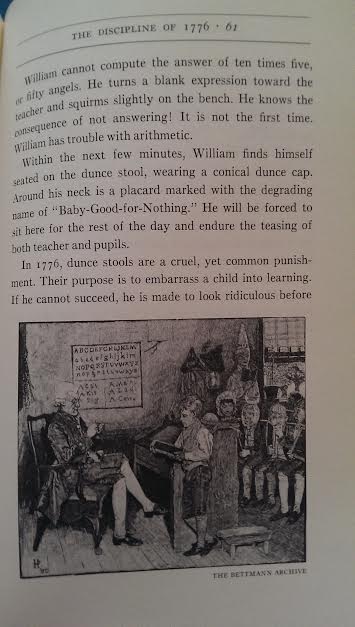
School1776Pic1These explanations are told in story form, rather than simply explaining listing the ways children could live, learn, and go to school, trying to help readers see their lives through the eyes of the children themselves.  The children’s lives are affected by the war around them.  As the book says, many town schools in New England were closed during the war, so the students would attend “dame schools” instead.  A dame school was a series of lessons taught in private homes by older women in the community.  In other places, such as cities like Philadelphia, official schools were still open.  Discipline was often strict, and school hours could be much longer than those in modern schools.  Sometimes, children would argue with each other over their parents’ positions on the war.

Some schools were similar to modern public schools, open to all children of a certain area and operated by the town fathers.  Others were church schools and included religious lessons.  Families with money were more likely to send their children to school than poorer families, who could not always afford tuition, although public schools would not always charge the students an extra tuition fee because the schools were funded with local taxes.  These systems varied throughout the colonies, and poor children in the South were less likely to be formally educated.  Wealthy plantation owners would open schools for the upper class children, and lower class children might receive lessons in “field schools.”  The field schools were just occasional, informal lessons given to the children in the fields by any adult who happened to be interested in the task.

Teaching in schools was not easy.  Sometimes, teachers were itinerant, moving from one school to another and finding work in agricultural areas between the growing seasons, when children would be free from chores to attend school.  Some teachers were even indentured servants, forced to remain in the employ of a person to whom they were indebted, often because that person paid for their passage from Europe to the Colonies.

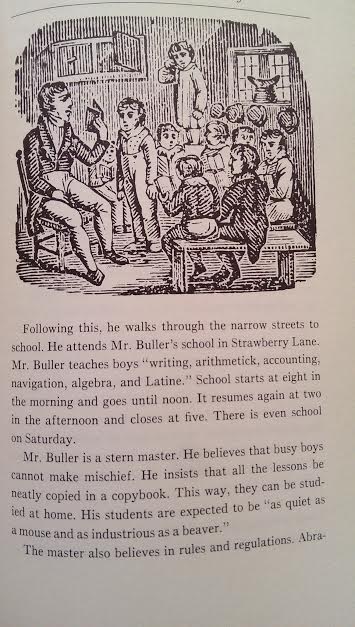
School1776Pic2There were different standards for what girls and boys were expected to learn because their learning was guided by what they were each expected to do with their adult lives.  A typical school might teach boys subjects like, “writing, arithmetick [sic], accounting, navigation, algebra, and Latine.”  Generally, “reading, writing, arithmetic, and religion” were common elementary school subjects.  Latin lessons and other advanced subjects were typically for boys who planned to become lawyers or clergymen.  Girls were likely to receive little formal education beyond reading and writing, and black people were less likely to receive even that.

Of course, not every child went to school.  There were other ways for children to learn, depending on what they expected to do with their lives.  Apprenticeships were common.  Boys would go to live in the house of a person with a particular profession and learn that profession from the master.  Aside from basic training for a profession, the master would provide room, board, basic necessities such as clothing, and training in the “three Rs”, which were “reading, ‘riting, and reckoning.”  In return, the apprentice would provide his master with his labor for a period of time.

Girls could also serve apprenticeships, although theirs were more focused on the domestic arts because most of them were expected to marry, and they often married young, about the age of sixteen.  Beyond reading and writing, girls would also learn practical skills such as various kinds of needlework and also music and dancing.  The book describes in some detail the various types of needlework a girl could learn and the materials they used.  Typically, girls would create a “sampler” to show off all the stitches they’d learned, kind of like an apprentice’s master piece or a certificate of completion done in cloth.  Unlike modern “samplers”, these would not be just cross-stitch alone because the idea was for the girl to demonstrate her skill and versatility, and using only one stitch would not impress anyone.  Commonly, the sampler would include the alphabet and the numbers one through ten, which would all be done in cross-stitch (which was the basic embroidery stitch), but there would also be an inspirational quote, message or Bible verse, the girl’s name and the date of the sampler’s completion, and other decorative embellishments, which would be done in other stitches such as tent stitch, eyelet stitch, chain stitch, and French knot.  There could be as many as twenty different types of stitches in a single sampler, depending on the girl’s skill and what she had learned.  Girls hoped to do at least as well as their mothers in terms of the number of stitches they knew and skill in execution.

There are also sections in the book which describe the lessons that children learned, the types of school books they used, discipline in the classroom, ways children liked to have fun, and types of clothing that children wore in 1776.

This book is currently available through Internet Archive.

The Secret at the Polk Street School

The Polka Dot Private Eye

SecretPolkStreet#3 The Secret at the Polk Street School by Patricia Reilly Giff, 1987.

Dawn’s class is competing against other classes in a contest to see which class does the most for the school.  All of the classes are working on their own special projects, trying hard to keep them a secret until the judging.  Dawn, as the class’s resident detective, suggests that she could solve a mystery on behalf of the class, but unfortunately, there is no mystery for her to solve.  Yet.

Instead, Ms. Rooney’s class decides to put on a play for the rest of the school.  It’s Little Red Riding Hood, and Dawn is playing the starring role.  Jason gets to be the Wolf, borrowing an old wolf costume from his sister without her permission.

At the class’s rehearsal, Dawn gets mad when someone dressed in the wolf costume tries to scare her, and she thinks that it’s Jason, goofing off.  But, it turns out that Jason wasn’t even there, and the wolf costume is missing.  Suddenly, Dawn has a mystery!

Dawn starts receiving messages from “The Wolf” saying that someone is going to get her and Jason.  Then, someone takes a bite out of the loaf of bread that Dawn has been using as a prop (the food that she’s taking to “Grandma’s House” in the play).  Could “The Wolf” be someone in a rival class, hoping to sabotage their play so they can win the contest?

The book is currently available online through Internet Archive.
Something Queer in the Cafeteria

SQCafeteria

Something Queer in the Cafeteria by Elizabeth Levy, illustrated by Mordicai Gerstein, 1994.

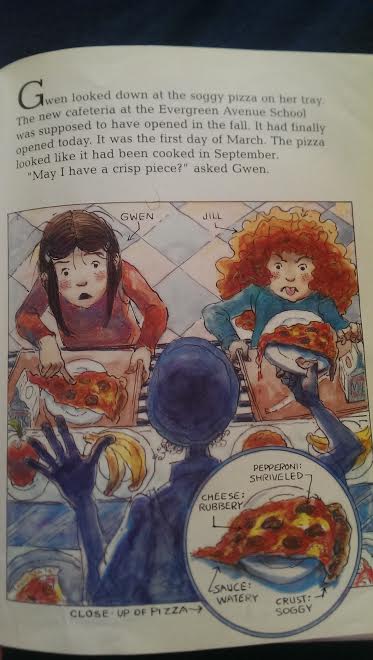
SQCafeteriaPic1Ms. Lensky, the cafeteria lady at Gwen and Jill’s school, is just plain mean. All of the food that the cafeteria serves is yucky, even though the cafeteria is new. There will be a party to celebrate the opening of the new cafeteria, and even the kids’ parents and the mayor are invited. Gwen and Jill are happy because their class will get to help decorate the cake. However, Ms. Lensky, the M.C.L. (Mean Cafeteria Lady), doesn’t like the girls, and she blames them for a number of accidents that happen in the cafeteria.

The first accident was caused by the M.C.L. herself when she was chewing out the girls for being messy (really, the food was messy), and she bumped into other students, causing a food fight to break out.  The M.C.L. blames Jill and Gwen, of course, for starting the fight.  As punishment, the girls are assigned to clean in the cafeteria.  While they’re cleaning up, the M.C.L. blames them when a faucet breaks.

SQCafeteriaFoodFight

Later, when their class visits the cafeteria to prepare for decorating the cake, a counter collapses, throwing frosting all over Gwen.  Then, the girls get in trouble again for criticizing the food.  When the cake burns at the party, and it looks like Fletcher the dog’s bandana is in the burned mess, the girls are blamed once more.

SQCafeteriaFrame

Is the cafeteria jinxed, or is the M.C.L. just out to get the girls?  Or is there another explanation?

This book is part of the Something Queer Mysteries.  It is currently available online through Internet Archive.

Mandie and the Forbidden Attic

MandieForbiddenAttic#4 Mandie and the Forbidden Attic by Lois Gladys Leppard, 1985.

Mandie is unhappy because her mother and Uncle John are sending her to a boarding school in Asheville. It is the same school her mother attended years ago, and her grandmother lives in the same town. Mandie is upset about leaving all of her friends and family behind, but Uncle Ned says that he will still visit her.

By the time that Mandie arrives at her new school, everyone else already knows each other, and none of them seem interested in making friends with her. One girl in particular, April Snow, takes a dislike to Mandie, which is difficult because they have been assigned to the same room.

Things change when Celia Hamilton comes to the school. She and Mandie become best friends, and Mandie is allowed to share a room with her. Then, strange things start happening. Mandie and Celia keep hearing strange noises during the night from the attic floor above them, and some of Mandie’s clothes disappear. At first, they suspect that April Snow may be playing a mean trick on them, but it turns out that she is not actually at fault. There is someone at the school who doesn’t belong, but finding this person may get Mandie and Celia into trouble.

This adventure requires Mandie to meet with her grandmother again.  Mandie is nervous about seeing her grandmother because her grandmother helped break up her parents’ marriage and sent her away with her father when she was a baby. Surprisingly, Mandie’s grandmother seems to like her and her friend Celia. She admires their spirit and even says that Mandie reminds her a little of herself when she was young.  This meeting helps the granddaughter and grandmother to make peace with each other and the past.

The book is currently available online through Internet Archive.