Schoolhouse Mystery

The Boxcar Children

It’s June, and the Aldens are trying to decide what to do for the summer. Benny says that his friend Max remarked that the Aldens always seem to find something exciting everywhere they go, but Max doesn’t think anybody could find anything exciting about the little village where his father likes to go fishing. Max says that it’s a tiny and isolated village on an island with little to do, and he doubts even the Aldens would find anything interesting or exciting there. The only people who usually go there are summer visitors going fishing, like Max’s dad. Mr. Alden has been thinking over other plans for the summer, but he says that, if the children want to take a short visit to his village, called Port Elizabeth, to test out Max’s theory of how boring the place is and see if they can find something exciting about the place, it’s fine with him. The Aldens think that purposely visiting a dull town and seeing what they can find there sounds interesting by itself, so they decide to go.

When they arrive, they find that the place is as small as Max described. It doesn’t take them long to explore the town. There is a small store, but it’s well-stocked with all the food they need. There’s a big old house that seems to be abandoned, and there’s a quaint little schoolhouse with a bell and an odd-shaped chimney.

The people of the town seem suspicious of them at first. They don’t get many outsiders coming to their town, and they can tell immediately that the Aldens are rich because of their car and their clothes. However, because the Aldens are friendly and polite visitors, people gradually begin warming up to them.

The Aldens learn that most people in town work for the local sardine factory. There aren’t many other job prospects in the area, and they don’t have access to higher education or even outside sources of information, like television, so the local kids don’t aspire to much more. Local kids work, too.
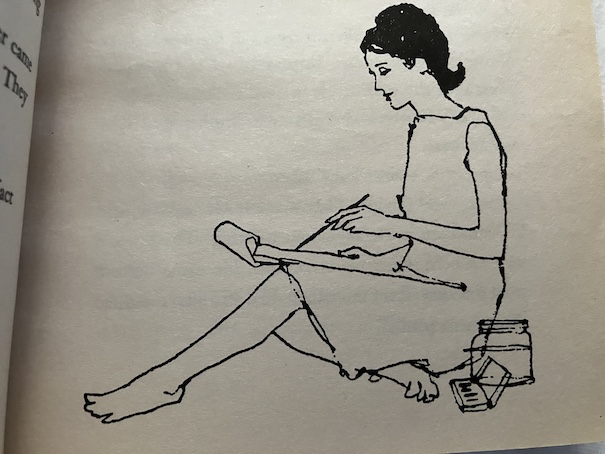
One day, a pair of twins approach Violent while she’s painting a picture and start talking to her about painting. They’ve never really owned any proper art supplies themselves, only some crayons, but they’ve been interested in learning to paint since a professional artist came to town to paint the seaside. They also tell Violet and her siblings that the town has had trouble keeping teachers. Most people don’t want to stay in the town very long because it’s so small, and there’s so little to do. Because they change teachers so often, the kids never really advance much in their classes. Every teacher basically keeps starting over in their lessons. The last one told them to study this summer to make progress and prevent themselves from forgetting what they’ve learned, but the local kids don’t really know how to study or what to study, and they’ve never had a teacher who taught any of the really fun subjects, like art.

The local kids ask the Aldens if they could help them study this summer, and the Aldens get the idea to set up their own summer school in the local schoolhouse. They speak to the lady who owns the schoolhouse, Miss Gray, and she gives her permission. The Aldens recognize her as a famous author, but now, she lives like she’s a recluse in her big, old house. She also asks the Aldens whether or not they know a blond man who smiles a lot, but the Aldens don’t know who she’s talking about.

The people in town don’t have much money, and they save what they can in cash rather than using a bank. However, something odd has happened recently because a man has bought a couple of coins from some of the locals for more than the face value of the coins. The locals don’t know why he was willing to do this, but they’re always grateful for anything extra they can get. The locals have started calling this blond man “the money man” because he not only buys coins but also various other odd, old things that most of the locals think of as junk. They don’t know why he wants these things, but they’re just glad he’s willing to pay something fro them. Mr. Alden is very interested in this man and wants to know more about him.
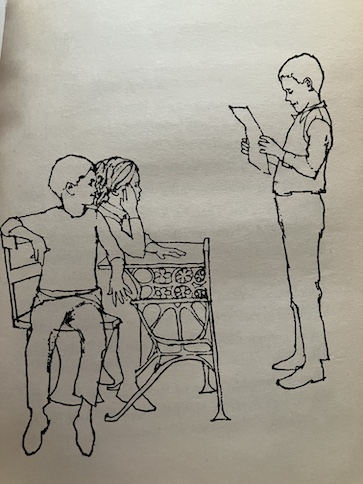
The Alden kids buy some art supplies and school supplies so they can get started with lessons for their summer school. Even though they provide some supplies and have some textbooks in the schoolhouse, they find that there are things they need because previous teachers in town haven’t left some of the things they need, like easy reading books. They improvise as best they can, with Benny helping the kids in class write simple stories about themselves and their lives to use for reading lessons. The local children talk more about the “money man” and how he trades them new toys for old ones they’ve had. The children think that’s great, but the Aldens are suspicious about the “money man’s” apparent generosity.

It isn’t long before Mr. Alden and the children have an encounter with the blond “money man.” The man, called Freddie, notices that Mr. Alden has a rare penny on his watch chain and offers to buy it. He explains that he deals in coins and antiques. Mr. Alden can tell that Freddie is knowledgeable but slick when it comes to buying collectible items. Mr. Alden refuses to sell the man his coin or his watch, and after he leaves, the children tell their grandfather what they know about his dealings with the local people.

It has become apparent that Freddie is cheating the locals, buying antiques and collectibles from them while either paying them much less than what they’re really worth or trading them for newer but cheaper items. Because this town is relatively isolated and the people don’t have much money, they’ve spent generations keeping and reusing antique items without knowing how valuable they’ve become. The local children are thrilled when he lives them newer and more colorful toys in exchange for their old ones, because they don’t know how much their antique toys are worth. Technically, Freddie hasn’t done anything illegal because the people he’s been buying from and trading with have agreed to the deals so far and been satisfied with what they’ve gotten, but that’s only because they don’t know that they could have gotten much better deals from someone else. Freddie’s dealings aren’t really fair or ethical, and Mr. Alden and the local author have become concerned that he may take even bigger advantages of the local people than he already has.

When some valuable collectors’ books disappear from the little village’s neglected library, the author, Miss Gray is convinced that Freddie is responsible. How can they catch him and prove to everyone what he’s been doing?

As with many of the earlier Boxcar Children books, there is an element of mystery but more emphasis on the adventure and the kids’ summer experiences than on the mystery. We have an obviously suspicious right at the beginning, and we have a sense of what he’s doing that’s a problem pretty quickly. This is one of those mysteries where the protagonists have an obvious villain and a good understanding of what’s going on, but the mystery is about getting the evidence and proving it. Part of the issue at first is that duping people into trading things with him or selling them to him for less than what they’re really worth is more unethical than illegal because, as long as the participants are satisfied with the trade and willingly agree to it, it’s difficult to prove that they were deceived. It’s when the villain crosses the lines and actually steals something nobody agreed to give him or sell him that they can really start to nail him for what he’s been doing.

Part of the solution felt a little contrived because it turns out that the villain has been hiding his ill-gotten gains in a location that is right under the children’s noses, and there is something special about the place that allows them to watch the villain without being observed. It’s an interesting set-up, but I usually prefer a more traditional style mystery where there’s more for the amateur detectives to figure out.

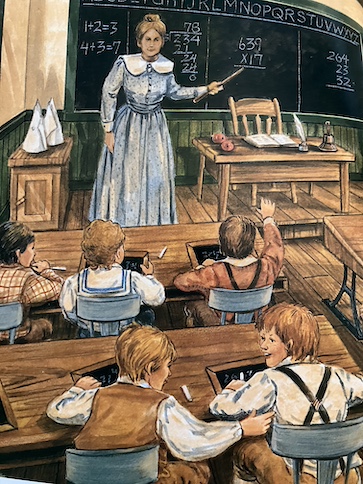
A One-Room School

Historic Communities

The book begins by saying that there was a time when not all communities had schools at all. In areas where the population was low, children had lessons at home or from a neighbor, if they had lessons at all. Towns and villages needed enough children living there to support even a small school. (The book doesn’t describe exactly when or where they’re talking about, but it’s implied that this is the United States or the American frontier.) When there were enough settlers in an area for a school, they might make a small log cabin for the school. As populations grew and there were more students, they would build better schools.

Requirements for teachers were different back then than they were today. Most teachers were men because married women were not allowed to be teachers. Only single women could teach. Teachers were also often required to handle rough students as well as teach them, and all ages and grades of students would study together in one-room schools. The teacher would manage the different grade levels by having them dividing them into groups based on their levels and having the different groups take turns reading aloud to her while other students did quiet work, like practicing writing. The teacher would set some students quiet tasks to do while focusing on a different group, and then, they would switch. Teachers were also responsible for the cleaning and maintenance of their school, but they typically assigned students chores to help with that. Local families would provide room and board for the teacher of their community, and they would also contribute toward the teacher’s salary.

Lessons were basic and focused mostly on the “three Rs” – reading, writing, and arithmetic. (Those three subjects contain the letter ‘R’ near the beginning, even if they don’t all start with that letter.) There was often little time to teach anything else, and these were the subjects that were most important to people with the most common jobs, such as farmer, craftsperson, or storekeeper. In schools that taught a wider range of subjects, students would also learn history (mainly focused on the United States), world geography, and grammar.

Small schools often had few books or supplies. Because paper was often in short supply, children would memorize lessons and verbally recite them back to the teacher and would practice writing on slates (small blackboards). When students were able to buy paper, they bought a blank notebook they called a copybook. The paper in the copybook wasn’t lined, so if they wanted lined paper, they had to draw the lines themselves, using a ruler.

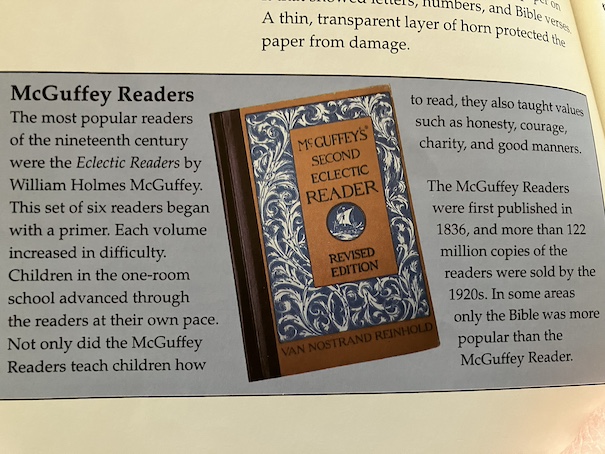
A small school might also only have two books for the students to study: a primer for beginning readers (which showed the alphabet, numbers, and some basic spelling words and poems) and a copy of the Bible. The most popular series of books for building reading skills in the 19th century was McGuffey’s Eclectic Readers. The series started with a primer and continued with six readers, each one at a higher reading level than the last one to build more advanced reading skills. In the small, one-room schools, students would work through these books at their own pace. (Since all ages and grade levels were together in one room, there was little concern about each student moving to the next grade at the exact same time as their peers since they were all still going to be in the same room with the same teacher anyway. As long as a student was continuing to come to school and make progress, it didn’t really matter how fast or slow the progress was.)

The book describes the daily routines of students at small, one-room schools, including how they would get to school each day and what they would do at lunchtime and recess. Most children simply walked to school, although they often had to walk long distances to get there. Sometimes, they might ride a horse to school or get a ride from an adult in a wagon or sleigh, if it was winter. Children brought their lunches from home, but some schools also maintained a school garden. Most of the children from these small schools would grow up to be farmers, so gardening was a valuable skill for them to practice, and the students would also eat what they grew in the school’s garden. During the winter, they could make a soup with vegetables they grew on the stove in the schoolhouse (which also kept the schoolhouse warm) that everyone would eat for lunch. The schoolhouse stove could also be used to heat up foods that the children brought from home. Besides their lunch break, the students would also have two short recess breaks during the day. During recess, they could walk around outside, talk to their friends, play games, or play with toys they brought from home, like marbles. Toys were often homemade or easily improvised, such as using string to play Cat’s Cradle.

Sometimes, students would play pranks on their teacher or fellow students, such as hiding bugs and spiders to scare someone, pouring water on their seat if they got up, or covering the schoolhouse chimney to fill the school with smoke and smoke everyone out of the school. The last prank was dangerous.

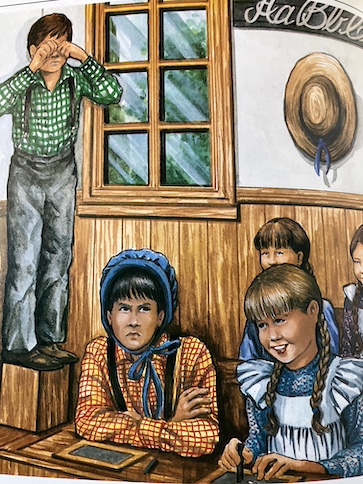
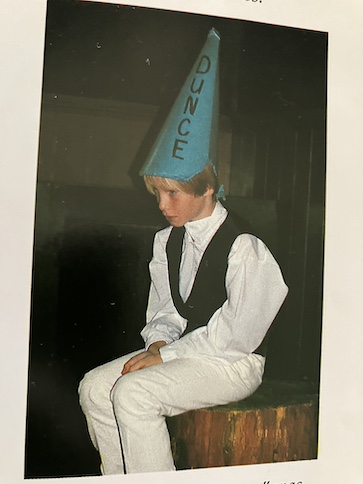
Punishments for pranks and misdeeds, such as being late or falling asleep in class, were at the teacher’s discretion. They could take whatever form the teacher thought was appropriate for the situation, and they could be as harsh and strict as the teacher thought was necessary. Sometimes, they could be a form of poetic justice, designed to fit the crime. We aren’t told why one misbehaving boy was told to put on a girl’s bonnet and sit with the girls in class, although it might have been a fitting punishment if his misdeed was teasing the girls. (That was just a guess of mine, that the teacher might have decided that, if he wanted to tease girls, he should try sitting in their place for awhile.) Some punishments were meant to teach lessons and reinforce the idea that children should not repeat certain behaviors, such as having the children repeatedly write lines, sentences that spelled out what they were supposed to do or not do. (For example, a student who was late to school could be assigned to write, “I will not be late to school” or “I will be on time to school from now on” a certain number of times.) Other punishments were purely for humiliation, like having a student wear a cap that labeled them as a “dunce”, in the hopes that the embarrassment would keep them from misbehaving again. (This could also be the goal of making a boy wear a bonnet and sit with the girls.) Punishments could even include physical punishments. Teachers were allowed to whip their students, if they though it was necessary, and some teachers even punished children who were physically fighting by making them take turns whipping or hitting each other with a stick. The book doesn’t explain the motive for doing this, but I think that they were probably emphasizing the idea that people who fight get hurt and that getting hurt is unpleasant to discourage them from fighting more in the future. I also suspect that the point of making them take turns hitting each other was to make it equal, so it wasn’t just one person beating up on the other, but that’s just a guess. When the students got home, and their parents found out about what they had done at school that day, they might even get a second punishment, on top of whatever punishment the teacher assigned them!

Sometimes, schools had special events for holidays or academic events that involved members of the wider community. For example, schools sometimes had spelling bees, including some where adult members of the community would watch or participate. Schools often had Christmas pageants, where children would sing songs or recite poems they had memorized or perform a play written by the students themselves. At the end of the school year, students would have oral exams in front of their parents and other community members, followed by a picnic with games.

The book ends with a section of games and activity suggestions designed to show modern kids what it might be like to be a student in an old-fashioned one-room school and compare their own schools to old-fashioned schools.

The book is available to borrow and read for free online through Internet Archive.

Books in the Historical Communities series focus mostly on the 1800s in the United States, but they don’t always mention exactly what time period they are describing. It’s often more implied than stated, and that’s true of this book, too. The book mentions the 19th century once or twice, but it doesn’t mention any specific date or date range.

The pictures in the book are a combination of drawings and photographs of real people in historical costumes, reenacting scenes at schoolhouses and the lives of the students. I liked the combination of real people and drawings to illustrate different concepts about life and education in old-fashioned, one-room schools.

There are some concepts of education in a one-room school that fit with the educational concepts of the modern Montessori system, such as having students of different levels being taught together and having students progress at their own rate in different subjects. In a way, I think that the Montessori system hearkins back to this one-room school style of education, and that’s examined in more detail in the classic children’s book Understood Betsy, which is by Dorothy Canfield Fisher, who was an early advocate of the Montessori method of education in the United States.

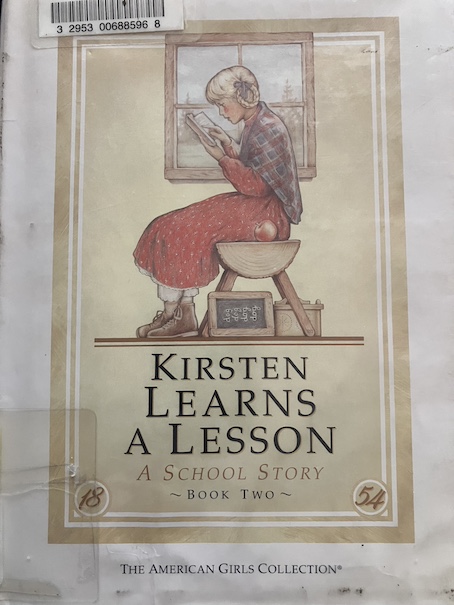
Kirsten Learns a Lesson

Kirsten, An American Girl

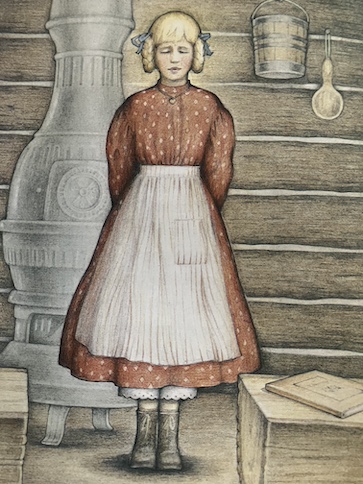
It’s November, 1854, and now that nine-year-old Kirsten’s family has settled in their new home in Minnesota and the harvest season is over, it’s time for the children to go to school. Kirsten and her brothers, Lars and Peter, will go to the small local school with their cousins, Lisbeth and Anna. Powderkeg School is a one-room schoolhouse in a little log cabin. Lisbeth and Anna’s stories about what Powderkeg School is like worry Kirsten. They talk about how strict their teacher, Mr. Coogan, is. Sometimes, the boys in class get rowdy and fight, and Mr. Coogan uses physical punishment on them. However, the girls tell Kirsten that she probably won’t have any problems with Mr. Coogan because he likes children who are well-behaved, and Kirsten is well-behaved. Still, Kirsten is nervous about what her new school will be like.

When they get to school, they learn that Mr. Coogan was injured in a fall from his horse, so they will have a replacement teacher, Miss Winston, who has only recently arrived from Maine. When one of the mean boys in class says he hops the horse also stepped on Mr. Coogan, Miss Winston tells him that nobody talks out of turn in her class and, although they live in the country, “we are not savages like the Indians.” (This is a 19th century attitude toward Native Americans, but this concept is challenged later in the story.)

Miss Winston has each of the children in class introduce themselves so she can get to know everyone. When it’s Kirsten’s turn to say her name, she forgets to address her teacher as ma’am, like the other students. Miss Winston insists that she say “ma’am”, and when she sees Kirsten struggling with the language, she asks Kirsten if she speaks English. Kirsten says that she speaks a little, and her cousins explain that her family just came from Sweden and that they speak Swedish at home. Miss Winston says that “practice makes perfect”, so Kirsten will practice her English in school. For now, she will have the easiest lessons and share seven-year-old Anna’s schoolbook.

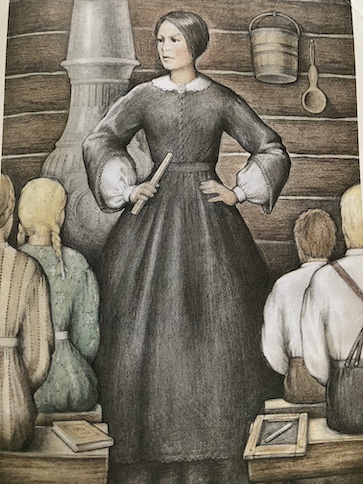
When the mean boy, Amos, laughs at Kirsten, Miss Winston glares at him and strikes the school’s iron stove with her ruler, startling the students. Miss Winston says that her father was a ship’s captain, so she knows how to be in charge of her students, like he was in charge of his crew. Then, she deconstructs the sentence “Miss Winston hit the stove”, pointing out which words are the subject, verb, and direct object of the sentence. Then she warns the class to “Be careful that the direct object of hit isn’t the student.” The implication is that Miss Winston is just as willing to use physical punishment against her students as Mr. Coogan was.

When Amos introduces himself to Miss Winston, we learn that he is nineteen years old, the same age as the new teacher, but the new teacher says that, in spite of being the same age, she’s still the teacher, and he’s the student. In spite of being more a young man than a boy in age, Amos has only just finished the third reader, and Miss Winston says her role is to help him read and do math like a man would, embarrassing Amos. (He can’t use his age to put himself on an equal footing with the new teacher because they are not intellectual equals. She’s the same age, but she has graduated from her own school and become a teacher, and he’s still struggling along with low level math and reading.)

Anna helps Kirsten with her lessons, and Miss Winston praises her for helping to teach Kirsten, but she doesn’t praise Kirsten for doing a good job. At the end of the school day, Kirsten and her cousins talk about the new teacher. Anna thinks that Miss Winston seems nice, but Kirsten thinks that Miss Winston doesn’t like her and that she seems very strict. She asks if that was what Mr. Coogan was like, and Lisbeth says he was worse. The best part of the day for Kirsten was lunchtime, when the children were allowed some play time. When she ran around and played tag with the other children, it didn’t matter if she didn’t speak much English.

When the girls play school with their dolls, Anna imitates Miss Winston and her comment about “savages.” Kirsten asks the other girls what that word means. They say it means “wild.” Kirsten asks them if the Indians (Native Americans) are really like that, and they say that some people say they’re kind and will help people if they need food but others day that they’re “cruel and bloodthirsty.” They’ve seen an Indian man before. He came to their house when their mother was roasting meat, and he left when their mother gave him some. They thought he looked pretty “savage” because his face was painted, and he had eagle feathers in his hair. The girls say that Native Americans also wear knives and live in tents. As a farmer, their father is concerned about the Native Americans. He knows that, if the farmers take too much of their usual hunting grounds for farming, it will drive away the animals, and the Native Americans will be starving and angry. While he is happy that he has been able to secure some farmland for his family (I explained a little about the famine conditions and lack of farmland in Sweden around this time that caused people like the Larsons to leave their country when I covered Meet Kirsten), he is aware that the Native Americans also need land for their survival.

At school, Miss Winston announces that each student will memorize a poem and recite it for the class. When they recite their poems, she wants them to say them with feeling and show the emotions their poem is trying to convey. Kirsten worries about this assignment because she’s still learning English. It’s hard enough for her to learn to read anything in English and understand the meaning of the words. She doesn’t know how she can also learn to memorize an entire poem and say it in front of everyone. Miss Winston gives Kirsten a short poem to learn, but having even a short one doesn’t seem to help Kirsten.

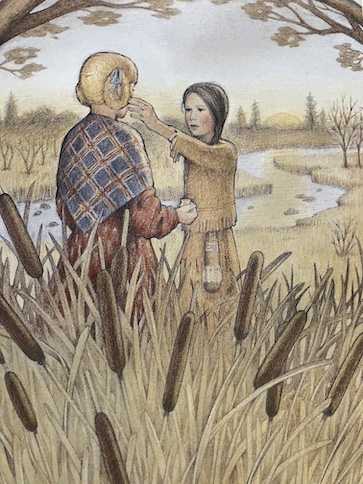
Meanwhile, Kirsten has her first encounter with a Native American when she spots an Indian (Native American) girl watching her while she’s getting water from the stream. The girl runs away, but Kirsten finds a blue bead that she dropped. Kirsten takes it and leaves her a little pretend cake that she and her cousins made for their dolls. Later, she finds that the cake is missing and that there’s a green duck feather in its place. She and the Indian girl trade little objects in this way, gradually becoming friends.

Kirsten’s secret friendship with the Native American girl becomes a comfort to her when school is stressful. Frontier teachers often board with families who live near the school, and when Miss Winston comes to stay at Kirsten’s aunt and uncle’s house, Kirsten feels like school is following her home. What’s worse is that Kirsten’s family will be joining them for dinner, and they will practice English during the meal. Kirsten knows that the meals, instead of being comfortable family time, will now be like lessons, and they will struggle to say things they would want to say because her family still hardly knows English. Worse yet, Miss Winston is cross with Kirsten because she can’t seem to memorize even her short poem.

Sneaking away to visit the Native American girl, who is called Singing Bird, gives Kirsten an escape from her struggles with English. Somehow, Kirsten and Singing Bird manage to communicate well enough with each other, even though neither of them speaks each other’s language. Then, Singing Bird takes Kirsten to see her village. To her surprise, Kirsten realizes that she has been gradually teaching Singing Bird English words without realizing it. However, Singing Bird’s people are going to be moving on soon. Kirsten’s uncle is correct that farming is driving away the animals the Native Americans depend on for food, and they’re suffering for it. Singing Bird invites Kirsten to come with her tribe when they leave, and it’s tempting to think of living an exciting life, traveling with Singing Bird and not going to school. But, is that what Kirsten really wants?

The book ends with a section of historical information about frontier schools in the mid-1800s.

The book is available to borrow and read for free online through Internet Archive (multiple copies).

Along with the first book in the series, this is the book that I remember the best of the Kirsten books. I think I either didn’t read the others or didn’t finish them because there are some sad things in the Kirsten stories that I didn’t like. In the first book, Meet Kirsten, another child Kirsten befriends on the journey to Minnesota dies of cholera. It’s historically accurate that some children died of disease on the journey west, but it was still hard to take. I also talked about how the reason why families like Kirsten’s wanted to come to America was that Sweden was experiencing famine around this time. The first book didn’t say much about that, but in this book, Kirsten remembers experiencing hunger in Sweden when her father’s crops failed and how her little brother cried from hunger.

Kirsten understands the plight of the Native Americans when they have to move to a new area when their food supplies run low. However, when Singing Bird invites Kirsten to come with them, she realizes that would mean leaving the rest of her family, and she can’t do that. While it’s tempting to go with her friend and escape the problems in her life, Kirsten can’t do that without also giving up the good things in her life and trading the problems in her life for a different set of problems. Although there are appealing aspects to their lives, the Native Americans also have their own struggles. To use an old adage, the grass isn’t always greener on the other side of the fence. People say it in different ways, but just because someone else’s situation is different doesn’t always mean that it’s better.

In this book, we also see what it’s like for Kirsten’s family as they begin learning English, so they can communicate with other people in their new country, and the children begin going to school. The little frontier school is different from other schools they’ve experienced before, and the teachers are strict. They have to be strict because some of the students are rough and fight with each other physically, and they have to make it clear that they’re not going to put up with that. This is a real-life aspect of schools from this time period. Fortunately, we never see the teacher actually using physical punishment against anybody. She just threatens to do it so her students will think twice about misbehaving.

When Miss Winston comes to board with Kirsten’s relatives, Kirsten thinks that everything is going to be worse, that she’s constantly going to be bombarded with lessons and the problems she’s been having at school. However, it turns into an opportunity for Kirsten and Miss Winston to get to know each other better. At first, Miss Winston can’t understand why Kirsten is having such a difficult time remembering her poem, even though it’s pretty short and easy. It’s partly because she’s still having difficulties with her English, but also, the content of the poem has no relation to anything currently happening in Kirsten’s life. It doesn’t interest her, and her mind is preoccupied with all the changes happening in her life, making it difficult for her to focus on the poem and remember it. When Miss Winston shows Kirsten a model of her father’s ship, it brings back memories of the ship Kirsten’s family traveled on when they came from Sweden. Miss Winston realizes that Kirsten has strong memories of the ship, so she gives her a different poem to memorize, one about a ship. Kirsten finds this poem easier to remember because it connects to memories she already has.

Although Miss Winston can be tough, she genuinely does care about Kirsten and looks for ways to help her learn. It just takes time to figure out the best way to help her, and Kirsten also needs time to adjust to her new language and new home. Once Kirsten sees that it’s possible for her to learn and for her new home to begin feeling like home, she begins to feel better about her new life in Minnesota.

I enjoyed the realistic aspects of the story and the references to historical events and real life conditions on the frontier. I think I liked this story better as an adult because I understood more about the historical background than I did when I was a kid. Parts of this series are still sad. Kirsten remembers people being sick and dying on the journey to America, and although she doesn’t go into detail about it, her family did suffer genuine hardship in Sweden.