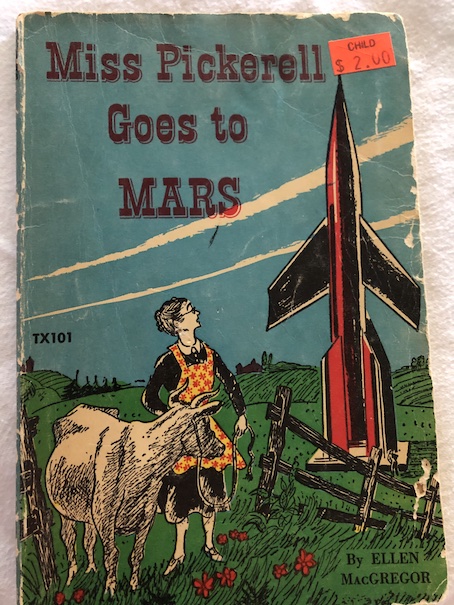
Miss Pickerell Goes to Mars by Ellen MacGregor, 1951.
This is the first book in the Miss Pickerell series, which was written to introduce scientific concepts to children in an entertaining way.
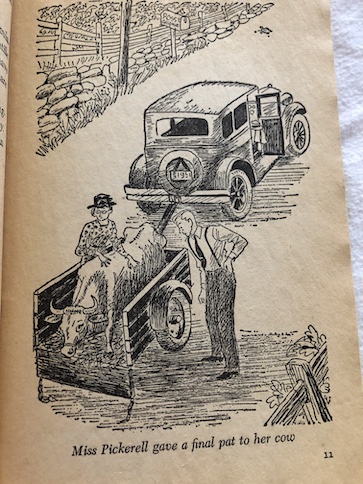
The story begins when Miss Pickerell is visiting her brother and her nieces and nephews. She takes the children to ride on a ferris wheel, but she refuses to get on it herself because she’s afraid of heights. Really, all she wants to do is take her pet cow home and start getting her rock collection ready for the exhibition at the state fair.
As she leaves, she offers a ride to a man when the bus he was waiting for didn’t stop for him. Although she isn’t anxious for conversation and would prefer silence after her visit with her noisy nieces and nephews, she does make a comment about the sound of a jet overhead. She explains that airplanes are her nieces’ and nephews’ newest obsession, and she’s glad because they were obsessed with flying saucers before, and at least airplanes actually exists. The man riding with her, Mr. Haggerty asks Miss Pickerell if she believes in flying saucers and space travel. Miss Pickerell says that she doesn’t believe in flying saucers and doesn’t think any intelligent person would, but Mr. Haggerty tells her that he will soon be traveling to Mars. At first, Miss Pickerell doesn’t believe him. He says that he works for a scientific expedition whose headquarters is nearby, but the captain in charge of the expedition wouldn’t want him to say too much about it too soon, just in case it doesn’t work out well.
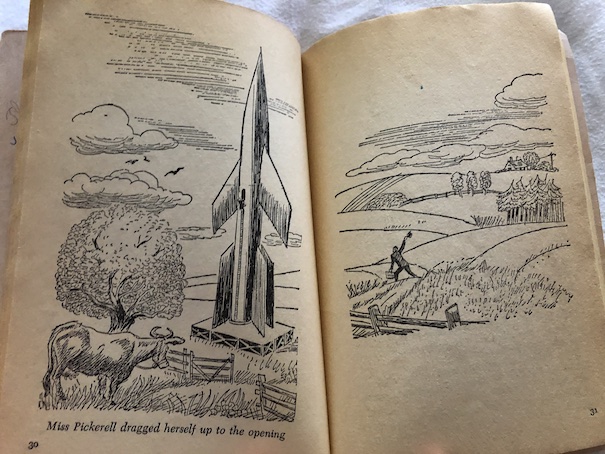
However, Miss Pickerell can’t help but get involved in the project, considering that they’re doing it on her land. Miss Pickerell lets Mr. Haggerty out of the car in front of her farm, but when she enters her own house, she can tell that someone else has been there in the weeks that she’s been gone. Then, she spots the space ship at the end of her cow pasture.
Miss Pickerell marches up to one of the people working on the expedition and demands to know what they’re doing on her property. The man says that they thought that the house was abandoned because it had been empty for weeks and they wanted a quiet place to work on their project. Miss Pickerell threatens to call the governor and report them. She picks the governor to call because, since she lives in the country, there are no police nearby, and she’s met the governor before at the state fair, where he’s given her prizes for her rock collection.
When she calls the governor, he isn’t there, so she leaves a message with his wife and decides to talk to the men at the space ship again while she waits for the governor to call her back. Although she’s afraid of heights, Miss Pickerell climbs into the space ship to talk to the men – right before it launches.
Soon, Miss Pickerell is in outer space and headed for trouble because it turns out that, not only was she not supposed to be there but they’ve accidentally left Mr. Haggerty behind. Mr. Haggerty is important because he’s the one who’s supposed to do the calculations for the flight.
The book is available to borrow and read for free online through Internet Archive.
My Reaction
I vaguely recalled my mother reading us one or two of the Miss Pickerell books from the library when we were kids. I think I liked them at the time, but it had been so long that I’d really forgotten what they were like.
I can definitely see the educational lessons in the book. After the ship launches, it takes awhile to impress on Miss Pickerell the seriousness of their situation and why they can’t just turn around and go back, during which they talk about Mars as a planet and how the ship’s course is programmed into the computer. A young man on the crew, Wilbur, shows Miss Pickerell how to drink water in outer space, and they talk about what gravity is and why there isn’t any in space. By accident, Miss Pickerell has caused further problems by bringing her hammer with her onto the ship because the hammer is magnetic, and the magnet is interfering with the ship’s equipment. Miss Pickerell’s first instinct is to throw the hammer out a door or window, but there are no windows, and Miss Pickerell is treated to an explanation about atmospheric pressure and oxygen in the space ship. Each event on the ship and on Mars itself requires explanation.
Fortunately, they do make it safely to Mars and back, and Miss Pickerell turns out to be surprisingly helpful and is actually glad that she made the trip. On their return, she finds out that Mr. Haggerty has been taking care of her cow, and the governor has invited her for a visit. The governor gives her an award, and she even brings back rocks from Mars with her and gives some to her nieces and nephews.
The Dangerous Book for Boys by Conn Iggulden and Hal Iggulden, 2006, 2007.
This is an activity/hobby book for children, especially for boys, but really, full of activities that girls could enjoy, too. It’s often sold in sets with a companion book, The Daring Book for Girls. These books follow in the tradition of earlier activity/hobby books like The American Boy’s Handy Book and The American Girl’s Handy Book by the Beard siblings. Some of the activities in these modern books are similar to ones included in historical children’s activity/hobby books, but there are some notable differences. Although The Dangerous Book for Boys includes sports and outdoor activities, it has more scientific and academic information than The American Boy’s Handy Book.
The differences between these books show changes that have taken place in society, the activities that adults want to promote for children, and the types of activities that children can actually use in the 125 years between the times when the two books were published. The motives of the authors of these books were similar, all of them wanting to produce the type of activity/hobby book that they would have liked to have when they were young and didn’t have, not because other hobby books didn’t exist exist when they were young but because they were looking for something that they hadn’t found in the hobby books of their youth. In the 1880s, Daniel Beard set out to write a hobby book for American boys because many of the hobby books of his youth were poorly written and/or came from England, using words that were not used in American English or recommendations for London shops where boys could buy equipment, which were of no use to an American boy. His book, The American Boy’s Handy Book, promoted do-it-yourself hobbies, particularly ones related to outdoor activities and suitable for children who lived near woods and lakes or rivers where they could do things like go fishing, sail boats that they made themselves, or build log cabin playhouses. However, 21st century society is much more urban/suburban, and it can be difficult or impossible for modern children to do something the things that Daniel Beard recommended. The Dangerous Book for Boys was written for 21st century children, who might need a bit of nudging to get off their computers and video game systems now and then and maybe a little academic help or something to ignite an interest in history or science, but are no less interested in learning something new and interesting or something fun to do with their friends. One thing that I hope readers come to understand from these books is that the world is full of things to do. There is more to do in life than anyone will have time to do in a single lifetime, and far, far more than can be contained in any one book. The Dangerous Book for Boys (published first in the UK and later in the US) contains things that 19th century Daniel Beard might have found very interesting but didn’t exist during his time, so they never even occurred to him as possibilities, and there are bound to be more things coming in the future that people either haven’t thought of yet or are quietly working on right now, planning the books and activities of the future. There’s always something to do. People just need time to do things and the willingness to get started.
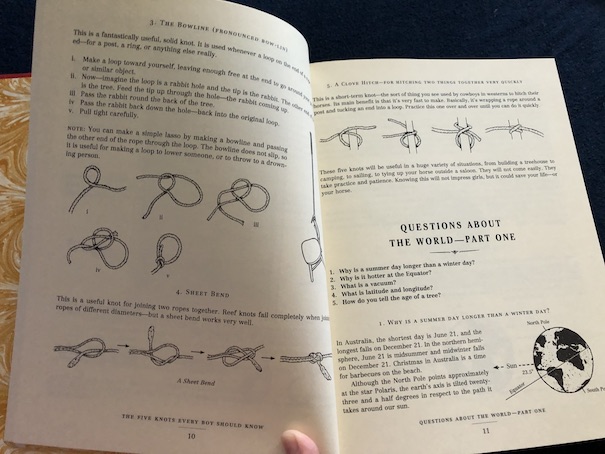
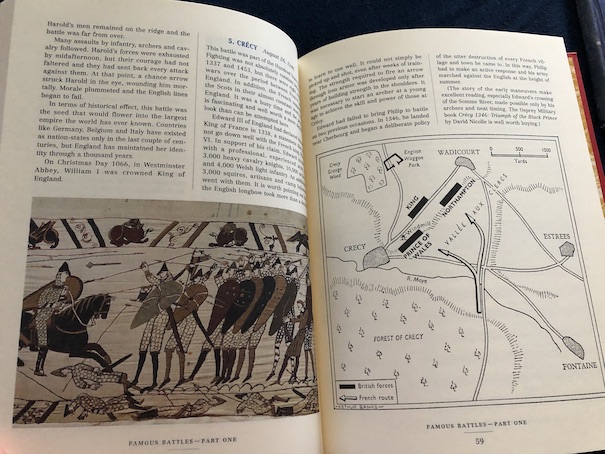
I like to explain the contents of books so that people will know whether they would like to read them in more detail. It’s difficult to describe the contents of The Dangerous Book for Boys succinctly because the contents are extensive and they are not grouped into convenient categories. It’s more like reading a very long magazine with isolated articles, although some of the articles are related to each other. It’s just that related topics are not put next to each other. For example, the information about reading star maps comes much later in the book than the introduction to astronomy, and information about the solar system comes even later, with many other sections in between. There are also some sections of trivia/interesting information, history, or academic topics which were purposely split into different numbered sections and distributed throughout the book, like Questions About the World (explaining natural phenomena like the seasons, the tides, and why the sky is blue), Famous Battles (divided into sections starting with ancient battles and then more modern ones), Extraordinary Stories (about the lives and accomplishments of famous men, including the Wright Brothers and Robert the Bruce), and Understanding Grammar (a more academic section).
Because it would be difficult for me to explain everything in this book without basically copying the entire table of contents, which would take quite a lot of space to do, I’ll just hit some of the highlights by describing them in sections that the book doesn’t have but which explain the types of activities covered in this book. All of the types of activities that I describe below are included in the book, but there is also more in the book than I could take the time and space to describe in detail.
Useful Skills and Knowledge
The book has sections explaining how to do first aid, how to tie different types of knots, how to wrap a package with brown paper and string, and how to make cloth fireproof.
I was somewhat amused by the section about how to talk to girls. Most of it is good advice, like maintaining a clean appearance and not being vulgar or overdoing it with jokes. Lesson #1 is “It is important to listen.”, which is always true. The part that I thought was funny was in the introduction: “You may already have noticed that girls are quite different from you. By this, we do not mean the physical differences, more the fact that they remain unimpressed by your mastery of a game involving wizards, or your understanding of Morse Code.” To that, I say, “Are you kidding?!” I used to have Morse Code memorized from playing the Nancy Drew computer games by Her Interactive, and I know from my fascination with activity books like this that the reason why Morse Code looks the way it does is that Morse wisely decided to make the letters of the alphabet used the most often the shortest to form. I used to play World of Warcraft, and I played every one of the available factions, but then I got more interested in physical board games and board game history. My female friends continued much longer, although they ended up switching to Final Fantasy. I’ve played both D&D and Call of Cthulu and liked them both. The more wizards, the better, as far as I’m concerned!
I always think that advice about what girls like often fails to take into account that girls are individuals with different interests and hobbies, no matter what their age. Not all woman like to wear high heels (which are stupid, annoying shoes that are bad for your feet, especially those with the dumb, skinny heels that always make me turn my ankle), and some either never wear makeup or consider it an annoying hassle that they feel obligated to do to because other people expect it. Some girls wear their hair long because they like the feminine look or like to experiment with different types of artistic braids and hairstyles, and some girls chop their hair short because they’d rather just quickly run a comb through it and forget about it. Some women, like me and my friends are geeks, who love books, play video games and role-playing games, know various types of computer programming or maker hobbies, study history, and would gladly do most of the activities in books like this. Some girls are into sports and working out. There are even some girls who are into things like hunting and even taxidermy and wished that they could have joined the Boy Scouts instead of learning to sew and bake cupcakes in Brownies. People in general can have many and varied interests. Even though this book was written for boys of the 21st century, I don’t think that the authors are really in touch with women and girls of the 21st century and understand the range of topics that many of them find interesting. Although, I think that the authors’ attitudes about girls’ interests aren’t just due to them growing up in the 20th century themselves. Guys have often tried to figure out what women like and what women want, and they frequently get it wrong because they approach the question from the wrong angle. Chaucer tackled the problem of what women want way back in the Middle Ages, and he figured it out. What women like most is often what men like most: having things their own way. What that means varies from person to person because of our different interests, but in some form or other, that’s what we all want. So, don’t try to figure out what “girls” like; just ask a particular girl what she likes. Guys don’t need to try to please all the girls in the world at once, just the one they’re with. Most people will tell you who they are and what they’re interested in, given the chance (or maybe a Facebook or Instagram page), and when a boy finds a girl who likes things that he also likes or is willing to do things that he likes to do, he’s found a good one.
Aside from random, useful life skills, there is also academic information in the book that would be useful to school, like standard and metric measurements, the sections about how grammar works, the origins of words, Latin phrases, quotes from Shakespeare, the Ten Commandments, and poems that boys should know and books that boys should read.
Games
I count games differently from sports because sports tend to be outdoor activities and require a certain level of physical skill, and games tend to be more general, require less physical skill, and can be played indoors. This book includes some pen-and-paper games, marbles, chess, role-playing games, poker, and table football.
Sports
The book has the rules for soccer and stickball. It also discusses famous baseball players and rugby.
Outdoor Activities
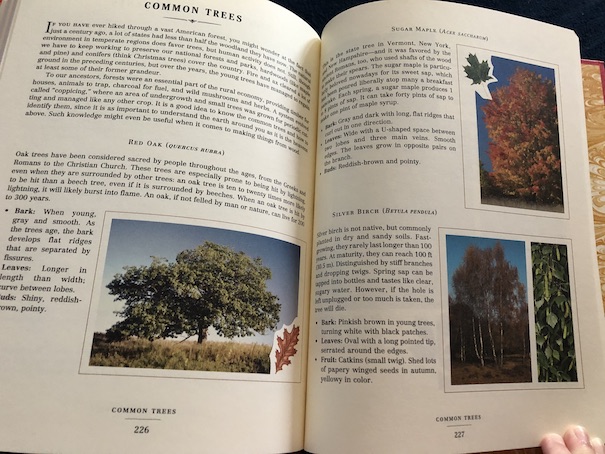
These are activities to do that are related to the outdoors and nature and things to make related that are related to outdoor activities, including fishing, building a treehouse, making a bow and arrow, how to hunt and cook a rabbit, how to tan an animal skin, making a go-cart, and learning various methods of navigation and different types of trees.
Science and Technology
The book describes various topics related to science, like astronomy, insects and spiders, cloud formations, and fossils and dinosaurs. There are also instructions for making projects that would probably make good science fair projects, like a battery, an electromagnet, a periscope, a pinhole projector, and crystals.
History and Geography
There are sections about US geography (I don’t know if the original UK version had this or if it focused on the geography of the UK), Early American History, the Declaration of Independence, the Golden Age of Piracy, descriptions of the Seven Wonders of the World (both ancient and modern), the sections about Famous Battles from history, and a Brief History of Artillery.
Spies and Secret Codes
There are sections about the codes and ciphers that spies use, the Navajo Code Talkers’ Dictionary from World War II, the US Naval Flag Codes, and how to make secret inks.
Crafts
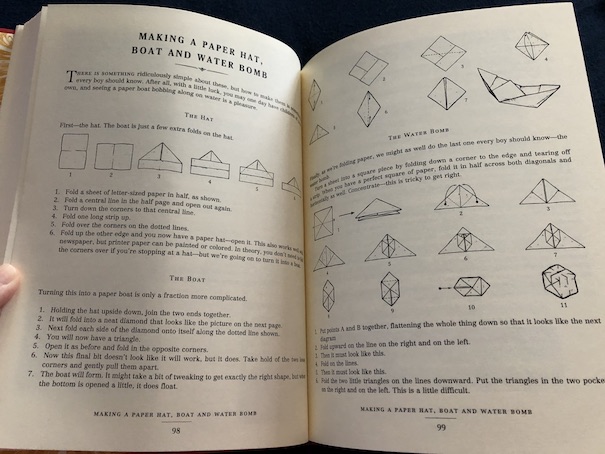
The book explains how to build a workbench, how to grind an italic nib for italic writing, and how to make marbled paper, making paper airplanes and paper hats, boats, and water bombs (these are little origami boxes that you fill with water and splat when you throw them at something – I’ve made them before).
Stunts and Random Skills
These are just random things that are fun to know how to do, like juggling, skipping stones, coin tricks. There is also a section about teaching tricks to dogs.
Dangerous Book for Boys Badges
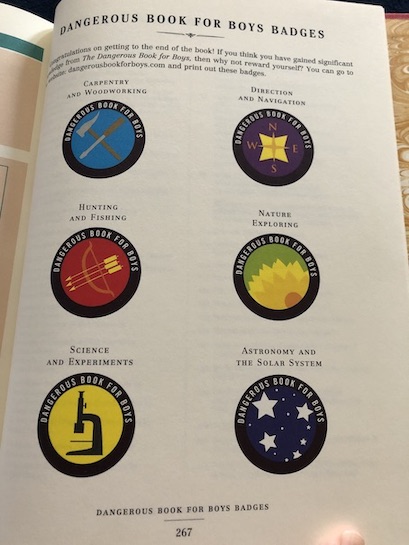
This is the final part of the book. Since many of the activities in the book are the kind done at summer camps or in scout troops, the book overs suggested “badges” you can award yourself and your friends for doing the activities. Even though the activities in the book are not sorted into specific categories, there are six categories of badges offered: Carpentry and Woodworking, Direction and Navigation, Hunting and Fishing, Nature Exploring, Science and Experiments, and Astronomy and the Solar System. The book doesn’t specify what activities you should master to award yourself these badges, leaving that up to the reader. My copy says that if you go to their website, you can print out these badges, but that website no longer exists. I don’t know if later printings say something different.
If you’re looking for something to do with the kids during coronavirus lock-downs and/or over summer vacation, this book has plenty of ideas, and you can even make up your own “badges”, using their ideas, my category suggestions, or anything else you would like to do yourself.
The book is available to borrow and read for free online through Internet Archive. I’ve also learned that the book has inspired a tv series, which is available through Amazon Prime. You can see the trailer on YouTube.
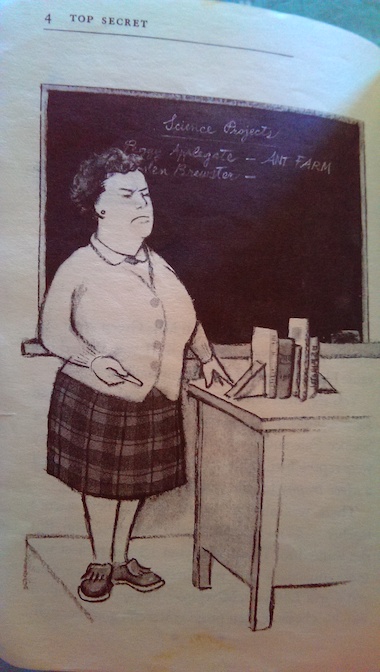
Nine-year-old Allen Brewster’s teacher, Miss Green, is obsessed with the science fair. Every year, there is a silver trophy awarded to the best science fair project and another prize for the best science teacher. No one in Miss Green’s class has ever won the trophy, and so Miss Green has never won the best science teacher award. All the best projects are done by older students. Miss Green hates it, and she’s been known to flunk kids who do especially bad on their science fair projects.
However, Allen Brewster thinks that he’s got the kind of project that Miss Green has been waiting for. When his mother served liver for dinner one night, Allen got to thinking how much nicer it would be if people didn’t have to eat, if they could just get nutrients from the sun, like plants do during photosynthesis. So, he decides that he wants to research human photosynthesis. When he tells Miss Green what he wants to do, she says that’s impossible and refuses to take his idea seriously. Instead, she tells him that he’s going to do a project on the topic of lipstick.
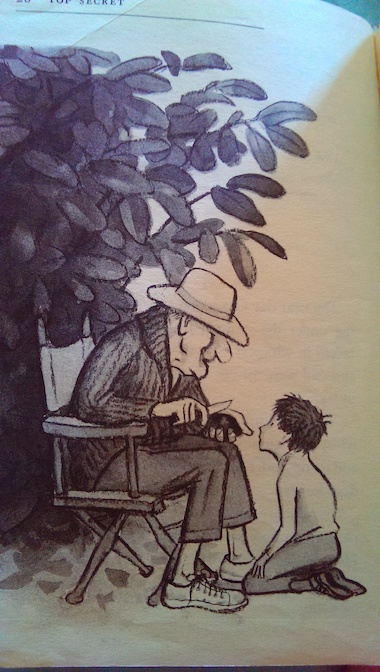
Allen is angry that Miss Green didn’t take him seriously, and lipstick is the last thing that he’s interested in. His parents think that he should just do the lipstick project and forget about it. Even if human photosynthesis were possible, how could a nine-year-old possibly achieve such a thing? Real discoveries are made by important men, not little boys. However, Allen’s grandfather encourages him to persevere in what he wants. He says that Allen has everything that a important man would have: five good senses and a brain that he can use to think. Allen’s grandfather often thinks about strange things himself, and he encourages Allen to think all the time.
“Cause you know what you are when you stop thinking, don’t you?”
“What?”
“You’re dead.”
Although Allen acts like he’s carrying out the lipstick project, with his parents’ help, he continues studying photosynthesis on the side. When Allen gets stuck on what to do next, his grandfather advises him to “think crazy,” to just let his mind explore possibilities and see what it comes up with.
What Allen comes up with is that, in order for a person to experience photosynthesis, the hemoglobin in human blood would have to act like chlorophyll in plants, and the difference between the two substances is magnesium. By experimenting with kitchen leftovers, especially (and unfortunately), the liver his mother made, Allen discovers that he is beginning to experience photosynthesis. He is no longer hungry for food, he craves water, loves sunlight more than ever, and he is turning green.
When his parents realize what he’s done, they panic and take him to a hospital, but the doctor can’t find anything wrong with him. He thinks that Allen is green because of allergies. When he goes to school, people notice right away how weird he looks, but they think that it’s just makeup. Miss Green is furious, sending him home to wash the “paint” off.
Trying to get everyone to believe what he’s done, Allen goes to the local newspaper. They do a story about him, but people still aren’t convinced. However, the President of the United States happens to be visiting the city. Allen writes to him, hoping to convince him of his discovery. In the end, Allen’s discovery is recognized by the government (whose scientists also figure out how to turn him back into a normal human), but it’s also, unfortunately, now considered top secret. Allen won’t be allowed to talk about it anymore or claim credit for it. Putting it in the science fair is completely out of the question. Allen could keep quiet about the whole thing . . . but he doesn’t want to.
Allen’s discovery has problems. One of which, as he learns for himself while he’s a plant person, is that with photosynthesis, he’s completely dependent on sunlight. During a spell of bad weather, it’s only his desk lamp that keeps him alive. Then, the government people point out that if people aren’t dependent on food, society as we know it would break down. Industries that produce food or food-related items would no longer be necessary. In fact, people wouldn’t really have to work at all because they would no longer need to buy food. Allen thinks that sounds pretty good, but the world would no longer be the same. To the government, the economic and social repercussions of Allen’s discovery are the most important, but personally, I think it’s just as well that the project does end because I think bad weather would be an insurmountable problem.
The humor really makes this story. I love Allen’s grandfather, who loves coming up with odd ideas and fully supports Allen’s project to turn himself into a plant person. He matter-of-factly sprays his grandson with bug spray when he gets aphids and has a spot for Allen reserved in his garden, if he needs it. I’m glad that Allen didn’t remain a plant person because I found his state a little disturbing, but Allen’s description of his experiment is pretty fun.
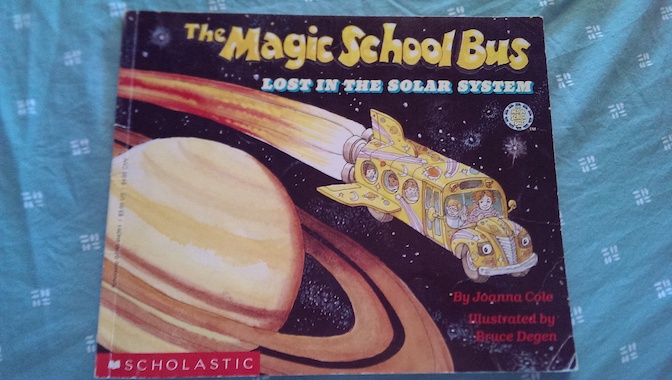
The Magic School Bus Lost in the Solar System by Joanna Cole, 1990.
Ms. Frizzle’s class is planning a trip to the planetarium as part of their lesson about the solar system, but of course, their magic school bus has other plans. When they get to the planetarium and find out that it’s closed for repairs, the bus sprouts rockets and takes them on a real trip through the solar system.
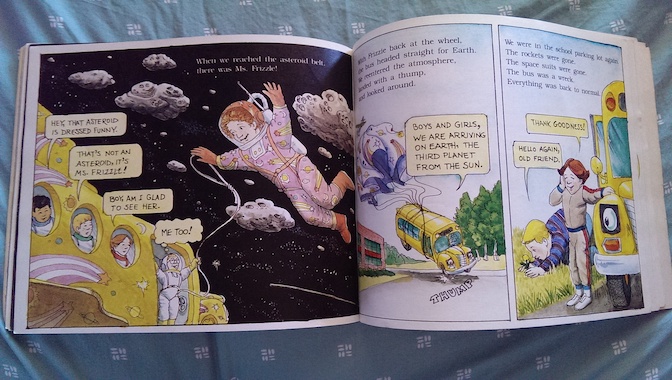
This time, the class is accompanied by Arnold’s visiting cousin, Janet. Janet is a show-off who brags constantly about everything, making up stories when she has nothing real to brag about. She gets on the other kids’ nerves, but when they’re separated from Ms. Frizzle because she got out of the bus to fix a taillight broken in the asteroid field, Janet takes charge, using Ms. Frizzle’s lesson plan to continue the field trip, eventually figuring out how to turn the bus around to rescue her and get back to Earth.
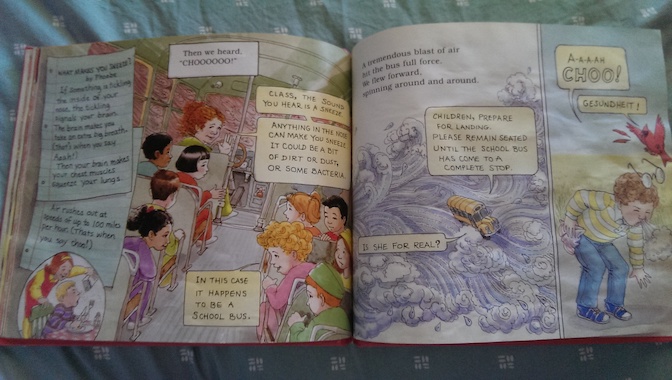
All through the book, there are facts about the sun, the moon, and the planets in the solar system from the students’ reports. Each time they stop at a planet, a scale shows the difference between Arnold’s weight on Earth and his weight on each planet. The book considers Pluto to be a planet because it was written before its planet status was reconsidered.
The book is currently available online through Internet Archive.
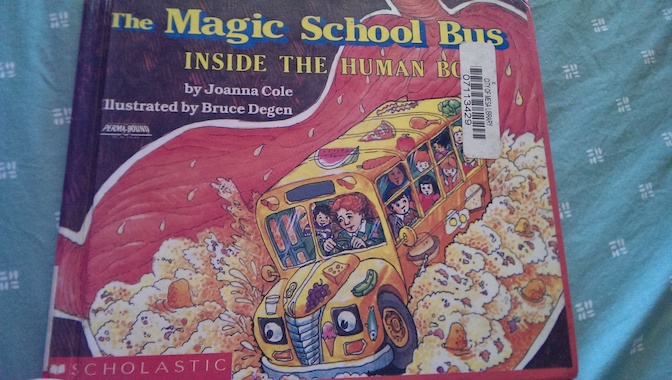
The Magic School Bus Inside the Human Body by Joanna Cole, 1989.
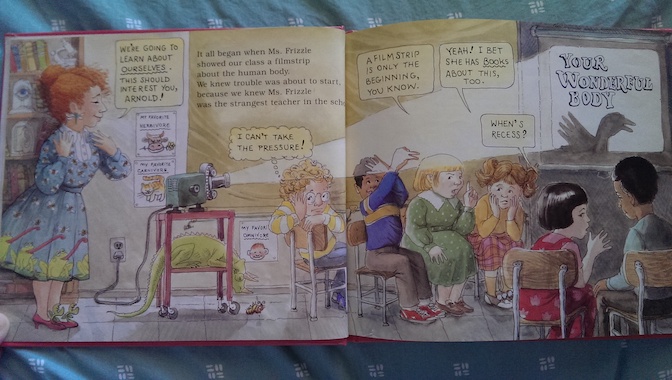
Ms. Frizzle’s class is now studying the human body, and they are going to take a trip to the science museum to see an exhibit about how bodies digest food for energy. Of course, this is not going to be a normal field trip, but it is weirder than anything the students could have expected.
After the class stops at a park for lunch, Arnold is accidentally left behind, and before they can go back for him, the bus shrinks small and is accidentally swallowed by Arnold.
While his classmates take a trip through Arnold’s body, Arnold panics at being left behind and makes his way back to school by himself, accompanied by a sympathetic bird, not knowing where the rest of the class went.
The book ends with a section of true and false questions that point out the impossibilities of the class’s field trip inside a student’s body, but also points out that the information about the human body itself is true.
The book is currently available online through Internet Archive.






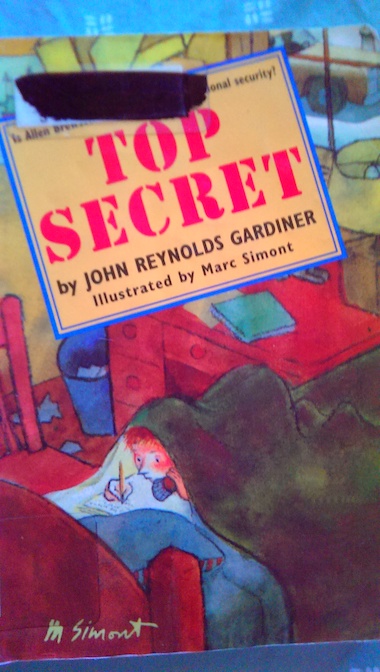 Top Secret by John Reynolds Gardiner, 1984.
 Allen is angry that Miss Green didn’t take him seriously, and lipstick is the last thing that he’s interested in. His parents think that he should just do the lipstick project and forget about it. Even if human photosynthesis were possible, how could a nine-year-old possibly achieve such a thing? Real discoveries are made by important men, not little boys. However, Allen’s grandfather encourages him to persevere in what he wants. He says that Allen has everything that a important man would have: five good senses and a brain that he can use to think. Allen’s grandfather often thinks about strange things himself, and he encourages Allen to think all the time.
 Although Allen acts like he’s carrying out the lipstick project, with his parents’ help, he continues studying photosynthesis on the side. When Allen gets stuck on what to do next, his grandfather advises him to “think crazy,” to just let his mind explore possibilities and see what it comes up with.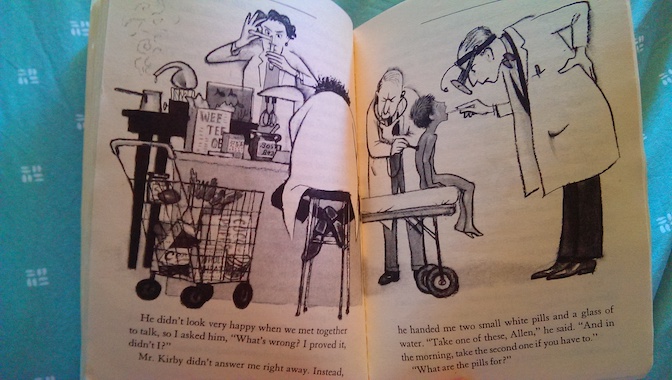



 Jestress's Forgotten Books and Stories