Lucky Dog Days

Pee Wee Scouts

Mrs. Peters tells the scouts that it’s Help-a-Pet month. The kids start talking about the kinds of pets they have, and Mrs. Peters asks them if they would like to do something to help a pet. She suggests that they could walk dogs at an animal shelter or raise money for homeless pets.

Mrs. Peters takes the scouts to an animal shelter. The kids like seeing all the animals, although Tracy turns out to be allergic to them. The other kids walk the dogs around the shelter yard. This turns into chaos because Rachel decides to walk a dog that’s really too big for her to handle, a St. Bernard. (The adults should have stopped her, but they never do in this series when a kid is about to do something they shouldn’t. They take Rachel’s word for it that she can handle a St. Bernard because she has walked her uncle’s Great Dane. However, even dogs of the same size don’t have the same temperament, and I think a real shelter worker would know the individual animal’s temperament and not offer an oversized dog with a lot of energy to a six-year-old child.) When her dog starts running and dragging her, the other dogs get out of control, too. Fortunately, they’re all in a contained yard, so none of them gets away. The incident ends with Rachel crashing into a lily pond in the yard.

Mrs. Peters tells the children that they will have a rummage sale to raise money for the animals at the shelter. All of the scouts will donate things to sell and collect donations from others. Tracy tells Molly and Mary Beth that she will help them collect donations. Molly is annoyed that Tracy is coming with them because she thinks Tracy is bossy and that her sniffling is gross. However, it turns out to be a good thing that Tracy comes because she brings a wagon with her to collect donations, which the other girls hadn’t thought to do. Unfortunately, their wagon disappears when the girls try to visit one last house to ask for donations and leave it unattended.

It turns out that some of the other scouts, Roger, Sonny, and Tim, found their wagon and try to claim the donations as their own at the next scout meeting. The boys say it’s theirs because they just found it on the sidewalk, but the girls tell Mrs. Peters what happened. Mrs. Peters smooths things over, saying that it doesn’t matter because these items will be sold to help the animals. Molly doesn’t think it’s fair for the boys to get credit for the work the girls did gathering donations, though. (I think Mrs. Peters should also have had a word with the boys about not taking things if you don’t know who they belong to and don’t have permission to take them. The adults in this series never explain things enough.)

There is one particularly fancy necklace that looks like diamonds among the donations. Mrs. Peters says that, rather than putting a price on it, they will auction it off to the highest bidder. They also have some adoptable dogs at the sale to attract people who might adopt them. It was Molly’s idea to have adoptable dogs there to sell because a lady expressed interest in Mrs. Peters’s big, black dog, Tiny. To Molly’s surprise, the lady who eventually buys the fancy necklace and pays a thousand dollars for it is the woman who donated it. When they ask her about it, she explains that it is a real diamond necklace and that she donated it by a mistake. However, even though she paid a lot of money to get it back, it’s still only a fraction of its real value, and she’s happy to make a big donation to a worthy cause.

In the end, Mrs. Peters congratulates the scouts on how much money they raised and how many animals were adopted that day. There is just one puppy left from the animals who were at the sale. The kids are attached to the puppy and don’t want to send him back to the shelter, so Mrs. Peters decides to keep him as a mascot for the troop. They name him Lucky, and Mrs. Peters says that they can take turns keeping him at their houses. (Except for the kids with allergies, like Tracy.)

The name of the book comes partly because the month is August, and Mrs. Peters explains to the kids what the “dog days” of summer are, although she just describes what the weather is like rather than explain why they’re called “dog days.” The term comes from the period after the rising of the dog star Sirius, but then again, I suppose that could be difficult to explain to six-year-olds. Not all adults would necessarily know it, either. I had to look it up myself to get the explanation. Even so, the name is appropriate because the theme of the book is pets, and it is set during late summer.

I still think that the adults in the story could explain some things to the kids more. That’s often a part of books in this series, although that’s also where much of the excitement of the story comes from, things going wrong because the kids don’t entirely know what they’re doing. Any lessons learned are more implied than spelled out.

The kids also keep insulting each other, even though they’re also kind of friends in the stories. We don’t really know why Molly thinks Tracy is bossy because she doesn’t really explain that. It just seems to her that Tracy tends to tell other people what to do and get her way. Molly relents a little in this book, though, because it turns out that Tracy has some good ideas, and even when she thought Tracy screwed up because they lost the wagon, everything worked out for the best.

Camp Ghost-Away

Pee Wee Scouts

The Pee-Wee Scouts sell powered sugar donuts door-to-door in their neighborhood to raise money for their trip to camp, and there is a special badge for the scout who sells the most. The kids all brag about how much they’re going to sell, each claiming that they can sell the most. Rachel teases Sonny because his over-protective mother will probably go with him while he’s going door-to-door. She calls him a “mama’s boy”, and he calls her “stuck up.” (There is some truth to both of these insults, but they’re still nasty, and no adult comments on it.) Molly and Mary Beth decide to do their selling together because they’re best friends.

In the end, Rachel and Sonny are the biggest sellers, each of them selling more than 100 boxes, in spite of Rachel’s teasing about his mother’s involvement and Rachel’s mother’s objection that donuts aren’t very healthy. However, there are some objections about how fair that is when Rachel and Sonny reveal the secrets of their success. Sonny’s mother sold 80 of his boxes at her workplace, and some kids object that it isn’t fair because Sonny didn’t sell them himself. He gets more teasing about being a “baby” and having his mother do things for him, but Mrs. Peters, the scout leader, says that it’s fair for a mother to sell on their behalf because the most important thing is the money they raise for camp.

Similarly, Rachel explains that her family went to a family wedding, and she sold most of her boxes to her relatives. Her family seems to have money, and her aunt and grandmother each bought 20 boxes. Jealously, Molly says that her relatives will get fat if they eat that many donuts. Rachel says that they won’t because they plan to donate the donuts to hungry people. Again, Mrs. Peters doesn’t say anything about the insults the children trade, just saying that the money they raised is important because they will now be able to afford to go to camp.

The camp is called Camp Hide-Away, and Mrs. Peters gives the children information about the camp and what to pack. They will go to camp next weekend, and Lisa’s mother will come with them on the trip. Rachel brags about how she has two swimsuits to bring, while the other kids only have one each, and she also shows off her new gold bracelet.

When they get to camp and Rachel discovers that they will be sleeping in tents, she isn’t so sure she wants to go camping after all. She doesn’t like bugs, and she worries about bears. The other kids call her “sissy” and “scaredy cat.” Mrs. Peters assures them that it will all be fine, and she has her large dog with them.

That night, they hear a strange sound, which sounds like the moaning of a ghost. The kids debate about whether it’s a ghost or some kind of wild animal. Either prospect is terrifying. When it starts talking, they’re sure it’s a ghost, but Mrs. Peters’s dog saves the day!

I’ve commented before that the kids in this book series do a lot of name-calling. In a way, it’s realistic for young children, but it’s also really annoying. Sonny inevitably gets called “sissy”, “baby”, and/or “mama’s boy” in every book I’ve read. It also bothers me that no adult ever tells the kids not to talk like that. The kids in the story are only six years old, so this kind of name-calling could be considered realistic, but adults telling kids not to talk like that is also realistic. I feel bad for Sonny because he often gets picked on in these books, and I think it’s unfair. Maybe his mother is a little over-protective, compared to the other parents, but at the same time, these kids are only six years old. Things like having a mom who walks to a six-year-old to school and doesn’t want a six-year-old to go door-to-door, selling things to strangers all by himself, are not outrageous. Even Rachel admits that she heard her mother saying that the kids were rather young to be away from home overnight for an entire weekend, and I think that’s true. There is some trouble with homesickness in the story, and I’m not surprised.

Like other books in this series, there are also multiple parts to the story, almost like short stories put together. The first part of this book is about selling the donuts to raise money for camp, and the second part is about their camping trip, although that part also has some smaller episodes. The highlight of the book is the spooky noise that the kids hear at night and think is a ghost. It is pretty quickly revealed that it’s just a couple of the scouts playing a prank on the others. The prank gets foiled by Mrs. Peters’s dog and the pranksters crashing into things because they have sheets over their heads.

There’s also a third part of the story, where Molly has more trouble with camp activities than the other kids. She can’t swim or row as well as they can, and when they look for interesting things, like rocks and wild flowers, on their hike, all she finds is poison ivy. But, she isn’t the only one having problems. Rachel doesn’t like bugs and the camping food, and Sonny gets homesick. Sonny’s mother comes to pick him up because he’s so upset. The other kids tease him again, but the truth is that other kids are also homesick and cry at night. Even Lisa cries, even though her mother is there on the trip. Molly realizes that she is the only one who isn’t homesick. Although she doesn’t get the badges for the standard camp activities, Molly does get one for not being homesick and another for finding Mary Beth’s lost ring. I was surprised that Rachel’s bracelet wasn’t the thing that got lost since she made a big deal of introducing it, but it was Mary Beth’s ring that got lost instead.

Although I often think that the adults don’t explain much to the children in this series, Mrs. Peters does tell the children that homesickness is natural. I think she could have given them a little more advice about it and defended Sonny from the teasing more, though.

Cookies and Crutches

Pee Wee Scouts

This is the first book in the Pee Wee Scouts series. The children in Troop 23 meet after school on Tuesdays, and their leader is Mrs. Peters. One Tuesday, they meet at Mrs. Peters’s house to bake cookies. Mrs. Peters says that, to earn their cookie badge, they must each bake cookies at home without help and have their parents write a note that they have done it. She teaches the children an easy cookie recipe that they will use.

Roger White doesn’t want to bake cookies because he thinks that baking is for girls. Sonny Betz argues that it’s not just for girls, but many of the other children think that Sonny is a sissy because his mother still walks him to school. Sonny thinks that Roger is a creep. Mrs. Peters says that cooking is for everyone who eats. If boys can eat, they can also cook.

Mrs. Peters demonstrates making a recipe for chocolate chip cookies (and the book provides the recipe). Molly and Mary Beth ask if they can make their own batch of cookies for their badge together. They are not supposed to have adults helping them, but Mrs. Peters says that it is fine if they work with each other. In spite of their earlier argument, Roger agrees to make cookies with Sonny as a team.

However, when Molly and Mary Beth try to bake cookies by themselves, they don’t think the cookie batter looks right. It looks too pale, and when Mrs. Peters made her cookies, the batter was more brown. To fix the color problem, they decide to pour in some root beer, which is not part of the recipe. Then, they decide that the batter is too runny, so they add some gravy mix to thicken it. Because they added things they shouldn’t have, the cookies come out all wrong, and the girls worry that they won’t get their badge.

At their next meeting, though, they learn that nobody’s cookies look like they should. Mrs. Peters has the kids make cookies together while she supervises, although she doesn’t help them directly, so they can say that they did it themselves. This time, the cookies work out, although some of them are oddly-shaped. However, all of the kids get their cookie badges together.

The scout troop then organizes an ice skating party with the kids’ fathers. It’s a little awkward because not all of the kids have fathers living at home. Most of the kids without fathers bring an uncle or brother instead, but Sonny doesn’t have either, so his mom comes. The other kids tease him about it because they think he’s already too much of a mommy’s boy.

Some of the kids are also nervous because they don’t know how to skate, and they’re not even sure that their fathers know. Molly gets into trouble because Rachel makes a big deal about her fancy skates, which she owns so she doesn’t need to rent any, and about her dainty little feet. Molly rents a pair in the same size as Rachel’s, trying to prove that her feet aren’t too big, but they’re really too small for her. She has to take off her socks to put them on, and even then, it’s a hard squeeze. She ends up spraining her ankle badly because she’s wearing the wrong skates, and she has to use crutches. Molly doesn’t get her skating badge, but she does get one that’s almost as good as a consolation.

This is one of those children’s books/series where the kids in the story, although they are part of the same troop and seem to be friends for the most part, still say insulting things about each other, like when Roger called Sonny a sissy and Sonny called Roger a creep. I know that kids do things like this sometimes, but I don’t really like books that seem to promote or are permissive about that kind of talk. What bothered me is that, even though the boys were insulting each other in front of Mrs. Peters, she didn’t tell them to stop, which makes it seem like she tacitly thinks those insults are fine. I liked it that she contradicted Roger’s assertion that cooking and baking are only for girls, but I wish that she had said something about the way the kids were insulting each other.

I knew from the beginning of the story that the way Mrs. Peters was teaching these young children to make the cookies, just by watching her, and then expecting them to do it right completely on their own, with no adult supervision, was probably going to lead to a disaster of some kind. Of course, that’s because I’m reading this from an adult perspective. Nobody learns anything complex from only having seen it done by somebody else just one, especially if they just watched and didn’t actively participate. These kids are also young, just in the first grade of elementary school. They can read, but they don’t have advanced reading skills or much experience with cooking anything before. What I’m saying is that they really needed adult supervision, and I didn’t think that telling them that they had to do this completely by themselves wasn’t a great idea. Although, it’s possible that Mrs. Peters assumed that the kids would get more supervision than they actually got, even if the adults didn’t actively help. I think a lot of adults assumed that not helping meant no supervising and no advice or intervention when the kids were about to do something wrong. I have to admit, though, that there wouldn’t be much of a story if they did everything right, and this activity went as expected.

The story has two parts to it, which aren’t directly related. I thought, at first, that the kids would be serving cookies they baked to the dads, and that would be the tie-in between the cooking baking and the party with the fathers. They didn’t, though. The skating incident and Molly’s injury are unconnected to each other. The only connection I can see to the two incidents isn’t explicitly stated, but both of this incidents involve the kids doing something they’ve never done before and not really doing it right. They need to have experiences where things go wrong to start figuring out how to do things right. Although Rachel brags about her skating ability and her skates, after Molly is injured, Rachel admits that she fell down a lot when she was younger and was first learning. Molly feels a little better, realizing that nobody does things perfectly the first time. Although getting hurt isn’t great, learning to use crutches is also something new that Molly experiences that none of the other kids have experienced before.

Rosy Noses, Freezing Toes

Pee Wee Scouts

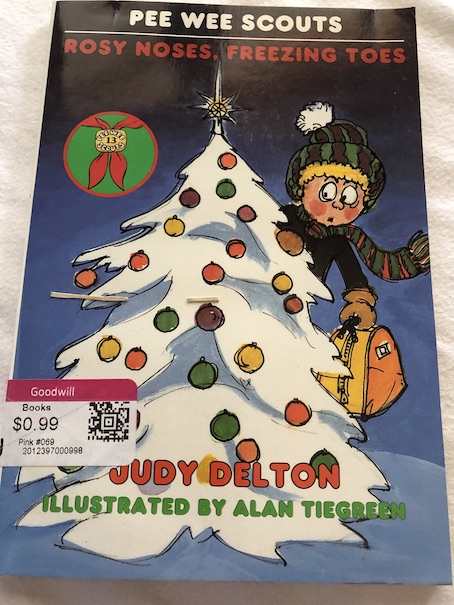
#13 Rosy Noses, Freezing Toes by Judy Delton, 1990.

At one of the scout meetings, Mrs. Peters, the troop leader, says that her antique vase is missing. It’s a family heirloom, and Mrs. Peters wants to ask the scouts if they know anything about its disappearance or if they have any idea of what could have happened to it. None of them knows, but they’re fascinated by the mystery. After they search the house and can’t find it, Mrs. Peters says that she’ll just have to report its disappearance to the insurance company. Mrs. Peters is willing to let the matter go at that, but the scouts keep wondering what happened to the vase and if one of them could have taken it.

Mrs. Peters tells the scouts that the next badge they will earn will be their music badge. To earn the badge, the children will have to sing or play an instrument or tell the group about the life of a composer. Some of the children already play instruments and know what they’re going to do, but others aren’t sure. Since it’s December, Mrs. Peters suggests that some of them could sing popular Christmas songs or a Hanukkah song.

Sonny Betz declares that he doesn’t want to participate because he can’t play an instrument and over the next few days, he seems upset and nasty with people. Molly asks him what the matter is, and Sonny tells her that his mother is forcing him to take violin lessons. Mrs. Betz has always wanted Sonny to learn to play the violin, and his new violin teacher has assured her that Sonny will be able to learn the first line of Jingle Bells in time for the scouts’ music show, even though it’s coming up fast. Sonny isn’t happy about it, and to make him feel better, Molly tells him that he’s lucky because nobody else will be playing the violin and it will make him different. Unfortunately, the other kids tease him and call him “Maestro,” so he starts feeling bad.

Molly doesn’t like the way the others keep teasing Sonny, and when Tracy says that Sonny is a baby, Molly tells her that it’s not his fault because his mother is the one who makes him take violin lessons and keep the training wheels on his bike even though he’s in the second grade and all the other things that people tease him about. Mrs. Betz doesn’t realize how much Sonny hates some of the things that she makes him do and how much the other kids tease Sonny about these things. Molly overhears her mother saying that Sonny will “be a handful by the time he gets to high school,” probably because she’s imagining that Sonny will rebel against all things his mother has been making him do once he’s a teenager. Actually, it’s not going to take that long.

Mrs. Peters uses the insurance money from her vase to buy a piano. The scouts’ music show goes okay at first, although none of the kids are spectacular at music. Molly, Mary Beth, and Lisa paint their noses red and sing Rudolph the Red-Nosed Reindeer. Kevin whistles. Roger plays White Christmas on the drums with no other accompaniment, confusing everyone about what song he’s actually playing. Poor Sonny has to go last, when everyone is starting to get tired of the entertainment, but he doesn’t play well. The other scouts cover their ears, and the screeching of the violin makes the dog bark and Mrs. Peters’s baby cry. Sonny is so upset that he runs away from the show and has a fit.

The next day, Molly learns that Sonny has run away from home completely, leaving behind a note that he’s heading to Alaska. Everyone is searching for Sonny and getting worried about him being outside alone in the snow. However, Molly soon discovers that Sonny hasn’t gone as far as everyone fears and he’s certainly not on his way to Alaska. She discovers Sonny hiding in her family’s bathtub. Sonny explains to her that he didn’t have the money to go to Alaska, but he couldn’t bring himself to go home, and he picked Molly’s house to hide in because Molly is the only one who didn’t tease at him. Molly promises not to turn him in, but she says that he won’t be able to stay in her bathtub forever. His mother has called the police to report his disappearance, and Molly’s parents are bound to find him eventually. Sonny swears that he can’t go home because he hates playing the violin so much. What can Molly do to help him change his mind?

I didn’t like the way the other scouts were so mean to Sonny in the book. Sonny does do childish things, like being mean to the younger kids on the playground when he’s upset and throwing fits when things go wrong. However, Molly tries to be understanding with Sonny, even when he’s being fussy and whining, and she recognizes that Sonny is in a difficult position. His mother has certain expectations of him, and Sonny doesn’t think that anything will change her mind. The way things work out, though, makes it seem like Sonny never really explained to his mother how upset he was about the violin lessons and maybe not even how upset he’s been about some other things. Part of Sonny’s difficulty and the reason why he seems babyish to the other kids is that he seems to have trouble managing and articulating his emotions, including standing up for himself and what he really wants. Some of the other scouts help Molly to convince Sonny that running away isn’t the solution, and Molly calls Mrs. Betz to tell her that Sonny is okay but won’t come home until she promises that he can stop playing the violin. Sonny declares that he wants to see that in writing, and his mother gladly writes him a note that says that he doesn’t have to play the violin again.

So, what about the antique vase mystery from the beginning of the story? Before the end of the book, they do locate the missing vase (not really stolen, more misplaced and forgotten), but Molly accidentally breaks it. Mrs. Peters says that it’s okay because, with the vase broken, she doesn’t have to give the money back to the insurance company, and she gets to keep her new piano. She’s been wanting a piano, and the truth is that she never really liked the vase, even though it was a family heirloom. Yay? Merry Christmas!

The book is available to borrow for free online through Internet Archive.

The Curse of the Egyptian Mummy

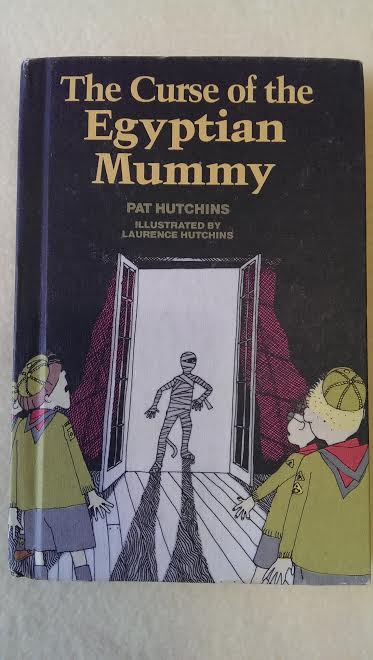
cursemummyThe Curse of the Egyptian Mummy by Pat Hutchins, 1983.

The 15th Hampstead Cub Scouts are looking forward to their camping trip. Miss. Hylyard, who runs a guesthouse for retired people, lets the scouts camp on her land and enjoys having them visit her house and entertain her guests. Mr. and Mrs. Webb are coming along to do the cooking, and their daughter, Victoria, will be there, too. She’s one of their friends from school.

Things start to get interesting pretty quickly when they hear that a man died from a poisonous snake bite not far from where they are camping. The boys are eager to show off their tracking skills by helping the police find the missing snake.  But, strangely, no one can figure out where the snake came from because none of the zoos in the area have reported one missing.  That’s only the beginning of what becomes a very strange trip for the scouts.

Sam finds a strange bird statue in a public wastebasket and decides to use it as the scouts’ new mascot. Then, someone trashes the campsite, and strange figures are seen running around the woods at night.  When Albert makes copies of the bird statue to earn his art badge, the first one is broken, and the second is stolen after some adult shoves Albert into the river near the camp.  Some of the guests at Miss Hylyard’s look suspicious, and when Victoria unexpectedly stumbles into an evening’s entertainment there still wrapped in bandages from the scouts’ first aid practice, a guest who was supposedly unable to speak suddenly blurts out, “The Curse of the Mummy’s Tomb!” in Arabic (which Miss Hylyard knows from her travels with her father).

Who are these mysterious people?  What is the importance of the statue?  And, is there really a curse?

The book is currently available online through Internet Archive.