The Ghost of the Gracie Mansion by Susan Kohl, illustrated by Ned Butterfield, 1999.
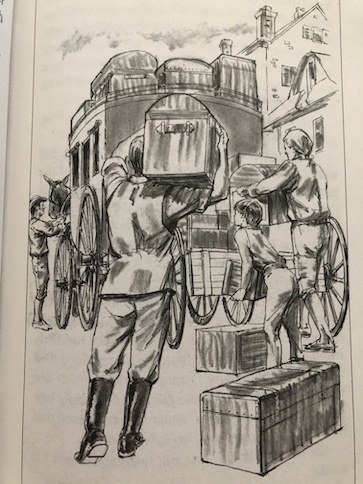
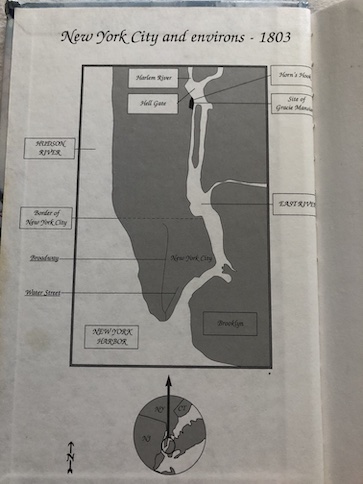
The year is 1803, and the Gracie family has decided to temporarily leave New York City because of the Yellow Fever Epidemic. William Gracie, the eldest son of the family, is disappointed because he has started working for his father’s shipping business, and he was looking forward to being promoted to clerk this spring. He wants to follow in his father’s footsteps, and he’s serious about wanting to learn the business. The trip that they’re taking to their new country home at Horn’s Hook, north of the city, seems to delay his plans because it’s so far away from everything, from his father’s business and from the Tontine Coffee House, where businessmen and other important people meet to discuss the issues of the day. However, William can’t help but admit that the situation in New York is serious. People are dying of Yellow Fever every day, including children, and his parents just want the family to be safe.
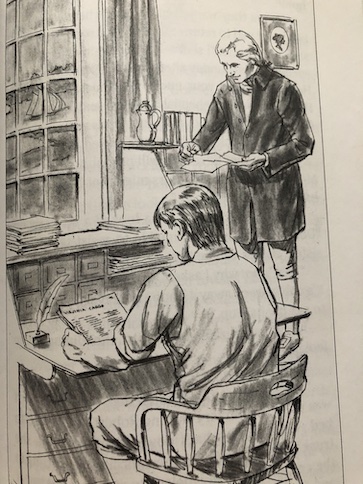
William begins to feel a little better when his father tells him that he’s arranged for them to work together from the family’s country mansion. His father says that captains of the ships he owns will stop at Horn’s Hook on their way to New York Harbor to report to him, and William will help him to prepare the cargo lists and timetables for the ships. Their temporary exile from New York hasn’t put a stop to their business or William’s education in that business; they’re just going to be doing things a little differently until the crisis is over.
While the family is traveling to their new country house, Mr. Gracie tells them about the history of the place. There used to be another house on that land, but it was destroyed during the American Revolution (an event still in relatively recent memory at the time this story takes place) as the British and the Patriots struggled to control it because that location is a strategic spot on the Harlem River. Mr. Gracie says that their new house is built over the basement of the old house, and that’s important because he’s aware that the former owners had a secret tunnel that led out of their basement in case they needed to use it as an escape route during the war. He told the builders to look out for it while they were building the new house, but if any of them ever figured out where it is, they never admitted it. The Gracie children are excited about the idea of their new house having a secret tunnel, and they’re eager to find it!
The new Gracie house is beautiful, really more of a mansion than just a house. However, there is something strange going on there. Soon after they arrive, William’s younger sister Sarah sees someone in the house dressed all in white. Sarah thinks that she saw the ghost of the person who owned the house that used to be on their property. The others don’t believe her because Sarah has a vivid imagination and is always making up stories, but Sarah insists that she saw someone.
When things start disappearing from the house, the rest of the family begins to believe that there may be some unknown person in their house. Sarah still thinks it’s a ghost, but William thinks maybe someone has found the secret passageway into the house. Who is this mysterious intruder?
The book is available to borrow and read for free online through Internet Archive.
My Reaction
I always like historical novels, particularly historical mysteries, and I really enjoyed this one. The mystery is meant for children in elementary school, and it isn’t too difficult, but it’s fun to see the Gracie children searching for the secret passage and trying to learn who is sneaking around the family’s country mansion. I also enjoyed that the story offers history lessons on multiple levels. The immediate situation for the characters is the yellow fever epidemic of 1803, but the story also touches on the American Revolution. The solution to the mystery is also related to Revolutionary War history. The Gracies, headed by father Archibald Gracie, were a real family who made their money in shipping, although the events in the story are fictional. There is a section in the back of the book that explains more about the family’s history. They associated with prominent people in New York in the early 19th century, and Alexander Hamilton makes an appearance in the story when he visits the Gracie Mansion. The Gracie Mansion is a real place. When it was first built, it was in the countryside outside the limits of New York City, but since then, the city has grown around it. It is now used as the home of the mayors of New York City.
Although this book was published before the coronavirus pandemic of the early 2020s, I also appreciated the part of the book at the beginning, where William is concerned that the current epidemic has changed his plans and impacted his ability to learn his father’s business. However, his father explains to him that they are still in business, and he has made arrangements for them to continue working in a different way during their time away from the city. People who lived through the quarantines and lockdowns of the covid pandemic will understand how it impacted the way people worked or continued their education and how people had to find ways to work around the problem. I appreciated that this story shows how people have had to deal with public health crises before in history and how they have always had to find creative solutions to deal with problems of this nature.
In this particular situation, the Gracies are a wealthy and privileged family, so their options for escaping from the crisis and working from outside the city are greater than other people of their time. Not everyone had a countryside mansion where they could go to escape the disease, and not everyone had employees who could report to them wherever they were. What Mr. Gracie and his son are doing during the course of the story is the early 19th century equivalent of “working remotely”, pre-Internet, and they accomplish it through people coming to report to them and taking goods and information into the city on their behalf. Even though the Gracie family can stay outside the city, they are still sending their ships into the city’s harbor because the cargo the ships carry is necessary there. There are people in the city who are waiting for the supplies the ships are carrying. The crews of the ships are what people in the 2020s came to call “essential workers” – the people whose type of work was necessary, no matter the circumstances, and who could not perform their duties from a remote location. The same is true for all the other people who must remain in the city because their jobs require them to work with or on behalf of the people who are still there.
Mystery at Kittiwake Bay by Joyce A. Stengel, 2001.
Cassie Hartt has only recently moved to Kittiwake Bay, Maine with her mother and brother following her parents’ divorce. Her mother is a nurse, and she has found a job at the local hospital, which is actually 30 miles away from the little town where they were able to find a house. Because of her mother’s long commute, Cassie will need to look after her 7-year-old brother, Danny. Soon after arriving, she meets a nice boy named Marc Nolan, who is a little older than she is and loves boats, and a girl name Liz Painter, who likes photography and walks her cat on a leash. Liz is the one who introduces Cassie and Danny to the Beachcombers Club, which is a group for kids Danny’s age who like to go swimming and camping and the kids who hang out at the Sand Shack coffee shop. Marc is one of the Sand Shack kids, and so is a boy named Ryan Jerrick, who is Liz’s crush. Cassie is glad to be making friends and starting to get settled into her new home, but soon, there are complications.
One evening, on her way home from the grocery store with her dog, Sam (short for Samson), Cassie sees some mysterious figures sneaking around in the dark. She doesn’t know who they are, but the way they’re sneaking around worries her. She later learns that there have been robberies in the area.
Cassie develops a fascination for the large house that she saw on a cliff near the ocean, and Marc and Ryan tell her that’s a senior citizens’ residence called Waterview Manor. Both of them work there part time. Liz says that the house wasn’t always a senior citizens’ residence and that there are a lot of weird stories about the place. It was built by a rich man before the Civil War, but it became property of the town in the 1950s. One of the stories about the place is that it was once part of the Underground Railroad helping escaped slaves. The boys say that a woman named Mrs. Wentworth says that her grandfather was one of the people helping escaped slaves. There’s also a story about Captain Kidd hiding his treasure somewhere around the old house, although Ryan doesn’t believe any of these stories. He thinks Mrs. Wentworth just tells tall tales. Cassie thinks that she might like to volunteer at the house, like the boys did before they started working there as employees. If her little brother joins the Beachcombers Club, she’ll have some free time for volunteer work.
When Cassie goes to Waterview Manor to sign up, she witnesses an argument between Ryan and Mrs. Wentworth, who is confined to a wheelchair. Ryan was being disrespectful because Mrs. Wentworth was telling one of her stories about the history of the town that Ryan thinks is outlandish, and Mrs. Wentworth was telling him off. Ryan doesn’t actually like working at Waterview, but he has to keep his job because he needs the money. Cassie thinks he’s arrogant. Ryan has no patience for the fetching and carrying he has to do for the older people, and he thinks that Mrs. Wentworth’s mind is going. Cassie thinks that Mrs. Wentworth sounds like she still has her faculties and is sympathetic when Mrs. Wentworth laments about not being able to do things she used to do because her hands and feet won’t obey her anymore. Mrs. Wentworth is physically feeble these days, but she knows what she’s talking about when it comes to local history.
After she signs up to volunteer, Cassie can’t resist a peek into the forbidden East Wing of the house, and she meets Marc there. They both admit that they’re curious about the stories of treasure in the house. Unlike Ryan, Marc believes Mrs. Wentworth’s stories, and Cassie can’t wait to hear more!
Mrs. Wentworth used to be a history teacher, and she does know more about local history than Ryan gives her credit. She tells Cassie how her grandfather used to be a conductor on the Underground Railroad and how his friend, Mr. Palmer, who was the original owner of Waterview Manor, was a stationmaster, which meant that he hosted and hid the escaping slaves that Mrs. Wentworth’s grandfather conducted to him. Mrs. Wentworth’s grandfather told her about a secret room where they used to hide people and a secret tunnel that would take them to the landing site for the boat that would smuggle the runaways to Canada. When Cassie asks her about the story about Captain Kidd hiding his treasure somewhere in the area, Mrs. Wentworth said that her grandfather always believed he did, although Captain Kidd was much older than both her grandfather and the Manor. She explains a little about the life story of Captain Kidd and how it seems that most of his treasure was never found.
However, they soon have a more modern mystery on their hands. Whoever has been stealing things in the area recently seems to have started taking things from Waterview Manor. First, an expensive chess set belonging to one of residents disappears. Then, some jewelry and a coin collection disappear. Then, someone steals Mrs. Wentworth’s beloved lavaliere necklace, a special present from her late husband. For someone to both know about the residents’ valuables and to have access to them, the thief must be somebody working at the Manor! Who, could it be? Is it grumpy Ryan, who needs money? Is it John, another employee, who often acts a little strange? Could it even be helpful Marc, who seems nice but is often lurking around areas where both he and Cassie aren’t supposed to be? Or is it someone else Cassie wouldn’t even think to suspect?
The mysteries of the past start mingling with the mysteries of the present. Cassie sees signal lights from the tower of the old house that remind her of of the signals Mrs. Wentworth said the Underground Railroad used. Is someone now using them for a different purpose?
The book is available to borrow and read for free online through Internet Archive.
My Reaction
The Underground Railroad is a popular subject in US children’s books. There is something compelling about people sneaking around on clandestine missions and hiding in secret rooms and secrets passages, and since these things were used in the real life Underground Railroad, they make convenient devices for US children’s books with some historical flavor. The former Underground Railroad secret passage in Waterview Manor does play a role in this story. Someone is using it for a new purpose, just like they’re using signals from the tower.
The purpose of the Underground Railroad secret tunnel in the story is also to show that Mrs. Wentworth knows what she’s taking about when she tells her stories about local history. Ryan tries to discount her stories because some of them sound a little far-fetched and dramatic and because he thinks scornfully of the old people he serves in his job. Ryan has a negative attitude and looks at the elderly as being senile and demanding. Cassie feels differently because she has more empathy and, perhaps, because her mother is a nurse, which may make her more aware of the human condition and more comfortable helping other people. She seems to understand what Mrs. Wentworth means when she talks about finding it frustrating that she can’t do things she used to do, and she says that she agrees with Mrs. Wentworth when she says that she likes keeping her hair long even though a nurse at the Manor says it would be easier to care for if she cut it shorter. The nurse is probably thinking that short hair would be easier on those who might have to help Mrs. Wentworth wash and brush it, but Cassie understands when Mrs. Wentworth explains why she likes her hair long. Cassie thinks the people who live at Waterview Manor are interesting, and she admits to her mother that she likes to pretend that they’re her grandparents. She is fascinated by Mrs. Wentworth’s stories, and because she and Marc believe what she says, they are able to get to the bottom of the mysteries surrounding the Manor.
I was pretty sure I knew who at least one of the thieves was, and I was also pretty sure I knew why. I was correct in my first guess, but there were enough red herrings along the way to give me some doubts, so there was plenty of suspense in the story. One of them wasn’t fully aware of what he was getting involved with at first, but he does bear responsibility for what he did even after he knew.
This book also deals with the subject of divorce and how it affects families and children. Books like this were once rare, but they have been very common staples of children’s literature since the late 20th century, reflecting changes in American society and a growing willingness to discuss difficult topics with children. Moving to a new state and starting over after the divorce wasn’t easy for Cassie, her mother, and her brother. Cassie quickly becomes interested in the history of her new town, and it doesn’t take her long to find some new friends and a volunteer activity to keep her occupied. However, other aspects of the changes in her life and family will take longer to get used to. Her mother has to work long hours with a long commute, so Cassie frequently has to be responsible for her younger brother when he’s not at activities of his own, and her mother often isn’t home for Cassie to discuss things with her.
There is also some tension between Cassie and her brother because the divorce has changed their relationship with each other. Because Cassie has become more of a caregiver to Danny because her mother has to work, she has to make arrangements for Danny before she can do anything on her own, which sometimes makes things awkward for her. Danny also becomes jealous because Cassie does have more ability to do things on her own than he does and because she makes friends and settles into their new town more easily than he does.
One part of this book that I hated was when Danny intentionally left Sam outside alone to spite Cassie, and Sam is poisoned by one of the villains and nearly dies. Cassie is very upset with Danny because of this incident, understandably so, but I didn’t like it that the other characters were pressuring her to be okay with Danny and forgive him too quickly. They do this because Danny is young, they think that he left the dog out by accident, and Danny feels really badly about almost getting the dog killed. Cassie knows, although Danny doesn’t initially admit it, that Danny left the dog outside on purpose. That purposefulness maliciousness is not a thing that I think should be too easily forgiven, especially not because someone just “feels bad.” Let’s insist on a little empathy here, Danny. Cassie feels bad because you almost got her dog killed. Sam really feels bad because he’s the one who almost died! Maybe your feelings shouldn’t be given first priority here, since you were the one who caused the harm. Sam is a dependent animal. Under no circumstances should animal abuse be excused, and leaving a dependent animal outside alone to be lost, hit by a car, or yes, harmed by some other malicious person is abusive. Danny should not be given a pass for malicious behavior or animal abuse just because he “feels bad.”
Giving people that type of excuse for malice and abuse just encourages more of it in real life because the person finds that there are no consequences for their actions and it gets them the forgiveness and attention they want, so they keep doing it. It’s a dangerous thing to allow. The story makes it clear that Danny was acting out on bad feelings that he already had about the divorce and feeling neglected by both his mother and Cassie, but I think it’s important to make it clear to him that, even if he’s “feeling bad”, that does not give him the right to hurt other people or animals. Nobody has the right to hurt others just because they’ve got mixed-up feelings. I hate it that the other characters don’t seem to feel that way.
The story ends happily when Danny tries to make it up to Cassie by investigating the situation and Cassie rescues him from the bad guys. They have a heart-to-heart talk that makes Cassie realize how important Danny is to her and that she has to make time for paying attention to him and supporting him more during this difficult time. Still, I feel very strongly that the story and the other characters should emphasize to Danny that causing hurt because you feel hurt is wrong and damaging to relationships. The way the other characters tried to make Cassie feel bad about the situation also really felt like gaslighting. She had a real and serious reason for being angry with her brother, and it just made me really angry when they acted like she was the bad one because Danny was “feeling bad” and she wanted him to be accountable for his actions. He knew what he was doing, and he should have known it was dangerous to Sam, even if he didn’t know that someone was going to deliberately try to kill the dog.
I know that Danny has some emotional issues that need to be addressed, but I’m saying that he also has some behavior issues that also need to be addressed. There are helpful ways to deal with emotions and destructive ways to deal with emotions. Danny is not too young to understand the consequences of his actions and to accept them. I don’t think that learning that it can take awhile to regain trust after betraying someone’s trust is also an unbearable lesson. In fact, I’d call it a life skill. If it helps him to develop more empathy and consider other people and the consequences of his actions before he lashes out, it is worth it.
Mystery of the Witches’ Bridge by Barbee Oliver Carleton, 1967.
Thirteen-year-old Dan Pride is an orphan. His father was an international correspondent, and during his early years, Dan lived in different European countries, as his parents traveled around to his father’s assignments. However, three years ago, his parents died in a plane crash. Since then, Dan has been living in a British boarding school. Now, he has returned to the United States to live with his father’s brother, Uncle Julian. Dan doesn’t know what to think about his new town because it’s very different from everything that he’s known before, but he likes the idea of belonging to a family once again because he has been lonely since his parents died.
The Pride family lives in a New England seacoast town. They were one of the founding families of the town in Puritan times, but Dan discovers that the local people aren’t particularly friendly with the Pride family. Billy Ben Corey, a man who works for his Uncle Julian, explains that the Pride family has been rather stand-offish with the townspeople, and there are also rumors and stories about witches that go back to Puritan times. Billy Ben says that most of the modern locals don’t really know all the details of the witch incidents, but the vague rumors that have circulated about the Pride family have caused the townspeople to treat them with suspicion.
This sounds like a somewhat sinister beginning to Dan’s life in York, Massachusetts as he comes to understand how much of life there is governed by the past relationships between the oldest families of the area. Billy Ben tells him that the Coreys have worked for the Prides for generations, but relations between the Prides and the Bishop family haven’t been good and that Dan should avoid them.
Dan presses Billy Ben for more information, and Billy Ben tells him the story of how one of his ancestors, Samuel Pride, was accused of witchcraft back in Puritan times. Some unfortunate happenings at the time, which were probably just the result of bad luck and bad weather, were blamed on him because he was kind of an odd, temperamental person. He was known for playing the fiddle extremely well, and people said that he used it to summon up the devil in the form of a black dog out of the marsh. The person who made the accusation and who led the group that came to arrest Samuel Pride was an ancestor of the Bishop family. Samuel came out to meet the group that came to apprehend them on the old stone bridge that leads to the island in the marsh where the Pride family has their house and farm, Pride’s Point. The story goes that when Samuel met the mob on the bridge, he placed a curse on them, that doom would come for them out of the night, out of the fog, and out of the marsh. Samuel and his wife were executed for witchcraft, and not only after, there was a terrible fog and a sickness that killed many people in town. People said that it was the result of Samuel’s curse. That’s why the Prides and the Bishops have a bad relationship even though they’re neighbors, why the townspeople are still a little suspicious of the Prides, why the Prides are somewhat standoffish of the townspeople (When you think about it, who really wants to be outgoing and friendly with people whose ancestors not only killed yours but who are not welcoming or friendly themselves because they have continually looked at you and your family with suspicion for generations, like you’re the weird ones? The townspeople basically created this situation and have been perpetuating it ever since, yet they act like the problem is with the Pride family instead of themselves. Gaslighting is a relatively new term from the 20th century, but the concept has been around forever, used even by people who don’t know what it is and that it’s what they’re really doing.), and why people in the area are afraid of the stone bridge that they call the Witches’ Bridge, the place where the curse was supposedly delivered. Even into modern times, people in the area see strange lights in the marsh and hear mysterious fiddle music or dog howls that they think might be Samuel’s ghost.
There is still more to come because the mysterious misfortunes of the Pride family have continued even into modern times. Dan is named for his grandfather, Daniel Pride, who died suddenly under very mysterious circumstances, something that still haunts his Uncle Julian. Young Dan learns the story from Mrs. Corey, a relative of Billy Ben’s, who is Uncle Julian’s housekeeper. Daniel Pride had been working to change the family’s image in the eyes of the local people, debunk all the old ghost and witch stories, and lay past quarrels to rest. To try to make peace with the Bishop family and restore the Pride family’s former fortunes, Daniel had been trying to arrange to buy the shipyards that the Bishop family owned, which had formerly been owned by the Pride family. The Bishop family initially agreed to the sale, and one foggy night, Daniel went to see the Bishops to finalize the sale. What happened after that is still a mystery. Daniel was found dead the next day near the old chapel with a look of terror on his face. It’s known that he had a heart condition, so he apparently had a heart attack, but from the marks on the ground, it also appears that he had been running before he collapsed, possibly deliberately frightened to death. Also, there were marks on the ground nearby where his briefcase fell, but the briefcase containing the sale papers was never found. The superstitious people in the area think that Daniel’s death was another symptom of the family’s curse, but it might also have been deliberate murder and theft. The Bishop family insist that they never finalized the sale of the shipyard with Daniel before his death, but Uncle Julian believes that the sale was finalized and that the Bishops are lying to take advantage of his father’s sudden death, just like their ancestors arranged the execution of Samuel for their own advantage. Uncle Julian remains suspicious and bitter about what has happened, just as the townspeople continue to look at the Prides suspiciously.
All of this makes York seem like it’s not the best place to raise a sensitive young orphan, and that’s basically what Uncle Julian says to Dan when Dan arrives at Pride’s Point. Uncle Julian seems elderly and physically frail, and Dan senses that he is a deeply troubled man. Uncle Julian tells Dan that the family and the old family home have a troubled history. That’s why Dan’s father decided to go away and live his life traveling to different places, and that’s why Uncle Julian delayed sending for Dan for so long after his parents’ deaths. Uncle Julian doesn’t seem to think that Pride’s Point is a very healthy place, and he hints at buried secrets. However, he does say that, now that Dan is there, there are going to have to be some changes.
Dan doesn’t think this sounds too hopeful, and he’s lonely and disappointed that he hasn’t found the happy family and home he was hoping for and that he doesn’t even seem particularly welcome there. He can’t even really enjoy playing his violin because of the connection people there seem to have between “fiddle” music, witchcraft, and his supposedly sinister ancestor. As Dan is looking around his new bedroom that night, he suddenly spots a mysterious flashing light from his window, outside in the marsh. It’s creepy because it not only supports all the ghost and witch stories that Dan has just heard but because he recognizes the patterns in the flashes of light as Morse Code … and the message being sent is his own name: D-A-N P-R-I-D-E.
Dan doesn’t believe that any supernatural force was using Morse Code to flash his name at night. It was obviously some human person, but who would do that and why? What is the truth about his grandfather’s death? Is Uncle Julian right that the Bishops caused Daniel Pride to die and then lied about the sale of the shipyard to cheat the Pride family? Or is someone else responsible?
The book is available to borrow and read for free online through Internet Archive.
My Reaction
I stand by my earlier statement that there is basically inter-generational gaslighting of the Pride family going on. It’s gone on for so long that the townspeople have trouble recognizing what they’re doing or stopping themselves from doing it, even though some of them seem to have the feeling that it isn’t right. At one point, some of the townspeople who come out to Pride’s Point to help fight a fire make jokes about the Pride curse. I could sense tension in them, and I think it was an attempt to lighten the mood, but under the circumstances, it wasn’t really appropriate for them to joke around, especially not about something that’s been a sensitive topic for the Prides, something that has literally caused members of their family to die and others to be persecuted for generations. Keep your audience in mind, and learn how to read a room, people of York!
Uncle Julian hates the stories and rumors that have circulated about his family since before he was born, but he doesn’t know what to do to stop it, and he sometimes wonders if it wouldn’t be better for the family to simply leave their old family home and start up again somewhere else. Mrs. Corey tells Dan that every single time anything bad happens in the area, people either look at the Prides suspiciously or find a way to blame them, even though they didn’t have anything to do with whatever it was. Dan can tell that Uncle Julian is so accustomed to having people blame him and his family for things and repeat scary stories about them that he halfway believes the stories in spite of himself, and he’s overly sensitive anytime it looks like the townspeople might be trying to blame the Prides for something yet again. That’s what makes this situation gaslighting, because the community’s constant untrue stories have warped even the Prides’ sense of reality and views of themselves. The community of York as a whole has created a situation that makes it difficult for the Prides to make friends with other people and get reality checks, and the most dangerous part of it is that among the few people that the Prides are in the habit of trusting is someone who turns out to be the person they should fear the most.
I couldn’t help but notice that there was someone in the story that Dan trusted too much in the beginning. It’s partly because Dan is young and in a situation where he is just getting to know the circumstances and people involved, but even when this person says things that are untrue, contradictory, or just plain mean, he doesn’t call him on it or seem to question within himself why this person is talking like that, at least not until about the middle of the book. Gaslighters will do this to a person, playing mind games, lying, alternately being friendly and praising their victim and then putting down their victim and/or trying to blacken their name to other people, discouraging them from getting close to people who care about them and might actually help them, acting like normal things that the victim does or feels are somehow weird or abnormal, trying to keep their victims in a constant state of confusion, unsure of what the reality of the situation really is. Although I found myself angry with the people of York in a general way for perpetuating something awful that their ancestors did for generations and for being apparently oblivious to what they’re doing in modern times, there is a definite villain in the story who is both deliberately and concretely evil.
There is a parallel drawn in the story between Uncle Julian’s big, black dog, Caliban, who is disfigured from an old injury and the Pride family themselves. Dan is afraid of the big dog, and Billy Ben tells him that it attacked him once, but Uncle Julian says that Caliban is just distrustful because he was badly abused and injured in his earlier life. People are like that, too. I understand that because I used to volunteer at an animal shelter, and that’s where I got my dog, Betty. (If you look at my About page, you’ll see a picture of Betty.)
I’ll never know Betty’s complete history because she was found wandering alone without a collar before she was brought to the shelter. However, I’m pretty good at reading between the lines, and I can read at least part of the story from her behavior. Betty is afraid of anyone, even me, walking behind her, and I’ve noticed since her shelter days that sometimes, her back end looks a little off-center when she runs. Her tail has an odd, permanent bend at the very tip that we didn’t discover until we had the hair on it trimmed. I think she’s been kicked hard from behind before, hard enough to leave permanent injury. She’s not as scared of things as she used to be after having lived with my family for a few years, but she used to be terrified of newspapers or anybody standing over her with anything in their hands, so I think she’s been hit with things before. Betty also gets scared when people laugh. She’s not as scared as she used to be because she’s gotten used to us laughing at something funny on tv, but there are times when she’s cringed and slunk away with her tail between her legs from people when they laugh and she can’t figure out why they’re laughing. Betty’s fear of laughter actually disturbs me because I think I know why it scares her. Based on her reaction, I’ve think that it’s likely that whoever hurt Betty before laughed when they did it. I think Betty has an association between laughter and pain, and that’s why she takes laughter as a bad sign, reacting fearfully to it when she thinks it might be directed at her. Laughing while inflicting pain is a sick thing to do, the product of a sick mind. There are stories in Betty’s reactions, and I’m disturbed by the mental picture I have of the person who had Betty before.
I have to admit that my own history has also both colored/given me insight into Betty’s behavior. If it isn’t obvious from comments in my previous reviews, I don’t see teasing as a positive thing. I’ve reacted to it in the past much like Betty does to sudden, unexplained laughter, which is why I understand the feeling behind it. Some people say that they like to tease their friends and people they like, but I just don’t like it, and I’ve learned to be more open and honest about how I never will like it. I do not have good feelings about people who tease others for fun, and I deeply resent being told that I have to like it because the people doing it are “just having fun.” It’s not a bonding activity, not with me, no matter who says it is. I absolutely refuse to “bond” with anyone who does it. Anyone telling me that I have to change myself to like people who tease is 100% guaranteed to get on my bad side. I have a bad history with teasing and bullying, I have a bad history with the people who do it, and I just don’t want to be around it. Teasing involves getting a laugh at someone else’s expense, benefiting from their discomfort, and getting a good feeling from making someone else feel bad. I don’t think any of that is right, and it doesn’t take much for it to get way out of hand, especially when people have the impulse press harder to get the reaction they want to their “jokes”, like the other person just didn’t get it, instead of cutting it out when their “jokes” just aren’t funny. It’s always awkward when it comes from people who don’t know the sore spots that they shouldn’t poke at and try to act like they’re special friends who should be cut some slack when the reality is that we don’t really know each other that well, we’re not really close friends, and no such special relationship actually exists between us. Real friends understand and demonstrate respect for each others’ feelings, and they don’t intentionally poke at a friend’s sore spots, like the people of York did to Uncle Julian with their jokes in this story.
What ties all of this together is that Betty’s reaction to laughter is like Uncle Julian’s reaction to the townspeople and their jokes and comments; it’s a conditioned response from long-term negative association. The townspeople are uneasy because Uncle Julian doesn’t laugh with them, but Uncle Julian doesn’t laugh with the townspeople because none of it was actually funny. By perpetuating these witch stories, even in the form of “jokes”, they’re constantly feeding the myths and ghost stories and making the situation worse, and they don’t seem to care about how he or his family feels or how it affects their lives. You can tell who respects you and who doesn’t by seeing who tries to treat you the way you want to be treated. The people of York were making jokes to soothe their own feelings, sharing in-jokes that they’ve had with each other at the Prides’ expense, and they got really uncomfortable when suddenly confronted with Uncle Julian’s, feelings that they helped to provoke and didn’t want to deal with.
Don’t worry about Betty. It’s sad that she’s been afraid of things and it’s kept her from being more outgoing and friendly, but we’re working through it. In non-pandemic times, I take her to places where I know she’s welcome, and she has acquired a fan club of people who like to see her and say hi whenever we visit. Anytime she seems uneasy because we’re laughing about something, I sit next to her, pet her, and praise her for being a Good Girl so she knows that nobody is trying to be mean to her and that we value her. When someone has been programmed through negative reinforcement, positive reinforcement is needed for balance. I’m trying to build more positive associations for her. It’s working, and she’s improving. She behaves very well and is very happy little dog when she’s treated well. Don’t worry about me, either. I’ve had some bad experiences, but I’m not the only one who’s had to deal with this stuff. There are lots of different kinds of people in the world, and I’ve learned some things about finding the kind of people I want to be around and making it clear how I want to be treated. I just gripe and vent now and then because I don’t like mean behavior or seeing others in these situations, and I’m all out of patience for it. I’ve learned what to do to help remedy such problems, but that doesn’t stop me from resenting the people who create problems that need to be solved.
The way both people and animals behave offers clues about what’s been happening with them. Sometimes, they offer warning signs of people to avoid, and sometimes, they are signs that the person or animal is in distress and needs some outside help and support. Caliban’s behavior in the story is more defensive than aggressive. That is, Caliban is reacting, not instigating … and if I saw what Dan saw in the story, I would know immediately to be very suspicious of the person Caliban hates the most because it explains where the source of harm in his life is. In a similar way, the Pride family is mostly reacting, not instigating. They have been harmed, both physically and psychologically, for an extended period of time, and while they seem to have the sense that’s the case, they’ve been too close to the problem for too long to see what the source of the greatest harm really is. But, about halfway through the book, Dan does learn to correctly read the people around him and comes to realize who is really his friend and how isn’t, based not on how others talk about them but by how they each actually treat him. When you pay attention and think about people’s actions in context, you can see who really has your best interests at heart and who doesn’t.
Dan spends much of the story, particularly at the beginning, feeling like he is unwanted, both in York and at Pride’s Point. At first, he thinks that his Uncle Julian doesn’t want him, but he gradually realizes that’s not it. There is someone else who doesn’t want Dan there, for reasons of their own. As I was reading, I noted times when this person said and did things that manipulated Dan’s feelings, even actively trying to make Dan feel bad while carefully seeming “honest” or “helpful” so Dan would continue to listen. I felt so much better when Dan finally realized the truth about this person. I have to say that I was really angry with Uncle Julian when I discovered that he was fully aware of who hurt his dog and that he still trusted this person. For me, the first hint of that would have caused me to permanently sever the relationship because it’s sick behavior and a sign of a disturbed mind, but I can only suppose that he felt unable to because he had been dependent on this person for too long, largely shunned by the wider community, who could have given him a reality check if they’d had a firmer grasp on reality themselves.
Dan, who had never heard of the Bishops before arriving in York, finds himself becoming angry and resentful of them, hating them for what they’ve done to his family for generations. His uncle even warns him not to get involved with the family, but that’s exactly what the real villain wants. When Dan makes friends with a boy named Pip Cole and his twin sister, Gilly, he confides his anger at the Bishops and how he blames them for this whole mess and for perpetuating it for generations, but Pip knows more about the situation than Dan suspects, and he has seen a different side of the problem. Pip tells Dan his family would have less problems if they would just forgive the Bishops, but Dan doesn’t believe it at first because, the way he sees it, the Bishops are the villains, who have actively profited from their villainy all along. I appreciate Dan’s situation. Pip doesn’t fully appreciate that, for Dan and his uncle, it’s not just about the past because they’re still actively suffering from the townspeople’s stories, rumors, and suspicions about them. It’s hard and maybe impossible to forgive something that’s ongoing from people who see no problem with the situation and aren’t particularly sorry. On the other hand, the resolution of this situation requires at least one of the parties involved to make the first move. Dan’s grandfather was trying, but his mysterious death prevented his mission from being completed. Even Uncle Julian reveals that he had been prepared to forgive the Bishops and marry their daughter, but some of the circumstances of his father’s death led him to believe that his fiance actually had a hand in it, and that apparent betrayal is what has left him such a haunted man all of these years.
The stories that Dan has heard about his family are not the complete story. Dan eventually comes to realize that the Prides and the Bishops each have only half of the real story, and because of their reluctance to associate with each other, the Bishops partly out of continued superstition and guilt, not knowing how to deal with the Prides’ anger, and the Prides, because they are both justifiably angry and accustomed to unfair treatment and being shunned by the community. However, it’s important that they do talk to each other because it’s the only way for each of them to get the complete picture of what’s really been happening and learn the real villain’s true motives.
The key to establishing the truth is in the missing briefcase, and both Dan and his enemy are searching for it. Dan needs to make peace with his family’s past, and he finds some help from a mysterious hermit called Lamie, who lives alone in the marsh. Lamie is another outcast of the York community. People avoid him because he has a reputation for being weird. People in this community in general may be “normal” in the sense that their behavior is fairly uniform, but uniformity by itself isn’t a virtue. When you’ve got an entire community doing something they shouldn’t, being the odd one out can be a good thing. Lamie helps Dan when he needs it, and Dan discovers that Lamie is actually a very kind and understanding person. Lamie’s solitary lifestyle is rather unorthodox, but he’s actually happy in his solitude because he knows who he is, he takes care of himself, he’s comfortable with himself, and he’s living the kind of life he likes, in touch with the natural world. When Dan talks to Lamie, he realizes that Lamie is comfortable with his own identity and at peace in his own mind in a way that his uncle isn’t. Even more importantly, Lamie sees things from a different perspective because he isn’t part of the groupthink of this community.
Lamie was friends with Dan’s grandfather, and he tells Dan about a hidden chamber built by the Prides’ ancestors, where Dan’s grandfather kept important family papers. However, Lamie tells Dan that he isn’t sure that he should look for it if his only motive is revenge. Dan does have a desire for revenge after all of the stories of injustice toward his family that he’s heard and what he’s suffered himself since he arrived in this area. Lamie helps to calm Dan’s desire for revenge by quoting from St. Francis of Assisi, emphasizing the importance of forgiveness instead of revenge. The part about truth speaks to Dan, and he comes to realize that what he really wants, more than revenge, is to know the truth about what happened to his grandfather. Lamie tells him that he saw some of what happened the night his grandfather died, from a distance. Because of the fog, he couldn’t see everything, but he knows that the Bishops were telling the truth that Dan’s grandfather didn’t make it to their place that night to complete their deal, defusing Dan’s anger at them for their supposed lies. Lamie’s memories also give him clues about the true identity of his grandfather’s attacker and the location of the secret hiding place. However, to find it and to evade his enemy, Dan will need the help of the very people his uncle has forbidden him to associate with.
I found the parts about the gaslighting of the Pride family and the poisonous duality of their true enemy frustrating and anger-inducing, but once Dan speaks to Lamie (really, my favorite charcter in the story) and begins to sort out who he can trust and who he can’t, I felt a lot better. The story is very atmospheric, with a grand old house and property, surrounded by a foggy marsh, and even when the characters know who their enemy really is, they are kind of trapped with him in a dangerous cat-and-mouse situation as they both race to find what they’re really looking for. By the end of the book, all of the old mysteries are wrapped up, including the source of the the mysterious “fiddler” music.
The Mystery of Drear House by Virginia Hamilton, 1987.
This book is the continuation of The House of Dies Drear, and the final book in the short series.
The Smalls are now settled into the house that formerly belonged to the abolitionist Dies Drear, who used secret tunnels to help smuggle escaping slaves to freedom as part of the Underground Railroad. Thomas Small’s father is a college professor, who finds the history of the house endlessly fascinating, especially now that they know about the hidden treasure that the caretaker, Mr. Pluto has been guarding for many years.
Apart from the Small family and Mr. Pluto, Pesty is only other person who knows where the hidden treasure is. Pesty (a nickname, her real name is Sarah) is the adopted daughter of the Darrow family, who live nearby. The Darrows are generally known to be nasty and scheming, and they have spent years looking for the treasure they know that Dies Drear hid. In the last book, Pesty helped the others to frighten off the Darrows when they were getting too close to the secret, but Thomas is still concerned that they might be a threat. He also privately questions Pesty’s loyalty, wondering if she’ll continue to keep the secret from the Darrows, although Mr. Pluto is confident that she will because she knew the secret of the treasure even before the Smalls did.
Mac, a boy about Thomas’s age, is the youngest of the Darrow brothers, and he’s not as mean as the rest of his family. Thomas kind of wants to be friends with him, but he’s not sure if he can really trust him. Mac tells Thomas that he can come over to visit sometime and that his mother is an invalid who sometimes spends months in bed. When Mac shows an interest in Thomas’s great-grandmother, who is coming to live with them, Thomas gets the idea to bring his great-grandmother over to the Darrow house to visit Mac and Pesty’s mother.
However, before they can visit Mrs. Darrow, she comes to visit them, entering their house through one of the secret passages that Thomas and his family haven’t learned about yet. She startles Thomas’s great-grandmother with her sudden arrival, and Thomas is irritated that Pesty didn’t tell him about that secret passage even though she knew about it. Pesty explains to them that her mother is mentally ill, a chronic condition of some kind, and she gets a little odd during times when she doesn’t take her medicine. Thomas’s great-grandmother seems to understand the situation, and she insists on escorting Mrs. Darrow home.
In the secret tunnel Mrs. Darrow used to come to their house, there are hidden rooms, and when they all arrive at the Darrow house, Mrs. Darrow begins telling them a kind of odd story, really little bits and pieces of stories that she has told Pesty and Mac before. Pesty seems to have a better understanding of what Mrs. Darrow is talking about than Mac does, but Thomas can tell that Mac has heard his mother tell these stories before and that he is also trying to get a better understanding of them. For some reason, Pesty seems to be holding back information from Mac as well as Thomas.
The story that seems to concern Mrs. Darrow the most is about an Indian Maiden (Native American). She seems to get upset at first when Thomas mentions that Mac had mentioned an Indian Maiden before. It turns out that the Darrows are part Native American, and the “Indian Maiden” is one of their relatives from the past. She played a role in the Underground Railroad with Dies Drear but lost her life when she was caught. The Indian Maiden was hiding secrets that Pesty is still trying to protect, and she has also been worried about Mrs. Darrow, who sometimes acts out part of the old story as if she were the Indian Maiden herself.
Meanwhile, it seems like someone is playing the ghost of Dies Drear and trying to frighten Mr. Pluto into telling him about the hidden treasure. Thomas and Pesty see the tracks of this person one day when they go to visit Mr. Pluto. The relationships between the different members of the Darrow family are complicated, and not all of them are really after the same thing.
The book is available to borrow for free online through Internet Archive.
My Reaction and Spoilers
Mrs. Darrow’s mental illness and the different motives of the younger Darrows vs. the older Darrow boys and their father are at the heart of much of the mystery and peculiarity of the Darrow family. Mac actually opposed his father and brothers the last time they tried to get the hidden Drear treasure, and since then, they’ve been shunning him. Pesty tries to look after Mrs. Darrow as best she can, but she’s been handling the job largely by herself, and at the same time, she could really use the support of a mother who can look after her. Pesty doesn’t really like all of the secrets that she has been forced to keep, but for a long time, she hasn’t felt safe in confiding the full truth of anything to anybody. She feels even more left out of the Darrow family than Mac is because she’s their adopted child, not a blood relative, even though she is always looking after Mrs. Darrow and thinks of her as her “Mama.”
The solution to many of the problems with the Darrows comes with the public exposure of the Drear treasure and the end to all the secrecy. The Smalls decide to give Mrs. Darrow the credit for finding the treasure, so although Mr. Darrow is angry that he will never get his hands on the hidden treasure that he and his family have searched for so long, they will get part of the reward money for finding it. The foundation that receives the treasure also gives jobs to Mr. Small and Mr. Darrow, changing the lives of the Darrows for the better. Even though Mr. Darrow didn’t get what his family originally wanted, they end up with something that improves their situation, and they no longer feel the need to hide Mrs. Darrow’s condition from everyone. The Darrows are freed from part of their past, and now, they’ll be able to go forward with their lives. Mr. Darrow also shows that he really cares about his adopted daughter.
The Darrows are a mixed race family, and their heritage is in keeping with real events in American history. People with mixed black and Native American heritage are sometimes colloquially known as “Black Indians,” and people with that type of mixed ancestry have existed in the Americas since Colonial times. By the end of the story, the Darrows’ full history isn’t completely explained in detail, but it seems that it was probably Dies Drear’s work with the Underground Railroad that brought their ancestors together. Freed and escaped slaves did sometimes intermarry with Native Americans.
The House of Dies Drear by Virginia Hamilton, 1968.
Thomas Small, a thirteen-year-old African American boy, is moving from North Carolina to Ohio with his family in order to live in an old house with an unusual history. His father is a history professor and has rented a house for them that was once owned by an abolitionist named Dies Drear. Dies Drear was part of the Underground Railroad that smuggled escaping slaves out of the South around the time of the Civil War, and his old house still has secret passages from that time. The local people believe that Dies Drear still haunts the house along with the ghosts of a couple of slaves who never made it to freedom.
The caretaker of this strange old house is a strange old man called Mr. Pluto. He lives on the property in a cave that he has made into a house. Mr. Pluto frightens Thomas, and Thomas is sure that he’s hiding something.
The Smalls’ new town is a close-knit community that doesn’t welcome outsiders. The people seem unfriendly and suspicious of the Smalls, especially the Darrow family. They know something about the secret passages at the house, but Thomas’s parents don’t want him poking around the passages anymore after he is briefly lost in them. However, that is where the real secret of the house lies.
Thomas comes to believe that someone is sneaking into the house at night, using the old secret passages. One night, this person leaves three small metal triangles at the bedroom doors. These mysterious triangles seem to fit together, but there also seems to be a missing piece. The Smalls have no idea what these pieces mean or who put them there. Mr. Pluto holds many of the answers, and he is going to need their help to protect the secret that he has kept safe for many years.
The book is currently available on Internet Archive (multiple copies). The book won the Edgar Award for Best Juvenile Mystery in 1969. There is also a made-for-tv movie version of the book. Sometimes, you can find it or clips of it on YouTube.
There is a sequel to this book called The Mystery of Drear House. There are only two books in this short series.
My Reaction and Spoilers
I love how the Smalls help Mr. Pluto deal with the Darrows in the end, using the ghost stories about the house to their advantage. There are hints that besting the Darrows, although it hurt their pride, may actually lead to a better relationship with them in the future.
Thomas and Pesty (a nickname for the young adopted daughter of the Darrow family, her real name is Sarah) are also memorable characters. Pesty is brave for learning the secret that her family has tried to learn but choosing to protect it instead of reveal it. Thomas is a thoughtful boy who, because of his earlier upbringing, actually feels more comfortable around older adults than around people his own age.
If you’re wondering about why the abolitionist had a strange name like “Dies Drear”, it isn’t exactly explained. At one point, the story says that he was from New England. A possible explanation that I found online is that Dies might actually be another form of the Germanic surname Diess, which may be related to the Biblical name Matthias. Perhaps Dies Drear might have some Germanic ancestry. Some people use the mother’s maiden name as a first or middle name for a child. But, that’s just a theory.
Some teachers use this book to introduce students to the concept of the Underground Railroad. While I was researching the book online, I also found this pdf of classroom worksheets related to the story. (I had a link to a different set of worksheets before, but those were removed, and I found a different set.) If you’re looking for additional lesson plans, I suggest looking at Teachers Pay Teachers, where teachers can buy lesson plans from other teachers. (I’m not sponsored by them, I just know about them from a friend who is a teacher and think it’s a useful resource.)
One final point that I would like to make is that there are no white characters in the story. Dies Drear was a white man, but he doesn’t actually appear in the book, having died over 100 years before. Every character who does appear in the book is black. The funny thing is that I can’t remember any point where the book explicitly describes the characters as black. It might be my memory playing tricks on me, but I seem to remember knowing that they were all black as I read the book, but I can’t think now why I knew it, and I don’t remember a point where the book actually described anyone’s appearance. I think I probably knew it partly from context, perhaps subtle hints in the story, but it might also be that I knew what the book was about before I read it because someone told me. I might even have seen the movie version at some point before reading the book, although I’m not sure now because it’s been years since I first read this story, and I can’t remember if I read the book or saw the movie first. The movie or clips of it sometimes appear on YouTube. It’s also available on dvd, although I haven’t seen many copies available.
This book is part of the Partridge Family book series, based on the The Partridge Family tv show.
Shirley has been thinking that she and her children could use a vacation, and her family band’s manager, Reuben Kinkaid, suggests a place where they could have a little vacation and do some rehearsing. Reuben arranges for the family to rent a large house with several acres of land attached in a small New England town not far from Salem, Massachusetts. That should have been their first clue. That, and the fact that the town’s name is Haunt Port.
At first, the Partridges are just thinking about how they can rehearse without disturbing anyone on such a big place, and Danny and Chris want to try camping out. However, when they arrive in town, they learn that the name of the house they’ve rented is Witch’s Hollow and that it’s close to a place called Hangman’s Hill. Soon after the family arrives at the house, Keith and Laurie also find a dummy hanging from a tree with a note that says, “Welcome! The Hangman.” It’s pretty disturbing, but Keith and Laurie decide to hide the dummy and not scare the others. They don’t know who is behind this awful joke, but they don’t want to give that person the satisfaction of seeing them react to it.
However, the disturbing things don’t end there. The family’s dog, Simone disappears. Also, people in town seem to have a strange attitude toward the house’s cook/housekeeper, Mrs. Judbury, and her daughter, Prudence. Prudence is sullen and anti-social with a habit of catching toads for fun. Keith has to admit that he can see how Prudence might have gotten a reputation for being a witch, but there’s more behind the strange happenings at Witch’s Hollow than that.
Simone eventually returns, although it’s clear that she’s frightened and hasn’t been fed well, and Mrs. Judbury tells the family the story of her family’s history in Haunt Port. One of Mrs. Judbury’s husband’s ancestors was one of the accusers at the Salem witchcraft trials, but later, when people began to realize that they had executed innocent people, some of the accusers themselves found public opinion turning against them. This ancestor decided to leave Salem and go to Judbury Port (the old name for Haunt Port) because he had family there, but he and his wife were never really accepted there, either. This man later hanged himself in despair (at the place called Hangman’s Hill), and his wife later died alone, also shunned by the town. Although some of the townspeople might feel bad about how things ended up with the Judburys, the old uneasy feelings about the family have remained, and Prudence’s stand-offish attitude, combined with her mother’s apparent psychic premonitions, has fueled some of the old stories.
At one point, Keith tells Prudence that he knows why she acts the way she does, because it’s much easier for her to keep her distance from people and behave strangely than it is for her to try to learn to get along with them and make friends. Prudence isn’t responsible for what the townspeople did in the past, but she isn’t helping things in the present. Jane Parsons, whose family owns the local store, also helps in a way because she and Prudence are cousins, and Prudence joins her in welcoming a cousin of their and his friend when they visit town. As Prudence becomes friendlier, she and her mother become allies in trying to figure out the mysteries of Witch’s Hollow, which turn out to have less to do with past wrongs than current crimes.
The book is available to borrow for free online through Internet Archive.
The story takes place in Italy, toward the end of the Middle Ages. Mangus, a formerly wealthy scholar and philosopher, is living under house arrest because the king believes that he has practiced black magic. Mangus was merely performing magic tricks to earn extra money, and in fact, does not believe in real magic. However, the king is very superstitious and easily influenced by his scheming advisor, Count Scarazoni, who needed a scapegoat to distract everyone from his schemes. Unfortunately, many people in the kingdom of Pergamontio believe that Mangus is a real magician with frightful powers. Even Fabrizio, an orphan who is Mangus’s only remaining servant, believes that magic really exists.
When a messenger arrives, summoning Mangus to the castle to see the king, they are afraid that the king has reconsidered his decision to spare Mangus’s life. However, it turns out that the king is in need of Mangus’s help. He believes that his young daughter, Princess Teresina, is being tormented by a ghost, and he wants Mangus to use his magic to get rid of it.
Mangus again protests that he does not do real magic, but both the king and Count Scarazoni promise dire consequences if he fails to help them deal with the problem. Mangus isn’t sure why Count Scarazoni has asked for his help because he knows that the count doesn’t really believe in magic, except perhaps as a way of appeasing the king. The king promises that if Mangus can free the princess from the influence of the ghost, he will not only end Mangus’s house arrest but reward him with a generous pension. Mangus has little choice but to agree to do his best, and the promise of the pension for his master convinces Fabrizio to do everything he can to make sure that Mangus succeeds, not only to save his master’s life but to restore his family’s fortunes.
But, what is the secret of the ghost? Fabrizio believes in ghosts, even though Mangus doesn’t. Princess Teresina insists that the ghost is real, appealing directly to Fabrizio to convince Mangus that it is. Adding to the mystery is the disappearance of the princess’s brother, Prince Lorenzo, and the murder of the princess’s tutor. Danger lurks in the castle, and conspiracies are around every corner. Could the troubled spirit really belong to the murdered prince?
The book is available to borrow and read for free online through Internet Archive.
My Reaction
I love historical books and spooky mysteries, and this is both! The Italian kingdom where the story takes place is fictional, but it takes its inspiration from real kingdoms of the later Middle Ages and early Renaissance, with Machiavellian intrigue, power struggles, and arranged marriages, even for children, that could influence the balance of power and successions. (There is talk of a potential arranged marriage in the story, but no child marriages actually take place. If a child is old enough for ghost stories and murder mysteries and isn’t too frightened by them, there is really nothing more concerning than that to prevent them from reading this book.)
Princess Teresina is one of the most intriguing characters in the book. Although young, she isn’t a shrinking violet or anyone’s fool, and she’s definitely not a tea party and ball gown kind of princess. Like real life Medieval princesses, she is the product of a family who came to power by the sword and maintains it by the iron fist in the velvet glove and some clever political maneuvering, although some members of the family are more clever about it than others. Princess Teresina well knows the family she was born into and what’s expected of her as royalty, and she knows to be careful about who she trusts and what the consequences of trusting the wrong people can be. Although apparently terrified by the ghost, the princess has a kind of toughness and shrewd determination to do what she thinks is necessary. She seems to be smarter and knows more than most people give her credit, and Fabrizio often wonders just how much she really knows.
One of the best things about the story is that, as soon as you think you know what’s going on, you learn that there is more to the story. There are conspiracies within conspiracies!
Hint: If you like pseudo-ghost stories, spooky stories of the Scooby-Doo variety, where there are logical explanations for the supernatural phenomena … you won’t be disappointed.
The Secret of the Strawbridge Place by Helen Pierce Jacob, 1976.
This story takes place in Ashtabula, Ohio during the Great Depression. Kate is frightened of the hobos who pass through town looking for work, but at the beginning of summer, her brother Josh dares her to come with him to spy on the hobo camp. The two of them witness a fight between three hobos, and in their haste to get away, Kate falls and breaks her arm. At first, she is sure that her summer is ruined, but when she considers the place where she fell, she realizes that she has stumbled on an important clue to a secret surrounding the old house where they live.
Locals say that during the Civil War, the Strawbridge family, who lived in the house before Kate’s family, were part of the Underground Railroad, hiding runaway slaves. However, no one has ever been able to find the place where the slaves were hidden. When Kate fell, she discovered the opening to a cave near the river that she never knew was there before.
Oscar, a boy visiting his grandfather nearby, becomes Kate’s friend. Since he was also injured in one of Josh’s escapades (having broken his leg when the kids were fooling around in the haymow), she invites him to join her in the search for the secret. They form a partnership called Cripples Incorporated and have fun inventing code words and writing secret messages about what they’ve discovered. Pursuing the secret comes with some risks, and before Kate can discover the whole truth about Strawbridge Place, she has a serious brush with danger.
It’s an interesting mystery that invites readers to try to figure out the clues along with Kate and Oscar as they ponder the sampler with the strange motto left behind by the Strawbridge twins. Oscar also introduces Kate to Sherlock Holmes stories, one of which provides her with the inspiration to solve the mystery. Kate also develops better feelings for the hobos, who, like the runaway slaves, turn out to be mostly ordinary people just looking for a better life.
The book is available to borrow and read for free online through Internet Archive. There is also a prequel book that focuses on the original adventures of the Strawbridge family when the house was operating as a stop on the Underground Railroad called The Diary of the Strawbridge Place.
Clark Lannigan meets Sarah Capshaw by accident when she comes to spend the summer with her grandparents in Wilsonburg. Sarah’s grandfather, Conrad Capshaw, is a lawyer, and he is handling the estate of Rodney Maplewood. Rodney Maplewood used to be a museum curator and had an impressive collection of antiques which he kept in his large house, Maplewood Manor.
Maplewood Manor is the oldest and the spookiest house in town. It was once owned by the eccentric Antonia Whitemarsh, who was a spiritualist and believed that her father’s spirit still inhabited the house. Now, people in town think that Rodney Maplewood’s ghost is also haunting the house because lights have been seen in the house at night. Conrad Chapshaw also says that, although nothing is missing, some objects in the house have been moved around.
Sarah persuades Clark and his friend “Frog” Fenniman to join her investigation of the house, but besides the resident ghost, they will also have to deal with a local group interested in psychic phenomena and a mysterious stranger who is paying the local bully to spy on the house.
This is the first book in the Sarah Capshaw Mysteries series. Sarah and her parents move to Wilsonburg, and she has other adventures with Clark and Frog, all narrated by Clark.
The book is currently available online through Internet Archive.





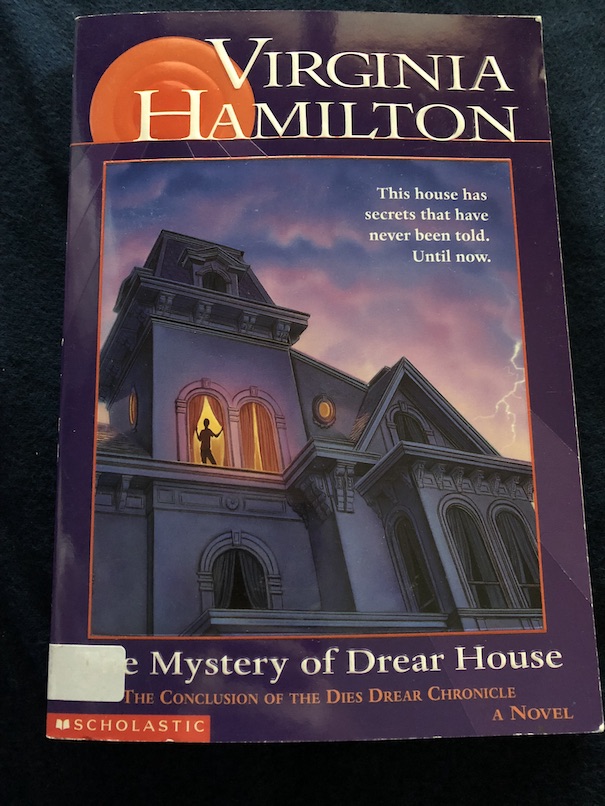
 The House of Dies Drear by Virginia Hamilton, 1968.
 Midnight Magic by Avi, 1999.
 The Secret of the Strawbridge Place by Helen Pierce Jacob, 1976.
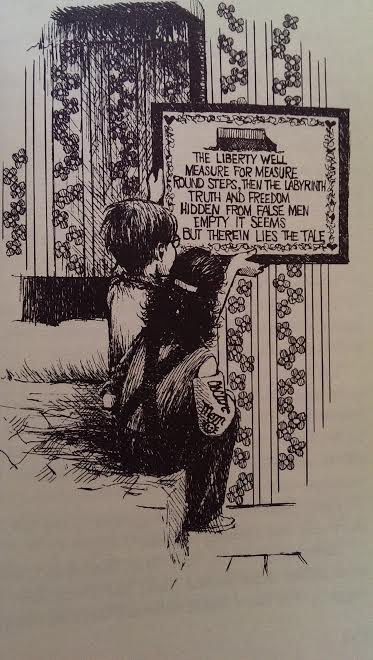 Oscar, a boy visiting his grandfather nearby, becomes Kate’s friend. Since he was also injured in one of Josh’s escapades (having broken his leg when the kids were fooling around in the haymow), she invites him to join her in the search for the secret. They form a partnership called Cripples Incorporated and have fun inventing code words and writing secret messages about what they’ve discovered. Pursuing the secret comes with some risks, and before Kate can discover the whole truth about Strawbridge Place, she has a serious brush with danger.
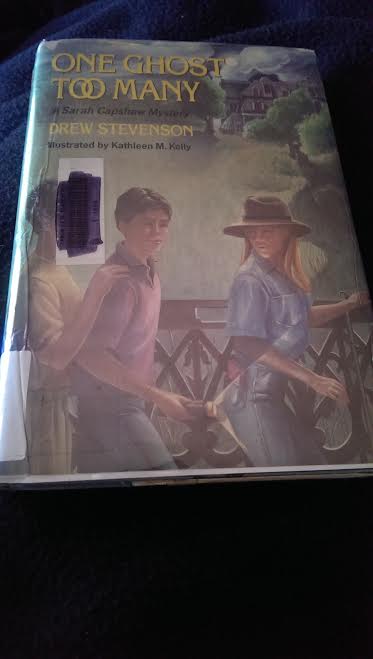 One Ghost Too Many by Drew Stevenson, 1991.
 Sarah persuades Clark and his friend “Frog” Fenniman to join her investigation of the house, but besides the resident ghost, they will also have to deal with a local group interested in psychic phenomena and a mysterious stranger who is paying the local bully to spy on the house.
 Jestress's Forgotten Books and Stories