
Chocolate Fever by Robert Kimmel Smith, 1972.
Henry Green absolutely loves chocolate, and he eats it all the time, at every meal! Although this doesn’t sound healthy, Henry’s parents let him eat as much chocolate as he wants because it never seems to affect his health. Henry doesn’t gain weight, have stomach aches, get cavities in his teeth, or suffer skin problems from eating all that chocolate, so his parents assume that it must be okay and let him eat whatever he wants. However, Henry is about to suffer some consequences from his chocolate obsession.
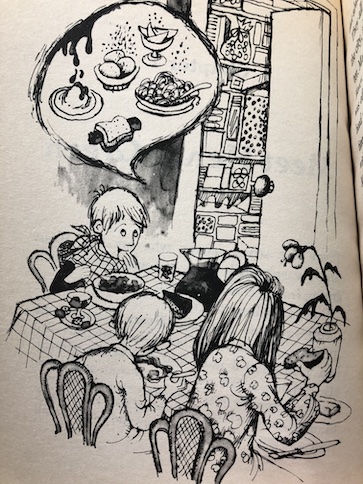

One morning, Henry starts feeling a little funny, and then, he notices that he’s breaking out in brown spots. His teacher takes him to the school nurse, and they notice that Henry’s rash smells oddly like chocolate. More little brown spots start popping out as they look at Henry.
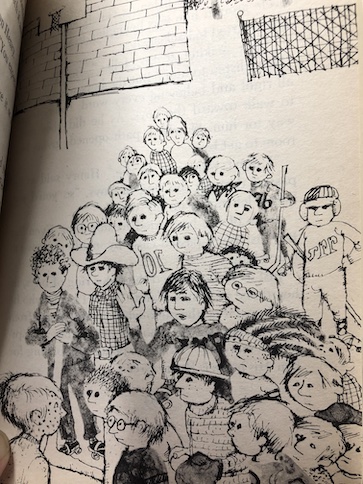
They take Henry to the hospital, where the doctor who sees him is mystified. He says it’s like Henry is turning into a candy bar, and he starts talking about making medical history. In a panic, Henry runs away from the hospital. However, he ends up lost, and everywhere he goes, people notice his spots and the smell of chocolate.
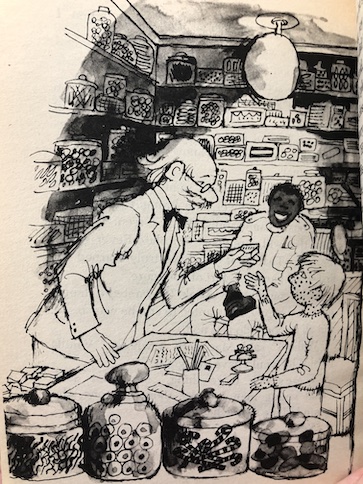
Henry is afraid that he’s going to spend the rest of his life as some kind of chocolate freak, but a kind truck driver helps him and a candy shop owner who’s experienced this problem before provides a solution to his Chocolate Fever.
The book is available to borrow and read for free online through Internet Archive (multiple copies).
My Reaction and Spoilers
I remember hearing about this book when I was a kid, but I didn’t read it until I was an adult. I liked it, and I enjoyed the character of Mac, the truck driver who helps Henry. At first, Henry is reluctant to explain his situation to Mac, but Mac can clearly see (and smell) Henry’s condition, and he just waits for Henry to explain himself without pressing him for answers. When Henry explains that he’s afraid of being a freak for the rest of his life, Mac tells him that he’s “unique” and “sort of special”, not really a “freak.” Henry is afraid of everyone staring at him at all the time, but Mac says that he’s already had experience with that. Mac is a black man in a mostly white society, and he says that being different from other people is bound to attract some attention, but he’s proud of what makes him different because “black is beautiful.” Henry says that’s not the same as his situation because being covered with spots is ugly. It’s true that people with different colors of skin look the way they do because it’s natural for them to look that way, like people with different hair colors and eye colors. That’s not quite the same as someone suddenly breaking out in a weird rash.
Henry just wants to run away from him problems, but Mac convinces him that he has to deal with the situation instead of just running away. He has parents who care about him, and he at least needs to let them know where he is and what’s happening, and they can work out another way to deal with the problem that doesn’t involve returning to the hospital with the doctor he doesn’t like. Mac points out that it’s also possible that this problem of his is a temporary one that will clear up on its own.
Mac’s plan to call Henry’s parents is interrupted by a couple of robbers who hijack the truck, but when Mac finally delivers the cargo he’s carrying – a shipment of chocolate bars – to a local candy shop, the owner of the candy shop provides the solution that Henry’s been looking for. The candy shop owner once had a problem like Henry’s, and he teaches him that it’s possible to have too much of a good thing and that he needs to learn moderation. Cutting back on chocolate also means that Henry gets to experience and appreciate other flavors that he’s been ignoring. The story ends with the potential for Henry to get hooked on some of these flavors as well, and we’re left with the question of whether or not Henry has completely learned his lesson yet.
It’s a fun story about learning not to overdo things. One thing that surprised me was that Mac smoked a cigar because children’s books cut back on portrayals of smoking during the late 20th century to discourage children from taking up the habit. There were still some books that had people smoking, but it just struck me as interesting in this particular story because the story is about out-of-control habits.






 Jestress's Forgotten Books and Stories