The Big Orange Splot by Daniel Manus Pinkwater, 1977.
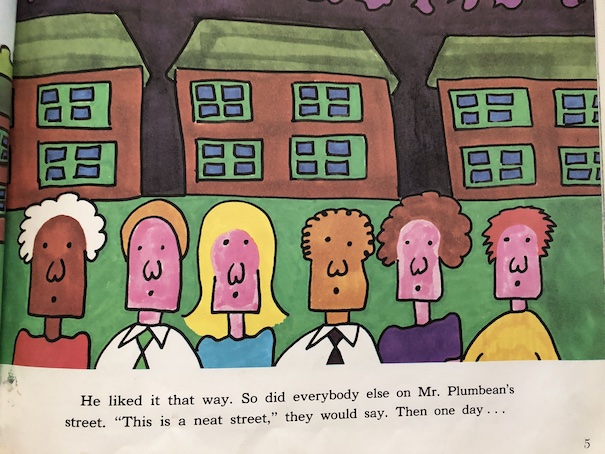
Mr. Plumbean lives in a neighborhood where all the houses look alike. He and his neighbors all think of the uniformity as making their street “neat” and tidy, and they appreciate it. Then, something happens that makes them reconsider.
For reasons that nobody ever understands, a seagull carrying a can of orange paint happens to fly over Mr. Plumbean’s house and drops the can, leaving a big orange splot on Mr. Plumbean’s roof. Mr. Plumbean realizes that the big orange splot means that he’ll have to repaint his house, but the painting project makes him think.
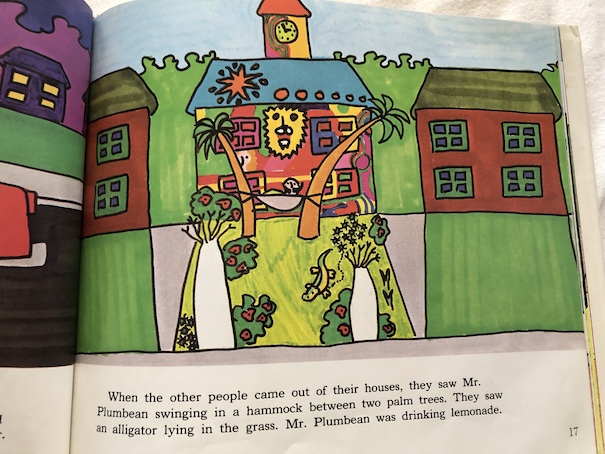
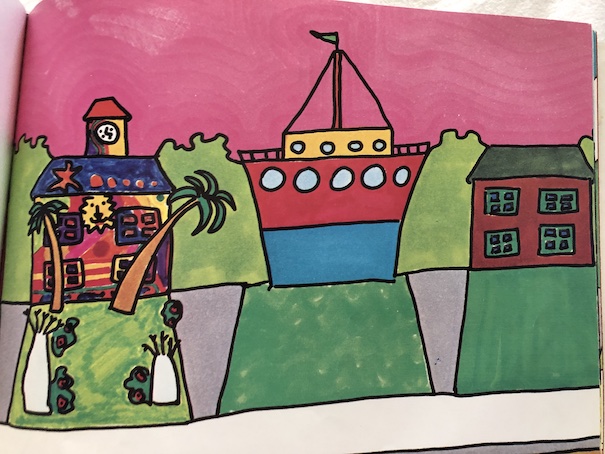
Instead of painting his house to look like everyone else’s, the way it was before, he gets a bunch of wild colors and turns the exterior of his house into a rainbow explosion, working around the big, orange splot on his roof! He adds paintings of animals and other things he likes and colorful patterns. It’s such a wild and crazy design that his neighbors think he went mad. Before long, he adds a clock tower onto his house and an alligator and some trees with a hammock in the front yard.
The neighbors think he’s gone too far, but Mr. Plumbean says, “My house is me and I am it. My house is where I like to be and it looks like all my dreams.”
One of Mr. Plumbean’s neighbors tries to talk some sense into him, but instead, Mr. Plumbean talks to him about his dreams. The next day, the man goes out to buy some building supplies. It turns out that he always loved ships, so he turns his house into the ship of his dreams!
With Mr. Plumbean’s encouragement, other neighbors also start to change their homes to reflect their dreams, changing their quiet, “neat” street into a magical wonderland of imagination!
The book is available to borrow and read for free online through Internet Archive (multiple copies).
My Reaction
I remember this book from when I was a kid, and I always liked the pictures! It’s fun to imagine all the creative themes a house could have and what you might choose if you had the opportunity to live in a house that could look like anything you wanted. The houses shown in the pictures of the neighborhood end up looking nothing like their original shapes, except for Mr. Plumbean’s house, oddly. The others are vastly different from their original shapes, and the windows aren’t even in the same places, making them look like they’ve been completely rebuilt. This level of renovation would be difficult and costly in real life, but this story is meant to be fun and to celebrate imagination and the capacity people have to add a touch of color to their lives. If you read this book with a child, you can invite them to decide which of the house was their favorite at the end (mine was the one that looked like a castle) or what they would do if they could make their house look like anything they want.
In real life, I’ve never particularly liked those neighborhoods where all the houses look alike. I’m not the only one because tract homes and uniform suburbs were controversial from their beginnings in the mid-20th century. In the early 1960s, a song called Little Boxes (listen to it on YouTube) poked fun at the uniformity of suburban houses and the lives of the people in them (although the houses in that song were still different colors – just saying). The connection between the uniformity of homes and the conformity of the people living in them is a topic that resurfaces periodically in popular culture and other songs, like “Subdivisions” by Rush (listen to it on YouTube).
The themes of non-conformity and self-expression are pretty profound, but the story is lots of fun and isn’t too deep for kids. If you read the back section about the author, it explains that the inspiration for this story came from a time when he spilled orange ink on his own pair of new yellow boots.
This picture book is a fun story about non-conformity and self-expression. In the beginning, Mr. Plumbean is as content as anyone with his neat, uniform neighborhood until a strange, inexplicable accident creates a situation where Mr. Plumbean has to paint his house. Once he’s confronted with the task of repainting his house, Mr. Plumbean begins to consider the creative opportunities this chore provides, and he enjoys exploring the possibilities and changing his house to be more of a reflection of the wild and wacky person he really is or dreams of being. Once his creative side is unleashed, it begins to get his neighbors thinking along similar lines. True, they liked it when their street was neat and uniform because they could see the appeal of having things orderly, but it turns out that each of them also has an inner creative side that’s been waiting for a chance to get out. The non-uniformity and non-conformity of their street becomes more comfortable for each of them as they each embrace those sides to their personalities that they don’t normally show. When they come to accept and embrace their own dreams and each other’s, it doesn’t matter to them anymore that they’re not all alike. They’re comfortable with the wacky and whimsical parts of their personalities, and they’re not afraid to show them anymore. They’re happy with themselves, their homes, and their different visions.
I really liked the art style of the illustrations in the book. It’s very simple but colorful, and you can tell that the artist used markers because you can see the marker lines, especially in the backgrounds of the drawings. It makes it different from more modern books that use digital art. I like seeing signs of the physical materials used, and it gives the story a funky, organic feel that goes well with the theme.
As I said earlier, I did notice that many of the new home designs in the pictures don’t take into account where the houses’ windows used to be, but that’s just part of the whimsy of the story. We don’t need to worry about how these people accomplished these drastic changes so quickly and easily. It’s just fun to think about how you can personalize your space to reflect what’s important to you.






 Jestress's Forgotten Books and Stories